AMTD
3, 1807–1842, 2010Upper-Air Reference Measurements
F. Immler et al.
Title Page
Abstract Introduction
Conclusions References
Tables Figures
◭ ◮
◭ ◮
Back Close
Full Screen / Esc
Printer-friendly Version
Interactive Discussion Atmos. Meas. Tech. Discuss., 3, 1807–1842, 2010
www.atmos-meas-tech-discuss.net/3/1807/2010/ © Author(s) 2010. This work is distributed under the Creative Commons Attribution 3.0 License.
Atmospheric Measurement Techniques Discussions
This discussion paper is/has been under review for the journal Atmospheric Measure-ment Techniques (AMT). Please refer to the corresponding final paper in AMT
if available.
A guide for upper-air reference
measurements
F. Immler1, J. Dykema2, T. Gardiner3, D. N. Whiteman4, P. W. Thorne5, and H. V ¨omel1
1
Richard-Assmann-Observatorium, Deutscher Wetterdienst, Lindenberg, Germany 2
School of Engineering and Applied Sciences, Harvard University, Cambridge, Massachusetts, USA
3
Environmental Measurement Group, National Physical Laboratory, Teddington, UK 4
Goddard Space Flight Center, NASA, Greenbelt, Maryland, USA 5
Hadley Centre, Met Office, Exeter, UK
Received: 29 January 2010 – Accepted: 1 April 2010 – Published: 16 April 2010 Correspondence to: F. Immler ([email protected])
AMTD
3, 1807–1842, 2010Upper-Air Reference Measurements
F. Immler et al.
Title Page
Abstract Introduction
Conclusions References
Tables Figures
◭ ◮
◭ ◮
Back Close
Full Screen / Esc
Printer-friendly Version
Interactive Discussion Abstract
The accurate monitoring of climate change imposes strict requirements upon observ-ing systems, in particular regardobserv-ing measurement accuracy and long-term stability. Currently available data records of the essential climate variables (temperature-T, geopotential-p, humidity-RH, wind, and cloud properties) in the upper-air generally fail 5
to fulfill such requirements. This raises serious issues about the ability to detect, quan-tify and understand recent climate changes and their causes. GCOS is currently imple-menting a Reference Upper-Air Network (GRUAN) in order to fill this major void within the global observing system. As part of the GRUAN implementation plan we provide herein fundamental guidelines for establishing and maintaining reference quality atmo-10
spheric observations which are based on principal concepts of metrology, in particular traceability. It is argued that the detailed analysis of the uncertainty budget of a mea-surement technique is the critical step for achieving this goal. As we will demonstrate with an example, detailed knowledge of the calibration procedures and data processing algorithms are required for determining the uncertainty of each individual data point. 15
Of particular importance is the careful assessment of the uncertainties introduced by correction schemes adjusting for systematic effects.
1 Introduction
Owing to the dedication of some outstanding scientists (e.g. Keeling, 1998, CO2record)
and to the high measurement standards at some atmospheric observatories, a number 20
of valuable datasets are available for the detection of climate change. However, the bulk of meteorological observations have been made for short-term purposes (e.g. weather forecasting) and, due to changing equipment and lower requirements for long-term sta-bility and traceasta-bility, those data often have limited value for climate research (Thorne et al., 2005; Titchner et al., 2009). This is particularly true for upper-air measurements 25
AMTD
3, 1807–1842, 2010Upper-Air Reference Measurements
F. Immler et al.
Title Page
Abstract Introduction
Conclusions References
Tables Figures
◭ ◮
◭ ◮
Back Close
Full Screen / Esc
Printer-friendly Version
Interactive Discussion where numerous and poorly documented changes in instrumentation and operational
procedures strongly limit their value for climate monitoring (Titchner et al., 2009; Sei-del et al., 2004). Poor sensor performance in the past has limited the application of operational radiosonde measurements for climate studies. A widespread transition to more accurate sensors has occurred in the last decade. The performance of the new 5
systems has proved difficult to link to the performance of the older radiosondes, given
the very complex nature of the errors in the older systems. Managing the transition was not helped by the tendency of the radiosonde manufacturers to modify the new designs without informing the users, as errors identified in the radiosondes in operations were rectified.
10
At the same time, the observational networks are getting denser, mainly due to the
excellent observational opportunities offered by satellites (see NOAA (2009);
EUMET-SAT (2009) for an overview of existing satellite observing systems). Therefore, the amount of available data is increasing. Most, if not all, of these observations need to be calibrated to a standard or the applied methods need to be validated by comparison 15
to an accepted reference. The reliability of these calibration or validation procedures over long periods of time is of particular importance if these observations are to provide irrefutable, useful data series suitable for monitoring climate changes. However, the necessary reference data are often not available, leading to the unsatisfying situation that a huge majority of observations are not traceable to standards of the international 20
system of units (SI) (Ohring et al., 2007, 2005). This means that separate datasets
from different stations, observing platforms, and technologies are not directly
compa-rable and therefore cannot necessarily be combined to give reliable long-term records. Central points for reference quality is the traceability of its calibration and the analysis of measurement uncertainty. In atmospheric science as well as in other disciplines the 25
discussion of measurement uncertainty is not as common as it should be, often leading to questionable interpretations and conclusions (Moldwin and Rose, 2009).
AMTD
3, 1807–1842, 2010Upper-Air Reference Measurements
F. Immler et al.
Title Page
Abstract Introduction
Conclusions References
Tables Figures
◭ ◮
◭ ◮
Back Close
Full Screen / Esc
Printer-friendly Version
Interactive Discussion define the requirements an observation must fulfill in order to serve as a reference
which can be used for calibrating or validating other observing systems, in particu-lar, satellite instruments.The challenges associated with satisfying the requirements of reference quality are illustrated by a case study. Because the GCOS Reference Upper-Air Network (GRUAN) is envisaged to be a small, albeit globally distributed, network of 5
ground stations (Seidel et al., 2009) the focus is on ground-based instrumentation but the principles are more universally applicable.
Most of the observations obtained from the higher atmospheric layers are either re-trieved from remote sensing or disposable balloon-borne sensors. To make either of these subject to a robust calibration is a big challenge. Our aim is to provide guide-10
lines that maximize confidence, while still considering the constraints of implementation within a global operational network with a finite budget (in contrast to an active research project). As such, we aim to elucidate the theoretical basis for the GRUAN and give some actual examples that demonstrate how upper-air reference observations using radiosondes are currently being made at various sites.
15
This paper provides a general definition of the term “reference” as context for GRUAN observations. Beyond delivering reference data for other observation systems, GRUAN aims to produce robust long-term upper-air climate records. This implies quantitative constraints on the measurement properties, in particular with respect to their accu-racy and their temporal and spatial density. These issues will be considered in other 20
studies, both outside and within GRUAN as outlined in the GRUAN implementation plan (GCOS, 2009a). The following section gives some basic definitions of the most important terminology used. It is complemented by a glossary at the end of the arti-cle. Section 3 describes in detail the steps that need to be taken to achieve reference quality measurements. Section 4 shows how these concepts can be realized in prac-25
AMTD
3, 1807–1842, 2010Upper-Air Reference Measurements
F. Immler et al.
Title Page
Abstract Introduction
Conclusions References
Tables Figures
◭ ◮
◭ ◮
Back Close
Full Screen / Esc
Printer-friendly Version
Interactive Discussion
2 Terminology
The formal terminology relating to measurements and uncertainties is set out in the International Vocabulary of Metrology (VIM) guidelines (JCGM, 2008). The following sections discuss the terms of particular relevance to upper air measurements.
2.1 Errors and uncertainty
5
Every measurement has imperfections that give rise to an error in the result. As a consequence, a measurement is never a perfect indicator of the instantaneous state of the measured parameter. Traditionally, an error is viewed as having two components, a random and a systematic one. A random error is the result of stochastic variation of quantities that influence the measurement and can never be completely avoided. 10
However, its effect can be reduced by increasing the number of observations, since, by
definition, its expected value is zero.
A systematic error introduces a difference between measured values and truth that
does not average to zero as the number of measurements increases, thus introducing
a non-zero offset. Systematic errors may be fixed in time, or they may change slowly
15
and can be dependent upon some operating conditions, which makes their identifi-cation and assessment essential for long-term climate studies. The deviation of the measurement result from truth arising from systematic errors defines the
measure-ment bias. Measuremeasure-ment scientists favor the termbias to describe uncertainty arising
from systematic effects. If appropriate fundamental standards are available, systematic
20
errors may be detected and quantified. If the magnitude of a known systematic error is comparable to the required measurement accuracy, a correction may be applied
to compensate for the systematic effect, although there will still be a residual
uncer-tainty associated with the correction. For example, it is known that there is a bias of up to 18 mK between the temperature determined by a standard platinum resistance 25
AMTD
3, 1807–1842, 2010Upper-Air Reference Measurements
F. Immler et al.
Title Page
Abstract Introduction
Conclusions References
Tables Figures
◭ ◮
◭ ◮
Back Close
Full Screen / Esc
Printer-friendly Version
Interactive Discussion principles to directly ascertain thermodynamic temperature. By taking advantage of
this more fundamental method, a correction can be derived for the standard platinum resistance thermometer (Ripple et al., 2007), reducing the uncertainty against thermo-dynamic temperature from 18 to 2 mK. Although this example deals with temperature uncertainties that are much smaller than those required for GRUAN, it illustrates a 5
practical and convincing method for reducing systematic error.
Following the “Guide to the expression of uncertainty in measurement” (JCGM/WG 1, 2008, GUM hereafter) it is expected that the result of any measurement has been
corrected for all known significant systematic effects and that every effort has been
made to identify such effects. It is important not only to correct for systematic effects 10
but also to robustly ascertain and document the uncertainty of this correction. Clearly, this level of knowledge of the systematic effects requires a detailed understanding of all aspects of the measurement. The accuracy of the measurement is then characterized
by one single number, theuncertaintyu, which is calculated from the uncertainties of
all input quantities, including the uncertainties of all corrections that were applied for 15
systematic effects. Assuming that proper corrections have been made for all systematic
effects, the expected value ofufor a large ensemble of measurements would
theoreti-cally tend toward zero. In practice, the only way it can be assumed that all systematic
effects have been properly corrected for is that measurements made by very different
physical principles agree to each other within their independent uncertainties (that is, 20
a statistically significant difference between them can be rejected at the desired confi-dence level). So the use of independent measurement methods is needed to confirm
that the systematic effects have been correctly compensated for and therefore provide
the best estimate of the overall uncertainty in the measured variable.
The GUM considers Type A and B evaluation of standard uncertainty. Type A eval-25
AMTD
3, 1807–1842, 2010Upper-Air Reference Measurements
F. Immler et al.
Title Page
Abstract Introduction
Conclusions References
Tables Figures
◭ ◮
◭ ◮
Back Close
Full Screen / Esc
Printer-friendly Version
Interactive Discussion
obtained. The standard uncertaintyuof the mean is estimated by
u=
v u u t 1
N(N−1)
N
X
i=1
(xi−x¯)2 (1)
If no series ofN measurements are available, the uncertainty must be determined by
other means than the statistical analysis of series of observations. Any of those other means are referred to as “Type B evaluation” in the GUM.
5
Since it is virtually impossible to observe a variable in the atmosphere at the same location and same time through several independent observations, Type B evaluation will play a major role for determining the uncertainty of aerological data within GRUAN.
Using Type B evaluation, the varianceu2or the standard uncertaintyuare evaluated by
scientific judgment based on all of the available information on the possible variability 10
ofx. According to the GUM , the pool of information may include :
– previous measurement data;
– experience with or general knowledge of the behavior and properties of relevant
materials and instruments;
– manufacturer’s specifications;
15
– data provided in calibration and other certificates;
– uncertainties assigned to reference data taken from handbooks.
(JCGM/WG 1, 2008) In atmospheric profile measurements the uncertainty needs to be determined for each data point (at each altitude) individually. All sources of uncertainty
should be summarized to an uncertainty budget. The total resulting uncertaintyu(x)
20
is calculated from independent sources of uncertainties u(vj) associated with the
AMTD
3, 1807–1842, 2010Upper-Air Reference Measurements
F. Immler et al.
Title Page
Abstract Introduction
Conclusions References
Tables Figures
◭ ◮
◭ ◮
Back Close
Full Screen / Esc
Printer-friendly Version
Interactive Discussion quantities:
u(x)=
v u u t
N
X
j=1
∂f(v1,..,vN) ∂vj
!
u(vj)2 (2)
whenx=f(v1,..,vN) describes the functional relationship between the final result and
the input variables.
2.1.1 Uncertainty of multiple measurements
5
When measurement results are averaged over temporal or spatial ranges, the
uncer-taintyua of the average ¯x is derived from the uncertainties of the individual
measure-ments ui by applying Eq. (2) to the rule for calculating the mean. Since the partial
derivative ofua with respect to each individual measurementxi is 1/N it follows:
ua=
1
N
v u u t
N
X
i=1
u2i (3)
10
This means that the uncertainty is reduced with 1/√N, by considering a larger set of
individual observations. However, this holds only if the input variables (uncertainties) are uncorrelated. When the most significant source of uncertainty is caused by a particular systematic effect, the individual uncertainties are highly correlated. In this case the uncertainty of a mean value over N data points is estimated by
15
ua= 1
N N
X
i=1
ui (4)
If allui were equal, Eq. (4) yieldsua=ui indicating that the uncertainty in this case is
AMTD
3, 1807–1842, 2010Upper-Air Reference Measurements
F. Immler et al.
Title Page
Abstract Introduction
Conclusions References
Tables Figures
◭ ◮
◭ ◮
Back Close
Full Screen / Esc
Printer-friendly Version
Interactive Discussion vertical profile where the uncertainties are caused essentially by the same systematic
effect and are therefore highly correlated.
If the total uncertainty of an average calculated from the uncertainties of individual data points obtained from either Eqs. (3) or (4) is less than the statistical uncertainty of the mean calculated by Eq. (1), the variability of the measurand exceeds the accuracy 5
and resolution of the measurement system. In this case, it is possible to distinguish be-tween measurement uncertainty and variability. The variability can then be expressed
as the standard deviation of the observed valuesxi by
σ=
v u u t 1
N−1
N
X
i=1
(xi−x¯)2 (5)
The statistical dispersion of the measured values are indicative of the character of the 10
measurand, namely the natural variability in the space and time frame of the atmo-sphere under consideration, if, and only if, the measurement uncertainty is less than the variability, i.e.ua< σ/√N orui< σ. It is important to note that the uncertaintyua, correctly evaluated, always characterizes a property of the measuring system, not of
the quantity being measured. Therefore, both valuesuaand σ should be reported as
15
significant information when averages of individual measurements have been used to calculate the final result of a measurement.
2.2 Metrological traceability
Metrological traceability is the property of a measurement result whereby the result can be related to a reference through a documented, unbroken chain of calibrations, 20
AMTD
3, 1807–1842, 2010Upper-Air Reference Measurements
F. Immler et al.
Title Page
Abstract Introduction
Conclusions References
Tables Figures
◭ ◮
◭ ◮
Back Close
Full Screen / Esc
Printer-friendly Version
Interactive Discussion (e.g., a standard that carries a calibration scale that is tied, according to a reproducible
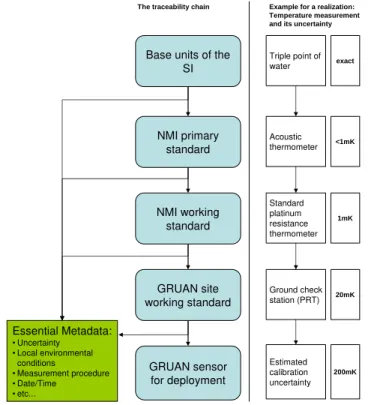
protocol, to a recognized community measurement standard). GRUAN stations should maintain a “GRUAN site working standard” for each basic unit, e.g. a thermometer pe-riodically calibrated to a NMI standard (Fig. 1), that is used for calibrating the sensor for deployment. For example, in a pre-launch recalibration procedure the thermometer 5
of a radiosonde can be adjusted to a thermometer with a certified calibration. These requirements establish traceability. Where the final data product of a reference ob-servation depends on ancillary measurements, these measurements must again be traceable to standards.
2.3 Measurement traceability
10
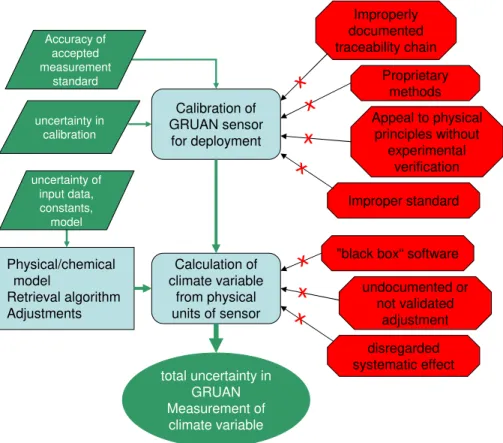
In particular, for climate research, it is important that data users have the opportunity to understand completely how the data that they are using for studying climate, were obtained. Therefore, every user should have access not only to the data, but also to a description of the instrument and algorithm used and, in particular, to any changes that occurred to either or both during the complete life cycle of the dataset (Fig. 2). Proper 15
documentation of the measurements and all related metadata is essential.
2.4 Reference
Reference is a very general term that can refer to the definition of a measurement unit through the practical realization of its basic definition, a measurement procedure that provides sufficient confidence in its results by relating to well-founded physical or 20
chemical principles, or a measurement standard that is calibrated to a recognized stan-dard, in general a standard provided by a National Metrological Institute (NMI). In our context, a fundamental requirement of a reference measurement is that the uncertainty of the calibration and the measurement itself is carefully assessed. This includes the requirement that all known systematic errors are considered and corrected, and that 25
consid-AMTD
3, 1807–1842, 2010Upper-Air Reference Measurements
F. Immler et al.
Title Page
Abstract Introduction
Conclusions References
Tables Figures
◭ ◮
◭ ◮
Back Close
Full Screen / Esc
Printer-friendly Version
Interactive Discussion eration for a reference measurement is that the measurement method and associated
uncertainties should be accepted by the user community as being appropriate to the application.
Another important requirement is that the methods by which the measurements are obtained and the data products calculated must be reproducible by any end user, at 5
any time in the future. It should be kept in mind that these end users will continue to look at climate records for decades to come. They should be able to reproduce how measurements were made, which corrections were applied, and be informed as to what changes occurred during the observation and post-observation periods to the instruments and the algorithms.
10
In brief, reference within GRUAN means that, at a minimum, the observed profiles
are tied to a traceable standard at one point (e.g., by an extended, manufacturer-independent ground check of a radiosonde), that the uncertainty of the measurement (including corrections) is determined, and that the entire measurement procedure and set of processing algorithms are properly documented and accessible.
15
2.5 Redundancy and consistency
One important factor of GRUAN is that independent measurements of the same (or related) variables will be reported in a consistent way. Traditionally, atmospheric obser-vatories operate a large set of instruments, some of which measure the same variable or related variables that strictly depend on each other (e.g., like water vapor profiles 20
and total column water vapor). An important requirement of GRUAN will be that such redundant measurements are cross-checked for consistency as an essential part of the quality assurance procedures. Since all data are to be reported with uncertainties, a consistency check is, in principle, a straight forward task. Roughly speaking, consis-tency is achieved when the independent measurements agree to within their individual 25
uncertainties.
AMTD
3, 1807–1842, 2010Upper-Air Reference Measurements
F. Immler et al.
Title Page
Abstract Introduction
Conclusions References
Tables Figures
◭ ◮
◭ ◮
Back Close
Full Screen / Esc
Printer-friendly Version
Interactive Discussion significance level. For the purpose of most GRUAN quality control tasks the Gaussian
test (or “Z-test”) will be the most appropriate way to do this. It requires the knowledge of the measurements uncertainty. It is helpful to introduce the coverage factor k which determines an interval about the mean value as a multiple of the standard uncertainty. Based on the probability density function (PDF) of the dispersion of the uncertainty, the 5
probability that values within this interval are measured can be calculated. Consider
two independent measurementsm1andm2of the same measurand with standard
un-certaintiesu1, andu2, respectively. Assuming that the hypothesis thatm1=m2is true
and that the uncertainty is normally distributed, the probability that
|m1−m2|> k·
q
u21+u22 (6)
10
occurs only by chance, is roughly 4.5% for k=2 and 0.27% for k=3. Speaking in
statis-tical terms, if Eq. (6) is true for k=2, the null hypothesis thatm1=m2 can be rejected
at a significance level of 4.5%. We suggest to call data in this case “significantly dif-ferent” and if Eq. (6) holds for k=3 “inconsistent”. If the results agree within k=1 (i.e.
|m1−m2|<
q
u21+u22) the data are “consistent”, and within k=2 they are “in (statistical) 15
agreement” (Table 1). Supporting the hypothesis m1=m2 the test looses statistical
power with increasing k, while the confidence of correctly rejecting the hypothesis
in-creases with k.1
The significance levels given in Table 1 can also be used to assess the quality of the uncertainty estimation: if large sets of data are compared and a fraction much 20
larger than 4.5% are significantly different, then either a systematic effect on either or
1
AMTD
3, 1807–1842, 2010Upper-Air Reference Measurements
F. Immler et al.
Title Page
Abstract Introduction
Conclusions References
Tables Figures
◭ ◮
◭ ◮
Back Close
Full Screen / Esc
Printer-friendly Version
Interactive Discussion both measurements have been overlooked or the uncertainty was estimated to small.
On the other hand, if much less than 32% of data are suspicious the measurement uncertainties are probably smaller than estimated.
If one of the two measurements does not provide uncertainties, the same termi-nology could be used assuming that the corresponding uncertainty is zero. This is 5
equivalent with the notion that this value “does or does not lie within the errorbars with a specified coverage factor of the reference measurement”. If none of the measure-ments has uncertainties attached, a meaningful consistency analysis is not possible.
Problems arise from co-location and co-incidence issues (a radiosonde profile is never obtained at the same time and location as a ground-based or space-based total 10
column measurement). These issues will be considered in a separate paper. The reader is referred to the GRUAN implementation plan (GCOS, 2009a), for a listing of these and other issues and the working groups in charge of addressing them.
3 Establishing operational upper-air reference observations
The establishment of upper-air reference observations on an operational basis con-15
sists of definition, execution and evaluation phases. First, the requirements for the measurements, which have been assembled through broad participation of the com-munity, must be understood. Second, a review must be conducted to identify the most appropriate measurement technologies. Third, the performance of those technologies must be systematically evaluated. Additionally, validation, re-calibration, and archiving 20
must be designed and implemented for an operational environment.
3.1 Defining requirements
AMTD
3, 1807–1842, 2010Upper-Air Reference Measurements
F. Immler et al.
Title Page
Abstract Introduction
Conclusions References
Tables Figures
◭ ◮
◭ ◮
Back Close
Full Screen / Esc
Printer-friendly Version
Interactive Discussion
nical and budgetary limitations of GRUAN stations, affecting the type and frequency
of observations. The GCOS Working Group on Atmospheric Reference Observations (WG-ARO) also made recommendations on requirements for GRUAN reference ra-diosonde (GCOS, 2009b). There is an ongoing discussion on how to deal with the dis-parity that often exists between the desirable and the feasible. In a first step, GRUAN 5
data are obtained with currently available and affordable equipment, provided they
meet the basic requirements outlined in these guidelines which are a traceable
cali-bration and a thorough analysis of the uncertainty. In a second step, efforts are made
to reduce the uncertainties to comply with the requirements of GCOS-112 and to en-courage new technologies where they cannot be so reduced. These items should be 10
accomplished in the initial phase of GRUAN from 2009–2013. A detailed analysis of the sources of uncertainty is the first, and often most important, step to improve the accuracy.
3.2 Reviewing existing instruments and choosing candidate(s)
A number of factors come into play in assessing the suitability of instrumentation for 15
GRUAN. These factors include:
– Instrumental heritage: how long has a sensor been in use by the community and
for what purpose; how substantial is the body of literature documenting its per-formance and measurement uncertainty; how widely distributed is the knowledge base that facilitates the sensor’s successful operation?
20
– Sustainability: are the cost of operation of the sensor and the demands of the
sensor on personnel consistent with the resources allocated for GRUAN sites; are the demand and technology available to support the production and utilization of the sensor for a meaningful period of time?
– Robustness of uncertainty: is the underlying accuracy claim for sensor and/or its
25
AMTD
3, 1807–1842, 2010Upper-Air Reference Measurements
F. Immler et al.
Title Page
Abstract Introduction
Conclusions References
Tables Figures
◭ ◮
◭ ◮
Back Close
Full Screen / Esc
Printer-friendly Version
Interactive Discussion GRUAN science objectives?
– Information content: are temporal/spatial resolution, measurement dynamic
range, and other sensor characteristics consistent with GRUAN requirements?
It is not expected that all GRUAN sites will use identical instrumentation. The com-patibility of instrumentation from site-to-site, as determined by intercomparison and 5
laboratory calibration activities, will, however, play a major role in evaluating the appro-priateness of sensors on a case-by-case basis.
3.3 Identifying and quantifying sources of uncertainty
The identification and quantification of uncertainties that can be handled using a type A (statistical) approach is a well established procedure. The identification and quan-10
tification of type B uncertainties in a way that is robust (e.g., likely to hold up to critical scientific inquiry) is a much more challenging project. Examples of success, relevant
to GRUAN, are the efforts to establish a standard for total column ozone using Dobson
spectrometers (Komhyr et al., 1989), and Keeling’s extremely reliable measurements of carbon dioxide mixing ratios Keeling (1998) which have been ongoing for more than 15
half a century. Similar methods have been employed in other areas of natural sciences and in the definition and maintenance of physical measurement units by the interna-tional community of nainterna-tional standards laboratories. Some examples of this include the utilization of quantum electrical standards to diagnose the biases in standard voltages realized with electro-chemistry (Hartland, 1988), as well as the example of acoustic 20
thermometry used to check contact thermometry described above. GRUAN can take advantage of these successes by utilizing multiple measurement methods for essential
geophysical variables, based on different physical principles, and by working to
encour-age and make use of ongoing research of relevant measurement methods. Synergies with existing networks like the Network for the Detection of Atmospheric Composition 25
AMTD
3, 1807–1842, 2010Upper-Air Reference Measurements
F. Immler et al.
Title Page
Abstract Introduction
Conclusions References
Tables Figures
◭ ◮
◭ ◮
Back Close
Full Screen / Esc
Printer-friendly Version
Interactive Discussion Error sources in radiosonde measurements are thoroughly discussed in the CIMO
Guide to Meteorological Instruments and Methods of Observation (WMO, 2006, chap-ter 12.8). For GRUAN data the uncertainty arising from those sources for the specific sensor in use must be readily quantified and reported. Attempts should be made to identify and quantify unknown sources of uncertainty.
5
GRUAN includes both in situ and remote sensing methods. In the case of in situ methods, the sensor is generally calibrated directly to the geophysical quantity of inter-est. In the case of remote sensing methods, the calibrated sensor data are in physical units of radiance and/or frequency, which are then analyzed to provide an estimate of the underlying geophysical variable of interest. Validation of data products for remote 10
sensing methods is therefore a two-step process, whereby the accuracy of both, the sensor calibration and the analysis algorithm (including algorithm parameters), are val-idated. Laboratory tests and intercomparisons are fundamental methods for confirming uncertainty estimates of data products. Laboratory tests provide an opportunity to in-vestigate in detail the performance of sensors under controlled conditions that can be 15
reproduced at any time, anywhere in the world. Field intercomparisons allow multiple in situ sensors and remote sensing data to be directly compared under complex en-vironmental conditions (temperature, humidity, pressure, wind/flow rate, radiation, and chemical composition) that cannot be fully reproduced in the laboratory. These com-plementary activities increase confidence that measurements are subject to neither 20
unanticipated effects nor undiscovered systematic uncertainties.
3.4 Defining in-field recalibration and validation (QA/QC) procedures
Some sensors/measurement devices derive their calibration from a pre-deployment comparison against an established reference. The results of these pre-deployment cal-ibrations need to be checked to maintain the integrity of the measurement. Additionally, 25
val-AMTD
3, 1807–1842, 2010Upper-Air Reference Measurements
F. Immler et al.
Title Page
Abstract Introduction
Conclusions References
Tables Figures
◭ ◮
◭ ◮
Back Close
Full Screen / Esc
Printer-friendly Version
Interactive Discussion idation procedures should be drawn initially from experience with a given sensor type,
then refined according to the results of laboratory tests and intercomparisons. The date and nature of field recalibrations should be included in metadata, so that if future ex-periments reveal shortcomings in schedules or methods that were in use, uncertainty estimates can be adjusted after the fact to reflect those newly-discovered issues. 5
Other ways of assuring quality include comparisons to forecast data, visual
inspec-tion of curves by experienced staff, or consistency checks to physical principles. These
checks do not generally feed directly into uncertainty budgets, but issues identified through such checks usually indicate problems with a specific measurement or uniden-tified systematic effects.
10
Before dissemination, GRUAN data will be subject to rigorous Quality Assurance (QA) and Quality control (QC) procedures. The strongest source of confidence is
con-sistency of redundant measurements that ideally use different measurement principles.
Co-located in situ and remote sensing data can be used for this purpose.
3.5 Data archiving and processing issues
15
Designing data archive strategies and algorithm version control are crucial elements of establishing a reference measurement network. These processes allow uniform data processing within the network and revisiting of entire datasets. The data handling, including QA/QC procedures, is therefore a major part of the GRUAN implementation
effort, the discussion of which goes beyond the scope of this paper. See the GRUAN
20
implementation plan (GCOS, 2009a) for more details.
4 Example: determining uncertainty in radiosonde temperature profiles
AMTD
3, 1807–1842, 2010Upper-Air Reference Measurements
F. Immler et al.
Title Page
Abstract Introduction
Conclusions References
Tables Figures
◭ ◮
◭ ◮
Back Close
Full Screen / Esc
Printer-friendly Version
Interactive Discussion ically in Figs. 1 and 2. According to these figures, these steps include:
substanti-ating the traceability of the temperature sensor calibration to the SI (in this case the ITS-90 temperature scale and thereby the Kelvin), evaluating the maintenance of that traceability through the ground check procedure, documenting and applying necessary corrections for systematic effects (particularly the radiation correction), and critically as-5
sessing the final uncertainty achieved in the atmospheric temperature measurement. The most important step is the determination of the measurement uncertainty. There is ongoing research on these issues and the results discussed below should be consid-ered preliminary. A final assessment with more details will be the subject of a dedicated paper that is currently in preparation.
10
4.1 Requirements
The requirements for GRUAN measurements of temperature have been specified in GCOS (2007), with an uncertainty of 0.1 and 0.2 K at a vertical resolution of 100 and 500 m in the troposphere and the stratosphere, respectively. Within the current state-of-the-art, these targets seem unrealistic, since the perhaps most accurate temperature 15
sonde, the “Accurate Temperature Measuring Radiosonde” (ATM) (Schmidlin, 1991), claims an uncertainty of 0.3 K throughout most of the upper troposphere and the strato-sphere. However, while maintaining the GCOS-112 specification as an ultimate goal for GRUAN, the current focus is on working out the steps described in Sects. 3.3 to 3.5 to establish a reference network in the near future using the best measurement 20
systems currently available.
4.2 Reviewing existing instruments
Instrument review is an ongoing process within the initial phase of GRUAN. It is not ex-pected that all sites use identical instrumentation. Establishing the uncertainty budgets of these instruments is an important step in ensuring the comparability of the measure-25
AMTD
3, 1807–1842, 2010Upper-Air Reference Measurements
F. Immler et al.
Title Page
Abstract Introduction
Conclusions References
Tables Figures
◭ ◮
◭ ◮
Back Close
Full Screen / Esc
Printer-friendly Version
Interactive Discussion long-term goals of the network.
4.3 Establishing the uncertainty budget
4.3.1 Uncertainty arising from of the indication of the measuring system
The capacitive sensors of the RS-92 or DFM-06 change the frequency of a resonant circuit depending on the sensor temperature. This frequency is of the order of 10 kHzv 5
and is measured and transmitted with a resolution of 0.01 Hz. The dependency of the frequency on temperature is roughly 0.5 Hz/K. The accuracy of the indication is therefore about 0.02 K and much lower than the stated uncertainty of the sensor of 0.15 K. It can be assumed that the contribution of the frequency measurement to the total uncertainty of the temperature sensor is negligible.
10
4.3.2 Calibration
The sensors of commercial radiosondes are generally calibrated by the manufacturer who should be able to provide a certificate stating the uncertainty of calibration. If the certificate is issued by a National Metrology Institute or another accredited agency, it generally ensures traceability to SI. A copy of the calibration certificate should be 15
submitted to the GRUAN meta database. The accuracy of the calibration is generally high, i.e., well below 0.1 K, throughout the entire temperature range under consider-ation (180 K to 310 K ). The random error of the RS-92 calibrconsider-ation (repeatability) is
0.15 K (k=2) according to the 2005 brochure (Vaisala, 2006). The calibration
uncer-tainty is considered to be an altitude-independent absolute systematic contribution to 20
AMTD
3, 1807–1842, 2010Upper-Air Reference Measurements
F. Immler et al.
Title Page
Abstract Introduction
Conclusions References
Tables Figures
◭ ◮
◭ ◮
Back Close
Full Screen / Esc
Printer-friendly Version
Interactive Discussion to SI. In this case the reference sensor could be considered a “GRUAN site working
standard” (Fig. 1).
The RS-92 is recalibrated in a ground check station (GC25) where the sensor is put into a chamber equipped with two reference sensors (Pt 100). These references are supposed to be recalibrated with a cycle of two years. The Lindenberg GRUAN station 5
holds a certificate (issued in 2009) indicating “traceability to the National Institute of Standards and Technology” and states an uncertainty of 0.02 K.
The indications from the two sensors are not visible to the user during the ground check. This data would be very helpful for assessing the uncertainty of this recalibration procedure. From experience it is known that in-air calibration has limited accuracy 10
due to strong temperature fluctuations that are highly dependent on the ventilation of
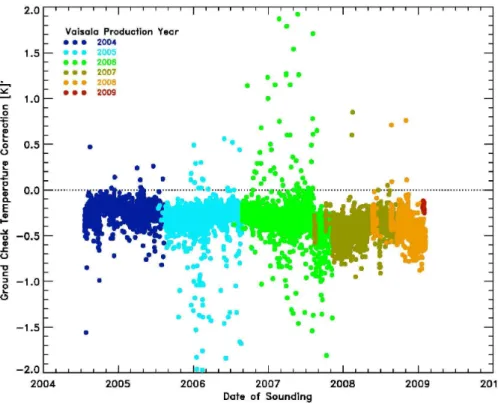
the sensors. The ground check adjustment is typically around−0.3 K (Fig. 3) with a
standard deviation of 0.2 K which was derived using Eq. (1). The reason why the mean value of these adjustments is larger than the claimed uncertainty of the calibration is not known and highlights the dangers of black box processes in ensuring the uncertainty 15
chain (Fig. 2).
Here, the available knowledge about the calibration may not be sufficient to
deter-mine the uncertainty in a traceable way. We suppose the overall uncertainty of the calibration is better than 0.2 K but we have to use this number as long as we do not have direct evidence to support a lower uncertainty.
20
The temperature sensor of the Graw DFM-06 Radiosonde is calibrated in a chamber by the manufacturer to a standard that is traceable to SI. According to the calibration certificate, uncertainty of the references, given here with a 95% coverage probability
(i.e. k=2), is better than 0.02 K. The calibration curve of the radiosonde temperature
sensors is determined from 12 comparisons in the range from 193 K to 303 K. The 25
calibration curve is a polynomial least-square fit of degree 5 with differences to the
measurement less than 0.015 K. Additional errors can arise from the compensation for
temperature effects during flight which is obtained using “reference capacities”. This
AMTD
3, 1807–1842, 2010Upper-Air Reference Measurements
F. Immler et al.
Title Page
Abstract Introduction
Conclusions References
Tables Figures
◭ ◮
◭ ◮
Back Close
Full Screen / Esc
Printer-friendly Version
Interactive Discussion measurement. Its contribution to the uncertainty is currently not known. The
manufac-turer GRAW specifies the total uncertainty of the temperature sensor of the DFM-06
with 0.2 K. Tests at the Lindenberg Observatory showed that the difference between the
DFM-06 sensor and a reference thermometer in a ventilated chamber is below 0.1 K, suggesting that the integration of the sensor in the radiosonde does not significantly 5
change the calibration. Upon request, GRAW disclosed the certificate of their calibra-tion reference, a sample of a calibracalibra-tion protocol of an individual radiosonde sensor, the algorithms used for calculating the temperature from the measured frequencies at the thermocapacitor, and the radiation correction scheme that is applied. Raw data are stored during the radiosounding and are easily accessible. The measurement chain of 10
this sensor is completely retraceable.
4.3.3 Radiation correction
The largest part of the overall uncertainty arises from the radiation that is absorbed or emitted by the sensor, in particular during day-time measurements. Radiation can affect the measurement in different ways:
15
– Incoming radiation heats the sensor directly
– Indirect radiative heating: Incoming radiation heats the sensor framework, the
mount that surrounds the radiosonde or any other part of the sounding equipment (incl. the balloon). This heat can then reach the sensor by conduction or via air passing over this part, warming up and then passing over the temperature sensor. 20
– The sensor emits (long-wave) radiation and is thereby cooled. This effect plays
a significant role for sensors with white coatings, but is considered negligible for metallic coatings as used for the RS-92 and DFM-06 (WMO, 2006).
Generally, a radiation correction is applied to the temperature by the software in the receiving station. This correction should be documented in the accessible literature 25
AMTD
3, 1807–1842, 2010Upper-Air Reference Measurements
F. Immler et al.
Title Page
Abstract Introduction
Conclusions References
Tables Figures
◭ ◮
◭ ◮
Back Close
Full Screen / Esc
Printer-friendly Version
Interactive Discussion The latter is often parameterized using only the solar zenith angle (SZA). However,
it depends on many more parameters, in particular the ground albedo, aerosols and clouds.
To assess the magnitude of the direct radiation correction several steps need to be taken:
5
the radiation correction CR (p, SZA) provided by the manufacturer needs to be val-idated by experiment. The Richard-Assmann-Observatory (RAO) in Lindenberg has
recently measured the effect of direct radiation on the Vaisala RS-92, InterMet 1, and
Graw DFM-06 radiosonde. The details of these measurements will be published in a
separate paper. A formula can be derived that relates the radiation effect to pressure,
10
ventilation and incoming radiation.
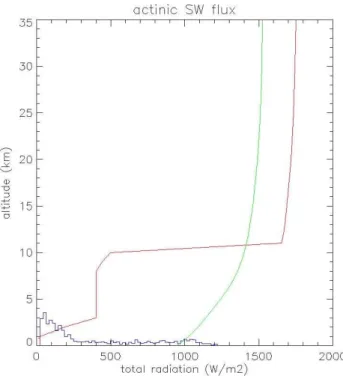
The variability of the radiation field is determined using a radiation transfer calculation and varying the above mentioned parameters within the ranges that are to be expected to occur at the measurement site. Figure 4 shows profiles derived from the radiative transfer model “streamer” (Key and Schweiger, 1998) for two cloud scenarios for a 15
November day in Lindenberg, Germany (52.21◦N, 14.12◦E) at noon. According to
the model, the ground fluxes of radiation through the surface of a unit sphere (“actinic flux”) are 21.5 W/m2 in the cloudy case and 948 W/m2 in the cloud-free case. From the radiation measurements performed at the Lindenberg BSRN station during the period 1997–2006, the probability density function (PDF) of November noon actinic fluxes is 20
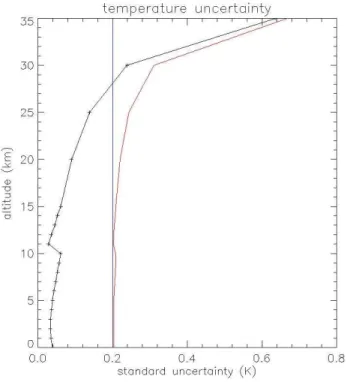
shown in blue in Fig. 4. Roughly 90% of the measured fluxes lie between the ground values of the modeled fluxes. Therefore, one may roughly assume that, with a coverage factor of k=2, the radiation field lies within the ranges outlined by the red and green line. The uncertainty that this variability implies for the temperature measurement is shown in Fig. 5.
25
AMTD
3, 1807–1842, 2010Upper-Air Reference Measurements
F. Immler et al.
Title Page
Abstract Introduction
Conclusions References
Tables Figures
◭ ◮
◭ ◮
Back Close
Full Screen / Esc
Printer-friendly Version
Interactive Discussion The effect of radiative balloon heating or adiabatic balloon cooling on the temperature
data is considered to be negligible by the CIMO guide, provided the rope between balloon and sonde is at least 40 m (WMO, 2006, chapter 12.7.4.). Another source of uncertainty is water or ice attaching to the temperature sensor in clouds. When the radiosonde emerges into dryer air above the cloud, evaporation of the condensed water 5
cools the sensor and creates a cool bias in this region (wetbulb effect). The RS-92
seems to be less affected than other sensors, but, this effect can lead to deviations up to 1 K above a cloud and the data need to be flagged appropriately, e.g., by assigning a correspondingly increased uncertainty to data in such regions.
4.4 Validating the temperature measurements
10
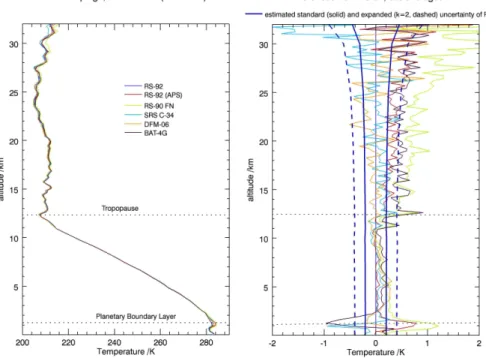
In fall 2008 an intercomparison campaign was conducted at the RAO Lindenberg in which a number of radiosonde manufacturers participated to check the performance of their products. Figure 6 shows the results of a temperature comparison. It depicts
the difference in temperature recorded by each sensor with respect to RS-92. The
blue lines indicate the uncertainty of the RS-92 derived in the previous section. In 15
the troposphere, above the boundary layer, the differences lie within the estimated
uncertainty, indicating consistency between all instruments. An exception is the range at about 1–2 km where the balloon had passed through a water cloud causing a wetbulb effect.
In the stratosphere, the differences are in some cases larger than the calculated
20
uncertainties. These discrepancies are clearly due to the radiation effect since it
in-creases significantly above a thick cirrus layer which was present at about 11 km. Most
likely, the differences between the Vaisala APS instrument (which has the same
tem-perature sensor as the RS-92) and the RS-92 are due to the indirect radiation effect
enhanced by the way this radiosonde was attached to the rig which was not ideal for 25
AMTD
3, 1807–1842, 2010Upper-Air Reference Measurements
F. Immler et al.
Title Page
Abstract Introduction
Conclusions References
Tables Figures
◭ ◮
◭ ◮
Back Close
Full Screen / Esc
Printer-friendly Version
Interactive Discussion In summary this comparison demonstrates, that the estimated uncertainties are
con-sistent with measurements from other instruments in the troposphere and into the lower
stratosphere, where there is no wetbulb effect. In the stratosphere some instruments
(RS-90 FN, Intermet BAT-4G) show significant differences to the RS-92. This is most
probably due to larger (direct or indirect) effects of solar radiation on these other sen-5
sors. It should be noted, that this was not a proper validation experiment since there was no reference instrument available. It is quite possible that all sensors have biases that can not be revealed by this experiment.
4.5 Improved ground check for RS-92
At Lindenberg, every routine radiosonde is tested in an isolated vessel that contains 10
purified water and is slightly heated and ventilated to ensure that the relative humidity in the vessel is at 100%. Since June 2009 this routine check for the humidity sensor has also included a certified temperature sensor. This enables an independent check of the calibration to be routinely obtained. Initial results indicate that the temperatures agree to better than 0.1 K. As discussed in Sect. 4.3, the calibration uncertainty is probably 15
much smaller than the one estimated from the RS-92 groundcheck calibration. By simply using an independent ground recalibration to a certified reference this error (and hence the overall uncertainty) could be considerably reduced.
4.6 Data archiving issue
An archive of raw sonde data allowing consistent reprocessing of all GRUAN data is 20
essential. In this case “raw” means uncorrected data that directly relate to the calibra-tion (which are currently not available for RS-92 soundings). The storage of raw data in well defined file archives (or data bases) will allow for later reprocessing of all available data from scratch with consistent QA/QC and correction schemes applied. Also, for the uncertainty analysis of the data it is important that all data of the network are processed 25
de-AMTD
3, 1807–1842, 2010Upper-Air Reference Measurements
F. Immler et al.
Title Page
Abstract Introduction
Conclusions References
Tables Figures
◭ ◮
◭ ◮
Back Close
Full Screen / Esc
Printer-friendly Version
Interactive Discussion scribe pre-launch recalibrations, and other procedures related to calibration and quality
assurance are available and accessible. The higher level data obtained this way, should be documented properly, which includes the availability of metadata and description or citations concerning the correction schemes and uncertainty calculations.
5 Conclusions
5
A pathway is described for the establishment of reference quality in upper-air climate observations, beginning with the choice of an appropriate instrument and proceed-ing through data archivproceed-ing and documentation issues. We conclude that the essential requirement for a reference measurement is that all aspects of the measurement un-certainty are carefully determined and documented. The most important steps are to 10
ensure SI traceability wherever possible, to correct the data for systematic errors, and to determine the uncertainty budget of the measurement, which includes the uncer-tainties associated with any applied correction. In an example we demonstrate how the determination of the uncertainty budget is obtained in the case of a temperature profile measured with a Vaisala RS-92 radiosonde. Since several details of the calibra-15
tion procedure and the applied correction schemes are not known, the analysis remains incomplete. This example demonstrates the need for an open information policy by the manufacturers, as well as accessible documentation of the instrument and the applied algorithms. Clearly, given the demands of determining the uncertainty and its valida-tion, there is ample work left to be done. However, an altitude-dependent uncertainty 20
profile has been derived that is deemed a reasonable representation of the uncertainty of this sensor for the specific environmental conditions. The framework presented here provides guidelines for the implementation of the GCOS Upper-Air Reference Network (GRUAN). GRUAN, which is also a WIGOS pilot project, aims to provide long-term climate records of essential upper-air variables that can also serve as reference data 25
AMTD
3, 1807–1842, 2010Upper-Air Reference Measurements
F. Immler et al.
Title Page
Abstract Introduction
Conclusions References
Tables Figures
◭ ◮
◭ ◮
Back Close
Full Screen / Esc
Printer-friendly Version
Interactive Discussion Glossary
Measurand Quantity intended to be measured.
Uncertainty Property of a measurement, characterizing the dispersion of a set or distribution of quantity values for the measurand, obtained by available information. Where possible, this should be derived from an experimental evaluation but can also be an estimate based on other information.
Standard uncertainty Measurement uncertainty expressed as a standard deviation.
Coverage probability Probability that the set of true quantity values of a measurand is contained within a specified coverage interval.
Coverage factor Number larger than one by which a combined standard measurement uncertainty is multiplied to obtain an expanded measurement uncertainty
Type A evaluation of uncertainty Evaluation of a component of the measurement uncertainty by a statistical analysis of measured quantity values obtained under defined measurement conditions. Type B evaluation of uncertainty Evaluation of a component of the measurement uncertainty determined by means
other than a Type A evaluation of measurement uncertainty.
Variability Standard deviation from the mean value of a variable in a given temporal or spatial range, not to be confused with the measurement uncertainty.
Reference standard Measurement standard designated for the calibration of other measurement stan-dards for quantities of a given kind in a given organization or at a given location. Working standard Measurement standard that is used routinely to calibrate or verify measuring
instru-ments or measuring systems.
Intrinsic standard Measurement standard based on a sufficiently stable and reproducible property of a phenomenon or substance. The quantity value of an intrinsic standard is assigned by consensus and does not need to be established by relating it to another mea-surement standard of the same type. Its meamea-surement uncertainty is determined by considering two components: (A) that associated with its consensus quantity value and (B) that associated with its construction, implementation and maintenance. Metrological Traceability Property of a measurement result whereby the result can be related to a reference
AMTD
3, 1807–1842, 2010Upper-Air Reference Measurements
F. Immler et al.
Title Page
Abstract Introduction
Conclusions References
Tables Figures
◭ ◮
◭ ◮
Back Close
Full Screen / Esc
Printer-friendly Version
Interactive Discussion
Acknowledgements. We like to thank the members of the working group for atmospheric ref-erence observations (WG-ARO) for helpful feedback on our draft, in particular Chris Miller, John Nash, Bill Murray, Masatomo Fujiwara, Dian Seidel, Junhong Wang, and Stephan Bojin-ski. P. Thorne was supported by the Joint DECC and Defra Integrated Climate Programme – DECC/Defra (GA01101).
5
References
EUMETSAT: EUMETSAT, http://www.eumetsat.int, last access: 13 April 2010, 2009. 1809 GCOS: GCOS Reference Upper-Air Network (GRUAN): Justification, requirements, siting and
instrumentation options, Tech.Doc. 112, WMO TD No.1379, http://www.wmo.int/pages/prog/ gcos/Publications/gcos-112.pdf, 2007. 1819, 1824
10
GCOS: GRUAN Implementation Plan 2009–2013, Tech. Rep., 134, WMO TD No. 1506, http: //www.wmo.int/pages/prog/gcos/Publications/gcos-134.pdf, 2009a. 1810, 1819, 1823 GCOS: Specifications for a Reference Radiosonde for the GCOS Reference Upper-Air Network
(GRUAN), Tech. Rep. Doc. 6.2a (6.II.09), GCOS, 2009b. 1820
Hartland, A.: Quantum standards for electrical units, Contemporary Physics, 29, 477–498,
15
http://www.informaworld.com/10.1080/00107518808222603, 1988. 1821
JCGM: International vocabulary of basic and general terms in metrology (VIM), Tech. Rep. JCGM 200:2008, International Bureau of Weights and Measures (BIPM), http://www.bipm. org/utils/common/documents/jcgm/JCGM 200 2008.pdf, 2008. 1811
JCGM/WG 1: Evaluation of measurement data Guide to the expression of uncertainty in
mea-20
surement, International Bureau of Weights and Measures/Bureau International des Poids et Mesures, http:/www.bipm.org/utils/common/documents/jcgm/JCGM 100 2008 E.pdf, Work-ing Group 1 of the Joint Committee for Guides in Metrology, 2008. 1812, 1813
Keeling, C. D.: Rewards and Penalties of Monitoring the Earth, Annu. Rev. Energ. Env., 23, 25–82, doi:10.1146/annurev.energy.23.1.25, http://arjournals.annualreviews.org/doi/abs/10.
25
1146/annurev.energy.23.1.25, 1998. 1808, 1821
Key, J. and Schweiger, A. J.: Tools for atmospheric radiative transfer: Streamer and FluxNet, Computers and Geosciences, 24, 443–451, doi:10.1016/S0098-3004(97)00130-1, 1998. 1828
Komhyr, W. D., Grass, R. D., and Leonard, R. K.: Dobson spectrophotometer 83 – A standard
AMTD
3, 1807–1842, 2010Upper-Air Reference Measurements
F. Immler et al.
Title Page
Abstract Introduction
Conclusions References
Tables Figures
◭ ◮
◭ ◮
Back Close
Full Screen / Esc
Printer-friendly Version
Interactive Discussion
for total ozone measurements, 1962–1987, J. Geophys. Res., 94, 9847–9861, doi:10.1029/ JD094iD07p09847, 1989. 1821
Moldwin, M. B. and Rose, S.: Documenting Precision and Accuracy in the Open Data Policy Era, Tech. rep., Eos, 2009. 1809
NOAA: NOAA/NESDIS, http://www.nesdis.noaa.gov/, last access: 13 April 2010, 2009. 1809
5
Ohring, G., Wielicki, B., Spencer, R., Emery, B., and Datla, R.: Satellite Instrument Calibration for Measuring Global Climate Change: Report of a Workshop., B. Am. Meteorol. Soc., 86, 1303–1313, doi:10.1175/BAMS-86-9-1303, 2005. 1809
Ohring, G., Tansock, J., Emery, W., Butler, J., Flynn, L., Weng, F., St. Germain, K., Wielicki, B., Cao, C., Goldberg, M., Xiong, J., Fraser, G., Kunkee, D., Winker, D., Miller, L., Ungar, S.,
10
Tobin, D., Anderson, J. G., Pollock, D., Shipley, S., Thurgood, A., Kopp, G., Ardanuy, P., and Stone, T.: Achieving Satellite Instrument Calibration for Climate Change, EOS Transactions, 88, 136–136, doi:10.1029/2007EO110015, 2007. 1809
Ripple, D. C., Strouse, G. F., and Moldover, M. R.: Acoustic Thermometry Results from 271 to 552 K, Int. J. Thermophys., 28, 1789–1799, doi:10.1007/s10765-007-0255-2, 2007. 1812
15
Schmidlin, F. J.: Derivation and application of temperature corrections for the United States radiosonde, in: Symposium on Meteorological Observations and Instrumentations, 7th, New Orleans, LA, 14–18 January 1991, Preprints (A92-32051 12-47), Boston, MA, American Me-teorological Society, 227–231, 227–231, /md1.csa.com/partners/viewrecord.phprequester=
gs&collection=TRD&recid=A9232077AH, 1991. 1824
20
Seidel, D. J., Angell, J. K., Christy, J., Free, M., Klein, S. A., Lanzante, J. R., Mears, C., Parker, D., Schabel, M., Spencer, R., Sterin, A., Thorne, P., and Wentz, F.: Uncertainty in Sig-nals of Large-Scale Climate Variations in Radiosonde and Satellite Upper-Air Temperature Datasets, J. Climate, 17, 2225–2240, doi:10.1175/1520-0442(2004)017h2225:, 2004. 1809 Seidel, D. J., Berger, F. H., Diamond, H. J., Dykema, J., Goodrich, D., Immler, F., Murray, W.,
25
Peterson, T., Sisterson, D., Sommer, M., Thorne, P., V ¨omel, H., and Wang, J.: Reference Upper-Air Observations for Climate: Rationale, Progress, and Plans, B. Am. Meteorol. Soc., 90, 361369, doi:10.1175/2008BAMS2540.1, 2009. 1810
Thorne, P. W., Parker, D. E., Christy, J. R., and Mears, C. A.: Uncertainties in cli-mate trends: Lessons from Upper-Air Temperature Records., B. Am. Meteorol. Soc.,
30
86, 1437–1442, doi:10.1175/BAMS-86-10-1437, /journals.ametsoc.org/doi/abs/10.1175/ BAMS-86-10-1437, 2005. 1808
AMTD
3, 1807–1842, 2010Upper-Air Reference Measurements
F. Immler et al.
Title Page
Abstract Introduction
Conclusions References
Tables Figures
◭ ◮
◭ ◮
Back Close
Full Screen / Esc
Printer-friendly Version
Interactive Discussion
D. E.: Critically Reassessing Tropospheric Temperature Trends from Radiosondes Us-ing Realistic Validation Experiments, J. Climate, 22, 465–485, http://dx.doi.org/10.1175% 2F2008JCLI2419.1, 2009. 1808, 1809
Vaisala: Vaisala Radiosonde RS92-SGP, http://www.vaisala.com/files/ VaisalaRadiosondeRS92-SGPbrochure2005.pdf, last access: 13 April 2010, 2006.
5
1825
WMO: Guide to Meteorological Instruments and Methods of Observation, World Meteorologi-cal Organization, 7th edn., www.wmo.int/pages/prog/www/IMOP/publications/CIMO-Guide/ CIMO%20Guide%207th%20Edition,%202008/CIMO Guide-7th Edition-2008.pdf, 2006.
AMTD
3, 1807–1842, 2010Upper-Air Reference Measurements
F. Immler et al.
Title Page
Abstract Introduction
Conclusions References
Tables Figures
◭ ◮
◭ ◮
Back Close
Full Screen / Esc
Printer-friendly Version
Interactive Discussion
Table 1. Terminology for checking a pair of independent measurements of the same quantity for consistency.
|m1−m2|< kqu2 1+u
2
2 TRUE FALSE significance level
k=1 consistent suspicious 32%
k=2 in agreement significantly different 4.5%
AMTD
3, 1807–1842, 2010Upper-Air Reference Measurements
F. Immler et al.
Title Page
Abstract Introduction
Conclusions References
Tables Figures
◭ ◮
◭ ◮
Back Close
Full Screen / Esc
Printer-friendly Version
Interactive Discussion Base units of the
SI
NMI primary standard
NMI working standard
GRUAN site working standard
GRUAN sensor for deployment Essential Metadata:
• Uncertainty • Local environmental
conditions
• Measurement procedure • Date/Time
• etc...
Triple point of water
Acoustic thermometer
Standard platinum resistance thermometer
Ground check station (PRT)
Estimated calibration uncertainty
Example for a realization: Temperature measurement and its uncertainty
exact
<1mK
1mK
20mK
200mK The traceability chain
Fig. 1. Conceptual traceability chain. Each step is defined by a comparison between two measurements with a stated, realistic uncertainty. All relevant details of the measurement comparison that can influence the measurement result must be recorded.
AMTD
3, 1807–1842, 2010Upper-Air Reference Measurements
F. Immler et al.
Title Page
Abstract Introduction
Conclusions References
Tables Figures
◭ ◮
◭ ◮
Back Close
Full Screen / Esc
Printer-friendly Version
Interactive Discussion Calibration of
GRUAN sensor for deployment
Calculation of climate variable
from physical units of sensor Physical/chemical
model
Retrieval algorithm Adjustments
total uncertainty in GRUAN Measurement of climate variable uncertainty of
input data, constants,
model uncertainty in
calibration Accuracy of
accepted measurement
standard Proprietary
methods Improperly documented traceability chain
Appeal to physical principles without
experimental verification
Improper standard
X
X X
X
"black box“ software
undocumented or not validated
adjustment
disregarded systematic effect
X
X
X
AMTD
3, 1807–1842, 2010Upper-Air Reference Measurements
F. Immler et al.
Title Page
Abstract Introduction
Conclusions References
Tables Figures
◭ ◮
◭ ◮
Back Close
Full Screen / Esc
Printer-friendly Version
Interactive Discussion
AMTD
3, 1807–1842, 2010Upper-Air Reference Measurements
F. Immler et al.
Title Page
Abstract Introduction
Conclusions References
Tables Figures
◭ ◮
◭ ◮
Back Close
Full Screen / Esc
Printer-friendly Version
Interactive Discussion
AMTD
3, 1807–1842, 2010Upper-Air Reference Measurements
F. Immler et al.
Title Page
Abstract Introduction
Conclusions References
Tables Figures
◭ ◮
◭ ◮
Back Close
Full Screen / Esc
Printer-friendly Version
Interactive Discussion
AMTD
3, 1807–1842, 2010Upper-Air Reference Measurements
F. Immler et al.
Title Page
Abstract Introduction
Conclusions References
Tables Figures
◭ ◮
◭ ◮
Back Close
Full Screen / Esc
Printer-friendly Version
Interactive Discussion