STRUCTURE AND LOGICAL ORGANIZATION OF CURRENT STUDIES IN TRACK AND FIELD SPORTS
Bobrovnik V.I.
National University of Physical Education and Sport of Ukraine
Annotation.. Purpose: to develop a system of assessment and prediction of technical skill athletes-athletes. Material: the study involved 450 athletes qualifications. Results: in the process of preparing members of the Ukrainian national team implemented a system of assessment of mental state. It includes: a set of informative indicators biomechanical laws and their changes; biomechanical model of motor actions; technology operational biomechanical modeling, changes in the functional state of the viscoelastic properties of skeletal muscle vestibulomotornoy system and speed- force readiness, evaluation and prediction of physical condition of athletes qualified. And complex pedagogical tests and scorecards. For the evaluation of the functional state of the autonomic nervous, cardiovascular system, external respiration system by analyzing the electrocardiogram, heart rate variability, the definition of autonomic balance, state of the myocardium, cardiac arrhythmias, spirometric studies, system performance evaluation of the athlete in extreme conditions by identifying the type and properties of temperament, level of personal anxiety and psychological evaluation reliability athletes. Conclusions: the structure and logical organization of modern studies of different primary focus, based on the assessment of technical skills, physical fitness, functional and mental state of highly skilled athletes. Keywords: structure, logical organization, athletics, technical skill, physical condition, mental condition.
Introduction1
Current level of track and field development, cardinal changes occurring in this sports event, expansion of sports calendar attract closer attention of specialists to different constituents of preparation process [6, 9 – 11, 15]. Ukrainian athletes have become winners and prizewinners of the Olympics and the World championships in this sports event on numerous occasions. However, due to various factors of external and internal character, sports performances have begun to decrease drastically. This has necessitated utilization of the present-day scientific achievements for sports practice demands, for search for the ways of gaining victories under the given conditions and for picking national teams of Ukraine for participation in major competitions. Sports result in track and field is directly dependent on qualitative management of athletes’ preparation, and includes rational structure and content of macro-, meso- and microcycles, ratio and distribution of training means within structural units, efficient organization and holding of centralized educational and training camps, well-balanced system of nutrition, provision of recovery services, regular measures aimed at estimation of various aspects of athletes’ fitness [7].
Complex scientific and methodical provision of top level athletes represents the most significant factor for improvement of the preparation efficiency of national track and field team of Ukraine [7, 8]. Its efficient realization is impossible without clear-cut structure and logical organization of current scientific studies in track and field sport. Latin “structura” means well-ordered formation. Structure is considered as the means of element organization and the character of link between them [phtt://www.onlinedics.ru/slovar/fil/s/struktura.html]. Pressing character of study is determined by increase of the efficiency of complex control and prediction of competitive activity results, system of athletes’ selection to national track and field teams, which necessitates clear-cut realization of structure and logical organization of studies in track and field, based upon objective criteria of athlete body functional state, physical, technical and mental fitness.
Studies were conducted in accordance with “Summary plan of scientific and research activities in the sphere of physical culture and sport for 2001-2005” of the State Committee of Youth Policy, Sport and Tourism of Ukraine in theme 1.4.7. “Improvement of technical skills of track and field jumpers in the process of long-term preparation” (№ of st. registration 0101U006316); “Summary plan of scientific and research activities in the sphere of physical culture and sport for 2006-2010” of the Ministry of Ukraine in Family Affairs, Youth and Sport in theme 2.1.4. “Improvement of athletic training of track and field athletes at the stages of long-term preparation” (№ of st. registration 0106U010769); “Summary plan of scientific and research activities in the sphere of physical culture and sport for 2011-2015 of the Ministry of Education and Science, Youth and Sport of Ukraine in theme 2.2. “Theoretico-methodical bases of top level athletes’ preparation under conditions of professionalization (on the example of track and field)” (№ of st. registration 0111U001721).
Purpose, tasks of the work, material and methods
Objective of work– improvement of research methodology on the basis of analysis of technical skills, physical fitness, functional and mental state of top level athletes by means of determining structure and logical organization of scientific studies in track and field sport.
Material and methods: to solve the tasks of study the following methods were used: analysis of scientific and methodical literature and generalization of advanced sports experience; anthropometry, videorecording; modelling; myotonometry, stabilography, electrotensodynamometry, pedagogical and psychological testing; spirometry, electrocardiography (ECG); methods of mathematical analysis of cardiac rhythm variability with application of “Cardio+” diagnostic automated complex, methods of mathematical statistics.
© Bobrovnik V.I., 2014
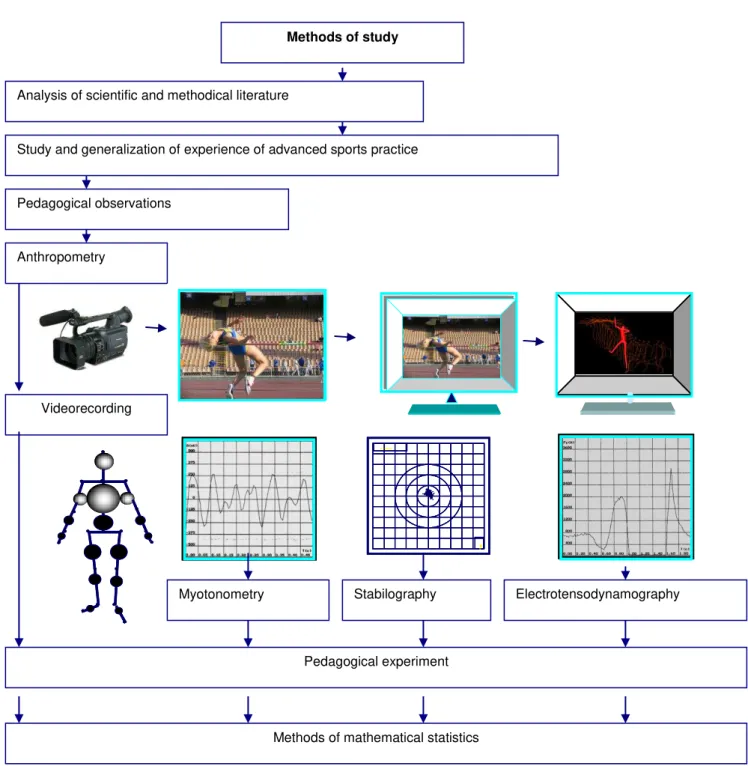
Fig. 1. Algorithm of studying technical skills of track and field athletes
Methods of study
Analysis of scientific and methodical literature
Study and generalization of experience of advanced sports practice
Pedagogical observations
Anthropometry
Videorecording
А(мм): х
y
А(мм): х
y
А(мм): х
y
Stabilography
Myotonometry Electrotensodynamography
Pedagogical experiment
The study was conducted at Track and Field Department of National University of Physical Education and Sport of Ukraine.
Problematics concerning improvement of technical skills and estimation of motor action techniques (on the material of track and field competitive jumps) has been developed in 1995-2005 together with Kinesiology Department under the guidance of Professor A.N. Laputin. Methodology of studying technical skills of athletes based on usage of the complex of informative indices of motor action techniques, functional state of viscoelastic qualities of skeletal muscles involved in main system-forming elements of the techniques of track and field competitive jumps, state of vestibulomotor system and speed-strength fitness has been introduced in preparation system of top level track and field athletes - members of national team of Ukraine (Fig.1).
In the course of methodology development a JUMP special computer program for analysis of athletes’ technical skills has been created and informative biomechanical indices of track and field competitive jumps have been revealed; besides, significance of their contribution to high sports performance achievement has been determined; biokinematic schemes, multifunctional biomechanical models of motor actions, providing achievement of targeted sports results in track and field jumps and the system of objectives have been developed together with technology of operative biomechanical modelling; regularities determining the efficiency of jump execution; peculiarities of competitive jumping exercise execution by males and females have been discovered. 208 athletes (males and females) specialized in track and field jumps participated in studies, among them 11 Merited Masters of Sports (MMS), 39 Masters of Sports of International Class (MSIC), 142 Masters of Sports (MS) and 16 Candidate Masters of Sports (CMS).
Since 2006 until now the studies have been directed to improvement of the system of evaluating the level of physical fitness of athletes in short, middle and long distance running, track and field jumps and throwing events by means of elaborated complex of informative tests, estimation of athletes’ body functional state on the basis of application of “Cardio+” diagnostic automated complex, assessment of athletes’ mental state. 450 athletes participated in studies. Since 2010, the system of evaluating mental state of athletes has been introduced in preparation process of top level track and field athletes – members of national team of Ukraine.
Results of studies and their discussion.
Motion videorecording [1, 12-14] followed by analysis of image on computer complex and development of JUMP special computer program, criteria of which have been obtained during study of track and field competitive jump biophysics, physical essence and content of complex motor actions, 45 biomechanical characteristics were analyzed and the most informative of them were revealed [1, 3]. It appears, that achievement of high sports performances in track and field competitive jumps depends on anthropometrical and biomechanical indices, presented in Tables 1-6. Revealed biomechanical indices and regularities of their alteration underlie organization of rational biomechanical structure of major system-forming elements of track and field competitive jump techniques. They are objective criteria of control and may be used in sports practice for formation of technical skills of top level track and field jumpers at stages of realization of individual capacities and maintenance of high sports mastery.
Proceeding from optimum integration of conceptual and motor aspects of complex system of motions, multifunctional biomechanical models of motor actions have been developed providing the achievement of targeted sports results in high jump: from 2,15 to 2,55m and from 1,90 to 2,25 m in males and females, respectively; in long jump: from 7,15 to 9,55 m and from 6,25 to 8,20 m in males and females, respectively; and in triple jump: from 15,80 to 19,50 m and from 13,10 to 16,50 m in males and females, respectively. They allow to determine the reserves of achieving planned biomechanical indices, main directions of technical skills formation and optimum levels of various aspects of fitness.
Methods of model creation included the following procedures: collection of information in the form of quantitative biomechanical characteristics of track and field competitive jumps; determination of their variability by means of personal computer; identification of interrelations between those characteristics and the degree of their impact upon sports result.
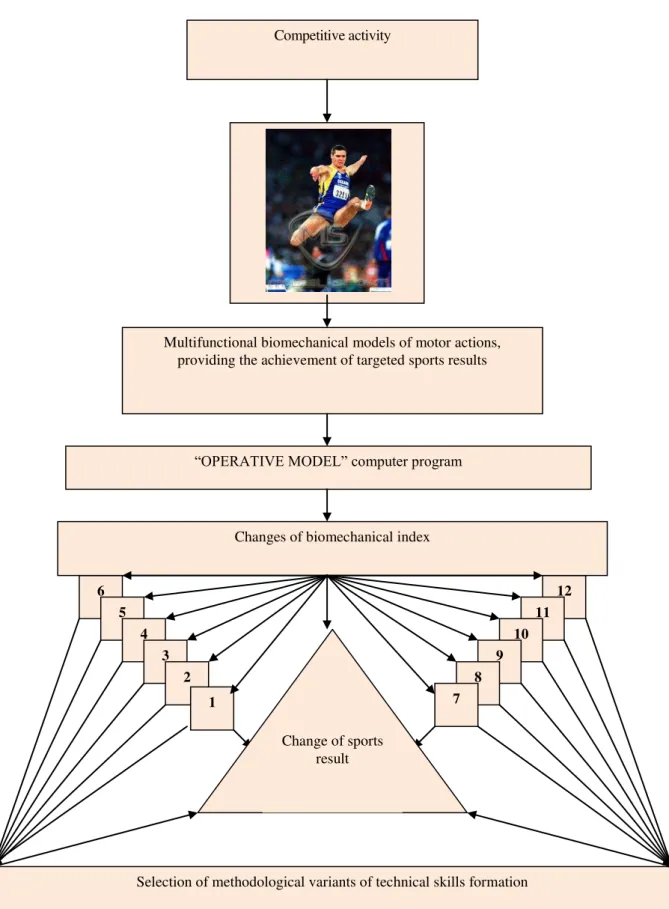
General regularities of organization of rational biomechanical structure of major system-forming elements of track and field competitive jump techniques have been revealed, which influence the achievement of high sports results; this is related to increase of all informative biomechanical indices of motor action multifunctional models, presented in Tables 1-6. The only exception refers to the duration of take-off phase and body mass of athlete, which tend to decrease along with improvement of sports results. Carried out studies have permitted to determine the contribution of informative biomechanical indices of track and field competitive jump techniques to the achievement of high sports results (see Tables 1-6). Besides, the technology of operative biomechanical modelling in accordance with informative biomechanical characteristics influencing the achievement of high sports results has been developed (Fig.2).
Table 1. Quantitative characteristics of motor actions multifunctional biomechanical models, providing the achievement of
targeted sports results in high jumps (males) Sports result, m Body mass, kg Body length, m Duration of take-off phase, s Speed of run-up before take-off, ms-1 Speed of body GCM fly off during take-off, ms-1 Angle of body GCM fly off, degr. Mean horizontal constituent of speed of
CM of leading leg
during take-off phase, ms
-1 Angular velocity of supporting knee joint extension during take-off, rads-1 Angular velocity of supporting ankle joint flexion during take-off rads-1 Resultant support reaction force during take-off phase, kN Mean complete energy of athlete body motion during take-off, kJ Take-off power, kW
2,15 73,90 1,90 0,16 7,10 5,88 53,70 8,46 6,11 13,21 3,95 2,49 7,26 2,25 73,29 1,96 0,15 7,39 6,12 54,41 8,68 6,76 13,47 4,12 2,69 7,86 2,35 72,67 2,02 0,14 7,75 6,40 55,55 8,91 7,52 13,89 4,32 3,00 8,46 2,45 71,93 2,09 0,13 8,10 6,69 56,56 9,04 8,23 14,52 4,62 3,32 9,06 2,55 71,32 2,15 0,11 8,45 6,93 57,32 9,06 8,51 14,71 5,00 3,62 9,66 Contribution
of index, %
3,92 5,00 11,76 6,84 13,72 13,98 3,50 1,96 5,88 7,96 9,80 15,68
Notes: selective data are presented; the range of values in original model varies from 2,15 m to 2,55 m per 1 cm. Improvement of sports results leads to increase of: take-off power, mean complete energy of athlete body motion during take-off, resultant support reaction force during take-off phase, angular velocity of supporting ankle joint flexion during take-off, angular velocity of supporting knee joint extension during take-off, mean horizontal constituent of speed of centre of mass (CM) of leading leg during take-off, angle of body general centre of mass (GCM) fly off, speed of body general centre of mass (GCM) fly off during take-off, speed of run-up before take-off, body length. Duration of take-off phase and body mass of athlete tend to decrease along with improvement of sports results.
Table 2.
Quantitative characteristics of motor actions multifunctional biomechanical models, providing the achievement of targeted sports results in high jumps (females)
Sports result, m Body mass, kg Body length, m Duration of take-off phase, s Speed of run-up before take-off, ms-1 Speed of body GCM fly off during take-off, ms-1 Angle of body GCM fly off, degr.. Angular velocity of supporting knee joint extension during take-off, rads-1 Angular velocity of supporting ankle joint flexion during take-off, rads-1 Mean complete energy of athlete body motion during take-off, kJ Take-off power, kW
1,90 57,50 1,80 0,17 6,60 4,90 43,00 5,69 12,00 1,82 4,50
1,95 57,19 1,83 0,16 6,82 5,10 44,40 6,09 14,51 1,85 4,86
2,00 56,89 1,86 0,15 7,03 5,31 45,61 6,49
16,01
1,89 5,17
2,05 56,58 1,89 0,13 7,27 5,51 46,31 6,89 17,52 1,92 5,51
2,10 56,27 1,92 0,12 7,57 5,72 47,12 7,29 19,29 1,95 5,93
2,15 56,96 1,96 0,12 7,68 5,92 47,63 7,69 20,96 2,00 6,38
2,20 56,63 1,99 0,11 7,74 6,04 48,84 8,09 22,84 2,09 6,64
2,25 56,33 2,02 0,10 7,80 6,10 50,00 8,49 24,10 2,15 7,00
Contribution of index,%
3,32 6,75 6,92 11,53 11,22 14,53 13,41 6,69 10,68 14,95
Table 3. Quantitative characteristics of motor actions multifunctional biomechanical models, providing the achievement of
targeted sports results in long jumps (males) Sports result, m Body mass, kg Body length , m Duratio n of take-off phase, s Speed of run-up before take-off, ms-1 Speed of body GCM fly off during take-off, ms-1 Angle of body GCM fly off, degr. Mean horizontal constitue nt of speed of CM of leading leg during take-off phase, ms-1 Minimu m angle of supportin g knee joint during take-off, degr. Angular velocity of supportin g hip joint extension during take-off phase, rads-1 Work performe d by athlete during take-off, kJ Mean complet e energy of athlete body motion during take-off, kJ Take-off power, kW
7,15 79,30 1,85 0,13 9,50 9,00 19,00 12,10 144,15 6,87 0,550 3,90 6,37 7,60 78,79 1,86 0,13 9,71 9,15 19,07 12,55 144,60 7,41 0,608 4,20 6,84 8,00 78,33 1,88 0,12 9,91 9,27 19,28 12,94 145,00 7,48 0,662 4,48 7,30 8,50 77,7
6 1,8
9
0,11 10,3 6
9,63 23,3 4
13,44 147,90 7,66 0,713 4,82 7,92
9,00 70,2 6
1,9 3
0,10 10,8 1
9,93 25,1 2
13,92 149,64 7,96 0,763 5,15 8,54
9,55 69,5 0
2,0 5
0,09 11,5 5
10,8 8
26,2 5
14,45 154,10 8,60 0,830 5,55 10,2 5 Contributio
n of index, %
5,00 4,0 0
10,50 7,90 12,7 2
11,9 8
3,80 2,40 3,53 13,85 8,30 16,0 2
Notes: selective data are presented; the range of values in original model varies from 7,15 m to 9,55 m per 5 cm. Improvement of sports results leads to increase of : take-off power, mean complete energy of athlete body motion during take-off, work performed by athlete during take-off, angular velocity of supporting hip joint extension during take-off phase, minimum angle of supporting knee joint during take-off, mean horizontal constituent of speed of CM of leading leg during take-off phase, angle of body GCM fly off, speed of body GCM fly off during take-off, speed of run-up before take-off, body length. Duration of take-off phase and body mass of athlete tend to decrease along with improvement of sports results.
Table 4. Quantitative characteristics of motor actions multifunctional biomechanical models, providing the achievement of
targeted sports results in long jumps (females) Sports result, m Body mass, kg Body length, m Duration of take-off, s Speed of run-up before take-off, ms-1 Speed of body GCM fly off during take-off, ms-1 Angle of body GCM fly off, degr. Mean horizontal constituent of speed of CM of leading leg during take-off , ms-1 Angular velocity of supporting knee joint extension during take-off phase, rads-1 Extension angle of supporting hip joint during take-off, degr. Work performed by female athlete during take-off, kJ Mean complete energy of female athlete body motion during take-off, kJ Take-off power, kW
6,25 57,90 1,72 0,12 9,16 8,55 18,50 11,87 7,24 183,50 0,450 2,39 5,06 6,60 57,48 1,75 0,10 9,31 8,90 18,99 12,12 7,34 191,98 0,500 2,63 5,11 7,00 57,00 1,78 0,09 9,50 9,33 19,50 12,50 7,50 195,00 0,548 2,69 5,46 7,50 55,47 1,82 0,08 9,76 9,42 20,11 12,78 7,81 196,22 0,566 2,75 5,78 7,90 54,26 1,85 0,07 9,97 9,49 20,60 12,99 8,05 197,20 0,581 2,79 6,03 8,20 53,35 1,87 0,07 10,13 9,55 20,96 13,16 8,23 197,92 0,592 2,82 6,22 Contribution
of index, %
4,92 7,46 8,54 8,35 9,84 8,92 6,56 7,38 6,20 9,54 9,54 12,75
speed of CM of leading leg during take-off, angle of body GCM fly off, speed of body GCM fly off during take-off, speed of run-up before take-off, body length. Duration of take-off phase and body mass of female athlete tend to decrease along with improvement of sports results.
Table 5. Quantitative characteristics of motor actions multifunctional biomechanical models, providing the achievement of
targeted sports results in triple jump (males) Sports
result,
m
Body mass, kg
Body length,
m
Take-off
Duration of
take-off, s
Speed of run-up before
take-off, ms-1
Speed of body
GCM fly off during
take-off, ms-1
Angle of body GCM fly off, degr.
Angular velocity of supporting hip joint extension
during take-off,
rads-1
Angular velocity of supporting knee joint extension during
take-off, rads-1
Angular velocity of supporting ankle joint flexion
during take-off,
rads-1
Mean complete
energy of athlete
body motion during take-off,
kJ
Take-off power,
kW
15,80 77,53 1,84 1 0,11 9,50 8,50 12,50 9,5 8,34 15,18 4,51 5,85
2 0,13 8,50 7,80 11,8 8,34 7 13,18 3,9 5,2
3 0,16 7,25 6,90 14,00 8,32 6,41 14,39 2,90 4,45
16,80 75,89 1,86 1 0,11 10,00 8,97 13,31 15,08 11,30 20,73 5,07 6,71
2 0,12 9,10 8,56 12,61 13,92 9,79 18,29 4,4 6,11
3 0,15 8,01 7,56 16,51 13,67 9,39 18,62 3,40 5,31
17,80 73,97 1,88 1 0,10 10,57 9,42 14,42 20,66 14,26 26,27 5,78 7,63
2 0,11 9,67 8,92 13,42 19,54 12,69 22,96 4,98 7,03
3 0,13 8,67 7,92 18,62 19,02 12,38 22,85 3,98 6,10
19,50 69,50 1,92 1 0,09 11,50 10,30 16,20 30,15 19,30 35,70 6,37 8,80
2 0,10 10,70 9,50 15,5 28,35 17,7 31,24 5,9 8,35
3 0,11 10,00 8,90 21,00 28,11 17,45 30,05 4,90 7,40
Contribution
of index, %
1,04 1,47 10,25 12,41 17,21 15,30 5,03 3,21 5,66 8,88 19,54
Table 6. Quantitative characteristics of motor actions multifunctional biomechanical models, providing the achievement of
targeted sports results in triple jump (females) Sports result, m Bo dy mas s, kg Bo dy len gth, m Ta ke-off Duration of take-off phase, s Speed of run-up before take-off, ms-1 Speed of body GCM fly off during take-off, ms-1 Angle of body GCM fly off, degr. Angular velocity of supporting hip joint extension during take-off, rads-1 Angular velocity of supporting knee joint extension during take-off, rads-1 Angular velocity of supportin g ankle joint flexion during take-off, rads-1 Mean complete energy of female athlete body motion during take-off, kJ Take-off power, kW
13,10 55,
00 1,7
1
1 0,10 8,80 7,80 17,50 10,47 8,18 15,53 2,90 4,50
2 0,12 7,70 6,90 12,70 8,05 8,05 14,17 2,40 4,00
3 0,14 7,00 6,30 19,00 9,97 8,2 14,08 1,80 3,40
14,10 53,
86 1,7
6
1 0,09 9,00 8,00 18,07 14,23 10,84 19,36 3,46 4,97
2 0,11 8,04 7,19 13,34 12,36 10,58 17,83 2,91 4,29
3 0,13 7,37 6,59 19,57 13,71 10,51 17,36 2,23 3,80
15,10 52,
71 1,8
1
1 0,09 9,20 8,20 18,64 17,98 13,51 23,18 4,07 5,41
2 0,10 8,39 7,47 14,01 16,67 13,11 21,49 3,43 4,59
3 0,12 7,74 6,87 20,14 17,46 12,82 20,71 2,66 4,20
16,50 51,
00 1,8
8
1 0,08 9,50 8,50 19,5 23,24 17,24 28,54 5,10 6,10
2 0,09 8,90 7,90 15,00 22,7 16,66 26,61 4,20 5,00
3 0,10 8,30 7,30 21,00 22,7 16,05 26,18 3,30 4,80
Contrib ution of index % 1,2 3 1,2 8
11,79 16,03 17,02 16,04 3,99 3,10 4,01 6,80 18,71
Fig. 2.Diagram of the technology ofoperative biomechanical modellingof track and field competitive jumps techniques.
Note. 1–12 – informative biomechanical indices of competitive activity of highly skilled jumpers Competitive activity
“OPERATIVE MODEL” computer program Multifunctional biomechanical models of motor actions,
providing the achievement of targeted sports results
6
5 4
3 2
1
12
11 10
9 8
7 Changes of biomechanical index
Change of sports result
“OPERATIVE MODEL”, specifically developed computer program, permits to change the value of biomechanical index, thus leading to alteration of sports result. As a result of setting different values of dynamic or kinematic indices of track and field competitive jumps techniques, one may determine, at the expense of which it is expedient to improve sports result. The given computer program allows projecting and analyzing the most expedient variants of motion techniques which may be adapted to specific athlete. Selection of respective variant depends on specificity of jumping discipline, individual peculiarities of competitive exercise performance, alteration of those indices, which are not genetically restricted but are sensitive to improvement as a consequence of application of proper complex of training impacts contributing to their increase.
Study of the functional state of viscoelastic properties of skeletal muscles, actively involved in basic system-forming element of jumping techniques, i.e. the take-off (gastrocnemius muscle, biceps of the thigh, musculus longissimus, dorsal gluteal muscle, quadriceps muscle of thigh) has been carried out by means of myotonometry method with application of special computer program allowing obtaining information on-line in graphical and digital form (15 indices). 19 male and 19 female high jumpers, 8 male and 8 female pole vaulters, 21 male and 21 female long jumpers and 16 male and 16 female triple jumpers participated in the experiment.
Correlation analysis has allowed to reveal informative indices of functional state of skeletal muscle viscoelastic properties and statistically significant relationship between rigidity (stiffness) (׀r׀ = 0,48–0,71, p<0,01); damping capacity (׀r׀ = 0,48–0,68, p<0,01); muscle contractility (׀r׀ = 0,44–0,72, p<0,01); energy of relaxed muscle oscillations during dosed mechanical impact (׀r׀ = 0,44–0,72, p<0,01); energy of tensed muscle oscillations during dosed mechanical impact (׀r׀ = 0,45–0,72, p<0,01) and sports result in long, high and triple jumps and pole-vaulting both in males and females.
On the basis of revealed informative indices it has been determined, that indices of skeletal muscles of take-off leg of top level athletes were inferior to those of leading leg at p<0,05 with the exception of triple jumpers and female high jumpers. In triple jumpers an even development of muscles of take-off and leading leg was observed, conditioned by competitive activity specifics. This functional state of skeletal muscles is related to irrational organization of training process, execution of basic training exercises by take-off leg.
Method of stabilography and special software packages providing information in graphical and digital form (10 indices) were used to study functional state of jumpers’ vestibulomotor system.
Carried out correlation analysis has indicated, that objective evaluation of vestibulomotor system functional state necessitates taking into account the following informative indices, which have statistically significant association with sports result: mean (׀r׀ = 0,60–0,67,p<0,01) and maximal (׀r׀ = 0,61–0,76, p<0,01) amplitude of body general centre of mass (GCM) oscillations, mean frequency of body GCM oscillations (׀r׀ = 0,61–0,68, p<0,01), body GCM maximal moving away from the centre of its projection (׀r׀ = 0,60–0,71, p<0,01) in the course of performing all track and field competitive jumps.
Conducted studies revealed peculiarities of vestibulomotor system functional state. High values of mean frequency of body GCM oscillations (from
x
= 13,66, S = 1,09 tox
= 22,50, S = 1,78 hz) and low values of meanamplitude of body GCM oscillations (from
x
= 6,78, S = 0,41 tox
= 8,20, S = 0,59 mm) were observed in females,whereas in males low values of mean frequency and mean amplitude of body GCM oscillations (from
x
= 9,73, S =0,61 to
x
= 15,19, S = 1,21 hz and fromx
= 5,87, S = 0,59 tox
= 8,06, S = 0,48 mm) were noted at p<0,05.It has been discovered, that vestibulomotor system functional state is dependent on jumping discipline specifics. It appears to be better in high jumpers and pole vaulters as compared to long and triple jumpers. The above is due to manifestation of greater degree of agility, coordination of movements and spatial orientation during performance of basic competitive exercise.
Improvement of sports results in track and field competitive jumps is provided by enhanced level of speed and strength fitness of athletes and their ability to organize motions, so that to realize their motor capacities in competitive activity.
Hardware-software complex intended for tensodynamometric studies and providing information in graphical and digital form on-line (14 indices) was used for assessment of speed and strength fitness of highly skilled athletes. In the course of studies informative indices have been determined, their statistically significant association with sports result in track and field competitive jumps in males and females has been established: maximal strength (׀r׀ = 0,50–0,59, p<0,01), strength gradient (׀r׀ = 0,50–0,76, p<0,01), strength impulse (׀r׀ = 0,51–0,64, p<0,01), time of maximal strength achievement (׀r׀ = 0,51–0,63, p<0,01), height of body GCM elevation (׀r׀ = 0,50–0,67, p<0,01).
Peculiarities of speed and strength capacities have been revealed: prevalence of speed and strength capacities in females and males, respectively. For instance, during performance of standing upward jump with arm swing, the time of maximal strength achievement varied from
x
= 0,16, S = 0,02 tox
= 0,28, S = 0,05 s and fromx
= 0,30, S = 0,02 tox
= 0,50, S = 0,04 s in females and males, respectively, whereas maximal strength varied fromx
= 2154,28, S =129,26 to
x
= 2486,3, S = 185,73 Н, and fromx
= 1798,1, S = 176,24 tox
= 2107,04, S = 168,56 Н at p<0,05 inFig. 3. Diagram of the methods of estimating physical state of skilled track and field athletes – members of reserve national team of Ukraine
Beginning from 2006 methods of physical state assessment of athletes of different skill levels have been actively implemented at educational and training camps. This has been mainly realized with respect to members of reserve national team specialized in running disciplines, jumps and throwing. Methods included the complex of pedagogical tests, estimation tables, model indices of cardiac rhythm variability, determination of the type of cardiac rhythm vegetative regulation and classification of functional states of athletes of different skill levels, specialized in different track and field events (Fig.3). Suggested methods were common for track and field athletes of different skill levels, however testing exercises, criteria of estimation of both physical fitness and functional state differed. Estimation tables were calculated with account for skill level. Mathematical analysis of cardiac rhythm variability, on the basis of which the type of cardiac rhythm vegetative regulation was determined, was made at rest before forthcoming load after the day of rest.
Functional state classification was conducted before the load both at rest and after standard testing load. Model indices of cardiac rhythm variability were calculated with account for sports specialization and athletes’ skill levels (at rest, after load).
Various testing exercises in running, jumps and throwing were used. Let us consider sprint and middle-distance running as an example (Fig.4).
Statistica-6, Excel-7, SPSS-16.0 integrated statistical and graphical packages were utilized for experimental material processing. Physical fitness level was estimated according to 5-point scale: 1 – low, 2 – below average, 3 – average, 4 – above average, 5 – high. It was determined for each group of track and field athletes on the basis of sigmoid scales {4}. Estimation scales were calculated for males and females separately, depending on their specialization. Coefficient of the relative strength of the upper extremities was determined according to formula: mass of bench-pressed barbell (kg) / m (kg), where m – body mass of athlete.
Despite successful testing and confirmation of the efficiency of developed system for assessment of physical state of track and field athletes of various skill levels the necessity of the given system improvement has arisen; it has been due to inclusion in it of current fundamental instrumental methods, allowing to obtain reliable information about functional state of body major systems (vegetative nervous, cardiovascular, system of external breathing). Necessity of mental state diagnostics gave no rise to doubts, which had been previously almost neglected (Fig.5).
Assessment of athletes’ physical state
Assessment of physical fitness level Assessment of athletes’ body functional state
Pedagogical testing of athletes’ motor capacities
Testing exercises
running
jumping
with weights
Estimation scales
Determination of the type of cardiac rhythm vegetative regulation
(on the basis of rhythmocardiography)
Model indices of cardiac rhythm variability (calculated indices)
Functional state classification (graph grammar-based analysis of cardiac rhythm variability
Fig. 4. Diagram of the methods of estimating physical fitness of skilled track and field athletes (on the example of sprinters and middle-distance runners)
System of physical state assessment and prediction presented in Fig.5 has some advantages as compared to previously developed one, presented in Fig.3: “Assessment of body functional state” component has been expanded and “Efficiency of athlete’s activity under extreme conditions” new component has been introduced.
Assessment of physical fitness level included testing exercises allowing thorough determination of the level of manifestation and development of speed, speed-strength, strength, coordination capacities, special endurance, intermuscular and intramuscular coordination by means of accessible informative tests as well as hand dynamometry (significance of each exercise has been mathematically confirmed). In addition, one may determine predisposition of an athlete to track and field specialization, predict performance success in forthcoming competitions, find out leaders, and build a team for participation in high-level competitions on the above basis. “Assessment of body functional state” including evaluation of cardiovascular, vegetative nervous system and system of external breathing by means of “Cardio+” diagnostic automated complex (Fig.6) represents an important component in the system of estimating and predicting physical state of track and field athletes of national team of Ukraine.
Methods of functional state assessment on the basis of application of “Multimoda Cardio 1” computer program have been developed under the guidance of I.A.Chaykovsky, Candidate of Medicine, together with Professor V.I.Bobrovnik, Doctor of Physical Education and Sport, for athletes with account for sports specialization. They have been integrated into software of “Cardio” complex of functional diagnostics in the form of “ORAKUL” program. It includes complex estimation of vegetative regulation on the basis of cardiac rhythm variability, state of myocardium on the basis of complete analysis of amplitude-and-temporal parameters of electrocardiogram, analysis of cardiac rhythm disorders as well as complex evaluation of cardiovascular and vegetative nervous system (estimation criteria have been developed with account for sports specialization and skill level of athletes) [2]. It is known that training and competitive
Tests
running jumping with weights
sprinters: – 30 m flying start, s;
– 30 m crouch start, s;
– 80 m crouch start, s;
– 120 m standing start, s
middle-distance runners: – 60 f flying start, s;
– 30 m crouch start, s;
– 600 m standing start, min;
– 1000 m standing start, min
sprinters: – standing long jump, m;
– 8-fold standing long jump, m;
– 8-fold standing long hop on right, left foot , m
middle-distance runners: – standing long jump, m;
– 5-fold standing long jump, m;
– 5-fold standing long hop on right, left foot, m
sprinters:
– 4 kg shot throwing forward from below, m;
– 4 kg shot throwing backward from below, m;
– determining strength of right, left hand, kg;
– benchpress, kg;
– pull-ups, rep.
middle-distance runners:
– 4 kg shot throwing forward from below, m;
– 4 kg shot throwing backward from below, m;
– determining strength of right, left hand, kg;
– pull-ups, rep.
Fitness level estimation scales
Fitness levels:
– low;
– below average; – average; – above average; – high
activity is accompanied with high mental tension. Efficiency of athlete’s activity under stress situations depends on type and traits of temperament, personal anxiety and mental reliability of athletes (Fig.7).
Fig. 5. Diagram of the system of assessment and prediction of physical state of skilled track and field athletes – members of reserve national team of Ukraine
The above has necessitated an expansion of criteria of their fitness assessment, the efficiency of athlete’s activity under extreme conditions, in particular [5].
Efficiency of athlete competitive activity depends in large part on temperament type and traits, which is a biological cornerstone of personality, based on properties of nervous system – power of excitation and inhibition processes, mobility of nerve processes, nervous system balance [5]. However, data about temperament only are not enough for prediction of successful competitive activity. Information about its structure is needed as well. Applied B.N.Smirnov’s “Study of temperamental psychological structure” questionnaire allows revealing several polar temperament traits: extraversion – introversion, emotional excitement – emotional balance, response rate (fast-slow), activity (high-low). For the purpose of studying psychological reliability of athletes, methods, developed by V.E.Milman have been used allowing to characterize the level of competitive emotional resilience (CER), competitive motivation (CM), stability - interference resistance (StIR) and self-regulation (SR).
Long-term studies of athletic activity of highly skilled athletes – members of national track and field team of Ukraine permit to recommend an integral system of training and competitive activity control, which includes assessment of technical skills, physical and mental fitness. Methodology of studies in track and field is presented in Figure 8. Its main advantage is an opportunity to predict success of performance in forthcoming competitions, find out leaders and build a team for participation in high level competitions.
System of assessment and prediction of athletes’ physical state
Assessment of physical fitness level
Assessment of body functional state
Efficiency of athlete’s activity under extreme conditions
ECG analysis
Analysis of cardiac rhythm variability
External breathing system assessment
Temperament type determination
Temperament trait determination
Athletes’ mental reliability determination Personal anxiety level
determination Pedagogical testing of motor
capacities
Fig. 6. Estimation methods of functional state of skilled track and field athletes – members of reserve national team of Ukraine
Fig. 7. Diagram of estimation of athlete activity efficiency under extreme conditions Personal anxiety determination
C. Spilberger
Determination of athlete’s temperament
Estimation of athletes’ mental reliability
Milman V.E. Efficiency of athlete’s activity under extreme conditions
Methods of determining
temperament domination (A.Belov) temperament trait (B.N.Smirnov) Determination of athletes’ Functional state assessment
“Cardio+” diagnostic automated complex
Electrocardiograph: simultaneous examination of 12 ECG-signals; registration, processing, automatic calculation and analysis of ECG parameters; ECG-signal monitoring;
Analysis of cardiac rhythm variability and estimation of vegetative nervous system state;
Fig. 8. Structure of studying training and competitive activity athletes’ state in track and field
я ия е в
System of athlete physical fitness, functional and mental state evaluation
Athlete physical fitness level evaluation
Pedagogical testing with application of the complex of testing exercises on the basis of developed estimation scales, quantitative indices of speed-strength fitness by means of tensodynamometry
Athlete functional state evaluation
Determination of cardiac rhythm vegetative regulation on the basis of rhythmocardiography,
modelling characteristics of cardiac rhythm variability (estimated indices) functional state classification on the basis of graph grammar-based
analysis of cardiac rhythm variability indices
ECG analysis by means of “Cardio+” diagnostic automated complex of external breathing system (VC, RR, TV, RMV, MBC, FVC, etc.)
Efficiency of athlete activity under extreme conditions Revealing regularities of organization of rational
biomechanical structure of major system-forming elements of techniques
Modelling the techniques of track and field events
Operative biomechanical modelling the techniques System of athlete technical skills evaluation
Determination of temperament type and traits, level of personal anxiety, mental reliability of athletes Estimating functional state of skeletal muscle
viscoelastic properties by means of myotonometry
Estimating vestibulomotor system functional state by means of stabilography
Conclusions
1. Structure and logical organization of studies in track and field sport based upon objective criteria of estimating technical skills, physical state of skilled track and field athletes and sequence of their application have been determined. 2. System of evaluation and prediction of athletes’ technical skills has been developed, including:
– complex of informative biomechanical indices and regularities of their changes, underlying organization of rational biomechanical structure of major system-forming elements of track and field competitive jump techniques and being objective criteria of control;
– biomechanical models of motor actions, providing the achievement of targeted sports results, which determine the main vector of top track and field athlete technical skills formations in the system of sports preparation and are objective criteria of control and prediction of sports result increase, estimation of individual reserves for the achievement of planned biomechanical indices of competitive activity;
– technology of operative biomechanical control, allowing prediction of various variants of solution of complex motor tasks by means of software, which represents the system of objective regularities of competitive jumping exercise rational organization;
– complex of informative indices and regularities of their alteration of functional state of viscoelastic features of skeletal muscles, vestibulomotor system and speed-strength fitness.
3. System for estimation and prediction of skilled track and field athlete physical state has been developed, including the complex of pedagogical tests, estimation tables, assessment of functional state of vegetative nervous, cardiovascular system and that of external breathing by means of analyzing ECG, cardiac rhythm variability, determining vegetative balance, state of myocardium, cardiac rhythm disorders, spirometric studies.
4. System of estimation of athlete activity efficiency under extreme conditions has been developed and tested by means of determining temperament type and traits, level of personal anxiety and estimating psychological reliability of athletes.
5. Modified structure and logical organization of current studies, based on revealed regularities of control and prediction of motor action technique, physical state and activity of athlete under extreme conditions, including the whole complex of modern research methods and obtained objective informative criteria and sequence of their application have been developed.
References
1. Bobrovnik V.I. Formirovanie tekhnicheskogo masterstva legkoatletov-prygunov vysokoj kvalifikacii v sisteme sportivnoj podgotovki [Formation of technical skill athletes jumpers qualifications in sports training system], Dokt. Diss., Kiev, 2007, 582 p.
2. Bobrovnik V.I. Pedagogika, psihologia ta mediko-biologicni problemi fizicnogo vihovanna i sportu [Pedagogics, psychology, medical-biological problems of physical training and sports], 2013, vol.1, pp. 12-19.
3. Bobrovnik V.I., Kozlova E.K. Mir sporta [World of Sports], 2008, vol.3, pp. 3-18.
4. Zaciorskij V.M. Osnovy sportivnoj metrologii [Fundamentals of sports metrology], Moscow, 1979, 152 p.
5. Il'in E.P. Psikhologiia individual'nykh razlichij [Psychology of individual differences], Sankt Petersburg, 2004, 701 p.
6. Kozlova E.K. Podgotovka sportsmenov vysokoj kvalifikacii v usloviiakh professionalizacii legkoj atletiki [Preparation of highly skilled athletes in terms of professionalization of athletics], Kiev, Olympic Literature, 2012, 368 p.
7. Platonov V.N. Periodizaciia sportivnoj trenirovki. Obshchaia teoriia i ee prakticheskoe primenenie [Periodization of athletic training. General theory and its practical application], Kiev, Olympic Literature, 2013, 624 p.
8. Platonov V.N., Pavlenko Iu.A., Tomashevskij V.V. Podgotovka nacional'nykh komand k Olimpijskim igram: istoriia i sovremennost' [Preparation of national teams for the Olympic Games: Past and Present], Kiev, 2012, 256 p. 9. Bateman T. An alternative high jump technique .The Coach, Peterborough, England, 2003, vol.17, pp. 30-31. 10. Carr G. Sport mechanics for coaches. 2nd ed. – Champaign: Human Kinetics, 2004, vol.16, 240 p.
11. Guthrie M. Coaching Track and Field Successfully Champaign: Human Kinetics, 2003, 224 p.
12. Knudson D., Morrison C. Qualitative Analysis of Human Movement. 2nd Edition. Human Kinetics, 2002, 264 p. 13. Miller K. High jumping for women. Leichtathletiktraining, 2004, vol.15, pp. 10-16.