Comparative Efficacy of Lamivudine and Emtricitabine: A
Systematic Review and Meta-Analysis of Randomized
Trials
Nathan Ford1*, Zara Shubber2, Andrew Hill3, Marco Vitoria1, Meg Doherty1, Edward J. Mills4, Andy Gray5
1Department of HIV/AIDS, World Health Organization, Geneva, Switzerland,2Department of Infectious Disease Epidemiology, Faculty of Medicine, Imperial College, London, United Kingdom,3Pharmacology Research Laboratories, University of Liverpool, Liverpool, United Kingdom,4Faculty of Health Sciences, University of Ottawa, Ottawa, Canada,5Division of Pharmacology, School of Health Sciences, University of KwaZulu-Natal, Durban, South Africa
Abstract
Introduction:Lamivudine and emtricitabine are considered equivalent by several guidelines, but evidence of comparable efficacy is conflicting.
Methods:We searched two databases up to June 30 2013 to identify randomized and quasi-randomized trials in which lamivudine and emtricitabine were used as part of combination antiretroviral therapy for treatment-naı¨ve or experienced HIV-positive adult patients. We only included trials where partner drugs in the regimen were identical or could be considered to be comparable. We allowed for comparisons between tenofovir and abacavir provided the study population did not begin treatment with a viral load.100,000 copies/ml.
Results:12 trials contributed 15 different randomized comparisons providing data on 2251 patients receiving lamivudine and 2662 patients receiving emtricitabine. Treatment success was not significantly different in any of the 12 trials. In the three trials that directly compared lamivudine and emtricitabine, the relative risk for achieving treatment success was non-significant (RR 1.03 95%CI 0.96-1.10). For all trials combined, the pooled relative risk for treatment success was not significantly different (RR 1.00, 95%CI 0.97–1.02). No heterogeneity was observed (I2= 0). Similarly, there was no difference in the pooled relative risk for treatment failure (RR 1.08, 95%CI 0.94–1.22,I2= 3.4%).
Conclusions:The findings of this systematic review suggest that lamivudine and emtricitabine are clinically equivalent.
Citation:Ford N, Shubber Z, Hill A, Vitoria M, Doherty M, et al. (2013) Comparative Efficacy of Lamivudine and Emtricitabine: A Systematic Review and Meta-Analysis of Randomized Trials. PLoS ONE 8(11): e79981. doi:10.1371/journal.pone.0079981
Editor:Mark Wainberg, McGill University AIDS Centre, Canada
ReceivedAugust 18, 2013;AcceptedOctober 5, 2013;PublishedNovember 11, 2013
Copyright:ß2013 Ford et al. This is an open-access article distributed under the terms of the Creative Commons Attribution License, which permits unrestricted use, distribution, and reproduction in any medium, provided the original author and source are credited.
Funding:This work was supported by funds from the Bill and Melinda Gates Foundation. The funders had no role in study design, data collection and analysis, decision to publish, or preparation of the manuscript.
Competing Interests:The authors have declared that no competing interests exist. * E-mail: [email protected]
Introduction
Lamivudine and emtricitabine are both widely used as a core component of the dual nucleoside reverse transcriptase inhibitor backbone in all currently preferred first-line antiretroviral combi-nations therapies The chemical structure of these two nucleoside analogues is very similar[1,2]; both are prodrugs requiring intracellular phosphorylation and both are active against HIV-1, HIV-2 and hepatitis B virus.
The latest antiretroviral treatment guidelines of the US Department of Health and Human Services [3] and the World Health Organization[4] consider lamivudine and emtricitabine to be equivalent and interchangeable from a clinical and program-matic perspective. However, inferior virological efficacy of lamivudine has been suggested based on limited data from early in-vitro studies[5,6] and this presumption of inferiority has been applied to recent cost-effectiveness analyses [7]. There is therefore uncertainly regarding the clinical comparability of these two drugs. In order to support recommendations for future guidance for first-line antiretroviral therapy, we conducted this systematic
review of available data from randomized trials to assess the comparative efficacy of these two antitretroviral drugs.
Methods
This systematic review was conducted according to the according to the criteria of the Preferred Reporting Items for Systematic Reviews and Meta-Analyses group [8].
Search strategy and study selection
Using a pre-defined protocol, we sought randomized and quasi-randomized trials in which lamivudine and emtricitabine were used as part of combination antiretroviral therapy for treatment-naı¨ve or treatment-experienced HIV-positive adult patients. Our search strategy was conducted in 2 stages. In the first stage, we screened separately in Medline (via PubMed) from inception to March 31 2013 for all trials including lamivudine or emtricitabine in one arm in an attempt to identify trials that could be compared indirectly through a network meta-analysis. In the second stage, we searched Medline, Embase, and the Cochrane Database of
Systematic Reviews up to June 30 2013 for trials in which comparable triple-drug regimens including lamivudine or emtri-citabine were assessed for virological efficacy. The two searches were cross-checked to ensure that no studies were missed. Conference abstracts from all conferences of the International AIDS society were also searched up to 30 June 2013 (Kuala Lumpur). Bibliographies of all included articles and other relevant articles were also screened. No date, language or geographical restrictions were applied.
We only included trials where partner drugs in the regimen were identical or could be considered to be comparable. We allowed for comparisons between tenofovir and abacavir provided the study population did not begin treatment with a viral load $100,000 copies/ml, as trials have concluded comparable efficacy for these two drugs below this threshold[9]. Studies in which different trial arms used partner drugs with established differences in safety or efficacy (for example comparing tenofovir and zidovudine) were excluded.
Data extraction and quality assessment
Data were extracted by one reviewer (NF) and independently verified by a second reviewer (ZS). Our primary outcomes of interest were virological success and virological failure as defined by the studies. Where studies only reported virological success, the inverse was used to estimate virological failure. Where studies reported outcomes at different time points, outcome data were extracted for the longest duration of follow up. We also sought data on the emergence of M184V resistance mutations and extracted information on patient and study characteristics, and indicators of study quality following criteria developed by the Cochrane Collaboration[10]. The overall quality of the evidence was assessed using GRADE [11].
Data synthesis and analysis
We calculated relative risks (RR), risk differences, and corresponding 95% confidence intervals (CIs) for each outcome using intent-to-treat analysis, and pooled data using fixed-effects meta-analysis, in which the weight assigned the estimated treatment effect from a given trial is proportional to the amount of information provided by that trial. The robustness of this analysis was explored in sensitivity analyses using the random-effects method [12]. Heterogeneity was assessed using the I2 statistic, which describes the percentage of variation across studies that is due to heterogeneity rather than due to chance [13]. Pre-defined subgroup analyses assessed the potential influence of prior treatment history, and study duration (48 weeks versus 96 weeks). Publication bias was assessed by funnel plot asymmetry[11]. All P-values are two-sided and we considered a P-value,0.05 to be significant.
All analyses were conducted using Stata version 12.0 (Stata-Corp. LP, College Station, Texas, USA) and GRADE Pro (www. gradeworkinggroup.org).
Results
1756 titles were screened for indirect comparisons and 1115 titles for direct comparisons. No valid indirect comparisons were identified. After excluding duplicates, 38 articles were read in full and 26 were excluded for one or more reasons, detailed in Figure 1. Among these, five trials were excluded for using non-comparable background regimens[14–18], one trial was excluded because all patients had high viral load ($100,000 copies/ml) at baseline [19], and two non-randomized trials were excluded[20,21]. One unpublished study was identified from bibliography screening[22].
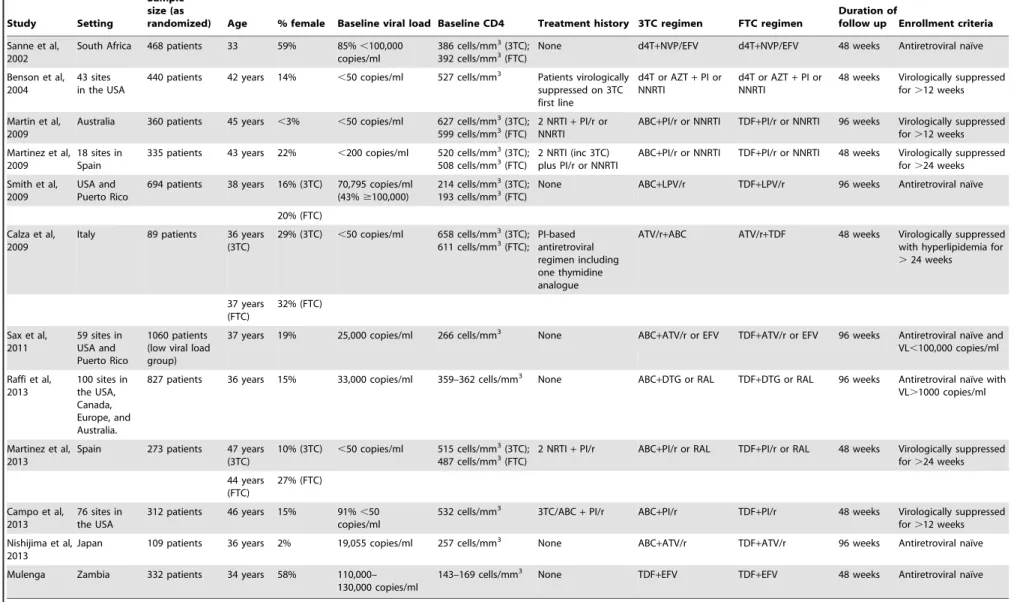
Twelve trials were included in the final review[9,22–31]. In total, 15 different randomized comparisons providing data on 2251 patients receiving lamivudine and 2662 patients receiving emtricitabine. Studies were published between 2002 and 2013. Five studies were done in treatment-naı¨ve patients. Three trials[22,23,32] had the same backbone regimens; the rest compared tenofovir and abacavir. Two trials included some patients with high viral loads at baseline (ie$100,000 copies/ml); only the results for those patients in the low viral load strata (,100,000 copies/ml) were included in the meta-analysis [9,27]. Study characteristics are summarized in Table 1.
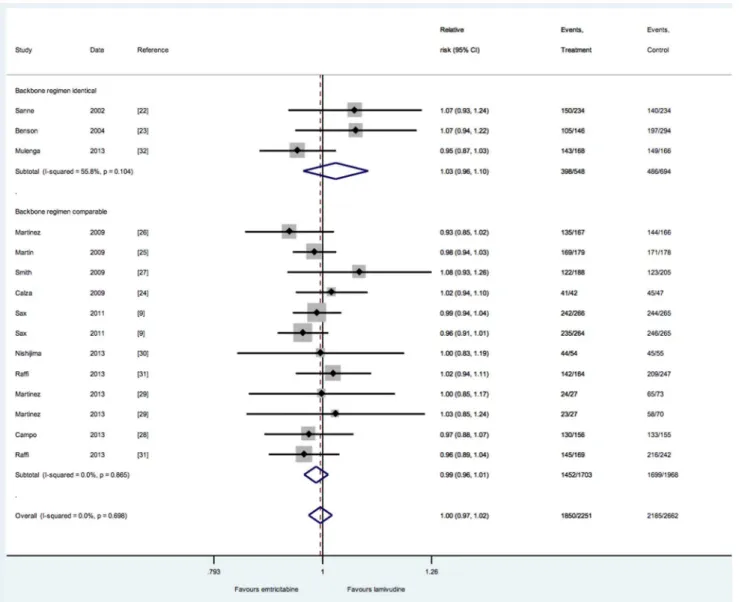
Treatment success was not significantly different in any of the 12 trials. In the three trials that directly compared lamivudine and emtricitabine [22,23,32], the relative risk for achieving treatment success was non-significant for both trials (RR 1.03, 95%CI 0.96– 1.10; P= 0.3). Overall, the pooled relative risk for treatment success was non-significant (relative risk, 1.00, 95% CI 0.97–10.2) (Figure 2). No heterogeneity was observed (I2= 0). This result was not different in any of the pre-defined subgroups (test for heterogeneity for all subgroups: p.0.1), or if random-effects methods were used to pool the data (RR 0.99, 95%CI 0.96–1.01). Similarly, all but one study[28] found no difference in the risk of treatment failure, and the pooled relative risk was not statistically significant (RR 1.08, 95%CI 0.94–1.22). Heterogeneity was low (I2= 3.4%), and no subgroup differences were apparent (P.0.1 for all subgroups).
Four trials provided data on the emergence of MI84V resistance mutations among virologically failing patients (n = 234) [9,22,23,29]. Two of these trials genotyped all patients experienc-ing virological failure, and found no difference by regimen[9,23]. The other two trials reporting resistance data did so only on a subset of virologically failing patients, and these studies reported an increased risk of MI84V resistance mutation development among patients receiving lamivudine. The overall pooled estimate, using a random-effects model, was not significant (RR 1.4l, 95%CI 0.6–3.3) but this result should be interpreted with caution due to high heterogeneity (I2= 80%) and the selective reporting of this outcome in some of the trials.
Finally, two of the three trials with identical backbone regimens provided data on adverse events [22,23]. In trial FTC302, no difference in the incidence of any grade 3 or 4 adverse event was reported. In trial FTC-303/350, 4% of patients discontinued treatment due to adverse events in the FTC arm and there were no discontinuations in the 3TC arm.
The GRADE assessment rated the quality of the evidence overall to be moderate (Table S1). Risk of bias was judged to be low (Table S2) and there was no evidence of publication bias (p = 0.3 using Egger’s test for funnel plot asymmetry). Results of all studies were consistent for the critical outcomes of virological suppression and failure. Concern was noted with respect to possible indirectness resulting from the inclusion of trials with non-identical backbone regimens[33] but the direction of this bias would be expected to favour emtricitabine[34].
Discussion
This systematic review of published and unpublished data from randomized trials found no significant differences in the efficacy of lamivudine and emtricitabine, consistent with very similar chemical structure of these two nucleoside analogues. Three of the 12 included trials in this review were identical in terms of background regimens, and the rest included regimens that are considered to be of equivalent efficacy. In the past, presumption of superior efficacy of emtricitabine has partly been based on the
results of randomized trials that used different backbone regimens resulting in higher terminations in the lamivudine group due to adverse events associated with partner antiretrovirals [35,36]. Such comparisons were excluded from this review.
Concern has also been expressed about the potential greater risk of development of MI184V resistance mutations among virolog-ically failing patients. This review was unable to provide conclusive evidence in this regard. However, differences appear to be small, and the clinical importance of the M184V mutations is unclear; this mutation appears to be associated with reduction of viral fitness[37] and increased susceptibility to zidovudine, which is recommended as part of the preferred second-line regimen for patients in whom virological failure is confirmed[38].
The largest randomized trial included in this review, A5202, found no difference in efficacy comparing tenofovir and emtricitabine vs abacavir and lamividine in patients with low baseline HIV RNA (,100,000 copies/ml) but superior outcomes favouring tenofovir+emtricitabine at higher viral load for patients whose baseline viral load was above this level [9]. Possible reasons
for this difference may include marginally superior antiviral activity of emtricitabine that becomes apparent when adherence is poor; minority species of some mutations leading to increased resistance to abacavir and enhanced susceptibility to tenofovir; and pharmacokinetic differences due to longer intracellular half lives of both tenofovirand emtricitabine compared to abacavir and lamividine. Further research is needed to understand the relative contribution of the different drugs to these findings. Another recent study compared dolutegravir combined with abacavir and lamividune against tenofovir combined with emtricitabine and efavirence and found superior efficacy and safety favouring the dolutegravir-containing regimen [39]. We did not include these results in our review as it was considered that backbone regimens were too different to determine the specific contribution of emtricitabine or lamivudine to these results.
Strengths of this review include a broad search strategy that allowed for the identification of published and unpublished trials, the restriction of inclusion to randomized trials, and the inclusion of comparable background regimens. The inclusion of outcome
Figure 1. Study flow chart.
doi:10.1371/journal.pone.0079981.g001
Comparative Efficacy of 3TC and FTC
Table 1.Study Characteristics.
Study Setting
Sample size (as
randomized) Age % female Baseline viral load Baseline CD4 Treatment history 3TC regimen FTC regimen
Duration of
follow up Enrollment criteria
Sanne et al, 2002
South Africa 468 patients 33 59% 85%,100,000 copies/ml
386 cells/mm3(3TC); 392 cells/mm3(FTC)
None d4T+NVP/EFV d4T+NVP/EFV 48 weeks Antiretroviral naı¨ve
Benson et al, 2004
43 sites in the USA
440 patients 42 years 14% ,50 copies/ml 527 cells/mm3 Patients virologically suppressed on 3TC first line
d4T or AZT+PI or NNRTI
d4T or AZT+PI or NNRTI
48 weeks Virologically suppressed for.12 weeks
Martin et al, 2009
Australia 360 patients 45 years ,3% ,50 copies/ml 627 cells/mm3(3TC);
599 cells/mm3(FTC) 2 NRTINNRTI+PI/r or ABC+PI/r or NNRTI TDF+PI/r or NNRTI 96 weeks Virologically suppressedfor
.12 weeks Martinez et al,
2009
18 sites in Spain
335 patients 43 years 22% ,200 copies/ml 520 cells/mm3(3TC); 508 cells/mm3(FTC)
2 NRTI (inc 3TC) plus PI/r or NNRTI
ABC+PI/r or NNRTI TDF+PI/r or NNRTI 48 weeks Virologically suppressed for.24 weeks
Smith et al, 2009
USA and Puerto Rico
694 patients 38 years 16% (3TC) 70,795 copies/ml (43%$100,000)
214 cells/mm3(3TC);
193 cells/mm3(FTC) None ABC+LPV/r TDF+LPV/r 96 weeks Antiretroviral naı¨ve
20% (FTC)
Calza et al, 2009
Italy 89 patients 36 years (3TC)
29% (3TC) ,50 copies/ml 658 cells/mm3(3TC);
611 cells/mm3(FTC); PI-basedantiretroviral regimen including one thymidine analogue
ATV/r+ABC ATV/r+TDF 48 weeks Virologically suppressed with hyperlipidemia for
.24 weeks
37 years (FTC)
32% (FTC)
Sax et al, 2011
59 sites in USA and Puerto Rico
1060 patients (low viral load group)
37 years 19% 25,000 copies/ml 266 cells/mm3 None ABC+ATV/r or EFV TDF+ATV/r or EFV 96 weeks Antiretroviral naı¨ve and VL,100,000 copies/ml
Raffi et al, 2013
100 sites in the USA, Canada, Europe, and Australia.
827 patients 36 years 15% 33,000 copies/ml 359–362 cells/mm3 None ABC
+DTG or RAL TDF+DTG or RAL 96 weeks Antiretroviral naı¨ve with VL.1000 copies/ml
Martinez et al, 2013
Spain 273 patients 47 years (3TC)
10% (3TC) ,50 copies/ml 515 cells/mm3(3TC); 487 cells/mm3(FTC)
2 NRTI+PI/r ABC+PI/r or RAL TDF+PI/r or RAL 48 weeks Virologically suppressed for.24 weeks
44 years (FTC)
27% (FTC)
Campo et al, 2013
76 sites in the USA
312 patients 46 years 15% 91%,50 copies/ml
532 cells/mm3 3TC/ABC
+PI/r ABC+PI/r TDF+PI/r 48 weeks Virologically suppressed for.12 weeks
Nishijima et al, 2013
Japan 109 patients 36 years 2% 19,055 copies/ml 257 cells/mm3 None ABC
+ATV/r TDF+ATV/r 96 weeks Antiretroviral naı¨ve
Mulenga Zambia 332 patients 34 years 58% 110,000– 130,000 copies/ml
143–169 cells/mm3 None TDF+EFV TDF+EFV 48 weeks Antiretroviral naı¨ve
3TC, lamivudine; ATV/r, ritonavir-boosted atazanavir; AZT, zidovudine; ABC, abacavir; d4T, stavudine; DTG, dolutegravir; EFV, efavirenz; FTC, emtricitabine; LPV/r, ritonavir-boosted lopinavir; NRTI, nucleoside reverse transcriptase inhibitor; NNRTI, non-nucleoside reverse transcriptase inhibitor; PI/r, ritonavir-boosted protease inhibitor; RAL, raltegravir; TDF, tenofovir disoproxil fumarate.
data from over 4500 randomizations allowed for a precise estimate of effect giving confidence in the overall result, and heterogeneity was neither detected nor apparent. The main limitation was the inclusion of studies that used background regimens that are not identical. Some studies have suggested superior efficacy of tenofovir compared to abacavir [40], although differences are not apparent in patients starting treatment with a low viral load [9]. The aim of this review was not to compare these regimens, but rather to identify studies in which the comparative efficacy of lamivudine and emtricitabine could be assessed because the efficacy of partner drugs were identical or could be considered comparable, and as such we excluded any studies in which patients started therapy with a high viral load (ie $100,000 copies/ml). Given the differences in safety profiles of the various background regimens, we did not report discontinuations due to adverse events as a primary outcome, but note that the frequency of adverse events was similar in the three trials in which backbone regimens were identical. We also specifically assessed differences in those studies that used identical partner drugs and explored differences formally in subgroup analysis, which found no apparent difference. Bias that may be introduced as a result of including these trials
would be expected to favour emtricitabine (the drug partnered with tenofovir) and the fact that no differences are seen is therefore reassuring. Publication bias can never be ruled out, as evidenced by the non-publication of one of the few trials to directly compare lamivudine and emtricitabine (this study was terminated early by the South African Medicines Control Council and placed on clinical hold by the US FDA). We found no statistical evidence of publication bias, but such tests are poorly powered, particularly when the number of publications is small. Finally, a major limitation in the current literature is the lack of information regarding the risk of risk of 184V selection, and future research is encouraged to continue to seek new evidence to further clarify this issue.
In light of these limitations, the results of this review should not be understood as definitive evidence of equivalence. Nevertheless, the overall findings provide supportive evidence for the recom-mendations of current international and national treatment guidelines to treat emtricitabine and lamivudine as interchange-able and reassurance to countries that, for reasons of affordability or availability [41] have opted for lamivudine as part of first line antiretroviral therapy.
Figure 2. Virological suppression comparing 3TC and FTC-including regimens.
doi:10.1371/journal.pone.0079981.g002
Comparative Efficacy of 3TC and FTC
Supporting Information
Table S1 GRADE evidence profile.
(DOC)
Table S2 Risk of bias.
(DOC)
Checklist S1 PRISMA Checklist.
(DOC)
Author Contributions
Wrote the paper: NF. Designed the review: NF. Undertook searches, extracted data and conducted authors for additional data: NF ZS AG. Performed the statistical analyses: NF. Contributed critical input: NF ZS AH MV MD EJM AG. Supported the interpretation of results, provided comments on subsequent drafts and approved the final version: NF ZS AH MV MD EJM AG.
References
1. Paff MT, Averett DR, Prus KL, Miller WH, Nelson DJ (1994) Intracellular metabolism of (-)- and (+ )-cis-5-fluoro-1-[2-(hydroxymethyl)-1,3-oxathiolan-5-yl]cytosine in hepg2 derivative 2.2.15 (subclone p5a) cells. Antimicrob Agents Chemother 38:1230–1238.
2. Chang CN, Doong SL, Zhou JH, Beach JW, Jeong LS, et al. (1992) Deoxycytidine deaminase-resistant stereoisomer is the active form of (+ /-)-29,39-dideoxy-39-thiacytidine in the inhibition of hepatitis b virus replication. J Biol Chem 267:13938–13942.
3. Anon (2013) Panel on antiretroviral guidelines for adults and adolescents. Guidelines for the use of antiretroviral agents in HIV-1-infected adults and adolescents. Department of Health and Human Services, USA, 2013. Available: http://aidsinfo.Nih.Gov/contentfiles/adultandadolescentgl.Pdf. Accesssed 10 October 2013.
4. Anon (2012) Technical Update on Treatment Optimization: Pharmacological equivalence and clinical interchangeability of lamivudine and emtricitabine: A review of current literature. WHO, Geneva.
5. Scaglione F, Berrino L (2012) Cytosine deoxyribonucleoside anti-hiv analogues: A small chemical substitution allows relevant activities. Int J Antimicrob Agents 39:458–463.
6. Schinazi RF (2003) Assessment of the relative potency of emtricitabine and lamivudine. J Acquir Immune Defic Syndr 34:243–5.
7. Walensky RP, Paltiel AD, Schackman BR (2013) Cost-effectiveness of generic antiretroviral therapy. Ann Intern Med 158:776–777.
8. Moher D, Liberati A, Tetzlaff J, Altman DG (2009) Preferred reporting items for systematic reviews and meta-analyses: The prisma statement. PLoS Med 6(7):e1000097.
9. Sax PE, Tierney C, Collier AC, Daar ES, Mollan K, et al. (2011) Abacavir/ lamivudine versus tenofovir df/emtricitabine as part of combination regimens for initial treatment of HIV: Final results. J Infect Dis 204:1191–1201. 10. Higgins JP, Altman DG, Gotzsche PC, Juni P, Moher D, et al. (2011) The
cochrane collaboration’s tool for assessing risk of bias in randomised trials. BMJ 343: d5928.
11. Sterne JA, Sutton AJ, Ioannidis JP, Terrin N, Jones DR, et al. (2011) Recommendations for examining and interpreting funnel plot asymmetry in meta-analyses of randomised controlled trials. BMJ 343: d4002.
12. Fleiss JL (1993) The statistical basis of meta-analysis. Stat Methods Med Res 2:121–145.
13. Higgins JP, Thompson SG (2002) Quantifying heterogeneity in a meta-analysis. Stat Med 21:1539–1558.
14. Fisher M, Moyle GJ, Shahmanesh M, Orkin C, Kingston M, et al. (2009) A randomized comparative trial of continued zidovudine/lamivudine or replace-ment with tenofovir disoproxil fumarate/emtricitabine in efavirenz-treated hiv-1-infected individuals. J Acquir Immune Defic Syndr 51:562–568.
15. Gallant JE, DeJesus E, Arribas JR, Pozniak AL, Gazzard B, et al. (2006) Tenofovir df, emtricitabine, and efavirenz vs. Zidovudine, lamivudine, and efavirenz for HIV. N Engl J Med 354:251–260.
16. Campbell TB, Smeaton LM, Kumarasamy N, Flanigan T, Klingman KL, et al. (2012) Efficacy and safety of three antiretroviral regimens for initial treatment of HIV-1: A randomized clinical trial in diverse multinational settings. PLoS Med 9:e1001290.
17. Robertson K, Jiang H, Kumwenda J, Supparatpinyo K, Evans S, et al. (2012) Improved neuropsychological and neurological functioning across three antiretroviral regimens in diverse resource-limited settings: AIDS Clinical Trials Group Study S5199, the International Neurological Study. Clin Infect Dis 55:868–876.
18. DeJesus E, Ruane P, McDonald C, Garcia F, Sharma S, et al. (2008) Impact of switching virologically suppressed, HIV-1-infected patients from twice-daily fixed-dose zidovudine/lamivudine to once-daily fixed-dose tenofovir disoproxil fumarate/emtricitabine. HIV Clin Trials 9:103–114.
19. Post FA, Moyle GJ, Stellbrink HJ, Domingo P, Podzamczer D, et al. (2010) Randomized comparison of renal effects, efficacy, and safety with once-daily abacavir/lamivudine versus tenofovir/emtricitabine, administered with efavir-enz, in antiretroviral-naive, HIV-1-infected adults: 48-week results from the assert study. J Acquir Immune Defic Syndr 55:49–57.
20. Palacios R, Hidalgo C, Rios MJ, Rivero A, Munoz L, et al. (2009) Effectiveness and safety of simplification from lamivudine (TDF-3TC) to tenofovir-emtricitabine (TDF-FTC) co-formulation (Truvada) in virologically suppressed HIV-infected patients on HAART. Eur J Clin Microbiol Infect Dis 28:399–402.
21. Tan DH, Chan K, Raboud J, Cooper C, Montaner JS, et al. (2011) Comparison of abacavir/lamivudine and tenofovir/emtricitabine among treatment-naive HIV-infected patients initiating therapy. J Acquir Immune Defic Syndr 58:38– 46.
22. Sanne I, van der Horst C, Shaw A, Hinkle J, Quinn J, et al.(2002) Two randomized, controlled, equivalence trials of emtricitabine (FTC) to lamivudine (3TC). XIV International AIDS Conference, Barcelona, July 7–12. Abstract 4432.
23. Benson CA, van der Horst C, Lamarca A, Haas DW, McDonald CK, et al. (2004) A randomized study of emtricitabine and lamivudine in stably suppressed patients with HIV. AIDS 18:2269–2276.
24. Calza L, Manfredi R, Colangeli V, Pocaterra D, Rosseti N, et al. (2009) Efficacy and safety of atazanavir-ritonavir plus abacavir-lamivudine or tenofovir-emtricitabine in patients with hyperlipidaemia switched from a stable protease inhibitor-based regimen including one thymidine analogue. AIDS Patient Care STDS 23:691–697.
25. Martin A, Bloch M, Amin J, Baker D, Cooper DA, et al. (2009) Simplification of antiretroviral therapy with tenofovir-emtricitabine or abacavir-lamivudine: A randomized, 96-week trial. Clin Infect Dis 49:1591–1601.
26. Martinez E, Arranz JA, Podzamczer D, Lonca M, Sanz J, et al. (2009) A simplification trial switching from nucleoside reverse transcriptase inhibitors to once-daily fixed-dose abacavir/lamivudine or tenofovir/emtricitabine in HIV-1-infected patients with virological suppression. J Acquir Immune Defic Syndr 51:290–297.
27. Smith KY, Patel P, Fine D, Bellos N, Sloan L, et al. (2009) Randomized, double-blind, placebo-matched, multicenter trial of abacavir/lamivudine or tenofovir/ emtricitabine with lopinavir/ritonavir for initial HIVtreatment. AIDS 23:1547– 1556.
28. Campo R, Dejesus E, Bredeek UF, Henry K, Khanlou H, et al. (2013) Swift: Prospective 48-week study to evaluate efficacy and safety of switching to emtricitabine/tenofovir from lamivudine/abacavir in virologically suppressed HIV-1 infected patients on a boosted protease inhibitor containing antiretroviral regimen. Clin Infect Dis 56:1637–1645.
29. Martinez E, d’Albuquerque PM, Perez I, Pich J, Gatell JM (2013) Abacavir/ lamivudine versus tenofovir/emtricitabine in virologically suppressed patients switching from ritonavir-boosted protease inhibitors to raltegravir. AIDS Res Hum Retroviruses 29:235–241.
30. Nishijima T, Takano M, Ishisaka M, Komatsu H, Gatanaga H, et al. (2013) Abacavir/lamivudine versus tenofovir/emtricitabine with atazanavir/ritonavir for treatment-naive Japanese patients with HIV-1 infection: A randomized multicenter trial. Intern Med 52:735–744.
31. Raffi F, Rachlis A, Stellbrink HJ, Hardy WD, Torti C, et al. (2013): Once-daily dolutegravir versus raltegravir in antiretroviral-naive adults with HIV-1 infection: 48 week results from the randomised, double-blind, non-inferiority Spring-2 study. Lancet 381: 735–743.
32. Mulenga L, Muwango A, Moyo C, Mweemba A, Musonda P, Mulenga P, et al. (2013) Efficacy of tenofovir disoproxil fumarate/emtricitabine and tenofovir disoproxil both in combination with efavirenz in antiretroviral-naı¨ve, HIV-1-infected Zambians. 7th IAS Conference on HIV Pathogenesis, Treatment and Prevention. 30 june – 3 july, Kuala Lumpur, Malaysia. Abstract TULBPE18. 33. Guyatt GH, Oxman AD, Kunz R, Woodcock J, Brozek J, et al. (2011) GRADE
guidelines: 8. Rating the quality of evidence – indirectness. J Clin Epidemiol 64:1303–1310.
34. Guyatt GH, Oxman AD, Sultan S, Glasziou P, Akl EA, et al. (2011) GRADE guidelines: 9. Rating up the quality of evidence. J Clin Epidemiol 64:1311–1316. 35. Saag MS, Cahn P, Raffi F, Wolff M, Pearce D, et al. (2004): Efficacy and safety of emtricitabine vs stavudine in combination therapy in antiretroviral-naive patients: A randomized trial. JAMA 292:180–189.
36. Pozniak AL, Gallant JE, DeJesus E, Arribas JR, Gazzard B, et al. (2006) Tenofovir disoproxil fumarate, emtricitabine, and efavirenz versus fixed-dose zidovudine/lamivudine and efavirenz in antiretroviral-naive patients: Virologic, immunologic, and morphologic changes – a 96-week analysis. J Acquir Immune Defic Syndr 43: 535–540.
37. Wainberg MA (2004) The impact of the M184V substitution on drug resistance and viral fitness. Expert Rev Anti Infect Ther 2:147–151.
38. Anon (2013) Consolidared guidelines on the use of antiretroviral drugs for treating and preventing HIV infection. WHO, Geneva.
39. Walmsley S, Antela A, Clumeck N, Duiculescu D, Eberhard A, et al. (2012)
Dolutegravir (DTG; S/GSK1349572) + Abacavir/Lamivudine Once Daily
Statistically Superior to Tenofovir/Emtricitabine/Efavirenz: 48-Week Results – SINGLE (ING114467). Abstract H-556b. 52nd Interscience Conference on Antimicrobial Agents and Chemotherapy. San Francisco.
40. Hill A, Sawyer W (2009) Effects of nucleoside reverse transcriptase inhibitor backbone on the efficacy of first-line boosted highly active antiretroviral therapy
based on protease inhibitors: Meta-regression analysis of 12 clinical trials in 5168 patients. HIV Med 10:527–535.
41. Anon (2013) Untangling the web of antiretroviral price reductions. 16th
edition. MSF, Geneva.
Comparative Efficacy of 3TC and FTC