1
Walking economy and aerobic power in Parkinson’s
disease after endurance exercise training: A pilot study
Júlia Maria D´Andrea GreveI; Paulo Roberto Santos-SilvaI; Danielli S SpecialiI,II
DOI: 10.5935/MedicalExpress.2017.06.05
RAPID COMMUNICATION
I Laboratório de Estudos do Movimento, Instituto de Ortopedia e Traumatologia, Hospital das Clínicas HCFMUSP, Faculdade de Medicina, Universidade de São
Paulo, São Paulo, SP, BR
II Hospital Israelita Albert Einstein, Laboratório de Estudos do Movimento Einstein (LEME), São Paulo, Brazil
OBJECTIVE: To verify the efect of an endurance exercise program in middle stages of Parkinson’s disease.
METHODS: The patients were two women and seven men with Parkinson’s disease, aged 56 to 74 years, classiied at Hoehn and Yahr stages 2 to 2.5. The study was designed as an open long-term pilot trial over three months of supervised treadmill exercise training. Cardiopulmonary exercise test evaluations were performed before the start of the study (test 1) and after three months (test 2). The main outcome measure was walking economy (i.e., the rate of oxygen consumption during gait) measured between VT1 and VT2 speeds and Oxygen consumption (VO2).
RESULTS: No changes (p=0.551) were observed for maximal oxygen uptake (VO2max, 24.6 vs 23.6 mL.kg-1.min-1)
between tests. The walking economy was 20% better (p<0.001) after three months of aerobic endurance training (266.7 vs 212.6 mL.kg-1.km-1, pre- vs. post-training); the Cohen’s “d” efect size (ES) was 0.99, a very large efect.
CONCLUSION: Evidence from this pilot study in individuals with Parkinson’s disease suggests that gains in walking economy occurs with a treadmill-training program without gain in aerobic power, but which may positively reduce the energy expenditure of activities of daily living in these patients.
KEYWORDS: physical functioning, ventilatory threshold, maximal oxygen uptake.
Greve JMA; Santos-Silva PR; Speciali DS. Walking economy and aerobic power in Parkinson’s disease after endurance exercise training: A pilot study. MedicalExpress (São Paulo, online). 2017 Dec;4(6):M170605.
Received for Publication on September 22, 2017; First review on November 5, 2017; Accepted for publication on November 20, 2017; Online on December 22, 2017
E-mail: [email protected]
■
INTRODUCTIONParkinson’s disease (PD) is a progressive, neuro-degenerative movement disorder that is often accom-panied by impaired balance and walking, as well as a reduced quality of life (QoL). Walking economy (WE),
defined as the steady-state aerobic demand for a given
submaximal speed of walking,1 is abnormal in some
vas-cular, neurological and orthopedic disorders.2 Increased
energy expenditure during walking (i.e, poor economy) has been linked to such conditions as peripheral arterial disease,3 stroke,4 spinal cord injury,5 amputation,6 and
cerebral palsy.7 In men with Parkinson’s disease (PD),
there was a trend for energy to be increased relative to healthy age and sex-matched controls.8 In PD, although
Copyright © 2016 MEDICALEXPRESS. This is an open access article distributed under the terms of the creative commons attribution Non-Commercial License (creativecommons.org/licenses/by-nc/4.0/) which permits unrestricted non commercial use, distribution and reproduction in any medium, provided the original work is properly cited.
neuromuscular, metabolic and cardiopulmonary limita-tions with low aerobic power can compromise functional capacity, little is known about the WE in this population.
The finding that energy expenditure was increased during
the displacement of the body led us to the hypothesis that WE may also be impaired for patients with PD. If true, interventions targeted to improve economy would be indicated to limit patient fatigue during daily activity. However, few studies have paid attention to this particu-lar aspect, namely whether the energy cost of walking is
increased in patients with PD. The findings observed in
the literature suggest that the physiologic stress of daily physical activities is increased in patients with early to mid-stage PD, and this may contribute to the elevated level of fatigue that is characteristic of PD.9 Therefore, the aim
2
MedicalExpress (Sao Paulo, online) 2017 December;4(6):M170605
Walking economy in Parkinson’s disease Greve JMD
thresholds 1 and 2 (VT1 and VT2) were determined. Based on these walking speeds, VO2 at VT1 and VT2 were averaged between these two intensities. For the determination of WE, VO2 and walking speeds were expressed as a function of ventilatory thresholds 1 and 2 (VT1 and VT2).
Training sessions
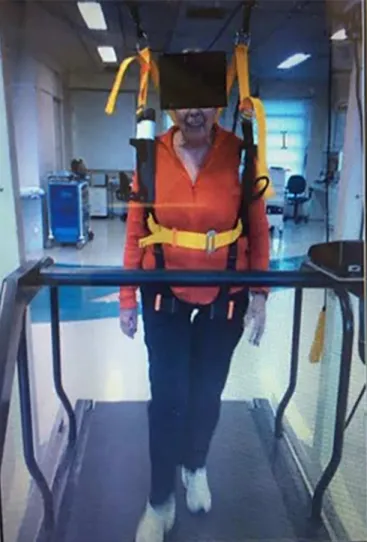
Figure 1 displays the non-weight-bearing harness used in this project: it is projected to eliminate the risk of falls. PD patients received a 12-week aerobic training program. Each session lasted 50 minutes, with a frequency of twice a week. All patients underwent treadmill training. The initial speed was 0.5 km.h-1,which corresponds to
ventilatory threshold 1; workload was by increased by 0.5 km.h-1 as tolerated. Vital signs were measured before,
du-ring, and after the assigned exercise. The PD patients had an attendance rate of 100% at the end of the program. All sessions were performed at the Laboratory of Movement Studies under direct supervision of exercise physiotherapist with study physicians available.
■
METHODSStudy design and participants
This was a longitudinal study. In the present pilot
study, seven patients (2 women and 7 men; mean age ± SD, 66.3 ± 6.4 years [range: 56-74yrs]) with PD participated in
our study. Volunteers underwent screening through a neuro-logical examination, blood testing, and a submaximal graded cardiopulmonary exercise stress test. Diagnosis of PD was
verified by a neurologist using the UK Brain Bank criteria.10
Volunteers in stages 1.5 to 3 using the modified Hoehn and
Yahr scale11 were enrolled. Patients were excluded if they had
uncontrolled hypertension, or limited exercise capacity based on musculoskeletal, neuromuscular (other than PD), or car-diovascular disorders. This protocol was approved (under the number cappesq 11623/15) by the institutional review board
at the University of São Paulo, School of Medicine, Hospital das
Clinicas. Informed consent was obtained from each participant.
Procedures
Cardiopulmonary exercise testing, to assess car-diovascular capacity and indirect calorimetry to assess metabolic responses, were carried out at the Laboratory
of Movement Studies of the HC-FMUSP Institute of Ortho -pedics and Traumatology utilizing a metabolic cart (CPX/
Ultima, MedGraphic™, St. Paul, MN, USA). The Heart rate was
monitored continuously using a 12-lead electrocardiogram
(HeartWare™, Belo Horizonte, MG, Brasil). The usual ECG
parameters (heart rate, PR interval, QRS duration, QT and QTc intervals, and P, QRS and T axes) were analyzed in rest, during exercise, and cooldown period.
The stress test was conducted on a medical-grade
treadmill (h/p/cosmos™, pulsar, Nussdorf-Traunstein, Germany) with variable speed (km.h-1) and slope (%). A
modified version of the Heck stress test protocol was used with fixed speed and increasing slope increments at the rate of
2% per minute.12 The speed was selected from those available
(2.4, 3.6, 4.8, 6.0, and 6.5 km.h-1) based on the limit of individual
conditions after two pilot tests with different speeds.13 Once a
speed had been selected, individuals remained for a one-minute period at rest and shortly thereafter began the protocol at the previously chosen and tested speed. Perceived exertion was evaluated by the patient at each stage of the exercise test on a 15-point linear scale (6-20) as described by Borg.14 The test was
discontinued at the request of the participant or when signs of tiredness were perceived. During the 3-minute recovery phase, beginning immediately after the end of the test proper, speed was decreased and maintained for one minute at every step of decrement. The entire test lasted on average for 10 minutes.
Walking economy determination
Walking economy (WE) was determined by measuring rate of oxygen consumption (VO2) by indirect calorimetry.
3
MedicalExpress (Sao Paulo, online) 2017 December;4(6):M170605 Walking economy in Parkinson’s disease
Greve JMD
Statistics
The Gaussian distribution (normality) for the data was verified by the Kolmogorov–Smirnov goodness-of-fit
test (Z value < 1.0). Descriptive statistics are expressed as
mean ± standard deviation (SD). A paired Student t-test was
used for pre- and post-training comparison. Cohen’s “d” effect size (ES) descriptors (trivial 0.0–0.1, small 0.1–0.3,
moderate 0.3–0.5, large 0.5–0.7, very large 0.7–0.9, nearly perfect 0.9–1, and perfect > 1) were used to compare the
variables after intervention.15 The level of significance was
established as p<0.05 for all the statistical analyzes. Analy-ses were performed using Sigma Stat (version 3.5, Systat Software, Inc, Point Richmond, CA).
■
RESULTSThe main outcome measure was WE (rate of oxygen consumption during gait at the speed in mL.kg-1.Km-1)
measured at treadmill. Nine subjects (7 men and 2 woman)
completed this pilot study. The subjects had a range of disease severity from mild to moderately severe PD. The level of medical comorbidity in the sample was low, and only one was a current user of beta-blocker therapy to attenuate other forms of tremor (atenolol, 50mg/day).
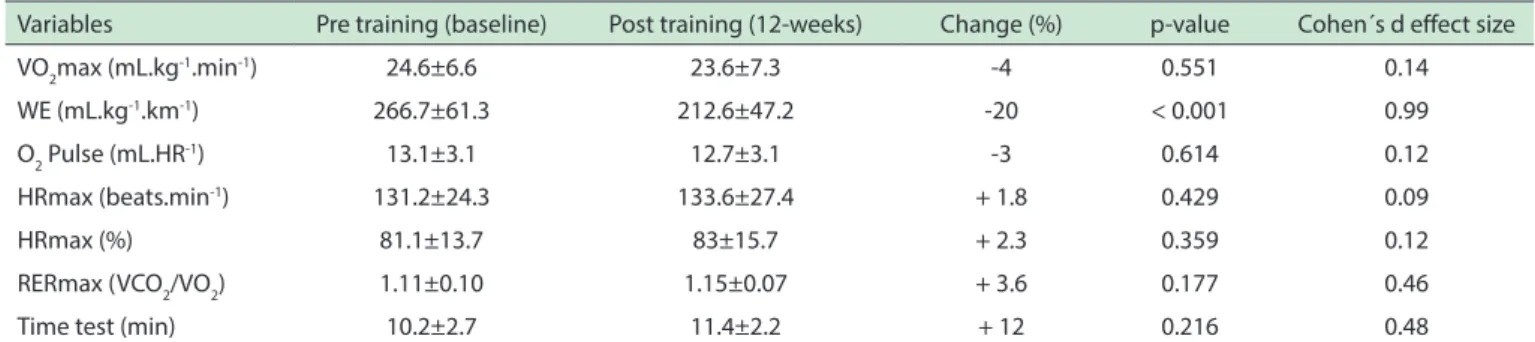
Table 1 displays the walking economy, which was 20% better (p <0.001) after three months of aerobic en-durance training, with a very large Cohen’s “d” effect size ES=0.99. No changes were observed for maximal oxygen uptake, oxygen pulse, age-predicted maximal heart rate, percentage of age-predicted maximal heart rate, respiratory exchange ratio, and time test. Effect Size ES for all other me-asured parameters were small to moderate after training.
■
DISCUSSIONThis small pilot study showed that aerobic exercise provides an important contribution to Parkinson’s disease patients. Improving oxygen delivery by reducing energy expenditure in this population is a giant step towards improving quality of life. Studies have shown that aerobic exercise increases factors that potentially have a protective
effect on the brain, which can slow the progression of the disease.16 Aerobic exercise liberates trophic factors - small
proteins in the brain that behave as fertilizers. Exercise helps maintain brain connections and counters brain shrinkage from PD as well as from aging. The current study shows that a training program conducted on a
low-volume, low-intensity treadmill protocol induces significant
improvement in the WE of PD patients. In the present study, the results showed a 20% lower energy expenditure after the training period. The patients were more economical when moving on the treadmill. Therefore, the improvement in submaximal aerobic capacity suggests that PD patients
may benefit from exercise just as much as a normal
population. In addition, the treadmill allows a more rigorous control of the metabolic and cardiorespiratory demand.
These findings are of clinical importance when prescribing
exercise in PD patients, in order to reduce the fatigue of these patients. However, the VO2max and all other parameters related to cardiovascular performance as O2 pulse, HRmax,
and percentage of HRmax did not change significantly after
12 weeks of aerobic training. It is probable that bradykinesia of the respiratory movement associated with degeneration of the cardiac sympathetic nerve that begins in the early phases of PD was a limiting factor to increase the cardiac output in these patients and consequently culminating with a low level of aerobic power.17
Previous studies have observed that cardiac
uptake of metaiodobenzylguanidine (MIBG) is frequently
decreased even in the early stages of PD (Hoehn-Yahr stage 1 or 2), which suggests an early involvement of the cardiac sympathetic nerve in these patients.18 Although the maximal
respiratory exchange rate (RERmax) of the Parkinson’s diseased patients amounted to a large ventilatory effort (RER = 1.15) at the exercise peak, it was not enough to improve aerobic power or exercise tolerance at maximal effort performed in treadmill exercise test.
In conclusion, we suggest that in PD the gain in WE may occur with a treadmill-training program, which may actually reduce the energy expenditure of activities of daily living. Low exercise intensity has the merit for improving WE motor manifestations of PD without increased in ae-robic power.
Table 1. Outcomes of 9 participants with Parkinson’s Disease following aerobic exercise (mean ± SD).
Variables Pre training (baseline) Post training (12-weeks) Change (%) p-value Cohen´s d efect size
VO2max (mL.kg-1.min-1) 24.6±6.6 23.6±7.3 -4 0.551 0.14
WE (mL.kg-1.km-1) 266.7±61.3 212.6±47.2 -20 < 0.001 0.99
O2 Pulse (mL.HR-1) 13.1±3.1 12.7±3.1 -3 0.614 0.12
HRmax (beats.min-1) 131.2±24.3 133.6±27.4 + 1.8 0.429 0.09
HRmax (%) 81.1±13.7 83±15.7 + 2.3 0.359 0.12
RERmax (VCO2/VO2) 1.11±0.10 1.15±0.07 + 3.6 0.177 0.46
Time test (min) 10.2±2.7 11.4±2.2 + 12 0.216 0.48
4
MedicalExpress (Sao Paulo, online) 2017 December;4(6):M170605
Walking economy in Parkinson’s disease Greve JMD
■
CONFLICT OF INTERESTAuthors report no conflict of interest regarding this
paper
■
AUTHOR PARTICIPATIONJMDAG, PRSS and DSS: Lead author, wrote the
manuscript, analyzed the data; Corrected the manuscript; Corrected the manuscript, analyzed the data, supervisor.
ECONOMIA DE CAMINHADA E POTÊNCIA AE-RÓBIA NA DOENÇA DE PARKINSON APÓS PRO-GRAMA DE TREINAMENTO DE ENDURANCE: UM ESTUDO PILOTO
OBJETIVO: Verificar o efeito de um programa de
treinamento físico aeróbio em estágios intermediários da
doença de Parkinson (PD).
MÉTODOS: Os pacientes eram duas mulheres e sete
homens com PD, com idade entre 56 e 74 anos, classificados como estágios Hoehn e Yahr 2 a 2,5. O estudo foi concebi -do como um ensaio piloto aberto de longo prazo durante três meses de treinamento supervisionado e realizado em esteira ergométrica. As avaliações da troca gasosa pelo
teste de exercício cardiopulmonar foram realizadas antes do início do estudo (teste 1) e após três meses (teste 2). A determinação da economia de caminhada (taxa de con -sumo de oxigênio durante a marcha) foi medida entre as velocidades do primeiro e do segundo limiar (LV1 e LV2) e do consumo de oxigênio (VO2) entre as duas velocidades
por interpolação.
RESULTADOS: Não foram observadas alterações (P
= 0,153) para o consumo máximo de oxigênio (VO2max:
26,7 vs. 24,2 mL.kg-1.min-1) após o período de intervenção.
A economia de caminhada foi 23% maior (P <0,001) após três meses de treinamento físico aeróbio (273,4 vs. 209,4
mL.kg-1.km-1, ES = 0.99, muito alto).
CONCLUSÃO: Evidências deste estudo piloto em
indivíduos com DP sugerem que os ganhos na economia
de caminhada podem ocorrer com um programa de
treina-mento de “endurance” aeróbica na esteira sem ganho na po
-tência aeróbia, mas que positivamente pode reduzir o gasto de energia das atividades da vida diária nesses pacientes.
PALAVRAS-CHAVE: Condicionamento físico, limiar
ventilatório, Consumo máximo de oxigênio
■
REFERENCES1. Martin PE, Heise GD, Morgan DW. Interrelationships between mechani
-cal power, energy transfers, and walking and running economy. Med Sci Sports Exerc. 1993;25(4):508-15.
2. Waters RL, Mulroy S. The energy expenditure of normal and pathologic gait. Gait Posture.1999;9(3):207-31.
3. Gardner AW, Ritti-Dias RM, Stoner JA, Montgomery PS, Scott KJ, Blevins
SM. Walking economy before and after the onset of claudication pain in patients with peripheral arterial disease. J Vasc Surg. 2010; 51(3): 628-33. DOI:10.1016/j.jvs.2009.09.053
4. Platts MM, Rafferty D, Paul L. Metabolic cost of over ground gait in younger stroke patients and healthy controls. Med Sci Sports Exerc. 2006;38(6):1041-6. DOI:10.1249/01.mss.0000222829.34111.9c 5. Teixeira da Cunha-Filho I, Henson H, Qureshy H, Williams AL, Holmes
SA, Protas EJ. Differential responses to measures of gait performance
among healthy and neurologically impaired individuals. Arch Phys Med Rehabil. 2003;84(12):1774-9. DOI:10.1016/S0003-9993(03)00373-3
6. Detrembleur C, Vanmarsenille JM, De Cuyper F, Dierick F. Relationship
between energy cost, gait speed, vertical displacement of centre of
body mass and efficiency of pendulum-like mechanism in unilateral
amputee gait. Gait Posture. 2005;21(3):333-40. DOI: 10.1016/j.gait -post.2004.04.005
7. van den Hecke A, Malghem C, Renders A, Detrembleur C, Palumbo
S, Lejeune TM. Mechanical work, energetic cost, and gait efficiency
in children with cerebral palsy. J Pediatr Orthop. 2007;27(6):643-7. DOI:10.1097/BPO.0b013e318093f4c3
8. Protas EJ, Stanley RK, Jankovic J, MacNeill B. Cardiovascular and meta
-bolic responses to upper- and lower-extremity exercise in men with idiopathic Parkinson’s disease. Phys Ther. 1996;76(1):34-40. DOI: 10.1093/ptj/76.1.34
9. Christiansen CL, Schenkman ML, McFann K, Wolfe P, Kohrt WM.
Walking economy in people with Parkinson’s disease. Mov Disord. 2009;24(10):1481-7. DOI:10.1002/mds.22621
10. Daniel SE, Lees AJ. Parkinson’s Disease Society Brain Bank, London:
overview and research. J Neural Transm Suppl. 1993;39:165-72.
11. Fahn S, Elton RL, Committee UD. Unified Parkinson’s Disease Rating Scale. In: Fahn S, Marsden CD, Calne D, Goldstein M, editors. Recent
Developments in Parkinson’s Disease. Macmillan Healthcare
Informa-tion; Florham Park, NJ: 1987. pp. 153–163.
12. Heck H, Mader A, Hess G, Mucke S, Muller R, Hollmann W. Justification
of the 4 mmol/L lactate threshold. Int J Sports Med.1985;6:117-30.
13. Karila C, de Blic J, Waernessyckle S, Benoist MR, Scheinmann P. Car
-diopulmonary exercise testing in children: an individualized protocol for workload increase. Chest. 2001;120:81-7.
14. Borg G. Physical training. 3. Perceived exertion in physical work.
Lakartidningen. 1970;67:4548-57.
15. Hopkins WG, Marshall SW, Batterham AM, Hanin J. Progressive statis
-tics for studies in sports medicine and exercise science. Med Sci Sports Exerc. 2009;41(1):3-13. DOI:10.1249/MSS.0b013e31818cb278.
16. Ahlskog JE. New and appropriate goals for Parkinson Disease physical
therapy. JAMA Neurol. 2016;73(3):269-70. DOI:10.1001/jamaneu -rol.2015.4449.
17. Amino T, Orimo S, Itoh Y, Takahashi A, Uchihara T, Mizusawa H. Profound
cardiac sympathetic denervation occurs in Parkinson disease. Brain Pathol. 2005;15(1):29-34. DOI:10.1111/j.1750-3639.2005.tb00097.x
18. Orimo S, Ozawa E, Nakade S, Sugimoto T, Mizusawa H. 123I-metaiodo