ABSTRACT:Introduction: Viral hepatitis is an important public health problem in Brazil and around the world.
Objective: To evaluate vaccination coverage against hepatitis B in adolescents and to identify the associated factors and reasons for non-adherence. Methods: A cross-sectional population-based study with sampling by clusters and in two stages, carried out from records of 702 adolescents aged 11 to 19 years old, non-institutionalized, living in an urban area of Campinas, São Paulo, Brazil, in 2008/2009. The data were obtained from the Health Survey in the city of Campinas (ISACamp). Results: The prevalence of vaccination (3 doses) was 72.2%. An independent and negative association with the vaccine was observed for the adolescents who were not born in the municipality. The orientation of a health care provider was positively and signiicantly associated with vaccination. The main reasons for non-adherence were the lack of orientation and not considering the vaccine necessary. Socioeconomic factors, health behaviors and conditions did not restrict the access to vaccination, but the coverage was below the target established by the Ministry of Health in Brazil. Conclusion: Health education programs, addressing the importance of vaccination to prevent the disease; strategies to actively reach out adolescents that did not complete the schedule; as well as orientation from the health care professional about the beneits of the vaccine to the adolescents, parents and guardians can extend the vaccination coverage.
Keywords: Hepatitis B. Vaccination. Prevalence. Adolescent health. Health Education. Health Surveys. Brazil.
Hepatitis B vaccination in adolescents
living in Campinas, São Paulo, Brazil
Vacinação contra hepatite B em adolescentes residentes em Campinas,
São Paulo, Brasil
Priscila Maria Stolses Bergamo FranciscoI, Maria Rita DonalisioI, Filomena de Jesus Oliveira GabrielI,II, Marilisa Berti de Azevedo BarrosI
IDepartment of Public Health, School of Medical Sciences, Universidade Estadual de Campinas – Campinas (SP), Brazil. IIClinic of the Army of Luanda, Armed Forces of Angola – Luanda (Luanda Province), Angola.
Corresponding author: Priscila Maria Stolses Bergamo Francisco. Departamento de Saúde Coletiva, Faculdade de Ciências Médicas, Universidade Estadual de Campinas, CEP: 13083-887, Campinas, SP, Brazil. E-mail: [email protected]
Conlict of interests: nothing to declare – Financial support: Conselho Nacional de Desenvolvimento Cientíico e Tecnológico (CNPq),
Public notice 409747/2006-8.
INTRODUCTION
Viral hepatitis is a major public health problem in Brazil and around the world1,2.
The infection with hepatitis B virus (HBV) is one of the main causes of acute and chronic liver disease. About 2 billion people have been infected with the virus, of whom an estimated 350 million are chronically infected and at risk of serious complications and deaths from cirrhosis and hepatocellular carcinoma1.
HBV can be transmitted through contact with blood or other body luids by parenteral, sexual and vertical routes (blood transfusions, contaminated sharp objects, semen, saliva, across the placenta or through breast-feeding)1,3-5. The chances of transmission through sexual
intercourse are higher than those of HIV, because HBV is considerably more infectious1,6.
The natural history of the disease takes on a diferent course depending on the age at which the infection occurs, among other factors3,7: more than 90% of newborns, almost
50% of children and adolescents and about 5 to 10% of adults that were infected develop the chronic disease3,6.
In Brazil, in 2011, the results of the most comprehensive survey about viral hepatitis carried out in seven years, with interviews and collection of blood samples of 26,102 people in all Brazilian State capitals and the Federal District, revealed that 7.4% of them had been infected with HBV, although only 0.4% presented hepatitis at the time of the survey. The percentage of those exposed to HBV was 1.14% in the population between 10 and 19 years old and 11.6% for people between 20 and 69 years old8.
RESUMO:Introdução: As hepatites virais constituem importante problema de saúde pública no Brasil e em todo o mundo. Objetivo: Avaliar a cobertura vacinal contra hepatite B em adolescentes e identificar os fatores associados e motivos da não adesão. Métodos: Estudo transversal de base populacional com amostra por conglomerados e em 2 estágios realizado a partir de 702 registros de adolescentes com idade entre 11 e 19 anos, não institucionalizados, residentes em área urbana no município de Campinas, São Paulo, em 2008/2009. Os dados foram obtidos do Inquérito de Saúde no município de Campinas (ISACamp).
Resultados: A prevalência de vacinação (3 doses) foi de 72,2%. Associação independente e negativa com a vacina foi observada para os adolescentes não naturais do município. A orientação de profissional de saúde esteve positiva e fortemente associada à vacinação. Os principais motivos para a não adesão foram a falta de orientação e não considerar a vacina necessária. Condições socioeconômicas, comportamentos e condições de saúde não restringiram o acesso à vacinação, mas a cobertura esteve abaixo da meta estabelecida pelo Ministério da Saúde. Conclusão: Programas de educação em saúde, abordando a importância da vacinação na prevenção da doença, estratégias para busca ativa aos adolescentes que não completaram o esquema, bem como a orientação do profissional de saúde sobre os benefícios da vacina aos adolescentes, pais e responsáveis podem ampliar as coberturas vacinais.
Studies show that the hepatitis B vaccine is highly immunogenic, efective and virtually free of complications1,2,6. Composed of fragments of the antigen of hepatitis B virus
(HBsAg)9, the immunization is carried out in 3 intramuscular doses, with a 1 month interval
between the 1st and 2nd doses and a 6 month interval between the 1st and 3rd doses (0, 1 and
6 months)2,3,6. Regarding the immunological response, a complete series gives a protective
response for 90% of adults and for more than 95% of healthy children and adolescents2,3.
The protection decreases over time, but the antibody levels remain for at least 15 years after the complete vaccination series9.
It should be noted the singular importance of vertical transmission in the adolescence (pregnant women to newborn). Data from the Ministry of Health indicated an increased number of pregnant women with HBV between the years 1999 and 2006, with 11,281 confirmed cases. In 2009, there were 1,556 cases, and the detection rate in Brazil was 0.5 per thousand live newborns8. Almost all babies contaminated at
birth develop chronic infection if prophylactic measures are not taken early, still in the first 12 hours of life1,3.
Studies have shown a decrease in the prevalence of HBV infection in the era of vaccination10,11. In Brazil, most of the serological and vaccination coverage of
hepatitis B surveys presents results of specific groups or populations from highly endemic regions12-14. There are few data on hepatitis B vaccination in
population-based studies7,15.
Data from the Health Department of the State of São Paulo (Secretaria de Estado da Saúde de São Paulo) suggest that 1 in 3 people from São Paulo aged 15 to 19 years old has not been immunized against hepatitis B, despite free availability of the vaccine at public health units16. Considering that the vaccination against hepatitis B was incorporated to the
immunization schedule in 1998 for all children under 1 year old, and that the age range has been expanded since 2001, extending also to people over 20 years old, recent eforts have sought to achieve adequate coverage among adolescents5,16. In this sense, the present
study aimed at estimating vaccination coverage against hepatitis B in adolescents living in Campinas, São Paulo, verifying the associated factors and identifying the reasons for non-adherence to the vaccination.
METHODS
A cross-sectional population-based study carried out from 702 records of adolescents (11 to 19 years old), who were not institutionalized and lived in an urban area in Campinas, São Paulo, Brazil, between 2008 and 2009. The data were obtained from the Health Survey in Campinas (ISACamp).
samples, of a thousand people, for each of the age groups, considering the situation corresponding to the maximum variability in the frequency of the studied events (p = 0.50), a confidence coefficient of 95% in the determination of confidence intervals (Z score = 1.96), sampling error between 4 and 5 percentage points and design effect equal to 2.
The sample of the survey was obtained by probabilistic sampling techniques by clusters and in two stages: census tract and residence. In the irst stage, 50 census tracts were drawn with probability proportional to size (number of residences). The draw was systematic, ordering the sectors by the percentage of heads of household that had university education, producing an implicit stratiication by the educational level of the head of the household. In each residence, all the residents of the selected age group were interviewed. The inal weight assigned to each individual respondente was a result of the multiplication of the design (inverse of sampling fraction), non-response (inverse of response rate) and post-stratiication weights, according to age and gender. To obtain the post-post-stratiication weights, we used data from the State System Foundation for Data Analysis (FSEADE 2007) for the population living in Campinas in 2007, in the following age groups: 10 to 19, 20 to 39, 40 to 59 and 60 years old or more, of both genders*.
The information were obtained through a questionnaire structured in thematic blocks, previously tested and applied in home interviews, carried out by trained and supervised interviewers.
In this study, the survey data referring to adolescents aged 11 to 19 years old were used, considering the age recommended by the vaccination schedule for adolescents at the time of the survey. Based on the responses, the participants were divided into two groups: those who reported vaccination and had already received the three doses and those who have not been vaccinated or had not completed the vaccination schedule. So, from that criterion, vaccination against hepatitis B with three doses (yes or no) was considered a dependent variable2,3,9,17.
The reasons for non-adherence to the preventive procedure were inquired using the question: “Why did you not take the vaccine against hepatitis B?”
For the analysis of factors associated with the vaccination against hepatitis, the following independent variables were selected:
• characteristics of the residence and surrounding: type of residence (apartment/ house, shack/room/other), condition of the property (own/paid/financed, rented, transferred/other), condition of the surrounding (considering the existence of paving, curbs and gutters, street lighting, services of sewerage and public collection of trash in the street of the residence and categorized as “adequate”, when all the conditions were present, and “inadequate”, in the absence of any of the investigated aspects) and housing (besides the type of residence, the existence of water from the general network or the tap, internal piped water, water closet
and electric lighting in the residence of the adolescent were also considered). The place was characterized as “adequate” when all the conditions were present and “inadequate” if any of these attributes was not available in the residence at the time of the survey;
• demographic and socioeconomic: gender, age, referred skin color/race, educational level of the head of household, per capita family income (in minimum wages), number of household members, occupation (works or does not work), school attendance and place of birth;
• health-related behaviors: smoking (considering the condition of passive smoking, that is, exposure to cigarette smoke, for the adolescent); consumption of alcohol and frequency of use; body mass index (BMI = kg/m2), calculated from reported
weight and height data and recommended cutoff points for adolescents18 and
physical activity in the leisure context;
• health conditions and characteristics associated with the use of health services: morbidity reported in the two weeks prior to the study, presence of chronic disease (hypertension, diabetes, cardiovascular disease, tumor/cancer, rheumatism/ arthritis/arthrosis, osteoporosis, asthma/bronchitis/emphysema, tendinitis/ repetitive stress injuries (RSI)/work related musculoskeletal disease (MSDs), circulation problems and others), reports of health problems/complaints (frequent headaches, allergies, dizziness/vertigo, insomnia), search of health care service or professional for health-related problems in the last 15 days, dental appointments and hospitalizations in the last year, membership in a medical health care plan, orientation regarding immunization that was evaluated through the question: “Were you oriented by a health professional about the importance of taking the vaccine against hepatitis B?”
The association between the mentioned vaccination and the independent variables was assessed using the Rao-Scott test at a 5% significance level. We estimated the prevalence ratios and 95% confidence intervals (95%CI), and the adjusted analysis was carried out with the Poisson multiple regression, using Stata 11.0 software.
The research project was approved by the Ethics Committee at the Universidade Estadual de Campinas (protocol no. 079/2007). All the respondents/guardians signed the Informed Consent, and there is no conflict of interest.
RESULTS
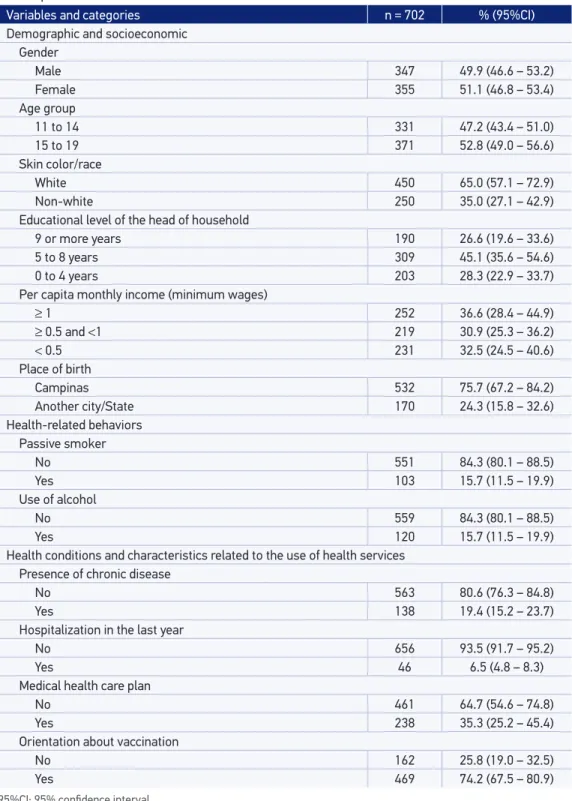
reported not having taken the vaccine, and the rest (13.1%) did not know or did not answer the question. Excluding those who could not provide information on the vaccination, 702 adolescents were considered, with a mean age of 14.8 years (95%CI 14.6 – 15.0), of whom 49.9% (95%CI 46.6 – 53, 2) were male. The characteristics of the studied population are shown in Table 1.
For the adolescents that reported vaccination, the number of doses was investigated, from the question: “How many doses did you take?”. The response categories were three doses, less than three doses and do not know/did not answer. Thus, considering only the answers with information and the criterion adopted for the composition of the categories of the dependent variable, data from 685 adolescents were analyzed, of whom 72.2% (95%CI 67.0 – 77.5) had received the 3 doses of the vaccine.
Regarding where the adolescents were vaccinated, 97.5% (95%CI 92.6 – 98.8) reported the public health service. The main reason mentioned by the adolescents for being immunized in the it was a preference for the private service.
In the assessment of the residence and surrounding characteristics, we observed higher prevalence of vaccination against hepatitis B in adolescents living in shacks, rooms or other types of housing, compared to those living in houses or apartments, with the prevalence ratio (PR) of 1.30 and 95%CI 1.14 – 1.48 (these data were not shown in a table).
Among the demographic and socioeconomic variables, there was a higher prevalence of vaccination in adolescents born in Campinas, and in those with lower per capita income in the limit of statistical signiicance. The remaining analyzed variables did not present an association with the vaccination (Table 2).
As for health-related behaviors, it is possible to observe in Table 3 a negative association between alcohol consumption and vaccination, in other words, lower prevalence of immunization in the adolescents that reported use of alcohol.
In Table 4, we present the prevalence of vaccination according to health conditions and characteristics associated with the use of health services. The recommendation of a health care professional about the importance of taking the vaccine against hepatitis B was positively associated with the vaccination (PR = 2.27, 95%CI 1.68 – 3.08).
The results of the Poisson multiple regression analysis are presented in Table 5. An independent and negative association with the vaccination was observed for adolescents not born in the city, from other cities or other State. The orientation of a health care professional about the vaccine was positively and strongly associated with the hepatitis B vaccination (p < 0.01).
Table 1. Distribution of adolescents, according to socio-demographic, health-related behaviors, health status and use of health services variables. Campinas, SP, Brazil. Health survey in the city of Campinas 2008/2009.
Variables and categories n = 702 % (95%CI)
Demographic and socioeconomic Gender
Male 347 49.9 (46.6 – 53.2)
Female 355 51.1 (46.8 – 53.4)
Age group
11 to 14 331 47.2 (43.4 – 51.0)
15 to 19 371 52.8 (49.0 – 56.6)
Skin color/race
White 450 65.0 (57.1 – 72.9)
Non-white 250 35.0 (27.1 – 42.9)
Educational level of the head of household
9 or more years 190 26.6 (19.6 – 33.6)
5 to 8 years 309 45.1 (35.6 – 54.6)
0 to 4 years 203 28.3 (22.9 – 33.7)
Per capita monthly income (minimum wages)
≥ 1 252 36.6 (28.4 – 44.9)
≥ 0.5 and <1 219 30.9 (25.3 – 36.2)
< 0.5 231 32.5 (24.5 – 40.6)
Place of birth
Campinas 532 75.7 (67.2 – 84.2)
Another city/State 170 24.3 (15.8 – 32.6)
Health-related behaviors
Passive smoker
No 551 84.3 (80.1 – 88.5)
Yes 103 15.7 (11.5 – 19.9)
Use of alcohol
No 559 84.3 (80.1 – 88.5)
Yes 120 15.7 (11.5 – 19.9)
Health conditions and characteristics related to the use of health services Presence of chronic disease
No 563 80.6 (76.3 – 84.8)
Yes 138 19.4 (15.2 – 23.7)
Hospitalization in the last year
No 656 93.5 (91.7 – 95.2)
Yes 46 6.5 (4.8 – 8.3)
Medical health care plan
No 461 64.7 (54.6 – 74.8)
Yes 238 35.3 (25.2 – 45.4)
Orientation about vaccination
No 162 25.8 (19.0 – 32.5)
Yes 469 74.2 (67.5 – 80.9)
Table 2. Prevalence of the mentioned vaccination against Hepatitis B in adolescents, according to demographic and socioeconomic variables. Campinas, SP. Health survey in the city of Campinas 2008/2009.
Variables and categories n Prevalence (%) p-value* PR (95%CI)
Gender
Male 337 71.1
0.57 1
Female 348 73.4 1.03 (0.92 – 1.15)
Age group
11 to 14 321 71.9
0.82 1
15 to 19 364 72.6 1.00 (0.93 – 1.10)
Skin color/race
White 439 72.4
0.95 1
Non-white 244 72.2 1.00 (0.94 – 1.06)
Educational level of the head of household
9 years or more 300 72.1
0.63
1
5 to 8 years 198 70.0 0.97 (0.83 – 1.13)
0 to 4 years 187 74.9 1.03 (0.92 – 1.17)
Per capita monthly income (minimum wages)
≥ 1 245 68.5
0.08
1
≥ 0.5 and < 1 213 69.1 1.01 (0.86 – 1.18)
< 0.5 227 79.3 1.16 (1.00 – 1.34)
No. of people in the residence
1 to 3 160 69.4
0.63
1
4 to 5 353 72.5 1.04 (0.91 – 1.20)
6 or more 172 74.4 1.07 (0.93 – 1.24)
Occupational activity
Yes 130 67.7
0.17 1
No 546 73.3 1.08 (0.96 – 1.22)
Goes to school
Yes, private 121 67.1
0.28
1
Yes, public 449 72.4 1.08 (0.90 – 1.29)
No 114 77.4 1.15 (0.96 – 1.39)
Place of birth
Campinas 519 74.3
0.06 1
Another city/State 166 66.0 0.89 (0.78 – 1.01)
non-adherence, the main ones were: lack of orientation (65.2%), and not considering the vaccine necessary (13.0%). Other referred reasons (17.9%) included: not being old enough to receive the vaccine, difficulty to get the vaccine, lack of time and forgetting. It is worth noting that the adolescents who mentioned insufficient age to receive the vaccine were 12 to 17 years old.
DISCUSSION
The results of this study showed that 72.2% of the adolescents living in Campinas in 2008 had completed the 3-dose schedule of the hepatitis B vaccine, with greater coverage among those who were born in the city (74.3%) and those who received orientation from a health professional about the importance of the vaccination (85.3%).
Table 3. Prevalence of the mentioned vaccination against hepatitis B in adolescents, according to health-related behaviors. Campinas, SP. Health survey in the city of Campinas 2008/2009.
Variables and categories n Prevalence (%) p-value* PR (95%CI)
Passive smoker
No 538 72.2
0.88
1
Yes 99 71.4 0.99 (0.86 – 1.14)
Use of alcohol
No 565 74.1
0.05
1
Yes 117 65.2 0.88 (0.77 – 1.00)
Body mass index
Underweight/eutrophic 477 71.8
0.71
1
Overweight/obese 143 70.2 0.98 (0.86 – 1.11)
Physical activity during leisure time
No 222 68.5
0.09 1
Yes 463 74.0 1.08 (0.94 – 1.23)
Table 4. Prevalence of the mentioned vaccination against hepatitis B in adolescents, according to health conditions and characteristics related to the use of health services. Campinas, SP. Health survey in the city of Campinas 2008/2009.
Variables and categories n Prevalence (%) p-value* PR (95%CI)
Morbidity in the last 15 days
No 560 73.7
0.14 1
Yes 125 66.0 0.90 (0.77 – 1.04)
Presence of chronic disease
No 548 72.2
0.88 1
Yes 134 71.7 0.99 (0.89 – 1.10)
Account of the following health problems/complaints**
Frequent headache/migraine 179 71.0 0.70 0.98 (0.86 – 1.10)
Allergy 276 70.5 0.48 0.96 (0.85 – 1.08)
Dizziness/vertigo 45 60.2 0.08 0.82 (0.64 – 1.06)
Search of service or professional for health problems in the last 15 days
No 588 72.2
0.90 1
Yes 97 72.8 1.01 (0.87 – 1.17)
Dental appointment in the last 12 months
No 282 70.5
0.48 1
Yes 402 73.4 1.04 (0.93 – 1.16)
Hospitalization in the last year
No 640 72.6
0.53 1
Yes 45 68.0 0.94 (0.75 – 1.16)
Medical health care plan
No 452 72.2
0.88 0.99 (0.86 – 1.13)
Yes 231 72.9 1
Orientation about vaccination
No 157 37.5
< 0.01 1
Yes 463 85.3 2.27 (1.68 – 3.08)
The adolescent’s origin was strongly associated with the occupational activity (p < 0.001; data not presented), in other words, a significantly higher proportion of adolescents not born in Campinas performed work activities at the period of the survey, which could influence the search of health services for this preventive procedure. A study carried out by Slonimet al.19 shows that the lack of knowledge about the disease and
the low perceived susceptibility are important barriers to the adherence to vaccination. The vaccination is a preventive procedure that cannot be considered essential by groups that have less time to seek this care, which demands that health services identify these segments and employ specific strategies to increase the coverage among adolescents and young adults that are part of the labor market.
The orientation of a health professional about the importance of taking the vaccine against hepatitis B was an independent factor and strongly associated with the immunization. The indication of the vaccine and the information about its benefits are strategic for greater adherence. Studies about factors associated with the vaccination, related to other vaccine-preventable diseases and age groups20,21, highlight the importance of counseling
and orientation from health teams to improve adherence to vaccination.
Although the expansion of the hepatitis B vaccine for age groups within 1 to 19 years has occurred in 2001, partial national data from 2009 referring to this population showed that 80.9% received the third dose, revealing that there were still vaccination opportunities6. For the Southeast Region, in the historical series of 3rd doses applied in
the 1994 to 2011 period (preliminary data from January to May), coverage of 91.8 and 60.6% was observed in the age groups of 11 to 14 years and 15 to 19 years, respectively. In Campinas, there was 77.5% of cumulative coverage for the population between Table 5. Poisson multivariate regression model for the mentioned vaccination against hepatitis B in adolescents. Campinas, SP. Health survey in the city of Campinas 2008/2009.
Adjusted PR: adjusted prevalence ratio using Poisson multivariate regression (620 adolescents were included in the inal model); *design efect.
Variables Adjusted PR (95%CI) p-value Standard error Def*
Place of birth
Campinas 1
Another city/State 0.89 (0.80 – 0.98) 0.02 0.04 0.73
Orientation about vaccination
No 1
11 and 14 years old and only 45.0% among adolescents aged 15 to 19 years old22 in the
referred period.
Considering gender, age, referred skin color, per capita family income and school attendance, no differences were observed between the coverages for the analyzed subgroups. A study conducted in Michigan, United States, discovered greater acceptance by the male adolescents19. However, other studies have shown that the female adolescents
are more likely to complete the vaccination schedule23-25. For the age group, the findings
of this study differ from what was observed for most of the municipalities of the West Metropolitan Region of São Paulo7 and what was verified from official data for many
municipalities22. Homogeneity of coverage was found in Campinas.
Regarding per capita income, an upward trend of immunization was observed in those with lower income, at the limit of statistical significance. Middleman et al.23
found that individuals with lower financial status are more likely not to complete the vaccination schedule. In this study, the socioeconomic conditions of the adolescents did not restrict the access to vaccination, indicating the reach of the campaigns. As for school attendance, there was no statistical difference in the prevalence of immunization against hepatitis B. Some studies highlight the importance of the school environment as a facilitator for obtaining the full schedule of three doses23,26.
In this study, no significant associations were observed between hepatitis B vaccination and health-related behaviors, except for the use of alcohol with lower prevalence at the limit of statistical significance. Alcohol is one of the psychoactive substances that are consumed earlier by young people27, raising the risk of future dependence.
The adolescents, more susceptible to peer pressure and holders of a greater sense of invulnerability and immortality, face difficulties associating current risky behaviors with future consequences25,27,28. Articulated actions between different fields of knowledge
and focused on the biopsychosocial needs of the adolescents can positively influence their development28.
Among the limitations of this study, it should be considered that the information on the vaccination was referred, subject to the memory bias. A study carried out in Braga, Portugal, found that, among 272 adolescents who confirmed immunization, 14% had negative anti-HBs, and, among those who reported no dose, 3.3% tested positive29.
The ISACamp is comprehensive and included several topics related to health. Given the difficulty of the interviewers to access the adolescent’s vaccine cards, the findings should be considered with caution.
about vaccination. Yet, the response categories used for the question about the number of doses included the alternatives “three doses”, “less than three doses” and “do not know/did not answer”, it was not possible to investigate the proportion of individuals that received two doses of the vaccine, which could possibly give some protection3,9,25.
It is possible that some adolescents had an incomplete schedule because the minimum interval between doses was not complete at the time of the data collection, but the survey data did not allow such an assessment. In this sense, it was only possible to evaluate the complete schedule versus incomplete/no dose.
Regarding the reasons for non-adherence to vaccination, the main ones mentioned by adolescents with incomplete vaccination schedule were forgetting and lack of orientation/information about the need for three doses of the vaccine. The protection against hepatitis B vaccine increases with the number of doses. In healthy adolescents and adults, the antibody response rates are 20 to 30% after one dose and 75 – 80% with two doses9. Still, in the general population, some healthy individuals can react in a
non-satisfactory manner to the vaccination against hepatitis B, and this percentage ranges from 5 to 10%3,9.
In many cases, the respondents did not report why they had not taken three doses of the vaccine. Identifying these reasons is essential to guide specific actions for these subgroups, enabling the increase of the coverage. Adolescents may believe they are immune to the infection after one dose of vaccine. In this sense, the information given by the health professionals during the application about the need for three doses are strategic, particularly regarding the 3rd dose, for protection
and an appropriate response9.
Among the adolescents that did not take the hepatitis B vaccine, besides the lack of orientation, some said they did not consider the vaccine necessary. Forgetting was also a frequently mentioned reason. Adolescents, who are in a typical phase of biopsychosocial development, may acquire behaviors that put them at particular risk for contracting the disease4,28,30. One could highlight the progressively earlier beginning of sexual activity27,28
with multiple partners, use of injectable drugs, lack of knowledge of the possibility of infection through sex4,25,30 — 60% of adolescents do not know the source of their
infection, compared to 30% of infected adults16.
According to the Counseling Guide prepared by the National Viral Hepatitis Program (PNHV) “the development of the educational component is an intrinsic part of both the collective and individual counseling” and “the information/orientation, although in itself does not favor the change in behavior, represents unquestionably the first step of the process, sensitizing the individual to the need for change”31. For the
and have not undergone training in the area in the last five years32. These results reveal
the need for investment in the training of professionals that are in the “gateways” of health services, given their importance in the implementation of preventive practices.
The potential evolution of hepatitis B to liver cirrhosis and hepatocellular carcinoma, the great infectivity of the virus and the role of the chronic carrier of the virus in the spread of the disease3,4,6 are some relevant information that need to be disclosed in a
meaningful and comprehensive way, so that there can be a greater appreciation of this preventive practice by the adolescents and young adults.
CONCLUSION
This study revealed the extent and reach of the immunization against hepatitis B in adolescents living in Campinas, São Paulo, Brazil, but still with low coverage. The orientation of a health professional was positively and strongly associated with vaccination. In this sense, health education programs aimed at this age group, addressing the importance of immunization to prevent the disease, strategies for an active search of those who did not complete the schedule, as well as information on the disease and orientation from health professionals about the benefits of vaccination to adolescents, parents and caretakers can improve the vaccination coverage in this population. Besides, specific actions, such as stimulating the use of condoms in sexual practices, should be directed to all the adolescents and, particularly, to those who are more vulnerable to the infection.
1. World Health Organization (WHO). Hepatitis B. http:// www.who.int/csr/disease/hepatitis/HepatitisB_ whocdscsrlyo2002_2.pdf (Acessado em 06 de janeiro de 2015).
2. Moraes JC, Luna EJA, Grimaldi RA. Inmunogenicidade de vacina brasileira contra hepatite B em adultos. Rev Saúde Pública 2010; 44(2):353-9.
3. Centers for Disease Control and Prevention. National Center for HIV/AIDS, Viral Hepatitis, STD & TB Prevention. Division of Viral Hepatitis. Viral hepatites surveillance: United States, 2010. Atlanta: CDC; 2010. Disponível em: http://www.cdc.gov/hepatitis/Statistics/2010Surveillance/ PDFs/2010HepSurveillanceRpt.pdf (Acessado em 05 de novembro de 2012).
4. Coutinho MFG. Adolescência: vacina contra hepatite B. Adolesc Saúde 2010; 7(1): 23-30.
5. São Paulo. Secretaria de Estado da Saúde de São Paulo. Centro de Vig ilância Epidemiológ ica “Prof. Alexandre Vranjac”. Casos de Hepatite B e C notificados em adolescentes ao Sistema Nacional de Informação de Agravos do Estado de São Paulo, de 2007 a 2010. Bol Epidemiol Paul 2011; 8(93): 4-13.
6. Brasil. Ministério da Saúde. Portaria nº 2.561, de 28 de outubro de 2009. Aprova o Protocolo Clínico e Diretrizes Terapêuticas - Hepatite Viral Crônica B e coinfecções. Brasília: Ministério da Saúde; 2009.
7. Riente KBC, Tsuguta EN, Barbosa SRBS, Zaparoli MA. Avaliação da cobertura vacinal contra hepatite B em 15 municípios da região metropolitana oeste de São Paulo. BECVE 2012, 2(10): 162-73.
8. Brasil. Ministério da Saúde. Secretaria de Vigilância em Saúde. Departamento de AIDS, DST e Hepatites Virais. Boletim Epidemiológico: hepatites virais. Ano II, nº 01. Brasília: Ministério da Saúde; 2011.
9. Davis JP. Experience with hepatitis A and B vaccines. Am J Med 2005; 118(Suppl 10A): 7S-15S.
10. Goldstein ST, Zhou F, Hadler SC, Bell BP, Mast EE, Margolis HS. A mathematical model to estimate global hepatitis B disease burden and vaccination impact. Int J Epidemiol 2005; 34(6): 1329-39.
11. Wasley A, Kruszon-Moran D, Kuhnert W, Simard EP, Finelli L, McQuillan G, et al. The prevalence of hepatitis B virus infection in the United States in the era of vaccination. J Infect Dis 2010; 202(2): 192-201.
12. Stief ACF\, Martins RM, Andrade SM, Pompilio MA, Fernandes SM, Murat PG, et al. Seroprevalence of hepatitis B virus infection and associated factors among prison inmates in state of Mato Grosso do Sul, Brazil. Rev Soc Bras Med Trop 2010; 43(5): 512-5.
13. Assunção AÁ, Araújo TM, Ribeiro RBN, Oliveira SVS. Vacinação contra hepatite B e exposição ocupacional no setor saúde em Belo Horizonte, Minas Gerais. Rev Saúde Pública 2012; 46(4): 665-73.
14. Távora LG, Hyppolito EB, Cruz JN, Portela NM, Pereira SM, Veras CM. Hepatitis B, C and HIV co-infections seroprevalence in a northeast Brazilian center. Arq Gastroenterol 2013; 50(4): 277-80.
15. Ferezin RI, Bertolini DA, Demarchi IG. Prevalência de sorologia positiva para HIV, hepatite B, toxoplasmose e rubéola em gestantes do noroeste paranaense. Rev Bras Ginecol Obstet 2013; 35(2): 66-70.
16. São Paulo. Governo do Estado de São Paulo. Secretaria da Saúde. SP inicia ‘força-tarefa’ para vacinar 5,8 milhões de paulistas contra hepatite B. Disponível em: http://www.saude.sp.gov.br/ses/noticias/2012/ janeiro/sp-inicia-forca-tarefa-para-vacinar-58-milhoes-de-paulistas-contra-hepatite-b (Acessado em 05 de outubro de 2012).
17. Leroux-Roels G, Desombere I, Cobbaut L, Petit MA, Desmons P, Hauser P, et al. Hepatitis B vaccine containing surface antigen and selected preS1 and preS2 sequences. Immunogenicity in poor responders to hepatitis B vaccines. Vaccine 1997; 15(16): 1732-6.
18. World Health Organization (WHO). Physical status: the use and interpretation of anthropometry. Technical Report Series No. 854. Geneva: WHO; 1995.
19. Slonim AB, Roberto AJ, Downing CR, Adams IF, Fasano N, Davis-Satterla L, et al. Adolescents’ knowledge, beliefs, and behaviors regarding hepatitis B: insights and implications for programs targeting vaccine-preventable diseases. J Adolesc Health 2005; 36(3): 178-86.
20. Francisco PMSB, Barros MBA, Cordeiro MRD. Vacinação contra inluenza em idosos: prevalência, fatores associados e motivos da não-adesão em Campinas, São Paulo, Brasil. Cad Saúde Pública 2011; 27(3): 417-26.
21. Francisco PMSB, Senicato C, Donalisio MR, Barros MBA. Vacinação contra rubéola em mulheres em idade reprodutiva em Campinas, São Paulo, Brasil. Cad Saúde Pública 2013; 29(3): 417-26.
22. Brasil. Ministério da Saúde. Secretaria de Vigilância em Saúde. Departamento de Vigilância Epidemiológica. Programa Nacional de Imunizações. Disponível em: http://pni.datasus.gov.br/apresentacao.asp (Acessado em 20 de fevereiro de 2013).
23. Middleman AB, Robertson LM, Young C, Durant RH, Emans SJ. Predictors of time to completion of the hepatitis B vaccination series among adolescents. J Adolesc Health 1999; 25(5): 323-7.
24. Middleman AB. Race/ethnicity and gender disparities in the utilization of a school-based hepatitis B immunization initiative. J Adolesc Health 2004; 34(5): 414-9.
25. Lawrence MH, Goldstein MA. Hepatitis B immunizations in adolescents. J Adolesc Health 1995; 17(4): 234-43.
26. Oliveira MDS, Paggoto V, Matos MA, Kozlowski AG, Silva NR, Junqueira ALN, et al. Análise de fatores associados à não aceitação da vacina contra hepatite B em adolescentes escolares de baixa renda. Ciênc Saúde Coletiva 2007; 12(5): 1247-52.
27. Instituto Brasileiro de Geograia e Estatística (IBGE). Pesquisa Nacional de Saúde do Escolar, 2012. Rio de Janeiro: IBGE; 2013. Disponível em: http://www.ibge. gov.br/home/estatistica/populacao/pense/2012/ pense_2012.pdf (Acessado em 05 de junho de 2014).
28. Chinazzo IR, Câmara SG, Frantz DG. Comportamento sexual de risco em jovens: aspectos cognitivos e emocionais. Psico-USF 2014; 19(1): 1-12.
29. Antunes H, Macedo M, Estrada A. Taxa de cobertura vacinal com imunização para o vírus da hepatite B. Acta Méd Port 2004; 17: 303-8.
31. Brasil. Ministério da Saúde. Programa Nacional para a Prevenção e o Controle das Hepatites Virais. Manual de aconselhamento em hepatites virais. Brasília: Ministério da Saúde; 2005. Disponível em: http://bvsms.saude. gov.br/bvs/politicas/hepatites_aconselhamento.pdf (Acessado em 04 de dezembro de 2012).
32. Pereira SF. A vacinação contra hepatite B nos núcleos de atenção integral à saúde do adolescente
do Distrito Federal: fatores condicionantes da baixa cobertura vacinal. [Dissertação de mestrado]. Brasília: UniEVANGÉLICA; 2009.
Received on: 06/10/2014