ABSTRACT
Adequacy of human milk viscosity to respond to
Mariangela Bartha de Mattos de ALMEIDA1, João Aprígio Guerra de ALMEIDA2, Maria Elisabeth Lopes MOREIRA3,
Franz Reis NOVAK4
1- MSc, Child and Woman Health, Speech-Language Therapist, Fernandes Figueira Institute, Oswaldo Cruz Foundation - FIOCRUZ, Rio de Janeiro, RJ, Brazil. 2- PhD in Public Health, Coordinator of Ibero American Program of Human Milk, Fernandes Figueira Institute, Oswaldo Cruz Foundation – FIOCRUZ, Rio de Janeiro, RJ, Brazil.
3- PhD in Public Health, Department of Neonatology, Fernandes Figueira Institute, Oswaldo Cruz Foundation - FIOCRUZ, Rio de Janeiro, RJ, Brazil. 4- PhD in Microbiology, Coordinator of The National Reference Center of a Human Milk Bank, Fernandes Figueira Institute, Oswaldo Cruz Foundation – FIOCRUZ, Rio de Janeiro, RJ, Brazil.
Corresponding address: Mariangela Bartha de Mattos de Almeida - Instituto Fernandes Figueira - Setor de Fonoaudiologia Hospitalar - Av. Rui Barbosa, ! "##$%&'($
N
eonatal nutrition is an important subject in health in the short, medium and long term. feeding practices; one of them is changing the consistency of the milk offered. Objectives: !" thickening to adapt the diet to the needs of dysphagic infants hospitalized in the Neonatal Intensive Cara Unit (NICU). Material and Methods: The authors altered the viscosity of natural #" $%&%'%*% $+ of 60 minutes at a temperature of 37ºC. Results: The infant lactose formula thickened at concentrations of 2% and 3% produced viscosities of 8.97cP and 27.73 cP, respectively. / 14 $%&%'%*%5 1 $+ " $% &% '% *% 11$+ < = 5 human milk diminishes. The results point out the importance not only of considering the concentration of the thickener but also the time being administered after its addition to effectively treat dysphagic infants.Key words: Deglutition disorders. Dysphagia. Deglutition. Human milk. Viscosity. Rheology.
INTRODUCTION
Neonatal nutrition is an important subject in community health and social planning policies, especially for questions arising from the lack of > nutrition takes on a predominant role for the child’s overall development. Clinical and epidemiological data reinforce the conclusion that lack of human milk in this phase of life increases the incidence of
diarrhea, respiratory infections, urinary infections,
otitis media and necrotizing enterocolitis7
as depriving infants of components that contribute to adequate development.
Health professionals confront challenges in
< 13. In the Neonatal
Intensive Care Unit (NICU), in general, preterm
others, that are often challenges for adequate nutrition.
Various obstacles can prevent adequate nutrition for this population during the hospitalization 1 in maturation and in acquiring the necessary oral sensory motor skills, prolonged use of tracheal-oral tubes and gastric probes, immaturity of the cardiorespiratory system, central nervous system and oro-facial musculature. These factors can also
the disorganization of the normal pattern of sucking, hyper-sensibility to peri-touch and/or intra-oral stimuli. There also can be a lack of coordination in complications such as food being aspirated effectively6,11,14,15.
G < implementation of practices to adapt feeding practices, including a change in the consistency of the milk offered.
Souza, et al.16 (2001)1
liquid causes a lack of coordination among sucking, / necessary to understand the importance of the J In the National Dysphagia Diet2, seven rheological
K 1 1 Among these, viscosity is the most important
The goal of this study is to determine the variation in viscosity of untreated human and " / information that can enable them to respond to the needs of the dysphagic infants hospitalized in the L=#
MATERIAL AND METHODS
/ Q= Laboratory of the Human Milk Bank of the Fernandes Z[\ ="Z]ZZ^ Z\=_#`w / ZZ^ FIOCRUZ’s Committee for Ethics in Research on Human Beings. All human milk samples came from |}[ZZ legislation that regulates the establishment and functioning of the Human Milk Bank throughout the National Territory5.
~
groups8 determined using version 13.0 of the
>/
to descriptive and statistical analysis using the / and the Kruskal-Wallis test for non-parameter 1 '%
1) Standardize the technique to determine viscosity of pumped human milk using Ford Viscometer cups
/ Ford Viscometer cup has been used for various L J publications that established the analytic technique viscosity of human milk according to this method. 1 J
Z " the determination of cinematic viscosity according to standard NBR 58493 for the investigation of
L J ] w $+4++ 1$& the Quimis brand model Q 280 Ford Viscometer cup.
J J / viscosity (centistoke) and then into dynamic viscosity (centipoise) using formulas based on the Z1
2) Study the effect of time on the viscosity of untreated human milk pumped and pasteurized milk was maintained at a temperature of 37°C with variation of ±2ºC
/ Determination took place every 3 hours for a period of 9 hours. Repeated observations of the same
and reducing experimental errors. The temperature < affected according its use in the service routine.
4 | ++ | $++| / of human milk and the triplicates composed by the
} 5 [
++| of 200 mL each. The pasteurization of human milk occurred as described by the ANVISA4 (2008). After
To determine the kinematic viscosity in
centistokes1$
L_' Viscosity=[(2,388xt) – (0,007xt²) – 57,008]
J /
3) Study the effect of time on the infant’s powdered milk viscosity appropriate for a variation of ±2ºC.
4'+| and analyzed changes in the viscosity at 20-minute intervals for a period of 60 minutes, maintaining the product in thermal equilibrium at 37ºC. We adopted 1 5 $% &% / according to manufacturer recommendations. This permitted recognition of the pattern of the viscosity. / previous step.
4) Study the effect of time on the viscosity of infant powdered milk appropriate for the
maintained at a temperature of 37°C with a variation of ±2ºC.
4$ $% &% /
20 minutes for a period of 60 minutes maintaining the product at thermal equilibrium at 37ºC. Thicken #]L_>"w
locally.
= 1 based the testing on our clinical practice and used a thin consistency (1-50 cP) that enabled suction of ~ Dietetic Association2.
on the Marte brand model A500 digital scale and to the manufacturer’s recommendation. The timing [ completed.
Z$% used as that of the previous study and for the 3% 1& Viscosity=[(2.314xt)–15,200]
5) Study the effect of time on the viscosity of untreated human milk, thickened in maintained at a temperature of 37°C with a variation of ±2ºC.
Z for testing the 2% and 3% concentrations and another pool for the 5% and 7% concentrations. "
determined in 20-minute intervals for a total of four measurements.
For the 2%, 3% and 5% concentrations, the $ Z *% 1 &
In studying 5% and 7% concentrations, the goal viscosity obtained in the concentration of infant at 2% and 3% concentrations.
6) Study the effect of time on the viscosity of pumped pasteurized human milk, thickened maintained at a temperature of 37°C with a variation of ±2ºC.
/ the untreated pumped human milk thickened in the same concentrations.
RESULTS
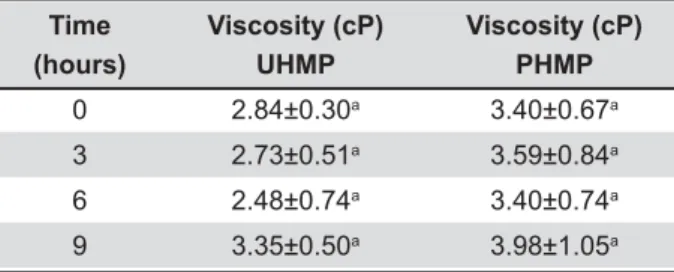
Samples of untreated human and pasteurized milk maintained at 37ºC for a period of nine hours
by analysis of the variance to determine a 5% level of probability and a median value of 2.84 cP
Time (hours)
&! '*+ 78<*
&! '*+ *8<*
0 2.84±0.30a 3.40±0.67a
3 2.73±0.51a 3.59±0.84a
6 2.48±0.74a 3.40±0.74a
9 3.35±0.50a 3.98±1.05a
Table 1- Effect of time on the viscosity of untreated human milk and pasteurized milk maintained at a temperature of 37°C
Values followed by same letter do not differ at 5%
probability (p<0.05)
in untreated milk and 3.40 cP in pasteurized milk as observed in Table 1.
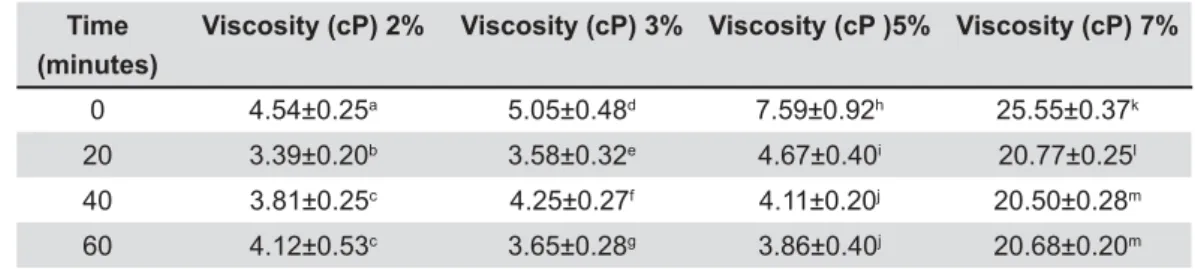
The viscosity determination values for first every 20 minutes after its preparation and maintained at 37ºC for a period of up to one hour, is presented in Table 2.
~ 4*&% ]++'w 1$+ " That is, in the initial period, the hydration of formula components takes place after its dissolution. It is instantaneously dissolves, the subsequent hydration requires time to occur. This conclusion is reinforced by the fact that the viscosity is maintained stable < + subsequent minutes.
/ > pumped human milk or pasteurized pumped human &*=
viscosity.
/$% milk at 37ºC produced double the increase in
20 minutes. The addition of 3% concentration [ relation to time zero.
Comparing all concentrations of thickener of " 1 to time (Table 3).
In all analyzed concentrations, the decrease in 1 $+ + +&%
passage of time (p<0.05).
In relation to untreated pumped human milk of 7% of the thickener increased the viscosity up to nine-fold.
Table 2- Effect of time on the viscosity of infant powdered milk maintained at 37°C
Time (minutes)
&! '*+ &! '*+ > &! '*+ >
0 4.49±0.54a 8.97±1.11a 27.73±1.88e
20 3.71±0.49b 13.43±0.55b 47.74±1.40f
40 3.81±0.33b 15.58±0.54c 47.57±1.22f
60 4.08±0.47b 15.92±0.52d 48.07±1.26f
Values followed by same letter do not differ at 5% probability (p<0.05)
Time (minutes)
&! '*+ > &! '*+ > &! '* +?> &! '*+ @>
0 4.54±0.25a 5.05±0.48d 7.59±0.92h 25.55±0.37k
20 3.39±0.20b 3.58±0.32e 4.67±0.40i 20.77±0.25l
40 3.81±0.25c 4.25±0.27f 4.11±0.20j 20.50±0.28m
60 4.12±0.53c 3.65±0.28g 3.86±0.40j 20.68±0.20m
Values followed by same letter do not differ at 5% probability (p<0.05)
Table 3- Effect of time on the viscosity of untreated human milk thickened maintained at 37°C
Time (minutes)
&! '*+ > &! '*+ > &! '*+ ?> &! '*+ @>
0 4.06±0.82a 5.53±0.68b 7.98±0.87e 27.09±1.01h
20 3.58±0.64a 4.43±0.22c 4.82±0.35f 20.92±0.38i
40 3.57±0.34a 4.43±0.28c 4.80±0.18f 20.59±0.20i
60 3.60±0.31a 4.01±0.30d 4.57±0.16g 20.76±0.18i
Values followed by same letter do not differ at 5% probability (p<0.05)
The addition of 2% of thickener in pasteurized pumped human milk did not modify its viscosity 1 &% '% *% 1 1 1$+/ " $++ (Table 4).
In relation to pasteurized pumped human milk 1 of 7% of thickener increased up to eight-fold the viscosity of pasteurized pumped human milk observed at time zero.
DISCUSSION
The samples maintained at 37ºC for a period of nine hours of untreated human and pasteurized milk did not have altered viscosity values.
< + < thickened at 2% and 3%, a considerable increase
= produced an inverse viscosity behavior: the " that the immediate offer of human milk after the addition of thickener could minimize such effects and preserve the desired degree of thickening.
The results reinforce that the use of thickeners should take into consideration not only the elapsing after preparation before administration is important in responding to the needs of the dysphagic infant.
Z in the viscosity of thickened human milk is associated " milk that promotes of partial hydrolysis of the starch contained in the thickener10. This leads to
the reduction, proving that pasteurization does not cause total inactivity of this enzyme in human milk.
Therefore, amylase becomes an important ally in the nutrition of the dysphagic infants. This "1 four months of life in the digestive tube of babies, is present in human milk9,12. Its presence in the
thickened human milk facilitates the digestive / babies’ enzyme. So, the thickening of the human 1< human milk its exclusive nutritional quality and acts as a facilitator of the digestive process.
For the standardization of the thickening
procedure of diet in the routine of hospital nutrition and speech therapy services, pasteurized pumped
four consistencies: 2%, 3%, 5% and 7% according to the speech pathologist’s evaluation.
The study points to the fact that the result of the thickening process for human milk is different / JJ in untreated human milk leading to a decrease in the thickened product’s viscosity.
~ determining the viscosity. It requires large volumes 1
Our results indicate that it is possible, in practical terms, to seek alternatives for thickening human / [ pasteurization viscosity variations arising from alterations in the quaternary structure of the milk proteins suggest that the paths for developing
the help of bacteria should be investigated1. The
coagulation of human milk, increasing its viscosity industry has used a similar technology for a long J for the feeding of the dysphagic infant, permitting 1
ACKNOWLEDGEMENTS
/ Z Support of Research of the State of Rio de Janeiro ]Z~>_w["1]> E- 26/102.873/2008).
REFERENCES
4[~~~"[_ de Janeiro: FIOCRUZ; 1999.
2- American Dietetic Association (ADA). The national dysphagia diet: standardization for optimal care. Chicago: The Association; 2002.
3- Associação Brasileira de Normas Técnicas (ABNT). NBR 5849: Tintas - Determinação da viscosidade pelo copo Ford. Rio de Janeiro: ABNT; 1986.
4- Brasil. Agência Nacional de Vigilância Sanitária (ANVISA). Banco de leite humano: funcionamento, prevenção e controle de riscos. ~L~5$++
5- Brasil. Agência Nacional de Vigilância Sanitária (ANVISA). Resolução RDC nº 171 de 04 set. 2006. Dispõe sobre o regulamento, a implantação e o funcionamento de Bancos de Leite } ! \1 # (2006 set. 05); Seção 1. p. 33.
7- Camelo JS Jr, Martinez FE. Lactoengenharia do leite humano. In: Pereira GR, Leone CR, Alves Filho N, Trindade Filho O. Nutrição do recém-nascido pré-termo. Rio de Janeiro: Medbook; 2008. p.11-29.
[Z>=> Nobel; 1978.
9- Martinez FE, Camelo JS Jr. Nutrition of the preterm infants. J. Pediatr (Rio J). 2001;77(Suppl. 1):S32-40.
4+[ G = | 1 > ]_ w 2009;85(2):157-62.
44[G[!GG} ~~! !~GZ 4 year of age. Pediatr Radiol. 2001;31(6):423-8.
4$[G~_!1" para uma vida saudável [Dissertação de Licenciatura]. Porto: Faculdade de Ciências da Nutrição e Alimentação, Universidade de Porto; 2005.
4&[ G G| G` = challenges for child health. Ciênc Saúde Coletiva. 2010;15(2):321-7.
4[LZ=|=_ sucking stimulation. Pro Fono. 2006;18(2):141-50.
4'[L |~ =>G=}~ function and medical diagnoses in infants suspected of dysphagia. Pediatrics. 2001;108(6):E106.