ABSTRACT
Psychometric assessments of life quality and
in Bauru, SP, Brazil
Janaína Gheissa MARTINELLO1, José Roberto Pereira LAURIS2, Alcione Ghedini BRASOLOTTO3
1- Speech-Language Pathologist, MSc in Speech-Language Pathology, Department of Speech-Language Pathology and Audiology, Bauru School of Dentistry, University of São Paulo, Bauru, SP, Brazil.
2- PhD, Associate Professor, Department of Pediatric Dentistry, Orthodontics and Community Health, Bauru School of Dentistry, University of São Paulo, Bauru, SP, Brazil.
3- MSc, PhD, Assistant Professor, Speech-Language Pathologist, Department of Speech-Language Pathology and Audiology, Bauru School of Dentistry, University of São Paulo, Bauru, SP, Brazil.
Corresponding address: Profa. Dra. Alcione Ghedini Brasolotto - Faculdade de Odontologia de Bauru - USP - Departamento de Fonoaudiologia - Alameda Dr. Octávio Pinheiro Brisolla 9-75 - C.P. 73 - 17012-901 - Bauru - SP - Brasil - Phone: +55 14 3235 8332 - e-mail: [email protected]
S
for the establishment of the prevalence of vocal alteration is based on teachers' self-perception. Objective: This study aimed at comparing voice-disordered quality of life in the different dimensions of voice quality of life. Material and Methods: Ninety-seven (97) Index (VHI), Voice-Related Quality of Life (V-RQOL), and the Voice Activity Participation ! "#$!!% &*+ /012 3 # %" 4 5*68 $$!4 "4 ; *68 < the physical functioning domain, both indicating the laryngeal discomfort and the impact of $ $$! ; < + = & dimensions of voice quality of life.
Key words: Voice. Teachers. Quality of life.
INTRODUCTION
Among voice professionals, teachers are the ones presenting the highest risks of vocal alterations14,15,18,21. Physical factors such as inadequate space, number of students per
classroom, and psycho-emotional factors such as professional adaptation problems and stress,
may contribute to the development of vocal alterations3,4,17 their professional performance, rendering their participation in the teaching profession non-viable14,15,22. Thus, it is necessary to investigate consequences to the life quality (LQ) of the teacher.
questionnaires that are thoroughly elaborated and idealized according to the declarations of the patients, to assess, objectively, the results of treatment or life quality6. On the life quality assessment, the impact of the disease is evaluated based on the perception of the patient and not + multidimensionality of human beings and their perceptions (subjectivity) are the common points
86"5,16.
The research aimed at investigating and relating vocal health to life quality contributes to the G perceive their vocal health, and the impact of voice in different dimensions of human existence, e.g., physical, emotional, social, etc.
< a vocal alteration, and its impact on their LQ, helps health professionals and those responsible for health promotion policies develop more effective programs to guarantee the health of teachers.
This study aimed at verifying the self-perception of teachers regarding the impact of vocal use on their LQ and development of their daily activities, by establishing the vocal alteration prevalence reported by the teachers and comparing LQ of teachers, i.e., the group that reported vocal alteration and the one reporting no vocal alteration.
MATERIAL AND METHODS
+ question: “Have you had any alteration in your
JK4
U symptomatology and sensation of vocal alteration in the teachers studied4
.
W5 #0X% system in Bauru, SP, Brazil, responded to three questionnaires that measured their LQ: the Vocal Handicap Index (VHI), the Life Quality and Voice #5*68%! "! and Vocal Activity (VAPP), validated to Portuguese2,6.
+45*68 &"5 scales. VHI assesses the organic, functional, and emotional multi-dimensions to establish a vocal disadvantage index. The greater the score, the " questionnaire. On the other hand, V-RQOL assesses voice LQ, based on the dimensions of physical function and social-emotional domain. The greater the V-RQOL score, the better the relationship 86
The VAPP protocol utilizes a 10 cm analogical-visual scale in each question. The instrument proposes the analysis of sections: voice problem
< communication, in social communication, and in emotion. The greater the score, the greater the impact of voice on the performance of daily activities.
+Z53& the group that reported vocal alteration (Group II) and the group that reported no vocal alteration #\ 4% + ; 5 4 $!!U& ; of V-RQOL and restriction and limitation of VAPP, 3] & $^2" in all statistical tests.
+ & _ Bureau of Bauru and by the Research Ethics Committee of the Bauru School of Dentistry – USP, nº 169/2007.
RESULTS
0X 0~02 females and 7.1% males. The prevalence of #\44% /012 ~2#\4%
$ (GI), 19% reported they sometimes are hoarse and 13.6% of the teachers reported both lack of air and voice failure. Vocal sensations, such as " < //02 <#2% burning (25.4%), and dry throat (35.9%).
The symptomatology and vocal sensations most #\44% #^2% voice loss (41%), voice failure (56.4%), lack of air #/12% #2% #^2%<#1X2% "#X2%<#//02% #/12%
+ \4\44
+ ~ scales of the VHI protocol. For VHI, the organic 5 " both in GI and GII (p<0.001).
+ / domains of V-RQOL. As for V-RQOL, both in GI and GII, the score on the social-emotional sub-domain is greater than that in the physical functionality sub-domain (p<0.001).
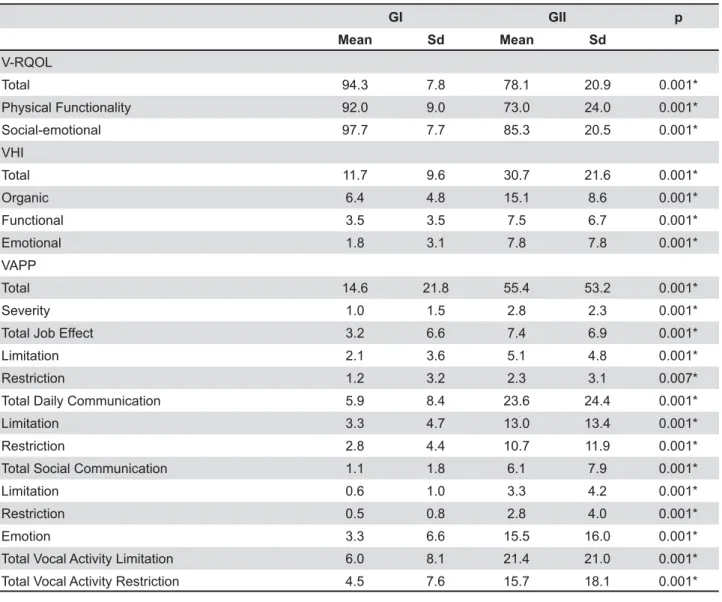
GI GII p
Mean Sd Mean Sd
V-RQOL
Total 94.3 7.8 78.1 20.9 0.001*
Physical Functionality 92.0 9.0 73.0 24.0 0.001*
Social-emotional 97.7 7.7 85.3 20.5 0.001*
VHI
Total 11.7 9.6 30.7 21.6 0.001*
Organic 6.4 4.8 15.1 8.6 0.001*
Functional 3.5 3.5 7.5 6.7 0.001*
Emotional 1.8 3.1 7.8 7.8 0.001*
VAPP
Total 14.6 21.8 55.4 53.2 0.001*
Severity 1.0 1.5 2.8 2.3 0.001*
Total Job Effect 3.2 6.6 7.4 6.9 0.001*
Limitation 2.1 3.6 5.1 4.8 0.001*
Restriction 1.2 3.2 2.3 3.1 0.007*
Total Daily Communication 5.9 8.4 23.6 24.4 0.001*
Limitation 3.3 4.7 13.0 13.4 0.001*
Restriction 2.8 4.4 10.7 11.9 0.001*
Total Social Communication 1.1 1.8 6.1 7.9 0.001*
Limitation 0.6 1.0 3.3 4.2 0.001*
Restriction 0.5 0.8 2.8 4.0 0.001*
Emotion 3.3 6.6 15.5 16.0 0.001*
Total Vocal Activity Limitation 6.0 8.1 21.4 21.0 0.001*
Total Vocal Activity Restriction 4.5 7.6 15.7 18.1 0.001*
V-RQOL=Voice-Related Quality of Life VHI=Voice Handicap Index
Sd=Standard deviation
Table 1- Comparison of the results of psychometric tests between GI (reported no vocal alteration) and GII (reported vocal alteration)
*+< GI GII
Mean Median dp Mean Median SD
Organic 6.4a 6.0 4.8 15.1a 14.0 8.6
Functional 3.5b 2.0 3.5 7.5b 6.0 6.7
1.8c 0.0 3.1 7.8b 6.0 7.8
Emotional
P <0.001* <0.001*
Table 2 - Comparison among the sub-areas of Voice Handicap Index(VHI) for GI (reported no vocal alteration) and GII (reported vocal alteration)
!"# $% &$% %!& '% '
VHI=Voice Handicap Index
< communication are significantly greater than the social communication section (p=0.008). \4 " #%
+ ^ scores of limitation and restriction of activities of protocol VAPP. In both in GI and GII, the score of limitation is greater than that of restriction (p<0.001).
DISCUSSION
One outstanding characteristic of the sample literature3,18.
When vocal alteration is reported by the teachers themselves, it is termed, “self-reported vocal alteration” or dysphonia. The prevalence of #/012% similar to that found in the study by Simões and Latorre17 (2006) (48.7%).
The most reported symptoms by both GI and
V-RQOL GI GII
Mean Median Dp Mean Median Dp
Physical functionality 92.0 95.8 9.0 73.0 79.2 24.0
Socio-emotional 97.7 100.0 7.7 85.3 93.8 20.5
p <0.001 * 0.001*
Table 3- Comparison between the domains of Voice-Related Quality of Life (V-RQOL) for groups GI (reported no vocal alteration) and GII (reported vocal alteration)
V-RQOL=Voice-Related Quality of Life
VAPP GI GII
Mean Median SD Mean Median SD
Job effect 8.0 1.3 16.5 18.4 a 11.3 17.3
Effect on Daily Communication 4.9 2.3 7.0 19.7 a 10.4 20.4
Effect on Social Communication 2.9 1.0 4.5 15.3 b 7.5 19.7
Emotion 4.7 1.4 9.4 22.1 a 14.7 22.9
P 0.116 ns 0.008*
Table 4-/''% !"# ;>
and GII (reported vocal alteration)
?
#
!"# $% &$% %!& '% '
SD=Standard Deviation
VAPP GI GII
Mean Median SD Mean Median SD
Limitation 6 2.8 8.1 21.4 12.3 21
Restriction 4.5 1.8 7.6 15.7 9.6 18.1
P <0.001* 0.001*
SD=Standard Deviation
Table 5-/'" $ K'N ;>
GII, i.e., hoarseness and voice loss, are similar to those found in Ferreira, et al.4#~X% as vocal sensations most reported by the 97 < _ highlighted symptoms and sensations of voice alteration.
The study by Tavares and Martins20 (2008) corroborated that vocal alterations might not be perceived by the teachers. The researchers did not report vocal alterations and found laryngeal alterations such as nodules, polyps, Reinke's edema, atrophy, and leukoplasia, in both groups.
+ " \4 and GII (see Table 1) in all the domains of protocols VHI, V-RQOL, and VAPP. These results indicate the & that the voice had a negative impact on their daily activities and LQ.
\4\44X/X respectively is observed for total VHI. The mean 4 \44 *
study15
vocal alterations, i.e., 31.58. On the validation of
VHI8 //0 5
perception of a mild problem.
As seen in Table 2, the organic sub-scale of VHI predominated over the other sub-scales, illustrating that teachers have a feeling of laryngeal " reported no vocal alteration do not regard laryngeal " alteration.
4 11,12, the organic
dimension of VHI also demonstrated higher scores + vocal signs/symptoms more easily interpreted by teachers are those that cause physical sensations of " 13. Nevertheless, the teachers are not particularly inclined to interpret these ] perceived, felt, interpreted, and meant.
As for V-RQOL, in the study of V-RQOL validation7, the mean scores for dysphonic and 5 ^/^ and 98 for total score, 55.9 and 98.9 for the social-emotional domain, and 51.9 and 97.3 for the physical functionality domain. Compared to \44 the dysphonic population.
The negative impact of voice on the LQ of the teachers studied herein seems to be mild, although " \4
\44 + 5 provided data on the dynamics of the relationship 864 that the physical dimension of individuals seems to 86 functional and emotional issues.
The dimension of physical functionality predominated over the socio-emotional one, both in GI and GII (Table 3). Other studies corroborate " impact on the physical functionality dimension than the social-emotional one1,6,10. Physical discomfort, < " < noisy environments, seems to contribute to the perception of the negative vocal impact on life quality related to voice, more than do the factors related to the socio-emotional component.
According to Jardim, et al.9 (2007) there seems to be a hierarchy in the impact of each domain on life physical functionality affects the psychological aspect that, in turn, affects the social one.
Furthermore, Smith, et al.19 (1999) state that life quality and health status are different concepts; as synonyms. For these authors, three great dimensions – mental health, physical functionality of life quality and health status. Thus, the mental 86 health status.
In the study of Jardim, et al.9 (2007), the authors highlight that, despite the high prevalence of vocal fatigue among teachers, the scores of V-RQOL did ] on life quality related to the voices of the teachers studied. Nevertheless, another psychometric protocol applied to the same population revealed that the teachers are getting sick, psychologically. The authors see a strong relation involving stress, emotion, and voice.
The values found in the VAPP protocol in GII are similar to those presented by teachers in another study22, 69.77. On the other hand, GI values are similar to the mean found in the control group of Ma and Yiu22 (2002), 16.9.
The activities limitation and restriction values \44 \4+ vocal alteration might face greater problems in problems, and might even restrict their teaching
#+ % that in GII, the vocal impact on the performance of daily activities is the same as in the session < social communication less affected than the W" among the sections in GI. These data indicate that voice utilization has a greater negative impact on < of emotions than on the process of socialization 4 \4 observed that no session predominated over the no vocal complaint, there is no voice impact.
It can be noticed that the teachers perceived the impact of voice more in terms of limitation of their <_ & that their voice might limit their professional performance (Table 5). For the teachers, the important aspect is to have voice. Mild vocal alterations do not seem to restrict their teaching activity. In the present study, most teachers rated their vocal alteration as mild and, among these, only 18.4% reported to have restricted their professional performance because of voice problems. Probably, this professional limitation noted by the teachers, both in GI and GII, is related to the symptomatology and sensations of vocal alterations, as reported by the teachers.
Vocal health programs are important to guide teachers in the suitable use of their voices, in order to diminish the symptomatology and sensations of vocal alterations and laryngeal discomfort reported by these professionals.
Furthermore, health promotion actions may < terms of quality, alterations, and transformations, in different social relations and everyday contexts13.
CONCLUSIONS
+ more negative impact on their LQ and their activities in all domains of the protocol, than did the teachers
The organic dimension of VHI predominated over and the physical functionality domain of V-RQOL presented smaller numeric measurements in relation to the social-emotional domain.
+ & that a voice alteration limits their professional performance more than it impairs the exercise of their profession.
REFERENCES
1- Behlau M, Hogykian N, Gasparini G. Quality of life and voice: study of a Brazilian population using the voice-related quality of life measure. Folia Phoniatr Logop. 2007;59:286-9.
2- Behlau M, Oliveira G, Santos LMA, Ricarte A. Validation in Brazil of self-assessment protocols of dysphonia impact. Pro Fono. 2009;21(4):326-32.
3- Delcor NS, Araújo TM, Reis EJFB, Porto LA, Carvalho FM, Silva MO, et al. Labor and health conditions of private school teachers in Vitória da Conquista, Bahia, Brazil. Cad Saúde Públ. 2004;20(1):187-96.
4- Ferreira LP, Giannini SPP, Latorre MRDO, Zenari MS. Distúrbio de voz relacionado ao trabalho: proposta de um instrumento para avaliação de professores. Disturb Comun. 2007;19(1):127-36. 5- Fleck MPA. O instrumento de avaliação de qualidade de vida da &Z#3685% perspectivas. Ciên Saúde Coletiva. 2000;5(1):3-38.
6- Gasparini G, Behlau M. Quality of life: validation of the Brazilian version of the voice-related quality of life (V-RQOL) measure. J Voice. 2009;23(1):76-81.
7- Hogykian ND, Sethuraman D. Validation of an instrument to measure voice-related quality of life (V-RQOL). J Voice. 1999;13(4):557-69.
15$\ <=4 $ G, Benninger MS, et al. The voice handicap index: development and validation. Am J Speech Lang Pathol. 1997;6(3):66-70. 9- Jardim R, Barreto SM, Assunção AA. Condições de trabalho, qualidade de vida e disfonia entre docentes. Cad Saúde Públ. 2007;23(10):2439-61.
10- Kasama ST; Brasolotto AG. Vocal perception and life quality. Pro Fono. 2007;19(1):19-28.
11- Kooijman PGC, De Jong FI, Oudes MJ, Huinck W, Van Acht H, Graamans K. Muscular tension and body posture in relation to complaints. Folia Phoniatr Logop. 2005;57(3):134-47.
12- Kooijman PGC, Thomas G, Graamans K, De Jong FI. Psychosocial impact of the teachers’ voice through the career. J Voice. 2007;21(3):316-24.
13- Penteado RZ, Pereira IMTB. Qualidade de vida e saúde vocal de professores. Rev Saúde Públ. 2007;41(2):236-43.
14- Preciado-López J, Pérez-Fernández C, Calzada-Uriondo M, Preciado-Ruiz P. Epidemiological study of voice disorders among teaching professionals of La Rioja, Spain. J Voice. 2008;22(4):489-508.
15- Roy N, Merril RM, Thibeault S, Parsa RA, Gray S, Smith EM. Prevalence of voice disorders in teachers and the general population. J Speech Lang Hear Res. 2004;47:281-93.
16- Seidl EMF, Zannon CMLC. Qualidade de vida e saúde: aspectos conceituais e metodológicos. Cad Saúde Públ. 2004;20:580-9. 17- Simões M, Latorre MRDO. Prevalência de alteração vocal em educadoras e sua relação com a auto-percepção. Rev Saúde Públ. 2006;40(6):1013-8.
18- Smith E, Gray SD, Dove H, Kirchner L, Heras H. Frequency and effects of teacher´s voice problems. J Voice. 1997;11(1):81-7. 053$W_$;U of life and health status in quality of life research: a meta-analysis. Qual Life Res. 1999;8(5):447-59.
~5+ _8ZZ *\ ~1~#%X5
~5 *8* < problems. Logoped Phoniatr Vocol. 2001;26(1):37-46.