ABSTRACT
Occurrence of consonant production errors in
lip and palate
Estefânia Leite PRANDINI1, Maria Inês PEGORARO-KROOK2, Jeniffer de Cássia Rillo DUTKA3, Viviane Cristina de Castro MARINO4
1- Graduate student, Department of Speech-Language Pathology and Audiology, Bauru School of Dentistry, University of São Paulo, Bauru, SP, Brazil. 2- PhD, Full Professor, Department of Speech-Language Pathology and Audiology, Bauru School of Dentistry, University of São Paulo, Bauru, SP, Brazil. 3- PhD, Assistant Professor, Graduate Program at Hospital for Rehabilitation of Craniofacial Anomalies and at Communication Disorders Department, Bauru School of Dentistry, University of São Paulo, Bauru, SP, Brazil.
4- PhD, Assistant Professor, Department of Speech-Language Pathology and Audiology, Univ. Estadual Paulista - UNESP, Marília, SP, Brazil.
Corresponding address: Estefânia Leite Prandini - Alameda Dr. Octavio Pinheiro Brizolla, 7-12 - Edifício Van Gogh - apto 42 - Bauru - SP - Brazil - 17012-901 - Phone: 32274308 - 97718452 - e-mail: [email protected]
5HFHLYHG-XO\$FFHSWHG-XO\
I
nformation about the prevalence of consonant production errors, including compensatory Portuguese is limited, particularly regarding liquid sounds. The literature primarily reports the occurrence of CA for plosive and fricative sounds, since occurrence of CAs in sounds that require higher amounts of oral air pressure is expected. While the use of CA during !!"" #" " as tongue clicks during production of /r/ and /l/. Objectives: Describe the occurrence " $ # %"# &$ # #'()* months and 15-18 months of age at primary palatoplasty. Material and Methods: A sample +'0 *+0)23 4 6 ")2+& %*+7 9"#4"&#')* );' #)<); *3; 4=# >>>>>?>>@>>>>># "& 4B "" 9"&( evaluation of the participants at the sixth year of age. Results: The use of middorsum palatal E=9*F 4G" >> # <<F 4 H "9 found related to surgical technique, but children operated earlier developed the use of the consonant cluster /r/ sooner than children operated later (p=0.040). Conclusion: We " #"&&"9& acquisition of consonant cluster /r/.INTRODUCTION
Cleft lip and palate (CLP) is a common congenital anomaly, occurring at a frequency # )V<33 )V033 # 17. According to
Pegoraro-Krook, et al.15*337
only the lip and premaxilla (CL), usually there is 46 disorders are present, intelligibility is affected by sound distortions resulting from dento-occlusal conditions or by lip retraction due to surgical scars. When cleft involves the palate, either as an isolated cleft palate (CP) or cleft lip and palate (CLP), oral communication can be severely affected #& " for nutrition and psychosocial and educational 4 G & be due to several factors: (1) unoperated cleft, (2) velopharyngeal dysfunction (VPD) resulting from the failure of the primary surgery to establish a functional velopharyngeal mechanism, (3) dento-occlusal conditions, and (4) hearing loss due to associated chronic otitis media, among other factors.
Surgical repair of the palate aims to correct " # " conditions for the velopharyngeal mechanism to function adequately, preventing the development of VPD and associated speech disorder12,21. B" & " of the face and the development of speech and hearing2,15. Authors suggest that the technique used for primary palatoplasty and the age of the & occurrence of speech and hearing disorders in ]=13,18. That is, according to the literature, some children are at higher risk of developing speech disorders due to the type of surgical correction they received for CLP.
The production of speech requires coordinated " ^ " & and respiratory muscles3,11,20. The expiratory _9 &" # V 4] & "9 the airstream. Production of consonants involves complete or partial obstruction of air in the oral cavity4,20. More specifically, the production of # 9 4 G production) has an impact on the type of sound that is generated. The sounds /p/, /b/ and /m/, for
! # ## to their place of production. The /f/ and /v/ are ! #4B # " " the alveolar ridge (such as /s/, /z/, /l/ and /r/), and are named linguodental (such as /t/, /d/ and >> " the teeth. Production of the velar sounds such as /k/, /g/ and /R/ involves contact or approximation of the back of the tongue to the back of the hard >`>>w> >{>>@> the tongue and hard palate4,20.
G 9 " type of constriction resulting from the articulatory contact. Thus, plosives sounds involve complete # #& release that is heard as a plosion. Plosive sounds include /p/, /t/, /k/, /b/, /d/ and /g/. Fricative sounds are those involving a close approximation of the articulators, leading to an audible friction >>>>>`>>>>> >w>4 # # #& >`>>w>4H & "&#" simultaneously to oral and nasal cavities, including >>>>>{>4%& " # 4>>>@> /r/, and /R/4,20. We can also name sounds according ( (like nasals and liquids) and high-pressure sounds (like plosive, fricative, and affricate).
G "" > ]= 9 " consonants that require a high amount of intraoral air pressure, as plosives, fricatives, and affricates2,17,23. According to Warren24 (2004), the inability to generate and/or maintain adequate levels of intraoral pressure for production of plosion or friction may lead to the development of atypical places of production, called compensatory articulations (CAs). As described by
Trost-Cardamone23 *337
fricative and middorsum palatal stop).
The use of middorsum palatal stop (MDPS) is described in literature for the plosives /t/, /d/, /k/ and /g/19,22. The presence of VPD, or a palatal 9 ! ^ " placement during speech, leading to compensations like the MDPS, for example17,234G " # 9 ! attempt to avoid air leakage during production of plosives /t/ and /d/, resulting in the use of the " palate (MDPS).
Other explanations for some speech errors # " ( abnormalities8,12,17,18,27. When a crossbite is present, ! ^&##& maxilla and the tongue and may be inadequately #" "^ " 46 " #& ^ the tongue dorsum (instead of the tip) in contact alveolar region) can also be observed for liquid sounds, a production called middorsum palatal
(MDP)124 G " 9&
dento-occlusal abnormalities are the cause of the compensatory adjustment, both MDPS and MDP can be observed.
While MDPS is used in substitution for plosive sounds and the plosion characteristic is present, MDP is used in substitution for liquid sound that does not involve high pressure, so plosion is absent. Articles describing the use of MDP place of articulation for 4 H ! "" CLP can make articulatory adjustments involving inadequate backing, elevation, protrusion, or even clicks of the tongue, particularly during production of /r/ and /l/. Besides backing of liquid oral targets, developmental articulatory errors ""9& speech sound development are also reported in the
7,8,10. Additionally,
9 #
!""14.
Information on prevalence of consonant production " 4G & the occurrence of CA during production of plosive, fricative, and affricate sounds for the Portuguese speakers1,2,5,9,15,21.
This study investigates consonant error production, including CAs, during liquid sound 4 " "" of consonant production error during liquid sounds
is important for the development of prevention " communication disorders related to CLP or VPD. "# of consonant error production, including CAs in & & #& different surgical techniques or at different ages "& 9 # protocols for CLP.
OBJECTIVE
G #^ &V# the occurrence of consonant production errors during liquid sound production; to compare the # % Langenbeck techniques for palatoplasty; and to # operated early (9-12 months of age) to those operated late (15-18 months of age) at primary palatoplasty.
MATERIAL AND METHODS
G &#& Ethics Committee of the Hospital for Rehabilitation of Craniofacial Anomalies at the University of São Paulo (HRAC/USP). The population of interest for this study consisted of 460 children of both genders & or other anomalies that could impair speech, "" "4 of the healthcare records of the referred children conducted by the speech-language pathologist (SLP) at the sixth year of life. At the sixth year ! completed phonological acquisition of speech sounds and to be compliant to speech assessment.
6RXQG7\SHV Adequate Mid dorsum palatal
Tongue anteriorization
Distortion Late acquisition
Substitution
/ l / 33% 5% 55% 1% 0% 6%
/ r / 68% 3% 13% 5% 1% 10%
/ R / 91% 0% 0% 1% 1% 7%
Ȝ 78% 1% 13% 1% 0% 7%
Cluster /r/ 82% 1% 1% 2% 11% 3%
Cluster /l/ 74% 1% 2% 2% 11% 10%
Average 71% 2% 14% 2% 4% 6%
Table 1- Distribution of percentage occurrence of consonant production errors during liquid targets
targets but place remains oral, d) nasal fricatives, e) nasal consonant for oral pressure consonants, f) nasalized voiced oral pressure consonants, g) (including erros related to dentofacial and oral structure deviations), i) developmental errors. While Henningsson, et al.8 (2008) reported middorsum palatal stops and middorsum palatal fricatives/affricates as “abnormal backing of oral targets but place remains oral”, in this study # pre-uvular backing of liquid targets (middorsum palatal liquids). Furthermore, this study included observation of tongue anteriorization (beyond incisors) and sound distortions. Instead of an overall developmental error category, this study reported delay in acquisition of liquids and simple substitutions during liquid targets.
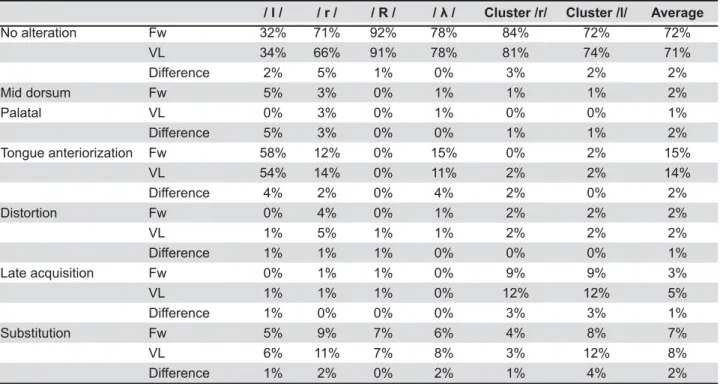
= ! # frequency of occurrence of consonant production errors during liquid sounds calculated in percentages. E( && difference in occurrence of sound production errors "9343<3 "# according to palatoplasty technique and according to age at palatoplasty.
RESULTS
" research site the primary palatoplasty for the & 9"# ] % %4"& & # '()* & closure) and 15-18 months (late closure). Out of the 460 children of interest for this study, only 397 (66%) had speech evaluation completed at the sixth year of life. Therefore, data reported & +'0 evaluations obtained from 237 males (60%) and 160 females (40%). A total of 163 children & % 7)F *+7 ] <'F4
While 189 children (48%) received early primary palatoplasty (9-12 months), 208 children (52%) received late primary palatoplasty (15-18 months). No secondary surgeries had been performed by the time the speech evaluations reported in this study ! &4
As indicated in Table 1, liquid sound productions # children at the sixth year of age (average=71%). Consonant production errors observed included: (a) middorsum palatal liquids (2%); (b) tongue anteriorization (14%); sound distortions (2%); delay in acquisition of liquids (4%); and simple substitutions (6%).
" & reported production errors for liquid consonants, # "">> 9"<<F#& "">>>@>)+F4 When used, middorsum palatal place of articulation 9">><F>> +F>@>)F)F4
/ l / / r / / R / Ȝ Cluster /r/ Cluster /l/ Average
No alteration Fw 32% 71% 92% 78% 84% 72% 72%
VL 34% 66% 91% 78% 81% 74% 71%
Difference 2% 5% 1% 0% 3% 2% 2%
Mid dorsum Fw 5% 3% 0% 1% 1% 1% 2%
Palatal VL 0% 3% 0% 1% 0% 0% 1%
Difference 5% 3% 0% 0% 1% 1% 2%
Tongue anteriorization Fw 58% 12% 0% 15% 0% 2% 15%
VL 54% 14% 0% 11% 2% 2% 14%
Difference 4% 2% 0% 4% 2% 0% 2%
Distortion Fw 0% 4% 0% 1% 2% 2% 2%
VL 1% 5% 1% 1% 2% 2% 2%
Difference 1% 1% 1% 0% 0% 0% 1%
Late acquisition Fw 0% 1% 1% 0% 9% 9% 3%
VL 1% 1% 1% 0% 12% 12% 5%
Difference 1% 0% 0% 0% 3% 3% 1%
Substitution Fw 5% 9% 7% 6% 4% 8% 7%
VL 6% 11% 7% 8% 3% 12% 8%
Difference 1% 2% 0% 2% 1% 4% 2%
Table 2- Distribution of percentage occurrence of consonant production errors during liquid targets for data distributed
according to surgical technique (Furlow versus von Langenbeck) for palatal repair
Fw: Samples of patients who received palatoplasty with Furlow technique VL: Samples of patients who received palatoplasty with von Langenbeck technique Difference: difference in % between groups Fw and VL
/ l / / r / / R / Ȝ Cluster /r/ * Cluster /l/ Average
No alteration 9-12 33% 70% 92% 78% 86% 75% 72%
15-18 35% 67% 91% 78% 79% 74% 71%
Difference 2% 3% 1% 0% 7% 1% 2%
Mid dorsum palatal 9-12 7% 4% 0% 1% 1% 1% 2%
15-18 3% 2% 0% 1% 0% 0% 1%
Difference 4% 2% 0% 0% 1% 1% 1%
Tongue anteriorization 9-12 56% 13% 0% 12% 1% 2% 14%
15-18 54% 13% 0% 13% 1% 2% 14%
Difference 2% 0% 0% 1% 0% 0% 1%
Distortion 9-12 0% 5% 1% 3% 3% 3% 3%
15-18 1% 5% 0% 0% 1% 1% 1%
Difference 1% 0% 1% 3% 2% 2% 2%
Late acquisition 9-12 0% 0% 2% 0% 7% 8% 3%
15-18 0% 1% 1% 0% 14% 14% 5%
Difference 1% 0% 0% 0% 7%* 6% 2%
Substitution 9-12 4% 8% 5% 6% 2% 8% 6%
15-18 7% 12% 8% 8% 5% 9% 8%
Difference 3% 4% 3% 2% 3% 1% 3%
Table 3- Distribution of percentage occurrence of consonant production errors during liquid targets for data distributed
according to age at primary palatoplasty (early versus late)
9-12: Samples of patients who received palatoplasty between 9 and 12 months 15-18: Samples of patients who received palatoplasty between 15 and 18 months Difference: difference in % between groups 9-12 and 15-18
DISCUSSION
6 &# production errors during liquid sounds for children *;F4 E " & and dento-occlusal abnormalities, especially # & explain articulation of tongue dorsum and a more posteriorized area of the hard palate. Other possible structural deviations that may contribute 9"" and dentition stage of children at sixth year of age (primary and mixed dentition). As reported in the " 9&( occlusal abnormalities are suggested by some authors17,27 to be the reason for adjustment of the tongue to a reduced oral space.
Particularly, the use of MDPS has been related to
]=>917,234%"
these authors explanation for occurrence of MDPS, one can also suggest that middorsum palatal " the presence of open structure. After experiencing ###" anatomical structure, posteriorized tongue posture # #" &&9 and VPD. The use of atypical place of production, such as pharynx or larynx, as place of articulation &4G 9"" that CAs, such as glottal stops and pharyngeal fricatives, are used for sounds that require higher amounts of intraoral air pressure.
Significant difference in the occurrence of & #"" %"#"" primary palatoplasty (early and late). Establishing a #& place of articulation during liquids and surgical "& controlling variables such as the presence of VPD, 9 4 % studies addressing these variables, therefore, are recommended.
Correct production of speech sounds depends on & "4 CLP are often hospitalized and commonly present hearing loss secondary to persistent middle ear _ & " presenting consonant production errors. Hardin-Jones and Hardin-Jones7 *33< "" the advances observed in management of CLP, ^& 2*F " & sound development. According to Morris and
Ozanne14 (2003), consonant cluster reductions 9 <3F normal expressive language. Trost-Cardamone23 (2004) also reports that around 50% of children B therapy during pre-school years. In our study, late acquisition (4%), distortions (2%), and sound substitution (6%) for liquids together represented & ))F 4 G 9" "" & & _ 9"4E" & & & # investigations.
Liquid sounds in the Brazilian Portuguese language are usually completely acquired by the end of the 6th year of life25,26. Significant differences due to timing of palatal surgery, ! # '()* )<(); months. Studies have suggested that the earlier the surgery establishes adequate oral structure and velopharyngeal functioning, the greater the speech16. In the present study, children operated earlier (9 and 12 months) developed the use of the consonant cluster /r/ sooner than children operated on later (15-18 months). While consonant clusters are one of the last phonological acquisitions14 their production depends on more complex articulatory ^& /r/. It appears that articulatory adjustments that 9 " >>#& established in more favorable morphological conditions.
Finally, the overall functioning of the speech system is determined by structural and functional aspects of speech structures6. Some changes in the articulatory production can be related to anatomic conditions such as deep palate, anterior open bite, crossbite, thickness of the alveolar ridge, degree of teeth protrusion or maxillary retrusion, tongue # 4 Other changes may be related to the presence and late maintenance of oral habits (such as use of 9 "" " ear pathologies). In this retrospective study, variables like dental conditions, oral habits, and " justifying further prospective investigations.
CONCLUSION
"& corrected unilateral CLP. With the exception tongue anteriorization during /l/ productions <<F & 4 "9 # during liquid production due to surgical technique, &"9" >> # children operated early and those operated late.
ACKNOWLEGMENTS
G &#&" brazilian government (CNPq) for junior investigator.
REFERENCES
)( 4 % #4 74 4 #V Pró-Fono; 2005.
*(B%49 labiopalatina operada. Pró-Fono. 1996;8(1):36-46.
3- Ball MJ. Manner of articulation. In: Ball MJ. Phonetics for speech pathology. London: Whurr; 1993. p. 34-42.
4- Callou D, Leite Y. Iniciação à fonética e à fonologia. 10ª. ed. Rio de Janeiro: Jorge Zahar; 2005.
5- Dutka JCR, Zimmermann MC, Tabith A. Identification of & &"
&4<<th Annual Meeting of the American
Cleft Palate-Craniofacial Association; 1998 Apr. 20-25; Baltimore, Maryland.
2( % E4 %" "V motricidade oral e audiologia. 1ª ed. São Paulo: Pancast; 1999. 7- Hardin-Jones MA, Jones DL. Speech production of preschoolers 44*33<$7*)V0()+4 ;(" =B=B&GG( JE, Withehill TL, et al. Universal parameters for reporting speech 4 J. 2008,45(1):1-17.
9- Jesus MSV, Di Ninno CQMS. Fissura labiopalatina - fundamentos para a prática fonoaudiológica. Brasil: Roca; 2009.
10- Jones CE, Chapman KL, Hardin-Jones MA. Speech development #"&4 Palate Craniofac J. 2003;40(1):19-31.
11- Kent RD. Research on speech motor control and it disorders: a 4=4*333$++<V+')(7*04
12- Kummer AW. Cleft palate and craniofacial anomalies: effects on speech and resonance. Clifton Park: Thomson Delmar Learning; 2001.
13- McWilliams BJ, Randall P, LaRossa D, Cohen S, Yu J, Cohen E 4 B % & " 4 Reconstr Surg. 1996:98(4)610-9.
14- Morris H, Ozanne A. Phonetic, phonological, and language 4 4 2003;40(5):460-70.
15- Pegoraro-Krook MI, Dutka-Souza JCR, Magalhães LCT, Feniman E?46"946V% 9(=E"B 4G%"4 São Paulo: Rocca; 2004. p. 339-455.
)2( 4B an isolated cleft palate: a longitudinal perspective. Cleft Palate Craniofac J. 2006;(43)3:295-309.
17- Peterson-Falzone SJ, Hardin-Jones MA, Karnell MP. Cleft palate speech. 3rd ed. St. Louis: Mosby; 2001.
18- Peterson-Falzone SJ, Trost-Cardamone JE, Karnell MP, Hardin-Jones MA. The clinician's guide to treating cleft palate speech. St. Louis: Mosby; 2006.
19- Santelmann L, Sussman J, Chapman K. Perception of repaired cleft palate. Cleft Palate Craniofac J. 1999;36:233-42. 20- Silva TC. Fonética e fonologia do português: roteiro de estudos "!4;4BV!$*33<4
21- Trindade IEK, Silva Filho OG. Fissuras labioplatinas: uma abordagem interdisciplinar. São Paulo: Editora Santos; 2007. 22- Trost JE. Articulatory additions to the classical descriptions of 44)';)$);V*+3('4 *+(G( 4="9 error patterns for planning therapy or physical management needs. In: Bzoch KR, ed. Communicative disorders related to cleft lip and palate. 5th ed. Austin: Pro-Ed; 2004.
24- Warren DW. Aerodynamic assessments and procedures to determine extent of velopharyngeal inadequacy. In: Bzoch KR, ed. Communicative disorders related to cleft lip and palate. 5th
ed. Austin: Pro-Ed; 2004.
*<(%B%6 HB%49 do distúrbio fonológico por meio de duas medidas de análise: "£ dos processos (PDI). Pró-Fono. 2001;13(1):90-7.