SUMMARY
Objective: To describe the proile of the reports of child and adolescent abuse in the state of São Paulo in 2009, and to analyze possible associated factors. Methods: A to-tal of 4,085 reports regarding children and adolescents younger than 15 years recorded by the Domestic, Sexual, and Other Interpersonal Violence Surveillance System (Siste-ma de Vigilância de Violência Doméstica, Sexual e Outras Violências Interpessoais – VIVA) were analyzed using a logistic regression model. Results: he females comprised 61.4% of the total cases. he most common age group among females was 10 to 14 years (38.8%) and among males was < 5 years (35.8%). Physical abuse accounted for 43.3% of cases in males, and sexual abuse cases accounted for 41.7% of cases in females. he main perpetrators of the abuse were parents (43.8% of the total) and acquaintances (29.4%). Male aggressors were 72.0% of the total. he abuse occurred at home in 72.9% of cases; repeated abuse was reported in 51.4% of cases. Diferences between the cases of physi-cal and sexual abuse: a) physiphysi-cal abuse – mostly males (50.9%), parents as perpetrators (48.4%), and women as perpetrators (42.8%), b) sexual abuse – mostly females (77.2%), known aggressors (48.4%), and men as perpetrators (96.1%). Variables associated with physical abuse: male gender (OR: 2.22), age 10-14 years (OR: 1.68), and parents as per-petrators (OR: 2.50). Sexual abuse was associated with female gender (OR: 2.84), age 5-9 years (OR: 1.66), and unknown authors (OR: 1.53). Conclusion: Public policies should guarantee that children and adolescents have a healthy and violence-free life. he analy-sis of the notiications is an important tool to establish prevention strategies.
Keywords: Abuse; external causes; domestic violence; sexual violence.
©2012 Elsevier Editora Ltda. All rights reserved.
Study conducted at Centro de Vigilância Epidemiológica/ Secretaria de Saúde do Estado de
São Paulo, São Paulo, SP, Brazil
Submitted on: 01/25/2012
Approved on: 07/01/2012
Correspondence to:
Vilma Pinheiro Gawryszewski Pan American Health Organization 525 23 rd St, NW Washington, DC, 20037 United States of America Phone: 1-202-492-7482 [email protected] [email protected]
Conlict of interest: None.
Child and adolescent abuse in the state of São Paulo, Brazil, 2009
VILMA PINHEIRO GAWRYSZEWSKI1, DALVA MARIADE OLIVEIRA VALENCICH2, CLÁUDIA VIEIRA CARNEVALLE3, LUIZ FRANCISCO MARCOPITO4
1 PhD in Public Health, Universidade de São Paulo; Advisor, Health Information and Analysis Project, Pan American Health Organization, EUA
2 Nurse; Divisão de Doenças e Agravos não Transmissíveis, Centro de Vigilância Epidemiológica, Coordenadoria de Controle de Doenças (CCD), Secretaria de Saúde do Estado de São
Paulo (SES-SP), São Paulo, SP, Brazil
3 MSc in Evaluation of Health Management, Santa Casa de São Paulo; Psycologist, Divisão de Doenças e Agravos não Transmissíveis, Centro de Vigilância Epidemiológica, CCD, SES-SP,
São Paulo, SP, Brazil
INTRODUCTION
It is the right of every child to have a healthy and violence-free life; society and public policies should ensure that right. Nevertheless, estimates of the World Health Orga-nization (WHO) show that millions of children worldwide are victims or witnesses of violence, which can seriously afect their health, quality of life, and full development1-3.
his is an old problem, as the irst scientiic article describ-ing a spanked child was a monograph by a French coro-ner in 18604. here is evidence that abuse, whether
expe-rienced or witnessed, can afect the physical and mental health of children not only in the short-term, but also in the medium- and long-term.
hese efects include learning disabilities, behavioral and relationship disorders, smoking, harmful alcohol use, depression, and psychological problems, among others1,5,6. Particularly, studies on the efects of abuse on
brain development in the early stages of childhood have shown that the infant brain, subjected to chronic stress, focus its resources on survival and response to threats from the environment1. his mechanism may lead to
the accentuated development of the brain regions that respond to anxiety and fear, at the expense of regions responsible for complex thinking, including learning. Moreover, evidence also shows that early intervention may minimize these efects1.
Although abuse against children and adolescents dates back to antiquity, it only began to be the object of study and research approximately 45 years ago2. It was
precisely the lack of systematic, reliable, and continu-ous data that constituted one of the major obstacles for the establishment of policies and actions to ight against it. Although the health sector received a special direc-tive from the Child and Adolescent Statute (Estatuto da Criança e do Adolescente – ECA) in 1990, which is the duty to report cases of abuse, the analysis of this infor-mation was not carried out on a regular basis. In 2006, the Brazilian Ministry of Health took an important step in this direction by nationally implementing the Domes-tic, Sexual, and Other Interpersonal Violence Surveil-lance System (VIVA), to collect data from surveilSurveil-lance services through a notiication form of domestic, sexual, and other types of violence7.
he present study aims to describe the cases of abuse against children and adolescents younger than 15 years registered in the VIVA system in the state of São Paulo in 2009, and to study possible associated factors.
METHODS
he data source used was the VIVA system, which is part of the System of Compulsory Notiication of Dis-eases (Sistema de Agravos de Notiicação Compulsória – SINAN NET). he information refers to cases that
occurred in 2009, in the state of São Paulo (data extraction date: May 4, 2010). he data collection instrument was the Notiication Form of Domestic, Sexual, and Other Types of Violence, which is nationally standardized7. A total of 4,085
valid reports of cases of abuse in children and adolescents younger than 15 years of age, carried out by 429 surveil-lance services, were analyzed. Although this study used secondary data on abuse, from compulsory notiication in the country, it was approved by the Ethics Committee of the Reference and Training Center in STD/AIDS – SP.
TYPOLOGYOFABUSE – DEFINITIONS
he term “abuse against children and adolescents” is in-ternationally accepted and refers to any form of physical, emotional, and sexual abuse, neglect, and/or any form of commercial exploitation and other types of abuse1. he
deinitions used in this study to classify the diferent types of abuse are listed below, and have been taken and adapted from the Notiication Form Instruction prepared by the Brazilian Ministry of Health7 and World Health
Organiza-tion3,8. It is noteworthy that the Notiication Form includes
other deinitions that are not shown here due to their low frequency. Additionally, this tool accepts the registration of one or more types of abuse in each event.
Physical abuse consists of violent acts that use physical force intentionally, not accidentally, with the objective to hurt, injure, cause pain and sufering, or to destroy the individual, whether or not leaving evident marks on his/ her body.
Psychological abuse is any form of rejection, deprecia-tion, discriminadeprecia-tion, disrespect, exaggerated demands, humiliating punishments, and use of the individual to meet the psychological needs of another. It is any action that endangers or causes damage to the individual’s self-esteem, identity, or personal development.
Sexual abuse is forcing someone to witness, maintain, or participate in unwanted sexual intercourse, through intimidation, coercion, or threat of force; to sell or use the individual’s sexuality in any way. hat is, every action in which a person, whether or not involving any type of power relationship, compels another person to carry out sexual acts against his or her will, by means of physical force, psychological inluence, use of weapons, or drugs.
DATAANALYSIS
First, a descriptive study of the following variables of inter-est was carried out: 1) demographic data (gender, age, eth-nicity, and education); 2) characteristics of the abuse (type of abuse, victim/perpetrator relationship, place of occur-rence, and repeated or recurring abuse), and 3) referrals to the service network (referrals to other institutions outside the health care sector).
Data are presented as absolute numbers and percent-ages. Considering that these data were from surveillance services, rates were not calculated for the state.
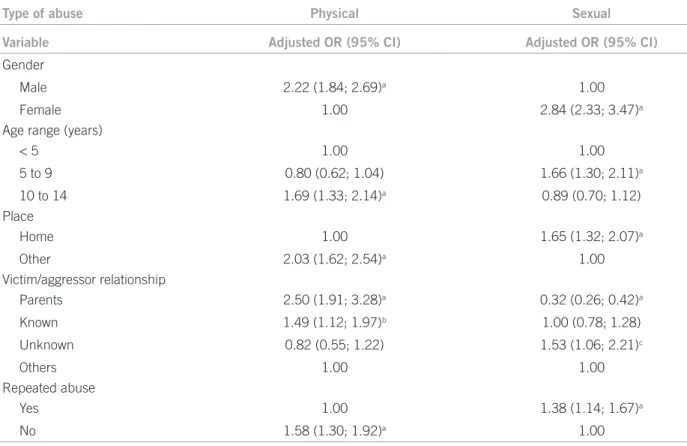
To study the association between the types of abuse and associated factors, logistic regression models were designed for the two most common types of abuse (physical and sexual abuse), using the stepwise forward procedure (including one variable at a time); a variable was maintained in the model when the descriptive level of the test was < 0.05 (p < 0.05). he dependent vari-able was the type of abuse compiled into two categories (physical = 1, all other types = 0; sexual = 1, all others = 0). he independent variables were gender, age range, com-piled places of occurrence (home = 1, all others = 0), compiled victim/perpetrator relationship (parents, acquaintances, strangers, and others), and repeated abuse. Odds ratios (OR) with 95% conidence intervals (95% CI) were calculated. Tests were performed with a signiicance level of 5%. he analyses were performed using the Statistical Package for Social Sciences (SPSS) version 13.0 for Windows.
he results shown here refer to 4,085 reports of abuse against children and adolescents younger than 15 years, carried out in 2009, which represented 29.1% of all noti-ications in that year.
RESULTS
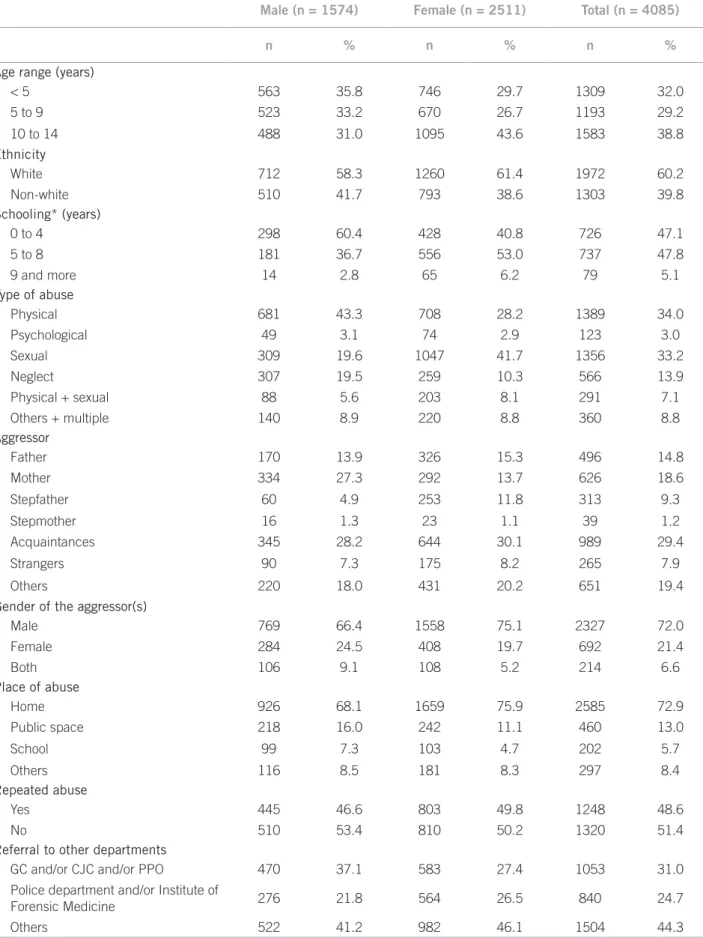
Table 1 shows the predominance of females among the re-ported cases, which accounted for 61.5% of the total (2,511 cases), while males represented 38.5% (1,574 cases). he age group with the highest number of cases was 10 to 14 years (38.8%), followed by the range of younger than 5 years (32.0%), and 5 to 9 years (29.2%). However, in rela-tion to gender, this distriburela-tion was diferent, as the noti-ications in the male gender occurred at younger ages than in females; the largest proportion of notiications among males was found in the age range younger than 5 years, whereas among females the predominant age range was 10 to 14 years. Children and adolescents classiied or referred to as whites accounted for 60.2% of all victims, while non-whites were 39.8%; this distribution by gender showed no marked diferences. As for the educational level of children aged 7 years or more, most of the reported cases had had between 5 and 8 years of schooling (47.8%), followed by those with 0 to 4 years (47.1%), and 9 years or more (5.1%).
Regarding the nature of the abuse, the most preva-lent were cases of physical abuse alone or associated with psychological abuse (34.0%), followed by sexual abuse alone (33.2%), neglect/abandonment (13.9%), other types of abuse and multiple forms (8.8%), sexual abuse associated with physical abuse (7.1%), and psychologi-cal abuse (3.0%). he main diference found in relation to gender was the higher proportion of sexual abuse in females (33.2% of total cases in females) than in males (19.5% of total cases in males). In contrast, the frequen-cies of physical abuse and neglect were higher among males. In almost half of these events (43.8%), the per-petrators of the aggression were the parents of the vic-tims: mother (18.6%), father (14.8%), stepfather (9.3%), and stepmother (1.2%). Acquaintances, including other family members were responsible for 29.0% of the cases, while strangers were responsible for 7.9% of cases. his distribution showed diferences regarding gender, high-lighting the high proportion of mothers as perpetrators of aggression against males. Most aggressors were males, 72% of the total.
Regarding the place of occurrence of these events, it was observed that home was the most frequent (72.9%) for both genders, but it was more common among fe-males (75.9%) than fe-males (66.4 %). Public streets or oth-er public places, including roads, highways, and squares ranked second, accounting for 13.0% of the total. 5.7% of cases occurred at school. Abuse was reported as repeated abuse in almost half of cases (48.6%), with no signiicant diferences between genders. he evaluation of referral to the care network for individuals in situations of abuse showed that 70.7% of cases were referred to the follow-ing institutions: Guardianship Council (GC), Child and Juvenile Courts (CJC), and Public Prosecution Oice (PPO) (25.8% of referred cases); special Police Depart-ments and Forensics Institutes (27.5% of referred cases), and other institutions, such as shelters, surveillance pro-grams, and Child Protection and Social Assistance Ser-vices (46.7% of referred cases).
Male (n = 1574) Female (n = 2511) Total (n = 4085)
n % n % n %
Age range (years)
< 5 563 35.8 746 29.7 1309 32.0
5 to 9 523 33.2 670 26.7 1193 29.2
10 to 14 488 31.0 1095 43.6 1583 38.8
Ethnicity
White 712 58.3 1260 61.4 1972 60.2
Non-white 510 41.7 793 38.6 1303 39.8
Schooling* (years)
0 to 4 298 60.4 428 40.8 726 47.1
5 to 8 181 36.7 556 53.0 737 47.8
9 and more 14 2.8 65 6.2 79 5.1
Type of abuse
Physical 681 43.3 708 28.2 1389 34.0
Psychological 49 3.1 74 2.9 123 3.0
Sexual 309 19.6 1047 41.7 1356 33.2
Neglect 307 19.5 259 10.3 566 13.9
Physical + sexual 88 5.6 203 8.1 291 7.1
Others + multiple 140 8.9 220 8.8 360 8.8
Aggressor
Father 170 13.9 326 15.3 496 14.8
Mother 334 27.3 292 13.7 626 18.6
Stepfather 60 4.9 253 11.8 313 9.3
Stepmother 16 1.3 23 1.1 39 1.2
Acquaintances 345 28.2 644 30.1 989 29.4
Strangers 90 7.3 175 8.2 265 7.9
Others 220 18.0 431 20.2 651 19.4
Gender of the aggressor(s)
Male 769 66.4 1558 75.1 2327 72.0
Female 284 24.5 408 19.7 692 21.4
Both 106 9.1 108 5.2 214 6.6
Place of abuse
Home 926 68.1 1659 75.9 2585 72.9
Public space 218 16.0 242 11.1 460 13.0
School 99 7.3 103 4.7 202 5.7
Others 116 8.5 181 8.3 297 8.4
Repeated abuse
Yes 445 46.6 803 49.8 1248 48.6
No 510 53.4 810 50.2 1320 51.4
Referral to other departments
GC and/or CJC and/or PPO 470 37.1 583 27.4 1053 31.0
Policedepartment and/or Institute of
Forensic Medicine 276 21.8 564 26.5 840 24.7
Others 522 41.2 982 46.1 1504 44.3
*The percentages were calculated for cases with known information. CG, Guardianship Council; CJC, Child and Juvenile Courts; PPO, Public Prosecution Office.
sexual abuse was 1.7 times signiicantly more likely to occur at home compared to “other places”. Compared to the “others” category, parents were 2.5 times more likely to be the perpetrators of physical aggression, whereas strangers were 1.5 times more likely. Among the report-ed cases, physical abuse was 1.6 times more likely to be non-recurring or repeated, while sexual abuse was 1.4 times more likely to be recurrent.
DISCUSSION
Child abuse is a matter of great complexity, as its dynam-ics and its determinant factors, as well as efective preven-tion strategies, difer markedly depending on the age of the victim, the scenario where the abuse occurs, and the rela-tionship between the victim and the aggressor1. his fact
is an important reason for health professionals to submit notiications, and for subsequent epidemiological analysis and dissemination of results, so that these factors can be better understood and preventive actions can be scientii-cally established.
Current scientiic knowledge shows that these inter-ventions should occur as early as possible in order to prevent potential harm to the physical and mental health of these children and, consequently, to their future.
A study showed an association between physical abuse and a diagnosis of attention deicit disorder and disrup-tive behavior6.
he indings of the present study show that violence is rooted in the Brazilian family, as home was the place of occurrence of most cases, and parents and stepparents were the main perpetrators of these acts. Moreover, the results are consistent with national data, which also have shown that younger children (aged 0 to 9 years) are the ones that most oten sufer abuse, that physical aggres-sion is the most prevalent type of abuse, and that home is where most cases of abuse occur4,9.
Also noteworthy is a study performed in Salvador, which used the Special Police Departments for the Pro-tection of Children and Adolescents as the data source, where the authors observed that there had been no no-tiications from health professionals; physical abuse was the most prevalent type of abuse, especially among males, and most aggressors were males10. Signiicant
dif-ferences were observed regarding the type of abuse and gender of the victim, demonstrating gender issues that deserve further consideration, both from a theoretical standpoint and the necessity to perform more studies to analyze this problem in detail. Special attention should
Type of abuse Physical Sexual
Variable Adjusted OR (95% CI) Adjusted OR (95% CI)
Gender
Male 2.22 (1.84; 2.69)a 1.00
Female 1.00 2.84 (2.33; 3.47)a
Age range (years)
< 5 1.00 1.00
5 to 9 0.80 (0.62; 1.04) 1.66 (1.30; 2.11)a
10 to 14 1.69 (1.33; 2.14)a 0.89 (0.70; 1.12)
Place
Home 1.00 1.65 (1.32; 2.07)a
Other 2.03 (1.62; 2.54)a 1.00
Victim/aggressor relationship
Parents 2.50 (1.91; 3.28)a 0.32 (0.26; 0.42)a
Known 1.49 (1.12; 1.97)b 1.00 (0.78; 1.28)
Unknown 0.82 (0.55; 1.22) 1.53 (1.06; 2.21)c
Others 1.00 1.00
Repeated abuse
Yes 1.00 1.38 (1.14; 1.67)a
No 1.58 (1.30; 1.92)a 1.00
ap < 0.001; bp < 0.05; cp < 0.01.
be given to the proportion of reports of abuse in females, which is related to the subordinate status of women in society, which begins in childhood.
The results presented here are subject to some limi-tations; the main most important is the incapacity to generalize the data and therefore construct overall rates, as the data were not collected universally, but in sur-veillance services. Therefore, it should be noted that de-spite the significant number of cases, the collected data could still be underestimated. As an example, a study carried out in two emergency services in Rio de Janeiro has showed low identification and reporting of cases of abuse in these services11. Another aspect concerns the
impossibility of performing analyses associating the cases with socioeconomic variables and inequalities, which are seen as structural factors that may favor the occurrence of abuse9.
Among the positive and promising findings in this study are the significant number of notifications and the finding that 70% of reported cases were referred to in-stitutions outside the health sector, which belong to the care network for individuals in situations of violence. This fact indicates a commitment to the referral of these cases and the existence of some interdisciplinary and intersectoral organization, essential to stop this type of abuse, which, most of the times, is beyond the scope of healthcare actions. Moreover, the role of the health sector regarding this problem is neither easy, nor vol-untary. It is understood that the reporting of suspected or confirmed cases is the most important weapon that can be used by the professional, as it starts the process of assistance and aid to the children and families12.
Con-versely, it is recognized that there are difficulties to be faced. Studies carried out among pediatricians indicat-ed possible factors: low level of confidence in the child protection agencies; little or no training on the subject; fear of becoming involved legally; and ignorance that the notification should be performed when suspecting abuse, not upon abuse confirmation13-16.
It is also known that the great demand for public services may compromise the quality of care given to specific groups17, but the consultation time must be
used to provide public health education18, and to advise
parents and guardians regarding care that goes beyond simple childcare. The results shown here indicate that many health professionals are identifying the suspected abuse, breaking the silence and reporting those cases. It is important to note that these professionals are in a unique position to diagnose, notify, and refer cases to the adequate reference services. Suspected abuse should be part of routine examination of the child. Thus, these professionals can help break the cycle of abuse that jeop-ardizes the future of many children and their families.
CONCLUSION
The VIVA system constitutes a source of important in-formation on abuse against children and adolescents. The results of this study provide a general profile of notifications in children younger than 15 years, show-ing that physical abuse was the predominant type, that main perpetrators of abuse were the parents, and that home was the main location of these occurrences. Given its high prevalence, it is recommended that the diagno-sis of abuse be a part of the routine examination of the children. In addition, this study emphasizes the adapta-tion to the Brazilian context of the abuse module of the Integrated Management of Childhood Illness (IMCI), proposed by the Pan-American Health Organization19.
Additionally, strategies to prevent abuse should empha-size the interconnection of social and public programs policies with public health policy.
REFERENCES
1. World Health Organization, International Society for Prevention of Child Abuse and Neglect. Preventing child maltreatment: a guide to taking ac-tion and generating evidence. Geneva: World Health Organizaac-tion Library Cataloguing-in-Publication Data; 2006.
2. World Health Organization, London School of Hygiene and Tropical Medi-cine. Preventing intimate partner and sexual violence against women: tak-ing action and generattak-ing evidence. Geneva, World Health Organization, 2010. [cited 2011 jul 7]. Available from: http://www.who.int/violence_in-jury_prevention/publications/violence/9789241564007_eng.pdf.
3. Deslandes SF, Assis SG, Santos NC. Violência envolvendo crianças no Brasil – um plural estruturado e estruturante. In: Impacto da violência na saúde dos brasileiros. Brasília (DF): Secretaria de Vigilância em Saúde. Ministério da Saúde; 2005.
4. Aded NLO, Dalcin BLGS, Moraes TM, Cavalcanti MT. Abuso sexual em crianças e adolescentes: revisão de 100 anos de literatura. Rev Psiquiatria Clín. 2006;33(4):204-13.
5. Hill, Terrence D, Schroeder RD, Bradley C, Kaplan LM, Angel RJ. he long-term health consequences of relationship violence in adulthood: an exami-nation of low-income women from Boston, Chicago, and San Antonio. Am J Public Health. 2009;99:1645-50.
6. Abramovitch S, Maia MC, Cheniaux E. Transtornos de déicit de atenção e do comportamento disruptivo: associação com abuso físico na infância. Rev Psiquiatr Clín. 2008;35(4):159-64.
7. Brasil. Ministério da Saúde. Secretaria de Vigilância em Saúde. Departa-mento de Análise de Situação de Saúde. Viva: Vigilância de Violências e acidentes; 2009. Ministério da Saúde, Vigilância em Saúde. Departamento de Analise de Situação de Saúde. Brasília (DF): Editora do Ministério da Saúde; 2010. [cited 2011 jun 27]. Available from: http://portal.saude.gov.br/ portal/arquivos/pdf/viva_2008_2009_30_11_2010.pdf.
8. Ministério da Saúde. Secretaria de Vigilância em Saúde. Manual instrutivo de preenchimento da icha de notiicação//investigação individual de vio-lência doméstica, sexual e/ou outras viovio-lências. [cited 20 jan 2011]. Avail-able from: http://www.cve.saude.sp.gov.br/htm/cve_dnc.htm.
9. Schraiber LB, D’Oliveira AFPL, Couto MT. Violência e saúde: estudos cientíicos recentes. Rev Saúde Pública. 2006;40(n. esp.):112-20.
10. Carvalho ACR, Barros SG, Alves AC, Gurgel CA. Maus-tratos: estudo através da perspectiva da delegacia de proteção à criança e ao adolescente em Salvador, Bahia. Ciênc Saúde Coletiva. 2009;14(2):539-46.
11. Moura ATMS, Moraes CL, Reichenheim ME. Detecção de maus-tratos con-tra a criança: oportunidades perdidas em serviços de emergência na cidade do Rio de Janeiro, Brasil. Cad Saúde Pública. 2008;24(12):2926-36. 12. Barbosa PZ, Pegoraro RF. Violência doméstica e psicologia hospitalar:
possi-bilidades de atuação diante da mãe que agride. Saúde Soc. 2008;17(3):77-89. 13. Bannwart TH, Brino RF. Diiculdades enfrentadas para identiicar e notii-car casos de maus-tratos contra crianças e/ou adolescentes sob a óptica de médicos pediatras. Rev Paul Pediatr. 2011;29(2):138-45.
14. Pires JM, Goldani MZ, Vieira EM, Nava TR, Feldens L, Castilhos K, et al. Barreiras, para a notiicação pelo pediatra, de maus-tratos infantis. Rev Bras Saúde Mater Infant. 2005;5(1):103-8.
16. Luna GLM, Ferreira RC, Vieira LJES. Notiicação de maus-tratos em cri-anças e adolescentes por proissionais da Equipe Saúde da Família. Ciênc Saúde Coletiva. 2010;15(2):481-91.
17. Nomura RMY, Benute GRG, Azevedo GA Dutra SEM, Borsari CG, Rebouças MSS, et al. Depressão, aspectos emocionais e sociais na vivência do aborto: comparação entre duas capitais brasileiras. Rev Assoc Med Bras. 2011;57(6):644-50.
18. Mourão PR. Tempo decorrido desde a última consulta: análise de um mod-elo estatístico aplicado ao caso das mulheres na Espanha. Rev Assoc Med Bras. 2011;57(2):164-70.