medical ethics
Lorena Cunha Ferreira 1, Rogério Antunes Mourão 2, Rogério José de Almeida3
Abstract
This aricle aims to characterize the perspecives of professors from a medicine course about medical ethics. It is a descripive cross-secional study with a quanitaive approach. Two quesionnaires were applied to the 86 professors of the medicine course at PUC-Goiás: a socio-demographic quesionnaire and another which assessed knowledge and interest in medical ethics. A descripive analysis was performed using the Kolmog-orov-Smirnov, Spearman, Mann-Whitney, chi-square and t tests (<0.05). The results found that the medical professors are aware of the Code of Medical Ethics and recommend its applicaion during all modules of the course. A minority updated their knowledge of the subject frequently, have read the code completely and used it to prepare their lessons. We concluded that the higher the self-assessment of knowledge about med-ical ethics and the importance of this for the professor’s own training, the greater the interest in using the Code in relaion to his or her students, speciically in the preparaion and implementaion of lessons.
Keywords: Educaion, medical. Teaching. Ethics, medical.
Resumo
Perspecivas de docentes de medicina a respeito da éica médica
Este arigo tem por objeivo caracterizar as perspecivas dos docentes médicos de um curso de medicina em relação à éica médica. Trata-se de estudo transversal descriivo com abordagem quanitaiva. Foram apli-cados a 86 docentes médicos do curso de medicina da PUC-Goiás dois quesionários: um sociodemográico e outro de avaliação do conhecimento e interesse em éica médica. Realizou-se análise descriiva, teste de Kolmogorov-Smirnov, Spearman, Mann-Whitney, Qui-quadrado e teste t (< 0,05). Os resultados mostram que os docentes conhecem o Código de Éica Médica (CEM) e o recomendam no decorrer de todos os módulos do curso. Uma minoria atualiza-se com frequência, leu totalmente o CEM e o uiliza no preparo de suas aulas. Conclui-se que, quanto maior a autoavaliação do conhecimento sobre éica médica e sua importância para a própria formação proissional, maior também é o interesse em uilizar o CEM na relação com os alunos, especiicamente na elaboração e realização das aulas.
Palavras-chave: Educação médica. Ensino. Éica médica.
Resumen
Perspecivas de los docentes de medicina acerca de la éica médica
Este arículo iene como objeivo caracterizar las perspecivas de los médicos docentes de una escuela de medicina en relación con la éica médica. Se trata de un estudio transversal, de ipo descripivo, con abordaje cuanitaivo. Se aplicaron dos cuesionarios a 86 profesores médicos del curso de medicina de la PUC-Goiás: una evaluación socio-demográica y otra de conocimientos e interés en la éica médica. Se realizó un análisis descripivo, la prueba de Kolmogorov-Smirnov, Spearman, Mann-Whitney, chi-cuadrado y la prueba t (<0,05). Los resultados muestran que los profesores médicos conocen el Código de Éica Médica y lo recomiendan en el trascurso de todos los módulos del curso. Una minoría actualiza sus conocimientos sobre éste con fre-cuencia, lo leyó totalmente y lo uilizan en la preparación de sus clases. Se concluye que cuanto mayor es la autoevaluación de conocimientos acerca de la éica médica y la importancia de ésta para su propia formación profesional, mayor es también el interés en uilizar el Código en la relación con los estudiantes, especíica-mente en la elaboración y ejecución de las clases.
Palabras-clave: Educación médica. Enseñanza. Éica médica.
Aprovação CEP/PUC-Goiás CAAE 39325614.9.0000.0037
1. Graduada [email protected] 2. Graduado [email protected] 3. Doutor [email protected] – Poniícia Universidade Católica de Goiás (PUC-Goiás), Goiânia/GO, Brasil.
Correspondência
Rogério José de Almeida – Rua 6, nº 250, apt. 603-C, Ediício Guarnieri CEP 74810-130. Goiânia/GO, Brasil. Declaram não haver conlito de interesse.
R
esear
Medical faculty careers in medical courses at Brazilian universiies usually start without the proper insituional and pedagogical supervision of these lecturers. Among medical lecturers, especial-ly doctors, in addiion to the technical skills of their profession, it is required to have didacic and edu-caional atributes that not only facilitate the access of students to basic knowledge, allowing them to develop technical and humanisic skills, but also the ability to awaken an understanding of the needs of
the community of which they are part 1.
Moreover, it is common for a medical lectur-er’s career to begin with the prospect of gaining professional medical status and to progress as they reach the stages that establish an academic career. Added to that are professional recogniion and scieniic acceptance, elements that inluence an in-crease in remuneraion. The passage from one stage to another is linked to both professional endeavours
as well as personal merits 2. The vast majority of
medical teachers tend to start their career in teach-ing without the necessary trainteach-ing in educaional
methodology 3.
The medical lecturer’s role has changed in re-cent imes. The tradiional knowledge-transferring lecturer is giving way to learning facilitators. In Bra-zil, the Naional Curriculum Guidelines (Diretrizes Curriculares Nacionais) for medical courses have
stated, in Aricle 26, that the degree course in
medi-cine will focus educaional projects on the student as the subject of learning and be supported by the lec
-turer as facilitator and process mediator, with a view to providing full and proper training to the student 4.
Lecturers need to have, not only a vocaion for teaching, but also competence, the right aitude, dedicaion and knowledge of ethical responsibiliies
and rights 5.
New medical schools adopt proacive method-ologies, applying these strategies during the course, among which the “methodology of quesioning” and “problem-based learning” are prioriised. With this approach, it is notable that, in daily contact with students, the medical faculies have been further consolidated as resources of experise and as opin-ion makers regarding medical conduct and careers. In many cases, this relaionship shows the strong inluence of the lecturer on the student, especial-ly because of the trust they place in their mentor’s words and conduct, and in the reciprocity of the teaching-learning process. It is a fact that, during the medical course, this relaionship is characterized by the direct inluence of the lecturer on the future
aitudes and proiciencies of students 3.
Today, before the transformaions menioned above and the great changes that medicine has experienced in recent years, the study of medical ethics has become of great importance in order to understand the reality of professional pracice and to anicipate new situaions that could impose themselves on the lives of future doctors. Therefore, to strengthen the pracice of medicine, medical eth-ics is translated into a code of etheth-ics that regulates medical conduct through devices to be adopted by professionals.
In Brazil, the current Code of Medical Ethics (Código de Éica Médica - CEM) came into force on
13th April 2010, ater two years work in conferences
and reviews with doctors and civil society eniies, incorporaing a new concept of the doctor- paient relaionship, in order to meet the populaion’s needs, and to reinforce the full exercise of medicine. This updated and reviewed version of the code also included new issues, such as palliaive care, with an emphasis on paient autonomy and assisted re-producion. Composed of 25 fundamental medical pracice principles, 10 diceological standards, 118
deontological standards and 4 general provisions 6,
CEM is important not only because it encompasses scieniic advances and their implicaions in medical pracice, but also to turn to, for digniied and
equi-table assistance for all ciizens 7.
Humanisic student educaion provides curric-ular guidelines for medical educaion in Brazil and, as such, is intended to promote 1) the acquisiion of speciic knowledge of the humaniies, 2) the devel-opment of communicaion skills and building bonds and 3) the development of moral behaviour
appro-priate to best pracices in medicine 4-8. It is intended
with this humanisic perspecive, to enable the fu-ture doctor to establish interpersonal relaionships driven by technique, medical ethics and
communi-caive acions 8.
The 1960s was marked by the growth of the study of ethics in medical courses in Brazil. The pro-posal of a basic curriculum for the teaching of ethics
in medical schools in 1983 9 signiied a new
advance-ment of the discipline in the country. In general, the
beginning of medical ethics educaion for the train -ing of future doctors was gradual and the number of
class hours reduced and always associated with the chair of forensic medicine, in most medical schools 10.
In today’s medical schools, we see a growing appreciaion of the development of ethical and relecive thinking, based on Medical Ethics and Bio-ethics disciplines, as well as assimilated behaviours in the classroom, academic pracice seings,
R
esear
laboratories and, mainly, as explained, in the
obser-vaion of the unique characterisics of lecturers 9.
Given the above and considering the current transformaions of medical courses in Brazil, espe-cially in relaion to acive learning methodologies, there is a growing importance to prioriize teaching medical ethics, and the direct and constant consul-taion of CEM by future physicians. CEM is what preserves doctors’ professional independence, giv-en its concern to mediate in conlicts and safeguard the professional from the unreasonable inluences of employers, industry and purely business
inter-ests 7. In addiion, CEM establishes obligaions for
medical pracice and provides the means to charge the improper acions of professionals and, thereby, protect society.
Therefore, the focus of the analysis of the quesions addressed in this aricle lies in the per-specives of the medical faculty of the PUC-Goiás medical school regarding medical ethics, consider-ing the possible impacts on the shapconsider-ing of medical students. That is, the present study aims to char-acterize the views of the medical faculty of this insituion regarding professional ethics.
Methodology
This is a descripive cross-secional study with a quanitaive approach that aims to analyse the relaionship between the frequency of character-isic of phenomena in a given populaion within a
deined imeline and a speciic place 11. This type of
study is intended to describe reality, not to explain it
or to intervene in it 12.
The survey was conducted by applying two quesionnaires to the medical faculty of the De-partment of Medicine at the Catholic University of Goiás (Poniícia Universidade Católica de Goiás – PUC-Goiás). In principle, it was planned to carry out a census; however, circumstances allowed us to interview 86 (51.8%) of the total 166 medical lectur-ers that were in the full exercise of their funcions in the insituion, during the period of data collec-ion, which was carried out between February and August 2015.
Two research instruments were used, one in the form of a socio-demographic quesionnaire (see Appendix I) and another was an evaluaion of the knowledge of and interest in medical ethics (see Appendix II). The later, created and validated
by Almeida et al. 13, is self-administered for
lectur-ers, with muliple choice quesions, and is divided
into three blocks of quesions: 1) characterizaion of the respondent (respecing anonymity); 2) per-cepion of teaching of medical ethics; 3) evaluaion of knowledge of the Code of Medical Ethics. As this quesionnaire was originally applied and validated in a medical course with tradiional teaching methods, it was decided to make some adjustments, especial-ly regarding the terminologies speciic to a medical course based on acive learning methodologies, as it is the case of the PUC-Goiás course, in which, for example, there are not disciplines, but units.
Ater applicaion of the two instruments, a database was created using the Staisical Package for Social Sciences (SPSS) sotware, version 16. The variables related to the subject studied were high-lighted and the results were primarily obtained by using descripive staisics.
Ater the descripive analysis, all quanitaive variables were veriied using the Kolmogorov-Smirn-ov normality test. Correlaions of quanitaive variables were given by the Spearman correlaion coeicient and the Mann-Whitney nonparametric tests were used for the median of the scores. Cat-egorical variables were analysed by the chi-square test, and for the quanitaive variables we used the t-test, always respecing the degree of signiicance (p <0.05).
Before applying the quesionnaire, the medi-cal lecturer read and signed the free and informed consent form (ICF), guaranteeing conideniality and the paricipant’s anonymity. This research is regis-tered with the Naional Research Ethics Commission (Comissão Nacional de Éica em Pesquisa - CONEP) and was approved by the Research Ethics Com-mitee (Comitê de Éica em Pesquisa - CEP) of the Catholic University of Goiás (Poniícia Universidade Católica de Goiás - PUC-Goiás).
Results
Eighty-six quesionnaires were administered with the medical faculty of the PUC Goiás Depart-ment of Medicine. Of this total, 47.7% were female and 52.3% male. The average age of respondents was 42.92 years (± 8.8), and the minimum age 26 years and the maximum 65 years. Among the par-icipants, 66.3% considered themselves as of white colour/ethnicity; 29.1% mixed; 3.5% black, and 1.1% other. Regarding marital status, 74.4% were mar-ried; 16.3%, single; 8.1% divorced and 1.2% others. Most (70.9%) did not pracice teaching in another educaional insituion, with only 29.1% who are
R
esear
also associated with another insituion.
The lecturers who said they knew the units that discuss medical ethics during the medical course at PUC-Goiás correspond to the amount of 37.2%. When asked if they had read the latest update of CEM (published with CFM Resoluion 1931/2009), 58.2% indicated “parially”; 8.1% “I never read it” and 33.7% “enirely.”
In relaion to the point in the course that medical ethics should be thought, 77.9% said it should be during the enire duraion of the medical course, permeaing the discussions in all modules, while 2.3% indicated that it should be provided in an extracurricular course, and 19.8% chose specif-ic modules. Regarding the frequency of updates on medical ethics, 32.6% answered that they “rarely” updated themselves; 29.1% “annually”; 12.8% “ev-ery six months”; 20.8% “monthly”, and 4.7% “never”. The main sources of medical ethics updates were specialized journals (38.4%), the internet (31.4%), conferences/forums (16.3%), lay magazines (2.3%), and other sources (11, 6%). Asked if they used the CEM as a reference source for the preparaion and conducing of medical course lectures, 43% said “yes”; 31.4% “no”, and 25.6% “supericially”.
Regarding the self-assessment score on knowl-edge of medical ethics quesioned on a scale of 1 to 5, it an average of 3.51 (± 0.81) was ideniied and distributed as follows: 2.3% grade 1; 7% grade 2; 33.7% grade 3; 51.2% grade 4; and 5.8% grade 5. Using the same scale to assess the importance of medical ethics for professional training, compared to other units, there was an average of 4.76 (± 0.46), according to the following percentages of marks awarded: 1.2% for grade 3; 22.1% for grade 4; and 76.7% for grade 5.
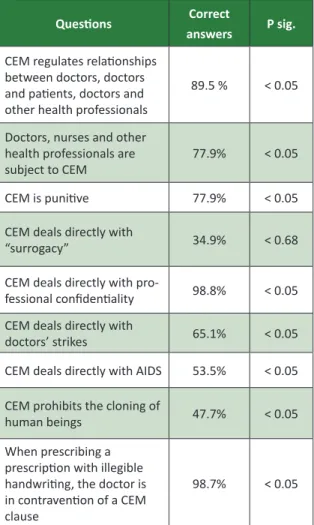
Quesions relaing to the evaluaion regarding knowledge of the CEM, which were tested in the third block of the quesionnaire, had the answer opions “true”, “false” and “do not know”. Data analysis showed a very signiicant amount of correct answers to the quesions presented, as well as sig-niicant results, according to the data of each of the issues explained below in Table 1.
In the analysis, a correlaion was observed between the knowledge of the units that discuss medical ethics during the medical course and the CEM as a reference source for the preparaion and conducing of classes (p <0.05). That is, the more the medical faculty know the medical ethics units in the medical courses, the more they are inclined to use the code as a reference for their classes. It was also
found that the medical faculty who read the latest update of the CEM, published by CFM Resoluion 1931/2009, use this knowledge in preparing and conducing their classes (p < 0.05).
Table 1. Correct answers to quesions about the Code of Medical Ethics
Quesions Correct
answers P sig.
CEM regulates relaionships between doctors, doctors and paients, doctors and other health professionals
89.5 % < 0.05
Doctors, nurses and other health professionals are
subject to CEM 77.9% < 0.05 CEM is puniive 77.9% < 0.05
CEM deals directly with
“surrogacy” 34.9% < 0.68
CEM deals directly with
pro-fessional conideniality 98.8% < 0.05 CEM deals directly with
doctors’ strikes 65.1% < 0.05 CEM deals directly with AIDS 53.5% < 0.05
CEM prohibits the cloning of
human beings 47.7% < 0.05
When prescribing a prescripion with illegible handwriing, the doctor is in contravenion of a CEM clause
98.7% < 0.05
It is interesing to note that, when asked about how oten they consider updaing themselves on medical ethics issues, the lecturers who answered “never” do not make use of medical ethics to pre-pare and teach their lessons (p <0.05). On the other hand, the medical lecturers that update themselves frequently are more likely to address medical eth-ics in their classes and to use specialized journals on the subject to keep up to date (p <0.05).
Another important fact is that the medical faculty who atributed grade 4 (51.2%) or grade 5 (5.8%) regarding their knowledge of medical eth-ics are oten those who most use the CEM for the preparaion and conducing of their classes during medical courses (p <0.05).
R
esear
Discussion
From the presented results, it was possible to draw a clear characterizaion of the perspecive of the medical faculty regarding their knowledge of the CEM, as well as of the importance they atribut-ed to teaching matribut-edical ethics in matribut-edical schools. It was possible to extract meaningful data about the knowledge of medical ethics and the applicability of the code during the course. In this regard, an aspect in the data that draws atenion is the great impor-tance of the constant exercise of self-evaluaion by
lecturers 14.
Today, in the face of major challenges faced in the teaching environment, one way of medical lecturers developing their knowledge would be through self-assessment, which would lead to a criical relecion regarding how their role can be
improved 14. Corroboraing this view, data showed,
signiicantly, that the lecturers surveyed who gave a higher score in the evaluaion of their knowledge of medical ethics are the ones that most use the CEM as a reference source for discussions in the class-room.
Research conducted by the Regional Council of Medicine for the State of São Paulo (Conselho Region-al de Medicina do Estado de São Paulo - CREMESP)
and analysed by Schefer and Callegari 7, showed
that the vast majority of professionals surveyed have already had contact with the new CEM. In ad-diion, the authors found that the CEM is rouinely consulted, as its text is comprehensive and easy to interpret. In the current study, it can be noted that, among the medical faculty who were quesioned, this trend is also veriied. This fact is consistent with the literature that advocates the importance of in-corporaing the CEM in both daily medical pracice
and in teaching 7.
While, on the one hand, most medical lec-turers claimed to have had contact with the latest update of the CEM and use it as a source for regular consultaion, on the other, the minority reported that they have not even read it. This fact will have negaive efects on the professional training of the student, since the acions of doctors are undeni-ably linked to their intellectual concepion of the principles that guide professional and academic life. Thus, medical educaion becomes, in a way, re-sponsible for the medical pracice culture, in that it has been accredited, across the board, for the inef-iciency of the intellectualizaion process of health
professionals 15.
In a study that evaluated the knowledge of
medical ethics among medical students 16, it was
ideniied that there is variaion in the progress of students during graduaion and students during the rural internship term did not have signiicant gains in knowledge about the CEM, thus showing the in-eiciency of teaching it only in one term. Therefore, the study proposes teaching medical ethics in all terms of the course. The data analysed in this study corroborate this inding, since it showed that most medical lecturers quesioned declared themselves in favour of the inclusion of teaching medical ethics in all medical course modules. The medical faculty also atributed high importance to medical ethics in relaion to other units of the course.
It is essenial that in a medical course guided by acive methodolgies, there are lecturers who are aware of the importance of their role in moi-vaing knowledge. A study that examined ethics and humaniies educaion in the medical course at the Federal University of Rio Grande do Norte
(UFRN) 17 revealed that there is a naional trend
of adaping universiies to educaion grounded in ethics and the humaniies. The study recommends that medical schools support atempts to ind ways that can ensure 1) teaching ethics in all modules, 2) the commitment and training of lecturers, 3) acive methodologies and 4) appropriate evaluaion in-struments.
This study ideniied that the medical lecturers interviewed are following this direcion, since most claimed to completely or supericially know both the medical ethics units of the course and the latest update of the CEM. Added to this is the fact that vir-tually all respondents atributed grade 4 or 5 when assessing the importance of the medical ethics unit in relaion to other units from the medical course.
Regarding the third block shown in the ques-ionnaire to the medical faculty, which directly assessed their knowledge regarding the CEM aricles (Appendix II), results obtained were similar to those
from other studies using the same instrument 13-18.
The quesions that received correct answers similar to the ones in these surveys were those dealing with general topics, such as doctor-paient relaionships, conideniality, AIDS, human cloning, and illegible handwriing. As for the diferences between this and other studies, they refer to the issues regarding the puniive disposiion of the CEM, the subjecion of other health professionals to CEM and doctors’ strikes.
In general, the medical faculty of PUC-Goiás obtained a greater percentage of correct answers.
R
esear
The fact that lecturers paricipate in medical courses that use acive learning methodologies can be an el-ement that contributes to this diference. For some ime it has been acknowledged that the biomedical model of educaion and, speciically, teaching of medical ethics need to be changed by adoping new methodologies that emphasize the quality of lectur-ers and future physicians.
Acive methodologies have been systemaical-ly suggested by scieniic literature in recent years.
According to Camargo et al. 19, the pedagogical
par-adigms adopted in the teaching of medical ethics and bioethics should be rethought. In research on the opinion of medical sixth year students regard-ing ethics and bioethics, the authors report that, according to those surveyed, the tradiional audi-torium lectures are not producive, suggesing the use of educaional resources in smaller groups in order to allow more in depth discussions, in addi-ion to closer contact with the lecturer and other colleagues. Adding to this are the students’ constant suggesions for joint discussion of real cases or ic-ional cases that they could encounter at some point in professional life. By considering these pedagog-ical principles, students could feel beter prepared to solve ethical issues. Another study on teach-ing ethics to undergraduates, assumes that new methodological models, as well as the training and aitude of the lecturer, are essenial to the
efec-iveness of the teaching-learning process 20.
In this study, there were staisically signiicant results that allowed relecion on the perspecives of the medical faculty. It was ideniied that the lec-turers who beter knew the course units regarding medical ethics, were those who most used the CEM as a reference source. It is important that medical lecturers be aware of the curriculum, to know the student’s prior contact with the unit, be aware of their level of learning and, consequently, consider and improve their pedagogical pracice, paricular-ly the evaluaion methods. In paricular, the course that is developed through acive learning methodol-ogies deines this evaluator funcion as a speciicity
of teaching, in which the lecturer during the
exer-cise of any of his aciviies is also the evaluator of his own performance, of student performance, of the performance of his peers and of the enire teach
-ing-learning process 21.
It was observed that medical lecturers who are up to date having read the CEM are more inclined to use it as a reference source for their classes. This fact shows the interest of using the CEM in the student approach. In medical courses that employ acive
learning methodologies, the previous preparaion for discussions gives the lecturer enough support to require students to demonstrate the knowledge acquired by means of formaive assessments. Thus, medical lecturers tend to take their role more rigor-ously, being competent and having full knowledge of the unit subjects for which they are responsible.
This also requires coninuous study and training 22.
Another aspect ideniied refers to the fact that lecturers who oten study the CEM are the ones that use it more oten as a reference source for their classes, and those who believe the constant discus-sion of medical ethics is important during the course are those who tend to use it in their classes. Chapter 1 of the CEM, which deals with fundamental prin-ciples, refers to doctors’ competency to coninually improve their knowledge and make the best use of
scieniic progress for the beneit of their paients 6.
To maintain professional competence and clinical experience, further educaion should be improved. What is learnt from lecturers in the primary stage of educaion is only the foundaion of medical knowledge and should therefore be coninuously
expanded and updated 22.
For many seeking pedagogical reorientaion in imes of change, it is essenial to ensure the acive paricipaion of students in the learning process, in order to promote the transformaion and training of competent professionals with a broad scienif-ic, ethical and humanisic knowledge, and imbued with social and ethical commitment. The atenion to individual and collecive needs, as well as the ed-ucaional work of each unit of the course, should be the priority of the current coniguraion of the
edu-caional project of medical schools 23.
Teaching needs to be incorporated into the professional idenity, and not only limited to a complementary acivity of the medical profession. Lecturers must not only have scieniic competence, but also consistent teaching and pedagogical training, good interpersonal skills, and an ability to develop a criical and relecive aitude in students. Medical lecturers become a great reference for students, as they know the course plan of the medical school, and use the CEM to ponder on the knowledge of medi-cal ethics, so that future professionals in training can
stay abreast of new demands arising from society 3.
Final consideraions
This study found that most of the medical fac-ulty at PUC-Goiás know the Code of Medical Ethics
R
esear
and recommend teaching it through out all the med-ical course modules. However, only a minority update themselves frequently, have read the CEM in full and use it to prepare their lessons. Therefore, paricipants who know and are up to date with the Code of Medical Ethics are more likely to use it in preparing their lessons.
The study also concludes that the greater the self-assessment grades regarding knowledge about medical ethics and the grades regarding the impor-tance of medical ethics for their own professional training, the greater the interest of lecturers in using the CEM in their interacion with students, specif-ically in the preparaion and conducing of lessons and in the coninuous and necessary updaing for the purpose of teaching.
There is an urgent need to generate increas-ingly signiicant changes in the medical educaion process. The inluence of the medical faculty con-duct and the humanised relaionships with paients jusiies an analysis of the greater commitment of lecturers to the teaching of medical ethics and the promoion of CEM knowledge in medical courses. Thus, it is necessary to relect on the knowledge of the medical faculty regarding CEM, since the lectur-er is seen by students as an important reflectur-erence in the building of their future profession.
The PUC-Goiás medical course opens the possibility of insigaing faculies regarding certain
issues. Guided by the horizontally aligned cur-riculum, the acive learning methods simulate the student to think criically, taking themselves, along with their mentor, to increase the interest in medical ethics. Literature shows that greater focus on paient aitudes can be atributed to the curriculum model based on acive learning
methodologies 24. Thus, it can be inferred that
the innovaive posiioning of the PUC-Goiás med-ical school curriculum may be related to the high percentage of posiive responses to the quesions that dealt with interest in the applicaion of CEM in the student-teacher relaionship, as well as with the lecturer’s knowledge of medical ethics in gen-eral.
Therefore, as Andrade et al. stated, it is
ex-pected that the future doctor takes a difereniated proile, based on the training of posiive aitudes and the overcoming or, at least, the awareness of conlicing and prejudicial aitudes, while operaing in society in a criical, transformaive, and human
-ist manner 25. Based on the results presented in this
aricle, it is possible to add to this statement the im-portance of ethical principles present in the CEM for the training of future professionals. The duty of the teaching physicians is to lead their students in this direcion, guiding them on the importance of doc-tors being increasingly aware of what the Code of Medical Ethics advocates.
Referências
1. Gonçalves EL. Médicos e ensino da medicina no Brasil. São Paulo: Edusp; 2002.
2. Zabalza MA. O ensino universitário: seu cenário e seus protagonistas. Porto Alegre: Artmed; 2004.
3. Costa NMSC, Cardoso CGLV, Costa D. Concepções sobre o bom professor de medicina. [Internet]. Rev Bras Educ Med. 2012 [acesso 15 fev 2016];36(4):499-505.
Disponível: htp://www.scielo.br/pdf/rbem/v36n4/08.pdf
4. Brasil. Ministério da Educação. Resolução nº 3, de 20 de junho de 2014. Insitui Diretrizes Curriculares Nacionais do Curso de Graduação em Medicina e dá outras providências. Diário Oicial da União. Brasília; 23 jun 2014.
5. Marínez FL. Vocación docente versus profesión docente en las organizaciones educaivas. Revista Electrónica Interuniversitaria de Formación del Profesorado. 2010;13(4):43-51.
6. Conselho Federal de Medicina. Resolução nº 1.931, de 17 de setembro de 2009. Aprova o Código de Éica Médica. Brasília: CFM; 2010.
7. Schefer MC, Callegari DC. Conhecimento dos médicos do Estado de São Paulo e considerações sobre o Código de Éica Médica. Rev. bioét. (Impr.). 2012;20(3):451-60.
8. Rios IC, Schraiber LB. A relação professor-aluno em medicina: um estudo sobre o encontro pedagógico. Rev Bras Educ Med. 2012;36(3):308-16.
9. Neves NC. Éica para os futuros médicos: é possível ensinar? Brasília: CFM; 2006.
10. Caramico HJ, Zaher V, Rosito MMB. Ensino da bioéica nas faculdades de medicina do Brasil. Bioethikos. 2007;1(1):76-90. p. 81.
11. Fronteira I. Estudos observacionais na era da medicina baseada na evidência: breve revisão sobre a sua relevância, taxonomia e desenhos. Acta Med Port. 2013;26(2):161-70.
12. Aragão J. Introdução aos estudos quanitaivos uilizados em pesquisas cieníicas. Revista Práxis. 2011;3(6):59-62.
R
esear
13. Almeida AM, Bitencourt AGV, Neves NMBC, Neves FBCS, Lordelo MR, Lemos KM et al. Conhecimento e interesse em éica médica e bioéica na graduação médica. Rev Bras Educ Med. 2008;32(4):437-44.
14. Guiérrez NPJ, López MMD, Castañeda PNZ. Desaíos educaivos para el profesor de medicina: evaluación de su desempeño. Iatreia. 2015;28(3):292-9.
15. Ribeiro WC, Júlio RS. Relexões sobre erro e educação médica em Minas Gerais. Rev Bras Educ Med. 2011;35(2):263-7.
16. Godoy MF, Ferreira HRA, Pria OAFD. Avaliação do conhecimento da éica médica dos graduandos de medicina. Rev Bras Educ Med. 2014;38(1):31-7.
17. Amorim KPC, Araújo EM. Formação éica e humana no curso de medicina da UFRN: uma análise críica. Rev Bras Educ Med. 2013;37(1):138-48.
18. Vieira PSPG, Neves NMBC. Éica médica e bioéica no curso médico sob o olhar dos docentes e discentes. O Mundo da Saúde São Paulo. 2009;33(1):21-5.
19. Camargo A, Almeida MAS, Morita I. Éica e bioéica: o que os alunos do sexto ano médico têm a dizer. Rev Bras Educ Med. 2014;38(2):182-9.
20. Carneiro LA, Porto CC, Duarte SBR, Chaveiro N, Barbosa MA. O ensino da éica nos cursos de graduação da área de saúde. Rev Bras Educ Med. 2010;34(3):412-21.
21. Almeida MTC, Baista NA. Ser docente em métodos aivos de ensino-aprendizagem na formação do médico. Rev Bras Educ Med. 2011;35(4):468-76. p. 474.
22. López EG. Éica en la educación médica. FEM. 2013;16(4):191-5.
23. Valdés MAS. El trabajo educaivo en la Universidad de Ciencias Médicas en el contexto histórico actual. Rev Haban Cienc Méd. 2013;12(4):637-49.
24. Peixoto JM, Ribeiro MMF, Amaral CFS. Aitude do estudante de medicina a respeito da relação médico-paciente × modelo pedagógico. Rev Bras Educ Med. 2011;35(2):229-36.
25. Andrade SC, Deus JA, Barbosa ECH, Trindade EMV. Avaliação do desenvolvimento de aitudes humanísicas na graduação médica. Rev Bras Educ Med. 2011;35(4):517-25. p. 524.
Paricipaion of the authors
Lorena Cunha Ferreira and Rogério Antunes Mourão paricipated in the research design, bibliographic research, data collecion, analysis and interpretaion of data, and inal drat of the paper. Rogério José de Almeida contributed in the research design, analysis and interpretaion of data and inal drat of the aricle and was also the research advisor.
Recebido: 27.11.2015 Revisado: 6. 1.2016 Aprovado: 14. 1.2016
R
esear
1. Age: _______
2. Gender: ( ) Feminine ( ) Masculine
3. Colour/Ethnicity ( ) White ( ) Black ( ) Mixed
( ) Naive Brazilian ( ) Other___________
4. Marital status: ( ) Single ( ) Married ( ) Widowed ( ) Divorced
( ) Outros ______________
5. Medical degree year of graduaion: ____________________
6. Insituion where you graduated in medicine: ____________________________________
7. Year admited as a lecturer at PUC-Goiás medical school: __________________
8. Medical speciality:
__________________________________
9. Weekly hours dedicated to PUC-Goiás medical school: _______________
10. Do you teach at other educaional insituion? ( ) Yes. Where? _________________________________ ( ) No
Appendix
Sociodemographic Quesionnaire
R
esear
Time since graduaion (years):____________
Teaching experience in higher educaion (years):____________
1. Do you know the units that discuss medical ethics dur-ing the PUC-Goiás medical course?
( ) Yes ( ) No ( ) Supericially
2. Have you read the latest update of the Brazilian Code of Medical Ethics (CFM Resoluion 1931/2009)?
( ) Enirely ( ) Parially ( ) I never read it
3. In your view, when should the medical ethics unit be taught in the course?
______ Module ( ) All modules
( ) In an extra-curricular unit
( ) It is not essenial during the graduaion course
4. How oten you do you get updated about medical eth-ics?
( ) Never ( ) Rarely ( ) Annually ( ) Every six months ( ) Monthly
5. What is your MAIN source of update on medical ethics? ( ) Lay magazines
( ) Specialized Journals ( ) Internet
( ) Convenions/seminars/similar
( ) Other ___________________________
6. Do you use the Brazilian Code of Medical Ethics as a reference source for the preparaion and conducing of your classes?
( ) Yes ( ) No ( ) Supericially
In quesions 7 and 8, select a value in the scale of 1 to 5, with 1 being the minimum and 5 the maximum.
7. How do you assess your knowledge about medical eth-ics in general?
5 4 3 2 1
8. For your training as a doctor, compared to other sub-jects, how do you assess the importance of medical eth-ics?
5 4 3 2 1
In quesions 9 to 17, consider the statements and ick if true or false.
9. The Brazilian Code of Medical Ethics regulates relaions between doctors, doctors and paients, doctors and other health professionals.
( ) True ( ) False ( ) Do not know
10. Doctors, nurses and other health professionals are subject to the Code of Medical Ethics.
( ) True ( ) False ( ) Do not know
11. The Code of Medical Ethics is puniive. ( ) True ( ) False ( ) Do not know
12. . The Code of Medical Ethics deals directly with “sur-rogacy”.
( ) True ( ) False ( ) Do not know
13. . The Code of Medical Ethics deals directly with profes-sional conideniality.
( ) True ( ) False ( ) Do not know
14. The Code of Medical Ethics deals directly with doctors’ strikes.
( ) True ( ) False ( ) Do not know
15. The Code of Medical Ethics deals directly with AIDS. ( ) True ( ) False ( ) Do not know
16. The Code of Medical Ethics prohibits the cloning of hu-man beings.
( ) True ( ) False ( ) Do not know
17. When prescribing a prescripion with illegible hand-wriing, the doctor is in contravenion of a clause from the Code of Medical Ethics.
( ) True ( ) False ( ) Do not know
Evaluaion of the knowledge of the CEM and of interest in medical ethics among medical lecturers
Source: Adapted from Almeida et al. 13.