Revista Gaúcha
de Enfermagem
How to cite this article:
Sassaki RL, Perroca MG. Interruptions and their effects on the dynamics of the nursing work. Rev Gaúcha Enferm. 2017;38(2):e67284. doi: http://dx.doi. org/10.1590/1983-1447.2017.02.67284.
doi: http://dx.doi.org/10.1590/1983-1447.2017.02.67284
Interruptions and their efects on
the dynamics of the nursing work*
Interrupções e seus efeitos sobre a dinâmica de trabalho do enfermeiro Interrupción y sus efectos sobre la dinámica de trabajo de enfermeira
Renata Longhi Sassakia Márcia Galan Perrocab
* Study contemplated with the Scientific Initiation Grant of the Faculdade de Medicina de São José do Rio Preto (FAMERP), 2015-2016.
a Faculdade de Medicina de São José do Rio Preto
(FAMERP). São José do Rio Preto, São Paulo, Brasil.
b Faculdade de Medicina de São José do Rio Preto
(FA-MERP), Departamento de Enfermagem Especializada. São José do Rio Preto, São Paulo, Brasil.
ABSTRACT
Objectives: To investigate the nurses’ perception about interruptions during the workflow and their implications on the professional practice environment.
Methods: A survey was conducted with 133 nurses in a school hospital in the state of São Paulo from October 2015 to March 2016, through the use of a self-administered questionnaire. For data analysis, Chi-square and Fischer tests have been used.
Results: Most of the nurses have reported frequent and recurring interruptions during their work activities. The interruptive processes are more frequent during the documentation process (n=118; 91.5%) and guidance to the patient/family (n=58; 45%). They are caused by the ringing of the phone (n=114; 87%), and by problem solving in the unit (n=107; 81.7%).
Conclusions: According to the nurses’ opinion, the interruptive processes have repercussions on the working dynamics, on the caring process and on the patient’s safety.
Keywords: Workflow. Time management. Nursing staff. Nursing process.
RESUMO
Objetivos:Investigar a percepção de enfermeiros sobre as interrupções durante a dinâmica de trabalho e suas implicações no am-biente de prática profissional.
Métodos:Pesquisa survey conduzida junto a 133 enfermeiros de um hospital de ensino nointerior do Estado de São Paulo nos meses de outubro de 2015 a março de 2016, mediante utilização de um questionário autoadministrado. Empregou-se os testes Qui--quadrado e Fisher para análise estatística.
Resultados: A maioria dos enfermeiros relatou interrupções constantes e recorrentes durante atividades de trabalho. Os processos interruptivos são mais frequentes durante o processo de documentação (n=118; 91,5%) e orientação ao paciente/família (n=58; 45%). São ocasionados por toque de telefone (n=114; 87%) e resolução de problemas na unidade (n=107; 81,7%).
Conclusões: No parecer dos enfermeiros, os processos interruptivos repercutem sobre a dinâmica de trabalho, o processo de cuidar e a segurança dos pacientes.
Palavras-chave: Fluxo de trabalho. Gerenciamento do tempo. Recursos humanos deenfermagem. Processos de enfermagem.
RESUMEN
Objetivos: Investigar la percepción de los enfermeros sobre las interrupciones durante el flujo de trabajo y sus consecuencias sobre el ambiente de la práctica profesional.
Métodos: Realizada con 133 enfermeros de un hospital universitario de octubre de 2015 a marzo de 2016 mediante el uso de un cuestionario autoadministrado. Se utilizó la prueba de chi-cuadrado y de Fischer para el análisis estadístico.
Resultados: La mayoría de las enfermeras reportaron interrupciones constantes y recurrentes durante las actividades laborales. Los procesos interrumpibles son más frecuentes durante el proceso de documentación (n=118; 91,5%) y la orientación al paciente/ familia (n = 58; 45%). Son causadas por el tono de llamada (n=114; 87%), resolución de problemas en la unidad (n=107; 81,7%). Conclusiones: En la opinión de los enfermeros, los procesos que se interrumpen repercuten en el flujo de trabajo, el proceso de atención y la seguridad del paciente.
INTRODUCTION
Interruptions are unexpected intrusions that disrupt the continuity of care to be provided(1) and often occur
during the nursing work in hospital institutions(2). They
differ from distractions, situations in which professionals perceive interferences in their activities, but they do not attend to them, and there are no breaks(3).
Interrupting processes can result from actions of other people or from environmental irregularities(4). The
occur-rence of interruptions in the work dynamics is a source of concern for its potential to have an unfavorable impact on the quality of care, on the patient’s safety and on the work of employees.
It is reported that greater time of nursing care per patient results in better results in their care(5). Interfering
with the team’s work increases the time it takes to per-form their activities(1), which can affect memory
process-es(6). Forgetfulness in doing any type of task can result
in negligence, increased incidence of human errors and costs, besides affecting the professional effectiveness(2,7).
Interruption is also considered to be one of the causes of errors during the drug administration activity that com-promises patient’s safety(4).
The nursing team hardly performs activities without any interference(8-9); which demands dedication, focus
and mastery from the professionals(9). Frequent breaks in
the work dynamics are stressors that impede attention, increase frustration and stress, and can lead to clinical negligence(10). Thus, interruptions negatively influence
the ability to concentrate(11) and it is imperative that,
when performing activities that require attention, pro-fessionals have tranquility and concentration in order to avoid distractions and errors(4,8).
Although the nursing work environment is consid-ered to be interruptive, the nature of these disruptions and their effects on the work dynamics, efficiency and productivity has not been properly clarified(2). The
iden-tification of the actions that break the continuity of the activities may allow improvement in the quality of the services offered and contribute to the safety of both pa-tients and professionals(9).
This study has been conducted in order to investi-gate the nurses’ perceptions about disruptions during the work dynamics and their implications on the pro-fessional practice environment. It aims at answering the following questions: “In what situations, in what form and at what frequency do interruptions occur during the care process? How do nurses perceive their implications for the work dynamics?”.
METHOD
The survey research method has been carried out in this scientific initiation study with 133 nurses, perfecting and residing in inpatient and specialized units, diagnostic and therapeutic support services and administrative services of an extra capacity school hospital located in the state of São Paulo.This method makes use of direct inquisition to a pre-established group through a questionnaire(12).
The field of study hospital is a reference medical center for the care of 102 cities that belong to the Regional Health Division of Rio Preto (RHD 15). It has 708 beds and makes an average of 89,025 monthly appointments. The nursing team is composed of 242 nurses, 565 nursing technicians and 481 nursing assistants.
The instrument for conducting the survey was a self-ad-ministered questionnaire, which has been built and tested previously in order to meet the objectives of this study. Ini-tially approaching a brief explanation to the participants about its purpose and form of fulfillment, it was composed of three parts. The first contained information regarding the profile and qualification of the professionals. Then, semi structured questions were asked, addressing types, sources (patients, relatives, nursing staff, medical staff, other profes-sionals and others), characteristics of the interruptions (fre-quency, recurrence and causes) as well as their perception by the nurses, involving psychological and professional income (time demanded for the return to the initial activ-ity and degree of loss). In the last part there was a 5-point Likert scale (from totally agreeing to totally disagreeing) containing 16 statements. They assessed the implications for the care outcome (degree to which it affects patient/ family care, when it occurs), and patient and staff safety (degree to which it affects, most harmful sources, occur-rence of errors during the medication administration, inter-ference with concentration, and stress at work). It was also left space for possible comments from the participants.
From the 221 nurses working in the different units and services contacted during the study period (excluding va-cations and leave), four of them have declined the invita-tion, obtaining a questionnaire response rate of 61.3%.
shifts and frequency of the outages x units and services. In small samples the Chi-square value error is high, and, there-fore, the test is not recommended. Due to that, Fisher’s test has been used. The level of significance was set at 0.05.
The study has been approved by the Research Ethics Committee of the field of study institution’s (Opinion No. 980.660 of 10/3/2015). The nurses have been individually in-vited by the researcher and briefed regarding the purpose of the research and the voluntary nature of their participation.
RESULTS
The majority of the participants were female (n=114, 85.7%), with an average age of 34.9 (Sd=8.2) years old, rang-ing from 22 to 58 and average time of performance of 9, 1 (Sd=1.1) years – variation from 3 months to 32 years. Regard-ing their qualification, 25 (18.9%) were graduated, 10 (7.6%) had an improvement course, 84 (63.6%) had a specialization, 11 (8.3%) had a master’s degree and two (1.5 %) had a PhD.
As shown in Table 1, 55 (42%) of the nurses have re-ported being interrupted more than 13 times during their work activities, and also that this discontinuity is more
fre-Interruptions N %
Frequency*
1-3 6 4.6
4-6 19 14.5
7-10 33 25.2
11-13 18 13.7
More than 13 55 42.0
When it occurs**
Documentation 118 91.5
Body care 10 7.8
Skin and mucous membrane
care 11 8.5
Monitoring and controls 41 31.8 Medication administration 14 10.9 Patient/family guidance 58 45.0 Emotional support to patient/
family 31 24.0
Nutrition and Hydration 8 6.2 Table 1 – Frequency and moment of the occurrence of nurses’ interruptions during their work activities. São José do Rio Preto, 2016 (N=133)
Source: Research data, 2016.
*Lost data; **Participants could choose more than one answer.
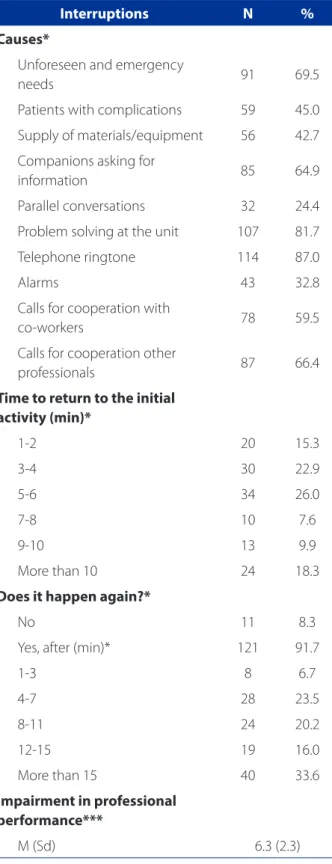
Interruptions N %
Causes*
Unforeseen and emergency
needs 91 69.5
Patients with complications 59 45.0
Supply of materials/equipment 56 42.7
Companions asking for
information 85 64.9
Parallel conversations 32 24.4
Problem solving at the unit 107 81.7
Telephone ringtone 114 87.0
Alarms 43 32.8
Calls for cooperation with
co-workers 78 59.5
Calls for cooperation other
professionals 87 66.4
Time to return to the initial activity (min)*
1-2 20 15.3
3-4 30 22.9
5-6 34 26.0
7-8 10 7.6
9-10 13 9.9
More than 10 24 18.3
Does it happen again?*
No 11 8.3
Yes, after (min)* 121 91.7
1-3 8 6.7
4-7 28 23.5
8-11 24 20.2
12-15 19 16.0
More than 15 40 33.6
Impairment in professional performance***
M (Sd) 6.3 (2.3)
Table 2 – Causes and consequences of nurses’ interrup-tions during their work activities. São José do Rio Preto, 2016 (N=133)
Source: Research data, 2016.
quent during the documentation process (n=118, 91.5%), followed by patient/family guidance (n=58; 45%).
The interruption processes have been caused in the nurses’ perception by phone ringing (n=114, 87%), prob-lem solving in the unit (n=107, 81.7%), unforeseen and emergency needs (n=91; 69.5%), calls for cooperation with other professionals (n=87, 66.4%) and companions requesting information (n=85, 64.9%).
For 34 (26%) of the professionals, it took five to six minutes for them to return to their previous activities. An
interruption occurred again (n=121; 91.7%) after 4 to 11 minutes (n=52; 43.7%) and they reported an average loss in their professional performance of 6.3 (Sd = 2.3) consider-ing a scale from 1 to 10, as evidenced in Table 2.
Regarding the activities developed at the time of the interruptions (Table 3), the documentation process has been identified in the different shifts; patient/family guid-ance at all shifts except at the night time; and monitoring and controls at night (n=12; 54.5%). The main causes of interference were: telephone ringing on all shifts
(vari-Interruptions Shifts*
M A E FT
Frequency*
1-3 1 (3.7) 1 (3.2) 1 (4.5) 1 (3.1)
4-6 4 (14.8) 5 (16.1) 1 (4.5) 6 (18.8)
7-10 8 (29.6) 8 (25.8) 3 (13.6) 11 (34.4)
11-13 6 (22.2) 4 (12.9) 4 (18.2) 4 (12.5)
More than 13 8 (29.6) 12 (38.7) 12 (54.5) 10 (31.3)
When it occurs*
Documentation 25 (92.6) 28 (90.3) 20 (90.9) 28 (87.5)
Body care 5 (18.5) 1 (3.2) 2 (9.1) 1 (3.1)
Skin and mucous membrane care 5 (18.5) 0 (0.0) 3 (13.6) 2 (6.3)
Monitoring and controls 8 (29.6) 11 (35.5) 12 (54.5) 3 (9.4)
Medication administration 7 (25.9) 2 (6.5) 3 (13.6) 0 (0.0)
Patient/family guidance 15 (55.6) 13 (419) 9 (40.9) 9 (28.1)
Emotional support to patient/family 6 (22.2) 6 (19.4) 6 (27.3) 5 (15.6)
Nutrition and Hydration 3 (11.1) 1 (3.2) 0 (0.0) 3 (9.4)
Causes*
Unforeseen and emergency needs 18 (66.7) 24 (77.4) 16 (72.7) 17 (53.1) Patients with complications 14 (51.9) 16 (51.6) 15 (68.2) 3 (9.4)
Supply of materials/equipment 12 (44.4) 16 (51.6) 11 (500) 7 (21.9)
Companions asking for information 19 (70.4) 23 (74.2) 15 (68.2) 11 (34.4)
Parallel conversations 6 (22.2) 8 (25.8) 5 (22.7) 6 (18.8)
Problem solving at the unit 24 (88.9) 22 (71.0) 21 (95.5) 23 (71.9)
Telephone ringtone 22 (81.5) 28 (90.3) 18 (81.8) 28 (87.5)
Alarms 12 (44.4) 11 (35.5) 10 (45.5) 2 (6.3)
Calls for cooperation with co-workers 18 (66.7) 20 (64.5) 18 (81.8) 9 (28.1) Calls for cooperation other professionals 19 (70.4) 18 (58.1) 12 (54.5) 21 (65.6) Table 3 – Frequency and causes of nurses’ interruptions during their work-shift activities. São José do Rio Preto, 2016 (N=133)
Source: Research data, 2016.
ation n=18; 81,8% to n=28; 87.5%); problem solving at the unit – in the morning shifts (n=24; 88,9%), evenings (n=21; 95.5%) and all day (n=23; 71.9%); cooperation with co-workers – at the evening shift (n=18; 81.8%); and un-foreseen and emergency needs – in the afternoon shift (n=27; 77.4%), among others. No significant differences have been found between the frequency of the interrup-tions and the different shifts by the Chi-square and Fisher tests (p variation=0,24 to p=0,64).
When considering the interruptions during work activ-ities by units and services (Table 4), it is observed that they occur more frequently during the documentation process in the Inpatient Units – IUs (n=29; 93.5%), Specialized Units – SU (n=69, 93.2%) and in Administrative Services – ADM (n=16; 84.2%); (n=20, 64.5%), SU (n=30, 40.5%) and in the Diagnostic and Therapeutic Support Services – DTSS (n=7), 77.8%). The professionals mention the telephone ring (vari-ation 66.7-90.3%) and the resolution of problems in the Interruptions
Units and Services*
IU SU DTSS ADM
N(%) N(%) N(%) N(%)
Frequency*
1-3 1 (3.2) 3 (4.1) 2 (22.2) 0 (0.0)
4-6 3 (9.7) 7 (9.5) 4 (44.4) 5 (26.3)
7-10 3 (9.7) 21 (28.4) 1 (11.1) 8 (42.1)
11-13 7 (22.6) 8 (10.8) 1 (11.1) 2 (10.5)
More than 13 16 (51.6) 34 (45.9) 1 (11.1) 4 (21.1)
When it occurs
Documentation 29 (93.5) 69 (93.2) 4 (44.4) 16 (84.2)
Body care 1 (3.2) 8 (10.8) 1 (11.1) 0 (0.0)
Skin and mucous membrane care 5 (16.1) 6 (8.1) 0 (0.0) 0 (0.0)
Monitoring and controls 10 (32.3) 28 (37.8) 3 (33.3) 0 (0.0)
Medication administration 4 (12.9) 10 (13.5) 0 (0.0) 0 (0.0)
Patient/family guidance 20 (64.5) 30 (40.5) 7 (77.8) 1 (5.3)
Emotional support to patient/family 11 (35.5) 16 (21.6) 4 (44.4) 0 (0.0)
Nutrition and Hydration 1 (3.2) 5 (6.8) 2 (22.2) 0 (0.0)
Causes
Unforeseen and emergency needs 22 (71.0) 56 (75.7) 3 (33.3) 9 (47.4)
Patients with complications 21 (67.7) 37 (50.0) 1 (11.1) 0 (0.0)
Supply of materials/equipment 14 (45.2) 40 (54.1) 1 (11.1) 1 (5.3)
Companions asking for information 27 (87.1) 51 (68.9) 5 (55.6) 2 (10.5)
Parallel conversations 7 (22.6) 21 (28.4) 1 (11.1) 3 (15.8)
Problem solving at the unit 28 (90.3) 63 (85.1) 6 (66.7) 10 (52.6)
Telephone ringtone 28 (90.3) 65 (87.8) 6 (66.7) 15 (78.9)
Alarms 11 (35.5) 31 (41.9) 0 (0.0) 1 (5.3)
Calls for cooperation with co-workers 24 (77.4) 49 (66.2) 3 (33.3) 2 (10.5)
Calls for cooperation other professionals 17 (54.8) 52 (70.3) 6 (66.7) 12 (63.2) Table 4 – Frequency and causes of nurses’ interruptions during their work activities by units and services. São José do Rio Preto, 2016 (N=133)
Source: Research data, 2016.
unit (variation 52.6 – 90.3%) as the main causes of work breakdown in all the units investigated.
It has been found significant differences between the frequency of interruptions between IU and DTSS (p=0.03), IU and Administrative Services (p=0.03), also between SU and DTSS (p=0.03). = 0.05) and SU and Administrative Ser-vices (p=0.05).
In the perception of the nurses investigated (Table 5), the interruptive processes interfere with the excellence of care – Median (Md) 4 (4-4), and they have a direct influence on the patient’s safety – Md 4 (4-5) during medication ad-ministration, which often leads to errors – Md 4 (4-4) and contribute to stress at work Md 4 (4-5).
DISCUSSION
This study has investigated the perception of nurses about the occurrence of interruptive processes during work dynamics and their implications on the profession-al practice environment. Most of the professionprofession-als have reported being the interruptions constant and recurrent during their work activities. Also, they occur more frequent-ly during the documentation process (n=118; 91.5%) and during patient/family guidance (n=58; 45%).
International findings indicate that, on average, nurses are disrupted between 0.3 to 13.9 times during one hour of work(13). They also confirm documentation as one of the
main activities carried out at the time of interruptions(2,7)
alongside hygiene care, administration and preparation of medicines and communication.
When interruptions by external stimuli occur, there is a concentration breakdown, raising the mental workload and leading to reduced performance(14). The instability related to
the interruptions and associated with performing tasks can induce errors(7,9), such as failures to fill in documents that are
relevant to the patient and to the team. In addition, they may result in misunderstanding of the nurse’s directions to the patient and his/her family. Direct participation in care by both the patient and his/her family(15) makes it important in
order to guide the care provided by the professional. Regarding the nature of the interruptions, the most mentioned sources were telephone ringing (n=114; 87%), problem solving in the unit (n=107, 81.7%) and unfore-seen and emergency needs (n=91; 69.5%). The telephone ringing has been confirmed as a major cause(14) along with
alarms, family members, multiprofessional staff, nursing colleagues and noises(2).
According to the reports, the patients (n=16, 51.6%) have caused fewer interruptions than the nursing team (n=20; 64.5%), a situation confirmed in another study(14).
This duality of professionals between the requirement to keep their concentration on the quality of the activities per-formed and to be collaborative with their co-workers can become a problem that demands learning and skills(16-17).
Statements Md Q1-Q3
They affect very little patient /family care. 3 2-4
They are more detrimental to patient’s safety when caused by:
Members of the nursing team 3 2-4
Other health professionals 3 2-4
Companion/family 3 2-4
Alarms and phone calls 3 2-4
During drug administration, they often lead to errors. 4 4-4
They always make me forget what I was doing. 3 2-4
They have a direct influence on patient’s safety. 4 4-5
They greatly affect patient/family care. 4 3-4
They interfere in the excellence of care. 4 4-4
During drug administration, they rarely lead to errors. 2 2-4
They do not make me forget what I was doing previously 4 2-4
They contribute to stress at work. 4 4-5
Table 5 – Nurses’ opinion about the interruptions and their impact on the work dynamics of the unit and of the caring process. São José do Rio Preto, 2016 (N=133)
It has been sought to investigate whether there was a difference in the frequency of interruptive processes be-tween work shifts. However, there were no significant differ-ences (variation of p=0.24 to p=0.64). It has been observed, though, that there were different causes among the shifts: in the morning, due to the demand for cooperation with other professionals (n=19; 70.4%), probably related to visits by the multidisciplinary team during this period. In the af-ternoon, due to unforeseen and emergency needs (n=24; 77.4) due to admissions, discharges and postoperative complications, among others; in the evening period due to the need to solve problems in the unit (n=21, 95.5%). No researches have been found that reported characteris-tics of interruptions related to the shift.
For nurses’ units, there was a significant difference in the frequency of interruptions between Impatient Units and Diagnostic and Therapeutic Support Services (p=0.03), Impatient Units and Administrative Services (p=0.03), be-tween Specialized Units and DTSS (p=0.05), and Special-ized Units and Administrative Services (p=0.05). This aspect seems to be consequence of the characteristics and pecu-liarities in the routine, team and work dynamics.
Observational surveys conducted in specialized units such as the ICU(14) and pediatric units(11) have showed a
greater number of interruptions in the ICU – 20 interrup-tions/hour(14) – in relation to the pediatric unit – on average
4.7L interruptions/hour(11). It is important to note that,
un-like the previously mentioned investigations, the findings of the present study refer to the nurses’ perceptions about interruptions in their work dynamics.
The occurrence of interruptions is constant in the health environment(1,18). Although they are sometimes necessary,
in order to transmit information that influences the deliv-ery of care(14), they should be restricted to unavoidable
sit-uations(18). Interruptions caused by unforeseen needs such
as patients with complications, urgent problem solving in the unit, alarms and relevant cooperation with co-workers and other professionals can be categorized as essential in the care process. However, the interruptions that are caused by the supply of materials, companions requesting information, parallel conversations and telephone ringing are classified as avoidable. The occurrence of interruptions is confirmed as detrimental to the work dynamics, regard-less of the categorization in which it is inserted.
The high frequency of interruptions can affect the care process and affect patient’s safety and the quality of care (4-5,9,11). Safety has been chosen as one of the main factors for
quality patient care(8). Several studies have shown how
in-terruptions can influence safety mainly in the preparation and administration of medications(4,7,9,19). The nurses
par-ticipating in this study have recognized that interruptive processes have a direct influence on patient’s safety – Md 4 (4-5), and can often lead to errors occurring during drug administration – Md 4 (4-4), interfering in care excellence – Md 4 (4-4) and contributing to work stress – Md 4 (4-5).
In view of all the recurrent problems of interruptions, researches have shown possible solutions to reduce their frequency and consequences(4), particularly during the
medication administration process. One of them is the “No Interruption Zone” (NIZ), in which employees wear colored vests to show that the person cannot be interrupted. This strategy reduced medication errors associated with inter-ruptions by 47%(4).
In this way, preventing and controlling disruptions is a way to ensure better assistance and better patient care (13-14,19). Interventions at this event would foster better work
dynamics and significantly increase the quality, safety and efficiency of care and productivity(11).
A deeper look at the findings of this research refers to how professionals are dealing with interruptions. Although the nursing work is considered to be interrup-tive, consideration should be given to what frequency it would be acceptable and would cause less harm to the patient/family and to the professional staff. The topic has recently emerged on the international scenario and still requires further studies(13).
CONCLUSION
It has been proposed in this study the mapping of in-terruptive processes contributing to examine its implica-tions on the context of professional practice. In the nurses’ opinion, they are constant, recurrent and occur more fre-quently during the documentation process (n=118, 91.5%) and during patient/family guidance (n=58; 45%), affecting the care dynamics, and patient’s safety. They are caused mainly by telephone ringing (n=114; 87%) and problem solving in the unit (n=107; 81.7%).
However, reflecting the perception of nurses from a sin-gle school hospital, the findings may differ from other care environments. The response rate obtained from 61.3%, although constituting a significant value, also indicates a low adherence rate among professionals. Another limiting factor was that the different degrees of impairment of each type of interruption have not been evaluated.
Prioritiza-tion of tasks, reducPrioritiza-tion of self-interrupPrioritiza-tions, adopPrioritiza-tion of error-checking systems, creation of non-interruption zones during medication administration, training of the multiprofessional team and encouragement of behav-ioral change of patients and companions are possible strategies to be implemented.
Since new collaborators are more vulnerable to inter-ruptions, it is fundamental to approach this topic during the graduation nursing courses by providing professional training directed to ways of dealing with interruptive pro-cesses. It is also worth mentioning the incipient production of knowledge regarding the interruptions and their impli-cations in the national practice scenario. Thus, this initial mapping may encourage future investigations with new developments in order to better understand and deepen this phenomenon.
REFERENCES
1. Hall LM, Pedersen C, Fairlei L. Losing the moment: understanding interruptions to nurses’ work. J Nurs Adm 2010;40(4):169-76.
2. D’Antonio S, Bagnasco A, Bonetti L, Sasso L. Observational study on interrup-tions during nurses work in two surgical wards of a hospital in Liguria. Prof Inferm. 2014;67(4):211-8.
3. Healey AN, Sevdalis N, Vincent CA. Measuring intra-operative interference from distraction and interruption observed in the operating theatre. Ergonomics. 2006;49(5-6):589-604.
4. Anthony K, Wiencek C, Bauer C, Daly B, Anthony MK. No interruptions please: impact of a No Interruption Zone on medication safety in intensive care units. Crit Care Nurse. 2010 [cited 2014 Oct 11];30(3):21-9. Available from: http://ccn. aacnjournals.org/content/30/3/21.full.
5. Aiken LH, Sermeus W, Van den Heede K, Sloane DM, Busse R, McKee M, et al. Patient safety, satisfaction, and quality of hospital care: cross sectional surveys of nurses and patients in 12 countries in Europe and the United States. BMJ. 2012 [cited 2014 Nov 18];344:e1717. Available from: http://www.bmj.com/ content/344/bmj.e1717.
6. Law AS, Trawley SL, Brown LA, Stephens AN, Logie RH. The impact of working memory load on task execution and online plan adjustment during multitasking in a virtual environment. Q J Exp Psychol. 2013;66(6):1241-58.
7. Kalisch BJ, Aebersold M. Interruptions and multitasking in nursing care. Jt Comm J Qual Patient Saf. 2010;36(3):126-32.
8. Buchini S, Quattrin R. Avoidable interruptions during drug administration in an intensive rehabilitation ward: improvement project. J Nurs Manag. 2012;20(3):326-34.
9. Cornell P, Herrin-Griffith D, Keim C, Petschonek S, Sanders AM, D’Mello S, et al. Transforming nursing workflow, part 1: the chaotic nature of nurse activities. J Nurs Adm. 2010;40(9):366-73.
10. Weigl M, Müller A, Angerer P, Hoffmann F. Workflow interruptions and mental workload in hospital pediatricians: an observational study. BMC Health Serv Res. 2014 [cited 2016 Jun 14];14:433. Available from: https://www.ncbi.nlm.nih. gov/pmc/articles/PMC4263126/.
11. Hall LM, Ferguson-Paré M, Peter E, White D, Bresner J, Chisholm A, et al. Go-ing blank: factors contributGo-ing to interruptions to nurses’ work and related out-comes. J Nurs Manag. 2010;18(8):1040-7.
12. Prodanov CC, Freitas EC. Metodologia do trabalho científico: métodos e técnicas da pesquisa e do trabalho acadêmico. 2. ed. Novo Hamburgo: Feevale; 2013. 13. Hopkinson SG, Jennings BM. Interruptions during nurses’ work: a
state-of-the-science review. Res Nurs Health. 2013;36(1):38-53.
14. Sasangohar F, Donmez B, Easty A, Storey H, Trbovich P. Interruptions experienced by cardiovascular intensive care unit nurses: an observational study. J Crit Care. 2014;29(5):848-53.
15. Martins, PAF, Alvim NAT. Plano de cuidados compartilhado: convergência da propos-ta educativa problematizadora com a teoria do cuidado cultural de enfermagem. Rev Bras Enferm. 2012 [citado 2016 jul 12];65(2):368-73. Disponível em: http:// www.scielo.br/scielo.php?script=sci_arttext&pid=S0034-71672012000200025. 16. Sorensen EE, Brahe L. Interruptions in clinical nursing practice. J Clin Nurs.
2014;23(9-10):1274-82.
17. Spooner AJ, Corley A, Chaboyer W, Hammond NE, Fraser JF. Measurement of the frequency and source of interruptions occurring during bedside nursing hando-ver in the intensive care unit: an observational study. Aust Crit Care. 2015 [cited 2016 Jul 10];28(1):19-23. Available from: http://www.australiancriticalcare. com/article/S1036-7314(14)00031-9/pdf.
18. Rivera AJ, Karsh B-T. Interruptions and distractions in healthcare: review and reappraisal. Qual Saf Health Care. 2010 [cited 2015 Jan 13];19(4):304-12. Avail-able from: http://www.ncbi.nlm.nih.gov/pmc/articles/PMC3007093/. 19. Raban MZ, Westbrook JI. Are interventions to reduce interruptions and errors
during medication administration effective? a systematic review. BMJ Qual Saf. 2014 [cited 2015 Jan 13];23:414-21. Available from: http://qualitysafety.bmj. com/content/qhc/23/5/414.full.pdf.
Corresponding author:
Renata Longhi SassakiE-mail: [email protected]