Rehabilitation of language
in expressive aphasias
A literature review
Denise Ren da Fontoura
1, Jaqueline de Carvalho Rodrigues
2, Luciana Behs de Sá Carneiro
3,
Ana Maria Monção
4, Jerusa Fumagalli de Salles
5ABSTRACT. Objective: This paper reviews the methodological characteristics of studies on rehabilitation of expressive aphasia, describing the techniques of rehabilitation used. Methods: The databases Medline, Science Direct and PubMed were searched for relevant articles (January 1999 to December 2011) using the keywords Expressive / Broca / Nonfluent Aphasia, combined with Language or Speech Rehabilitation / Therapy / Intervention. Results: A total of 56 articles were retrieved describing rehabilitation techniques, including 22 with a focus on lexical processing, 18 on syntax stimulation, seven with the aim of developing speech and nine with multiple foci. Conclusion: A variety of techniques and theoretical approaches are available, highlighting the heterogeneity of research in this area. This diversity can be justified by the uniqueness of patients’ language deficits, making it difficult to generalize. In addition, there is a need to combine the formal measures of tests with measures of pragmatic and social skills of communication to determine the effect of rehabilitation on the patient’s daily life.
Key words: rehabilitation, language disorders, review, aphasia.
REABILITAÇÃO DA LINGUAGEM NAS AFASIAS EXPRESSIVAS: UMA REVISÃO DA LITERATURA
RESUMO. Objetivo: Revisar as características metodológicas dos estudos sobre a reabilitação da afasia expressiva, descrevendo as técnicas de reabilitação utilizadas. Métodos: Foram pesquisados artigos nas bases de dados Medline, Science Direct e PubMed (Janeiro de 1999 a Dezembro de 2011), utilizando as palavras-chave Expressive / Broca /
Nonfluent Aphasia, combinado com Language or Speech Rehabilitation / Therapy / Intervention. Resultados: Foram encontrados 56 artigos descrevendo técnicas de reabilitação, incluindo 22 com foco no processamento lexical, 18 na estimulação da sintaxe, sete com objetivo de desenvolver a fala e nove com múltiplos focos. Conclusão: Há variedade de técnicas e abordagens teóricas, destacando a heterogeneidade da investigação nesta área, que pode justificar-se pela singularidade dos déficits linguísticos dos pacientes, tornando-se difícil a generalização. Existe também necessidade de combinar as medidas formais de testes com medidas de habilidades pragmáticas e sociais da comunicação, para determinar o efeito da reabilitação na vida diária do paciente.
Palavras-chave: reabilitação, transtornos da linguagem, revisão, afasia.
INTRODUCTION
A
phasia is deined as the impairment of
expressive and/or receptive language,
caused by brain damage, usually to the left
hemisphere. It can be classiied according to
performances in oral and written language
(comprehension, expression, naming,
rep-etition).
1,2Among the types of aphasia, this
analysis will focus on expressive aphasia (or
nonluent aphasia), highlighting the methods
of language rehabilitation.
he World Health Organization proposes
three levels of analysis concerning the
func-tional consequences of chronic conditions
1Fonoaudióloga, Doutora em Ciências da Linguagem/Psicolinguística pela Universidade Nova de Lisboa (UNL), Mestre em Ciências da Saúde/Neurociências pela Pontifícia Universidade Católica do Rio Grande do Sul (PUCRS), Especialista em Reabilitação Fonoaudiológica/ Voz pelo Instituto Metodista IPA e Pós Graduada em Neuropsicologia/ Linguagem pela PUCRS. 2Psicóloga Clínica, Mestranda em Psicologia no Programa de Pós-Graduação em Psicologia, Universidade Federal do Rio Grande do Sul – UFRGS. 3Fonoaudióloga Clínica. 4Professora Auxiliar do Departamento de Linguística da Universidade Nova de Lisboa, Doutora em Psicolin-guística, Licenciada em Psicoterapia e Mestre em Neuropsicologia e Demências. 5Fonoaudióloga, Doutora em Psicologia, Professora Adjunta do Departamento de Psicologia do Desenvolvimento e da Personalidade, Instituto de Psicologia, Programa de Pós-Graduação em Psicologia, Universidade Federal do Rio Grande do Sul – UFRGS, Coordenadora do Núcleo de estudos em Neuropsicologia Cognitiva – NEUROCOG.
Denise R. Fontoura. Instituto de Psicologia – Rua Ramiro Barcelos, 2600 / sala 114 – 90035-003 Porto Alegre RS – Brazil. E-mail: denisedafontoura@yahoo. com / [email protected]
such as aphasia: the Impairment, the Disability and the
Handicap (WHO, 2001).
3Considering these three
lev-els of analysis, three diferent lines of rehabilitation in
aphasia may be characterized, namely: the Traditional
School of Language-Oriented Aphasia herapy, the
Functional/Pragmatic School of Aphasia herapy and
the Cognitive Neuropsychology School.
4he Traditional School of Language-Oriented
Apha-sia herapy focuses primarily on the levels Impairment
and Disability. It is based on the type of aphasia and
its symptoms, with a focus on intensive stimulation of
language functions, through repetition, auditory and
vi-sual stimulation in linguistic and situational contexts. It
addresses the restoration of language skills as a means
of enhancing functional communication.
4,5he
Func-tional/Pragmatic School of Aphasia herapy is based
on the interaction diiculties with the environment
(Handicap). It encourages the patient to use
compen-satory strategies (verbal, written, gestural or graphical
language), focusing on daily communication skills.
6-8he Cognitive Neuropsychology School is based on
the impairment of the patient, focusing on functional
recovery. he treatment is characterized by planning
and structuring therapeutic goals through the
theoreti-cal basis for the assessment of the patient’s language
skills.
7Initially, the compromised cognitive functions
are identiied through neuropsychological assessment
and subsequently the cognitive process that will be
trained is deined.
2,9In the scientiic literature, there are diferent
thera-peutic methods based on the above-mentioned three
lines of rehabilitation. hus, it is important to verify
how these techniques are being researched and how
they are consolidated. Review studies such as Cappa et
al. (2003)
10, Cicerone et al. (2005)
11and Cicerone et al.
(2011)
12show the beneits of these interventions in
lan-guage and communication. However, it is important to
systematize the indings of this research, and identify
its shortcomings and advances.
he main objective of this study was to review the
methodological characteristics of studies on
rehabili-tation of expressive aphasias. More speciically, it was
sought to: [1] characterize the study participants
re-garding the etiology of their aphasia, post-injury time,
the study design and intervention time, [2] identify the
design of surveys, [3] describe the therapeutic
tech-niques used in the research and outcome in these cases.
his systematic review is not exhaustive in terms of
the knowledge of language rehabilitation in expressive
aphasia, but intends to identify the most recent studies
in this area.
METHODS
he databases Medline, Science Direct and PubMed
were searched for scientiic articles published from
January 1999 to December 2011 using the keywords:
on one side, Expressive Aphasia or Broca Aphasia or
Nonluent Aphasia and, on the other side, Language
Rehabilitation, Language herapy, Language
Interven-tion, Speech RehabilitaInterven-tion, Speech herapy and Speech
Intervention. his search, with all combinations of
key-words above, retrieved 8,035 items, including
duplicat-ed studies repeatduplicat-ed in more than one database.
To achieve the proposed objective of this review, only
empirical studies that had some method of language
in-tervention in expressive aphasic patients were sought.
It is known that these patients may also have signiicant
diiculties in language comprehension. However, these
search criteria were determined so as to focus on
stud-ies describing only techniques for expressive language,
excluding the motor aspects of speech (dysarthrias and
dyspraxias).
All studies on language rehabilitation of children,
bi-lingual patients, or in pathologies other than aphasia,
studies concerning noncognitive therapy, such as drug
treatment, neurosurgical intervention and transcranial
stimulation, and those which were not written in
Portu-guese, Spanish or English, were excluded. From reading
the abstracts of articles found, a total of 115 studies
(ex-cluding duplicates), whose aim was to report a
rehabili-tation technique for acquired expressive aphasia, were
preselected. hese studies were analyzed as a whole,
with emphasis on method, results and conclusions.
Of the preselected studies, 56 were identiied as
meeting the study criteria where the remaining studies
did not mention data on the efect of the technique in
the Aphasia cases assessed. Based on the selected
ar-ticles, a descriptive analysis was performed exploring
the following aspects: design, sample proile,
therapeu-tic procedures performed, duration of intervention and
outcome in these cases. he rehabilitation techniques
were organized according to lexical, syntactic and
dis-course language levels.
RESULTS
Concerning the methodological design of the analyzed
articles, 39 (69.7%) were case studies, 11 (19.6%) of
which were related to the description of a single case and
34 (60.7%) to multiple single-cases. Forty-six (82.1%)
performed the research with group/case control.
94.6%) while only ive (9%) were on traumatic brain
injury, one (1.8%) studied simple herpetic encephalitis
and another was of unknown etiology. he post-injury
time until the beginning of intervention was variable
where the majority of the articles used a period of at
least six months after the irst clinical manifestation of
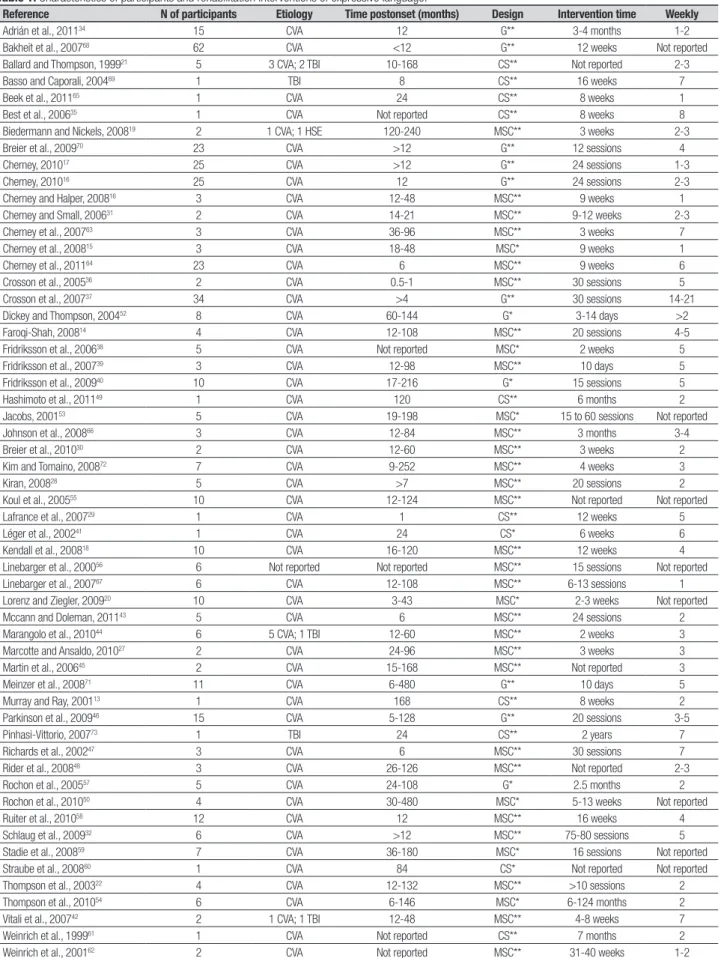
disease for the beginning of the intervention (Table 1).
he intervention time of the rehabilitation
tech-niques ranged from two weeks to two years, but
aver-aged one month of treatment. Intervention durations
were found of 30 minutes, 50 minutes, one hour, one
hour and a half, two hours and four hours (with
inter-val). he number of sessions per week also varied, with
cases from one to seven visits per week, but studies of
two, three and ive sessions per week (Table 1) were the
most frequent.
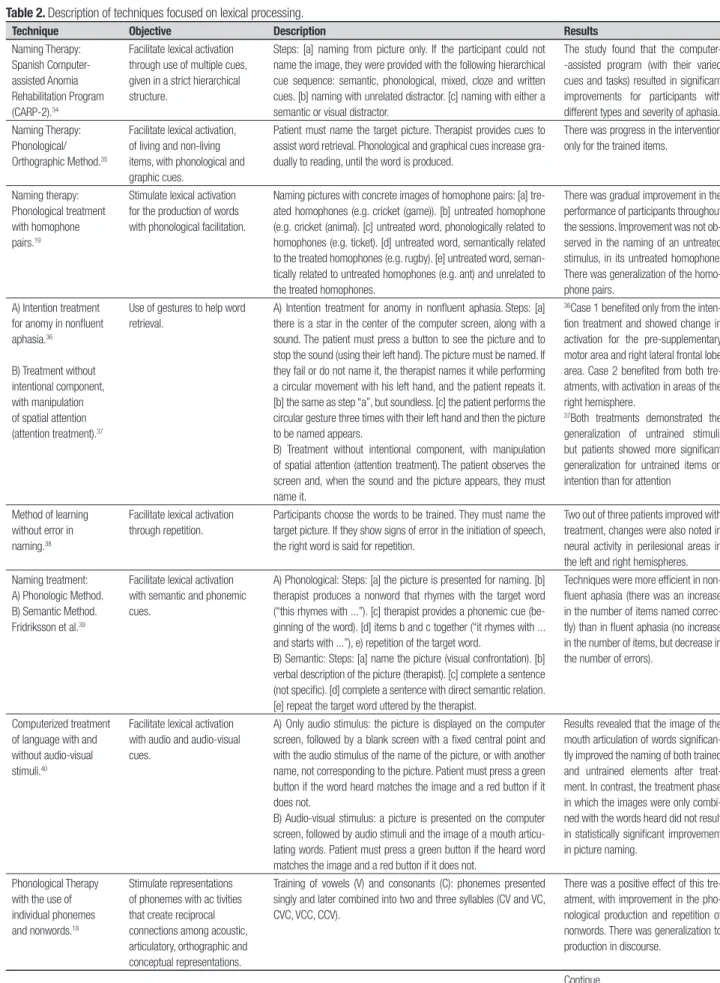
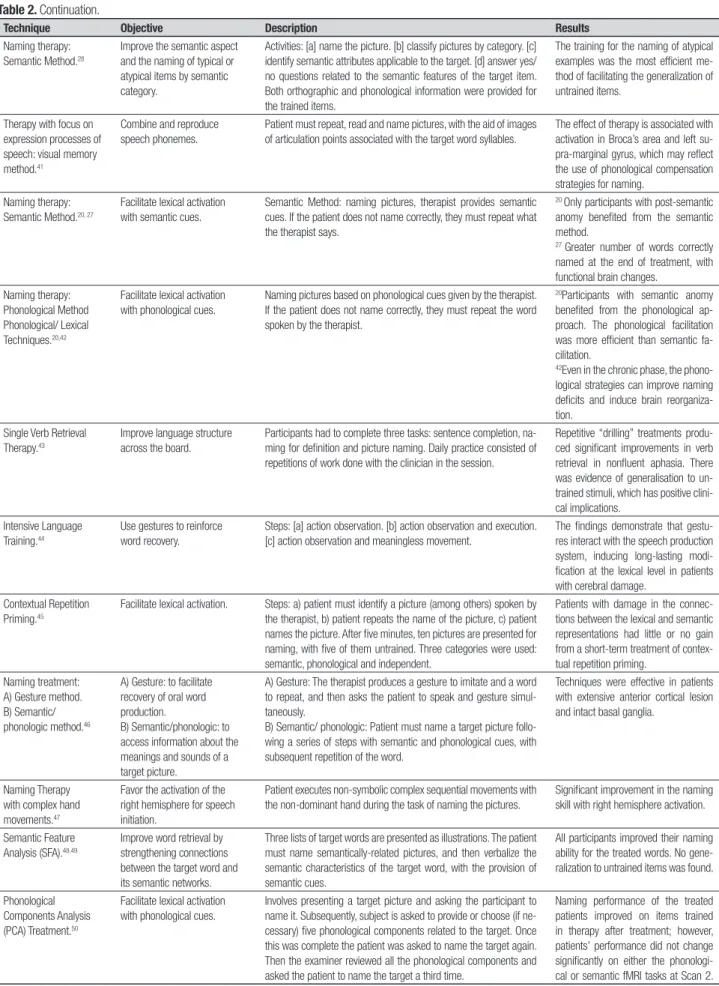
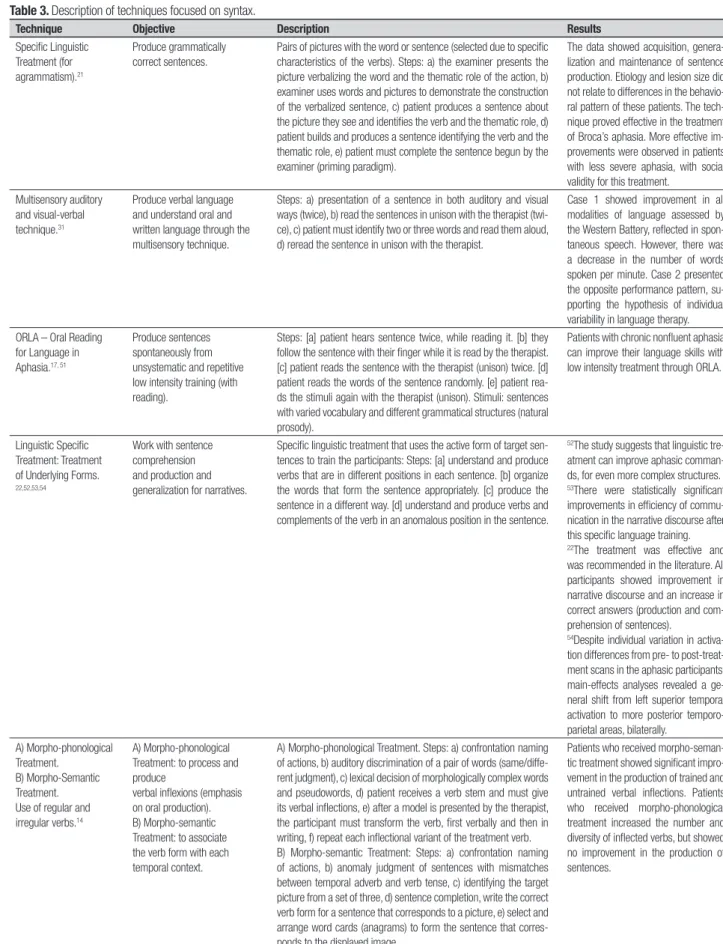
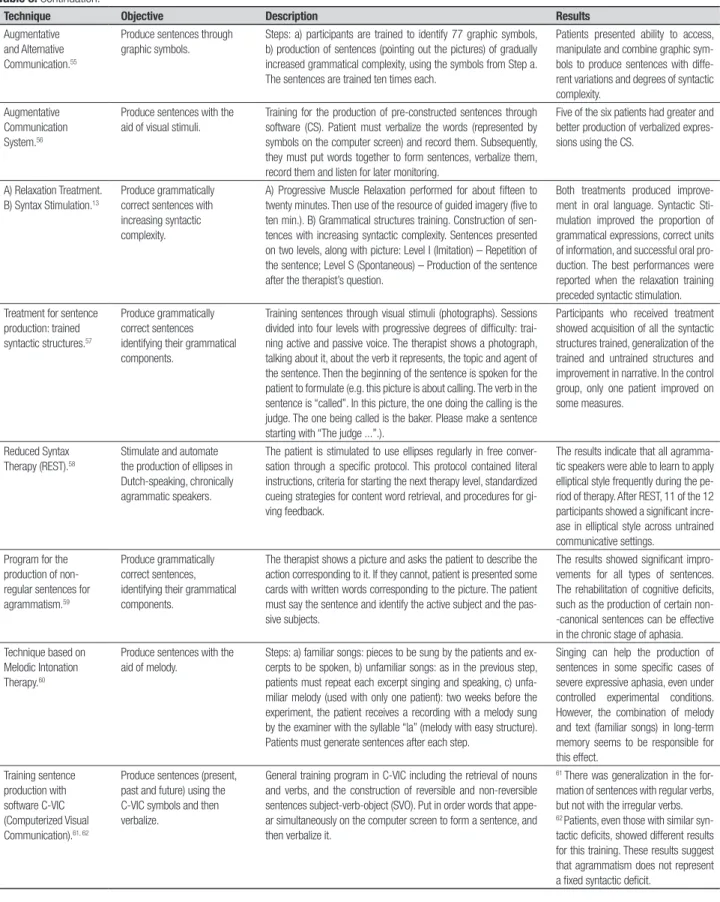
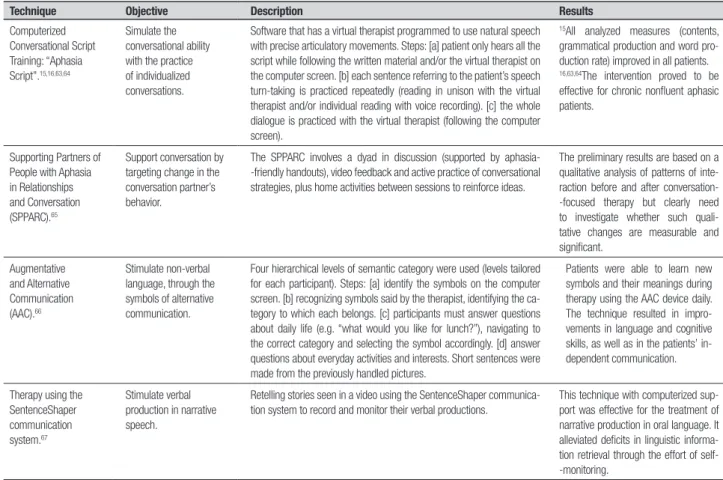
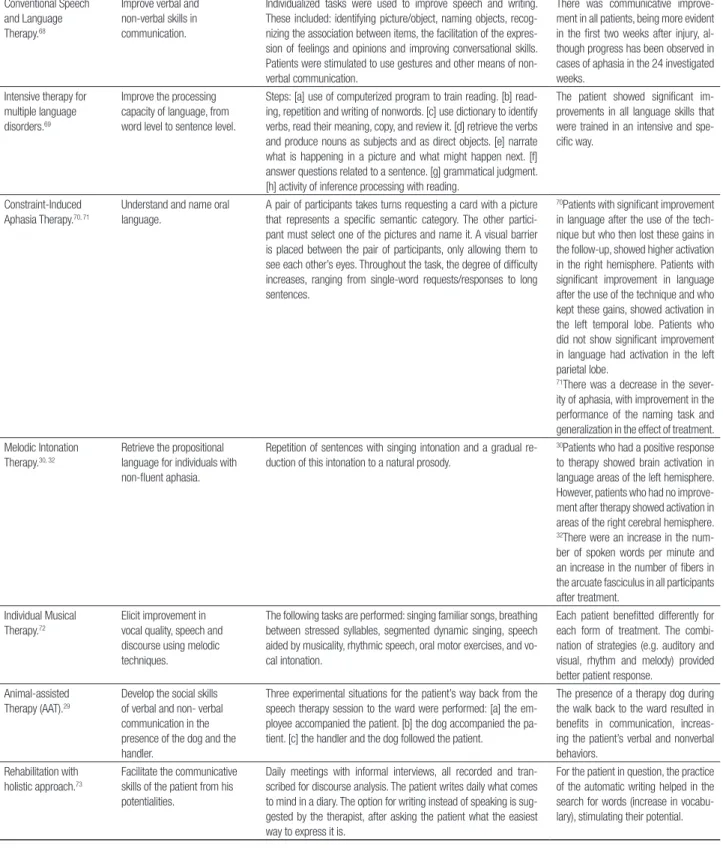
he rehabilitation techniques identiied in this
re-view study incorporated several approaches, with 22
articles (39.3%) using techniques focused on lexical
pro-cessing (Table 2); 18 articles (32.1%) focusing on syntax
stimulation (Table 3), seven articles (12.5%) with the
aim of developing discourse (Table 4) and nine articles
(16%) with multiple foci (Table 5).
Only four articles (7.1%) set out to assess the eicacy
of the therapeutic technique used. Eicacy refers to
im-provements concerning accurately conducted research,
having a strictly selected sample from a clearly deined
clinical population undergoing a speciic treatment
protocol delivered by a highly trained clinician, as
ex-plained by Cherney and Halper (2008). he techniques
that showed therapeutic eicacy were applied in chronic
patients (from 10 to 132 months post-onset), only one
study group, while the others were case studies (Table
1). he following techniques demonstrated therapeutic
eicacy for patients with nonluent aphasia:
Morphose-mantic Treatment
14, Computer-Based Script Training,
16Oral Reading for Language in Aphasia (ORLA),
17and
Linguistic Speciic Treatment.
22he studies used a variety of diferent methods to
measure therapeutic eicacy. Standardized testing was
conducted pretreatment, posttreatment and weeks
af-ter the end of treatment with the following instruments
employed, by frequency of studies: Western Aphasia
Battery (WAB),
14,16,17Quality of Communication Life
(QCL),
16Communication Activities of Daily Living-2
(CADL-2),
16and the Communicative Efectiveness
In-dex (CETI).
16Narrative measures were obtained (baseline,
treat-ment, and follow-up) in some studies, including rate
of speech, mean length of utterance, proportion of
sentences, proportion of grammatical sentences,
pro-portion of verbs, open-closed class ratio, among other
measures.
14,22Additionally, at the time of posttreatment
assessment, Cherney and Halper (2008) conducted an
exit interview with the participant and/or signiicant
other in order to determine their perception of change
resulting from the script training and their satisfaction
with the treatment program.
16he other studies proposed to identify the efects of
rehabilitation in patients by assessing the activation of
neural networks (through neuroimaging techniques),
describing the rehabilitation protocol used, and
explor-ing the proile of patients after a speciic rehabilitation
technique, without mentioning therapeutic eicacy.
DISCUSSION
his paper reviewed studies on rehabilitation of
expres-sive aphasia, investigating the methodological
charac-teristics of these studies. Regarding design, most of the
articles were found to be case studies. he use of this
methodology aims to foster clinical innovations, study
rare phenomena, develop new techniques, assess results
for more reined techniques, provide clinical data for
subsequent controlled investigations, address questions
and to support theoretical views (Barlow and Hersen,
1984). Generally, single case studies are performed
more frequently in rehabilitation due to the diiculty
in forming homogeneous groups, having, as an
alter-native, the single-case experimental design (Wilson,
2009). Most articles selected used control/group cases
to support the data, highlighting methodological
con-trol studies in the search for evidence of rehabilitation
techniques of language.
With respect to samples used, most of the articles
in-vestigated the efect of rehabilitation in stroke patients
– a feature also identiied in the review study of
Cice-rone et al. (2005). Stroke is a major public health
prob-lem worldwide, causing care-dependent neurological
pa-tients to need rehabilitation, prompting clinical studies
on this population. he worldwide prevalence of stroke
is from 5 to 10 cases per 1000 inhabitants (Bonita et al.,
1997) and the worldwide incidence is one to two cases
per 1000 inhabitants (horvaldsen et al., 1995).
Table 1. Characteristics of participants and rehabilitation interventions of expressive language.
Reference N of participants Etiology Time postonset (months) Design Intervention time Weekly
Adrián et al., 201134 15 CVA 12 G** 3-4 months 1-2
Bakheit et al., 200768 62 CVA <12 G** 12 weeks Not reported
Ballard and Thompson, 199921 5 3 CVA; 2 TBI 10-168 CS** Not reported 2-3
Basso and Caporali, 200469 1 TBI 8 CS** 16 weeks 7
Beek et al., 201165 1 CVA 24 CS** 8 weeks 1
Best et al., 200635 1 CVA Not reported CS** 8 weeks 8
Biedermann and Nickels, 200819 2 1 CVA; 1 HSE 120-240 MSC** 3 weeks 2-3
Breier et al., 200970 23 CVA >12 G** 12 sessions 4
Cherney, 201017 25 CVA >12 G** 24 sessions 1-3
Cherney, 201016 25 CVA 12 G** 24 sessions 2-3
Cherney and Halper, 200816 3 CVA 12-48 MSC** 9 weeks 1
Cherney and Small, 200631 2 CVA 14-21 MSC** 9-12 weeks 2-3
Cherney et al., 200763 3 CVA 36-96 MSC** 3 weeks 7
Cherney et al., 200815 3 CVA 18-48 MSC* 9 weeks 1
Cherney et al., 201164 23 CVA 6 MSC** 9 weeks 6
Crosson et al., 200536 2 CVA 0.5-1 MSC** 30 sessions 5
Crosson et al., 200737 34 CVA >4 G** 30 sessions 14-21
Dickey and Thompson, 200452 8 CVA 60-144 G* 3-14 days >2
Faroqi-Shah, 200814 4 CVA 12-108 MSC** 20 sessions 4-5
Fridriksson et al., 200638 5 CVA Not reported MSC* 2 weeks 5
Fridriksson et al., 200739 3 CVA 12-98 MSC** 10 days 5
Fridriksson et al., 200940 10 CVA 17-216 G* 15 sessions 5
Hashimoto et al., 201149 1 CVA 120 CS** 6 months 2
Jacobs, 200153 5 CVA 19-198 MSC* 15 to 60 sessions Not reported
Johnson et al., 200866 3 CVA 12-84 MSC** 3 months 3-4
Breier et al., 201030 2 CVA 12-60 MSC** 3 weeks 2
Kim and Tomaino, 200872 7 CVA 9-252 MSC** 4 weeks 3
Kiran, 200828 5 CVA >7 MSC** 20 sessions 2
Koul et al., 200555 10 CVA 12-124 MSC** Not reported Not reported
Lafrance et al., 200729 1 CVA 1 CS** 12 weeks 5
Léger et al., 200241 1 CVA 24 CS* 6 weeks 6
Kendall et al., 200818 10 CVA 16-120 MSC** 12 weeks 4
Linebarger et al., 200056 6 Not reported Not reported MSC** 15 sessions Not reported
Linebarger et al., 200767 6 CVA 12-108 MSC** 6-13 sessions 1
Lorenz and Ziegler, 200920 10 CVA 3-43 MSC* 2-3 weeks Not reported
Mccann and Doleman, 201143 5 CVA 6 MSC** 24 sessions 2
Marangolo et al., 201044 6 5 CVA; 1 TBI 12-60 MSC** 2 weeks 3
Marcotte and Ansaldo, 201027 2 CVA 24-96 MSC** 3 weeks 3
Martin et al., 200645 2 CVA 15-168 MSC** Not reported 3
Meinzer et al., 200871 11 CVA 6-480 G** 10 days 5
Murray and Ray, 200113 1 CVA 168 CS** 8 weeks 2
Parkinson et al., 200946 15 CVA 5-128 G** 20 sessions 3-5
Pinhasi-Vittorio, 200773 1 TBI 24 CS** 2 years 7
Richards et al., 200247 3 CVA 6 MSC** 30 sessions 7
Rider et al., 200848 3 CVA 26-126 MSC** Not reported 2-3
Rochon et al., 200557 5 CVA 24-108 G* 2.5 months 2
Rochon et al., 201050 4 CVA 30-480 MSC* 5-13 weeks Not reported
Ruiter et al., 201058 12 CVA 12 MSC** 16 weeks 4
Schlaug et al., 200932 6 CVA >12 MSC** 75-80 sessions 5
Stadie et al., 200859 7 CVA 36-180 MSC* 16 sessions Not reported
Straube et al., 200860 1 CVA 84 CS* Not reported Not reported
Thompson et al., 200322 4 CVA 12-132 MSC** >10 sessions 2
Thompson et al., 201054 6 CVA 6-146 MSC* 6-124 months 2
Vitali et al., 200742 2 1 CVA; 1 TBI 12-48 MSC** 4-8 weeks 7
Weinrich et al., 199961 1 CVA Not reported CS** 7 months 2
Table 2. Description of techniques focused on lexical processing.
Technique Objective Description Results
Naming Therapy: Spanish Computer-assisted Anomia Rehabilitation Program (CARP-2).34
Facilitate lexical activation through use of multiple cues, given in a strict hierarchical structure.
Steps: [a] naming from picture only. If the participant could not name the image, they were provided with the following hierarchical cue sequence: semantic, phonological, mixed, cloze and written cues. [b] naming with unrelated distractor. [c] naming with either a semantic or visual distractor.
The study found that the computer--assisted program (with their varied cues and tasks) resulted in significant improvements for participants with different types and severity of aphasia. Naming Therapy:
Phonological/ Orthographic Method.35
Facilitate lexical activation, of living and non-living items, with phonological and graphic cues.
Patient must name the target picture. Therapist provides cues to assist word retrieval. Phonological and graphical cues increase gra-dually to reading, until the word is produced.
There was progress in the intervention only for the trained items.
Naming therapy: Phonological treatment with homophone pairs.19
Stimulate lexical activation for the production of words with phonological facilitation.
Naming pictures with concrete images of homophone pairs: [a] tre-ated homophones (e.g. cricket (game)). [b] untretre-ated homophone (e.g. cricket (animal). [c] untreated word, phonologically related to homophones (e.g. ticket). [d] untreated word, semantically related to the treated homophones (e.g. rugby). [e] untreated word, seman-tically related to untreated homophones (e.g. ant) and unrelated to the treated homophones.
There was gradual improvement in the performance of participants throughout the sessions. Improvement was not ob-served in the naming of an untreated stimulus, in its untreated homophone. There was generalization of the homo-phone pairs.
A) Intention treatment for anomy in nonfluent aphasia.36
B) Treatment without intentional component, with manipulation of spatial attention (attention treatment).37
Use of gestures to help word retrieval.
A) Intention treatment for anomy in nonfluent aphasia.Steps: [a] there is a star in the center of the computer screen, along with a sound. The patient must press a button to see the picture and to stop the sound (using their left hand). The picture must be named. If they fail or do not name it, the therapist names it while performing a circular movement with his left hand, and the patient repeats it. [b] the same as step “a”, but soundless. [c] the patient performs the circular gesture three times with their left hand and then the picture to be named appears.
B) Treatment without intentional component, with manipulation of spatial attention (attention treatment).The patient observes the screen and, when the sound and the picture appears, they must name it.
36Case 1 benefited only from the
inten-tion treatment and showed change in activation for the pre-supplementary motor area and right lateral frontal lobe area. Case 2 benefited from both tre-atments, with activation in areas of the right hemisphere.
37Both treatments demonstrated the
generalization of untrained stimuli, but patients showed more significant generalization for untrained items on intention than for attention
Method of learning without error in naming.38
Facilitate lexical activation through repetition.
Participants choose the words to be trained. They must name the target picture. If they show signs of error in the initiation of speech, the right word is said for repetition.
Two out of three patients improved with treatment, changes were also noted in neural activity in perilesional areas in the left and right hemispheres. Naming treatment:
A) Phonologic Method. B) Semantic Method. Fridriksson et al.39
Facilitate lexical activation with semantic and phonemic cues.
A) Phonological: Steps: [a] the picture is presented for naming. [b] therapist produces a nonword that rhymes with the target word (“this rhymes with ...”). [c] therapist provides a phonemic cue (be-ginning of the word). [d] items b and c together (“it rhymes with ... and starts with ...”), e) repetition of the target word.
B) Semantic: Steps: [a] name the picture (visual confrontation). [b] verbal description of the picture (therapist). [c] complete a sentence (not specific). [d] complete a sentence with direct semantic relation. [e] repeat the target word uttered by the therapist.
Techniques were more efficient in non-fluent aphasia (there was an increase in the number of items named correc-tly) than in fluent aphasia (no increase in the number of items, but decrease in the number of errors).
Computerized treatment of language with and without audio-visual stimuli.40
Facilitate lexical activation with audio and audio-visual cues.
A) Only audio stimulus: the picture is displayed on the computer screen, followed by a blank screen with a fixed central point and with the audio stimulus of the name of the picture, or with another name, not corresponding to the picture. Patient must press a green button if the word heard matches the image and a red button if it does not.
B) Audio-visual stimulus: a picture is presented on the computer screen, followed by audio stimuli and the image of a mouth articu-lating words. Patient must press a green button if the heard word matches the image and a red button if it does not.
Results revealed that the image of the mouth articulation of words significan-tly improved the naming of both trained and untrained elements after treat-ment. In contrast, the treatment phase in which the images were only combi-ned with the words heard did not result in statistically significant improvement in picture naming.
Phonological Therapy with the use of individual phonemes and nonwords.18
Stimulate representations of phonemes with ac tivities that create reciprocal connections among acoustic, articulatory, orthographic and conceptual representations.
Training of vowels (V) and consonants (C): phonemes presented singly and later combined into two and three syllables (CV and VC, CVC, VCC, CCV).
There was a positive effect of this tre-atment, with improvement in the pho-nological production and repetition of nonwords. There was generalization to production in discourse.
Table 2. Continuation.
Technique Objective Description Results
Naming therapy: Semantic Method.28
Improve the semantic aspect and the naming of typical or atypical items by semantic category.
Activities: [a] name the picture. [b] classify pictures by category. [c] identify semantic attributes applicable to the target. [d] answer yes/ no questions related to the semantic features of the target item. Both orthographic and phonological information were provided for the trained items.
The training for the naming of atypical examples was the most efficient me-thod of facilitating the generalization of untrained items.
Therapy with focus on expression processes of speech: visual memory method.41
Combine and reproduce speech phonemes.
Patient must repeat, read and name pictures, with the aid of images of articulation points associated with the target word syllables.
The effect of therapy is associated with activation in Broca’s area and left su-pra-marginal gyrus, which may reflect the use of phonological compensation strategies for naming.
Naming therapy: Semantic Method.20, 27
Facilitate lexical activation with semantic cues.
Semantic Method: naming pictures, therapist provides semantic cues. If the patient does not name correctly, they must repeat what the therapist says.
20 Only participants with post-semantic
anomy benefited from the semantic method.
27 Greater number of words correctly
named at the end of treatment, with functional brain changes.
Naming therapy: Phonological Method Phonological/ Lexical Techniques.20,42
Facilitate lexical activation with phonological cues.
Naming pictures based on phonological cues given by the therapist. If the patient does not name correctly, they must repeat the word spoken by the therapist.
20Participants with semantic anomy
benefited from the phonological ap-proach. The phonological facilitation was more efficient than semantic fa-cilitation.
42Even in the chronic phase, the
phono-logical strategies can improve naming deficits and induce brain reorganiza-tion.
Single Verb Retrieval Therapy.43
Improve language structure across the board.
Participants had to complete three tasks: sentence completion, na-ming for definition and picture nana-ming. Daily practice consisted of repetitions of work done with the clinician in the session.
Repetitive “drilling” treatments produ-ced significant improvements in verb retrieval in nonfluent aphasia. There was evidence of generalisation to un-trained stimuli, which has positive clini-cal implications.
Intensive Language Training.44
Use gestures to reinforce word recovery.
Steps: [a] action observation. [b] action observation and execution. [c] action observation and meaningless movement.
The findings demonstrate that gestu-res interact with the speech production system, inducing long-lasting modi-fication at the lexical level in patients with cerebral damage.
Contextual Repetition Priming.45
Facilitate lexical activation. Steps: a) patient must identify a picture (among others) spoken by the therapist, b) patient repeats the name of the picture, c) patient names the picture. After five minutes, ten pictures are presented for naming, with five of them untrained. Three categories were used: semantic, phonological and independent.
Patients with damage in the connec-tions between the lexical and semantic representations had little or no gain from a short-term treatment of contex-tual repetition priming.
Naming treatment: A) Gesture method. B) Semantic/ phonologic method.46
A) Gesture: to facilitate recovery of oral word production.
B) Semantic/phonologic: to access information about the meanings and sounds of a target picture.
A) Gesture: The therapist produces a gesture to imitate and a word to repeat, and then asks the patient to speak and gesture simul-taneously.
B) Semantic/ phonologic: Patient must name a target picture follo-wing a series of steps with semantic and phonological cues, with subsequent repetition of the word.
Techniques were effective in patients with extensive anterior cortical lesion and intact basal ganglia.
Naming Therapy with complex hand movements.47
Favor the activation of the right hemisphere for speech initiation.
Patient executes non-symbolic complex sequential movements with the non-dominant hand during the task of naming the pictures.
Significant improvement in the naming skill with right hemisphere activation.
Semantic Feature Analysis (SFA).48,49
Improve word retrieval by strengthening connections between the target word and its semantic networks.
Three lists of target words are presented as illustrations. The patient must name semantically-related pictures, and then verbalize the semantic characteristics of the target word, with the provision of semantic cues.
All participants improved their naming ability for the treated words. No gene-ralization to untrained items was found.
Phonological Components Analysis (PCA) Treatment.50
Facilitate lexical activation with phonological cues.
Involves presenting a target picture and asking the participant to name it. Subsequently, subject is asked to provide or choose (if ne-cessary) five phonological components related to the target. Once this was complete the patient was asked to name the target again. Then the examiner reviewed all the phonological components and asked the patient to name the target a third time.
Table 3. Description of techniques focused on syntax.
Technique Objective Description Results
Specific Linguistic Treatment (for agrammatism).21
Produce grammatically correct sentences.
Pairs of pictures with the word or sentence (selected due to specific characteristics of the verbs). Steps: a) the examiner presents the picture verbalizing the word and the thematic role of the action, b) examiner uses words and pictures to demonstrate the construction of the verbalized sentence, c) patient produces a sentence about the picture they see and identifies the verb and the thematic role, d) patient builds and produces a sentence identifying the verb and the thematic role, e) patient must complete the sentence begun by the examiner (priming paradigm).
The data showed acquisition, genera-lization and maintenance of sentence production. Etiology and lesion size did not relate to differences in the behavio-ral pattern of these patients. The tech-nique proved effective in the treatment of Broca’s aphasia. More effective im-provements were observed in patients with less severe aphasia, with social validity for this treatment.
Multisensory auditory and visual-verbal technique.31
Produce verbal language and understand oral and written language through the multisensory technique.
Steps: a) presentation of a sentence in both auditory and visual ways (twice), b) read the sentences in unison with the therapist (twi-ce), c) patient must identify two or three words and read them aloud, d) reread the sentence in unison with the therapist.
Case 1 showed improvement in all modalities of language assessed by the Western Battery, reflected in spon-taneous speech. However, there was a decrease in the number of words spoken per minute. Case 2 presented the opposite performance pattern, su-pporting the hypothesis of individual variability in language therapy. ORLA – Oral Reading
for Language in Aphasia.17, 51
Produce sentences spontaneously from unsystematic and repetitive low intensity training (with reading).
Steps: [a] patient hears sentence twice, while reading it. [b] they follow the sentence with their finger while it is read by the therapist. [c] patient reads the sentence with the therapist (unison) twice. [d] patient reads the words of the sentence randomly. [e] patient rea-ds the stimuli again with the therapist (unison). Stimuli: sentences with varied vocabulary and different grammatical structures (natural prosody).
Patients with chronic nonfluent aphasia can improve their language skills with low intensity treatment through ORLA.
Linguistic Specific Treatment: Treatment of Underlying Forms.
22,52,53,54
Work with sentence comprehension and production and generalization for narratives.
Specific linguistic treatment that uses the active form of target sen-tences to train the participants: Steps: [a] understand and produce verbs that are in different positions in each sentence. [b] organize the words that form the sentence appropriately. [c] produce the sentence in a different way. [d] understand and produce verbs and complements of the verb in an anomalous position in the sentence.
52The study suggests that linguistic
tre-atment can improve aphasic comman-ds, for even more complex structures.
53There were statistically significant
improvements in efficiency of commu-nication in the narrative discourse after this specific language training.
22The treatment was effective and
was recommended in the literature. All participants showed improvement in narrative discourse and an increase in correct answers (production and com-prehension of sentences).
54Despite individual variation in
activa-tion differences from pre- to post-treat-ment scans in the aphasic participants, main-effects analyses revealed a ge-neral shift from left superior temporal activation to more posterior temporo-parietal areas, bilaterally.
A) Morpho-phonological Treatment.
B) Morpho-Semantic Treatment. Use of regular and irregular verbs.14
A) Morpho-phonological Treatment: to process and produce
verbal inflexions (emphasis on oral production). B) Morpho-semantic Treatment: to associate the verb form with each temporal context.
A) Morpho-phonological Treatment. Steps: a) confrontation naming of actions, b) auditory discrimination of a pair of words (same/diffe-rent judgment), c) lexical decision of morphologically complex words and pseudowords, d) patient receives a verb stem and must give its verbal inflections, e) after a model is presented by the therapist, the participant must transform the verb, first verbally and then in writing, f) repeat each inflectional variant of the treatment verb. B) Morpho-semantic Treatment: Steps: a) confrontation naming of actions, b) anomaly judgment of sentences with mismatches between temporal adverb and verb tense, c) identifying the target picture from a set of three, d) sentence completion, write the correct verb form for a sentence that corresponds to a picture, e) select and arrange word cards (anagrams) to form the sentence that corres-ponds to the displayed image.
Patients who received morpho-seman-tic treatment showed significant impro-vement in the production of trained and untrained verbal inflections. Patients who received morpho-phonological treatment increased the number and diversity of inflected verbs, but showed no improvement in the production of sentences.
Table 3. Continuation.
Technique Objective Description Results
Augmentative and Alternative Communication.55
Produce sentences through graphic symbols.
Steps: a) participants are trained to identify 77 graphic symbols, b) production of sentences (pointing out the pictures) of gradually increased grammatical complexity, using the symbols from Step a. The sentences are trained ten times each.
Patients presented ability to access, manipulate and combine graphic sym-bols to produce sentences with diffe-rent variations and degrees of syntactic complexity.
Augmentative Communication System.56
Produce sentences with the aid of visual stimuli.
Training for the production of pre-constructed sentences through software (CS). Patient must verbalize the words (represented by symbols on the computer screen) and record them. Subsequently, they must put words together to form sentences, verbalize them, record them and listen for later monitoring.
Five of the six patients had greater and better production of verbalized expres-sions using the CS.
A) Relaxation Treatment. B) Syntax Stimulation.13
Produce grammatically correct sentences with increasing syntactic complexity.
A) Progressive Muscle Relaxation performed for about fifteen to twenty minutes. Then use of the resource of guided imagery (five to ten min.). B) Grammatical structures training. Construction of sen-tences with increasing syntactic complexity. Sensen-tences presented on two levels, along with picture: Level I (Imitation) – Repetition of the sentence; Level S (Spontaneous) – Production of the sentence after the therapist’s question.
Both treatments produced improve-ment in oral language. Syntactic Sti-mulation improved the proportion of grammatical expressions, correct units of information, and successful oral pro-duction. The best performances were reported when the relaxation training preceded syntactic stimulation. Treatment for sentence
production: trained syntactic structures.57
Produce grammatically correct sentences identifying their grammatical components.
Training sentences through visual stimuli (photographs). Sessions divided into four levels with progressive degrees of difficulty: trai-ning active and passive voice. The therapist shows a photograph, talking about it, about the verb it represents, the topic and agent of the sentence. Then the beginning of the sentence is spoken for the patient to formulate (e.g. this picture is about calling. The verb in the sentence is “called”. In this picture, the one doing the calling is the judge. The one being called is the baker. Please make a sentence starting with “The judge ...”.).
Participants who received treatment showed acquisition of all the syntactic structures trained, generalization of the trained and untrained structures and improvement in narrative. In the control group, only one patient improved on some measures.
Reduced Syntax Therapy (REST).58
Stimulate and automate the production of ellipses in Dutch-speaking, chronically agrammatic speakers.
The patient is stimulated to use ellipses regularly in free conver-sation through a specific protocol. This protocol contained literal instructions, criteria for starting the next therapy level, standardized cueing strategies for content word retrieval, and procedures for gi-ving feedback.
The results indicate that all agramma-tic speakers were able to learn to apply elliptical style frequently during the pe-riod of therapy. After REST, 11 of the 12 participants showed a significant incre-ase in elliptical style across untrained communicative settings.
Program for the production of non-regular sentences for agrammatism.59
Produce grammatically correct sentences, identifying their grammatical components.
The therapist shows a picture and asks the patient to describe the action corresponding to it. If they cannot, patient is presented some cards with written words corresponding to the picture. The patient must say the sentence and identify the active subject and the pas-sive subjects.
The results showed significant impro-vements for all types of sentences. The rehabilitation of cognitive deficits, such as the production of certain non--canonical sentences can be effective in the chronic stage of aphasia. Technique based on
Melodic Intonation Therapy.60
Produce sentences with the aid of melody.
Steps: a) familiar songs: pieces to be sung by the patients and ex-cerpts to be spoken, b) unfamiliar songs: as in the previous step, patients must repeat each excerpt singing and speaking, c) unfa-miliar melody (used with only one patient): two weeks before the experiment, the patient receives a recording with a melody sung by the examiner with the syllable “la” (melody with easy structure). Patients must generate sentences after each step.
Singing can help the production of sentences in some specific cases of severe expressive aphasia, even under controlled experimental conditions. However, the combination of melody and text (familiar songs) in long-term memory seems to be responsible for this effect.
Training sentence production with software C-VIC (Computerized Visual Communication).61, 62
Produce sentences (present, past and future) using the C-VIC symbols and then verbalize.
General training program in C-VIC including the retrieval of nouns and verbs, and the construction of reversible and non-reversible sentences subject-verb-object (SVO). Put in order words that appe-ar simultaneously on the computer screen to form a sentence, and then verbalize it.
61 There was generalization in the
for-mation of sentences with regular verbs, but not with the irregular verbs.
62 Patients, even those with similar
Table 4. Description of techniques focused on discourse.
Technique Objective Description Results
Computerized Conversational Script Training: “Aphasia Script”.15,16,63,64
Simulate the conversational ability with the practice of individualized conversations.
Software that has a virtual therapist programmed to use natural speech with precise articulatory movements. Steps: [a] patient only hears all the script while following the written material and/or the virtual therapist on the computer screen. [b] each sentence referring to the patient’s speech turn-taking is practiced repeatedly (reading in unison with the virtual therapist and/or individual reading with voice recording). [c] the whole dialogue is practiced with the virtual therapist (following the computer screen).
15All analyzed measures (contents,
grammatical production and word pro-duction rate) improved in all patients.
16,63,64The intervention proved to be
effective for chronic nonfluent aphasic patients.
Supporting Partners of People with Aphasia in Relationships and Conversation (SPPARC).65
Support conversation by targeting change in the conversation partner’s behavior.
The SPPARC involves a dyad in discussion (supported by aphasia--friendly handouts), video feedback and active practice of conversational strategies, plus home activities between sessions to reinforce ideas.
The preliminary results are based on a qualitative analysis of patterns of inte-raction before and after conversation--focused therapy but clearly need to investigate whether such quali-tative changes are measurable and significant.
Augmentative and Alternative Communication (AAC).66
Stimulate non-verbal language, through the symbols of alternative communication.
Four hierarchical levels of semantic category were used (levels tailored for each participant). Steps: [a] identify the symbols on the computer screen. [b] recognizing symbols said by the therapist, identifying the ca-tegory to which each belongs. [c] participants must answer questions about daily life (e.g. “what would you like for lunch?”), navigating to the correct category and selecting the symbol accordingly. [d] answer questions about everyday activities and interests. Short sentences were made from the previously handled pictures.
Patients were able to learn new symbols and their meanings during therapy using the AAC device daily. The technique resulted in impro-vements in language and cognitive skills, as well as in the patients’ in-dependent communication.
Therapy using the SentenceShaper communication system.67
Stimulate verbal production in narrative speech.
Retelling stories seen in a video using the SentenceShaper communica-tion system to record and monitor their verbal produccommunica-tions.
This technique with computerized sup-port was effective for the treatment of narrative production in oral language. It alleviated deficits in linguistic informa-tion retrieval through the effort of self--monitoring.
Concerning aphasic patients, research has indicated
that in the irst few months after injury, spontaneous
improvement in language skills may occur, and
treat-ment may enhance recovery.
25Studies sought to avoid
the period of spontaneous recovery, and so tended to
assess cognitive-linguistic improvement promoted by
interventions carried out at least six month after the
in-jury. It is also evident that studies usually treat patients
with chronic aphasia, suggesting the need to
investi-gate whether these techniques are appropriate for acute
aphasia.
Based on the articles investigated, the intervention
time varied according to the technique applied, the goal
of rehabilitation and patients’ linguistic features. he
number of rehabilitation sessions can also be an
impor-tant factor in determining improvement in language,
with intensive, prolonged care,
25planned on an
individ-ual basis,
26being the most prescribed. Although longer
intensive therapy is preferred, individuals with chronic
nonfluent aphasia may have improved their language
skills with low-intensity ORLA treatment, and
difer-ences in modality-specific outcomes may have been
anticipated based on the severity of the aphasia.
17he
studies that showed therapeutic eicacy had intense
weekly sessions or an extended number of sessions,
cor-roborating the importance of intervention time.
Regarding the rehabilitation techniques presented
in the studies, it is clear that, despite the fact that the
techniques are diversiied, most work with speciic
symptoms of expressive aphasia. he studies focused
on improving lexical, syntactic, discourse processing or
had multiple foci. However, most interventions focused
on the lexicon. hus, it is evident that most studies are
using either a traditional approach or
neuropsychologi-cal approach of language rehabilitation, with a minority
incorporating a functional-pragmatic therapy approach.
he analyses also revealed evidence that the same
rehabilitation technique is applied in diferent
stud-ies. he naming therapy through the Semantic
Tech-nique, for example, is implemented in one manner by
Lorenz and Ziegler (2009)
20and Marcotte and Ansaldo
(2010),
27and in another way by Kiran (2008),
28as
Table 5. Description of multiple-foci techniques.
Technique Objective Description Results
Conventional Speech and Language Therapy.68
Improve verbal and non-verbal skills in communication.
Individualized tasks were used to improve speech and writing. These included: identifying picture/object, naming objects, recog-nizing the association between items, the facilitation of the expres-sion of feelings and opinions and improving conversational skills. Patients were stimulated to use gestures and other means of non-verbal communication.
There was communicative improve-ment in all patients, being more evident in the first two weeks after injury, al-though progress has been observed in cases of aphasia in the 24 investigated weeks.
Intensive therapy for multiple language disorders.69
Improve the processing capacity of language, from word level to sentence level.
Steps: [a] use of computerized program to train reading. [b] read-ing, repetition and writing of nonwords. [c] use dictionary to identify verbs, read their meaning, copy, and review it. [d] retrieve the verbs and produce nouns as subjects and as direct objects. [e] narrate what is happening in a picture and what might happen next. [f] answer questions related to a sentence. [g] grammatical judgment. [h] activity of inference processing with reading.
The patient showed significant im-provements in all language skills that were trained in an intensive and spe-cific way.
Constraint-Induced Aphasia Therapy.70, 71
Understand and name oral language.
A pair of participants takes turns requesting a card with a picture that represents a specific semantic category. The other partici-pant must select one of the pictures and name it. A visual barrier is placed between the pair of participants, only allowing them to see each other’s eyes. Throughout the task, the degree of difficulty increases, ranging from single-word requests/responses to long sentences.
70Patients with significant improvement
in language after the use of the tech-nique but who then lost these gains in the follow-up, showed higher activation in the right hemisphere. Patients with significant improvement in language after the use of the technique and who kept these gains, showed activation in the left temporal lobe. Patients who did not show significant improvement in language had activation in the left parietal lobe.
71There was a decrease in the
sever-ity of aphasia, with improvement in the performance of the naming task and generalization in the effect of treatment. Melodic Intonation
Therapy.30, 32
Retrieve the propositional language for individuals with non-fluent aphasia.
Repetition of sentences with singing intonation and a gradual re-duction of this intonation to a natural prosody.
30Patients who had a positive response
to therapy showed brain activation in language areas of the left hemisphere. However, patients who had no improve-ment after therapy showed activation in areas of the right cerebral hemisphere.
32There were an increase in the
num-ber of spoken words per minute and an increase in the number of fibers in the arcuate fasciculus in all participants after treatment.
Individual Musical Therapy.72
Elicit improvement in vocal quality, speech and discourse using melodic techniques.
The following tasks are performed: singing familiar songs, breathing between stressed syllables, segmented dynamic singing, speech aided by musicality, rhythmic speech, oral motor exercises, and vo-cal intonation.
Each patient benefitted differently for each form of treatment. The combi-nation of strategies (e.g. auditory and visual, rhythm and melody) provided better patient response.
Animal-assisted Therapy (AAT).29
Develop the social skills of verbal and non- verbal communication in the presence of the dog and the handler.
Three experimental situations for the patient’s way back from the speech therapy session to the ward were performed: [a] the em-ployee accompanied the patient. [b] the dog accompanied the pa-tient. [c] the handler and the dog followed the papa-tient.
The presence of a therapy dog during the walk back to the ward resulted in benefits in communication, increas-ing the patient’s verbal and nonverbal behaviors.
Rehabilitation with holistic approach.73
Facilitate the communicative skills of the patient from his potentialities.
Daily meetings with informal interviews, all recorded and tran-scribed for discourse analysis. The patient writes daily what comes to mind in a diary. The option for writing instead of speaking is sug-gested by the therapist, after asking the patient what the easiest way to express it is.
For the patient in question, the practice of the automatic writing helped in the search for words (increase in vocabu-lary), stimulating their potential.
the techniques for rehabilitation of language have been
tested in diferent forms, enriching research in this area.
here is concern over methodological studies having
control cases, as can be seen. However, few studies
speech. Hence, studies typically train a speciic language
skill and monitor whether there was comparatively
bet-ter performance of the patients on the tasks carried
out before and after the intervention. However, these
studies show positive results of rehabilitation in the
therapeutic setting, but not in the patients’ daily lives
(generalization). To verify the efect of rehabilitation
on patients’ daily lives Cherney and Halper (2008),
16for
example, emphasized qualitative changes in patients’
verbal communication and independence at home,
dif-ferences not observed in the neuropsychological tests
applied, but in interviews given by the family. Given
these characteristics, it is suggested that, in addition to
the quantitative measures of neuropsychological tests
(formal assessment), qualitative measures of the efect
of rehabilitation (functional assessment) also be
consid-ered, through interviews, conversation recordings and
observations of nonverbal communication, a method
previously used in some studies.
15,16,29Besides observing the results of standardized tests
after neuropsychological rehabilitation, many studies
use measures of discourse as an alternative to check the
efects of rehabilitation on patients’ daily lives. Since
the goal of rehabilitation in expressive aphasia is to
im-prove expression (both verbal and non-verbal
commu-nication), it is important to develop methods of
verify-ing improvement in communication among patients.
None of the studies showed improvement after
com-municative interaction in the patient-caregiver dyad,
which could also serve as evidence of improvements in
language for everyday situations.
Finally, studies on rehabilitation have advanced in
the search for evidence of improvement on
neuroim-aging, showing speciic brain changes after
rehabilita-tion.
27,30-32Functional neuroimaging analysis in
reha-bilitation studies may determine whether the recovery
is the result of brain reorganization within an existing
scheme, if there has been recruitment of new areas
within the neural network, or if there is plasticity in
re-gions around the injured area.
33Adaptive brain
plastic-ity seem to operate diferently in each patient, despite
the similarity of naming recovery profiles in anomia
therapy, where recovery depends on the severity of the
deicits of each patient.
27In addition, results highlight
individual variability following language therapy, with
brain activation changes depending on lesion site and
size, language skill, type of intervention, and the nature
of the neuroimage task.
31Breier et al. (2010)
30reported that one of the patients
who received Melodic Intonation herapy showed brain
activation in language areas of the left hemisphere,
suggesting some neuroregeneration and brain
plastic-ity around the damaged area. By contrast, Schlaug et
al. (2009)
32found an increase in the number of ibers
of the right arcuate fasciculus in all participants after
treatment (contralateral hemisphere of the lesion),
sug-gesting probable recruitment of new areas for linguistic
functioning within the neural network.
he results of this review of studies investigating
expressive aphasia rehabilitation, have highlighted the
use of a variety of techniques, theoretical approaches
and methods, thus showing heterogeneity in
methodol-ogy employed in this area. his diversity can be justiied
by the uniqueness and complexity of the patients’
lin-guistic deicits. However, few studies have measured the
efectiveness of rehabilitation techniques; thus, there is
a need for further research with controlled methods for
measuring therapeutic eicacy. Detailed description of
techniques applied is also important, so as to enable
replication of studies.
Clinical research on rehabilitation of expressive
aphasia considers the linguistic aspects of
communica-tion in terms of words, phrases and discourse,
choos-ing to evaluate and rehabilitate one of these aspects
individually. However, the changes obtained by means
of rehabilitation are sometimes observed only on the
tests, and not in the patient’s daily life. hus, there is
still a need to combine measures from formal tests with
measures of pragmatic and social skills of
communi-cation to determine the efect of rehabilitation on the
patient’s daily life, aimed at enhancing their functional
independence.
he aim of this study was to further the knowledge
on expressive aphasia rehabilitation, while seeking to
identify gaps and advances in this area. A description of
the techniques in use can help clinicians select the most
suitable for their patient. Only journal articles were
evaluated: book chapters, short essays, theses and
dis-sertations that could also report a systematic study on
rehabilitation and contribute to this review were not
in-cluded. For future research, databases of theses and
dis-sertations, as well as new databases, should be included
to encompass a broader range of studies in
rehabilita-tion of expressive aphasia.
REFERENCES
1. Goodglass H, Kaplan E, Barresi B. The Assessment of Aphasia and Related Disorders. 3nd ed. Philadelphia: Lippincott Williams & Wilkins; 2001:85.
2. Helm-Estabrooks N, Albert ML. Manual of Aphasia and Aphasia Thera-py. Austin: Pro-Ed.;2003:281.
3. World Health Organization (2001). World Health Report 2001. Mental Health: New Understanding, New Hope.Geneva: World Health Orga-nization.
4. Schwartz MF, Fink RB. Rehabilitation of aphasia. In: Feinberg TE, Farah MJ (Editors), Behavioral Neurology and Neuropsychology, 2nd ed. Unit-ed States of America: McGraw-Hill Professional; 2003:179-195. 5. Basso A. The efficacy oh the impairment-based treatment. In: Halligan
PW, Wade DT (Editors.), Effectiveness of rehabilitation for cognitive defi-cits. United States: Oxford University Press; 2005:185-194.
6. Code C. Multifactorial processes in recovery from aphasia: Develop-ing the foundations for a multileveled framework. Brain Lang 2001;77: 25-44.
7. Céspedes JMM, Ustárroz JT. Rehabilitación neuropsicológica. Madrid: Editorial Sínteses S. A.; 2008:01-238.
8. Haase VG, Lacerda SS. Neuroplasticidade, variação interindividual e recuperação funcional em neuropsicologia. Temas em Psicologia da SBP 2004;12:28- 42.
9. Mateer CA. Fundamentals of cognitive rehabilitation. In: Halligan PW, Wade DT (Editors.), Effectiveness of rehabilitation for cognitive deficits. United States: Oxford University Press; 2005: 21-29.
10. Cappa SF, Benke T, Clarke S, Rossi B, Stemmer B, van Heugten CM. EFNS guidelines on cognitive rehabilitation: report of an EFNS task force. Eur J Neurol 2003;10:11-23.
11. Cicerone KD, Dahlberg C, Malec JF, et al. Evidence-based cognitive rehabilitation: Updated review of the literature from 1998 through 2002. Arch Phys Med Rehab 2005;86:1681-1692.
12. Cicerone KD, Langenbahn DM, Braden C, et al. Evidence-based cogni-tive rehabilitation: Updated review of the literature from 2003 through 2008. Arch Phys Med Rehab 2011;92:519-530.
13. Murray LL, Ray AH. A comparison of relaxation training and syntax stimulation for chronic nonfluent aphasia. J Commun Disord 2001;34: 87-113.
14. Faroqi-Shah Y. A comparison of two theoretically driven treatments for verb inflection deficits in aphasia. Neuropsychologia 2008;46:3088-3100.
15. Cherney LR, Halper AS, Holland AL, Cole R. Computerized script train-ing for aphasia: Preliminary results. Am J Speech Lang Pathol 2008;17: 19-34.
16. Cherney LR, Halper AS. Novel technology for treating individuals with aphasia and concomitant cognitive deficits. Top Stroke Rehabil 2008; 15:542-554.
17. Cherney LR. Oral reading for language in aphasia: Impact of aphasia severity on cross-modal outcomes in chronic nonfluent aphasia. Semin Speech Lang 2010a;31:42-51.
18. Kendall DL, Rosenbek JC, Heilman KM, et al. Phoneme-based rehabili-tation of anomia in aphasia. Brain Lang 2008;105:1-17.
19. Biedermann B, Nickels L. The representation of homophones: More evi-dence from the remediation of anomia. Cortex 2008;44:276-293. 20. Lorenz A, Ziegler W. Semantic vs. word-form specific techniques in
anomia treatment: A multiple single-case study. J Neuroling 2009;22: 515-537.
21. Ballard KJ, Thompson CK. Treatment and generalization of com-plex sentence production in agrammatism. J Speech Lang Hear Res 1999;42:690-707.
22. Thompson CK, Shapiro LP, Kiran S, Sobecks J. The role of syntactic complexity in treatment of sentence deficits in agrammatic aphasia: The complexity account of treatment efficacy (CATE). J Speech Lang Hear Res 2003;46:591-607.
23. Cappa SF. Spontaneous Recovery in Aphasia. In: B. Stemmer & H. A. Whitaker (Editors), Handbook of Neurolinguistics. San Diego: Academic Press;1998:536-545.
24. Blomert L. Recovery from language disorders: Interaction between brain and rehabilitation. In: B. Stemmer, H. A. Whitaker (Editors), Hand-book of Neurolinguistics. San Diego: Academic Press; 1998:548-557. 25. Carlomago S, Pandolfi M, Labruna L, Colombo A, Razzano C. Recov-ery from moderate aphasia in the first year poststroke: Effect of type of therapy. Arch Phys Med Rehabil 2001;82:1073-1080.
26. Wilson BA. Evidence for the effectiveness of neuropsychological reha-bilitation. In: Wilson BA, Gracey F, Evans JJ, Bateman A (Editors), Neu-ropsychological Rehabilitation: Theory, Models, Therapy and Outcome. Cambridge: Cambridge University Press; 2009: 22-36.
27. Marcotte K, Ansaldo AI. The neural correlates of semantic feature analy-sis in chronic aphasia: Discordant patterns according to the etiology. Semin Speech Lang 2010;31: 52-63.
28. Kiran S. Typicality of inanimate category exemplars in aphasia treat-ment: Further evidence for semantic complexity. J Speech Lang Hear Res 2008;51:1550-1568.
29. LaFrance C, Garcia LJ, Labreche J. The effect of a therapy dog on the communication skills of an adult with aphasia. J Commun Disords 2007;40:215-224.
30. Breier JI, Randle S, Maher LM, Papanicolaou AC. Changes in maps of language activity activation following melodic intonation therapy using magnetoencephalography: Two case studies. J Clin Exp Neuropsychol 2010;32:309-314.
31. Cherney LR, Small SL. Task-dependent changes in brain activation following therapy for nonfluent aphasia: Discussion of two individual cases. J Int Neuropsychol Soc 2006;12: 828-842.
32. Schlaug G, Marchina S, Norton A. Evidence for plasticity in white-matter tracts of patients with chronic Broca’s aphasia undergoing intense into-nation-based speech therapy. Ann N Y Acad Sci 2009;1169:385-394. 33. Grady CL, Kapur S. The use of neuroimaging in neurorehabilitative
research. In Stuss DT, Winocur G, Robertson IH (Editors), Cognitive Neurorehabilitation. Cambridge: Cambridge University Press; 1999: 47-48.
34. Adrián JA, González M, Buiza JJ, Sage K. Extending the use of Spanish Computer-assisted Anomia Rehabilitation Program (CARP -2) in people with aphasia. J Commun Disord 2011;44:666-677.
35. Best W, Schröder A, Herbert R. An investigation of a relative impairment in naming non-living items: Theoretical and methodological implica-tions. J Neuroling 2006;19: 96-123.
36. Crosson B, Moore AB, Gopinath K, et al. Role of the right and left hemi-spheres in recovery of function during treatment of intention in aphasia. J Cogn Neurosc 2005; 17: 392-406.
37. Crosson B, Fabrizio KS, Singletary F, et al. Treatment of naming in nonfluent aphasia through manipulation of intention and attention: A phase 1 comparison of two novel treatments. J Int Neuropsychol Soc 2007;13:582-594.
38. Fridriksson J, Morrow-Odom L, Moser D, Fridriksson A, Baylis G. Neu-ral recruitment associated with anomia treatment in aphasia. Neuroim-age 2006;32:1403-1412.
39. Fridriksson J, Moser D, Bonilha L, et al. Neural correlates of phonologi-cal and semantic-based anomia treatment in aphasia. Neuropsycholo-gia 2007;45:1812-1822.
40. Fridriksson J, Baker JM, Whiteside J, et al. Treating visual speech per-ception to improve speech production in nonfluent aphasia. Stroke 2009;40:853-858.
41. Léger A, Démonet JF, Ruff S, et al. Neural substrates of spoken lan-guage rehabilitation in an aphasic patient: An fMRI study. Neuroimage 2002;17(1):174-183.
42. Vitali P, Abutalebi J, Tettamanti M, et al. Training-induced brain re-mapping in chronic aphasia: A pilot study. Neurorehabil Neural Repair 2007;21:152-160.
43. McCann C, Doleman J. Verb retrieval in nonfluent aphasia: A replication of Edwards & Tucker, 2006. J Neuroling 2011;24:237-248.
44. Marangolo P, Bonifazi S, Tomaiuolo F, et al. Improving language with-out words: First evidence from aphasia. Neuropsychologia 2010;48: 3824-3833.
45. Martin N, Fink RB, Renvall K, Laine M. Effectiveness of contextual rep-etition priming treatments for anomia depends on intact access to se-mantics. J Int Neuropsychol Soc 2006;12: 853-866.
46. Parkinson BR, Raymer A, Chang YL, Fitzgerald DB, Crosson B. Lesion characteristics related to treatment improvement in object and action naming for patients with chronic aphasia. Brain Lang 2009;110:61-70. 47. Richards K, Singletary F, Rothi LJG, Koehler S, Crosson B. Activation of intentional mechanisms through utilization of nonsymbolic movements in aphasia rehabilitation. J Rehabil Res Dev 2002;39:445-454. 48. Rider JD, Wright HH, Marshall RC, Page JL. Using semantic feature