Rev Paul Pediatr 2012;30(2):292-5.
Case Report
Leprosy in children under 15 years: the importance of early diagnosis
Hanseníase em menores de 15 anos: a importância do exame de contatoEnfermedad de Hansen en menores de 15 años: la importancia del examen de contacto
Carla Andrea A. Pires1, Cláudia Marques S. R. Malcher2, José Maria C. Abreu Júnior3, Tamires Gomes de Albuquerque4,
Igor Ricardo S. Corrêa4, Egon Luiz R. Daxbacher5
Instituição: Universidade Federal do Pará (UFPA), Belém, PA, Brasil 1Mestre em Doenças Tropicais; Docente da UFPA, Belém, PA, Brasil 2Farmacêutica-Bioquímica pela UFPA, Belém, PA, Brasil
3Especialista em Anatomia Patológica; Preceptor do Serviço de Patologia do Hospital Universitário João de Barros Barreto da UFPA, Belém, PA, Brasil 4Graduando da Faculdade de Medicina da UFPA, Belém, PA, Brasil 5Preceptor do Serviço de Dermatologia do Hospital Universitário Pedro Ernesto da Universidade do Estado do Rio de Janeiro (Uerj), Rio de Janeiro, RJ, Brasil
Endereço para correspondência: Carla Andréa Avelar Pires
Rua Bernal do Couto, 901, apto 1.802 – Torre Winter CEP 66080-200 – Belém/PA
E-mail: [email protected]
Conflito de interesse: nada a declarar
Recebido em: 18/6/2011 Aprovado em: 16/11/2011
ABSTRACT
Objective: To describe two cases of leprosy in children un-der 15 years old, being one patient aged with 18 months and other 13 years, diagnosed by different modes of detection, emphasizing the importance of examining the contacts.
Case description: One of the cases was diagnosed early by examining household contacts, while the other was diag-nosed by spontaneous demand, after four years of the onset of lesions, although he had been a former patient contact who was not examined at the time.
Comments: In endemic countries, the high detection of leprosy in children under 15 years old reveals the persistence of the bacillus transmission and the difficulties encountered by public health programs to control the disease. Delay in leprosy diagnosis leads to sequels and deformities and, thus, the search for contacts is important as an effective method for early diagnosis of the disease in childhood, where clinical signs are not always easy to be identified due to the great variety of clinical forms in which the disease may occur.
Key-words: leprosy; epidemiology; pediatrics.
RESUMO
Objetivo: Descrever dois casos de hanseníase em menores de 15 anos, sendo um de paciente com 18 meses de idade e outro de 13 anos, diagnosticados por modos de detecção dife-rentes, ressaltando a importância de examinar os contatos.
Descrição do caso: Um dos casos foi diagnosticado pre-cocemente por meio do exame de contatos intradomiciliares, enquanto o outro foi diagnosticado por demanda espontânea após quatro anos de aparecimento das lesões e, apesar de ser contato de um ex-paciente, não foi examinado na época.
Comentários: Em países endêmicos, a alta detecção da hanseníase em menores de 15 anos revela a persistência na transmissão do bacilo e as dificuldades dos programas de saúde para o controle da doença. O maior tempo para diagnóstico ocasiona sequelas e deformidades e, dessa forma, a busca dos contatos constitui importante método para o diagnóstico precoce da doença na infância, quando os sinais clínicos nem sempre são fáceis de serem identificados e há grande diversidade de formas clínicas em que a doença pode se apresentar.
Palavras-chave: hanseníase; epidemiologia; pediatria.
RESUMEN
Objetivo: Describir dos casos de enfermedad de Hansen en menores de 15 años, siendo uno de paciente con 18 me-ses de edad y otro de 13 años, diagnosticados por modos de detección distintos, subrayando la importancia de examinar a los contactos.
293
Rev Paul Pediatr 2012;30(2):292-5.
Carla Andrea A. Pires et al
a pesar de ser contacto de un ex-paciente, no fue examinado en la época.
Comentarios: En países endémicos, la alta detección de enfermedad de Hansen en menores de 15 años revela la persistencia en la transmisión del bacilo y las dificultades de los programas de salud para el control de la enfermedad. El mayor tiempo para diagnóstico ocasiona secuelas y de-formidades y, de ese modo, la búsqueda por los contactos constituye importante método para el diagnóstico temprano de la enfermedad en la infancia, cuando las señales clínicas no siempre son fáciles de identificarse y hay gran diversidad de formas clínicas en que la enfermedad puede presentarse.
Palabras clave: enfermedad de Hansen; epidemio-logía; pediatría.
Introduction
Leprosy is an indolent infectious disease caused by Mycobacterium leprae(1), which exhibits tissue tropism for
the skin and peripheral nerves. If not diagnosed early, leprosy can lead to deformity and disability, exposing patients to stigma and prejudice, which is still highly prevalent(2).
Despite the efforts of the World Health Organization (WHO) and several international health agencies to elimi-nate leprosy as a public health issue (target prevalence rate <1 per 10,000 population), active transmission of the dis-ease persists, as corroborated by the diagnosis of infection in children and increasing case numbers, even in countries that have reached the aforementioned target(3-5).
In Brazil, between the years 1990 and 2008, the case detection rate ranged from 20.0 per 100,000 population in 1990 to 29.4 per 100,000 in 2003, which constitutes a “very high” prevalence detection according to oficial classiication schemes. As of 2008, cases of leprosy in children under 15 years of age had been notiied in 798 (14.3%) Brazilian municipalities(6). Also in 2008, 2,913 cases were diagnosed
in under-15s, which corresponds to a detection rate of 5.89 per 100,000 in this age range(7).
Diagnosis is essentially based on clinical and epidemiological indings, obtained by a detailed analysis of the patient’s history and living conditions and skin and neurological examination to identify skin lesions or areas with abnormal sensitivity and/or pe-ripheral nerve involvement (sensory, motor, and autonomic)(8).
Leprosy may occur at all ages. However, reducing new cases among under-15s is a priority of the National Leprosy Control Program (Programa Nacional de Controle da Hanseníase,
PNCH) run by the Brazilian Ministry of Health Secretariat for Epidemiological Surveillance. When leprosy presents in child-hood, particularly between the ages of 0 and 5 years, it is indica-tive endemicity, lack of information on the disease in this age range, and a lack of effective health education interventions(2).
This report describes two cases of leprosy in children under the age of 15. Both were contacts of index cases, high-lighting the need for more effective disease surveillance(2).
Case description
Case 1
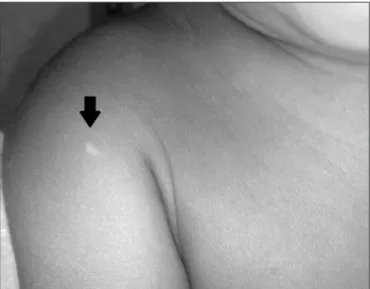
An 18-month-old boy living in the municipality of Ananindeua, state of Pará, was brought to the local referral unit by his parents for household contact examination. The patient’s mother and father had borderline and lepromatous leprosy respectively, with overt skin lesions of at least 1 year’s duration prior to diagnosis. There were no other contacts. Clinical onset in our patient occurred approximately 3 months before presentation, with small, atypical, skin-colored pap-ules and micropappap-ules disseminated across the arms, trunk, and right lower extremity. These lesions had reportedly in-creased in number and size; nine were present on examination (Figure 1). Due to the patient’s young age, which precluded thermal sensitivity testing, and to the atypical, nonspeciic aspect of his lesions, which were not pathognomonic of any particular condition, we chose to perform a skin biopsy and histopathological examination. This revealed tuberculoid granulomas, a perineural and periadnexal lymphohistiocytic iniltrate, and two acid and alcohol-fast bacilli, thus establish-ing a diagnosis of borderline tuberculoid leprosy (Figure 2).
294
Rev Paul Pediatr 2012;30(2):292-5. Leprosy in children under 15 years: the importance of early diagnosis
In view of the number of lesions, the patient was classiied as having multibacillary disease and was placed on multidrug therapy (dapsone/clofazimine/rifampicin) as recommended by WHO. Dosage was calculated according to the patient’s weight (10kg). During twice-monthly follow-up, the child re-mained stable and tolerated therapy well. Degree of disability was not calculated, as the patient would not have been prop-erly responsive to commands at the young age of 18 months. After four months of therapy, lesions had regressed almost completely; only two upper extremity papules remained. At six-month follow-up, all lesions had resolved completely.
Case 2
A 13-year-old boy from the metropolitan region of Belém, Pará, was brought to the local leprosy referral center by his mother with a chief complaint of “lumps all over his body.” According to the patient’s mother, he had a 4-year history of small, disseminated nodular lesions which increased in number and size over time and were ultimately followed by spontaneous onset of wounds on the lower extremities. Also according to the patient’s mother, they had been seeking a diagnosis at local primary health centers, unsuccessfully, since the onset of symptoms. At the time of presentation, the patient was leading a normal life and attending school. Relevant history included contact with a paternal half-broth-er who had received treatment for leprosy 7 years before; however, at the time, no contact tracing was performed and the patient had not received a BCG booster.
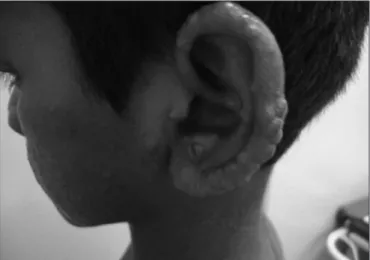
Physical examination revealed disseminated papules, nodules, and tubercles across the patient’s body, auricular iniltration and frank lepromas (Figure 3), and ulcers on the anterior aspect of the legs. The patient had grade 1 disability due to loss of protective sensation in both feet. A skin smear was strongly positive for acid-fast bacilli (4+), and histopatho-logical examination revealed countless leprosy bacilli within macrophages (Fite-Faraco staining). In view of the patient’s multiple, disseminated, iniltrative and ulcerative lesions and skin smear and histopathology indings, the patient was classiied as having multibacillary disease and was placed on multidrug therapy (dapsone/clofazimine/rifampicin) as recom-mended by WHO. All recorded contacts were examined and tested, and none were diagnosed with leprosy.
Discussion
The clinical signs of leprosy are often dificult to rec-ognize in childhood, but the importance of this disease
Figure 2 - Perineural and periadnexal lymphohistiocytic iniltrate (larger image) and granuloma (inset at lower right)
Figure 3 - Iniltration and lepromas on the auricle (Case 2)
and the social, physical, and psychological issues it en-tails cannot be neglected, due to the high likelihood of deformity particularly in some regions where leprosy is endemic(9). Disease progression to physical deformity and
295
Rev Paul Pediatr 2012;30(2):292-5.
Carla Andrea A. Pires et al
In endemic countries, children usually come into contact with smear-positive patients early in life.Both patients reported in this paper were under 15 years of age, were contacts of leprosy patients, and developed multibacil-lary disease, which shows the severity of leprosy in this population(9). The large number of cases of leprosy in
children and adolescents under the age of 15 is indicative of hyperendemic status in the community and of break-downs in disease surveillance and control. This suggests failure to implement effective health policies geared to early diagnosis of the disease, particularly in the pediatric population, which includes contact tracing(9).
Effective control of leprosy is a perennial challenge to health services due to its long incubation period, large number of cases, stigma associated with the disease, and sequelae developed by patients(10). Within this context,
incessant contact tracing is an effective method for early diagnosis of leprosy that can reduce sources of infection and break the chain of transmission, since the source of contagion is often easier to identify in pediatric patients, as it is usually physically close and recent. Furthermore, in childhood, due to the dificulty of diagnosis, patients are at increased odds of developing complications and defor-mities due to the longer period to disease resolution(10).
References
1. Barbieri CL, Marques HH. Leprosy in children and adolescents: bibliographical review and current situation in Brazil. Pediatria (São Paulo) 2009;31:281-90. 2. Amador MP, Barros VR, Albuquerque PJ, Buna MI, Campos JM. Childhood
leprosy in the Curionópolis district – southeastern Pará state – a case report. Hansen Int 2001;26:121-5.
3. Autoria não referida. Leprosy - global situation. Wkly Epidemiol Rec 2000;75:226-31.
4. World Health Organization [homepage on the Internet]. Guide to eliminate leprosy as a public health problem [cited 2010 Jul 27]. Available from: http://www.searo. who.int/LinkFiles/Tools_and_Guidelines_GuidetoEliminateprev.pdf
5. World Health Organization [homepage on the Internet]. Elimination of leprosy in sight. Global alliance created to achieve complete elimination by the end of 2005 [cited 2010 Jul 27]. Available from: http://www.who.int/inf-pr-1999/en/ pr99-70.html
6. Cortés SL, Rodríguez G. Leprosy in children: association between clinical and pathological aspects. J Trop Pediatr 2004;50:12-5.
7. Brasil. Ministério da Saúde. SVS em rede [homepage on the Internet]. Brasil reduz casos de hanseníase em menores de 15 anos [cited 2010 Jul 31]. Available from: http://189.28.128.179:8080/svs_informa/edicao-69-janeiro-de-2010/brasil-reduz-casos-de-hanseniase-em-menores-de-15-anos 8. Brasil. Ministério da Saúde - Secretaria de Vigilância em Saúde. Guia de
vigilância epidemiológica. [Série A. Normas e Manuais Técnicos]. 7ed. Brasília: Ministério da Saúde, 2009.
9. Ferreira IN, Alvarez RR. Leprosy in patients under ifteen years of age in the city of Paracatu - MG (1994 to 2001). Rev Bras Epidemiol 2005;8:41-9. 10. Silva AR, Portela EG, Matos WB, Silva CC, Gonçalves EG. Leprosy in the