Official Journal of the Brazilian Psychiatric Association Volume 34 • Number 4 • December/2012
Psychiatry
Revista Brasileira de Psiquiatria
Abstract
Background: The Beck Depression Inventory (BDI) is used worldwide for detecting depressive symptoms. This questionnaire has been revised (1996) to match the DSM-IV criteria for a major depressive episode. We assessed the reliability and the validity of the Brazilian Portuguese version of the BDI-II for non-clinical adults. Methods: The questionnaire was applied to 60 college students on two occasions. Afterwards, 182 community-dwelling adults completed the BDI-II, the Self-Report Questionnaire, and the K10 Scale. Trained psychiatrists performed face-to-face interviews with the respondents using the Structured Clinical Interview (SCID-I), the Montgomery-Åsberg Depression Scale, and the Hamilton Anxiety Scale. Descriptive analysis, signal detection analysis (Receiver Operating Characteristics), correlation analysis, and discriminant function analysis were performed to investigate the psychometric properties of the BDI-II. Results: The intraclass correlation coeficient of the BDI-II was 0.89, and the Cronbach’s alpha coeficient of internal consistency was 0.93. Taking the SCID as the gold standard, the cut-off point of 10/11 was the best threshold for detecting depression, yielding a sensitivity of 70% and a speciicity of 87%. The concurrent validity (a correlation of 0.63-0.93 with scales applied simultaneously) and the predictive ability of the severity level (over 65% correct classiication) were acceptable.
Conclusion: The BDI-II is reliable and valid for measuring depressive symptomatology among Portuguese-speaking Brazilian non-clinical populations.
Validation of the Brazilian Portuguese version of the
Beck Depression Inventory-II in a community sample
Marcio Henrique Gomes-Oliveira,
1Clarice Gorenstein,
1,2Francisco Lotufo Neto,
1Laura Helena Andrade,
1Yuan Pang Wang
11Section of Psychiatric Epidemiology (LIM-23), Institute and Department of Psychiatry,
Faculdade de Medicina, Universidade de São Paulo
2Department of Pharmacology, Institute of Biomedical Sciences, Universidade de São Paulo
Submitted on July 13, 2011; accepted on March 3, 2012
DESCRIPTORS:
Depression;
Psychometric Scales; Validity;
Beck Depression Inventory; Brazil.
ORIGINAL ARTICLE
Corresponding author: Dr. Wang, YP. Núcleo de Epidemiologia Psiquiátrica; Instituto de Psiquiatria do Hospital das Clínicas; Faculdade de Medicina da Universidade de São Paulo. Rua Dr. Ovídio Pires de Campos, no. 785; 3o. andar - Ala Norte - Sala 17; CEP: 05403-010; São Paulo, SP, Brasil. Phone/Fax: (+55 11) 2661-6976. E mail: [email protected]
Validação da versão brasileira em português do Inventário de Depressão de Beck-II numa amostra da comunidade
Resumo
Objetivos: O Inventário de Depressão de Beck (IDB) é utilizado mundialmente para detectar sintomas depressivos. Este questionário foi revisado (1996) para se adequar aos critérios do DSM-IV para episódio depressivo maior. Avaliamos a coniabilidade e validade da versão I em português-brasileiro do IDB-I em uma amostra não clínica de adultos. Métodos: O questionário foi aplicado em duas ocasiões para 60 estudantes universitários. Em seguida, 182 adultos residentes na comunidade preencheram IDB-II, Questionário de Auto-Resposta e escala K10. Psiquiatras treinados entrevistaram pessoalmente os respondentes através da Entrevista Clínica Estruturada (SCID-I), a escala de depressão de Montgomery-Åsberg e de ansiedade de Hamilton. Análise descritiva, detecção de sinal (Receiver Operating Characteristics), correlação e função discriminante foram realizadas para investigar as propriedades psicométricas do IBD-II. Resultados: O coeiciente de correlação intraclasse do IDB-II foi de 0,89 e o coeiciente alfa de consistência interna foi de 0,93. Adotando a SCID como padrão-ouro, o ponto de corte de 10/11 foi o melhor limiar para detectar depressão, alcançando sensibilidade de 70% e especiicidade de 87%. A validade concorrente (correlação de 0,63-0,93 com escalas aplicadas simultaneamente) e a capacidade preditiva de gravidade (mais de 65% de classiicação correta de indivíduos deprimidos) foram aceitáveis. Conclusão: O IDB-II é idedigno e válido para mensurar sintomatologia depressiva na população brasileira não clínica falante do português.
DESCRITORES:
Depressão,
Escala de depressão, validade,
Inventário de Depressão de Beck, Brasil.
Introduction
The Beck Depression Inventory (BDI) is a self-rating instru-ment that is extensively used worldwide. Originally proposed by Beck and colleagues, the scale was revised in 1996 to include the DSM-IV criteria for a major depressive episode (MDE).1 The BDI-II2 has been translated from English into
several other languages and features sound psychometric properties regarding its applicability and validity. Given the high prevalence of depressive disorders, the validation process comprises an essential step to extend its use to a wide range of populations.
Aim of the study
Considering the need to validate a version of the instrument in a new language, the objective of this study is to examine the psychometric properties of the Brazilian Portuguese version of the BDI-II3 in terms of reliability, criteria, and
concurrent validity. We report evidence supporting the validity of the BDI-II in detecting MDEs and overlaps with anxiety and psychological distress, considering the SCID-I as the gold standard.
Methods
The English version of the BDI-II was translated into Brazilian Portuguese by two bilingual researchers (Y.P.W. and C.G.) from the University of São Paulo and back-translated by a native-speaker. Semantic equivalence was discussed with two bilingual clinical psychiatrists. Subsequently, this version was compared with an independent Brazilian translation that was developed by a clinical psychologist at another university. The conciliated version was submitted to an expert panel discussion composed of one clinical psychiatrist, two clinical psychologists, and one psychopharmacologist, all of whom were
qualiied professionals regarding psychometric instruments and
had clinical experience in depressive conditions. This version was submitted to a new back-translation. Before applying the instrument to the target samples, the BDI-II was pilot-tested
with 20 medical students for cognitive debrieing purposes.
Therefore, the current version differs slightly from the previous Portuguese version of the BDI-II that was proposed in Portugal.4
Participants
Two independent samples were drawn to document different psychometric properties of the BDI-II: a student sample, for retest reliability, and a community sample to establish the best cutoff point for and the validity of the BDI-II with external criteria.
Sample 1
The BDI-II was administered to 60 medical students of the Universidade de São Paulo (mean age = 24.6 years, SD = 1.2, range = 22-26, with 51% women). The students completed the BDI-II,3 the Self-Report Questionnaire (SRQ-20),5 and the K10
scale6 in their classroom on two occasions, with an average
interval length of 15 days.
Sample 2
Subsequently, a convenience sample of 182 adult participants drawn from a population-based household survey of the met-ropolitan area of São Paulo7 completed the BDI-II,3 the SRQ-20,5
and the K106 at the Institute of Psychiatry. Regardless of their
mental health or physical condition, the participants were liv-ing in their household at the time of the assessment. The mean age of this community-dwelling sample was 41 yo. (SD = 10.8, range = 20-60), the mean number of years of education was 9.4 (SD = 3.9, range = 2-19), and 102 participants were female (56%). All participants underwent face-to-face interviews that used the Structured Clinical Interview (SCID-I)8 anchored with the Clinical
Global Impression (CGI),9 the Montgomery-Åsberg Depression
Measures
The BDI-II2,3 consists of 21 sets of statements about
depres-sive symptoms in the last 15 days that are rated on a 0-to-3 ordinal scale, yielding total scores ranging from 0 to 63. The suggested thresholds1 for levels of severity were as follows:
0-13, minimal/no depression; 14-19, mild depression; 20-28, moderate depression; and 29-63, severe depression.
The following comparison instruments were applied consecutively to further assess the criterion-based validity of the BDI-II:
1) Structured Clinical Interview for DSM-IV Axis I Disorders (SCID-I)8 and the Clinical Global Impression
Scale (CGI)9
2) Montgomery-Åsberg Depression Rating Scale (MADRS)10
3) Hamilton Anxiety Scale (HAM-A)11
4) Kessler's psychological distress scale (K10)5
5) Self-Report Questionnaire (SRQ-20)6
This study was approved by the Ethics Committee of the University Hospital Board and written informed consent was obtained from the participants before they entered the study.
Data analysis strategy
Descriptive analyses, the intraclass correlation (ICC) of the
student sample, and the internal consistency coeficient
(Cronbach's alpha) of the BDI-II of the community sample were computed. Subsequently, signal detection analyses
against the diagnoses of the SCID-I/MDE were conducted for all possible BDI-II scores by building the Receiver Operating Characteristics (ROC) curve. Positive predictive value (PPV), negative predictive value (NPV), and the percentage of misclassification were calculated. After classification of subjects into depressed and non-depressed subgroups according to the best threshold, Spearman's correlations of
classiication and the CGI were calculated.
Pearson's correlations between the BDI-II and the psy-chometric tools were calculated. The discriminant function analysis was executed according to the severity level of the BDI-II using a canonical discriminant function to predict the category membership of the severity level and using the diagnosis of SCID-I/MDE as the criterion. All analyses were
performed using SPSS 14.0, with a signiicance level of 0.05
for two-tailed tests.
Results
The ICC coeficient for the retest reliability of the BDI-II
for the student sample was 0.89 (95%CI 0.82-0.93). The
Cronbach’s alpha coeficient of the BDI-II for the community
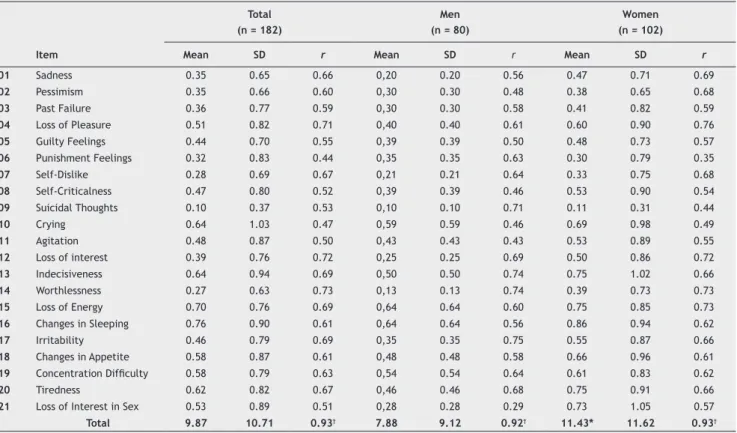
sample was 0.93, and the alphas were 0.92 and 0.93 for male and female subgroups, respectively. The item-total correla-tion ranged from 0.44 to 0.73, indicating satisfactory item homogeneity for assessing the underlying construct.
The mean score and the standard deviation (SD) of each BDI-II item are displayed in Table 1 for the total sample and
separated by gender. Men scored signiicantly lower than
women (7.88 vs. 11.43; F = 5.05; p < 0.05).
Table 1 Means, standard deviations, and corrected item-total correlations of the BDI-II for the total sample and for the subgroups of men and women
Total (n = 182)
Men (n = 80)
Women (n = 102)
Item Mean SD r Mean SD r Mean SD r
01 Sadness 0.35 0.65 0.66 0,20 0.20 0.56 0.47 0.71 0.69
02 Pessimism 0.35 0.66 0.60 0,30 0.30 0.48 0.38 0.65 0.68
03 Past Failure 0.36 0.77 0.59 0,30 0.30 0.58 0.41 0.82 0.59
04 Loss of Pleasure 0.51 0.82 0.71 0,40 0.40 0.61 0.60 0.90 0.76
05 Guilty Feelings 0.44 0.70 0.55 0,39 0.39 0.50 0.48 0.73 0.57
06 Punishment Feelings 0.32 0.83 0.44 0,35 0.35 0.63 0.30 0.79 0.35
07 Self-Dislike 0.28 0.69 0.67 0,21 0.21 0.64 0.33 0.75 0.68
08 Self-Criticalness 0.47 0.80 0.52 0,39 0.39 0.46 0.53 0.90 0.54
09 Suicidal Thoughts 0.10 0.37 0.53 0,10 0.10 0.71 0.11 0.31 0.44
10 Crying 0.64 1.03 0.47 0,59 0.59 0.46 0.69 0.98 0.49
11 Agitation 0.48 0.87 0.50 0,43 0.43 0.43 0.53 0.89 0.55
12 Loss of interest 0.39 0.76 0.72 0,25 0.25 0.69 0.50 0.86 0.72
13 Indecisiveness 0.64 0.94 0.69 0,50 0.50 0.74 0.75 1.02 0.66
14 Worthlessness 0.27 0.63 0.73 0,13 0.13 0.74 0.39 0.73 0.73
15 Loss of Energy 0.70 0.76 0.69 0,64 0.64 0.60 0.75 0.85 0.73
16 Changes in Sleeping 0.76 0.90 0.61 0,64 0.64 0.56 0.86 0.94 0.62
17 Irritability 0.46 0.79 0.69 0,35 0.35 0.75 0.55 0.87 0.66
18 Changes in Appetite 0.58 0.87 0.61 0,48 0.48 0.58 0.66 0.96 0.61
19 Concentration Dificulty 0.58 0.79 0.63 0,54 0.54 0.64 0.61 0.83 0.62
20 Tiredness 0.62 0.82 0.67 0,46 0.46 0.68 0.75 0.91 0.66
21 Loss of Interest in Sex 0.53 0.89 0.51 0,28 0.28 0.29 0.73 1.05 0.57
Total 9.87 10.71 0.93† 7.88 9.12 0.92† 11.43* 11.62 0.93†
SD: Standard-Deviation; r: item-total correlation.
†Cronbach’s alpha coeficient of internal consistency.
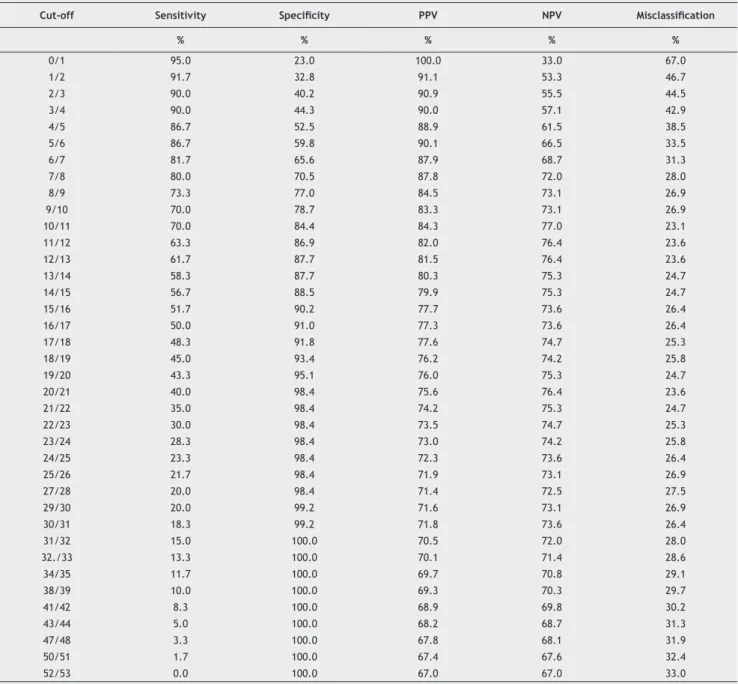
Table 2 Sensitivity, speciicity, positive and negative predictive value, and misclassiication rate of the Beck Depression
Inventory-II for the diagnosis of a Major Depressive Episode, according to the cutoff points of the total score of the scale against the Structured Clinical Interview for DSM-IV Axis I Disorders (SCID-I)
Cut-off Sensitivity Speciicity PPV NPV Misclassiication
% % % % %
0/1 95.0 23.0 100.0 33.0 67.0
1/2 91.7 32.8 91.1 53.3 46.7
2/3 90.0 40.2 90.9 55.5 44.5
3/4 90.0 44.3 90.0 57.1 42.9
4/5 86.7 52.5 88.9 61.5 38.5
5/6 86.7 59.8 90.1 66.5 33.5
6/7 81.7 65.6 87.9 68.7 31.3
7/8 80.0 70.5 87.8 72.0 28.0
8/9 73.3 77.0 84.5 73.1 26.9
9/10 70.0 78.7 83.3 73.1 26.9
10/11 70.0 84.4 84.3 77.0 23.1
11/12 63.3 86.9 82.0 76.4 23.6
12/13 61.7 87.7 81.5 76.4 23.6
13/14 58.3 87.7 80.3 75.3 24.7
14/15 56.7 88.5 79.9 75.3 24.7
15/16 51.7 90.2 77.7 73.6 26.4
16/17 50.0 91.0 77.3 73.6 26.4
17/18 48.3 91.8 77.6 74.7 25.3
18/19 45.0 93.4 76.2 74.2 25.8
19/20 43.3 95.1 76.0 75.3 24.7
20/21 40.0 98.4 75.6 76.4 23.6
21/22 35.0 98.4 74.2 75.3 24.7
22/23 30.0 98.4 73.5 74.7 25.3
23/24 28.3 98.4 73.0 74.2 25.8
24/25 23.3 98.4 72.3 73.6 26.4
25/26 21.7 98.4 71.9 73.1 26.9
27/28 20.0 98.4 71.4 72.5 27.5
29/30 20.0 99.2 71.6 73.1 26.9
30/31 18.3 99.2 71.8 73.6 26.4
31/32 15.0 100.0 70.5 72.0 28.0
32./33 13.3 100.0 70.1 71.4 28.6
34/35 11.7 100.0 69.7 70.8 29.1
38/39 10.0 100.0 69.3 70.3 29.7
41/42 8.3 100.0 68.9 69.8 30.2
43/44 5.0 100.0 68.2 68.7 31.3
47/48 3.3 100.0 67.8 68.1 31.9
50/51 1.7 100.0 67.4 67.6 32.4
52/53 0.0 100.0 67.0 67.0 33.0
PPV: Positive predictive value; NPV: Negative predictive value
All possible scores of the BDI-II were compared with the cases of the SCID-I/MDE (Table 2). The best cut-off point was 10/11. This threshold showed a sensitivity of 70% and
a speciicity of 84.4%. In addition, the PPV was 84.3%, the NPV was 77%, and the misclassiication rate was 23.1%.
The area under the ROC curve indicated that the instrument could discriminate 82.1% (95%CI 75-89) of cases of MDE, demonstrating substantial accuracy.
When adopting a cut-off of 10/11, 121 subjects were
classiied as non-depressed (BDI ≤ 10) and 61 were classiied
as depressed (BDI > 10). The proportions of CGI scores were as
follows: 87.6% of non-depressed individuals were classiied
as "not ill/minimally ill" (CGI 1-3), and 64.6% of depressed
subjects exceeded the "moderately ill" level (CGI 4-7). The CGI was correlated with the BDI-II score and the dichotomous
10/11 classiication of depression (rho = 0.67, p < 0.05).
Adopting the diagnosis of MDE as the criterion and the suggested severity threshold, the best discriminative perfor-mance of the BDI-II was observed between those individuals with "minimal/no depression" (scores 0-13) and those with "very severe" depression (scores 29-63), which were 81.1% and 85.7%, respectively. The overall predictive ability of
cases correctly classiied was 65.4%.
correlations with the K10 were 0.63 and 0.93. The correlation with the MADRS was 0.75, and that for the HAM-A was 0.66 in the community sample.
Discussion
This study provides the irst data on the psychometric per
-formance of the Brazilian Portuguese version of the BDI-II in a non-clinical population. The instrument showed temporal stability and was internally consistent and valid for predict-ing the presence of depressive symptoms. While most studies have assessed student samples, our main data, along with the clinical interviews, come from community adults across
wide ranges of ages and educational levels. The signiicance
of the self-rated score of depression was also correlated with a clinical assessment of severity.
The reliability of the Brazilian Portuguese version is
similar to the original coeficients reported for the American
version.2 In general, the internal consistencies of
linguisti-cally diverse versions of the BDI-II have been described as
good to excellent. This similarity most likely relects the
robust underlying construct and displays the representative
item quality of the revised questionnaire. The coeficient
value for the Brazilian data of approximately 0.90 supports
its stableness, and this coeficient is comparable to those
reported for the versions in English and Spanish,12 Turkish,13
and Icelandic.14
As in most of the published investigations on the BDI-II, an effect of gender emerged consistently in the total score. The gender bias of the BDI-II is invariantly found in instru-ments used to assess depression, and this bias deserves future investigation.
There is controversy in the literature about the cut-score ranges used to categorize mildly, moderately, and severely depressed individuals.1 Adopting Kendall’s recommendation
(10/11 for dysphoria and 15/16 mild depression), Dozois et al.15
found a sensitivity of 71% and a speciicity of 88%. However,
the higher cut-offs of 13/14 and 20/21 improved the
sen-sitivity to 81% and the speciicity to 92%. Recently, Shean
et al.16 showed that the threshold of 18/19 is an adequate
indicator of speciicity (84.4% to 100%) for moderate to
severe depression.
Our cut-off point of 10/11 is similar to the thresholds of Canadian15 and Turkish studies.13 In contrast, the sensitivity
decreases to 58.3% and there is a small increase in speciic
-ity (87.7%) when the threshold to detect mild depression is increased to 13/14.2 Moreover, with a higher threshold
(e.g., 20/21), unacceptable sensitivity and high speciicity
are observed. If the suggested cut-off of 26/27 for severe depression is adopted,2 the sensitivity becomes too trivial
for detecting depression (21.7%). The 10/11 threshold of this Brazilian Portuguese version works well in binary prediction for 82% of depression vs. non-depression cases. While the predictive capacity for different levels of severity is accept-able, it is lower than the 87% value of the Icelandic study.14
The BDI-II demonstrated high correlations with instru-ments applied simultaneously. In the literature, the overlap of the construct assessed by the BDI-II and common scales used to screen for depression (e.g., MADRS, HAM-D) ranged between 0.69 and 0.86. In our investigation, the BDI-II also showed good correlations with scales of general psychopa-thology, such as the K10 and SRQ-20.
Some weaknesses of this study should be noted. The sample was assessed in a health care setting, which may bias the results. Participants may have exaggerated their symptoms to obtain treatment for health problems. However, our results are comparable most international studies and ensure the applicability of the BDI-II to non-clinical samples. Additionally, the adoption of the SCID-I as the criterion may
have hampered the prediction because the SCID-I’s time
frame exceeds that of the BDI-II, which only assesses the past two weeks. Therefore, some depressive symptoms may have remitted to the point of being undetectable by the questionnaire. Likewise, the periods covered by concurrent instruments (e.g., SRQ-20 and K10) also outnumber the time length covered by the BDI-II.
Much of the construct validity of the BDI-II remains to
be demonstrated. Some speciiers of depression (e.g., the
chronicity, remission, and symptomatic pattern of atypical presentation) should be investigated with a prospective design and a more inclusive sample. The applicability of the BDI-II should be tested in clinical samples of active cases of depression, epidemiological surveys, primary care, and general hospital settings. In conclusion, the indicators of reliability and validity of the Brazilian Portuguese version of the BDI-II were satisfactory and sup-port its use in Brazilian non-clinical populations to predict probable depression.
Acknowledgments
The Fundação de Amparo à Pesquisa do Estado de São Paulo sponsored this project. Dr. YPW is the recipient of the grant (Process # 2008/11415-9). The Conselho Nacional de Pesquisa (CNPq) sponsored Dr. CG and LHA. We acknowledge the involvement of the Publisher Casa do Psicólogo, who kindly provided the BDI-II forms and gave permission for its use in Brazil. We are also grateful to Prof. Ronald C. Kessler, who gave permission to use the K10 instrument.
Disclosures
Marcio Henrique Gomes-Oliveira, BA
Employment: Section of Psychiatric Epidemiology (LIM-23), Institute and Department of Psychiatry, Faculdade de Medicina, Universidade de São Paulo (USP), Brazil.
Clarice Gorenstein, PhD
Employment: Section of Psychiatric Epidemiology (LIM-23), Institute and Department of Psychiatry, Faculdade de Medicina, Universidade de São Paulo (USP); Department of Pharmacology, Institute of Biomedical Sciences, USP, Brazil.
Francisco Lotufo-Neto, PhD
Employment: Department of Psychiatry, Faculdade de Medicina, Universidade de São Paulo (USP), Brazil.
Laura Helena Andrade, PhD
Employment: Section of Psychiatric Epidemiology (LIM-23), Institute and Department of Psychiatry, Faculdade de Medicina, Universidade de São Paulo (USP), Brazil.
Yuan-Pang Wang, PhD
Employment: Section of Psychiatric Epidemiology (LIM-23), Institute and Department of Psychiatry, Faculdade de Medicina, Universidade de São Paulo (USP), Brazil.
The study was conducted at the Section of Psychiatric Epidemiology (LIM-23), Institute and Department of Psychiatry, Faculdade de Medicina, Universidade de São Paulo, Brazil.
* Modest
** Signiicant
*** Signiicant. Amounts given to the author’s institution or to a colleague for
References
1. American Psychiatric Association. Diagnostic and statistical manual of mental disorders. 4th. edition (DSM-IV). American Psychiatric Press. 1994.
2. Beck AT, Steer RA, Brown GK. BDI-II: Beck Depression Inventory Manual. Psychological Corporation. 1996.
3. Gorenstein C, Wang Y-P, Argimon IL, Werlang BSG. Manual do Inventário de depressão de Beck - BDI-II. Beck AT, Steer RA, Brown GK, editors. São Paulo: Editora Casa do Psicólogo. 2011. 4. Coelho R, Martins A, Barros H. Clinical proiles relating gender and depressive symptoms among adolescents ascertained by the Beck Depression Inventory II. Eur Psychiatry. 2002;17(4):222-6. 5. Harding TW, de Arango MV, Baltazar J, Climent CE, Ibrahim HH,
Ladrido-Ignacio L, et al. Mental disorders in primary health care: a study of their frequency and diagnosis in four developing countries. Psychol Med. 1980;10(2):231-41.
6. Kessler RC, Andrews G, Colpe LJ, Hiripi E, Mroczek DK, Normand SL, et al. Short screening scales to monitor population prevalences and trends in non-speciic psychological distress. Psychol Med. 2002; 32(6):959-76.
7. Viana MC, Teixeira MG, Beraldi F, Bassani I de S, Andrade LH. Sao Paulo Megacity Mental Health Survey - a population-based epidemiological study of psychiatric morbidity in the Sao Paulo metropolitan area: aims, design and ield implementation. Rev Bras Psiquiatr. 2009;31(4):375-86.
8. First M, Spitzer R, Gibbon M, J W. Structured Clinical Interview for DSM-IV- TR Axis I Disorders, Research Version, Non-patient Edition (SCID-I/NP). Biometrics Research, New York State Psychiatric Institute. 2002.
9. Guy W. ECDEU Assessment Manual for Psychopharmacology. Revised Rockville,MD. 1976:218-22.
10. Montgomery SA, Asberg M. A new depression scale designed to be sensitive to change. Br J Psychiatry. 1979;134:382-9. 11. Hamilton M. The assessment of anxiety states by rating. Br J
Med Psychol. 1959;32(1):50-5.
12. Wiebe JS, Penley JA. A psychometric comparison of the Beck Depression Inventory-II in English and Spanish. Psychol Assess. 2005;17(4):481-5.
13. Kapci EG, Uslu R, Turkcapar H, Karaoglan A. Beck Depression Inventory II: evaluation of the psychometric properties and cut-off points in a Turkish adult population. Depress Anxiety. 2008;25(10):E104-10.
14. Arnarson TO, Olason DT, Smari J, Sigurethsson JF. The Beck Depression Inventory Second Edition (BDI-II): psychometric properties in Icelandic student and patient populations. Nord J Psychiatry. 2008;62(5):360-5.
15. Dozois D, Dobson K, Ahnberg J. A psychometric evaluation of the Beck Depression Inventory-II. Psychol Assess. 1998;10(2):83-9. 16. Shean G, Baldwin G. Sensitivity and speciicity of depression