Rev Bras Psiquiatr. 2012;34:213-216
Official Journal of the Brazilian Psychiatric Association Volume 34 • Number 2 • June/2012
Psychiatry
Revista Brasileira de Psiquiatria
Severe compulsive sexual behaviors: a report
on two cases under treatment
Letter to the Editors
Dear Editor,
Compulsive sexual behavior (CSB) is deined by sexual urges, sexually arousing fantasies, and sexual behaviors that are re
-current and intense, causing distressful interference in daily life.1 Severe CSB can be associated to prolonged occurrence
of CSB and several negative consequences: intense emotional suffering, legal sanctions, and increased health risks1 - e.g.
intentional unprotected anal intercourse (barebacking) and sexual practice among men (MSM),2 contributing to increase
HIV transmission indicators.3
In Brazil, MSM account for 28% of male AIDS cases dating from 2000.4 Looking at the reports of two severe CSB cases
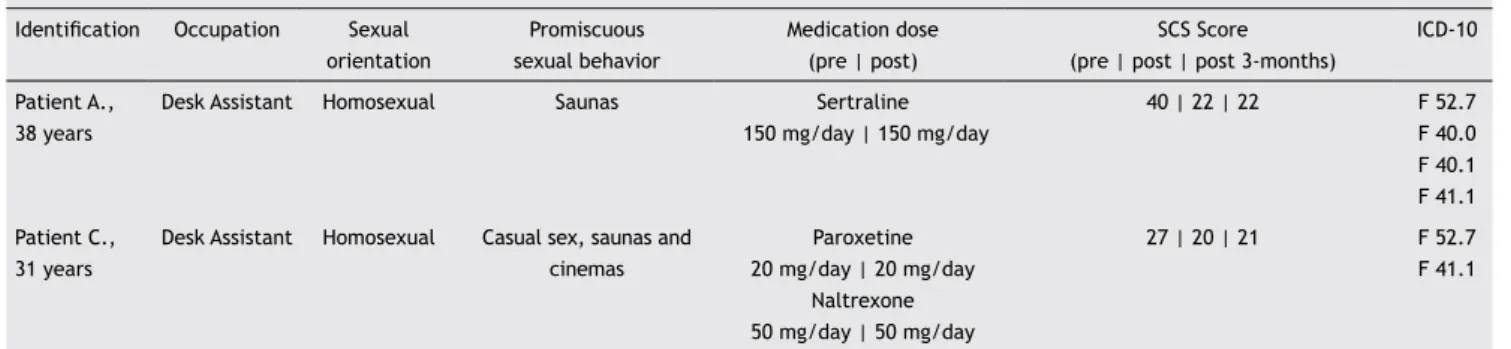
associated with barebacking, we see that these patients underwent medicated psychiatric treatment (Table 1) and 16 sessions of psychodynamic psychotherapy. The inventory used was the Sexual Compulsivity Scale (SCS), that was applied before, immediately after, and three months following the intervention (Table 1). The sexual behaviors studied were: having a main partner, number of casual partners and condom use during anal intercourse. The criterion for barebacking behavior was report of no condom use during most instances of anal sexual intercourse. The criterion for CSB was exceed
-ing the cutoff score of 24 on the SCS.5
This study was approved by the Ethics Committee of the Hospital das Clínicas in the Medicine School of the Universidade de São Paulo (HC-FMUSP). The patients sought treatment for CSB at the Sexuality Studies Program of the Institute of Psychiatry in HC-FMUSP. After they signed the consent form, they were enrolled in the study.
C., who is HIV-negative, reports CSB occurring since 2000. The main aspects of his CSB include: chatting via phone calls or internet and visiting cinemas and saunas looking for sex. He reported 30 to 40 casual partners over the last six months, despite a three-year relationship with a main partner with whom he rarely uses condoms. He had been using other sexual harm-reduction strategies such as having his partner withdraw prior to ejaculation.
A., who is HIV-positive, reports never having a stable relationship and is constantly searching for sex in saunas. He pays for his sexual encounters and reports having unpro
-tected receptive anal intercourse with three different men each time. A. reported having 50 casual partners over the last six months.
At the end of treatment, A. and C. improved according to scores of SCS (Table 1), increasing their control over CSB and their use of condoms. A. visited saunas less frequently, had only four casual partners over last six months, and used
Table 1 Sociodemographic and clinical data of patients. São Paulo, Brazil. 2011
Identiication Occupation Sexual
orientation
Promiscuous sexual behavior
Medication dose
(pre | post)
SCS Score
(pre | post | post 3-months)
ICD-10
Patient A., 38 years
Desk Assistant Homosexual Saunas Sertraline 150 mg/day | 150 mg/day
40 | 22 | 22 F 52.7 F 40.0 F 40.1 F 41.1 Patient C.,
31 years
Desk Assistant Homosexual Casual sex, saunas and cinemas
Paroxetine 20 mg/day | 20 mg/day
Naltrexone 50 mg/day | 50 mg/day
27 | 20 | 21 F 52.7 F 41.1
Note: SCS: Sexual Compulsivity Scale. F 52.7: Excessive sexual drive; F40.0: Agoraphobia; F40.1: Social phobias; F41.1: Generalized anxiety disorder.
214 Letter to the Editors
condoms most of the time. He increased awareness about risks of sexually transmitted diseases involving unsafe sex. C. increased the use of condoms with his main partner, stopped visiting saunas and cinemas and decreased his use of the internet and practice of casual sex, dropping to four casual partners over a period of six months with a 50% frequency of condom use.
These reports suggest that psychiatric drug treatment and brief psychodynamic psychotherapy may increase control over CSB and reduce negative outcomes.
Acknowledgements
This paper is part of the Project funded by the Fundação de Amparo à Pesquisa do Estado de São Paulo (FAPESP), Process n. 2010/15921-6. We thank Dr. Carmita Abdo who coordinates ProSex.
Maria Luiza Sant’Ana do Amaral;
1,2Marco de Tubino Scanavino, PhD
31 Psychologist; 2 Expert in Human Sexuality, School of Medicine,
Universidade de São Paulo (USP);
3 Assistant-Physician, Sexuality Studies Program (ProSex),
Institute of Psychiatry of the School of Medicine, Universidade de São Paulo (USP).
Disclosures
Maria Luiza Sant’Ana do Amaral
Employment: Psychologist, Expert in Human Sexuality; School of
Medicine, Universidade de São Paulo (USP), Brazil.
Marco de Tubino Scanavino, PhD
Employment: Assistant-Physician, Sexuality Studies Program (ProSex),
Institute of Psychiatry of the School of Medicine, Universidade de São Paulo (USP), Brazil.
This study is part out of the Sexuality Studies Program (ProSex), car-ried out at the Department and Institute of Psychiatry of the School of Medicine of the Universidade de São Paulo (USP), Brazil.
Financial support: Fundação de Amparo à Pesquisa do Estado de São Paulo (FAPESP), Processo n. 2010/15921-6, Brazil.
* Modest
** Signiicant
*** Signiicant. Amounts given to the author’s institution or to a colleague for
research in which the author has participation, not directly to the author.
References
1. Miner M, Coleman E, Center B, Ross M, Rosser B. The compulsive sexual behavior inventory: psychometric properties. Arch Sex Behav. 2007;36(4):579-87.
2. Carballo-Diéguez A, Ventuneac A, Bauermeister J, G.W. Dowsett,
Dolezal C, Remien RH, Balan I, Rowe M. Is ‘bareback’ a useful construct in primary HIV-prevention? Deinitions, identity and research. Cult Health Sex. 2009;11(1):51-65.
3. Parsons J, Bimbi D. Intentional unprotected anal intercourse among sex who have sex with men: barebacking - from behavior to identity. AIDS Behav. 2007;11(2):277-87.
4. Brasil. Ministério da Saúde. Programa Nacional de DST e Aids. 2011. http://portal.saude.gov.br/portal/arquivos/pdf/ gerson_pereira.pdf.
5. Parsons JT BD, Halkitis PN. Sexual compulsivity among gay/