Arquivos Brasileiros de Cardiologia - Volume 83, Nº 5, Novembro 2004
445
Case Report
Stent Implantation in Critical Stenosis of the Celiac
Trunk: Enlarging the Frontiers of Percutaneous
Vascular Intervention
Alexandre Schaan de Quadros, Rogério Sarmento-Leite, Cláudio Vasquez Moraes, Luis Maria Yordi
Porto Alegre, RS - Brazil
Hospital Mãe de Deus e Hospital Moinhos de Vento - Porto Alegre Mailing address: Alexandre Schaan de Quadros - Av. Ganzo, 677/602 Cep 0150-071 - Porto Alegre, RS, Brazil
E-mail: [email protected] Received for publication: 02/14/2003 Accepted for publication: 02/27/2004
dL, urea=68mg/dL), normal electrolytes, and fasting glyce-mia=123 mg/dL. Electrocardiogram at rest demonstrated sinus rhythm, HR=64 bpm, left ventricular overload pattern with ST segment depression in leads V5 and V6. A chest X-ray de-monstrated cardiomegaly without signs of pulmonary venocapillary congestion.
Epigastric pain assessment was performed with digestive en-doscopy, which was normal, and with the assessment of the gastroenterologist, severe mesenteric angina was diagnosed. Angio resonance of the abdominal aorta and its branches was performed and demonstrated stenosis of 80% in the origin of the celiac trunk, 50% proximal stenosis in the superior mesenteric artery, inferior mesenteric artery occlusion, and stenosis of 70% in the right renal artery. Abdominal aortography was indicated, as well as visceral arteriography, with intervention in the same procedure, in case the angiography scan findings were confirmed.
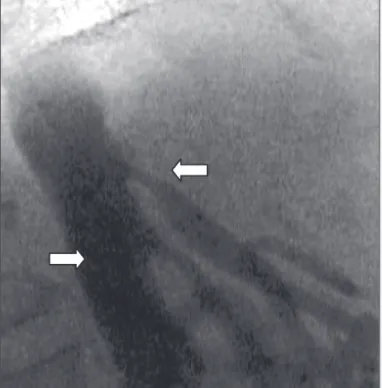
The patient was taken to the hemodynamic laboratory in good clinical conditions, with neither angina nor heart failure. Puncture of the femoral artery and abdominal aortography were performed in anteroposterior projection and left lateral projection with a pigtail catheter, confirming the findings of the angiographic scan: 70% stenosis in the origin of the celiac trunk, 50% stenosis in the superior mesenteric artery, and occlusion of the inferior mesenteric artery (fig. 1 and 2). Renal arteries did not have significant stenosis. Endovenous 5.000 U heparin was administered, and catheterization of the celiac trunk was selectively performed using a Veripath Lima 7F-guiding catheter (Guidant, Indianapolis, Indiana, USA). The steno-sis was surpassed with a 0.014 ACS Hi-Torque Extra Sport guidewire (Guidant, Indianapolis, Indiana, USA). Once in place, a Herculink 6.0 X 18-mm biliary stent (Guidant/Advanced Cardiovascular Systems, Indianapolis, Indiana, USA) was released and pushed against the artery wall by using 18 atm (fig. 3). Normal flow was observed at the end of the procedure, with residual stenosis lower than 10% (fig. 4 and 5). The patient left the laboratory in good condition, and in the first postoperative period, she could eat normally, without abdominal pain. In clinical follow-up, one year after the procedure, the patient remains asymptomatic, without recurrent symptoms and has returned to her normal weight.
Discussion
Chronic mesenteric ischemia caused by severe atherosclerosis of visceral arteries is a rare clinical situation, and it is usually followed by postprandial abdominal pain, weight loss, and athe-rosclerotic involvement in other vascular territory 1-8. Therapeutic
options are limited, and revascularization surgery has high
mor-Symptomatic mesenteric ischemia usually associated with severe and diffuse atherosclerosis of the visceral arteries is a rare clinical situation, difficult to treat.
We describe here the case of a 75-year-old woman with disabling mesenteric angina and stenosis of 80% in the origin of the celiac trunk, proximal stenosis of 50% in the superior mesenteric artery, and occlusion of the inferior mesenteric artery. A stent was successfully implanted in the ostium of the celiac trunk, without complications. The symptoms reversed in the first postoperative day, and the patient has remained asympto-matic for one year after the procedure, which is considered safe and efficient and which may become the treatment of choice for this disease.
Symptomatic mesenteric ischemia is usually associated with seve-re and diffuse atherosclerosis in the visceral arteries, and it is a raseve-re clinical situation that is difficult to treat. Revascularization surgery has high morbidity and mortality due to the high surgical risk. Per-cutaneous implantation of endoprostheses is an effective minimally invasive choice, ideal for patients with several comorbidities.
Case Report
A 75-year-old-female, with progressive epigastric pain in the prior 3 months, starting during meals and stopping after 30 minu-tes, evolved with progressive weight loss of 4kg, and was unable to eat properly. The patient had a clinical diagnosis of severe ischemic heart disease (triple-vessel disease without the possibility of invasive treatment), NYHA class III heart failure because of left ventricular systolic function, diabetes mellitus, chronic renal failure, and peripheral vascular disease. She was taking digoxin 0.125 mg/day, furosemide 80 mg/day, spironolactone 25 mg/day, losartan 100 mg/day, glibenclamide 4 mg/day, isosorbide dinitrate 120 mg/day, metoprolol 100 mg/day, acetylsalicylic acid 100 mg/day, and simvastatin 40 mg/day.
Arquivos Brasileiros de Cardiologia - Volume 83, Nº 5, Novembro 2004
446
Stent Implantation in Critical Stenosis of the Celiac Trunk: Enlarging the Frontiers of Percutaneous Vascular Intervention
bidity and mortality, ranging from 5 to 15% even in referral university hospitals dedicated to the treatment of vascular diseases 4,5.
Per-cutaneous revascularization through balloon angioplasty or endo-prostheses implantation is an attractive option because it is a minimally invasive procedure, which is ideal in this group of patients with multiple comorbidities. Balloon angioplasty has been used in the treatment of superior mesenteric artery stenosis, inferior me-senteric artery stenosis, and celiac trunk artery stenosis for over a decade, with suboptimal results probably because of the ostial nature of many of these lesions 1,3,5,8. Balloon angioplasty in ostial
lesions is associated with more severe residual stenosis due to the intense elastic recoil caused by the large number of circular elastic fibers in the ostium, which is, in turn, associated with the increase in complications (acute occlusion) and restenosis 5,8.
Fig. 1 - Aortography in left lateral position demonstrating severe stenosis in the ostium and in the segment proximal to the celiac trunk and moderate stenosis in the superior mesenteric arteries (arrows).
Fig. 2 - Anteroposterior projection demonstrating severe stenosis in the ostium and segment proximal to the celiac trunk (arrow).
Fig. 3 - Image in lateral projection demonstrating stenting in the celiac trunk.
Fig. 4 - Anteroposterior projection demonstrating luminal recovery with minimal residual stenosis after stenting (arrow).
Stent implantation decreases these complications because it provides a metallic support that prevents the elastic recoil of the vessel. Because of the low prevalence of this disease, clinical experience with stent implantation in visceral artery stenosis is limited, restricted to case reports and retrospective studies with small number of patients 3-9. In these studies, stent implantation
was more often associated with lower complication and restenosis rates than was isolated balloon angioplasty1,3,8,10 and lower
morbi-dity when compared with that in traditional surgical treatment 5.
The risks of this procedure are small, but they include distal embolism with ischemia worsening, reperfusion syndrome, cho-lesterol embolism for inferior limbs through manipulation of the aortic plaques, and aortic dissection in cases of ostial stenosis.
vis-Arquivos Brasileiros de Cardiologia - Volume 83, Nº 5, Novembro 2004
447
Stent Implantation in Critical Stenosis of the Celiac Trunk: Enlarging the Frontiers of Percutaneous Vascular Intervention1. Pietura R, Szymanska A, El Furah M et al. Chronic mesenteric ischemia: diagnosis and treatment with balloon angioplasty and stenting. Med Sci Monit 2002; 8: PR8-PR12. 2. Waybill P, Enea N. Use of a palmaz stent deployed in the superior mesenteric artery
for chronic mesenteric ischemia. J Vasc Interv Radiol 1997; 8: 1069-1071. 3. Faries P, Morrissey NJ, Teodorescu V et al. Recent advances in peripheral
angio-plasty and stenting. Angiology 2002; 53: 617-626.
4. Sheeran SR, Murphy T, Khwaja A et al. Stent placement for treatment of mesenteric artery stenoses or occlusions. J Vasc Intervent Radiol 1999; 10: 861-67. 5. Kasirajan K, O´Hara PJ, Gray BH et al. Chronic mesenteric ischemia: open surgery
versus percutaneous angioplasty and stenting. J Vasc Surg 2001; 33: 63-71. 6. Steinmetz E, Tatou E, Favier-Blavoux C et al. Endovascular treatment as first
choice in chronic intestinal ischemia. Ann Vasc Surg 2002; 16: 693-99.
References
7. Nyman U, Ivancev K, Lindh M et al. Endovascular treatment of chronic mesenteric ischemia: report of five cases. Cardiovasc Intervent Radiol 2000; 23: 410-2. 8. Matsumoto AH, Angle JF, Spinosa DJ et al. Percutaneous transluminal
angioplas-ty and stenting in the treatment of chronic mesenteric ischemia: results and long-term follow-up. J Am Coll Surg 2002; 194: S22-31.
9. Forauer AR, Gordon K. Primary stenting of the superior mesenteric artery for treat-ment of chronic mesenteric ischemia: a case report. Angiology 1999; 50: 63-67. 10. Gotsman I, Verstanding A. Intravascular stent implantation of the celiac artery in
the treatment of chronic mesenteric ischemia. J Clin Gastroent 2001; 32: 164-66. 11. Fusman B, Jolly N, French M et al. Procedural outcome of percutaneous interven-tion on celiac or mesenteric arteries for the treatment of chronic mesenteric ische-mia. Am J Cardiol 2002; 90: 64H.
Fig. 5 - Left lateral projection demonstrating luminal recovery with minimal residual stenosis after steting (arrow).
ceral vessels and of other vascular territories (severe ischemic heart disease, previous stroke, inferior limb vascular disease), just as described in several studies in the literature 1-8. The typical
symptom of severe and disabling postprandial pain, and the finding of severe stenosis in the angiographic scan, and negative diagnostic investigation for peptic disease, encouraged a preferential indication for percutaneous revascularization due to the high surgical risk 11.
Follow-up was excellent, with pain relieved in the first postoperative period and improvement in the clinical picture. Intervention only in the artery with most severe atherosclerotic involvement has been described as the preferred approach for the management of these patients 7, and the patient we have described remains
asymp-tomatic at one-year follow-up.