440
Fibrinolytic therapy and primary percutaneous transluminal coronary angioplasty are effective methods used to promote myo-cardial reperfusion in acute myomyo-cardial infarction (AMI) 1. However,
the re-establishment of normal epicardial flow (TIMI grade 3) is not achieved in a significant number of patients who undergo fibrinolytic treatment 2,3. The strategy of a rescue percutaneous
coronary intervention (PCI) early after failure of fibrinolytic treatment has a logical indication; however, the clinical impact and the selection of the precise strategy is still controversial and still has inferior results when compared with the results of a primary procedure 4-8. Therefore, primary PCI, when available, is considered
the gold standard for coronary reperfusion 9.
The objective of this study was to perform a comparative analysis of in-hospital results obtained from AMI patients who underwent rescue or primary PTCA, consecutively included in a national registry of interventional cardiology (CENIC - Central Nacional de Intervenções Cardiovasculares).
Methods
The CENIC registry was created in 1991 and sponsored by the Brazilian Society of Interventional Cardiology (SBHCI). The procedures were established in a spontaneous fashion. The consistency of the results have been analyzed in former publica-tions10-13. The PCI procedures started being gathered in a central
nationwide database in 1992; the new coronary percutaneous device technology was incorporated in 1996. From January 1997 until December 2000, the CENIC databank received consecutive information on 68,236 patients who underwent PCI, either with balloon or coronary stent implantation, performed by 215 invasive cardiologist members of SBHCI, in 185 different hospitals, encompassing all 5 different geographic regions in Brazil. The PCI procedure report was sent to the CENIC coordinating center in Sao Paulo, by conventional or electronic mail, on a prespecified and equal database sheet. This file contains the clinical and angiographic baseline plus the procedural results, as well as the occurrence of major in-hospital adverse cardiac events. Additional information may be obtained at the SBHCI Web site (www.sbhci.org.br).
We analyzed files that indicated that a primary or a rescue PCI had been performed in the first 24 hours after AMI onset. Only complete files were analyzed. All the information obtained
Original Article
A Comparison of Rescue and Primary Percutaneous
Coronary Interventions for Acute Myocardial
Infarction. A Multicenter Registry Report of
9,371 Patients
Luiz Alberto Mattos, Amanda G.M.R. Sousa, Ibraim M.F. Pinto, Expedito R. Silva,
José Klauber Carneiro, J. Eduardo Sousa, José Armando Mangione, Paulo Caramori,
Valter Lima, Ronaldo L. Bueno, in the name off all investigators CENIC/SBHCI.
São Paulo, SP - Brazil
Instituto Dante Pazzanese de Cardiologia e Sociedade Brasileira de Hemodinâmica e Cardiologia Intervencionista, São Paulo, SP, Brasil Mailing address: Luiz Alberto Mattos - Av. Jandira, 550/121 Cep - 04080-003 - São Paulo, SP, Brasil
E-mail: [email protected] Received: 6/11/03
Accepted: 11/24/03
Objective
To perform a comparative analysis of in-hospital results obtai-ned from AMI patients who underwent rescue or primary PTCA.
Methods
From the Brazilian Interventional National Registry (CENIC), we selected all consecutive patients who underwent a percuta-neous coronary intervention for myocardial infarction (≤ 24 hours), between 1997 and 2000, analyzing those undergoing a rescue (n=840) or a primary (n=8,531) procedure, and compa-ring their in-hospital results.
Results
Rescue patients were significantly younger males with ante-rior wall infarctions, associated with left ventricular dysfunction, but had less multivessel disease, compared with those treated with primary intervention. Coronary stents were implanted in at similar rates (56.9% vs. 54.9%; P=0.283). Procedural success were lower for rescue cases (88.1% vs. 91.2%; P<0.001), with higher mortality (7.4% vs. 5.6%; P=0.034), compared with the primary intervention group; target vessel revascularization (≤ 0.5%), emergency bypass surgery (≤ 0.3%) and reinfarction (≤ 2.6%) rates were similar for both strategies. Multivariate analysis identified the rescue procedure as a predictor of in-hospital death [OR(CI=95%) = 1.60 (1.17-2.19); P=0.003].
Conclusion
Patients who underwent a rescue coronary intervention had higher in-hospital death rates compared with those who under-went a primary coronary intervention.
Key words
441
from the files was displayed. Data with consistent and frequent flaws were discarded. The diagnosis of AMI was performed in each center. During this period, 9,371 (13.7% of the total) patients fulfilled these criteria, and their data were then analyzed in a comparative fashion: 840 (1.2%) underwent a rescue and 8,531 (12.5%) a primary PCI.
In the rescue group, patients were previously treated with streptokinase, alteplase, or with a combination. Patients underwent rescue PCI according to the discretion of the clinician, during the first 24 hours of the acute event. We analyzed only patients with a culprit AMI vessel clearly identified and with a visual estimation of a lesion ≤ 90%. All primary PCI patients were analyzed (patients who did not receive previous fibrinolytics).
In more than 90% of the patients, aspirin were administered plus ticlopidine or clopidogrel, in the event of a coronary stent implantation. Abciximab was administered at the operator’s discretion, and was the only IIb/IIIa blocker recorded in the registry. We classified the AMI location as being anterior or nonanterior related to the culprit AMI vessel presentation, either the left anterior descending or a surgical graft. The left ventricular ejection fraction and the diameter of stenosis of the vessels were analyzed with a qualitative method (visual), performed in each center without interference from the CENIC center.
The PCI success was defined as a final stenosis diameter less than 50% with TIMI flow grade 2 or 3 14,and major adverse
events were considered until hospital discharge: reinfarction as recurrent chest pain associated with any secondary increase in the creatinine kinase, new target vessel-revascularization (TVR) as the performance of a new PCI of the culprit vessel or coronary bypass surgery in patients with recurrent ischemic symptoms, emergency surgical revascularization as the need for the patient to undergo a coronary bypass revascularization within the first 24 hours after the index procedure, and all-cause deaths were considered.
The statistical analysis was done with SPSS 10.0 statistical software. All continuous variables were expressed as mean ± SD. Univariate analysis included the chi-square test for evaluating dichotomous variables and the Student t test for continuous variables. Cox progressive regression analysis was performed to
identify the independent influence of each baseline variable in the in-hospital death rate. P values ≤ 0.05 were considered significant.
Results
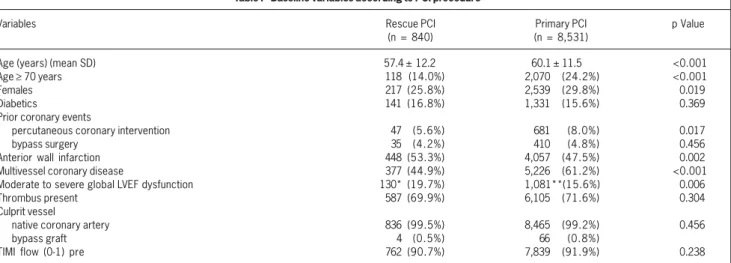
Streptokinase was the fibrinolytic agent more frequently administered before rescue PCI was performed [n=733 (87.3%)], followed by alteplase [n=61 (7.3%)]. In 46 (5.4%) patients, the fibrinolytic strategy was combination of these. Rescue PCI proce-dures were performed in younger patients, more frequently men, with significantly more infarctions located in the anterior wall, when compared with those who underwent a primary procedure, without previous fibrinolytic therapy (tab. I). The angiographic variables demonstrated that by the time of the rescue procedure, significantly more patients had a severe reduction in ejection fraction, but with fewer diagnoses of multivessel coronary heart disease (tab. I). A higher incidence of visible thrombi (≥70%) was noted for both PCI strategies, with the treatment of a native coronary artery in the vast majority of the cases (>90%), repre-sented by complete occlusion (TIMI 0-1) of the culprit vessel (≥90%), in either forms of PCI in AMI. Overall, abciximab usage was below 15%, but even lower in the rescue PCI group compared with its use in primary procedures (4.6% vs. 15.2%, P<0.001). At least half of the patients received a coronary stent implant, in similar rates either for rescue or primary intervention (56.9% vs. 54.9%, P=0.283) (tab. II).
The achievement of procedural success was significantly higher in patients who had not received previous fibrinolytic therapy (91.2% vs. 88.1%, P=0.003). The final diameter of stenosis was significantly lower in patients who underwent primary versus rescue PCI (13.2±12% vs. 15.9±14%, P<0.001) (tab. II).
The need for emergency bypass surgery or a new and urgent TVR were uncommon events, for both PCI strategies (≤0.5%). Reinfarctions were observed in less than 3% of the patients, similarly for rescue or primary PCI (2.3% vs. 2.6%, P=0.552). In-hospital death rates were significantly higher for patients who underwent rescue PCI, after the failure of previous fibrinolytic therapy (7.4% vs. 5.6%, P=0.034). The association of PCI failure and in-hospital mortality indicated similar casualties for both groups
Table I - Baseline variables according to PCI procedure
Variables Rescue PCI Primary PCI p Value
(n = 840) (n = 8,531)
Age (years) (mean SD) 57.4 ± 12.2 60.1 ± 11.5 <0.001
Age ≥ 70 years 118 (14.0%) 2,070 (24.2%) <0.001
Females 217 (25.8%) 2,539 (29.8%) 0.019
Diabetics 141 (16.8%) 1,331 (15.6%) 0.369
Prior coronary events
percutaneous coronary intervention 47 (5.6%) 681 (8.0%) 0.017
bypass surgery 35 (4.2%) 410 (4.8%) 0.456
Anterior wall infarction 448 (53.3%) 4,057 (47.5%) 0.002
Multivessel coronary disease 377 (44.9%) 5,226 (61.2%) <0.001
Moderate to severe global LVEF dysfunction 130* (19.7%) 1,081**(15.6%) 0.006
Thrombus present 587 (69.9%) 6,105 (71.6%) 0.304
Culprit vessel
native coronary artery 836 (99.5%) 8,465 (99.2%) 0.456
bypass graft 4 (0.5%) 66 (0.8%)
TIMI flow (0-1) pre 762 (90.7%) 7,839 (91.9%) 0.238
442
[23 (23.0%) vs. 173 (23.1%); P=0.977]. Hospital discharge was effective at the end of the first week either for rescue or primary PCI (7.36±3.0 vs. 7.26±3.2 days, p=0.360) (tab. III). Multivariate analysis identified independent predictors for in-hospital mortality. Patients who underwent a rescue procedure had a higher chance of suffering a fatal event until hospital discharge [OR (95%CI) = 1.60 (1.17-2.19); P=0.003]. Other demographic variables were also identified, most of them already known as independent predictors of a worse procedural and clinical outcome (tab. IV).
Discussion
Rescue PCI remains an uncommon procedure in this recent national registry analysis, when compared with primary coronary intervention in myocardial infarction 15,16.
Patients who underwent a PCI after fibrinolytic failure were identified as more likely to be young, with an anterior myocardial infarction, and with more extensive left ventricular dysfunction, when compared with patients admitted for primary PCI. Otherwise, primary patients were older and with a more frequent diagnosis of multivessel coronary heart disease. More than 90% of the AMI patients had a totally occluded vessel. We observed a balance between the adversity of the baseline variable distribution between both groups, regarding the ones considered more prone to the occurrence of death. Probably they reflected the bias of the indication of each procedure, for example, the anterior MI location for rescue patients and older age for those undergoing a primary procedure.
Abciximab was not used very often and even less in rescue procedures compared with its use in primary PCI. The predomi-nance of streptokinase as the fibrinolytic of first choice might have warranted its use related to the fear of the occurrence of major bleeding events. Despite coronary stent implantation in more than half of the patients, like primary procedures, the success was significantly lower for rescue patients.
In-hospital major adverse events occurred at similar rates but with the exception of mortality. In-hospital death was nearly 25% higher in rescue patients. The relationship between procedural failure and death was not demonstrated because both mechanical
strategies had similar rates, up to 20%. After multivariate analysis, rescue PCI was identified as an independent predictor for higher hospital mortality.
The analysis of primary PCI results resembles other results already published, either regarding procedural success (>90%) or in-hospital deaths (<6%) 17-19. However, these results were
not transferred for patients who underwent rescue PCI. Randomized trials that studied the performance of PCI after fibrinolytic treatment (PRAGUE 1 and 2 8,20) corroborate these findings, with a significant
trend toward higher death rates in these patients. These trials may be a good comparison with the Brazilian registry because the fibrinolytic regimen was the same (streptokinase). A word of caution should be mentioned, regarding the inclusion criteria of the PRAGUE 1 and 2 trials in which the analysis was focused on transferring patients to PCI centers and not only on those with failure of lytic treatment 21.
Former consecutive series and randomized trials reported the results obtained after rescue PCI, using in the vast majority of patients, only the balloon. These series also showed higher death rates when rescue was compared with primary PCI 4-6,22-26. In the
RESCUE I-II study, the death rates were greater than 5% and close to 10% 7. The higher reocclusion rates (20-30%) might be
responsible for that, a reflection of the balloon PCI era. Coronary stent implantation had strongly reduced the in-hospital rates of recurrent ischemia and as a consequence, vessel reocclusion 27.
One Dutch registry is the exception. This study 24 also compared
rescue and primary PCI with similar in-hospital mortality rates (4.7% vs. 6.6%, P=0.37) in a scenario of a lower rate of stent usage (<40%). The authors speculated that lower time to treatment delay might have helped them (<3 hours). Our results were different, and one of the multiple explanations might be the interaction of the baseline variables, some not reported in the CENIC registry.
How can we explain the higher death rate after a rescue PCI? These patients had a worse prognosis related to a more extensive and thicker atherosclerotic plaque, associated with extensive myocardial damage, especially to microvascular circulation 28,29.
Former analysis of randomized data emphasizes the importance of the protection of the distal coronary circulation, measured by the tissue myocardial perfusion grade (TMPG). In the TIMI 10B trial 30, patients who achieved a higher TMPG score (grade 2 or
3) had a lower mortality rate in the 2-year follow-up after a rescue PCI, compared with those with lower (0 or 1) TMPG scores (9.1% vs. 4.8%, P=0.038) 31,32.
Table II - Procedural results according to PCI procedure
Variable Rescue PCI Primary PCI p Value (n = 840) (n = 8,531)
Abciximab usage 39 (4.6%) 1,296 (15.2%) <0.001 Coronary stent implantation 478 (56.9%) 4,684 (54.9%) 0.283 Procedural success 740 (88.1%) 7,783 (91.2%) 0.003 Final diameter stenosis 15.9 ± 14% 13.2 ± 12% <0.001 (mean SD)
Table III - In-hospital major adverse events according to PCI procedure
Variable Rescue PCI Primary PCI p Value (n = 840) (n = 8,531)
Emergency bypass surgery 3 (0.3%) 21 (0.2%) 0.803 New target vessel 4 (0.5%) 31 (0.4%) 0.786 revascularization
Reinfarction 19 (2.3%) 222 (2.6%) 0.552 Death 62 (7.4%) 477 (5.6%) 0.034
Table IV - Predictors of in-hospital death by multivariate analysis
Variables OR (95% CI) p Value
Moderate to severe global 8.01 (6.34-10.01) <0.001 LVEF dysfunction
Procedural failure 7.14 (5.55-8.33) <0.001 Multivessel coronary heart disease 2.37 (1.93-2.91) <0.001 Rescue percutaneous 1.60 (1.7 - 2.19) 0.003 coronary intervention
Females 1.57 (1.30-1.91) <0.001 Previous bypass surgery 1.51 (1.02-2.27) 0.040 Diabetics 1.45 (1.17-1.81) <0.001 Balloon coronary angioplasty 1.26 (1.03-1.56) 0.030 Age ≥ 70 years 1.04 (1.03-1.05) <0.001
443
Is it possible to optimize rescue PCI results? There is a strong trend toward the more liberal use of potent antiplatelet agents (IIb/IIIa inhibitors) in these high-risk AMI patients, justified by their capacity to protect the microvascular coronary circulation. Their use is still not frequent, but most often is related to the administration of the nonfibrin- specific agents, like streptokinase. A recent metaanalysis of 12 trials that included AMI patients who underwent treatment with the last generation of fibrin-specific agents, demonstrated a more liberal and concomitant use of IIb/ IIIa inhibitors 3. In 3,418 rescue procedures, 1,032 patients had
a trend toward a reduced 30-day death rate [4.6% vs. 6.6%; OR (CI=95%)=0.71 (0.49-1.01)], without significantly increasing the cerebral vascular bleeding rate [0.4% vs. 0.9%; OR (CI=95%) 1.64 (0.19-1.90)], compared with those who did not receive IIb/ IIIa agents. However, the total sum of moderate or severe bleeding rates was higher in these patients [10.2% vs. 8.1%; OR=(CI=95%)= 1.64(1.24-2.16)]. The prescription of these agents (IIb/IIIa inhibitors) to patients who are undergoing rescue PCI is expanding, as is the association of new percutaneous devices that enhance distal microcirculation protection like thrombi extrac-tors or distal vessel filters 27,33-35. Ongoing trials will clarify and
stratify the use of these new pharmacological and mechanical strategies for those patients undergoing rescue PCI.
The CENIC registry promoted the possibility of analyzing a large cohort of patients in a short period, reflecting the real and daily practice of PCI in Brazil. Former analyses were performed and the results published, already proving the consistency of these data 10-13. However, the registry has its own pitfalls. Many other
clinical, angiographic, and procedural variables were not collected, such as the Killip class, AMI vessel TIMI flow, and the occurrence of other major adverse events like bleeding with their consequences. Other important variables were registered but frequently had flaws, like time to treatment delay and the size and number of percuta-neous devices used. Also, it has already been mentioned that this is a spontaneous registry that might not reflect all the nationwide PCI procedures, and finally, the judgment of the PCI results was performed at each center and not by an independent center. We hope to optimize and correct these limitations in the near future. We concluded from this comparative analysis between 2 different strategies of PCI performance in AMI patients that rescue PCI had less procedural success with higher in-hospital death rates. Rescue PCI was identified as an independent predictor of a higher death rate. Future research should be focused on improving the results in this subgroup of patients who still exhibit worse results when compared with those treated with the gold standard, primary PCI.
Acknowledgment
The following 215 Brazilian interventional cardiologists contributed to this registry in the following period, 1997 to 2000, data originating from 185 different invasive cardiology centers: Adnam Salmam, Adriano Caixeta, Alberto Najjar, Alberto Sottomayor, Alcides Zago, Aldegio Caldeira, Aldo Duarte, Alexandre Abizaid, Alexandre Azmuz, Alexandre Varela, Álvaro
444
1. Boersma E, Mercado N, Poldermans D, Gardien M, Vos J, Simmoons ML. Acute myocardial infarction. Lancet 2003; 361: 847-58.
2. The GUSTO angiographic investigators: the effects of tissue plasminogen activator, streptokinase, or both on coronary-artery patency, ventricular function and sur-vival after acute myocardial infarction. N Engl J Med 1993; 329: 1615-22. 3. Roe MT, Giugliano RP, Tuttle R et al. Safety of adjunctive glycoprotein IIb/IIIa
block-ade during rescue/early percutaneous coronary intervention following full-dose fibrinolytic therapy for acute myocardial infarction. J Am Coll Cardiol 2003; 41: 332A (abstract).
4. Abbottsmith CW, Topol EJ, George BS et al. Fate of patients with acute myocardial infarction with patency of the infarct-related vessel achieved with successful thrombolysis versus rescue angioplasty. J Am Coll Cardiol 1990; 16: 770-8. 5. Ellis SG, da Silva ER, Heyndrickx G et al. Randomized comparison of rescue
angioplasty with conservative management of patients with early failure of thrombolysis for acute myocardial infarction. Circulation 1994; 90: 2280-4. 6. Vermeer F, Oude Ophuis AJ, vd Berg EJ et al. Prospective randomized comparison
between thrombolysis, rescue PTCA, and primary PTCA in patients with extensive myocardial infarction admitted to a hospital without PTCA facilities: a safety and feasibility study. Heart 1999; 82: 426-31
7. Ellis SG, Ribeiro da Silva E, Spaulding CM et al. Review of immediate angioplasty after fibrinolytic therapy for acute myocardial infarction: insights from RESCUE I, RESCUE II, and other contemporary clinical experiences. Am Heart J 2000; 139: 1046-53.
8. Widminsky P, Groch L, Zelizko M, Aschermann M, Bednar F, Suryapranata H. Multicentre randomized trial comparing transport to primary angioplasty vs. im-mediate thrombolysis vs. combined strategy for patients with acute myocardial infarction presenting to community hospital without a catetherization laboratory. The PRAGUE study. Eur Heart J 2000; 21: 823-31.
9. Keeley EC, Boura JA, Grines CL. Primary angioplasty versus intravenous thrombo-lytic therapy for acute myocardial infarction: a quantitative review of 23 randomised trials. Lancet 2003; 361: 13-20.
10. Sousa AG, Mattos LA, Campos Neto C, Carvalho H, Stella FP, Nunes G. Percuta-neous myocardial revascularization procedures in Brazil in 1996-1997 compared to 1992-1993 period. A report of the National Registry - National Center for Car-diovascular Interventions (CENIC). Arq Bras Cardiol 1998; 70: 423-30. 11. Mattos LA, Sousa A, Campos Neto C, Labrunie A, Alves CR, Saad J, on behalf of
the CENIC investigators. Primary stenting versus PTCA on acute myocardial infarc-tion: in-hospital results from the Brazilian Interventional Registry. J Am Coll Cardiol 1999; 33: 29A (abstract).
12. Mattos LA, Sousa AG, Campos Neto C et al. The use of primary stenting or bal-loon percutaneous transluminal coronary angioplasty for the treatment of acutely occluded saphenous vein grafts. Results from the Brazilian National Registry (CENIC) - Central Nacional de Intervenções Cardiovasculares. Arq Bras Cardiol 2001; 76: 483-95.
13. Mattos LA, Sousa AGMR, Pinto IMF et al. Primary coronary angioplasty in 9,434 patients during acute myocardial infarction: predictors of major in-hospital ad-verse events from 1996 to 2000 in Brazil. Arq Bras Cardiol 2002; 79: 412-8. 14. The TIMI study group. The Thrombolysis in Myocardial Infarction (TIMI) trial:
phase I. New Engl J Med 1985; 312: 932-6.
15. Eagle KA, Goodman SG, Avezum A, Budaj A, Sullivan CM, López-Sendón J, for the GRACE Investigators. Practice variation and missed opportunities for reperfusion in ST-segment-elevation myocardial infarction: findings from the Global Registry of Acute Coronary Events (GRACE). Lancet 2002; 359: 373-7.
16. Puma JA, Sketch MH, Thompson TD et al. Support for the open-artery hypothesis in survivors of acute myocardial infarction: analysis of 11,228 patients treated with thrombolytic therapy. Am J Cardiol 1999; 83: 482-7.
References
17. Rogers WJ, Canto JG, Lambrew CT et al. Temporal trends in the treatment of over 1,5 million patients with myocardial infarction in the US from 1990 through 1999. J Am Coll Cardiol 2000; 36: 2056-63.
18. Zahn R, Schiele R, Schneider S et al. Decreasing hospital mortality between 1994 and 1998 in patients with primary angioplasty but not in patients treated with intravenous thrombolysis. J Am Coll Cardiol 2000; 36: 2064-71.
19. Zahn R, Schiele R, Schneider S et al. Primary angioplasty versus intravenous thrombolysis in acute myocardial infarction: can we define subgroups of patients profiting most from primary angioplasty? J Am Coll Cardiol 2001; 37: 1827-35. 20. Widminsky P, Budesinksy T, Groch L et al. Long distance transport for primary
angioplasty vs. immediate thrombolysis in acute myocardial infarction. Final re-sults of the randomized national multicentre trial PRAGUE-2. Eur Heart J 2003; 24: 21-3.
21. Grines CL. Reply (Letter to the Editor). J Am Coll Cardiol 2003; 41: 518-9. 22. The CORAMI Study group. Outcome of attempted rescue coronary angioplasty
after failed thrombolysis for acute myocardial infarction. Am J Cardiol 1994; 74: 172-4.
23. Gibson CM, Cannon CP, Greene RM et al. Rescue angioplasty in the thrombolysis in myocardial infarction (TIMI) 4 trial. Am J Cardiol 1997; 80: 21-6.
24. Bar F, Vainer J, Stevenhagen J et al. Ten-year experience with early angioplasty in 759 patients with acute myocardial infarction. J Am Coll Cardiol 2000; 36: 51-8. 25. Cannon CP, Gibson CM, Lambrew CT et al. Relationship of symptom onset to balloon time and door to balloon time with mortality in patients undergoing angioplasty for acute myocardial infarction. JAMA 2000; 283: 2941-7. 26. Ellis SG, Van der Werf F, Ribeiro da Silva E, Topol EJ. Present status of rescue
coronary angioplasty: current polarization of opinion and randomized trials. J Am Coll Cardiol 1990; 16: 770-8.
27. Zhu MM, Feit A, Chadow H, Alam M, Kwan T, Clark LT. Primary stent implantation compared with primary balloon angioplasty for acute myocardial infarction: a meta-analysis of randomized clinical trials. Am J Cardiol 2001; 88: 297-300. 28. Topol EJ. Toward a new frontier in myocardial reperfusion therapy: emerging
platelet preeminence. Circulation 1998; 97: 211-8.
29. Tanaka A, Kawarabayashi T, Nishibori Y et al. No-reflow phenomenon and lesion morphology in patients with acute myocardial infarction. Circulation 2002; 105: 2148-52.
30. Gibson CM, Cannon CP, Murphy SA, Marble SJ, Barron HV, Braunwald E, for the TIMI Study Group. Relationship of the TIMI myocardial perfusion grades, flow grades, frame count and percutaneous coronary intervention to long-term out-comes after thrombolytic administration in acute myocardial infarction. Circulation 2002; 105: 1909-13.
31. Stone GW, Peterson MA, Lansky AJ, Dangas G, Mehran R, Leon MB. Impact of normalized myocardial perfusion after successful angioplasty in acute myocardial infarction. J Am Coll Cardiol 2002; 39: 591-7.
32. Dibra A, Mehili J, Dirschinger J et al. Thrombolysis in myocardial infarction perfusion grade in angiography correlates with myocardial salvage in patients with acute myocardial infarction treated with stenting or thrombolysis. J Am Coll Cardiol 2003; 41: 925-9.
33. Kornowski R, Ayzenberg O, Halon DA, Kusniec F, Assali A. Preliminary experience using X-sizer catheter for mechanical thrombectomy of thrombus-containing lesions during acute coronary syndromes. Catheter Cardiovasc Interv 2003; 58: 443-8. 34. Limbruno U, Micheli A, Petronio AS et al. Adjunctive porous filter protection from
distal embolization in primary percutaneous intervention for acute myocardial infarction. J Am Coll Cardiol 2003; 41: 46A (abstract).