Faculdade de Medicina de Catanduva - FAMECA
Mailing address: Olavo de Carvalho Freitas – FAMECA - Depto. de Ciências Fisiológicas – Disciplina de Fisiologia – Av. São Vicente de Paula, 1455 – 15800-000 – Catanduva, SP, Brazil – E-mail: [email protected]
(English version by Stela Maris C. e Gandour)
Objective - To study the prevalence of systemic hyper-tension and its control in the population of Catanduva, in the state of São Paulo, Brazil.
Methods - We carried out a randomized cross-sectio-nal population-based study of the urban population of Ca-tanduva with individuals above 18 years of age (688 indivi-duals accounting for 0.9% of the referred population). We interviewed study participants to analyze the major qualita-tive and quantitaqualita-tive variables that could influence the hy-pertensive scenario and the risk for systemic hypertension. Blood pressure was measured through the indirect method according to the III Consenso Brasileiro de Hipertensão (III Brazilian Consensus on Hypertension), which established blood pressure levels ≥ 140/90 mm Hg as hypertensive.
Results - The prevalence of systemic hypertension was higher in individuals with: (1) history of hypertension (p<0.0001); (2) diabetes mellitus (p=0.05); (3) body mass index (B. M. I) ≥ 25 kg/m² (p<0.001); (4) low educational level (p<0.0001); (5) familial income ranging from 1 to 5 minimum wages (p<0.05); (6) unmarried status (divorced/separated and widow(er)s) (p<0.0001). Of the interviewed individuals, 27.6% (p=0.05) had blood pressure levels under control.
Conclusion - Our study showed that the prevalence of systemic hypertension was 31.5%, and that 27.6% of the individuals interviewed had blood pressure levels under control at the time of the interview.
Key words - hypertension, antihypertensive treatment,
epidemiological study of hypertension
Arq Bras Cardiol, volume 77 (nº 1), 16-21, 2001
Olavo de Carvalho Freitas, Fabiano Resende de Carvalho, Juliana Marques Neves, Paula Karine Veludo, Ricardo Silva Parreira, Rodrigo Marafiotti Gonçalves, Simone Arenales de Lima,
Reinaldo Bulgarelli Bestetti
Catanduva, SP - Brazil
Prevalence of Hypertension in the Urban Population of
Catanduva, in the State of São Paulo, Brazil
Several studies on prevalence of systemic hypertensi-on exist in the internatihypertensi-onal medical literature 1-7. In Brazil,
these values have ranged from 16.1% to 35.1% 8-16,
depen-ding on the ethnic and social groups studied and on the pa-rameters proposed as the defined limits of hypertension.
In Brazil, some studies assess the association between systemic hypertension and demographic characteristics, such as age bracket, ethnic group, socioeconomic level, smoking, alcohol consumption, salt ingestion, stress, dia-betes, and obesity 8-16. However, little attention has focused
on the control of antihypertensive treatment, which ac-counts for therapeutical failure in more than 60% of the ca-ses 13,17-19.
In the Northwestern region of the state of São Paulo there are municipalities with a high socioeconomic level, such as Catanduva, and their economy are based on the citric and sugar cane agroindustry and also on the tertiary sector industry. Therefore, some of these municipalities have a quality of life similar to that observed in developed countries. Our study aims to assess the prevalence of syste-mic hypertension associated with some of the above-cited factors in Catanduva. The total population estimated for the city in 1998 was 103,889 inhabitants, 77,598 of whom were above 18 years of age. The prevalence of the male sex was observed until the age of 50 years, according to the IBGE (Brazilian Institute of Geography and Statistics).
Methods
An analytical cross-sectional population-based study with randomized sampling20 was carried out. The population
were females. The relative disproportion between males and females was mainly due to the fact that more men than wo-men are in the workforce and therefore wo-men were not readily available to interview. To minimize this effect, the interviews were performed early in the morning to include men before they had to go to work.
To avoid sampling errors, the city was divided into 40 sectors, in which the number of dwellings and the social groups contained did not matter. These sectors were selec-ted, and the study began with the first selected sector, and so on. In each sector, 3 dwellings per block were randomly chosen. No dwelling was excluded, not even those without sewage or electricity. If the inhabitants of the selected dwel-ling could not participate or if the dweldwel-ling was empty, the nearest dwelling was then chosen to meet the criterion esta-blished.
The research team comprised 2 teachers (cardiolo-gists), 6 medical students (interviewers), and 1software specialist. The medical students were properly trained and oriented to administer the questionnaires and to measure the anthropometric parameters. The interviewers wore bad-ges of the Faculdade de Medicina de Catanduva to facilitate contact with the population and data collection 17.
According to the III Brazilian Consensus on Hyper-tension of 1998 18, systemic hypertension is defined as
sys-tolic pressure >140mmHg and diassys-tolic pressure >90mmHg (for individuals older than 18 years) 19. These criteria were
adopted by the interviewers.
The interview had a mean duration of 30 minutes, be-ing performed from 6 to 10 a.m.19-23 daily from February 2 to
April 4, 1998. The team was distributed in 3 pairs of intervie-wers, each pair comprising individuals of both sexes. The pairs of interviewers were changed and the criteria of the interview were reassessed weekly.
After explaining to the interviewee the objectives and procedures of the study, 1 of the interviewers collected the personal data and, then, the other interviewer measured the anthropometric data and the blood pressure level. The in-terview comprised assessment of qualitative and quanti-tative variables, such as age, sex, race, profession, daily work load, marital status, educational level, familial income, use of medication that could positively influence hyperten-sion (tricyclic antidepressants, monoamine oxidase inhibi-tors, oral contraceptives), as well as antihypertensive drugs and their use, regular or not. The following parameters were also assessed: dietary habits (amount of meat, number of eggs, number of milk liters ingested per day or weekly), salt ingestion (quantification was based on the presence of the salt container on the table, as no salt quantification in grams was performed because of the difficulty that this would im-ply), smoking (number of cigarettes smoked daily), ethanol in-gestion (if higher than 30mL per day), number of annual me-dical visits for blood pressure assessment, weekly program-med physical activity, antecedents of hypertension on first-degree relatives, previous knowledge of hypertension, dwel-ling conditions, and satisfaction at home and at work 21-26.
The criterion for considering a physical activity was the
practice of physical exercises 3 or more times a week for a mi-nimum period of 45 minutes each time 18,21,22. All
intervie-wees were asked about the above-cited items, in the that se-quence. They received no questionnaire to fill out.
After one medical student administered the question-naire, the other medical student measured the blood pressu-re level through the indipressu-rect method using an aneroid sphygmomanometer, which is less accurate than the mercu-ry one, but more appropriate for field research because it is easier to handle and is less often rejected by the intervie-wees 21,23. Before blood pressure measurement, the
inter-viewee rested for 5 minutes in a calm environment with a pleasant temperature, remaining seated on a chair with 1 of the arms resting on a table, at heart level. The brachial artery of the right arm was located by palpation. The cuff was firm-ly placed 2 to 3 cm above the cubital fossa over the brachial artery, centralizing the rubber bag above it. Korotkoff pha-ses determined systolic and diastolic pressures as follows: phase I determined systolic pressure, and phase V determi-ned diastolic pressure. After 3 minutes, a new measurement of blood pressure was performed. The mean of both measu-rements was obtained18. At the end, height was measured
with a tape measure, and the interviewee was weighed for calculating the body mass index.
For measuring blood pressure, the interviewee should not have performed the following activities in the 30 minu-tes prior to the interview: practiced physical exercises, drunk alcoholic beverages or coffee, ingested food, and smoked 17-21. If the interviewer noticed any emotional
change in the interviewee, the examination was postponed. After the assessment, the medical student provided a bro-chure with information on systemic hypertension preven-tion and its predisposing factors to the interviewee. In addi-tion, every hypertensive interviewee received recommen-dations for more effective compliance with the antihyper-tensive treatment 27-30. The individual who ignored his
hy-pertensive condition was informed of his condition and ad-vised to get a more comprehensive assessment at the medi-cal service of the medimedi-cal school of Catanduva 17. The
ad-dress of the hypertensive individual was recorded for futu-re futu-reassessments.
Aneroid sphygmomanometers of a single brand were used, and they were properly calibrated every 15 days. Ste-thoscopes, scales, and measuring tapes were also of a sin-gle brand to avoid technical deviations in values because of the material used 23.
Software in the Delphi language for Windows was de-veloped for analyzing, formulating, and computing the results.
Fisher exact test was used for comparing the proporti-on of nproporti-oncproporti-ontinuous variables between 2 groups. The sig-nificance level adopted was lower than or equal to 0.05.
Results
the sample of 77,598 inhabitants. The prevalence of isolated diastolic hypertension was 14.8% (n=102), the prevalence of isolated systolic hypertension was 6.5% (n=45), and that of systolic/diastolic hypertension was 10.2% (n=70).
The prevalence of systemic hypertension was 33.9% for the male sex (n=286) and 29.9% for the female sex (n=402), in population above 18 years of age in the munici-pality (77,598). Figure 1 shows the systolic and diastolic blood pressure levels in the respective age brackets for both sexes. In regard to the hypertensive population, 44.7% (n=97) were of the male sex and 55.3% (n=120) of the female sex.
The prevalence of systemic hypertension for indivi-duals working up to 6 hours per day was 20.7% and for tho-se working 8, 10, and 12 hours it was, respectively, 21%, 29.3%, and 28.3%. The workload was systematically ob-served, and in regard to those women who answered they were housewives and did not have a helper, they were pla-ced in the 12h group.
In regard to the interviewees (n=688), 577 (84.1%) were white, 107 (15.5%) were black (individuals resulting from miscegenation were considered as black people), and 4 were individuals of Far Eastern heritage, 3 of whom were hypertensive. These latter values were not included in the percentages because they constituted a very small group. The population of the municipality of Catanduva has a pre-dominance of white individuals as compared with most Bra-zilian cities, because of the high concentration of Italian im-migrants and their descendants there. This fact resulted in an unexpected percentage of 31.8% of white hypertensive individuals and 29% of black hypertensive individuals,
considering that 577 of the interviewees were white and 107 were black, a fact already reported in a previous study 10.
In regard to the educational level, which is a variable rarely studied in the medical literature, we observed that 49.5% of the illiterate individuals (n=107) had systemic hy-pertension and only 12.7% (n=71) of the individuals who had completed the university educational level had hyper-tension (p<0.0001). Figure 2 shows the percentage relation between educational level and systemic hypertension.
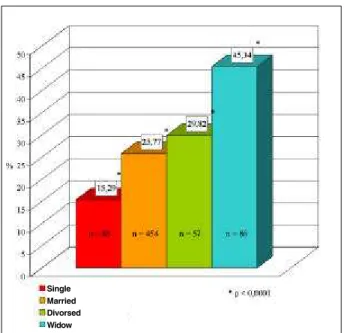
Another result of our study, which had not been repor-ted in the literature, was the higher prevalence of systemic hypertension in the unmarried group (divorced/separated and widow(er)s) as compared with that of the married group (p<0.0001), which deserves a further assessment (Table I and fig. 3). The bachelors were not included in the unmar-ried group because of their predominantly low age bracket. The criterion for analyzing the control of the treatment followed the algorithm in chart I. The medication being used was analyzed in detail, and an inquiry about changes in lifes-tyle was performed. If the interviewee did not have a strict change in lifestyle, he was excluded from this group. In regard to the elderly, an exception was considered for those who were not in condition to exercise due to any type of physical incapacity. However, even if not participating in physical exercise, if the individual met the remaining criteria for changes in lifestyle, he would be included in the group. The results of this cross-sectional analysis are shown in chart I.
In regard to familial income, our results seemed to be related to the educational level; this correlation, however, was not exactly contiguous (fig. 4).
Fig. 2 – Comparison of blood pressure levels of hypertensive individuals with their respective educational levels in the municipality of Catanduva (p<0.0001).
Table I - Prevalence of systemic hypertension in the married and unmarried groups in the municipality of Catanduva
Married 25.77% N=454 P<0.0001
Divorced/separated 29.82% N=57 P<0.0001 Widow(er)s 45.34% N=86 P<0.0001
Bachelors 15.29% N=85 P<0.0001
Fig. 1 – Prevalence of systemic hypertension in the female and male sex in different age brackets.
Men Women
The results of the study confirmed the strong correla-tion between diabetes mellitus and the prevalence of syste-mic hypertension (p=0.05). We investigated the 2 forms of diabetes (I and II), whether the interviewees knew in ad-vance they had diabetes, and whether they were treating their disease. Among those reporting not having diabetes, the prevalence of systemic hypertension was 27.8% (n=399). Among those with type I or II diabetes, the preva-lence was 66.9% (n=46) (p=0.05). Among those who did not know they had the disease and were hypertensive, the pre-valence was 19.5% (n=231). Twelve interviewees did not answer this question (fig. 5).
A result of little significance was that 26.1% of those in-dividuals not visiting the doctor regularly were hypertensive, and 28.6% of those visiting the doctor regularly had the disease. The interviewees ingesting more than 30 mL of etha-nol per day had a prevalence of systemic hypertension of 34.8%, and those who did not drink or who drank less than
30 mL of ethanol per day had a prevalence of systemic hy-pertension of 25.8% (p=0.05) (fig. 6).
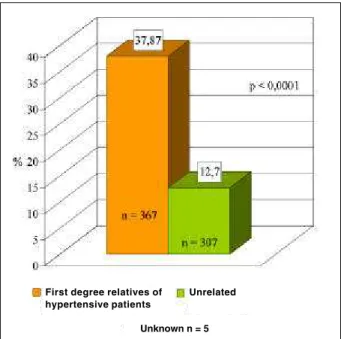
In regard to programmed physical activity (3 times a week, for at least 45 minutes), 23.2% of the individuals with this practice were hypertensive (n=99). Among those who did not have a programmed physical activity practice, 26.9% (n=491) had systemic hypertension. The investiga-tion regarding the history of hypertension among first-de-gree relatives confirmed previously reported data 8-15.
Preva-lence of systemic hypertension in these individuals was 37.8% (n=367), and among those who had no hypertensive first-degree relatives it was 12.7% (n=307) (p<0.0001). Four-teen interviewees did not answer this question (fig. 7).
Considering the interviewees, 167 (77%) knew about their previous hypertensive condition. The remaining 23% (n=50) had hypertension but did not know about it.
The analysis of body mass index of the population of the municipality of Catanduva showed a strong correlation between obesity and systemic hypertension (p<0.001) ( fig. 8).
Discussion
The study carried out in the municipality of Catandu-va, in some ways, reports a reality of Brazilian cities. The 31.5% prevalence of hypertension in a population of
Fig. 3 – Prevalence of systemic hypertension in the groups of different marital statuses in the municipality of Catanduva (p<0.0001).
Fig. 4 – Prevalence of systemic hypertension in the groups of different familial incomes in the municipality of Catanduva (p<0.05), SM: Minimum wage.
Fig. 5 – Prevalence of systemic hypertension in diabetic and nondiabetic individuals in the municipality of Catanduva (p<0.05).
Hypertensive population n = 217
Unknown hypertensive patients n = 50
23%
Known hypertensive patients n = 167
77%
Treated n = 134 80,2%
Controled n = 37 27,6%
Untreated n = 33 19,8%
Uncontroled n = 97 72,4%
Chart I – Profile of the antihypertensive treatment in the municipality of Catanduva.
Single Married Divorsed Widow
No diabetes
diabetes
103,889 inhabitants is not startling, because studies carried out in other Brazilian municipalities have shown prevalence rates higher than 30% 10. Even though the criteria used in
this latter study were those of the World Health Organizati-on and the criteria adopted in our study were those of the III Brazilian Consensus on Hypertension, both results are considered high for a certain chronic disease.
The inadequate therapeutical control of hypertension deserves special emphasis, because it involves not only the health professional but also primarily the acceptance by the patient of the need to change lifestyles and to adjust the me-dication for the therapy to become effective 21,23.
In our study, with antihypertensive control in 27.6% (chart I) of participants, the change in lifestyle was conside-red a criterion adequate for treatment that should be prioriti-zed, either associated or not with medicamentous therapy.
Control of blood pressure levels, even though not very common, may be obtained only with changes in lifestyle, as we observed in our study. We also observed that despite medicamentous therapy and appropriate changes in lifesty-le, some interviewees did not obtain satisfactory blood pressure levels 16 (chart I). This low antihypertensive
con-trol was mainly due to the difficulty of the hypertensive indi-vidual to adequately make changes in lifestyle with priate medicamentous therapy, and also to the lack of appro-priate medical orientation for the patient to fit a correct treat-ment program. This inadequacy was also due to the fact that some groups of hypertensive individuals had econo-mic difficulties in obtaining medication that could effective-ly control hypertension.
In our study, 55.81% of the individuals with morbid obesity (body mass index ≥40kg/m²) were hypertensive, 44.86% had body mass index between 30 and 39.99kg/m², and only 20.64% of the individuals with body mass index between 20 and 24.99kg/m² had systemic hypertension. Therefore, obesity is certainly one of the major factors acco-unting for systemic hypertension. Correlating all risk fac-tors for systemic hypertension, we observed that the worst association was obesity and familial history of hypertensi-on, which had a prevalence of 28.2%, as compared with 11.2% of the association with other factors.
In regard to salt ingestion, our study did not find a signi-ficant difference between those who admitted taking the salt container to the table during the meals and those who did not, 26.49% and 25.44%, respectively. This may have resulted from the technical incapacity of measuring the daily intake of NaCl, because of the subjective response and idea that each individual had of the amount of salt present in food, and the difficulty in quantifying the amount of salt in the food ingested, resulting in a higher amount of salt consumed.
In our study, the interviewees with an ethanol ingesti-on higher than 30 mL/day had a prevalence of systemic hy-pertension similar to that found in the literature.
We observed that hypertension prevailed among those who did not have regular physical activity.
Fig. 6 – Prevalence of systemic hypertension in the interviewees drinking more than 30 mL/day of ethanol in the municipality of Catanduva (p<0.005).
Fig. 7 - Prevalence of systemic hypertension in individuals with familial history of hypertension in the municipality of Catanduva (p<0.0001).
Fig. 8 – Correlation between prevalence of systemic hypertension and body mass index of the interviewees in the municipality of Catanduva (p<0.001).
No alcohol intake Alcohol intake > 30 ml/day
First degree relatives of hypertensive patients
Unrelated
Unknown n = 5
1. Ennis IL, Gende AO, Cingolani HE. Prevalencia de hipertension arterial en 3154 jovenes estudiantes. Medicina 1998; 58 (5PT 1): 483-91.
2. De Backer G, Myny K, De Henauw S, et al. Prevalence, awareness, treatment and control of arterial hypertension in na elderly population in Belgium. J Hum Hy-pertens 1998; 12: 701-6.
3. De Henauw S, De Bacquer D, Finteyne W, Stam M, Kornitzer M, De Backer G. Trends in the prevalence, detection, treatment and control of arterial hypertension in the Belgian adult population. J Hypertens 1988; 16: 277-84.
4. Torno MJ, Navarro C, Chirlaque MD, Perez FD. Prevalence and control o arterial hypertension in the south - east of spain: a radical but still in suicient improve-ment. Eur J Epidemiol 1997; 13: 301-8.
5. Reyes M, Karin M, De los Rios JM. Prevalencia de hipertensión arterial en cram-poma Huarochiri - Lima - Perú. Acta Andin 1998; 7: 147-53.
6. Arroyo C, Victor M. Prevalencia de hipertensión arterial en población general Chucuito (Puno). Arequipa 1997; 23 sept: 51.
7. Boffi BHJ, Ustaran JK, Andrade J. Prevalencia de la hipertensión arterial en varo-nes de 18 años de la ciudad Buenos Aires. Medicina 1988; 48: 365-70. 8. Carvalho JJM, Silva NAS, Oliveira JM, Arguelles E, Silva JAF. Pressão Arterial e
Grupos Sociais. Estudo Epidemiológico. Arq Bras Cardiol 1983; 40: 115-20. 9. Barreto ML, Meira RLC. Hipertensão arterial em uma comunidade do oeste do
Estado da Bahia, Brasil. Arq Bras Cardiol 1980; 34: 363-6.
10. Lolio CA. Prevalência da hipertensão arterial em Araraquara. Arq Bras Cardiol 1990; 55: 167-73.
11. Fuchs FD, Moreira LB, Moraes RS, Bredemeier M, Cardozo SC. Prevalência de hi-pertensão arterial sistêmica e fatores associados na região urbana de Porto Alegre. Estudo de base populacional. Arq Bras Cardiol 1995; 63: 473-9.
12. Klein CH, Leal MC, Araújo JWG, Silva PCT. Hipertensão arterial em Volta Redon-da. Anais do Hospital Siderúrgico de Volta Redonda 1980; 4: 59-63. 13. Barros MA, Arruda Jr. ER, Silva SM, Mendonça MZG. Hipertensão arterial no Estado da
Paraíba. Estudo epidemiológico em 12 municípios interioranos. CCS 1983; 5: 15-18. 14. Trindade IS, Heineck G, Machado JR, et al. Prevalência da hipertensão arterial sis-têmica na população urbana de Passo Fundo. Arq Bras Cardiol 1998; 71: 127-30.
References
15. Ayres JEM. Prevalência da hipertensão arterial na cidade de Piracicaba. Arq Bras Cardiol 1991; 57: 33-6.
16. Carneiro O, Jardim PCBV. Pressão arterial em tribo Xavante. Comparação 15 anos depois. Arq Bras Cardiol 1993; 61: 275-82.
17. Hossne WS. A dignidade como meta. Caderno de Ética em Pesquisa. Comissão Nacional de Ética Médica 1998; ano I: n° 1.
18. III Consenso Brasileiro de Hipertensão, fevereiro de 1998 .
19. Kaplan NM. Measurement of Blood Pressure. In: Kaplan NM, eds. Clinic Hyper-tension, 6°ed. Dallas: Williams & Wilkins, 1994: 23-45.
20. Fletcher RH, Fletcher SW, Wagner EH. Epidemiologia Clínica. Elementos Essen-ciais. 3ª ed. Porto Alegre: Artes Médicas, 1996: 200-01.
21 Braunwald E. Tratado de Medicina Cardiovascular. 5ª ed. São Paulo: Roca, 1999: 859-915.
22. Sexto Relatório da Comissão Nacional Conjunta de Prevenção, Detecção, Avalia-ção e Tratamento da Hipertensão Arterial. Archive International Medicine 1997; 157: 2413-41.
23. Perloff D, Grim C, Flack J, et al. Human blood presure. Determination by sphygmo-manometry. American Heart Association Medical/Scientific Statement. Circulation 1993; 88(part 1): 2459-67.
24. Instituto Brasileiro de Geografia e Estatística (IBGE) ???Ano, ???vol. 25. Klatsky AL, Friedman GD, Armstrong MA. The relationship between alcoholic
beverage use and other traits to blood pressure: A new Kaiser permanent study. Circulation 1986; 73: 628-36.
26. Carvalho JJ. Aspecto Epidemiológico e preventivos da hipertensão arterial. Rev Bras Clín Terap 1984; 6: 225-9.
27. Pierin AMG, Mion DJr. Adesão ao tratamento anti-hipertensivo. Hipertensão 1999; 2: 9-15.
28. Bloch KV, Klein CH, Silva NAS, Nogueira AR, Campos LHS. Hipertensão arterial e obesidade na Ilha do Governador - Rio de Janeiro, RJ. Arq Bras Cardiol 1994; 62: 17-22. 29. Ribeiro AB. Hipertensão arterial como síndrome São Paulo. Ass Med Brasil
1997; 43: 179.
30. Figthing disease e stroke edited by American Heart Association, 1997; 2: 131-42.
We also observed that the prevalence of systemic hy-pertension was higher among smokers.
Our study reconfirms that diabetes is one of the major diseases associated with systemic hypertension. The most likely causal link is obesity. Patients with diabetes had a pre-valence of systemic hypertension of 66.9% (p=0.05), sho-wing that the fact of having type I or II diabetes is closely re-lated to systemic hypertension.
The prevalence of systemic hypertension in males was higher than that in females up to the age of 70 years. This may result from the fact that, in our society, males are less concerned with preventive measures of chronic diseases, such as being physically active, eating healthy food, and not smoking.
A correlation exists between the high workload and the prevalence of systemic hypertension. We could assume that the individual who works more has less or no time for applying measures for changing lifestyles. However, we were not able to obtain a statistical significance between the hours worked (6, 8, 10, and 12 h) and hypertension.
The population of the municipality of Catanduva has a high predominance of white individuals as compared with most Brazilian cities, due to the high concentration of des-cendants of Italian immigrants. As already reported in pre-vious studies 11, the proportion of systemic hypertension in
white and black people was not the one expected, which may have resulted from the higher proportion of white resi-dents in the municipality of Catanduva (error β).
The fact that the prevalence of systemic hypertension
is higher in the group with a lower educational level and lo-wer in the group with a higher educational level may result from parallel factors most of the time, because the individual with a lower educational level has a lower knowledge of how to prevent chronic diseases.
A fact that has not yet been reported in the medical lite-rature and that was observed in our study was the higher prevalence of systemic hypertension in unmarried indivi-duals (divorced/separated and widow(er)s) as compared with that of the married ones. This may have a very plausible explanation because these individuals who are considered unmarried are usually older and, therefore, have a higher tendency toward systemic hypertension.
Heredity was an extremely important factor for syste-mic hypertension. In our study, we found an elevated level of significance for it, which shows the importance of inqui-ring about the familial history of hypertension, which should be valued by health professionals.