BOTULINUM TOXIN TYPE A IN THE
TREATMENT OF LOWER-LIMB SPASTICITY
IN CHILDREN WITH CEREBRAL PALSY
Carlos Henrique F. Camargo
1, Hélio A.G. Teive
2, Marise Zonta
3, Gilmar C. Silva
3, Marcelo R. Oliveira
1,
Maurício M. Roriz
1, Ivar V. Brandi
1, Nilson Becker
1, Rosana Hermínia Scola
2, Lineu César Werneck
4Abstract – We evaluated the safety and effectiveness of botulinum toxin A (BoNT/A) in the treatment of spasticity in 20 children with spastic diplegic cerebral palsy (CP). All the patients received injections in the gastrocnemius and soleus, and 15 received injections in the adductors. The total dose varied from 70 to 140 U (99.75±16.26 U), or 7.45±2.06 U/kg per patient. The treatment improved the patients’ walking and gait pattern significantly. There was also a significant alteration in the heel-ground distance and increased motion of the ankle joint. These structural changes in the feet were sustained until the end of the follow-up, although the same was not observed for the functional parameters. Three patients complained of weakness in the lower limbs. In conclusion, BoNT/A is safe and effective when used in a single session of injections and produces a sustained structural modification of the lower limbs. However, functional changes are temporary and are only observed during the peak effect of the drug.
Key Words: cerebral palsy, botulinum toxin, spasticity.
Toxina botulínica tipo A como tratamento para espasticidade de membros inferiores em crianças com paralisia cerebral
Resumo – Para avaliação da segurança e eficácia do tratamento com toxina botulínica A (TB-A) na espasticidade na paralisia cerebral (PC), foram selecionadas 20 crianças com a forma diplegia espástica. Todos os pacientes receberam injeções nos gastrocnêmios e sóleos, 15 receberam doses nos adutores da coxa. A dose total variou de 70 a 140 Us (99,75±16,26 U), 7,45±2,06 U/Kg por paciente. o tratamento com a TB-A melhorou significativamente a deambulação e o padrão de marcha. Houve também significativa alteração da distância tornozelo-solo e aumento da amplitude de movimento da articulação do tornozelo. essas mudanças estruturais dos pés se mantiveram até o final do acompanhamento. o mesmo não foi observado com parâmetros funcionais. Três pacientes apresentaram fraqueza em membros inferiores. Conclui-se que a TB-A, em uma única aplicação, é segura e eficaz. Há modificação sustentada da estrutura motora dos membros inferiores, porém mudanças funcionais são temporárias, durante o pico de ação do medicamento.
PAlAvrAs-CHAve: paralisia cerebral, espasticidade, toxina botulínica.
Movement disorders Unit, Neurology service, department of Clinical Medicine, Hospital de Clínicas, Universidade Federal do Paraná, Curitiba Pr, Brazil: 1Neurologist; 2Associate Professor; 3Physiotherapist; 4Full Professor.
received 11 April 2008, received in inal form 3 october 2008. Accepted 17 November 2008.
Dr. Hélio A.G. Teive – Rua General Carneiro 181 / 12º andar - 80060-900 Curitiba PR - Brasil. E-mail: [email protected]
Cerebral palsy (CP) can be deined as a movement and posture disorder that appears at an early age, is second-ary to a lesion or dysfunction of the central nervous sys-tem and is not caused by any known progressive or degen-erative brain disease. The medical history, together with a neurological exam, allow the cause of the motor dei-cit to be identiied as a brain abnormality and a diagnosis of CP to be made1. CP is a widespread problem and has a
worldwide incidence of approximately 2 to 2.5 cases per 1,000 live-born infants. The condition is most common in premature children, who represent approximately 65%
of all cases. The different types of CP have been well es-tablished and classiied according to the degree of motor impairment in spastic, dyskinetic, ataxic, hypotonic and mixed CP2. The most common form of CP is spastic
diple-gia, which manifests mainly in the lower limbs and has a well-established association with prematurity3,4.
with muscles affected by spasticity5. Botulinum toxin A
(BoNT/A), a practical neuromuscular blocking agent that causes a clinical reduction in spasticity in working mus-cles, appears to have a beneicial effect on the natural his-tory of CP patients with equinus deformity6.
The objective of the present study was to evaluate the safety and effectiveness of BoNT/A in the treatment of children with spastic diplegic cerebral palsy.
METHOD
Patient selection
Twenty patients with spastic diplegic CP who had been re-ferred to the Botulinum Toxin outpatient Unit in the Neurology service, Hospital de Clínicas, Federal University of Paraná (HC-UFPr), between May and November 2000 were selected.
The inclusion criteria were: (1) children from 2 to 16 years of age; (2) patients with dynamic deformities of the lower limbs due to static cerebral lesion with poor response to physiother-apy (dynamic deformities were considered to be those in which the limb could return to the neutral position with maximal or submaximal passive manipulation); (3) patients who were able to walk with or without assistance; and (4) patients taking part in rehabilitation programs.
The exclusion criteria were: (1) ixed deformity of a joint; (2) prior orthopedic surgery or the need for surgical treatment; (3) prior use of botulinum toxin; (4) myasthenia gravis or a disease of the neuromuscular junction; (5) use of aminoglycoside anti-biotics; (6) physiotherapy discontinued; and (7) consent not giv-en by those responsible for the patigiv-ent.
Assessment and clinical follow-up
All the patients had the diagnosis of spastic diplegic CP con-irmed by at least two neurologists following clinical examina-tion and neuroimaging and laboratory tests. each patient was then assessed by at least one physiotherapist before being in-cluded in the study.
The patients were assessed on admission and approximate-ly 30, 90 and 180 days after treatment had started. This assess-ment consisted of:
1 – Clinical neurological and physiotherapy assessment. 2 – Measurement of the degree of hip abduction, knee ex-tension and ankle dorsilexion. The ankle dorsilexion angle with the knee at maximum extension and 90º of lexion was mea-sured using the goniometer. With the foot placed in the supine position, the ankle was kept in the neutral position to avoid calcaneus valgus or varus and dorsilexed to the limit of move-ment. The ixed arm of the goniometer was kept parallel to the long axis of the ibula, and the mobile arm parallel to the long axis of the calcaneus.
3 – Ashworth spasticity scale. Assessment of the tonus of the triceps surae during passive dorsilexion of the ankle with the knee and thigh lexed7.
4 – Physician rating scale (Prs). This scale allows six
func-tional elements of gait to be assessed while the patient is walk-ing barefoot for a distance of at least 15 steps. This scale grades the following functional elements: (1) gait pattern (0–2); (2) posi-tion of the ankle while walking (0–2); (3) elevaposi-tion and curvature of the foot while walking (0–3); (4) position of the knee while walking (0–3); (5) degree of lexion and shortening of the low-er limbs (0–3); and (6) gait speed (0–1). The total Prs score was the sum of the six components for each patient (0–14, 0=worst score and 14=best score)8.
5 – Ambulation speed. A measurement of the time needed to cover a distance of 25 steps with or without assistance.
6 – Heel-ground distance. Measured with the patient in the orthostatic position with the knee at maximum extension.
7 – spasticity scale for thigh adductors: 0–normal muscle tonus; (1) increased tonus, thighs easily abducted up to 45º by only one examiner; (2) thighs abducted up to 45º by only one ex-aminer with minor effort; (3) thighs abducted up to 45º by only one examiner with moderate effort; (4) two examiners needed to abduct thighs up to 45º.
8 – Analysis of gait using video recordings.
All participants were required to continue physiotherapy throughout the study in the same institutions they had been having treatment in prior to the application of botulinum toxin. The staff at these centers were advised by the physiotherapists from the HC-UFPr to continue a program of at least three 1-hour sessions a week containing, as a minimum: (1) muscle stretching, especially for the Achilles tendon; (2) exercises to assist ankle dorsilexion; (3) gait training going up and down steps; (4) train-ing of those responsible for the child to ensure that certain ex-ercises were repeated as part of the child’s daily routine.
Treatment
The clinical treatment patients had been receiving prior to inclusion in the study was continued, and none of the patients were submitted to surgery during the study. All the patients re-ceived BoNT/A therapy (Botox®, Allergan, Irvine, CA, UsA).
The lyophilized preparation of the toxin (1 lask=100 U=5 ng) was stored at –20ºC and reconstituted with 1 ml of 0.9% saline solution at the time of injection . The 10 U per 0.1 ml solution was administered in a 1cc (1 ml) tuberculin syringe.
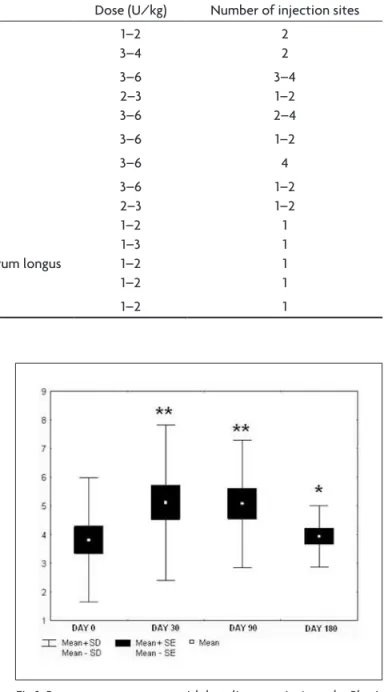
The number of points where the toxin was injected and the dose were adjusted for each muscle (Table 1). The maximum dos-es used for BoNT/A injections were: (a) 12 U/kg or 400 U per session; (b) 3–6 U/kg per large muscle; (c) 1–2 U/kg per small muscle; and (d) 50 U per injection point.7
was 10 milliseconds/cm. After the muscle where the BoNT/A was to be injected had been chosen, the needle electrode was inserted at the site nearest to the motor point, and when the presence of motor unit action potentials (MUAPs) suggested that the needle was inserted in the muscle, the BoNT/A was injected.
Adverse effects, latency to start, peak and duration of ac-tion of the BoNT/A and interference in daily life were measured with a questionnaire.
Statistical analysis
The distribution pattern for all the data was tested (normal or non-normal). The statistical differences between the means of the groups were determined using two-tailed and single-tailed paired student t tests where indicated and the Wilcoxon test. The results are given as mean ± sd (standard deviation). All the statistical analysis was performed with version 99 of the Statis-tica for Windows program. differences were considered signif-icant if p<0.05.
RESULTS
All 20 children selected [13 males and 7 females aged between 2 and 11 years (4.73±2.18 years) and weighing be-tween 8 and 34 kg (12.72±5.87 kg)] received BoNT/A injec-tions at the beginning of the study. All had equinus in both feet and were given BoNT/A injections in the gastrocne-mius and soleus muscles. There was no statistically signif-icant difference between the severity of the deicit in the lower right limbs and that in the lower left limbs (p=0.827). Fifteen patients had dificulty abducting their thighs and therefore had BoNT/A injected in the thigh adductors. The BoNT/A dose varied from 70 to 140 Us (99.75±16.26 U) and was 7.45±2.06 U/kg per patient. The parents or those responsible for the children reported that the med-ication started having an effect between the second and
twentieth day after application (7.1±4.57 days). All the pa-tients attended for follow-up assessment at 30 days post-application, 85% attended for assessment at 90 days and 75% at 180 days.
Treatment with BoNT/A improved ambulation and equinus gait pattern signiicantly in children with spastic diplegia when these parameters were assessed using the Prs (p<0.001). The treatment continued to have beneicial effects at the follow-up assessment 90 days post-treat-ment (p<0.001). At the follow-up assessment 180 days post-treatment, however, parameters similar to those pri-or to treatment were observed (Fig 1). only two children (10%), who had severe functional impairment at the be-ginning of the study, failed to show any improvement on Table 1. Pediatric doses of botulinum toxin A (Botox® Allergan) for lower-limb spasticity.
Muscle dose (U/kg) Number of injection sites Hip lexion Iliopsoas
rectus femoris
1–2 3–4
2 2 Knee lexion middle biceps femoris
lateral biceps femoris gastrocnemius
3–6 2–3 3–6
3–4 1–2 2–4 Thighs adducted adductor longus and brevis 3–6 1–2
Knee extended quadriceps 3–6 4
equinovarus medial and lateral gastrocnemius soleus
tibialis posterior tibialis anterior
lexor digitorum brevis and lexor digitorum longus lexor hallucis longus
3–6 2–3 1–2 1–3 1–2 1–2
1–2 1–2 1 1 1 1
Hallux extended extensor hallucis longus 1–2 1
the Prs scale at the +30 day follow-up assessment and did not attend for reassessment at +180 days.
Gait speed also changed signiicantly as a result of the use of BoNT/A (p<0.05). Nevertheless, this improvement was not sustained, as can be seen in the +90 and +180 day follow-up assessments (Fig 2). Three patients (15%) were able to ambulate without any support in all the fol-low-up assessments. one patient who required support when walking at the irst, second and third follow-up as-sessments, managed to ambulate without support at the +180 day follow-up assessment. The remaining 16 patients (80%) were unable to ambulate without assistance at any of the assessments.
Assessment of triceps surae spasticity with the Ash-worth scale showed that there was a signiicant response to BoNT/A (p<0.05), which was still in evidence at day
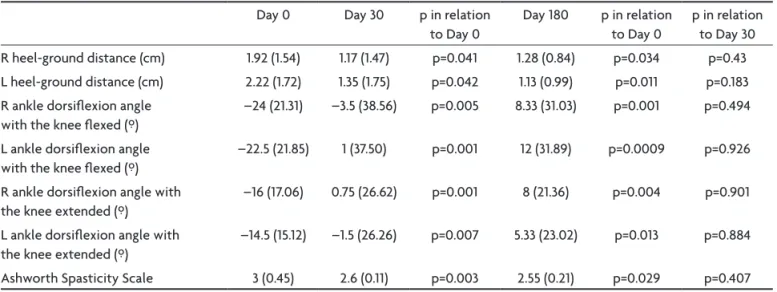
90 (p<0.05), but that the muscles had returned to their baseline values at day 180. The response of these muscles was also tested by measuring ankle dorsilexion. When this method of assessment was used, both with the knee lexed or at maximum extension, there was a signiicant response to BoNT/A in both limbs, and this was sustained until the end of the study. The heel-ground distance, which is increased in equinus because of the spasticity of the triceps surae, also changed signiicantly following the application of BoNT/A, and the results were sustained un-til day 180 (Table 2).
The thigh adductor muscle group also responded signif-icantly to the therapy, and the longer the time elapsed since the BoNT/A injection, the greater was the response (Fig 3).
Three patients were found to have weakness in the low-er limbs aftlow-er BoNT/A had been applied, and one
report-Fig 2. Response to treatment with botulinum toxin A measured by gait speed (sec/25 steps). *p<0.05 in relation to day 0.
Fig 3. Response of spastic thigh adductor muscles to treatment with botulinum toxin A. *p<0.05 in relation to day 0; + p<0.05 in rela-tion to day 30.
Table 2. Parameters to assess the effect of botulinum toxin A (Botox® Allergan) on the gastrocnemius and soleus muscles.
day 0 day 30 p in relation to day 0
day 180 p in relation to day 0
p in relation to day 30 r heel-ground distance (cm) 1.92 (1.54) 1.17 (1.47) p=0.041 1.28 (0.84) p=0.034 p=0.43 l heel-ground distance (cm) 2.22 (1.72) 1.35 (1.75) p=0.042 1.13 (0.99) p=0.011 p=0.183 r ankle dorsilexion angle
with the knee lexed (º)
–24 (21.31) –3.5 (38.56) p=0.005 8.33 (31.03) p=0.001 p=0.494
l ankle dorsilexion angle with the knee lexed (º)
–22.5 (21.85) 1 (37.50) p=0.001 12 (31.89) p=0.0009 p=0.926
r ankle dorsilexion angle with the knee extended (º)
–16 (17.06) 0.75 (26.62) p=0.001 8 (21.36) p=0.004 p=0.901
l ankle dorsilexion angle with the knee extended (º)
–14.5 (15.12) –1.5 (26.26) p=0.007 5.33 (23.02) p=0.013 p=0.884
ed having falls. These symptoms were mild and resolved in a few weeks without the need for medical intervention.
DISCUSSION
In this study we have shown that the use of intramus-cular BoNT/A injections to treat children with CP (spastic diplegia) who have spastic thigh adductor muscles and equinus is both safe and effective.
Treatment with BoNT/A was very effective in correct-ing the position of the feet, as shown by the reduction in the heel-ground distance and by the increased range of motion of the ankle joint, conirming the indings of pre-vious studies10-15. The increased dorsilexion of the foot
caused by the greater range of motion of the ankle joint was similar both with the knee extended and with the knee lexed. This occurred because of the role of all the muscles in the triceps surae complex – gastrocnemius and soleus – in producing equinus in our patients16. There was
thus an effective response to BoNT/A in all these target muscles. The improved positioning of the feet was also conirmed by the reduction in spasticity in the triceps su-rae muscles measured on the Ashworth scale. Physiologi-cal explanations for this adjustment in the feet include not only weakening of the gastrocnemii and soleus but also the increase in length of the gastrocnemii muscle-tendon unit, the shortening of the antagonist muscles or a combi-nation of these events. Any of these effects could be the direct result of chemical denervation caused by BoNT/A, and it is unlikely that they would occur spontaneously11.
A clear improvement in the spasticity of the thigh ad-ductor muscles was also observed after treatment with BoNT/A, corroborating the indings of other studies5. The
positive effect on the thigh adductor muscles was pro-gressive and was sustained throughout the follow-up pe-riod. We observed that the beneicial effects of BoNT/A in terms of spasticity of the triceps surae were still present six months after the application of the toxin. The effects of a single dose of BoNT/A lasted on average three to six months in other studies of children with CP. Although the duration and effect of BoNT/A reported in the literature varies, it is generally considered to be effective for at least three months11.
All our patients took part in rehabilitation programs before and after the application of BoNT/A, preferably based on a neurophysiological method, using splints when necessary. The use of electrical stimulation and immobi-lization was not recommended14,16. We believe that the
prolonged positive effect of BoNT/A – until the end of the study in some cases – is also related to the results of physiotherapy11,17. Thus, BoNT/A should not be considered
a substitute for physiotherapy or orthoses, but rather an additional therapeutic strategy10,18. Better biomechanical
alignment through muscular relaxation, such as improved range of motion of the ankle, allows the patient to adapt better to orthoses10,11. Furthermore, the muscular
relax-ation achieved following applicrelax-ation of BoNT/A allows muscle-stretching exercises to be performed more easily and the child to learn to use and strengthen opposing muscles. For most children BoNT/A does not lead to a sus-tained increase in the length of the gastrocnemii but helps delay shortening of the muscles. speciic physiotherapeu-tic treatment and orthoses can help the small percentage of children in whom there is evidence of prolonged mus-cle stretching19. These are clear arguments for intensifying
physiotherapy after the application of BoNT/A to achieve better results in the long term6,10,11,20.
The impact of BoNT/A in children is different from that in adults. Unlike adults, whose organisms are relative-ly static, children have two processes that are exclusive to childhood – growth and development – superimposed on the underlying spastic condition. Although the effects of BoNT/A are seen primarily in a reduction of hyperto-nia, the change in tonus can improve the child’s balance, strength, motor control and ixed contractures21. As the
child develops, the spastic muscles fail to grow as quickly as the neighboring structures, and dynamic structures are transformed into ixed contractures. relaxation of spastic muscles allows these to stretch, encourages their growth and prevents contractures. These improvements lead to functional gain10.
It has been stressed recently that assessment of func-tional improvement is more important than assessment of the reduction in muscle tonus or the increase in the range of motion of the joint10,18. The physiological and
mechani-cal effects of BoNT/A treatment are genuine and measur-able in patients with spastic diplegia. However, these ef-fects may not trigger a major change in function or change in the patient’s or his/her parents’ perception of function and thus not be recorded as a signiicant improvement in the patient’s family and social life22.
Hesse et al.12 reported a noticeable improvement in
equinus followed by a more erect gait posture after in-jection of BoNT/A in the gastrocnemius and ischiotibial muscles. However, there was no functional improvement according to the assessment tools used. reddihough et al.23 observed discrete gait improvements after three
months of follow-up, but failed to observe functional improvements after 3 or 6 months. Fazzi et al.13 , on the
We observed an improvement on the Prs scale after treatment; nevertheless, the beneicial effect was not sus-tained until the end of the study. The scale subitems gait pattern and ankle position, which are the two elements that are most closely related to spasticity of the gastroc-nemii and soleus, improved signiicantly with BoNT/A. Gait speed, the item with the greatest functional value on the scale, also improved signiicantly, but this improve-ment was not sustained until the sixth month of follow-up. We also found that only one patient was able to am-bulate without support, while the other 16 still needed support during the gait tests. These data, which show that functional gains were not sustained, support other authors’ concern to lay greater emphasis on instruments to measure function when analyzing the applicability of BoNT/A10,18,22.
However, the objective of this study was to assess the eficacy of BoNT/A applied in a single session. serial injec-tions of BoNT/A may lead to a greater reduction in focal spasticity and allow children with CP to learn movement patterns that more closely resemble normal ones and to improve their balance and gait speed as well as increase step size when ambulating11. Hawamdeh et al.10 showed that
there was an overall improvement for 18 months after three applications of BoNT/A in children with spastic diplegia. The improvement was greater than that observed when physiotherapy and orthoses were used in isolation and was sustained until the last follow-up session at 18 months. This suggests that BoNT/A may influence physiothera-py, prolonging and amplifying its effects and increasing the functional capacity of children with spastic diplegia.
In addition to increased functional capacity, another important beneit of long-term treatment with BoNT/A is that surgical interventions can be postponed6. Without
treatment, muscles that have been spastic for a long time can develop ixed contractures that often require surgical procedures. equinus recurs after corrective procedures are performed in early childhood. reduced spasticity follow-ing BoNT/A applications can delay the need for surgery, thus reducing the possibility of deformities recurring11,17.
With regard to the effectiveness of BoNT/A, quantita-tive variables have been found to be predicquantita-tive factors for a favorable treatment outcome. In terms of age, children under 48 months can show better results13. We assessed
children from 2 to 11 years of age (4.73±2.18 years), and our initial results were signiicant. With younger children we might have been able to maintain the functional gains be-cause the motor pattern of very young children provides greater scope for better development and recovery (a younger child has greater potential than an older child for increasing the plasticity of the central nervous system)13.
Papadonikolakis et al.24 , however, support the view that
carefully selected patients can show an improvement fol-lowing treatment with BoNT/A despite being older (aver-age (aver-age 11 years). These authors used selection criteria that were similar to those we used, i.e., only patients who were undergoing physiotherapy, did not have ixed contractures and were able to ambulate were included in the study.
Fattal-valevski et al.25 found that greater spasticity,
an inability to ambulate and lower motor function levels are predictive factors for a good response to BoNT/A. In contrast with these authors’ indings, in our study we observed that patients with a high degree of motor limi-tation were precisely those who had the worst response to BoNT/A treatment. Kay et al.26 followed up 23 children
over the age of four years with more severe CP (including patients with quadriplegia) who had dystonic movements and ixed contractures in the ankle. The authors did not observe any differences between lower-limb spasticity in the group that received BoNT/A and that in the group that had been treated with physical therapy alone. Two possi-ble explanations for Fattal-valevski et al.25 indings are that
BoNT/A was injected in a larger number of motor points in patients with more severe CP or that small changes in function, tonus and the range of motion of joints can be detected more easily in these children.
Another interesting point, which we did not address in our study, is the inluence of cognitive level and visual function. The role of cognitive and sensory development in the acquisition of motor abilities is well understood. Fazzi et al.13 showed that the best results in terms of gait
improvement were produced by children with normal or borderline cognitive levels. similarly, a signiicant im-provement in gait was observed in patients with normal or borderline visual acuity.
As the predictive factors are well understood, BoNT/A treatment should be tailored to suit each patient. In addi-tion, the effect and duration of treatment depends on the ability to deliver toxin to the target muscle(s); preinjec-tion muscle physiology, including power, endurance and spasticity; connective tissue extensibility; and the range of motion of the joint11.
Family members must have realistic expectations about the BoNT/A treatment before the procedure starts. Bjornson et al.22 showed that the family members’
expec-tations for the therapy were far removed from the actual effects of the treatment and that they had dificulty ap-preciating the beneits of the treatment.
on the other hand, patients and family members un-derstand and rarely complain about the adverse effects of the treatment. BoNT/A is generally well tolerated and safe when used to treat spastic CP and rarely produces severe side effects. In agreement with the literature, no impor-tant side effects were observed in our patients. However, we did observe weakness in the lower limbs and falls – probably related to a reduction in muscle tonus after the treatment – in individuals used to ambulating with spastic muscles11,15,17,24.
Although we did not use sedatives or local anesthet-ics, there were no complaints of pain at the injection site or local adverse effects because of traumatism as a result of sudden movements by the children. Koman et al.6 also
failed to ind adverse effects and reported that all their patients agreed to second injection sessions. Topical an-esthetics are not effective in reducing pain produced by the injections because they do not affect the muscle un-derneath the skin at the injection site6. The argument for
using general anesthesia when injecting BoNT/A is that it helps avoid emotional stress and anxiety in the child, especially when the procedure needs to be repeated in the future27. The use of sedatives such as oral midazolam,
which causes amnesia, can be a safer, less expensive alter-native to general anesthesia when the aim is to sedate the patient before the procedure15,27.
In the group of patients with spastic diplegia in the present study, a single session of injections of BoNT/A was safe and effective. There was an important, sustained change in the motor structure in the lower limbs of the children tested; however, functional changes were only observed when the effect of the medication was at its peak. These indings indicate that serial injections of the medication are required if all the positive effects obtained are to be maintained.
Acknowledgments – The authors would like to thank Allergan, Inc.; which provided the botulinum toxin (Botox®) for this study. disclosure: The authors have nothing to disclose
REFERENCES
1. Nelson KB, Ellenberg JH. Epidemiology of cerebral palsy. Adv Neurol 1978;19:421-435.
2. Hagberg B, Hagberg G, Olow I. Gains and hazards of intensive neona-tal care: an analysis from Swedish Cerebral palsy epidemiology Dev Med Child Neurol 1982;24:13-19.
3. Hagberg B, Hagberg G, Beckung E, Uvebrant P. Changing panorama of cerebral palsy in Sweden. VIII. Prevalence and origin in the birth year period 1991-94. Acta Paediatr 2001;90:271-277.
4. Koman LA, Smith BP, Shilt JS. Cerebral palsy. Lancet 2004;363: 1619-1631.
5. Hazneci B, Tan AK, Guncikan MN, Dincer K, Kalyon TA. Comparison of the eficacies of botulinum toxin A and Johnstone pressure splints against hip adductor spasticity among patients with cerebral palsy: a randomized trial. Mil Med 2006;171:653-656
6. Koman LA, Mooney JF 3rd, Smith BP, Walker F, Leon JM. Botulinum toxin type A neuromuscular blockade in the treatment of lower extrem -ity spastic-ity in cerebral palsy: a randomized, double-blind, placebo-controlled trial. BOTOX Study Group. J Pediatr Orthop 2000;20:108-115. 7. Bohannon RW, Smith MB. Interrater reliability of a modiied Ashworth
scale of muscle spasticity. Phys Ther 1987;67:206-207.
8. Koman LA, Mooney JF 3rd, Smith BP, Goodman A, Mulvaney T. Man-agement of spasticity in cerebral palsy with botulinum-A toxin: re -port of a preliminary, randomized, double-blind trial. J Pediatr Orthop 1994;14:299-303.
9. Russman BS, Tilton A, Gormley ME Jr. Cerebral palsy: a rational ap-proach to a treatment protocol, and the role of botulinum toxin in treat -ment. Muscle Nerve 1997;6(Suppl):S181-S193.
10. Hawamdeh ZM, Ibrahim AI, Al-Qudah AA. Long-term effect of botu-linum toxin (A) in the management of calf spasticity in children with diplegic cerebral palsy. Eura Medicophys 2007;43:311-318.
11. Koman LA, Brashear A, Rosenfeld S, et al. Botulinum toxin type a neuromuscular blockade in the treatment of equinus foot deformi-ty in cerebral palsy: a multicenter, open-label clinical trial. Pediatrics 2001;108:1062-1071.
12. Hesse S, Brandl-Hesse B, Seidel U, Doll B, Gregoric M. Lower limb muscle activity in ambulatory children with cerebral palsy before and after the treatment with Botulinum toxin A. Restor Neurol Neurosci 2000;17:1-8.
13. Fazzi E, Maraucci I, Torrielli S, Motta F, Lanzi G. Factors predicting the eficacy of botulinum toxin-A treatment of the lower limb in children with cerebral palsy. J Child Neurol 2005;20:661-666.
14. Detrembleur C, Lejeune TM, Renders A, Van Den Bergh PY. Botulinum toxin and short-term electrical stimulation in the treatment of equinus in cerebral palsy.Mov Disord 2002;17:162-169.
15. Ubhi T, Bhakta BB, Ives HL, Allgar V, Roussounis SH. Randomised double blind placebo controlled trial of the effect of botulinum toxin on walking in cerebral palsy. Arch Dis Child 2000;83:481-487. 16. Teive HA, Zonta M, Kumagai Y. Tratamento da espasticidade: uma
at-ualização. Arq Neuropsiquiatr 1998;56:852-858.
17. Molenaers G, Desloovere K, Fabry G, De Cock P. The effects of quantita-tive gait assessment and botulinum toxin a on musculoskeletal surgery in children with cerebral palsy. J Bone Joint Surg Am 2006;88:161-170. 18. Desloovere K, Molenaers G, Jonkers I, et al. A randomized study of
combined botulinum toxin type A and casting in the ambulant child with cerebral palsy using objective outcome measures. Eur J Neurol 2001;(Suppl 5):S75-S87.
19. Eames NW, Baker R, Hill N, Graham K, Taylor T, Cosgrove A. The ef-fect of botulinum toxin A on gastrocnemius length: magnitude and du -ration of response. Dev Med Child Neurol 1999;41:226-232
20. Slawek J, Klimont L. Functional improvement in cerebral palsy pa-tients treated with botulinum toxin A injections: preliminary results. Eur J Neurol 2003;10:313-317.
21. El O, Peker O, Kosay C, Iyilikci L, Bozan O, Berk H. Botulinum toxin A injection for spasticity in diplegic-type cerebral palsy. J Child Neu-rol 2006;21:1009-1012.
22. Bjornson K, Hays R, Graubert C, et al. Botulinum toxin for spasticity in children with cerebral palsy: a comprehensive evaluation. Pediatrics 2007;120:49-58
23. Reddihough DS, King JA, Coleman GJ, et al.. Functional outcome of botulinum toxin A injections to the lower limbs in cerebral palsy. Dev Med Child Neurol 2002;44:820-827.
24. Papadonikolakis AS, Vekris MD, Korompilias AV, Kostas JP, Ristanis SE, Soucacos PN. Botulinum A toxin for treatment of lower limb spas -ticity in cerebral palsy: gait analysis in 49 patients. Acta Orthop Scand 2003;74:749-755.
25. Fattal-Valevski A, Giladi N, Domanievitz D, et al. Parameters for pre-dicting favorable responses to botulinum toxin in children with cere -bral palsy. J Child Neurol 2002;17:272-277
26. Kay RM, Rethlefsen SA, Fern-Buneo A, Wren TA, Skaggs DL. Botuli-num toxin as an adjunct to serial casting treatment in children with ce -rebral palsy. J Bone Joint Surg Am 2004;86:2377-2384.