Floristics, structure and soil of insular vegetation in four
quartzite-sandstone outcrops of “Chapada Diamantina”, Northeast Brazil
ABEL AUGUSTO CONCEIÇÃO
1,4,
JOSÉ RUBENS PIRANI
2and SERGIO TADEU MEIRELLES
3(received: August 31, 2004; accepted: December 6, 2007)
ABSTRACT – (Floristics, structure and soil of insular vegetation in four quartzite-sandstoneoutcrops of “Chapada Diamantina”, Northeast Brazil). Soil islands on rocky surfaces often harbor aggregated vegetation that consists of insular plant communities. These islands are typical of the rocky outcrops and in various parts of Brazil form the so-called “campos rupestres” vegetation. Four of such sites have been selected in the state of Bahia, Northeast Brazil, for this comparative study on floristics and vegetation structure: three areas situated inside the “Parque Nacional da Chapada Diamantina” (Guiné, Fumaça and “Gerais da Fumaça”) and one is at the border of the Environmental Protection Area of “Marimbus-Iraquara” (“Mãe Inácia”). All occurring vegetation islands were studied in four random plots of 10 × 10 m per site. Soil was often shallow, sandy and acidic.Vascular plant species were determined, with respective life forms and canopy coverage areas. The total number of species when all four sites were added was 135, and the number of species per island varied from 2 to 32. The areas of the 214 soil islands varied from 0.015 to 91.9 m2,
totaling 568 m2 in the four sites. Monocotyledon families were dominant, essentially Velloziaceae, as well as Orchidaceae, Bromeliaceae,
Amaryllidaceae and Cyperaceae. Among the eudicotyledons, dominant families were mainly Clusiaceae, Asteraceae and Melastomataceae. The biological spectra revealed that phanerophytes and hemicryptophytes predominated among the life forms, while chamaephytes had the largest coverage area. Epilithic and desiccant chamaephytes composed the most conspicuous interspecific associations, and were probably related to early successional processes. Sites closest to one another were not the most similar in structure, indicating that other factors more relevant than distance might be involved in the abundance of species in space. Key words - floristics, rocky outcrops, soil islands on rocks, vegetation islands, vegetation structure
RESUMO – (Florística, estrutura e solo da vegetação insular em quatro afloramentos de quartzito-arenito na Chapada Diamantina, nordeste do Brasil). Ilhas de solo abrigam comunidades vegetais agregadas no espaço e delimitadas pela superfície rochosa. Tais ilhas são típicas dos afloramentos rochosos de várias regiões brasileiras e, por vezes, integram parte da vegetação chamada de campo rupestre. Quatro sítios caracterizados por elevadas proporções de superfície rochosa foram selecionados para este estudo de florística e estrutura vegetacional: três situados dentro do Parque Nacional da Chapada Diamantina (Guiné, Fumaça e Gerais da Fumaça) e um no limite com a APA Marimbus-Iraquara (Mãe Inácia). Sortearam-se quatro parcelas de 10 × 10 m por sítio, onde todas as ilhas de solo ocorrentes tiveram suas áreas estimadas. O solo foi em geral raso, arenoso e ácido.Foram determinadas as espécies de plantas vasculares, com respectivas formas de vida e áreas de cobertura vegetal. O número de espécies nos quatro sítios foi 135, variando de 2 a 32 espécies por ilha. As áreas das 214 ilhas de solo variaram de 0,015 a 91,9 m2, somando 568 m2 nos quatro sítios. Famílias de monocotiledôneas foram as dominantes,
especialmente Velloziaceae, além das Orchidaceae, Bromeliaceae, Amaryllidaceae e Cyperaceae. Dentre as eudicotiledôneas ressaltam-se as Clusiaceae, Asteraceae e Melastomataceae. Os espectros biológicos revelaram as formas de vida fanerófita e hemicriptófita como predominantes, apesar da caméfita possuir maior área de cobertura. Espécies camefíticas epilíticas e camefíticas dessecantes formaram as associações mais conspícuas, provavelmente relacionadas com os processos iniciais de sucessão da vegetação na rocha. Os sítios mais próximos entre si não foram os mais similares na estrutura, indicando outro(s) fator(es) mais relevante(s) do que a distância, envolvidos na abundância das espécies no espaço.
Palavras-chave - afloramentos rochosos, estrutura vegetacional, florística, ilhas de solo sobre rocha, ilhas de vegetação et al. 1974, Wiser et al. 1996). Severe environmental conditions, such as soil scarcity and nutrient deficiency, high daily temperature oscillations and intense irradiation restrict the occupation of the exposed rock by plants (Shure & Ragsdale 1977, Burrows 1990, Ware 1990), although these unfavorable conditions are somewhat ameliorated when the vegetation is denser (Daubenmire 1968). These plant aggregations surrounded by rock surfaces are called “soil mat communities” (Hambler 1964), “island communities” (Burbanck & Platt 1964, McCormick et al. 1974, Shure & Ragsdale 1977),
1. Universidade Estadual de Feira de Santana, Departamento de Ciências Biológicas, km 03 – BR 116, Campus Universitário, 44031-460 Feira de Santana, BA, Brazil.
2. Universidade de São Paulo, Instituto de Biociências, Departamento de Botânica, Caixa Postal 11461, 05422-970 São Paulo, SP, Brazil. 3. Universidade de São Paulo, Instituto de Biociências, Departamento de Ecologia Geral, Caixa Postal 11461, 05422-970 São Paulo, SP, Brazil. 4. Corresponding author: [email protected]
Introduction
“vegetation islands” (Medina et al. 2006) or “soil islands” (Conceição & Pirani 2005). In this paper we adopt the latter terminology.
Studies on soil islands on rocks are more abundant in granitic-gneiss outcrops in Africa and in the United States. In South America, Ibisch et al. (1995) referred to families such as Bromeliaceae, Cactaceae, Cyperaceae, Orchidaceae, Poaceae, and Velloziaceae as typical of local inselbergs, while Velloziaceae is typical also of African inselbergs (Sarthou & Villiers 1998, Michelangeli 2000). In Brazil, some of the earliest studies on plant communities in rock outcrops were those of Segadas-Vianna (1965), Oliveira et al. (1975) and Carauta & Oliveira (1982). Again, Bromeliaceae, Velloziaceae and Orchidaceae appeared as important components in rocky slopes and/or high altitude zones of Rio de Janeiro, organized in “plant clumps that were similar to islands”, as described by Carauta & Oliveira (1982).
In Brazil, there appears to be a very restricted number of taxa that are common on rocky outcrop vegetation (França et al. 1997, Meirelles et al. 1999, Ribeiro & Medina 2002, Conceição & Pirani 2005, 2007, Medina
et al. 2006, Conceição et al. 2007). The “Chapada Diamantina” region, inserted in the semi-arid “caatinga” biome of the Brazilian northeast (Giulietti & Pirani 1988), has been chosen for this study for its high biodiversity, high level of endemisms and the presence of quartzite-sandstone rock outcrops (Harley & Simmons 1986, Giulietti et al. 1987, 1996, 1997, Giulietti & Pirani 1988, Alves & Kolbek 1994, Harley 1995, Stannard 1995, Conceição 2000, Conceição & Pirani 2005, 2007). According to Harley & Simmons (1986), “campo rupestre” is the expression that defines the vegetation that grows on quartzite-sandstone substrate, although this terminology is used to refer to Brazilian vegetation on other types of rocky substrate such as granitic-gneiss (e.g., Queiroz et al. 1996) or ferruginous (i.e., the locally called “canga”,
e.g., Viana & Lombardi 2007). Still according to Harley & Simmons (1986), “campos rupestres” occur in altitudes higher than 900 m in the Brazilian states of Goiás, and some isolated areas in São Paulo and Rio de Janeiro, and along the Espinhaço mountain chain in Minas Gerais and Bahia States.
“Morro do Pai Inácio”, an inselberg with elevations between 1,100 and 1,170 m, is the single location at “Chapada Diamantina” that has been studied in respect to the vegetation ecology on soil islands (Conceição et al. 2007). This “campo rupestre” vegetation is composed essentially of shrubs and herbs (Conceição & Giulietti 2002). The present study adds four other locations to the list of study sites of “Chapada Diamantina” as
regards the ecology of vegetation on soil islands. To each of them, we aimed to describe and discuss the relationships between edaphic conditions, floristics and vegetation structure.
Material and methods
Study sites – This study was carried out at four “campo rupestre” sites with a great proportion of exposed rock on hilltops and ridge tops at “Serra do Sincorá” (“Sincorá” Range), “Chapada Diamantina”, state of Bahia, Northeast Brazil (figure 1).“Mãe Inácia” site (12°27’ S and 41°28’ W) is located in the municipality of Palmeiras, and is the only site outside the “Parque Nacional da Chapada Diamantina”, with elevations between 1,100 and 1,140 m a.s.l. It is the most isolated hill of our four study sites and has four small summits (1 to 3 ha) isolated from each other by three cleefs of 5 to 10 m of width. “Cachoeira da Fumaça”(12°35’ S and 41°27’ W) and “Gerais da Fumaça”(12°36’ S and 41°28’ W) outcrops are located at “Serra da Larguinha”, in the municipality of Palmeiras, between 1,310 and 1,360 m of altitude.“Gerais da Fumaça” is the less isolated site from the surrounding vegetation. Guinéoutcrops are found on the western border of “Serra do Sincorá” and “Parque Nacional da Chapada Diamantina”, at “Serra do Esbarrancado”, municipality of Mucugê (12°45’ S and 41°30’ W). They are the highest outcrops (ca. 1,400 m a.s.l.) among our study sites.
The climate at the study sites is Central Brazil Tropical, sub-hot, semi-humid, with a humid summer and four to five dry months concentrated during spring. From June to August, months are cooler and the first morning hours are often cloudy. Mean annual temperatures at locations with elevations between 1,000 and 1,100 m are lower than 20 °C, and minimum daily temperatures lower than 4 °C may occur (Nimer 1989). Predominant winds come from the southeast and orographic rains occur in the eastern sector, where our study sites are found (Jesus et al. 1985).
within the plots were also sampled entirely. Thus, establishing plots was a strategy only to standardize the islands sampled. Soil sampling – The collection of soil samples was hindered by the small quantity of sediments in the soil islands, both
at surface and in depth. Shallow sediments appeared associated to fractures and other unevenness on the rock surfaces. The sediments were composed mainly by organic and inorganic material and root mass, while ant and termite nests were often found.
For each site, two out of the four 10 × 10 m plots were randomly chosen for the extraction of two sediment samples at 10 cm of depth in each of them, totaling four soil samples per site. These collections were made in the central portions of the largest and the smallest island that had at least 10 cm of depth. In one of the plots at “Morro da Mãe Inácia”, only one island had 10 cm of depth, which meant a smaller number of samples for this site (15 soil samples rather than 16).
Soil samples were analyzed at the Department of Soils and Plant Nutrition at the “Escola Superior de Agricultura Luiz de Queiroz”, Piracicaba, state of São Paulo, following the methods described by Ruggiero et al. (2002). Between-site comparison of edaphic parameters were done by one-way ANOVA (Callegari-Jacques 2003), calculated by the software
Statistica 6.0. Initially, variables were tested for normality
(Kolmogorov-Smirnov, P > 0.05) and homocedasticity (Levene, P > 0.05). The hypothesis tested by ANOVA was that means were equal in each site (H0: µM = µF = µGF = µG,
α= 0.05; where sites are M = “Mãe Inácia”, F = Fumaça,
GF = “Gerais da Fumaça” e G = Guiné). Rejection of H0 meant between-site difference, and Tukey test (a = 0.05) was applied to test such differences (Callegari-Jacques 2003). Surface area of vegetation islands and cover area of individual species – The surface areas of the islands were estimated by measuring their longest axis (l) and greatest width (w). Then, based on the general form of the island, either the area of an ellipse (¼ l.w.π) or a rectangle (l.w) was calculated. The percent
area covered by the different plant species composing each island was visually estimated based on the vertical projection of all aerial plants parts (Westhoff & Maarel 1978). Species composition and life forms – Fertile specimens of all species on the soil islands were collected and oven-dried. Voucher specimens were deposited at the herbarium SPF (“Universidade de São Paulo”). Family names followed Cronquist (1981), except for Amaryllidaceae and Fabaceae
s.l. (= Leguminosae). The abbreviations of the names of the botanical authorities followed Brummitt & Powell (1992). Raunkiaer’s life-forms were determined according to Ellenberg & Müeller-Dombois (1967) and further details are provided in Conceição & Pirani (2005).
Data analyses – Community structure was explored applying the multivariate statistical techniques of classification and ordination on the patterns of species distribution and abundance in soil islands of the different sites.
A cluster procedure was used for representation of species co-occurring in soil islands on all sites. The procedure was applied on a Jaccard similarity coefficient matrix calculated from the species presence-absence data on soil islands. Only species that occurred in more than 9% of the soil islands were included in the analysis. The construction of the similarity Figure 1. Location of the study sites: “Morro da Mãe Inácia”
dendrogram was based on the unweighed pair-group mean clustering algorithm (UPGMA).
For exploring the patterns arising from species abundance by site, an ordination procedure by correspondence analysis (CA) of the detrended variant (DCA) was applied as a strategy for unbiased indirect gradient detection (Ter Braak 1997). This ordination procedure was applied on a matrix of sites and species abundance values in soil islands occurring on 100 m2 plots. Detrending was done by segments. The ordination
of sites on the two first axes was examined by interpolation of DCA scores resulting from the DCA.
Detrended correspondence analysis ordinations and the r-mode UPGMA cluster analyses were performed using MVSP version 3.12 software (Kovach Computing Service, Anglesey, UK) (Kovach 1999).
Results
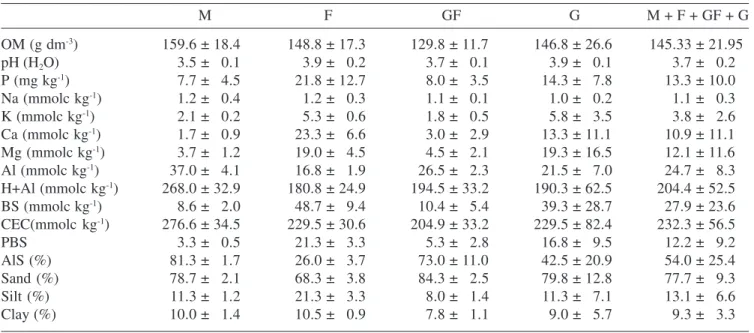
Soil – Soil analyses showed marked variations in regard to the edaphic features of our four study sites (table 1). Calcium concentration was higher at Fumaça, as compared to “Mãe Inácia” and “Gerais da Fumaça” (FCa (3, 11) =
5.9066, P = 0.0118). The percentage of silt was higher also at Fumaça as compared to “Gerais da Fumaça” (Fsilt(3, 11) = 5.5784, P = 0.0142). Aluminum concentration
was higher at “Mãe Inácia” than at Fumaça and Guiné (F(3, 11) = 9.8631, P = 0.0019). At Fumaça, pH was more
acidic than at “Mãe Inácia” (F(3, 11) = 6.7698, P = 0.0075).
However, three out of seven edaphic variables that
satisfied the assumptions of ANOVA were statistically similar between the study sites (P > 0.05): organic matter (F(3, 11) = 1.0783), cation exchange capacity (F(3, 11) =
0.8456) and sodium (F(3,11) = 0.2444).
Vegetation – Table 2 lists the 135 species of angiosperms (distributed in 43 families) found in the 214 soil islands of four rocky outcrops of “Chapada Diamantina”. There were nine species included in seven families of vascular cryptogams. Eudycotyledons were represented by 58 species included in 24 families. The family Piperaceae was represented by one species and monocots were 67 species of 11 families. The surface area of the soil islands varied from 0.015 to 91.9 m2, and 2 to 32 plant species
were found per island. The total surface area of soil islands when all 214 islands of our four sites were added was 568 m2, while the total coverage of vascular plant
species in these islands was 675 m2. The difference between
the two values is due to overlaps between branches of different species in given soil islands. Thus, there was an average of 0.23 plant species m-2 of soil islands. The
site Fumaça had the highest number of species (85) on 216 m2 of soil islands (0.39 species m-2), while “Gerais
da Fumaça” had the lowest (39 species m-2) on 213 m2
of soil islands (0.18 species m-2). Guiné had 57 species
on 74 m2 (0.76 species m-2) and “Morro da Mãe Inácia”
had 42 on 63 m2 (0.66 species m-2) of soil islands.
Orchidaceae was the most species-rich family (26), followed by Poaceae (12), Asteraceae (10), Velloziaceae
Table 1. Mean values of chemical and granulometric soil parameters, from soils collected in 15 soil islands. Study sites, located at “Chapada Diamantina”, Bahia, Brazil, are: M = “Morro da Mãe Inácia”, F = Fumaça, GF = “Gerais da Fumaça”, and G = Guiné. Parameters analysed: OM = organic matter; BS = base sum; CEC = cation exchange capacity; PBS = percent base saturation; AlS = aluminum saturation.
M F GF G M + F + GF + G
OM (g dm-3) 159.6 ± 18.4 148.8 ± 17.3 129.8 ± 11.7 146.8 ± 26.6 145.33 ± 21.95
pH (H2O) 3.5 ±00.1 3.9 ±00.2 3.7 ±00.1 3.9 ±00.1 3.7 ±00.2
P (mg kg-1) 7.7 ±04.5 21.8 ± 12.7 8.0 ±03.5 14.3 ±07.8 13.3 ± 10.0
Na (mmolc kg-1) 1.2 ±00.4 1.2 ±00.3 1.1 ±00.1 1.0 ±00.2 1.1 ±00.3
K (mmolc kg-1) 2.1 ±00.2 5.3 ±00.6 1.8 ±00.5 5.8 ±03.5 3.8 ±02.6
Ca (mmolc kg-1) 1.7 ±00.9 23.3 ±06.6 3.0 ±02.9 13.3 ± 11.1 10.9 ± 11.1
Mg (mmolc kg-1) 3.7 ±01.2 19.0 ±04.5 4.5 ±02.1 19.3 ± 16.5 12.1 ± 11.6
Al (mmolc kg-1) 37.0 ±04.1 16.8 ±01.9 26.5 ±02.3 21.5 ±07.0 24.7 ±08.3
H+Al (mmolc kg-1) 268.0 ± 32.9 180.8 ± 24.9 194.5 ± 33.2 190.3 ± 62.5 204.4 ± 52.5
BS (mmolc kg-1) 8.6 ±02.0 48.7 ±09.4 10.4 ±05.4 39.3 ± 28.7 27.9 ± 23.6
CEC(mmolc kg-1) 276.6 ± 34.5 229.5 ± 30.6 204.9 ± 33.2 229.5 ± 82.4 232.3 ± 56.5
PBS 3.3 ±00.5 21.3 ±03.3 5.3 ±02.8 16.8 ±09.5 12.2 ±09.2
AlS (%) 81.3 ±01.7 26.0 ±03.7 73.0 ± 11.0 42.5 ± 20.9 54.0 ± 25.4
Sand (%) 78.7 ±02.1 68.3 ±03.8 84.3 ±02.5 79.8 ± 12.8 77.7 ±09.3
Silt (%) 11.3 ±01.2 21.3 ±03.3 8.0 ±01.4 11.3 ±07.1 13.1 ±06.6
Table 2. Species or morphospecies of vascular plants sampled in 214 soil islands at “Morro da Mãe Inácia”, Fumaça, “Gerais da Fumaça” and Guiné study sites, “Chapada Diamantina”, Bahia, Brazil. Life forms (LF): microphanerophyte (mF), nanophanerophyte (nF), epilithic chamaephyte (eC), desiccation tolerant chamaephyte (dC), chamaephyte not epilithic and not desiccation-tolerant (Ch), hemicryptophyte (H), cryptophyte (Cr), therophyte (T), epiphyte (E), succulent (S) and liana (L). Family
LF Voucher material
Species
AMARYLLIDACEAE
Hippeastrum puniceum (Lam.) Kuntze Cr V.C.Souza 5226
Hippeastrum solandriflorum (Lindl.) Herb. Cr Conceição 616
APOCYNACEAE
Mandevilla bahiensis (Woodson) M. F. Sales Cr Conceição 219
Mandevilla tenuifolia (Mikan) Woodson Cr Conceição 208
AQUIFOLIACEAE
Ilex amara (Vell.) Loes. nF Conceição 735
ARACEAE
Philodendron pachyphyllum Krause nF Conceição 402
ASCLEPIADACEAE
Metastelma harleyi Fontella L Conceição 432
Metastelma myrtifolium Decne. Cr Conceição 300
ASTERACEAE
Acritopappus hagei R. M. King & H. Rob. nF Grillo 70
Baccharis cf. salzmannii DC. nF Conceição 964, 1077
Bahianthus viscosus (Spreng.) R. M. King & H. Rob. nF Conceição 56
Lasiolaena duartei R. M. King & H. Rob. nF Conceição 133
Lychnophora triflora (Mattf.) H. Rob. nF Conceição 55
Mikania glandulosissima W. C. Holmes L Conceição 780
Paralychnophora bicolor (Mart. ex DC.) MacLeish nF Conceição 34
Stylotrichium rotundifolium Mattf. nF Conceição 884
Verbesina baccharifolia Mattf. nF Conceição 607
Vernonia cotoneaster (Willd. ex Spreng.) Less. T Conceição 841
BEGONIACEAE
Begonia grisea A.DC. nF Conceição 205
BROMELIACEAE
Hohenbergia cf. catingae Ule H Conceição 407
Neoregelia bahiana (Ule) L. B. Sm. H Conceição 640
Orthophytum albopictum Philcox H Conceição 1097
Orthophytum burle-marxii L. B. Sm. & Read H Conceição 75
Tillandsiastricta Sol. E PCD 507
Vriesea atra Mez H Conceição 408
Vriesea friburguensis Mez H Conceição 602
CACTACEAE
Arrojadoa bahiensis (P. J. Braun & Esteves) N. P. Taylor & Eggli S Harley 24522
Micranthocereus purpureus (Gürke) F. Ritter S Zappi 141
Pilosocereus pachycladus F. Ritter S Harley 25562
CLUSIACEAE
Clusia obdeltifolia Bittrich nF/mF Conceição 287
Clusia melchiorii Gleason nF Conceição 830
CONVOLVULACEAE
Evolvulus jacobinus Moric. Ch Conceição 303
Jacquemontia sp. nov. nF Conceição 823, 942
Family
LF Voucher material
Species CYPERACEAE
Abildgaardia scirpoides Nees T Conceição 877
Abildgaardia sp. T Conceição 560
Bulbostylis aff. jacobinae (Steud.) Lindm. T Conceição 984
Lagenocarpus rigidus (Kunth) Nees H Conceição 422
Trilepis lhotzkiana Nees dC Conceição 308, 448
DIOSCORIACEAE
Dioscorea sincorensis R. Knuth Cr Conceição 293, 435
DRYOPTERIDACEAE
Rumohra adiantiformis (Forst.) Ching H Conceição 779
ERICACEAE
Gaylussacia brasiliensis (Spreng.) Meisn. nF Conceição 605, 838
Gaylussacia incana Cham. & Schltdl. nF Conceição 873
ERIOCAULACEAE
Leiothrix angustifolia (Koern.) Ruhland T Conceição 635
Paepalanthus pulchellus Herzog T Conceição 606
Paepalanthus sp. nov. H Conceiçao 612
EUPHORBIACEAE
Croton timandroides Müll. Arg. nF Conceição 667
Phyllanthus klotzschianus Müll. Arg. nF Conceição 706
Stillingia saxatilis Müll. Arg. nF Conceição 766, 848
FABACEAE s.l.
Calliandra asplenioides (Nees) Renvoize nF Conceição 749, 1016
Calliandra cf. viscidula Benth. nF Conceição 1021
Calliandra sp. nF Conceição 776,993
Chamaecrista cytisoides (Collad.) Irwin & Barneby nF Conceição 778
Zornia flemmingioides Moric. Cr Conceição 216
GENTIANACEAE
Curtia verticilaris (Spreng.) Knobl. T Conceição 879
Schultesia pachyphylla Griseb. T Conceição 795, 818
GESNERIACEAE
Paliavana tenuiflora Mansf. nF Conceição 115
Sinningia elatior (Kunth) Chautems nF Conceição 228
GRAMMITIDACEAE
Cochlidium punctatum (Raddi) L. E. Bishop E Conceição 854
HYMENOPHYLLACEAE
Hymenophyllum polyanthos (Sw.) Sw. H Conceição 564
LAMIACEAE
Eriope exaltata Harley nF/mF Conceição 36
Hyptis hagei Harley nF Conceição 48
LOGANIACEAE
Spigelia cremnophila Zappi & E. Lucas Ch Conceição 64
LYCOPODIACEAE
Huperzia mooreana (Baker) Holub. Ch Conceição 447
LYTHRACEAE
Cuphea sp. nF Conceição 673
Cuphea ericoides Cham. & Schltdl. nF Conceição 672
continuation
Family
LF Voucher material
Species
MELASTOMATACEAE
Marcetia vellutina Markgr. nF Conceição 142
Microlicia sp. nF Conceição 57, 688
Tibouchina oreophila Wurdack nF Conceição 825
Tibouchina pereirae Brade & Markgr. H/nF/mF Grillo 32
MYRTACEAE
Myrcia myrtifolia DC. nF Conceição 295, 730
ORCHIDACEAE
Acianthera hamosa (Barb.Rodr.) Pridgeon & M. W. Chase E/Ch Conceição 126
Acianthera ochreata (Lindl.) Pridgeon & M. W. Chase eC Conceição 70
Bifrenaria magnicalcarata (Hoehne) Pabst Ch Conceição 979
Cattleya elongata Barb. Rodr. eC PCD 1741
Cyrtopodium aliciae Lindau Ch PCD 1136
Epidendrum saxatile Lindl. eC Conceição 721
Epidendrum secundum Jacq. eC Conceição 394
Habenaria pseudohamata Toscano Cr Conceição 788
Oncidium blanchetii Rchb.f Ch Conceição 129
Oncidium sp. Ch Conceição 762
Pelexia viridis (Cogn.) Schltr. Cr Conceição 689, 1009
Prescottia plantaginea Lindl. Cr Conceição 894
Sacoila lanceolata (Aubl.) Garay Cr Conceição 755, 977
Skeptrostachys congestiflora (Cogn.) Garay Cr Conceição 214
Sophronitis bahiensis (Schltr.) Van den Berg & M. W. Chase eC Conceição 600
Sophronitis sincorana (Schltr.) Van den Berg & M. W. Chase eC Conceição 719
Veyretia sincorensis (Schltr.) Szlach. Cr Conceição 717, 897
Zygopetalummackayi Hook. H Conceição 519, 793
Zygopetalum selowii Rchb.f H Conceição 1103
Orchidaceae sp. 1 Cr –
Orchidaceae sp. 2 Cr –
Orchidaceae sp. 3 H –
Orchidaceae sp. 4 H –
Orchidaceae sp. 5 Cr –
Orchidaceae sp. 6 Cr –
Orchidaceae sp. 7 Ch –
PIPERACEAE
Peperomia galioides Kunth eC Conceição 442
POACEAE
Andropogon sp. H Conceição 786
Axonopus aureus P. Beauv. H Conceição 304
Panicum belmontae Renvoize H Conceição 1089
Panicum cumbucana Renvoize H Conceição 1054
Ichnanthus inconstans (Trin. ex Nees) Doell H Conceição 1055
Panicum animarum Renvoize H Conceição 882
Panicum trinii Kunth H PCD 690; Grillo 30
Panicum sp. H Conceição
Paspalum minarum Hack. H Conceição 311, 847
Schizachyrium sanguineum (Retz.) Alst. H Conceição 576
Trachypogon macroglossus Trin. H Conceição 915
Trachypogon spicatus (L. f.) Kuntze H Conceição 839
continuation
and Bromeliaceae (seven each), Cyperaceae and Fabaceae (five each), and Verbenaceae and Melastomataceae (four each). Most families (27; 63%) had only one or two species. Out of the ten most frequent families, seven were monocots (figure 2A). The surface area covered by species belonging to the Velloziaceae family amounted to 43% of the 675 m2 of total coverage area when all vascular
species belonging to the 214 soil islands are added (figure 2B).
Figure 3 shows percentage occurrence (A) and percent cover (B) of the seven most representative botanical families per site. From all families in the two legends, six were the same throughout (Velloziaceae, Asteraceae, Cyperaceae, Bromeliaceae, Orchidaceae, and Melastomataceae), while Amaryllidaceae was representative for occurrence and Clusiaceae for aerial plant coverage. “Gerais da Fumaça” had the highest proportion (47%) of occurrence of species belonging to
Family
LF Voucher material
Species
POLYGALACEAE
Polygala guedesiana Marques T Conceição 857
Polygala tuberculata Chodat nF Conceição 771
Polygala sincorensis Chodat H Conceição 773
POLYPODIACEAE
Pleopeltis macrocarpa (Bory ex Willd.) Kaulf. H Conceição 1111
Polypodium catharinae Langsd. & Fish H Conceição 818
Polypodium triseriale Sw. H Conceição 874
PTERIDACEAE
Doryopteris ornithopus (Mett. ex Hook. & Baker) J. Sm. H Conceição 782
RUBIACEAE
Borreria capitata (Ruiz & Pav.) DC. T Conceição 468
Declieuxia aspalathoides Müll. Arg. nF Grillo 25
Hillia parasitica Jacq. nF Conceição 358
SCROPHULARIACEAE
Esterhazya splendida J. C. Mikan nF Conceição 935, 948
SELAGINELLACEAE
Selaginella marginata (Humb. & Bonpl.) Spring dC Conceição 565
SMILACACEAE
Smilax elastica Griseb. L Conceição 539
VELLOZIACEAE
Barbacenia blanchetii Goethart & Henrard dC Conceição 49
Barbacenia sp. nov. dC Conceição 511
Vellozia dasypus Seub. dC Conceição 909
Vellozia hemisphaerica Seub. dC Conceição 113
Vellozia punctulata Seub. dC Conceição 210
Vellozia sincorana L. B. Sm. dC Conceição 912
Vellozia jolyi L. B. Sm. dC Conceição 956, 968
VERBENACEAE
Lantana caatingensis Moldenke Ch Conceição 35
Lippia alnifolia Schauer nF Conceição 273
Stachytarpheta crassifolia Schrad. nF Conceição 31
Stachytarpheta froesii Moldenke nF Conceição 1050
XYRIDACEAE
Xyris mello-barretoi L. B. Sm. T Conceição 1034
Xyris cf. obcordata Kral & Wand. T Conceição 1029
“other families”, i.e., those that do not belong to the seven plant families in the legend of figure 3A, whereas in “Morro da Mãe Inácia” these families were the most representative (80%). In terms of aerial coverage, the seven families were again more strongly represented in the latter site (figure 3B). Phanerophyte and hemicryptophyte life forms were predominant, while therophytes were numerous in site “Gerais da Fumaça” (figure 4A). Percent cover was expressive for desiccation-tolerant chamaephyte,
phanerophyte and thallo-chamaephyte (lichens), while hemicryptophytes covered high proportions of sites “Gerais da Fumaça” and Guiné, and epilithic chamaephyte did so at “Mãe Inácia” (figure 4B).
Classification and ordination analysis – The classification of the 22 species according to their occurrence in 214 soil islands revealed distinct patterns of floristic composition among the soil islands. The dendrogram in figure 5 shows that there are four distinct groups of co-occurring species
Figure 2. Plant families with more than 9 occurrences (A) or more than 2 m2 of aerial cover (B), on 214 soil islands with 135
in soil islands. These groups are related to specific sites, which was evidenced by the presence of exclusive species for “Mãe Inácia” (Barbacenia blanchetii and Vellozia hemisphaerica), Fumaça (Vellozia punctulata and
Vellozia dasypus), Guiné (Orthophytum albopictum) and “Gerais da Fumaça” and Guiné (Vellozia jolyi). In addition to the exclusive species, there were exclusive combinations of species for the soil islands, such as the pair Trilepis lhotzkiana and Cattleya elongata in the “Mãe Inácia” site. The islands characterized by the combination of Orthophytum albopictum and Mandevilla bahiensis occurred at Guiné, and included Lasiolaena
duartei and Vriesea atra. Islands containing the combination of Hippeastrum solandriflorum, Abildgaardia sp.,
Schizachyrium sanguineum and Tibouchina pereirae
were typical for “Gerais da Fumaça” and Guiné, but are common species in soil islands of all sites.
The two first axes resulting from DCA analysis of the abundance matrix represented together 31.64% of the total variation in the matrix with 23.22% and 8.42% in the first and the second axis respectively. A gradient can be depicted through the interpolation of the site scores on the first two axes. The arrangement of site scores is polarized by the “Mãe Inácia” plots in opposition to Fumaça, while Gerais and “Gerais da Fumaça” are in intermediate positions. The second axis discriminates the Gerais and “Gerais da Fumaça” plots. All the plots appear in very distinct groups in the interpolation of the two first axes scores. The “Mãe Inácia” plots occur in a small gradient on the first axis, which suggests a higher heterogeneity in this site.
Discussion
Soil type and site isolation – The soil type of the vegetation islands and the degree of isolation of the study sites were often two of the main factors related to between-site variation in diversity and species composition for the four sites studied at “Chapada Diamantina”. This pattern probably results in a high beta-diversity, as already described for inselbergs in the state of Rio de Janeiro (Meirelles et al. 1999).
The shallow, sandy and acidic soil of the vegetation islands of “Chapada Diamantina” resembled those of other “campos rupestres” (Duarte 1967, Joly 1970, Harley 1995, Vitta 1995, Conceição & Giulietti 2002, Conceição & Pirani 2005). Since community structure is influenced by resource availability (Huggett 1995), soil type is likely to be related to the differences in diversity between sites found here. For instance, the high percentages of silt and base saturation, plus the high concentration of phosphorus and low aluminum saturation, might help explain the highest species richness found at the Fumaça site. The higher humidity in this site is due to a neighboring waterfall that might benefit decomposers (Huggett 1995), as well as the plants directly. Moreover, the finest soil particles (clay) are related to a higher capacity of nutrient retention (Raven et al. 2001). Conversely, the “Gerais da Fumaça” site that had the lowest species richness also had low percentages of silt, clay, organic matter, low capacity for cation exchange, soil acidity, and a relatively high concentration of aluminum. The “Morro da Mãe Inácia” site had similarly low species richness, and despite
Figure 4. Percentage of species (A) and cover (B) of life forms on the 214 soil islands at “Morro da Mãe Inácia” (M), Fumaça (F), “Gerais da Fumaça” (GF) and Guiné (G) study sites at “Chapada Diamantina”, Bahia, Brazil. Numbers following letters are the total of species (A) or areas in m2 (B). Life forms: F = phanerophyte, dC = desiccation tolerant chamaephyte,
eC = epilithic chamaephyte, Ch = chamaephyte not epilithic and not desiccation-tolerant, H = hemicryptophyte, Cr = cryptophyte, T = therophyte, E = epiphyte, S = succulent, L = liana, T-Ch = thallo-chamaephyte.
a high concentration of organic matter, all other parameters resembled “Gerais da Fumaça”. Guiné, which was the site with intermediate species richness, also had intermediate values for soil parameters, particularly for organic matter, base saturation and aluminum.
Species composition of “Morro da Mãe Inácia”, the most isolated site, revealed a number of microendemisms, not found on the other sites less isolated from the surrounding
Figure 5. Dendrogram using UPGMA on the matrix of Jaccard similarity values calculated for the presence/absence matrix that included species with more than 20 occurrences on the 214 soil islands at “Morro da Mãe Inácia”, Fumaça, “Gerais da Fumaça” and Guiné study sites, “Chapada Diamantina”, Bahia, Brazil.
species. This is an indication that factors other than distance alone might be more relevant to determine spatial patterns of species occurrence, such as soil discussed above. Floristic patterns – Despite the regional variation between sites and the overall diversity found, the taxonomic entities of the studied flora largely resemble those of other rock outcrops in Brazil. For instance, the predominance of monocots confirms a well-known pattern for neotropical rock outcrops (Ibisch et al. 1995, Meirelles 1996, Porembski
et al. 1998, Meirelles et al. 1999, Gröger 2000, Safford & Martinelli 2000, and Ribeiro et al. 2007, in this issue). The main families of vascular plants found here were also found elsewhere in “Chapada Diamantina” (Conceição
et al. 2007) and even in south-east Brazil (e.g., Velloziaceae, Bromeliaceae, Orchidaceae, Cyperaceae, Asteraceae, Amaryllidaceae, Poaceae, Melastomataceae, Clusiaceae). Interestingly, there are some species co-occurrences with nepheline-syenite outcrops at high altitude in Itatiaia, Rio de Janeiro State (Ilex amara, Peperomia galioides
and Polypodium catharinae; Ribeiro & Medina 2002) and in granitic outcrops in Atibaia, São Paulo State (four vascular cryptogams, Tillandsia stricta, Trilepis lhotzkiana,
Hillia parasitica and Epidendrum secundum [syn.
Epidendrum elongatum Lindl.]; Meirelles 1996, Meirelles
et al. 1999).
Similarly, genera such as Abildgaardia, Acianthera
(Pleurothallis), Barbacenia, Clusia, Epidendrum,
Hippeastrum, Lychnophora, Orthophytum, Polypodium, Tibouchina, Trilepis, Vellozia and Vriesea are commonly found in our study site and in other rock outcrops in Brazil (Oliveira et al. 1975, Carauta & Oliveira 1982, Ibisch et al. 1995, Meirelles 1996, França et al. 1997, Porembski et al. 1998, Waldemar 1998, Meirelles et al.
1999, Safford & Martinelli 2000, Conceição et al. 2007). Although some of these genera are broadly distributed, many species are endemic to “Chapada Diamantina” – including new species found that belong to the genera
Barbacenia (Velloziaceae), Paepalanthus (Eriocaulaceae) and Jacquemontia (Convolvulaceae) – which confers a regional floristic peculiarity.
spp., and several orchids) suggest an adaptive value for underground structures capable of tolerance to fire, drought (see also Conceição 2003) and trampling by cattle; 4) the commonness of thallo-chamaephytes demonstrates the importance of lichens in such vegetation type (see also Burrows 1990). However, the high proportion of therophytes found at “Gerais da Fumaça” is less commonly described in other neotropical rock outcrops and might result from the proximity with surrounding grassland fields, as already mentioned, which harbor many such species prone to temporary waterlogging.
“Morro do Pai Inácio” (surveyed by Conceição et al. 2007) had a higher number of species per area than the sites studied here (table 3). Interestingly, this site had the lowest mean island size (total island size/number of islands). This seems to suggest that, considering two cases where total island areas are the same, the one with a high number of small islands is likely to harbor more species than that with a low number of larger islands. This pattern points to the environmental heterogeneity and competition as probable sources of species richness in these rock outcrops. Similar patterns have been described elsewhere (Virolainen et al. 1998).
The well defined groups obtained from the classification analysis of soil islands can be related to the occurrence of defined island “types”, similar in composition and structure. These island types can be represented by species combinations more or less related to the site of occurrence. The cluster analysis presented some of these “island types” in groups. Some examples were the Trilepis lhotzkiana – Cattleya elongata and
Vellozia hemisphaerica – Acianthera ochreata islands. These islands types are dominated by plants with desiccation tolerant behavior (T. lhotzkiana and V. hemisphaerica) being probably related to primary succession patterns on “Mãe Inácia” site. Similar compositions were found on Fumaça with combinations of Vellozia punctulata – V. dasypus and Epidendrum secundum. Clues on the cause of the clear segregation of plot scores resulting from DCA (figure 6), can be
found on the difference in surface roughness (crested on “Mãe Inácia” and smooth on Fumaça.) and site specific features such as available humidity on Fumaça site, due to the proximity of a waterfall.
One of the most remarkable features of rock outcrop vegetation is the tendency to harbor microendemisms that can be produced even on a scale in which is unlike to occur segregation. This pattern is possibly related to the combination of the rock outcrop extreme conditions and species competitive advantages and requirements in the limited space of the soil islands. Soil, as well as minor local microclimate variations, can be responsible for a higher competitive advantage of a given species on a particular island. Thus, the observed effect is the arrangement of typical species assemblages on soil islands on rock outcrops situated nearby as well as microendemisms. Such features emphasize the extreme sensitivity of rock outcrop plant populations as the microendemics can become extinct with minor environmental changes produced by human interference or natural dynamics of the substrate and microclimate.
Acknowledgements – We thank IBAMA for research permits; CAPES and FAPESP (99/05322-7) for grants for the first author; F.R. Scarano for valuable comments and translation advice; and the following plant specialists: A. Giulietti (Eriocaulaceae), A. Grillo (Fabaceae s.l.), A. Rapini (Asclepiadaceae), A. Zanin (Poaceae), A.C. Araújo (Cyperaceae), A.L. Toscano-de-Brito (Orchidaceae), A. Martins (Melastomataceae), C. Garcia (Poaceae), C. Mônica (Araceae), C. van den Berg (Orchidaceae), D. Zappi (Cactaceae), E. Jacques (Begoniaceae), E. Smidt (Orchidaceae), F.N. Costa (Eriocaulaceae), F.R. Salimena (Verbenaceae), F. Vitta (Cyperaceae), G. Pedralli (Dioscoreaceae), H. Bautista (Asteraceae), H. Longhi-Wagner (Poaceae), I. Cordeiro (Euphorbiaceae), J. Baumgratz (Melastomataceae), J. Coffani-Nunes (Bromeliaceae), J. Prado (criptógamas vasculares), J. Semir (Asteraceae), J. Wurdack (Melastomataceae), L. Funch (Myrtaceae), L. Queiroz (Fabaceae s.l.), L.R. Lima (Euphorbiaceae), M. Alves (Cyperaceae), M. Groppo (Aquifoliaceae), M. Paciencia (criptógamas vasculares), M. Wanderley (Xyridaceae), N. Roque (Asteraceae), N.D. Hind Table 3. Number of soil islands and species, island area and species per area (Species m-2) on studies performed in Bahia
(BA), Rio de Janeiro (RJ) and São Paulo (SP), Brazil.
Site Study Islands Species Area (m2) Species m-2
Four sites (BA) present 214 135 0568.0 0.23
Pai Inácio (BA) Conceição et al. 2007 078 063 0074.8 0.84
Itatiaia (RJ) Ribeiro & Medina 2002 197 114 0336.6 0.34
Rio de Janeiro (RJ) Meirelles et al. 1999 347 085 12640 0.07
(Asteraceae), P. Labiak (criptógamas vasculares), P. Sano (Eriocaulaceae), R. Forzza (Bromeliaceae), R. Harley (Lamiaceae), R. Mello-Silva (Velloziaceae), R. Simão-Bianchini (Convolvulaceae), S. Atkins (Verbenaceae), T. Silva (Verbenaceae) and W. W. Thomas (Cyperaceae).
References
ALVES, R.J.V. & KOLBEK, J. 1994. Plant species endemism in savanna vegetation on table mountains (campo rupestre) in Brazil. Vegetatio 113:125-139.
BRUMMITT, R.K. & POWELL, C.E. 1992. Authors of plant names. Royal Botanic Gardens, Kew.
BURBANCK, M.P. & PLATT, R.B. 1964. Granite outcrop comunities of the Piedmont Plateau in Georgia. Ecology 45:292-306.
BURROWS, C.J. 1990. Processes of vegetation change. Urwin Hyman, London.
CALLEGARI-JACQUES, S.M. 2003. Bioestatística: princípios e aplicações. Artmed, Porto Alegre.
CARAUTA, J.P. & OLIVEIRA, R.R. 1982. Fitogeografia das encostas do Pão de Açúcar. Alguns estudos – II. Série trabalhos técnicos no 2/82. Fundação Estadual de
Engenharia do Meio Ambiente. Secretaria de Estado de Obras e Serviços Públicos, Rio de Janeiro.
CONCEIÇÃO, A.A. 2000. Alerta para a conservação da biota na Chapada Diamantina. Ciência Hoje 27:54-56. CONCEIÇÃO, A.A. 2003. Ecologia da vegetação em afloramentos rochosos na Chapada Diamantina, Bahia, Brasil. Tese de doutorado, Universidade de São Paulo, São Paulo.
CONCEIÇÃO, A.A. & GIULIETTI, A.M. 2002. Composição florística e aspectos estruturais de campo rupestre em dois platôs do Morro do Pai Inácio, Chapada Diamantina, Bahia, Brasil. Hoehnea 29:37-48.
CONCEIÇÃO, A.A. & PIRANI, J.R. 2005. Delimitação de habitats em campos rupestres na Chapada Diamantina: substratos, composição florística e aspectos estruturais. Boletim de Botânica da Universidade de São Paulo 23: 85-111.
CONCEIÇÃO, A.A. & PIRANI, J.R. 2007. Diversidade em quatro áreas de campos rupestres na Chapada Diamantina, Bahia, Brasil: espécies distintas, mas riquezas similares. Rodriguésia 58:193-206.
CONCEIÇÃO, A.A., GIULIETTI, A.M. & MEIRELLES, S.T. 2007. Ilhas de vegetação em afloramentos de quartzito-arenito no Morro do Pai Inácio, Chapada Diamantina, Bahia, Brasil. Acta Botanica Brasilica 21: 335-347. CRONQUIST, A. 1981. An integrated system of classification
DAUBENMIRE, R.F. 1968. Plant communities: a textbook of plant synecology. Harper & Row, London.
DUARTE, A.C. 1967. Alguns aspectos geográficos do Planalto da Conquista e da Chapada Diamantina. Boletim Geográfico 26:39-65.
ELLENBERG, H. & MÜLLER-DOMBOIS, D. 1967. Tentative physiognomic-ecological classification of plant formations of the earth. Bericht des Geobotanischen Instituts der E.T.H., Stiftung Rübel in Zürich 37:21-55. FRANÇA, F., MELO, E. & SANTOS, C.C. 1997. Flora de inselbergs da região de Milagres, Bahia: caracterização da vegetação e lista de espécies de dois inselbergs, Brasil. Sitientibus 17:163-184.
GIULIETTI, A.M., MENEZES, N.L., PIRANI, J.R., MEGURO, M. & WANDERLEY, M.G.L. 1987. Flora da Serra do Cipó, Minas Gerais: caracterização e lista das espécies. Boletim de Botânica da Universidade de São Paulo 9:1-151. GIULIETTI, A.M. & PIRANI, J.R. 1988. Patterns of geographic distribution of some plant species from the Espinhaço Range, Minas Gerais and Bahia, Brazil. In
Proceedings of a workshop on neotropical distribution patterns (P.E. Vanzolini & W.R. Heyer, eds.). Academia Brasileira de Ciências, Rio de Janeiro, p.39-69. GIULIETTI, A.M., PIRANI, J.R. & HARLEY, R.M. 1997.
Espinhaço Range Region, Eastern Brazil. In Centres of plant diversity. A guide and strategy for their conservation. v.3. The Americas (S.D. Davis, V.H. Heywood, O. Herrera-Macbryde, J. Villa-Lobos & A.C. Hamilton, eds.). IUCN Publication Unity, Cambridge, p.397-404.
GIULIETTI, A.M., QUEIROZ, L.P. & HARLEY, R.M. 1996. Vegetação e flora da Chapada Diamantina, Bahia. Anais da 4a Reunião Especial da SBPC, Feira de
Santana, Bahia, p.144-156.
GRÖGER, A. 2000. Flora and vegetation of inselbergs of Venezuelan Guayana. In Inselbergs (S. Porembski & W. Barthlott, eds.). Ecological Studies, v.146. Springer-Verlag, Berlin, p.291-314.
GUEDES, M.L.S. & ORGE, M.D.R. 1998. Check-list das espécies vasculares do Morro do Pai Inácio (Palmeiras) e da Serra da Chapadinha (Lençóis), Chapada Diamantina, Bahia, Brasil. Universidade Federal da Bahia, Salvador. HAMBLER, D.J. 1964. The vegetation of granitic outcrops in western Nigeria. Journal of Ecology. 52:573-594. HARLEY, R.M. 1995. Introduction. In Flora of the Pico
das Almas, Chapada Diamantina, Brazil (B.L. Stannard, ed.). Royal Botanic Gardens, Kew, p.1-42.
HARLEY, R.M. & SIMMONS, N.A. 1986. Florula of Mucugê, Chapada Diamantina – Bahia, Brazil. Royal Botanic Gardens, Kew.
HUGGETT, R.J. 1995. Geoecology: an evolutionary approach. Routledge, New York.
IBISCH, P.L., RAUER, G., RUDOLPH, D & BARTHLOTT, W. 1995. Floristic, biogeographical, and vegetational aspects of Pre-Cambrian rock outcrops (inselbergs) in eastern Bolivia. Flora 190:299-314.
JESUS, E.F.R., FALK, F.H., RIBEIRO, L.P. & MARQUES, T.M. 1985. Caracterização geográfica e aspectos geológicos da Chapada Diamantina, Bahia. Centro editorial e didático da Universidade Federal da Bahia, Salvador. JOLY, A.B. 1970. Conheça a vegetação brasileira. Edusp &
Polígono, São Paulo.
KLUGE, M. & BRULFERT, J. 2000. Ecophysiology of vascular plants on inselbergs. In Inselbergs (S. Porembski & W. Barthlott, eds.). Ecological Studies, v.146. Springer-Verlag, Berlin, p.143-173.
KOVACH, W.L. 1999. MVSP – A Multivariate Statistical Package for Windows, Kovach Computing Services, Wales.
MCCORMICK, J.F., ARIEL, E.L. & SHARITZ, R.R. 1974. Experimental analysis of ecosystems In Vegetation and environment (B.R. Strain & W.D. Billings, eds.). Dr. W. Junk, The Hague, p.151-179.
MEDINA, B.M.O., RIBEIRO, K.T. & SCARANO, F.R. 2006. Plant-plant and plant-topography interactions on a rock outcrop at high altitude in southeastern Brazil. Biotropica 38:27-34.
MEIRELLES, S.T. 1996. Estrutura da comunidade e características funcionais dos componentes da vegetação de um afloramento rochoso. Tese de doutorado, Universidade Estadual de Campinas. MEIRELLES, S.T., MATTOS, E.A. & SILVA, A.C. 1997.
Potential desiccation tolerant vascular plants from Southeastern Brazil. Polish Journal of Environmental Studies 6:17-21.
MEIRELLES, S.T., PIVELLO, V.R. & JOLY, C.A. 1999. The vegetation of granite rock outcrops in Rio de Janeiro, Brazil, and the need for its protection. Environmental Conservation 26:10-20.
MICHELANGELI, F.A. 2000. Species composition and species-area relationships in vegetation isolates on summit of a sandstone mountain in southern Venezuela. Journal of Tropical Ecology 16:69-82.
MOREIRA, A.A.N. & CAMELIER, C. 1977. Relevo. Geografia do Brasil. IBGE, Rio de Janeiro.
NIMER, N.1989. Climatologia do Brasil. IBGE, Rio de Janeiro. OLIVEIRA, R.F., COIMBRA FILHO, A.F. & SILVA, Z.L. 1975. Sobre litosere: algumas espécies para revestimento de encostas rochosas. Brasil Florestal 6:3-18.
POREMBSKI, S., MARTINELLI, G., OHLEMÜLLER, R. & BARTHLOTT, W. 1998. Diversity and ecology of saxicolous vegetation mats on inselbergs in the Brazilian atlantic rainforest. Diversity and Distribution 4:107-119.
POREMBSKI, S., SEINE, R. & BARTHLOTT, W. 2000. Factors controlling species richness of inselbregs. In Inselbergs (S. Porembski & W. Barthlott, eds.). Ecological Studies, v.146. Springer-Verlag, Berlin, p.451-481.
RAVEN, P.H., EVERT, R.F. & EICHHORN, S.E. 2001. Biologia vegetal. Guanabara Koogan, Rio de Janeiro. RIBEIRO, K.T. & MEDINA, B.M.O. 2002. Estrutura, dinâmica e biogeografia das ilhas de vegetação sobre rocha do Planalto do Itatiaia, RJ. Boletim do Parque Nacional do Itatiaia 10:11-82.
RUGGIERO, P.G.C., BATALHA, M.A., PIVELLO, V.R. & MEIRELLES, S.T. 2002. Soil-vegetation relationships in cerrado (Brazilian savanna) and semideciduous forest, Southeastern Brazil. Plant Ecology 160:1-16. SAFFORD, H.D. & MARTINELLI, G. 2000. Southeast
Brazil. In Inselbergs (S. Porembski & W. Barthlott, eds.). Ecological Studies, v.146. Springer-Verlag, Berlin, p.339-389.
SARTHOU, C. & VILLIERS, J. 1998. Epilithic plant communities on inselbergs in French Guiana. Journal of Vegetation Science 9:847-860.
SEGADAS-VIANNA, F. 1965. Ecology of the Itatiaia range, southeastern Brazil. I – Altitudinal zonation of the vegetation. Arquivos do Museu Nacional 53:7-30. SHURE, D.J. & RAGSDALE, L. 1977. Patterns of primary
succession on granite outcrop surfaces. Ecology 58:993-1006.
STANNARD, B.L. 1995. Flora of the Pico das Almas, Chapada Diamantina, Brazil. Royal Botanic Gardens, Kew.
TER BRAAK, C.F.J. 1997. Ordination. In Data analysis in community and landscape ecology. (R.H.G. Jongman, C.J.F. Ter Braak & O.F.R. van Tongeren, eds.). Cambridge University Press, New York.
TORQUATO, J.R. & FOGAÇA, A.C.C. 1981. Correlação entre o Supergrupo Espinhaço no Brasil, o Grupo Chela em Angola e as Formações Nasib e Khoabendus da Namíbia. In Anais do simpósio sobre o Craton do São Francisco e suas faixas marginais. Sociedade Brasileira de Geologia – Núcleo da Bahia, Coordenação da Produção Mineral, Salvador, p.87-99.
VIANA, P.L. & LOMBARDI, J.A. 2007. Florística e caracterização dos campos rupestres sobre canga na Serra da Calçada, Minas Gerais, Brasil. Rodriguésia 58:159-177.
VIROLAINEN, K.M., SUOMI, T., SUHONEM, J. & KUITUNEM, M. 1998. Conservation of vascular plants in single large and several small mires: species richness, rarity and taxonomic diversity. Journal of Applied Ecology 35:700-707.
VITTA, F.A. 1995. Composição florística e ecologia de comunidades campestres na Serra do Cipó, Minas Gerais. Dissertação de mestrado, Universidade de São Paulo, São Paulo.
WALDEMAR, C.C. 1998. A vegetação rupestre heliófila do Parque Estadual de Itapuã, Viamão-RS. Dissertação de mestrado, Universidade Federal do Rio Grande do Sul, Porto Alegre.
WARE, S. 1990. Adaptation to substrate-and lack of it-in rock outcrop plants: Sedum and Arenaria. American Journal of Botany 77:1095-1100.