R
EVIEWA
RTICLE519
Smoking as risk factor for chronic kidney disease: systematic
review
Authors
Ubiracé Fernando Elihimas Júnior1
Helen Conceição dos Santos Elihimas2
Victor Macedo Lemos1 Mariana de Albuquerque Leão1
Michel Pompeu Barros de Oliveira Sá2
Eduardo Eriko Tenório de França1
Andrea Lemos1 Lucila Maria Valente1,3 Brivaldo Markman Filho1,4
1 Federal University of Pernambuco.
2 Pernambuco University. 3 Federal University of São Paulo.
4 University of São Paulo.
Submitted on: 04/09/2014. Approved on: 07/18/2014.
Correspondence to: Ubiracé Fernando Elihimas Júnior. Federal University of
Pernambuco/UFPE - Recife/PE - Brazil. Chronic Kidney Disease Conservative Care Clinic/ Hospital das Clínicas, Federal University of Pernambuco. Rua Professor Mário Castro, nº 192, apto. 1201. Recife, PE, Brasil. CEP: 51031-260.
E-mail: [email protected] Tel: (81) 9987-2676/(81) 3341-1836.
INTRODUCTION
Chronic kidney disease (CKD) and smoking are public health issues.1,2
The disturbances introduced in the health care system related to CKD stem from the increasing incidence of this condition and the significant costs involved in the treatment of individuals affected by it.3 Although
more resources have been made
Introduction: Chronic kidney disease (CKD) and smoking are public health problems. Objective: To assess smoking as a risk factor for progression of CKD. Methods: We conducted a systematic review in Medline, LILACS, SciELO, Google Scholar, Embase and Trials.gov with articles published until February/2013. Were included: cohort, clinical trials and case-control. Performed in humans, aged ≥ 18 years with smoking as a risk factor for progression of CKD. We excluded studies that reported no smoking and CKD in the title or had proposed to reduce smoking. Results: Among 94 citations, 12 articles were selected. Of these, six were multicenter conducted in developed countries, four were randomized. Males predominated 51-76%. There was associated with smoking progression in 11 studies. It was found that the consumption ≥ 15 packs/ year increases the risk of progression of CKD. Conclusion: Smoking is a risk factor for progression of CKD.
A
BSTRACTKeywords: disease progression; kidney failure, chronic; renal insufficiency; re-view; risk factors; smoking.
DOI: 10.5935/0101-2800.20140074
available to treat patients with CKD, the conservative management of this disease still leads to high rates of morbidity and mortality.4
Tobacco smoke contains over 4,000 particles and gases, some of which nephrotoxic.5 Particles include
heavy metals known to cause tubular injury such as cadmium and lead, which may reach serum concentrations above 40% in smokers.6 The action
of nicotine on specific cholinergic receptors causes hemodynamic changes such as elevations in blood pressure, heart rate and peripheral vascular resistance.7
CKD patients are subject to the deleterious effects of inflammation, oxidative stress and uremic toxins, which combined lead to rates of cardiovascular death 20-30 times greater than the general population.8
Additionally, smoking increases the incidence of heart failure, peripheral vascular disease, and death in patients with CKD.9
In spite of these shocking evidences, few studies have assessed smoking as a risk factor for CKD. Two systematic reviews have been published to date on the matter. The first, by Burton-Jones et al.,10 (2007) reviewed
the incidence of CKD in smokers. The second systematic review was published by Noborisaka11 (2013) to
J Bras Nefrol 2014;36(4):519-528 Smoking vs. chronic kidney disease
520
et al.,12 in which the knowledge then available
on smoking as a risk factor for kidney disease was summarized. The present review13 aims to
examine smoking as a risk factor for progression of CKD.
METHOD
SEARCHSTRATEGY
A systematic search for literature took place between November of 2011 and February of 2013. The following databases were used in this process: Medical Literature Analysis and Retrieval Online (Medline), Literature in the Health Sciences in Latin America and the Caribbean (LILACS), Google Scholar, Scientific Electronic Library Online (SciELO), EMBASE, and Trials.gov. A specific strategy was devised for each search portal to cross-reference descriptors and keywords in order to facilitate the retrieval of papers from the literature.
Medline was accessed via search portal Pubmed, using the following syntax: ((“kidney failure, chronic” [Majr]) AND/OR (“renal insufficiency, chronic” [Majr]) AND “smoking” [Majr]). Descriptors “tabagismo” AND “doença renal crônica” AND “insuficiência renal crônica” were used in LILACS and SciELO. In Embase, the sarch was made via portal Evidence Based Medicine using the following syntax: ‘smoking’/ exp/mj AND ‘chronickidneydisease’/exp/mj. In Trials.gov, the syntax category was chronic kidney failure -> refine results -> smoking. In Google Scholar, the syntax was “allintitle kidney chronic smoking insufficiency OR failure OR disease.”
The resulting list of papers was then submitted to eligibility, inclusion, and exclusion criteria. Original articles in which smoking was deemed as a risk factor for chronic kidney disease, without linguistic or time restrictions were considered eligible. The PICOS (Population, Intervention, Comparison, Outcome, Study Design) search strategy was used.10 Selected papers included:
(1) prospective/retrospective cohort studies, randomized and non-randomized clinical trials, and case-control studies; (2) studies in which smoking was considered a risk factor for CKD
progression; (3) studies in humans aged 18 years and older; (4) studies in which CKD patients were offered conservative treatment, studies enrolling smokers with or without CKD who progressed to CKD as a result of smoking, and (5) studies comparing the outcomes of smokers and nonsmokers with CKD. Papers with no reference in their titles to smoking and CKD or studies proposing measures to combat smoking were excluded.
DATA ANALYSIS
Paper selection was carried out in three steps. In the first step, independent researchers VML and MAL read the papers blinded for their authors and journals on which they were published. Disagreements were resolved by consensus or, when needed, with the aid of a third researcher (UFEJ) called in to break the tie.
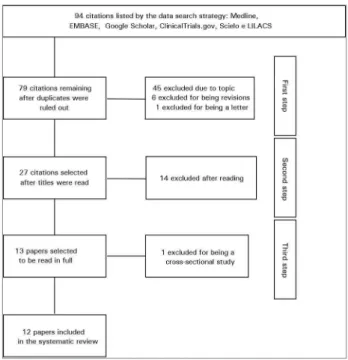
Papers failing to meet the inclusion criteria were excluded. In the second step, the independent researchers read the abstracts from the studies selected in the first step and excluded additional articles that did not meet the inclusion criteria. In the third step, the studies still remaining from the first two steps were read in full and selected to be included in this review (Figure 1).
RESULTS
J Bras Nefrol 2014;36(4):519-528 Smoking vs. chronic kidney disease
521
The three references found on Trials.gov were excluded because of their titles.
Chart 1 shows the data and the results of the 12 included studies and reveals that the first study on smoking as a risk factor for progression of CKD was published in 1998. Most of the papers contained accounts of observational case-control or cohort studies designed to assess relative risk (RR) or odds ratios (OR).14-18 Multicenter trials
carried out in developed nations prevailed over other study types.14,15,18-21 No papers from Latin
America were included. Four were randomized controlled trials.14,17,18,22
Male patients were predominantly enrolled in the included studies, and accounted for 51%-77% of the subjects. Six studies20-25 reported increased
rates of CKD progression among smokers. Differently from others, one paper identified a transient increase of 0.32 ml/min/1.73 m2/year
in the glomerular filtration rate (GFR) of female smokers versus female nonsmokers. However, this difference disappeared seven years after they started smoking. This change in GFR was not statistically significant in males.26 Five studies15-18,27 reported
a dose-effect relationship in which higher risk of CKD progression was associated with heavier smoking, particularly when individuals smoked more than 15 packs of cigarettes a year.
DISCUSSION
THERELATIONSHIPBETWEENSMOKINGAND CKD
The perception that smoking may cause renal injury is recent in the history of nephrology and, therefore, deserves some contextualization. The first causal association between smoking and CKD was discussed by Orth et al.16 in
1998, with the publication of a multicenter trial involving nine research centers. This study looked into the outcomes of patients with primary IgA nephropathy (inflammatory model of CKD) and subjects with autosomal dominant polycystic kidney disease (non-inflammatory genetic model) all the way to stage-5 CKD. The authors concluded that male smokers with IgA nephropathy or autosomal dominant polycystic kidney disease were at a higher risk of progressing to stage-5 CKD when compared to nonsmoking patients.16 The United States Renal
Data Systems (USRDS) published a paper that same year alerting the scientific community to the growth of a global epidemic of CKD.25 Since
this publication, expert committees from around the world have begun to scale up the attention given to the risk factors associated with CKD progression. In 2002, the guidelines from the National Kidney Foundation1 already considered
smoking as a factor in CKD progression.
This review found five case-control15-18,25 and
seven cohort studies14,20-23,26,28 with the analytical
robustness required to produce risk assessments. Nonetheless, the subjects in the case and control groups of the case-control studies were not given equal odds15-17,21,24,26,28, as they were not
randomized. Additionally, most of the studies enrolled patients with established kidney disease, indicating the need for a prospective cohort study with CKD-free individuals. Two studies were designed with this method in mind,21,28
but their outcomes are questionable due to methodological flaws.
In 2011, Hallan & Orth21 carried out a study
on CKD and smoking based on the population of the HUNT-2 cross-sectional study. However, the HUNT-2 study was not conceived to assess the habit of smoking. Instead, the Norwegian study was designed to evaluate the status of
J Bras Nefrol 2014;36(4):519-528 Smoking
vs.
c
hronic kidne
y disease
522
CHART 1 CHARACTERISTICSOFOBSERVATIONALSTUDIESANDASSOCIATIONBETWEENCHRONICKIDNEYDISEASEANDSMOKING
Authors and year
Country Criteria adopted for CKD categorization
Study/follow-up
Randomized Gender distribution
No. of subjects enrolled
No. of subjects with CKD
Ratio of smokers to nonsmokers with CKD
No. of controls/ comparison
No. of controls/ comparison CKD
No. of controls/ comparison nonsmokers
Mean age (years)
OR or RR (95%CI)
Cumulative effect (packs/ year) Risk (95%CI; p)
Results related to CKD progression
Orth et al. (1998)16
DEU ITA AUT
SCr > 3.0 mg/dL
Case-control no M = 144 F = 60
582 148 72/- 72 72 - 47 OR = 4.5 (1.9-10.9; p
< 0.001)
00-05 p/y: 1.0
p > 0.05 5-15 p/y: 3.5 (1.3-9.6; p = 0.017) > 15 p/y: 5.8 (2.0-17; p = 0.001)
Male smokers with CKD, IgA nephropathy, and polycystic kidney disease are at a higher risk for renal function deterioration when compared to nonsmokers; disease worsens for heavy smokers
Stengel
et al.
(2000)15
FRA SCr > 1.96 mg/dL
Case-control 5 years
no M = 77% 295 295 140/155 242 132 110 41 OR = 2.1 (0.9-4.9)
≤ 15 p/y: 1.9 (0.8-4.3; p > 0.05) > 15 p/y: 3.9 (1.6-4.5; p < 0.01)
No association was found between smoking and renal function deterioration in females; association between number of packs smoked a year and renal function deterioration was found for male smokers with primary glomerulonephritis Regalado
et al. (2000)22
USA Hypertension SCr = 0.25 ± 0.11 mg/dL Hypertension Smoker SCr = 1.47 ± 0.13 mg/dL
Prospective cohort 2 years and 11 months
Controls only M = 56% 192 53 30/23 139 64 75 51 na - Analysis of potential risk factors for renal function deterioration in hypertensive patients yielded smoking a weight of 4.3820 (p < 0.0001), even when blood pressure is controlled
Ejerblad
et al.
(2004)18
SWE H SCr > 3.4 mg/dL M SCr > 2.8 mg/dL
Case-control 2 years
yes M = 65% 998 926 567/348 994 574 420 58 OR = 1.17 (0.95-1.44)
1-15 p/y: 0.95 (0.73-1.24) 16-30 p/y: 1.32 (1.00-1.75) > 30 p/y: 1.52 (1.08-2.14)
Smoking worsens renal function of CKD patients; degree of deterioration is associated with number of packs smoked a year
Shankar
et al.
(2006)27
USA K/DOQI Cohort 5 years
yes M = 47.5% 4898 324 146/178 4898 967 3931 62 RR = 2.18 (1.57-3.03)
< 15 p/y: 1.11 (0.89-2.08) 15-34 p/y: 2.57 (1.79-3.70) (2.08-4.12)
Smoking worsens renal function 2.18 times more
J Bras Nefrol 2014;36(4):519-528
Smoking
vs.
c
hronic kidne
y disease
523
Kronborg
et al. (2008)26
NOR K/DOQI Prospective cohort 7 years
no M = 50.6% F = 49.4%
4441 na na 4441 1379 3062 - - Alcohol intake improved renal function in males, but not in females; increased physical activity improved GFR in women; DM, CVD, systolic hypertension, and increased fibrinogen levels were correlated with GFR reductions in both genders; increase in GFR by 0.32 ml/min/1.73 m2/ year for female smokers
versus nonsmokers. Lash et al.
(2009)23
USA K/DOQI Prospective cohort
yes M = 54% - 3612 2513/1593 no no no - - - Among risk factor for progression of CKD, smoking worsens the GFR Yacoub et
al. (2010)17
SIR K/DOQI Case-control 4 years
yes M = 51% - 198 86/112 351 251 251 45 OR = 1.6 1-15 p/y: 2.1 (1.12-2.29; p < 0.009) (0.96-4.57;
p = 0.06) 16-30 p/y: 2.04 (1.08-3.88;
p = 0.028) > 30 p/y: 2.06 (1.53-4.41;
p = 0.0001)
Renal function worsens 1.6 times more in smokers than in nonsmokers; renal function deterioration is strongly associated with number of packs smoked per year
Míguez-Burbano
et al. (2010)24
USA K/DOQI Case-control 1 year Patients with HIV
no M = 306 (69%) F = 230 (31%)
536 65 (85%) na yes - OR = 1.97
p = 0.03
- African American and Caribbean men had lower hemoglobin and albumin levels.
Patients with CKD were hospitalized twice as much.
35% of the patients (HIV & CKD) had stage IV or V disease 1 to 2 packs/year increases the risk of HIV patients having CKD by 1.5 times (OR = 1.57; 95%CI 1-2.53; p = 0.05) effect not seen in former smokers (OR = 1.1; 95%CI 2-4.7;
p = 0.8) Hallan
e Orth (2011)21
NOR K/DOQI Cohort 10.3 years (0.1-11.3)
no M = 78 (63%) F = 46 (37%)
65589 124 nr/nr yes yes yes 50 When age < 70 years smoker RR = 4.0 (1.23-8.25) ex-smoker RR = 3.3 (1.43-11.2)
01-09 p/y: 4.21 (0.5-35.16;
p = 0.18) 10-19 p/y: 8.84 (1.58-49.89;
p = 0.01) 20-39
Patients aged < 70 years, smokers and former smokers versus
J Bras Nefrol 2014;36(4):519-528 Smoking
vs.
c
hronic kidne
y disease
524
p/y: 13.5 (2.2-81.5; p = 0.005) ≥ 40 p/y: 37.7 (4.17-336; p = 0.001)
Risk of progressing to stage-5 CKD increased linearly with cumulative smoking. Gender and blood pressure were less relevant predictors; no statistically significant differences were seen between genders. Patients aged 70 and older were not at a higher risk of having CKD.
Hellemons
et al. (2011)20
NED K/DOQI Cohort 5 years Lung transplant
no M = 166 F = 160
326 na na na na 134 44 Progression to CKD III RR = 1.69 (1.27-2.24) Progression to CKD IV RR = 1.9 (1.11-3.27)
DRC III 01-10 p/y: 1.57 (1.09-2.25; p = 0.015) 11-25 p/y: 1.65 (1.15-2.36; p = 0.006) > 25 p/y: 1.92 (1.32-2.79; p = 0.001) DRC IV 01-10 p/y: 1.3 (0.63-2.7; p = 0.48) 11-25 p/y: 1.96 (1.04-3.7; p = 0.04) > 25 p/y: 2.78 (1.41-5.46; p = 0.003)
GFR decreased within the first two years after lung transplantation, and was worse during the first six months after surgery. Former smokers smoked a median 17.5 packs/year and linear association with cumulative dose was observed. Smoking was a risk factor for progression of CKD in patients with COPD
Noborisa-ka et al. (2013)28
JPN KDIGO Retrospective cohort 6 years
no M = 58.8% F = 41.2%
6998 na na/na na na na M: 41 F: 42
Risk of proteinuria in smokers OR = 2.52 (1.5-4.5)
na GFR was higher in smokers than in nonsmokers; smokers progressed more frequently to stage-1 and stage-2 CKD, but progression to stage-3 CKD was less frequent than nonsmokers and former smokers. Smoking cessation reduced protein loss by 50% and the risk of CKD progression. Male former smokers had significantly greater GRF drops than nonsmokers and smokers. In the presence of proteinuria, GFR reduction was not correlated with smoking.
Moderate alcohol intake reduced the decrease in GFR
CONTINUED CHART 1.
J Bras Nefrol 2014;36(4):519-528 Smoking vs. chronic kidney disease
525
public health issues such as cardiovascular disease (CVD), diabetes mellitus (DM), chronic obstructive pulmonary disease (COPD), osteoporosis, and mental health. As a consequence of methodological carelessness, patients with multiple cardiovascular comorbidities were included in the study on smoking and CKD,21 a
decision that introduced selection and survival biases in the studied sample of the population.
In 2013, Noborisaka et al.28 evaluated 6,998
Japanese active workers without CKD, although with the following selection biases: (1) subjects who reported to have stopped smoking at baseline were categorized as former smokers; (2) the time for which the subjects had smoked was not accounted for; (3) patients with CKD were categorized from a single evaluation;29
additionally, the KDIGO29 was reported to have
been the basis for categorization but its criteria were not followed; (4) proteinuria (indicative of kidney damage) was ruled out from the examination of a single sample tested with a reagent strip, a method subject to selection and information biases.
THECOUNTRIESOFORIGINOFTHESTUDIES
This review predominantly included studies carried out in developed nations, possibly because of the greater number of epidemiologic surveillance efforts in effect in these countries and the longer life expectancy of their populations,30
as is the case in Germany,20 Austria,16 Sweden,18
the United States,23 Norway,26 and Japan.28
Projections for 2015 developed by the World Bank and the World Health Organization indicate that 6.4 million people will die of causes related to smoking - the equivalent to 10% of the deaths for all causes and a figure 50% greater than the number of deaths attributed to the human immunodeficiency virus (HIV).31
Despite the preoccupying nature of this data and the impact smoking potentially has on the progression of CKD, no studies have been published on this matter in Latin America to date. The intersection between CKD and smoking must not be neglected. These issues combined may overwhelm health systems worldwide, particularly in poorer or developing nations such as Brazil.
CONTROVERSIESOVER CKD ANDGENDER
The higher prevalence seen in male populations is consistent with the epidemiologic findings of other populations.17,32 For yet unknown reasons, males
are at a higher risk of developing CKD.33 Evidence
suggests that estrogen offers protection against renal disorders as it affects the conservation of nitric oxide - an important regulator of glomerular ultrafiltration - by modulating mesangial cells and afferent arterioles,34 an effect not observed
in postmenopausal women.35 However, data
from the USRDS36 have shown that the female
population with CKD has grown between 1988 and 2010 and achieved a prevalence rate of 10.2% - versus 8.6% in males - due to increases in female life expectancy, obesity, and a greater number of cases of systemic hypertension and
DM.37,38
Only the study by Kronborg et al.26 reported
improved GFR in female smokers based on the follow-up of the cohort enrolled in the Tromsø Study,39 designed by its authors to determine
high risk factors for cardiovascular death and develop strategies for the prevention of acute myocardial infarction (AMI) and stroke. However, it should be noted that the authors26
had difficulties explaining this finding. The improvement observed in the GFR of the female patients was attributed to hyperfiltration and smoking-induced loss of muscle mass. This transient improvement disappears after seven years and the GFR then decreases progressively.26
Loss of muscle mass and hyperfiltration are physiologically associated with decreases in serum creatinine, either by decreased synthesis or increased clearance. However, this explanation is far from being biologically plausible, particularly when the vascular alterations introduced by smoking are considered.39
Despite the difference introduced by the transient improvement in the GFR of females, the Norwegian team39 concluded that gender
J Bras Nefrol 2014;36(4):519-528 Smoking vs. chronic kidney disease
526
with GFR increases in females, while DM and CVD have led to renal function deterioration in both genders.39
Most studies have shown that smoking more than 15 packs a year increases the risk of renal disorder progression.16-18,21,27 This
finding appears to be similar to what has been reported for other diseases such as lung cancer in relation to the cumulative effects of smoking.40
A statistically significant correlation between the cumulative effects of smoking and renal function decline15-18,21,27 has also been observed when
patients with other comorbidities such as HIV24
and lung transplant recipients were assessed, even more than six months after smoking cessation.20
Smoking cessation was assessed in ten studies included in this review and was shown to have been statistically correlated with renal function improvement. However, particularly among heavy smokers - defined as individuals who smoke more than 15 packs of cigarettes a year - the risk of progression persisted, with a relative risk of 8.84.41
The method used in the studies that looked into the association between smoking and CKD may have introduced selection and information biases to the analysis. A great deal of these studies was designed to establish the risk factors for conditions such as severe hypertension,22 lung
transplant associated with use of calcineurin inhibitors, COPD,20 and HIV.24 Smoking was
one of the data points collected from enrolled individuals. Smoking and CKD were not among the main objectives of these studies, although they were retrospectively identified as risk factors.18-21,27
This review identified the need for studies to determine the pathophysiological mechanisms of kidney injury associated with smoking and the establishment of smoking as both a triggering agent and a risk factor for the progression of CKD. There still is no evidence as to whether the hemodynamic hypothesis (linked to nicotine)8
or tubular toxicity (linked to heavy metals)9 are
the only mechanisms of renal injury. Perhaps there is a specific substance responsible for the entire process as in the bladder cancer model, in which a mutagen - 3,4-benzopyrene - acts as the initiator of damage to cell DNA.42
NEW PATHOPHYSIOLOGICAL FRONTIERSTO EXPLAIN OLD
HISTOPATHOLOGICALPROCESSES
In 2012, researchers from the University of Alabama at Birmingham (Nephrology and Pathology) showed that rats submitted to 5/6 nephrectomies had an oligomer known as α7 nicotinic acetylcholine receptor (α7nAChR) and changed the understanding of how nicotine acts on the kidneys. This protein led to increases of 100% in proteinuria but not in albuminuria, thus revealing impaired tubular reabsorption. The levels of NADPH oxidase 4 (NOX4), the main marker of oxidative stress in the renal cortex, were increased by 100%. Markers of fibrosis such as fibronectin and transforming growth factor beta (TGF-β) increased by 50% and 200%, respectively. Expression of α7nAChR was more pronounced in the proximal tubule and decreased toward the distal tubules. Levels of α7nAChR were not detected in glomeruli or in the intrarenal vasculature. The administration of methyllycaconitine (MLA), a specific α7nAChR blocker, led to reversals in proteinuria, hypertension, and expression of fibronectin, TGF-β, and NOX4 in rats submitted to 5/6 nephrectomy.
These findings have redirected research perspectives around the progression of CKD in smokers. Apparently, we are beginning to solve the puzzle of how nicotine acts on the kidneys. Experimental data indicate that nicotine activates α7nAChR in the proximal tubule and triggers the biosynthesis of profibrotic and proinflammatory cytokines.43
According to this theory, smoking not only causes substance production and deregulation in the endothelium, release of endothelin-1 (efferent arteriole vasoconstrictor), and decreased levels of nitric oxide (efferent arteriole vasodilator)10 as previously thought,
J Bras Nefrol 2014;36(4):519-528 Smoking vs. chronic kidney disease
527
If the theory involving proximal tubule inflammation and α7nAChR43 is proven valid
in humans, Science will be able to explain the findings identified in the study of idiopathic nodular glomerulosclerosis associated with smoking and hypertension.44
Perhaps in the coming years the discussion of the toxic inflammatory effects of nicotine on the proximal tubule might guide further research for a selective receptor blocker or renal nicotine-acetylcholine receptors. In the future, it will be possible to stabilize or reverse the progression of CKD with drug therapy.
SMOKINGANDCLINICALPRACTICE
Regardless of the mechanism of renal injury, the evidence derived from observational studies indicates that CKD patients with comorbidities (primary glomerulonephritis,16 COPD,20 hypertension,25
HIV,24 proteinuria28) tend to experience faster
declines in GFR and increased risk of death.44,45 The
evidence on CKD progression, mortality, tobacco dose-effect, and renal function deterioration leaves no doubt over the need to combat smoking. The main tool available for smoking cessation is a combination between treatment with a multidisciplinary team and drug therapy.
In our opinion, antismoking medications such as bupropion hydrochloride (Bup®) and varenicline
tartrate (Champix®) combined with chewing gum
and nicotine patches (Niquitin®) should be added
to the therapeutic arsenal of nephrologists.
A NEWPERSPECTIVEINNEPHROLOGY
In our view, physicians - nephrologists in particular - should change their approach to smoking. Smoking needs to be seen as a public health issue, as the treatment of smokers does not lie only in the hands of psychiatrists and pulmonologists. We need to intervene upon this modifiable element in the progression of CKD. To that end, the following are needed: 1) guidelines and refresher courses to train nephrologists on how to combat smoking; 2) change our perspectives in relation to smoking; 3) offer antismoking medication in CKD units; 4) address smoking cessation responsibly during patient visits to the CKD unit.
In short, smoking cessation should be valued and treated in the same manner in which one deals with other renal disease progression factors such as anemia, hyperphosphatemia, hypertension, proteinuria, and secondary hyperparathyroidism.
CONCLUSION
This systematic review revealed a correlation between smoking and progression of CKD. This positive correlation became more pronounced for individuals smoking 15 of more packs of cigarettes a year.
ACKNOWLEDGEMENT
The authors would like to thank Dr. Michel Pompeu Barros de Oliveira Sá for his help in organizing and designing this review; Dr. Lais Guimarães Vieira for the technical support and corrections made to the manuscript of this review; and the Coordination of Postgraduate and Masters Programs on Health Sciences at the Federal University of Pernambuco for their academic support.
REFERENCES
1. National Kidney Foundation. K/DOQI clinical practice guide-lines for chronic kidney disease: evaluation, classification, and stratification. Am J Kidney Dis 2002;39:S1-266.
2. Orth SR, Hallan SI. Smoking: a risk factor for progression of chronic kidney disease and for cardiovascular morbidity and mortality in renal patients-absence of evidence or evidence of absence? Clin J Am Soc Nephrol 2008;3:226-36. PMID: 18003763
3. Levey AS, Atkins R, Coresh J, Cohen EP, Collins AJ, Eckardt KU, et al. Chronic kidney disease as a global public health problem: approaches and initiatives - a position statement from Kidney Di-sease Improving Global Outcomes. Kidney Int 2007;72:247-59. PMID: 17568785 DOI: http://dx.doi.org/10.1038/sj.ki.5002343 4. Zoccali C. Traditional and emerging cardiovascular and renal risk factors: an epidemiologic perspective. Kidney Int 2006;70:26-33. PMID: 16723985 DOI: http://dx.doi.org/10.1038/sj.ki.5000417 5. Cooper RG. Effect of tobacco smoking on renal function.
In-dian J Med Res 2006;124:261-8. PMID: 17085829
6. Satarug S, Moore MR. Adverse health effects of chronic ex-posure to low-level cadmium in foodstuffs and cigarette smoke. Environ Health Perspect 2004;112:1099-103. PMID: 15238284 DOI: http://dx.doi.org/10.1289/ehp.6751
7. Hansen HP, Rossing K, Jacobsen P, Jensen BR, Parving HH. The acute effect of smoking on systemic haemodynamics, kidney and endothelial functions in insulin-dependent diabetic patients with microalbuminuria. Scand J Clin Lab Invest 1996;56:393-9. PMID: 8869661 DOI: http://dx.doi.org/10.3109/00365519609088793 8. Foley RN. Clinical epidemiology of cardiovascular disease in
chronic kidney disease. J Ren Care 2010;36:4-8. DOI: http:// dx.doi.org/10.1111/j.1755-6686.2010.00171.x
J Bras Nefrol 2014;36(4):519-528 Smoking vs. chronic kidney disease
528
10. Jones-Burton C, Seliger SL, Scherer RW, Mishra SI, Vessal G, Brown J, et al. Cigarette smoking and incident chronic kidney disease: a systematic review. Am J Nephrol 2007;27:342-51. DOI: http://dx.doi.org/10.1159/000103382
11. Noborisaka Y. Smoking and chronic kidney disease in heal-thy populations. Nephrourol Mon 2013;5:655-67. DOI: http:// dx.doi.org/10.5812/numonthly.3527
12. Oliveira GR, Suh JI, Bérgamo RR. Tabagismo como fator de risco para doença renal. In: Cruz J, Cruz HMM, Barros RT, eds. Atualidades em Nefrologia. 7a ed. São Paulo: Sarvier; 2002. p.481-5.
13. Petticrew M, Roberts H. Systematic reviews in the social scien-ces: a practical guide. Oxford: Blackwell Publishing; 2006. 14. Shankar A, Klein R, Klein BE. The association among smoking,
heavy drinking, and chronic kidney disease. Am J Epidemiol 2006;164:263-71. PMID: 16775042 DOI: http://dx.doi. org/10.1093/aje/kwj173
15. Stengel B, Couchoud C, Cénée S, Hémon D. Age, blood pressure and smoking effects on chronic renal failure in primary glomerular nephropathies. Kidney Int 2000;57:2519-26. PMID: 10844621 16. Orth SR, Stöckmann A, Conradt C, Ritz E, Ferro M, Kreusser
W, et al. Smoking as a risk factor for end-stage renal failure in men with primary renal disease. Kidney Int 1998;54:926-31. PMID: 9734618 DOI: http://dx.doi.org/10.1046/j.1523-1755.1998.00067.x
17. Yacoub R, Habib H, Lahdo A, Al Ali R, Varjabedian L, Atalla G, et al. Association between smoking and chronic kidney di-sease: a case control study. BMC Public Health 2010;10:731. DOI: http://dx.doi.org/10.1186/1471-2458-10-731
18. Ejerblad E, Fored CM, Lindblad P, Fryzek J, Dickman PW, Elinder CG, et al. Association between smoking and chronic renal failure in a nationwide population-based case-control stu-dy. J Am Soc Nephrol 2004;15:2178-85. DOI: http://dx.doi. org/10.1097/01.ASN.0000135048.35659.10
19. Orth SR. Smoking-a risk factor for progression of renal disease. Kidney Blood Press Res 2000;23:202-4.
20. Hellemons ME, Agarwal PK, van der Bij W, Verschuuren EA, Postmus D, Erasmus ME, et al. Former smoking is a risk fac-tor for chronic kidney disease after lung transplantation. Am J Transplant 2011;11:2490-8. DOI: http://dx.doi.org/10.1111/ j.1600-6143.2011.03701.x
21. Hallan SI, Orth SR. Smoking is a risk factor in the progres-sion to kidney failure. Kidney Int 2011;80:516-23. PMID: 21677635 DOI: http://dx.doi.org/10.1038/ki.2011.157 22. Regalado M, Yang S, Wesson DE. Cigarette smoking is
associa-ted with augmenassocia-ted progression of renal insufficiency in severe essential hypertension. Am J Kidney Dis 2000;35:687-94. DOI: http://dx.doi.org/10.1016/S0272-6386(00)70017-5
23. Lash JP, Go AS, Appel LJ, He J, Ojo A, Rahman M, et al.; Chro-nic Renal Insufficiency Cohort (CRIC) Study Group. ChroChro-nic Renal Insufficiency Cohort (CRIC) Study: baseline characte-ristics and associations with kidney function. Clin J Am Soc Nephrol 2009;4:1302-11. DOI: http://dx.doi.org/10.2215/ CJN.00070109
24. Míguez-Burbano MJ, Wyatt C, Lewis JE, Rodríguez A, Duncan R. Ignoring the obvious missing piece of chronic kidney disease in HIV: cigarette smoking. J Assoc Nurses AIDS Care 2010;21:16-24. DOI: http://dx.doi.org/10.1016/j.jana.2009.07.005 25. U.S. Renal Data System. USRDS 1998 Annual Data Report
Na-tional Institutes of Health, NaNa-tional Institute of Diabetes and Digestive and Kidney Diseases. U.S. Renal Data System: Bethes-da; 1998.
26. Kronborg J, Solbu M, Njølstad I, Toft I, Eriksen BO, Jenssen T. Predictors of change in estimated GFR: a population-based 7-year follow-up from the Tromso study. Nephrol Dial Trans-plant 2008;23:2818-26. DOI: http://dx.doi.org/10.1093/ndt/ gfn148
27. Shankar A, Klein R, Klein BE. The association among smoking, heavy drinking, and chronic kidney disease. Am J Epidemiol 2006;164:263-71. PMID: 16775042 DOI: http://dx.doi. org/10.1093/aje/kwj173
28. Noborisaka Y, Ishizaki M, Yamada Y, Honda R, Yokoyama H, Miyao M, et al. The effects of continuing and discontinuing smoking on the development of chronic kidney disease (CKD) in the healthy middle-aged working population in Japan. En-viron Health Prev Med 2013;18:24-32. DOI: http://dx.doi. org/10.1007/s12199-012-0285-7
29. Kidney Disease. Improving Global Outcomes (KDIGO) CKD Work Group. KDIGO 2012 Clinical Practice Guideline for the Evaluation and Management of Chronic Kidney Disease. Kid-ney Inter Suppl 2013;3:1-150.
30. Kalache A, Veras RP, Ramos LR. O envelhecimento da po-pulação mundial. Um desafio novo. Rev Saúde Pública 1987;21:200-10. DOI: http://dx.doi.org/10.1590/S0034-89101987000300005
31. Mathers CD, Loncar D. Projections of global mortality and burden of disease from 2002 to 2030. PLoS Med 2006;3:e442. DOI: http://dx.doi.org/10.1371/journal.pmed.0030442 32. Sesso RC, Lopes AA, Thomé FS, Lugon JR, Burdmann EA.
Bra-zilian Dialysis Census, 2009. J Bras Nefrol 2010;32(4):374-8. 33. Crews DC, Charles RF, Evans MK, Zonderman AB, Powe NR.
Poverty, race, and CKD in a racially and socioeconomically di-verse urban population. Am J Kidney Dis 2010;55:992-1000. DOI: http://dx.doi.org/10.1053/j.ajkd.2009.12.032
34. Baylis C. Sexual dismorphism, the aging, and involvement of nitric oxid deficiency. Semin Nephrol 2009;29:569-78. DOI: http://dx.doi.org/10.1016/j.semnephrol.2009.07.003
35. Neugarten J, Acharya A, Silbiger SR. Effect of gender on the progression of nondiabetic renal disease: a meta-analysis. J Am Soc Nephrol 2000;11:319-29.
36. Collins AJ, Foley RN, Herzog C, Chavers B, Gilbertson D, Herzog C, et al. US Renal Data System 2012 Annual Data Re-port. Am J Kidney Dis 2013;61:A7,e1-476. DOI: http://dx.doi. org/10.1053/j.ajkd.2012.11.031
37. Rychlik I, Miltenberger-Miltenyi G, Ritz E. The drama of the continuous increase in end-stage renal failure in patients with type II diabetes mellitus. Nephrol Dial Transplant 1998;13:6-10. PMID: 9870418 DOI: http://dx.doi.org/1998;13:6-10.1093/ndt/13. suppl_8.6
38. Ritz E, Koleganova N. Obesity and chronic kidney disea-se. Semin Nephrol 2009;29:504-11. DOI: http://dx.doi. org/10.1016/j.semnephrol.2009.06.007
39. Jacobsen BK, Eggen AE, Mathiesen EB, Wilsgaard T, Njøls-tad I. Cohort profile: the Tromso Study. Int J Epidemiol 2012;41:961-7. DOI: http://dx.doi.org/10.1093/ije/dyr049 40. Lubin JH, Caporaso N, Wichmann HE, Schaffrath-Rosario
A, Alavanja MC. Cigarette smoking and lung cancer: mode-ling effect modification of total exposure and intensity. Epi-demiology 2007;18:639-48. DOI: http://dx.doi.org/10.1097/ EDE.0b013e31812717fe
41. Hallan SI, Orth SR. Smoking is a risk factor in the progres-sion to kidney failure. Kidney Int 2011;80:516-23. PMID: 21677635 DOI: http://dx.doi.org/10.1038/ki.2011.157 42. Feng Z, Hu W, Rom WN, Beland FA, Tang MS.
4-amino-biphenyl is a major etiological agent of human bladder can-cer: evidence from its DNA binding spectrum in human p53 gene. Carcinogenesis 2002;23:1721-7. DOI: http://dx.doi. org/10.1093/carcin/23.10.1721
43. Rezonzew G, Chumley P, Feng W, Hua P, Siegal GP, Jaimes EA. Nicotine exposure and the progression of chronic kidney
disease: role of the α7-nicotinic acetylcholine receptor. Am J
Physiol Renal Physiol 2012;303:304-12. DOI: http://dx.doi. org/10.1152/ajprenal.00661.2011
44. Markowitz GS, Lin J, Valeri AM, Avila C, Nasr SH, D'Agati VD. Idiopathic nodular glomerulosclerosis is a distinct clini-copathologic entity linked to hypertension and smoking. Hum Pathol 2002;33:826-35. PMID: 12203216 DOI: http://dx.doi. org/10.1053/hupa.2002.126189