387
AbstractObjective: To evaluate the efficacy of three frequently used spacer devices to deliver aerosol to the lung, and to compare radioaerosol deposition with each device in different age groups.
Methods: Nine healthy, non-smoking volunteers were recruited: three adults and six children, including three toddlers and three school age children. Qualitative and semi-quantitative analysis of radioaerosol deposition in the lung were carried out. Yet, two small-volume devices (Aerochamber® and Inal-Air®) and one large-volume device
(Flumax®) were compared. Each patient inhaled 99mtechnetium-phytate. The device was filled during 30 seconds
with radioaerosol. Oxygen was used as the driving gas. During 10 seconds, the patients inhaled the radioaerosol. The radiation emitted at the front and back of the chest was measured. The radiation inside the device was also measured.
Results: The quantitative evaluation of lung deposition revealed that the younger the patient, the less aerosol was deposited in the lung with the large-volume spacer device (Flumax®). The difference between small-volume
devices (Aerochamber® and Inal-Air®) was not significant.
Conclusion: Small-volume spacers are the most appropriate for children. Large-volume devices should only be used by adolescents and adults.
J Pediatr (Rio J). 2004;80(5):387-90: Inhalation therapy, spacers, 99mtechnetium-fitate.
Evaluation of the influence of patient age
and spacer device volume
on aerosol lung deposition
Wilson Rocha Filho,1 Virgínia X. Noronha,2 Simone N. Senna,3 Carlos Jorge R. Simal,4 Wawrwyk B. Mendonça5
0021-7557/04/80-05/387 Jornal de Pediatria
Copyright © 2004 by Sociedade Brasileira de Pediatria
1. Coordinator of the Service of Pediatric Pneumology and Allergy, Hospital Felício Rocho (HFR), Belo Horizonte, MG, Brazil.
2. Graduate student in Pediatric Pneumology and Allergy, HFR, Belo Horizonte, MG, Brazil.
3. Preceptor of Pediatric Pneumology and Allergy, HFR, Belo Horizonte, MG, Brazil.
4. Coordinator of the Service of Nuclear Medicine, HFR, Belo Horizonte, MG, Brazil.
5. Graduate student in Nuclear Medicine, HFR, Belo Horizonte, MG, Brazil.
Manuscript received Dec 12 2003, accepted for publication Jun 30 2004.
Suggested citation: Rocha Filho W, Noronha VX, Senna SN, Simal CJR, Mendonça WB. Evaluation of the influence of patient age and spacer device volume on aerosol lung deposition. J Pediatr (Rio J). 2004;80:387-90.
Introduction
Nowadays inhalation therapy is one of the principal therapeutic weapons in the arsenal of respiratory diseases treatment. Although it was used even before the Christian era, its use has only become widespread over the last 30 to 40 years with the advent of ever more efficient devices
ORIGINAL ARTICLE
in terms of pulmonary deposition. Added to this is a growing number of available medications, highly effective and with low incidence of collateral effects. Inhalation therapy by metered-dose aerosols is quick and easy to administrate. In addition to this it offers better pulmonary deposition with a lower cost than conventional nebulizers. One obstacle that is encountered when metered-dose aerosols are employed is the need for good patient coordination, in order that the medication is adequately deposited within the lungs.
Spacing devices are valved devices capable of overcoming these difficulties. The correct choice and adequate utilization of spacing devices is a pre-requisite for the successful treatment of asthma in children. Spacing devices facilitate medication deposition within the lungs and eliminates the need for precise coordination, which is
hard to achieve with certain patients.1-3 Over recent
388 Jornal de Pediatria - Vol. 80, No.5, 2004 Spacer device and lung deposition in children Rocha Filho W et alii
medication to the patient. It is known that their physical characteristics, such as size, format, volume and electrostatic charge directly affect this availability.4
One of the main dilemmas in inhalation therapy is choosing a spacer that unites the ideal characteristics that lead to the greatest efficacy in terms of the pulmonary deposition of the medication inhaled from among those most employed within the health services. Nowadays we have innumerable spacing devices available in Brazil, of varying shapes and sizes. However, we lack studies testing their efficacy. Rubim et al., employed scintigraphic techniques with the objective of evaluating a large volume spacer.5 Studies using radioisotopes for the comparative evaluation of spacing device efficacy in terms of pulmonary deposition have not yet been performed in our country. Starting from these assumptions, the study in question has the objective of comparing, by means of clinical trial, three of the most often prescribed spacing devices at health services: Flumax®, a large volume, plastic spacer (700 ml); Aerochamber®, a small volume, acrylic space (190 ml); and the Inal-Air®, small volume, aluminum, and, therefore, electrostatically uncharged, spacer (230 ml).
Methods
Nine healthy, non-smoking patients with no history of respiratory diseases were studied. Three adults and six children were chosen, three pre-school age (3 and 4 years) and three school-age (6 and 7 years), who voluntarily offered to participate in the study, with the signed authorization given by the candidate themselves or their legal guardian. The study and consent form were approved by the Ethics Committee at our institution.
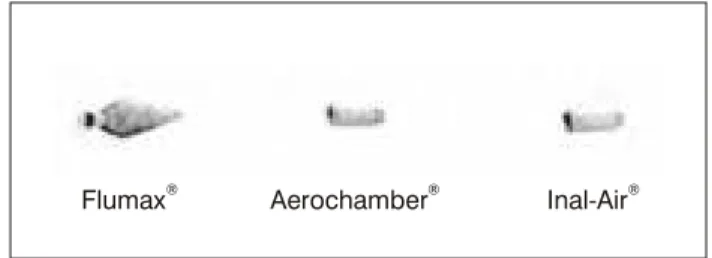
Aerosol particles containing 99mtechnetium-phytate were impelled into the spacing devices for 30 seconds by an oxygen flow at 10 l/min. Images were made of the spacing devices filled with radioaerosol using scintigraphy (Figure
1). The patient then inhaled the 99mtechnetium-phytate
particles. Inhalation was sustained for 10 seconds, smoothly and by mouth, using a mask coupled to the spacer, a similar technique to that employed by Rubim et al.5 After inhalation, with the patient within the gamma-chamber, the radiation count was begun, of emissions from both the anterior and posterior thorax. The count was sustained for 2 minutes for each projection. Gamma radiation was detected and counted by the standardized technique for pulmonary inhalation scintigraphy, modified for this study. To perform this an Aerogama Medical nebulization system was used with a Siemens gamma-chamber, model Orbiter, connected to an Alfanuclear, IM512P image acquisition and processing system.6 The pulmonary deposition of the radioaerosol was estimated as a percentage of the total radioactive activity seen in the spacer.
Each patient performed the procedure three times, one for each spacer, with the order being randomized by simple lottery. The procedures were performed on different days, at a minimum of 72-hour intervals apart, in order to permit complete elimination of the radioactive material inhaled on
Figure 1 - Retention of aerosol particles containing 99m
techne-tium-phytate into the spacing devices for 30 seconds after they were filled
Flumax
®Aerochamber
®Inal-Air
®* p = 0.0313.
the previous occasion. On each occasion the patients were requested to inhale deeply for approximately 10 seconds, which is the equivalent of three or four breaths. These breaths should be by mouth, smooth and homogeneous. The total radiation received by each patient was less than they would have been subjected to during chest tomography.
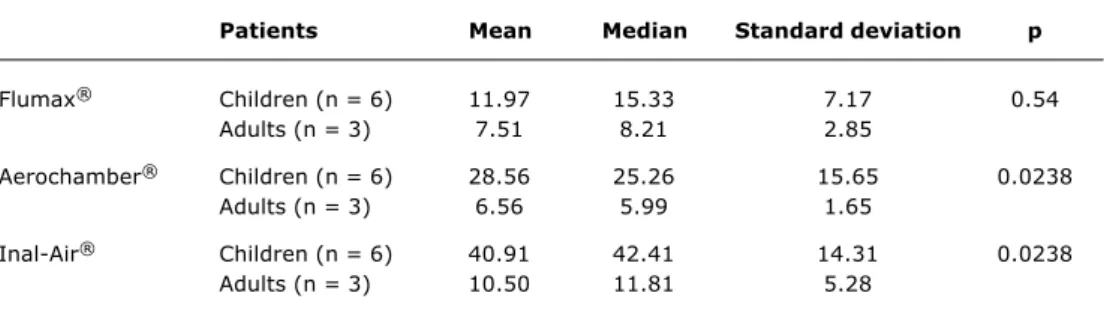
Data were analyzed using exact inference and the Friedman test and the Wilcoxon-Mann-Whitney test were applied, with a significance level 5%, i.e. p value of less than 0.05, for an adequate analysis of data (Table 1). Taking into account the 5% significance level, the sample size9 and the mean values and standard deviation between treatments, we obtained a statistical power of approximately 80%.
Results
Employing the methods described above, the aerosol pulmonary deposition index was calculated for each spacing device. Thus, each individual was analyzed three times, each time with a different spacer, making a total sample of 27 events.
Significant variation was observed in terms of pulmonary deposition, with a large standard deviation, from patient to patient and from spacer to spacer (Table 1). In eight of the nine patients, irrespective of age group, there was less pulmonary deposition when the large volume spacer was
used (Flumax®), compared with the small volume ones
(Aerochamber® and Inal-Air®). The children exhibited
significant differences in pulmonary deposition between small and large volume spacing devices, with significantly
greater deposition occurring when the Aerochamber® and
Inal-Air® small volume spacing devices were used. In these children, pulmonary deposition was statistically greater using the Inal-Air small volume, uncharged spacer when
compared with the Flumax® large volume spacer with
Jornal de Pediatria - Vol. 80, No.5, 2004 389
Discussion
In world literature studies using radioisotopes to assess the efficacy of spacers remain scarce and with disparate results.5 Pedersen et al. showed deposition of 4 to 8% of aerosols inhaled via spacing devices and nebulizers.7 In adult patients, studied by Dolovich et al., deposition by metered-dose aerosols varied from 7 to 14%.4 It is important to note that in all these studies, including ours, there is underestimation of pulmonary aerosol deposition when
radioactively marked material is employed, due to radiation absorption by thoracic structures.
Our study has a number of limitations. Among these is the small number of patients studied. Despite this the statistical power was calculated for around 80%. Pulmonary deposition may be different with chronic respiratory disease patients. Asthmatic children, during an acute crisis, or even during the inter-crisis period, may exhibit a pulmonary deposition pattern that is different from normal patients. We would also point out that the observed differences in pulmonary deposition do not necessarily indicate greater clinical efficacy. In order to determine this, studies with greater patient numbers which assess the clinical effectiveness of each spacer.
Spacer volume may impact on the availability of medication for inhalation, which itself may vary depending on the medication employed. Clinicians should be aware that deposition data for a given spacer, originating from studies of a particular drug may not be applicable to
others.4,8,9 It is estimated that the tidal volume of
children is around 8 to 10 ml/kg.4 A four year-old child weighing 20 kg would therefore have tidal volume of between 160 and 200 ml. It is not difficult to imagine that such a child, using a large volume spacer (500 to 800 ml), would not manage to inhale its entire contents. The childs respiratory capacity is insufficient and does not permit the inhalation of the whole contents. Furthermore,, after a few seconds, progressive decantation of the medication occurs within the spacer reservoir and this portion is no longer available to the patient.9 We had the opportunity to document this finding when analyzing the images of the spacing devices filled with radioisotopes (Figure 1). Greater deposition is clearly observable within the larger volume spacer, due to the decantation of this aerosol. Another important factor to take into account is the electrostatic
charge present on the inner surface of each spacer.2,10
Synthetic spacing devices present a negatively charged surface. Aerosols have a positive charge, which fact facilitates their adherence to the wall of the reservoir. The Figure 2 - Comparison of pulmonary deposition of
99mtechnetium-phytate radioaerossol in children
and adults using Flumax®, Aerochamber® and
Inal-Air® spacing devices
Table 1 - Mean, median, standard deviation and p value of 99mtechnetium-phytate deposition of
Flumax®, Aerochamber® and Inal-Air® spacing devices, according to age group
70
60
50
40
P
u
lm
o
n
a
ry
d
e
p
o
s
it
io
n
30
20
10
0
Adult
Aerosols:
Age
Child
Flumax
Aerochamber® ® Inal-Air®
Significant p value < 0.05.
Patients Mean Median Standard deviation p
Flumax® Children (n = 6) 11.97 15.33 7.17 0.54
Adults (n = 3) 7.51 8.21 2.85
Aerochamber® Children (n = 6) 28.56 25.26 15.65 0.0238
Adults (n = 3) 6.56 5.99 1.65
Inal-Air® Children (n = 6) 40.91 42.41 14.31 0.0238
Adults (n = 3) 10.50 11.81 5.28
* p = 0.0317.
390 Jornal de Pediatria - Vol. 80, No.5, 2004
electrostatic charge, therefore, reduces aerosol deposition in the lungs. This is inversely proportional to air humidity and has a greater effect in small volume spacers. While washing with neutral detergent reduces the charge a dry cloth will increase it considerably. On the other hand, the electrostatic charge is avoided when metal spacers are used. Wildhaber et al. demonstrated that in the absence of the charge, plastic spacing devices attain the same
level of efficacy as metal ones.10 Our study was not
capable of discerning any statistical difference in pulmonary deposition when we compared spacers with and without electrostatic charges.
We assessed two spacing devices from the domestic market (Flumax® and Inal-Air®) and one imported model (Aerochamber®), internationally recognized for its pulmonary deposition adequacy. We found that domestically sourced spacing devices present deposition indices that are comparable with international standards, with the Inal-Air® small volume uncharged spacer exhibiting superior results to those of the Aerochamber®, particularly in children. Our study clearly demonstrates that small volume spacing devices are superior to those of large volume. We demonstrate that the benefits of small volume spacing devices are greater the smaller the child and that spacing devices with no electrostatic charge exhibit superior pulmonary deposition than the others. These findings are in agreement with Tal et al. who studied radioactively marked salbutamol delivered via a plastic spacer without reducing the electrostatic charge.9
The ideal spacer should permit the greatest possible p u l m o n a r y d e p o s i t i o n o f t h e m e d i c a t i o n b e i n g administered. To this end, small volume spacing devices with the lowest possible internal surface charge are to be considered the most adequate. When we compared the Inal-Air® and Aerochamber® small volume spacing devices we found better deposition with the former, particularly with pre-school aged children due to the absence of electrostatic charge. The results obtained in this study confirm data from earlier studies. Additionally, we documented the efficacy of low cost, Brazilian spacing devices which offer pulmonary deposition similar to internationally recognized devices. Large volume spacing devices should be restricted to adolescents and adults.
Acknowledgements
The authors would like to thank Yáskara Ferreira, Dra. Marisa Lages, Dra. Juliana Barros, Dra. Rosiléia Alves, Julienne (statistician), Patrícia Lapertosa and the Felicoop team.
References
1. Forte R Jr, Dibble C. The role of international environmental agreements in metered-dose inhaler technology changes. J Allergy Clin Immunol. 1999;104:217-20.
2. Kamps A, Ewijk B, Roorda RJ, Brand PLP. Poor inhalation technique, even after inhalation instructions, in children with asthma. Ped Pulmonol. 2000;29:39-42.
3. Coates AL, Ho SL. Drug administration by jet nebulization. Ped Pulmonol. 1998;26:412-23.
4. Closa RM, Ceballos JM, Gomes-Papí A, Galiana AS, Gutierrez C, Martí-Henneber C. Efficacy of bronchodilators administered by nebulizers versus spacer devices in infants with acute wheezing. Ped Pulmonol. 1998;26:344-8.
5. Reinsner C, Katial RK, Bartelson BB, Buchmeir A, Rosenwasser LJ, Nelson HS. Characterization of aerosol output from various nebulizer/compressor combinations. Ann Allergy Asthma Immunol. 2001;86:566-74.
6. Duarte M, Camargos P. Efficacy and safety of a home-made non-valved spacer for bronchodilator therapy in acute asthma. Acta Paediatr. 2002;91:909-13.
7. OCallaghan C, Barry P. How to choose delivery devices for asthma. Arch Dis Child. 2000;82:185-91.
8. Karpel JP, Aldrich TK, Prezant DJ, Guguchev K, Gaitan-Salas A, Pathiparti R. Emergency treatment of acute asthma with albuterol metered-dose inhaler plus holding chamber. Chest. 1997;112:348-56.
9. Dolovich MB. Aerosols. In: Barnes PJ, Grunstein MM, editors. Asthma. Philadelphia: Lippincott-Raven; 1997. p. 1349-65. 10. Rubim JA, Simal CJR, Lasmar LMLBF, Camargos PAM. Deposição
pulmonar de radioaerossol e desempenho clínico verificado com espaçador fabricado no Brasil. J Pediatr (Rio J). 2000;76:434-42. 11. Mallol J, Rattray S. Aerosol deposition in infants with cystic
fibrosis. Pediatr Pulmonol. 1996;21:276-81.
12. Tal A, Golan H. Deposition pattern of radiolabeled salbutamol inhaled from a metered-dose inhaler by means of a spacer with mask in young children with airway obstruction. J Pediatr. 1996;128:479-84.
13. Pedersen S. Delivery systems in children. In: Barnes PJ, Grunstein MM, editors. Asthma. Philadelphia: Lippincott-Raven; 1997. p. 1918-9.
14. Thompson PJ. Drug delivery to small airways. Am J Respir Crit Care Med. 1998;157:199-202.
15. Wildhaber J, Devadason S, Hayden MJ, Eber E, Summers QA, LeSouef PN. Aerosol delivery to wheezy infants: a comparison between a nebulizer and two small volume spacers. Ped Pulmonol. 1997;23:212-16.
Corresponding author: Wilson Rocha Filho
Avenida do Contorno, 9530/2º andar - Pulmolab CEP 30110-130 - Belo Horizonte, MG
Brazil
E-mail: [email protected]