Abstract
Objective: To study the association between atopy and variables such as weight, length, and socioeconomic level at birth and in young adulthood.
Methods: A total of 2,063 subjects were investigated in a prospective birth cohort study of individuals born in Ribeirão Preto, Brazil, in 1978/1979, and examined at the age of 23-25 years. Skin prick tests (SPT) for eight common allergens in Brazil were performed. Subjects with a wheal reaction ≥ 3 mm to one or more of the eight allergens tested were considered to be atopic. We used the log-binomial model (generalized linear model) in order to assess the association between atopy and birth or adult variables.
Results: The prevalence of positive SPT was 47.6%. Male gender was associated with an increased risk of atopy (relative risk [RR] = 1.18; 95% conidence interval [95%CI] 1.07-1.30). Low level of schooling was a protective factor against atopy, with a RR = 0.74; 95%CI 0.62-0.89. Living with a smoker in childhood was also associated with lower risk of atopy (RR = 0.87; 95%CI 0.79-0.96). Birth weight, length and order, maternal age, and intrauterine growth restriction were not associated with positive SPT.
Conclusions: This study showed that male gender was associated with an increased risk of atopy. Low socioeconomic status, assessed by low level of schooling, was a protective factor against atopy. These data agree with the hygiene hypothesis.
J Pediatr (Rio J). 2011;87(4):336-342: Allergens, allergy, risk factors, skin test.
ORiginAl ARtiCle
Copyright © 2011 by Sociedade Brasileira de Pediatria336 introduction
There is increasing interest in the prenatal origin of health and disease as initially suggested by Barker.1
According to this hypothesis, fetal growth and maturation
characteristics (programming) may inluence the likelihood
of several diseases later in life. The implication of this new line of thinking for the study of allergic disease became immediately apparent, since preliminary evidence has
already indicated an active involvement of the prenatal environment in the development of allergic states among children.2 Because anthropometric parameters at birth relect fetal growth and, to some extent, intrauterine
and nutritional status, several studies have examined the relationship between these measures and atopic disease.2-7
Atopy risk factors at birth and in adulthood
erica Ferraz,1 Clécia Aparecida garcia,2Heloísa Bettiol,3
Roseane Durães Caldeira,1 Viviane Cunha Cardoso,3luiza Karla Arruda,4 Marco Antônio Barbieri,5 elcio Oliveira Vianna4
1. Doutora. Departamento de Clínica Médica, Faculdade de Medicina de Ribeirão Preto (FMRP), Universidade de São Paulo (USP), Ribeirão Preto, SP, Brazil. 2. Mestre. Departamento de Puericultura e Pediatria, FMRP, USP, Ribeirão Preto, SP, Brazil.
3. Doutora. Departamento de Puericultura e Pediatria, FMRP, USP, Ribeirão Preto, SP, Brazil. 4. Livre-docente, Departamento de Clínica Médica, FMRP, USP, Ribeirão Preto, SP, Brazil. 5. Professor titular, Departamento de Puericultura e Pediatria, FMRP, USP, Ribeirão Preto, SP, Brazil.
No conflicts of interest declared concerning the publication of this article.
Finnancial support: Fundação de Amparo à Pesquisa do Estado de São Paulo (FAPESP).
Suggested citation: Ferraz E, Garcia CA, Bettiol H, Caldeira RD, Cardoso VC, Arruda LK, et al. Atopy risk factors at birth and in adulthood. J Pediatr (Rio J). 2011;87(4):336-42.
Manuscript submitted Dec 21 2010, accepted for publication May 25 2011.
Variables n %
Sex
Male 995 48.2
Female 1,068 51.8
Skin color*
White 1,367 66.3
Mulatto 666 32.3
Yellow 30 1.5
Years of schooling
Less than 8 320 15.5
From 9 to 11 1,039 50.4
12 or more 704 34.1
Occupation
Non-manual 434 21.0
Skilled manual 342 16.6
Semi-skilled manual 366 17.7
Unskilled manual 429 20.8
Outside the EAP 490 23.8
Unknow 2 0.1
Marital status†
Cohabiting 661 32.0
Non-cohabiting 1,402 68.0
Children
Have children 562 27.2
Have no children 1,501 72.8
Total 2,063 100
table 1 - Sociodemographic characteristics of young adults aged 23-25 years, Ribeirão Preto, Brazil, 2002/2004
EAP = economically active population.
* According to racial measurements in the Brazilian census, which considers self-reported skin color.
† Cohabiting includes married and living with a companion but not married. Genetic factors alone are insuficient to explain the
substantial differences in the prevalence of allergic diseases between ethnically similar populations or their increased prevalence. Thus, the expression of allergic diseases may
be strongly inluenced by environmental factors. A long list
of environmental and/or lifestyle factors associated with atopy includes indoor and outdoor pollution,8 nutrition,9
exposure to allergens,10 socioeconomic status,11 infections,
family size,12 and gestational and perinatal factors.3,5,6,11,13
However, most of these factors have not demonstrated so far a clear and consistent association with atopic phenotypes in epidemiological studies.
Birth and adult characteristics and their associations with the risk of atopic sensitization in young adulthood were therefore investigated in a birth cohort, in order to test the hypothesis that birth factors may interfere with the prevalence of atopy.
Subjects and methods
Ribeirão Preto, a city located 250 miles (approximately 402 kilometers) from the sea, latitude 21° 11’ south and longitude 47° 49’ west, is one of the wealthiest cities in Brazil, with approximately 550,000 inhabitants.
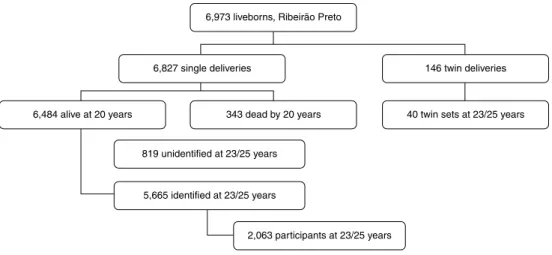
The original cohort consisted of 6,827 live births from Ribeirão Preto, and covered 98% of the children born in that city between June 1, 1978 and May 31, 1979. Data collection was started at birth, and follow-up data on the health status of the subjects were collected at various ages. For the follow-up in early adulthood in 2002-2004, individuals whose mothers did not reside in Ribeirão Preto at the time of delivery (2,094) were excluded from the study. Thus, 6,973 liveborn subjects remained in the study, 6,827 singletons and 146 twins. Of the 6,827 singletons, 343 died up to 20 years of age. From the 6,484 alive at 20
years, 5,665 were identiied for the up. The
follow-up sample was reconstituted from original birth charts containing addresses of the liveborn babies included in the study and from updated addresses retrieved from a number
of databases, including the Uniied Health System electronic
database, lists of users of private health plans, school charts from the follow-up performed in 1987-1989, and military recruitment charts belonging to the original cohort. One out of three of the remaining 5,665 individuals living in the same geographical area were randomly selected for evaluation at age 23-25 years, based on a list of names of participants previously built and drawn from the databases described above. The selection was made based on the geo-economic characterization of the city, which is composed
of four geographic regions deined by the income of the head of the family and classiied as “poor,” “middle-poor,” middle-rich,” and “rich.”14 Losses (705) occurred because of
refusal to participate, imprisonment, death after 20 years
of age, and failure to attend for interview. In case of refusal
or impossibility to participate, contact was made with the next name on the list using the same sampling frame. The
inal sample resulted in 2,063 young adults (Table 1). The
full description of the sample characteristics and methods has been published elsewhere.15 The sample low chart is
shown in Figure 1.
The objectives of the initial investigation were to analyze the behavior of some indicators of perinatal health and their associations with the social and biological variables of mothers and newborns, to measure the utilization of health services for prenatal, delivery and newborn care,
and to relate these data to mortality during the irst year
of life.17 Study participants were followed until 2002/2004 speciically to investigate the contribution of early life events
to non-communicable diseases.18
Among the 2,063 subjects who attended the examinations, 1,915 performed skin prick test (SPT), which means that data on response to allergens were missing for 148 participants due to refusal or due to use of medication
that could interfere with SPT, and ive subjects were excluded
Source: Barbieri et al.16.
Figure 1 - Sampling frame of the 1978/1979 birth cohort
The variables studied were birth length (categorized as
< 47 cm, 47-48.9 cm, 49-50 cm, and ≥ 51 cm) and weight
(categorized as < 2,500 g, 2,500-2,999 g, 3,000-3,999
g, and ≥ 4,000 g), intrauterine growth restriction (IUGR)
(categorized as no or yes), gender (categorized as female
or male), birth order (categorized as irst, second, third, and ≥ fourth child), maternal age (categorized as < 20 years, 20-34 years, and ≥ 35 years), parental smoking during
pre-school age (categorized as yes or no), and education
(categorized as 1-8 years, 9-11 years, and ≥ 12 years of
schooling). The analysis of home smoking was limited to
pre-school age and to parents in order to select signiicant
second-hand smoking exposure, since exposure to smoking at home should decrease during school years and possible exposure to other smoking relatives would not be very
important. The study was approved by the Ethics Committee
of the University Hospital, Medical School of Ribeirão Preto, University of São Paulo. All participants gave written informed consent to participate in the study.
The concept of IUGR was based on the birth weight ratio
(BWR), that is, the ratio between the newborn’s weight
and the local population’s sex-speciic mean birth weight for each gestational age. Individuals were classiied as non growth restricted (BWR ≥ 0.85), moderately growth restricted (BWR < 0.85 and ≥ 0.75), and severely growth
restricted (BWR < 0.75).16
The SPT for allergy was performed using eight extracts of inhalant allergens common in Brazil, namely grass,
dog, cat, Dermatophagoides farinae, Dermatophagoides pteronyssinus, Penicillium notatum, Alternaria alternata,
and Aspergillus fumigatus, plus normal saline as a negative
control. Skin reactions to each allergen tested were recorded after 15 min as the average of the maximum wheal diameter and the diameter perpendicular to the maximum. Subjects
with a wheal reaction ≥ 3 mm to one or more of the eight
allergens tested were considered to be atopic.19 The tests
and measurements were carried out at the University Hospital, Medical School of Ribeirão Preto, and stringent safety procedures were observed at all times.20
Statistical analysis
Exploratory analysis was irst performed using frequency
tables. The log-binomial model (generalized linear model) was used to determine the association between birth weight (or length) and atopy, as well as the relation among control variables. The link function of this model is the logarithm of the proportion under study, and the error distribution is binomial. The measure of the effect of this model is also relative risk (RR).21
For k covariables, the model is written as follows:
log(
π
) = β0 + β1 x1 + β2 x2 +…+ βk xk,where
π
is the probability of success, i.e., the proportion of sick individuals in the group, xi are the covariables, andn %
Grass 42 2.2
Dog 73 3.8
Cat 164 8.6
Dermatophagoides farina 734 38.4
Dermatophagoides pteronyssinus 830 43.5
Penicillium notatum 35 1.8
Alternaria alternate 14 0.7
Aspergillus Fumigatus 12 0.6
Positive skin prick test 910 47.6
table 2 - Prevalence rates of atopic sensitization to inhalant allergens among 23-25 years old Brazilians
Results
Among subjects who performed SPT (n = 1,910), gender distribution was 48.8% (933/1,910) males and 51.2% (977/1,910) females; 6.4% (123/1,910) of the subjects had low birth weight (< 2,500 g), 11.1% (211/1,901) had low birth length (< 47 cm), and 14.3% (273/1,910) had
IUGR; 38.9% (736/1,894) were irst born, and 12.1%
(229/1,898) were children of mothers aged less than20 years; 63.0% (1,187/1,884) lived with a smoker during childhood, and 15.3% (292/1,910) of the subjects had less than 8 years of study.
The overall prevalence of atopy (at least one positive SPT reaction) was 47.6% (Table 2). The most common sensitizations were to D. pteronyssinus, D. farinae, cat, and dog (43.5, 38.4, 8.6, and 3.8%, respectively).
The prevalence of positive SPT was 51.1% among males subjects, 52.1% among the subjects with high
birth weight (≥ 4,000 g), 50.3% among the subjects with high birth length (≥ 51 cm), 48.5% among those without IUGR, 49.4% among second and third borns, 49.2% among
children of mothers aged between 20 and 34 years, 52.4% among those who did not have a smoker at home during childhood, and 52.4% among those with more than 12 years of study (Table 3).
The associations of risk factors with atopic sensitization in separate analysis and mutually adjusted analysis are shown in Table 3. At age 23-25 years, male subjects showed
a signiicantly increased prevalence of atopic sensitization compared to female subjects (p = 0.0029). Level of schooling in adulthood was also inluential. Low schooling level (compared with ≥ 12years of study) and living with a smoker during pre-school age were inversely related to atopic sensitization (p < 0.0001 and 0.0022, respectively).
Birth weight and length, IUGR, birth order, and maternal age did not have a signiicant association with atopy in
separate analysis or mutually adjusted analysis.
Discussion
The present 23-25 year follow-up study showed that male gender was associated with an increased risk of atopic
sensitization, as measured by SPT. In addition, low level
of schooling was a protective factor against sensitization. Having a smoker at home in childhood was also associated with protection against atopy, which may be a case of inverse causality. Birth weight, length, birth order, maternal age,
and IUGR were not associated with a positive SPT.
Perinatal factors, especially intrauterine growth,22 have been proposed as “programming” inluences on the developing immune system. Our indings do not suggest an important inluence of any of these factors, although we lack the speciic information required to evaluate the effect
of neonatal head circumference or prolonged, exclusive breastfeeding in this cohort.
In studies on children, adolescents, and adults in the
United Kingdom (UK)5 and New Zealand,7 birth weight was not associated with total serum IgE level or positive SPTs to
common allergens. Neither was there an association between birth weight and allergic rhinitis or atopic dermatitis in
9-year-old Italian children23 nor in a cohort of adolescents from
New Zealand.4 Leadbitter et al.7 also found no association
between these variables. However, a body of evidence showed that there is an inverse relationship between birth weight and SPT reactivity or atopic disease.6 Low birth weight
was associated with more allergic rhinitis and positive SPT in a UK study of 2-year-old children.3
Children who lived with smoking parents during pre-school age (irst 7 years of life) presented a mild reduction
of the prevalence of atopy (RR = 0.87). We explained this
inding by inverse causality. Disease-related modiication
of exposure (inverse causality) concerns the interaction between cause and effect. The effect from breastfeeding is a classic example in which inverse causation might lead to erroneous conclusions. Debut of symptoms of eczema or wheezy disorder tends to prolong the duration of exclusive breastfeeding because of the general belief in its protective effect.24 Such inverse causation could be misinterpreted
as the duration of breastfeeding leading to eczema or wheezy disorder, when, in fact, the disorders lead to longer breastfeeding.25 In the case of smoking and atopy, the early
presence of atopy could have led to smoking cessation at home, with a reduction of the number of smoking parents in allergic children’s homes, while this number was larger in healthy children’s homes.
The hygiene hypothesis was proposed 2 decades ago and recently revisited. Strachan12 postulates that the protection
Variable* Prevalence (%) Crude RR (95%Ci) Adjusted RR (95%Ci)†
Birth weight (g)
< 2,500 50/123 (40.7) 0.83 (0.67-1.03) 1.04 (0.76-1.43)
2,500-2,999 166/380 (43.7) 0.89 (0.78-1.01) 0.97 (0.83-1.15)
3,000-3,999 621/1,267 (49.0) 1.0 1.0
≥ 4,000 73/140 (52.1) 1.06 (0.90-1.26) 1.04 (0.87-1.24)
Birth length (cm)
< 47 84/211 (39.8) 0.87 (0.72-1.06) 0.85 (0.68-1.05)
47-48.9 210/459 (45.8) 1.0 1.0
49-51 380/772 (49.2) 1.08 (0.95-1.22) 1.03 (0.90-1.18)
≥ 51 231/459 (50.3) 1.10 (0.96-1.26) 0.98 (0.83-1.14)
IUGR
No 794/1,637 (48.5) 1.0 1.0
Yes 116/273 (42.5) 0.88 (0.76-1.01) 0.95 (0.78-1.16)
Gender
Female 433/977 (44.3) 1.0 1.0
Male 477/933 (51.1) 1.15 (1.05-1.27) 1.18 (1.07-1.30)
Birth order
First child 355/736 (48.2) 1.0 1.0
Second and third child 440/891 (49.4) 1.02 (0.93-1.13) 1.00 (0.91-1.11)
≥ forth child 106/267 (39.7) 0.82 (0.70-0.97) 0.84 (0.70-1.01)
Maternal age (years)
< 20 95/229 (41.5) 0.84 (0.72-0.99) 0.88 (0.74-1.04)
20-34 743/1,509 (49.2) 0.83 (0.68-1.00) 0.86 (0.70-1.06)
≥ 35 65/160 (40.6) 1.0 1.0
Smoking‡
Yes 535/1,187 (45.1) 0.86 (0.78-0.95) 0.87 (0.79-0.96)
No 365/697 (52.4) 1.0 1.0
Level of schooling (years)
1-8 108/292 (37.0) 0.71 (0.60-0.83) 0.74 (0.62-0.89)
9-11 460/965 (47.7) 0.91 (0.82-1.01) 0.94 (0.85-1.04)
≥ 12 342/653 (52.4) 1.0 1.0
table 3 - Atopy prevalence and risk factors in separate analysis and mutually adjusted analysis of Brazilian young adults
95%CI = 95% confidence interval; IUGR = intrauterine growth restriction; RR = relative risk. * The total is different for some variables due to missing values.
† Adjusted for IUGR, birth weight and length. ‡ Parental smoking before the 7 years.
a large family and/or the presence of older siblings was
mediated by infection acquired from contact with siblings.
Over the last decade, it appeared that there is a rather consistent and statistically independent protective effect of larger family size, domestic crowding, and low socioeconomic status on hay fever and atopic sensitization.11,12 However,
these factors may also be regarded as indirect measures of some other factors which increase in the presence of
low socioeconomic status and/or large family size. In the
present study, low socioeconomic status was indicated by low level of schooling.
Our results were consistent with those of many other studies in demonstrating a higher prevalence of atopy among males than females.6,7,11 Therefore, we corroborated
the involvement of both principal determinants of atopy: environment (represented by schooling) and genetics
(represented by male sex). If the hygiene hypothesis is the most reasonable explanation for our indings, its
immunologic basis has been controversial. For many years, the hygiene hypothesis was recognized to result from the
lack of shifting of allergen-speciic responses from the TH2
References
1. Barker DJ. The fetal origins of diseases of old age. Eur J Clin Nutr. 1992;46 Suppl 3:S3-9.
2. Bjorksten B. Allergy priming early in life. Lancet. 1999;353:167-8.
3. Arshad SH, Stevens M, Hide DW. The effect of genetic and environmental factors on the prevalence of allergic disorders at the age of two years. Clin Exp Allergy. 1993;23:504-11. 4. Fergusson DM, Crane J, Beasley R, Horwood LJ. Perinatal
factors and atopic disease in childhood. Clin Exp Allergy. 1997;27:1394-401.
5. Gregory A, Doull I, Pearce N, Cheng S, Leadbitter P, Holgate S, et al. The relationship between anthropometric measurements at birth: asthma and atopy in childhood. Clin Exp Allergy. 1999;29:330-3.
6. Kuyucu S, Saraçlar Y, Tuncer A, Saçkesen C, Adalioglu G, Sumbuloglu V, et al. Determinants of atopic sensitization in Turkish school children: effects of pre- and post-natal events and maternal atopy. Pediatr Allergy Immunol. 2004;15:62-71.
7. Leadbitter P, Pearce N, Cheng S, Sears MR, Holdaway MD, Flannery EM, et al. Relationship between fetal growth and the development of asthma and atopy in childhood. Thorax. 1999;54:905-10. 8. Volkmer RE, Rufin RE, Wigg NR, Davies N. The prevalence of
respiratory symptoms in South Australian preschool children. II. Factors associated with indoor air quality. J Paediatr Child Health. 1995;31:116-20.
9. Weiland SK, von Mutius E, Husing A, Asher MI. Intake of trans
fatty acids and prevalence of childhood asthma and allergies in Europe. ISAAC Steering Committee. Lancet. 1999;353:2040-1. 10. Wahn U, Lau S, Bergmann R, Kulig M, Forster J, Bergmann K, et al.
Indoor allergen exposure is a risk factor for sensitization during the irst three years of life. J Allergy Clin Immunol. 1997;99:763-9. 11. Strachan DP, Harkins LS, Johnston ID, Anderson HR. Childhood
antecedents of allergic sensitization in young British adults. J Allergy Clin Immunol. 1997 Jan;99(1 Pt 1):6-12.
12. Strachan DP. Family size, infection and atopy: the irst decade of the ”hygiene hypothesis”. Thorax. 2000 Aug;55 Suppl 1:S2-10. 13. Braback L, Kjellman NI, Sandin A, Bjorksten B. Atopy among
schoolchildren in northern and southern Sweden in relation to pet ownership and early life events. Pediatr Allergy Immunol. 2001;12:4-10.
14. Goldani MZ, Barbieri MA, Bettiol H, Barbieri MR, Tomkins A. Infant
mortality rates according to socioeconomic status in a Brazilian city. Rev Saude Publica. 2001;35:256-61.
15. Barbieri MA, Bettiol H, Silva AA, Cardoso VC, Simões VM, Gutierrez MR, et al. Health in early adulthood: the contribution of the 1978/79 Ribeirao Preto birth cohort. Braz J Med Biol Res. 2006;39:1041-55.
16. Barbieri MA, Gomes UA, Barros Filho AA, Bettiol H, Almeida LEA, Silva AA. Saúde perinatal em Ribeirão Preto, SP, Brasil: a questão do método. Cad Saude Publica. 1989;5:376-87.
17. Batty GD, Alves JG, Correia J, Lawlor DA. Examining life-course
inluences on chronic disease: the importance of birth cohort
studies from low- and middle-income countries. An overview. Braz J Med Biol Res. 2007;40:1277-86.
However, after the discovery of regulatory T cells, another proposed mechanism has been the decreased activity of these cells (reduced immune suppression).26
The pattern of allergic inheritance is complex. Recent results showed the effect of different gene polymorphisms on an individual’s predisposition to allergic diseases. The most important linkages produced, to date, include those
among the genes for IL-4, IL-13, HLA-DRB, TNF, LTA, FCER1B, IL-4RA, ADAM33, TCR alpha/delta, PHF11, GPRA, TIM, p40, CD14, DPP10, T-bet, GATA-3, and FOXP3 and allergic
disorders. The two parallel research efforts, epidemiologic and genetic, are only recently starting to converge, producing fascinating results on the gene-environment interactions that might have in the development of atopy. The lesson learned through this research effort is that not only a small number but many separate risk factors act in concordance in the production of the allergic phenotype.27
Among the strengths of this study is the use of a standardized and objective test (prick test) and of objective measurements such as weight and height. The criteria used in this study are international, which allows us to compare our results with those from other countries.28 Moreover, we
looked at a random sample of 36% of the original cohort, a fairly large population, a fact that allowed us to exclude any case with methodological doubts. Although the differences
are signiicant, the RRs are very close to 1, which may
indicate a not very potent relationship. For multifactorial diseases, cross-sectional analysis is rather limited by variable selection, and only long-term observations of the start and end of exposure and disease can account for bias. However,
the fact that our indings are consistent with other studies
indicates they are valid. Despite the study represents only two life stages, birth and early adulthood, very few studies from the developing world have such data.
The onset of asthma in children may be caused by virus
infection. Viral etiologies were identiied in 90% of wheezing illnesses in children from birth to age 3 years. In this same
study, approximately 90% of children who had infection with wheezing by rhinovirus up to age 3 were asthmatic at age 6 years.29 The respiratory syncytial virus (RSV) infection is also associated with the subsequent development of wheezing
in childhood, as shown in a pioneer study.30 Several other
studies have addressed the association of RSV infections
in early life and the subsequent development of recurrent wheezing and asthma later in life. In our sample cohort,
we have no data on virus etiology of previous respiratory
infections. Speciic virus tests and follow-up studies would
be necessary to evaluate the role of virus infection in childhood. Thus, this major risk factor for asthma could not be assessed. However, our study was aimed at atopic sensitization instead of asthma or wheezing, and few data have associated childhood infection with atopy. According to Jartti et al.,31 allergic sensitization is positively linked to
rhinovirus, but not to other viruses.
In conclusion, this study showed that male gender was
associated with an increased risk of atopic sensitization, and low socioeconomic status, assessed by level of schooling, was a protective factor against atopy in a prospective birth cohort study of subjects at age 23-25 years. These data agree
with the hygiene hypothesis. Living with a smoker during
18. Kramer MS, Platt R, Yang H, McNamara H, Usher RH. Are all
growth-restricted newborns created equal(ly)? Pediatrics. 1999;103:599-602.
19. Vianna EO, Garcia CA, Bettiol H, Barbieri MA, Rona RJ. Asthma
deinitions, relative validity and impact on known risk factors in
young Brazilians. Allergy. 2007;62:1146-51.
20. Liccardi G, D’Amato G, Canonica GW, Salzillo A, Piccolo A, Passalacqua G. Systemic reactions from skin testing: literature review. J Investig Allergol Clin Immunol. 2006;16:75-8. 21. Barros AJ, Hirakata VN. Alternatives for logistic regression in
cross-sectional studies: an empirical comparison of models that directly estimate the prevalence ratio. BMC Med Res Methodol. 2003;3:21.
22. Godfrey KM, Barker DJ, Osmond C. Disproportionate fetal growth
and raised IgE concentration in adult life. Clin Exp Allergy. 1994;24:641-8.
23. Girolomoni G, Abeni D, Masini C, Sera F, Ayala F, Belloni-Fortina A, et al. The epidemiology of atopic dermatitis in Italian schoolchildren.
Allergy. 2003;58:420-5.
24. Laubereau B, Brockow I, Zirngibl A, Koletzko S, Gruebl A, von BA, et al. Effect of breast-feeding on the development of atopic
dermatitis during the irst 3 years of life-results from the
GINI-birth cohort study. J Pediatr. 2004;144:602-7.
25. Strassburger SZ, Vitolo MR, Bortolini GA, Pitrez PM, Jones MH, Stein RT. Nutritional errors in the irst months of life and their
association with asthma and atopy in preschool children. J Pediatr(Rio J). 2010;86:391-9.
26. Romagnani S. Coming back to a missing immune deviation as
the main explanatory mechanism for the hygiene hypothesis. J Allergy Clin Immunol. 2007; 119:1511-3.
Correspondence: Elcio O. Vianna
Departamento de Clínica Médica, FMRP, USP Av. Bandeirantes, 3900 – Monte Alegre CEP 14048-900 – Ribeirão Preto, SP – Brazil Tel.: +55 (16) 3602.2706
Fax: +55 (16) 3633.6695 E-mail: [email protected]
27. Grammatikos AP. The genetic and environmental basis of atopic diseases. Ann Med. 2008;40:482-95.
28. Rona RJ, Vargas C, Vianna EO, Bustos P, Bettiol H, Amigo H, et al. Impact of speciic sensitization on asthma and rhinitis in young Brazilian and Chilean adults. Clin Exp Allergy. 2008;38:1778-86.
29. Jackson DJ, Gangnon RE, Evans MD, Roberg KA, Anderson EL, Pappas TE, et al. Wheezing rhinovirus illnesses in early life predict asthma development in high-risk children. Am J Respir Crit Care Med. 2008;178:667-72.
30. Stein RT, Sherrill D, Morgan WJ, Holberg CJ, Halonen M, Taussig LM, et al. Respiratory syncytial virus in early life and risk of wheeze and allergy by age 13 years. Lancet. 1999;354:541-5.