Abstract
Objectives: To describe the experience of the emergency department of a pediatric hospital with rapid sequence intubation (RSI) and to identify the factors associated with successful intubation.
Methods: This prospective, observational, cross-sectional study conducted from July 2005 to December 2007 consisted of collection of data regarding tracheal intubations performed at the emergency department of Instituto da Criança of Hospital das Clínicas, School of Medicine, Universidade de São Paulo. Successful tracheal intubations were the ones performed at the irst attempt.
Results: One-hundred and seventeen tracheal intubations were performed; 80% of them were RSIs; 79% of patients had underlying diseases; acute respiratory failure was the cause of tracheal intubation in 40%; success rate was 39%; second-year pediatric resident physicians were responsible for 74% of tracheal intubations; positive pressure ventilation was performed in 74% of procedures, with less frequent use among patients who were successfully intubated (p = 0.002). Midazolam was the sedative used in 80% of procedures, and rocuronium was the neuromuscular blocker in 100%; complications of RSI were described in 80% of intubations, with decreased oxygen saturation being reported in 47% and lower decrease in those patients successfully intubated (p < 0.001); dificulties related to tracheal intubation were less frequent in the successful procedures (p < 0.001).
Conclusion: RSI is the method of choice for tracheal intubations performed in the emergency department (80%). In spite of the low success rate (39%) in the present study, RSI has proven to be a safe method, with a low incidence of severe complications. The success of tracheal intubation using RSI seems to be directly related to the preparation of the procedure and the health professional’s experience. Thus, we conclude that further training of resident physicians and health professionals working in the emergency department is required.
J Pediatr (Rio J). 2011;87(4):343-349: Intratracheal intubation, intubation methods, adverse effects of intubation, neuromuscular blockers, emergency treatment, child, laryngoscopy, trachea.
O
RiginAlA
RtiCle Copyright © 2011 by Sociedade Brasileira de Pediatria343
introduction
Several clinical situations require tracheal intubation (TI), and airway management is a major concern and certainly one of the most critical aspects of the care provided to critically ill patients in the emergency departments.1-3
In patients requiring emergency TI, there is a combination of potential complications caused by the procedure and the factors related to the disease, which increases the risk of adverse reactions to the procedure and further complications.
A higher number of TI attempts is responsible for increased complications, and most TI complications in the emergency department can be attributed to the lack of experience and training of the physician who performs the procedure.4,5
Rapid sequence intubation (RSI) consists of the performance of the TI procedure using an organized approach, which involves the use of sedatives and neuromuscular blocking agents (NMBs).6 Such procedure
evaluation of rapid sequence intubation
in the pediatric emergency department
graziela A. Sukys,1 Cláudio Schvartsman,2 Amélia g. Reis21. Mestre, Pediatria. Instituto da Criança, Hospital das Clínicas, Faculdade de Medicina, Universidade de São Paulo (USP), São Paulo, SP, Brazil. 2. Doutor(a), Pediatria. Instituto da Criança, Hospital das Clínicas, Faculdade de Medicina, USP, São Paulo, SP, Brazil.
No conflicts of interest declared concerning the publication of this article.
Suggested citation: Sukys GA, Schvartsman C, Reis AG. Evaluation of rapid sequence intubation in the pediatric emergency department. J Pediatr (Rio J). 2011;87(4):343-9.
has been reported to be safe and effective and decreases the number of complications caused by conventional TI.6-8
RSI offers the great advantage of eliminating the resistance to direct laryngoscopy, promoting rapid induction of anesthesia, rapid occurrence of optimal conditions that facilitate direct laryngoscopy, and reduction of the risk of pulmonary aspiration2,6; therefore, RSI is appropriate for patients who require emergency TI.7,9,10
RSI indications are the same as those of emergency TI.2,6 The procedure-related risks are not negligible, and drug side effects and dificulty with airway management are the major issues to consider.11,12 RSI has been performed in emergency TI in the last two decades in the United States and it has proven to be safe and effective, becoming the method of choice in the main emergency departments.13-15
RSI has recently started to be used in children in Brazil. Its use started after the release of the 2000 Guidelines for Pediatric Advanced Life Support of the International Liaison Committee on Resuscitation, which occurred in 2002.11 The studies published so far have demonstrated low frequency of RSI in Brazil.16-18
The objectives of the present study were to evaluate the performance of RSI in children in an emergency department and to analyze the compliance with the RSI protocol as well as the variables associated with successful TIs.
Methods
We conducted a prospective, observational, cross-sectional study from July 2005 to December 2007 at the emergency department of Instituto da Criança (ICr) of Hospital das Clínicas, School of Medicine of Universidade de São Paulo, Brazil.
Data were collected on emergency TI performed in children and adolescents aged from 1 day of life to 18 years. In the present study, we included the TI procedures with the use of RSI.
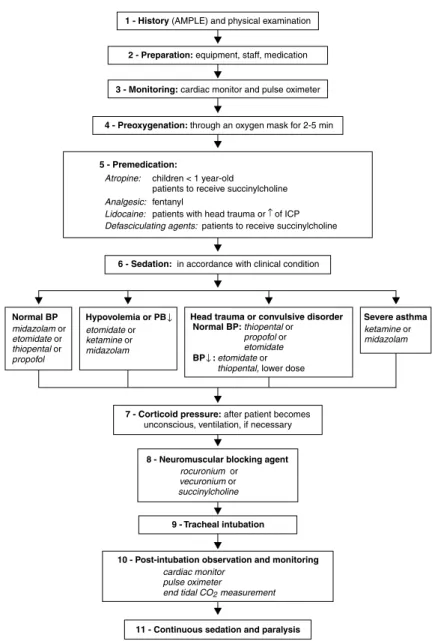
The RSI lowchart used in the present study was based on lowcharts recommended by international and national medical associations.11 It was adapted for the emergency department of ICr (Figure 1). The physicians involved in the treatment had complete freedom in selecting and administering the drugs. Only the cases that followed the steps described in the proposed lowchart were considered RSI.
A form created for the present study was used to collect data from the RSI lowchart and from the record of the main complications reported in the National Emergency Airway Registry (NEAR). A resident physician illed out this form at the procedure. If the TI form was incomplete or contained divergent data, an interview with the assistant physician in charge was conducted. In order to ensure the
quality of information, an active daily search of the cases through phone interviews or in person with the nurses, and resident and assistant physicians was made; as well as a search on the emergency department logbook where all complications and advanced procedures of the department are routinely recorded.
TI performed and conirmed at the irst attempt of passage of the tube through the airway was considered successful.
The Statistical Package for the Social Sciences (SPSS) 13.0 was used for the statistical analysis. A p-value < 0.05 was considered statistically signiicant; all statistical tests were two-tailed.
Results
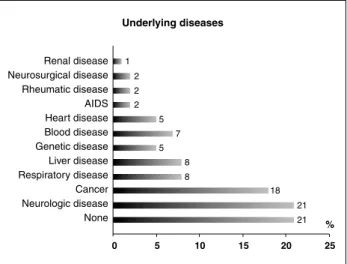
The characteristics of the study population are described in Table 1 and Figure 2. Of the 94 patients included in our study, 37 (39%) underwent successful RSI, i.e., performed and conirmed at the irst attempt to pass the tube through the airway.
Patients who underwent successful TI using RSI were younger than those patients whose procedure failed (median age in years: 1.2 vs. 5.4; U = 658, p = 0.002). The frequency of success in cancer patients was lower than in patients without cancer (p = 0.048). There was no signiicant difference in the success rate in terms of other underlying diseases and TI causes (p = 0.748).
In 70 (74%) patients, positive pressure ventilation (PPV) was used, and 38% received PPV in the pre-oxygenation phase. The proportion of patients who used PPV was signiicantly lower among those patients who underwent successful TI: of 37 patients who underwent successful TI procedure, 21 (56%) received PPV, and of 57 patients whose TI procedure failed, 49 (86%) received PPV (p = 0.002).
In terms of medications used, the groups were similar. In the pre-medication phase, atropine was used in 47 patients, accounting for 50% of the RSI. Midazolam was the sedative of choice, being administered to 75 (80%) patients as the only sedative or in combination. The other sedatives of choice were: ketamine, used in 28 (30%) patients; thiopental, in 16 (17%); and propofol in two (2%). Rocuronium was the NMB administered in 100% of the RSI procedures.
The number of TI attempts using RSI ranged from one to eight (median = 2). In 82 (87%) procedures, at most three attempts were made for TI conirmation. In 70 (74%) patients, TI was performed by the second-year pediatric resident physician (R2); in 13% by the assistant physician; in 8% by the third-year pediatric resident physician; and in 2%, by emergency medicine resident physicians.
↑ = increase; ↓ = decrease; AMPLE = Allergy, Medications, Past medical history, Last meal, Events leading to need for intubation; BP = blood pressure; ICP= intracranial pressure.
Source: adapted from Hazinski et al.11
Figure 1 - Rapid sequence intubation algorithm Complications caused by the TI procedure were reported
in 75 (80%) patients. A decreased oxygen saturation (O2) was recorded in 47% of cases, being the most prevalent complication. Table 2 shows the complications according to the success of the TI procedure. Successful TIs showed signiicantly fewer complications (p < 0.001). The decrease in O2 saturation, the main complication reported, was lower in the group with successful TI (p = 0.002). Dificulties
general RSi
Emergency department visits* 4,070/month –
Intubations 117† 94 (80%)
Age in years (median) 2.4 4.4
Male (%) 58 56
Underlying disease (%) 78 79
TI causes (%)
Respiratory failure 40
Changes in the degree of consciousness 20
Shock 18
Respiratory failure + shock 16
Status epilepticus 5
Obstruction of the tracheal tube 1
Successful Failed
Complications n = 37 (%) n = 57 (%) p
Aspiration 1 (3) 4 (7) 0.645
Bradycardia 3 (8) 10 (17) 0.195
Decreased O2 saturation 10 (27) 34 (60) 0.002
Epistaxis 0 (0) 2 (3) 0.518
Air leak 7 (19) 13 (23) 0.653
High blood pressure* 0 (0) 1 (2) 1.000
Hypotension* 2 (6) 8 (16) 0.191
Soft tissue laceration 3 (8) 8 (14) 0.518
Pneumomediastinum 0 (0) 1 (2) 1.000
Bleeding 0 (0) 13 (23) 0.002
Tachycardia 4 (11) 11 (19) 0.272
Dental trauma 0 (0) 3 (5) 0.276
Vomiting 0 (0) 6 (10) 0.078
Pneumothorax 0 (0) 1 (2) 1.000
table 1 - Characteristics of the study population
RSI = rapid sequence intubation; TI = tracheal intubation.
* Emergency Department of Instituto da Criança, Hospital das Clínicas, School of Medicine, Universidade de São Paulo, São Paulo, SP, Brazil.
† 1 TI/1,000 visits.
table 2 - Comparison of frequencies of complications caused by successful and failed tracheal intubation procedure in rapid sequence intubation
* Blood pressure was measured in only 84 patients in these variables.
Discussion
The need for TI in the emergency departments in the United States is estimated at two to 10 per 1,000 visits of children and adults, including trauma.7,8,19 In the present study, the intubation rate (1:1.000) can be considered high, since the emergency department studied is exclusively a pediatric emergency department and no polytrauma patients
are treated there, which can relect the high complexity and severity of the cases.
Figure 2 - Frequency of underlying diseases of the patients who underwent rapid sequence intubation
to be used in children outside the surgery room2,6,11 and, in Brazil, its use started with the Training Program in Pediatric Advanced Support Life of the American Heart Association and American Academy of Pediatrics in 2002.
The prevalence of underlying disease in the present study makes it unique, and our results are dificult to compare with the literature. Patients with severe diseases are usually at higher risk while undergoing emergency invasive procedures and using medications.8,12,21,22
The immediate condition that prompted the use of RSI was acute respiratory failure alone and in combination with other causes. Other studies have found lower rates of respiratory failure as the immediate cause of TI.8,21,23,24 The indication for TI in cases with exclusive respiratory impairment depends on the clinical interpretation and different deinitions adopted, which routinely are not well deined in the studies.
A larger number of TI attempts is directly associated with increased morbidity and progressive dificulty to access the airway.4
It should be noted that intubations performed in the emergency department are elective and carried out in stressful and uncontrolled situations. Standardization of care protocols, such as the RSI, aim to make this procedure safer and improve the success rate of TI.
Data were collected at the beginning of the introduction of the RSI protocol, and as shown by Simpson et al. and Sagarin et al., current data should better relect the subjective perception of improvement in the quality of the procedure.21,22
U.S. studies conducted at university hospitals have revealed success rates of TI in emergency departments up to 78%.8,21 In the present study, we found a success rate
of 39% in all procedures and 38% in those performed by R2 (79% of TIs); though this rate seems low compared with the literature data, we should be careful, since the levels of training are different between departments. Sagarin et al.21 report that only 10% of the TIs performed at their department were done by R2, with a success rate of 50%.
The success of intubation and the complications associated with it are related to the performance of laryngoscopy, a procedure that requires high level of training and experience.1 At ICR, TIs are performed by professionals under training, with low level of experience, supervised by the assistant physician, which contributes to a lower success rate and higher number of reports of complications when compared with specialized medical departments in the United States. No data were found in the national literature that allow comparative analysis.
Despite the low success rate, all patients in the study were submitted to TI in the emergency department without aid of anesthesia, endoscopy, or surgical airway, which shows that the team is allowed in the management and airway control in emergency situations.
While reviewing the RSI procedure, we found that all patients received preoxygenation, but the recommendation is to use PPV during pre-oxygenation only in speciic situations – for example in cases of apnea6 – such recommendation apparently was not adopted.
It is assumed that the PPV is associated with increased complications and lower TI success rate because it causes gastric distension and risk of pulmonary aspiration. PPV was widely used and was directly associated with the procedure failure (p = 0.002). The excessive use of PPV may have been associated with increased severity of the patients’ health status or failure to understand the term oxygenation. Although the medications used in the RSI were suggested in the lowchart of the RSI care protocol, the assistant physicians who supervised the procedure were free to choose the medications both in the premedication phase and in the sedation and analgesia phase. There was no difference in the use of medications in the successful and unsuccessful groups, since the drugs were chosen based on the underlying disease and the TI cause.
The sedatives and NMB used in the RSI procedure differ in different emergency departments, which makes it dificult to perform a comparative analysis. In an emergency care protocol, it is essential that the health professionals know the pharmacodynamics of the agents used and thus are familiar with their action and adverse effects.
References
1. Blanda M, Gallo UE. Emergency airway management. Emerg Med Clin North Am. 2003;21:1-26.
2. McAllister JD, Gnauck KA. Rapid sequence intubation of the pediatric patient. Fundamentals of practice. Pediatr Clin North Am. 1999;46:1249-84.
3. Walls RM. The decision to intubate. In: Walls RM, Murphy MF, Luten RC, Schneider RE, editors. Manual of emergency airway management. Philadelphia: Lippincott Williams & Wilkins; 2004.
4. Rose DK, Cohen MM. The airway: problems and predictions in 18,500 patients. Can J Anaesth. 1994;41:372-83.
5. Holzman RS. Morbidity and mortality in pediatric anaesthesia. Pediatr Clin North Am. 1998;52:671.
6. Gerardi MJ, Sacchetti AD, Cantor RM, Santamaria JP, Gausche M, Lucid W, et al. Rapid-sequence intubation of the pediatric patient. Pediatric Emergency Medicine Committee of the American College of Emergency Physicians. Ann Emerg Med. 1996;28:55-74. 7. Gnauck K, Lungo JB, Scalzo A, Peter J, Nakanishi A. Emergency
intubation of the pediatric medical patient: use of anesthetic agents in the emergency department. Ann Emerg Med. 1994;23:1242-7.
8. Sakles JC, Laurin EG, Rantapaa AA, Panacek EA. Airway management in the emergency department: a one-year study of 610 tracheal intubations. Ann Emerg Med. 1998;31:325-32. 9. Nakayama DK, Waggoner T, Venkataraman ST, Gardner M, Lynch
JM, Orr RA. The use of drugs in emergency airway management in pediatric trauma. Ann Surg. 1992;216:205-11.
10. Sellick BA. Cricoid pressure to control regurgitation of stomach contents during induction of anaesthesia. Lancet. 1961;2:404-6.
11. Hazinski MF. Pediatric Advanced Life Support Provider Manual. Dallas: American Heart Association; 2002.
12. Marvez E, Weiss SJ, Houry DE, Ernst AA. Predicting adverse outcomes in a diagnosis-based protocol system for rapid sequence intubation. Am J Emerg Med. 2003;21:23-9.
The ideal sedative to be in the RSI procedure is one that promotes unconsciousness quickly, with a short duration and action and minimal side effects. Such characteristics can be found in several medications.25-27 Midazolam, alone or in combination, was the most commonly used sedative. Midazolam is a fast-acting benzodiazepine with anticonvulsant and amnesic property, which makes it a suitable sedative in RSI, although other sedatives are also appropriate.6,11 There is a lot of controversy about the use of sedative agents in critically ill patients.25
The use of paralytic agents is the cause of major discussion and a deadlock at the moment of intubation. Rocuronium was the NMB used in 100% of the procedures described in the present study. This practice proved to be safe and effective. The main NMB described in the literature and used in RSI is succinylcholine, although in more recent studies other agents have been recommended.28-30 Side effects of succinylcholine, such as hyperkalemia, bradycardia and cardiac arrest, are more common in children, which explains why it is not used in the protocol of the present study.24 Recent studies have shown that succinylcholine offers optimal conditions for TI in a faster and easier manner than rocuronium; however, both NMBs promote acceptable clinical conditions for the performance of TI.31 Recent research has brought sugammadex to market, which is a reversal agent of rocuronium. Reversal offers the possibility of using deep relaxation in elective or emergency TI without the risk of clinically important cardiovascular effects because there is no interaction of this drug with the cholinergic system.32 This breakthrough is a milestone in the use of anesthesia and NMBs in the emergency departments, offering more comfort and easiness to the medical team regarding the management of these drugs.
There was a high rate of complications reported in the TI procedure (80%) compared with the literature,8,21,22 where the rate of complications reported with the use of RSI is between 8 and 15%, with hypoxemia being the most frequent complication. The comparison between studies is severely hampered because the deinitions of what is considered a complication or effect inherent to the procedure vary greatly.
Although the occurrence of decreased O2 saturation (47%) and bradycardia (14%) is a cause of concern, these conditions did not contribute to clinical deterioration and were reversed without the need for cardiopulmonary resuscitation. In the successful TIs, the rate of complications was signiicantly lower (p < 0.001). Several TI attempts are related to increased complications and procedure failure.13,15,33
The presence of secretion in the airways was the main dificulty related to the TI procedure, followed by the use of inadequate equipment and anatomical dificulties. It is estimated that these dificulties could be correctable with
the proper preparation and choice of material, as well as with better trained health professionals.
The adherence to the RSI protocol seemed to increase over the 30 months analyzed. Familiarity with the effects of medications, adverse effects of drugs, and TI preparation was quickly implemented in the emergency department. It should be noted that to achieve standardized and formal records of invasive and risky procedures in the emergency department is a dificult goal, and the small number of studies conducted in emergency departments shows that the quality of information in an uncontrolled environment is erratic and requires discipline.
13. Bair AE, Filbin MR, Kulkarni RG, Walls RM. The failed intubation attempt in the emergency department: analysis of prevalence, rescue techniques, and personnel. J Emerg Med. 2002;23:131-40.
14. Marvez-Valls E, Houry D, Ernst AA, Weiss SJ, Killeen J. Protocol for rapid sequence intubation in pediatric patients - a four-year study. Med Sci Monit. 2002;8:CR229-34.
15. Sagarin MJ, Barton ED, Chng YM, Walls RM. Airway management by US and Canadian emergency medicine residents: a multicenter analysis of more than 6,000 endotracheal intubation attempts.
Ann Emerg Med. 2005;46:328-36.
16. Amantéa SL, Piva JP, Zanella MI, Bruno F, Gracia PC. Acesso rápido à via aérea. J Pediatr (Rio J). 2003;79:S127-38.
17. Gomes Cordeiro AM, Fernandes JC, Troster EJ. Possible risk factors associated with moderate or severe airway injuries in children who underwent endotracheal intubation. Pediatr Crit Care Med. 2004;5:364-8.
18. Ventura AM, Souza DC, Fernandes IC, Costa G, Fernandes JC. Introdução de protocolo de sequência rápida de intubação (SRI) em UTIP: taxas de adesão, sucesso e complicações. Scientia Medica. 2004;14:37-8.
19. Walls RM, Gurr DE, Kulkarni. 6294 Emergency department intubations: second report of the Ongoing National Emergency Airway Registry (NEAR) II study. Ann Emerg Med. 2000;36: S51.
20. Li J, Murphy-Lavoie H, Bugas C, Martinez J, Preston C. Complications of emergency intubation with and without paralysis. Am J Emerg Med. 1999;17:142-3.
21. Sagarin MJ, Chiang V, Sakles JC, Barton ED, Wolfe RE, Vissers RJ, et al. Rapid sequence intubation for pediatric emergency airway management. Pediatr Emerg Care. 2002;18:417-23.
22. Simpson J, Munro PT, Graham CA. Rapid sequence intubation in the emergency department: 5 year trends. Emerg Med J. 2006;23:54-6.
23. Zuckerbraum NS, Pitetti RD, Herr SM, Roth KR et al. Use of etomidate as an induction agent or rapid sequence intubation in a pediatric emergency department. Acad Emerg Med. 2006;13:602-9. 24. Fastle RK, Roback MG. Pediatric rapid sequence intubation:
incidence of relex bradycardia and effects of pretreatment with
atropine. Pediatr Emerg Care. 2004;20:651-5.
Correspondence:
Graziela de Almeida Sukys Av. Zelina, 700 - Vila Zelina
CEP 03143-001 – São Paulo, SP - Brazil Tel.: +55 (11) 8346.5535, +55 (11) 2341.9456 E-mail: [email protected]
25. Zelicof-Paul A, Smith-Lockridge A, Schnadower D, Tyler S, Levin S, Roskind C, et al. Controversies in rapid sequence intubation in children. Curr Opin Pediatr. 2005;17:355-62.
26. Krauss B, Green SM. Sedation and analgesia for procedures en children. N Engl J Med. 2000;342:938-45.
27. Salonen M, Kanto J, Lisalo E. Induction of general anesthesia in children with midazolam – is there an induction dose? Int J Clin Pharmacol Ther Toxicol. 1987;25:613-5.
28. Martyn JA, Richtsfeld M. Succinylcholine-induced hyperkalemia in acquired pathologic states: etiologic factors and molecular mechanisms. Anesthesiology. 2006;104:158-69.
29. Larsen PB, Hansen EG, Jacobsen LS, Wiis J, Holst P, Rottensten H, et al. Intubation conditions after rocuronium or succinylcholine for rapid sequence induction with alfentanil and propofol in the emergency patient. Eur J Anaesthesiol. 2005;22:748-53. 30. Andrews JI, Kumar N, van den Brom RH, Olkkola KT, Roest GJ,
Wright PM. A large simple randomized trial of rocuronium versus succinylcholine in rapid-sequence induction of anaesthesia along with propofol. Acta Anaesthesiol Scand. 1999;43:4-8.
31. Perry JJ, Lee JS, Sillberg VA, Wells GA. Rocuronium versus succinylcholine for rapid sequence induction intubation. Cochrane Database Syst Rev. 2008:CD002788.
32. Groudine SB, Soto R, Lien C, Drover D, Roberts K. A randomized, dose-inding, phase II study of the selective relaxant binding drug, Sugammadex, capable of safely reversing profound rocuronium-induced neuromuscular block. Anesth Analg. 2007;104:555-62. 33. Thibodeau LG, Verdile VP, Bartield JM. Incidence of aspiration