Abstract
Objective: To investigate the incidence and prevalence of epilepsy and seizure disorders during childhood, and their relationship to selected social determinants.
Methods: Population-based birth cohort study, with children born between January 1st and December 31st, 2003 in the city of Passo Fundo (RS), Brazil. Data were prospectively collected in two stages. In the irst one, the Questionnaire of Neurologic Tracking for Epilepsy (QNT-E) was applied during a visit at the children’s homes, together with the assessment of social determinants of health. Constructs of social position (economic class, mother’s educational level, marital status and occupation), biological and behavioral factors (alcohol and tobacco consumption during pregnancy, number of prenatal appointments, and use of medicines during pregnancy), and psychosocial factors (religious meetings attendance) were analyzed. In the second stage, children with a positive QNT-E were submitted to neuroclinical assessment for diagnostic conirmation.
Results: Eleven cases of epilepsy, 27 of febrile seizures, 10 of neonatal seizures, 8 of single seizures, in addition to 26 patients with non-epileptic paroxysmal events, were identiied. The incidence rate of epilepsy was 7/100,000 children, and the prevalence 65.2/10,000 children. Nine children had active epilepsy, giving a point prevalence of 53.3/10,000 children. After multivariate analysis, no social determinants could be signiicantly related to epilepsy.
Conclusions: In this study, a low incidence rate of epilepsywas reported, in contrast to almost a double incidence of febrile seizures and non-epileptic paroxysmal events. Moreover, the achievement of an accurate diagnosis of epilepsy in developing countries is still a challenge, in order to avoid misdiagnosis.
J Pediatr (Rio J). 2011;87(1):50-56: Epilepsy, epileptic syndromes, incidence, prevalence, childhood.
ORiginAl ARtiCle
Copyright © 2011 by Sociedade Brasileira de Pediatria50 introduction
Epilepsy is a highly prevalent disorder around the world, particularly in developing countries, where the health care system still fails to prevent one of the most common causes of epilepsy, namely infectious diseases. Many studies assessing the prevalence of epilepsy are available in the literature, but not so many have evaluated the incidence
of epilepsy in a speciic child population.1-16
The incidence of epilepsy has been studied in several countries and in several subgroups of the population. However, due to different study designs and criteria used,
the data obtained is dificult to compare, and the rates
reported are hardly comparable.6 Furthermore, since many
studies were retrospective, a complete description of the cases is not available. A prospective approach allows a more
incidence of epilepsy and seizure disorders
in childhood and association with social determinants:
a birth cohort study
Magda lahorgue nunes,1 lorena teresinha Consalter geib,2 grupo Apego3
1. MD, PhD. Associate professor, Neurology, School of Medicine, Pontifícia Universidade Católica do Rio Grande do Sul (PUCRS), Porto Alegre, RS, Brazil. 2. PhD. Institute of Biological Sciences, Universidade de Passo Fundo (UPF), Passo Fundo, RS, Brazil.
3. Ana Maria Bellani Migott, Tadeu Lima Lampert, Fernando Luiz Giacomini, Alberi Nascimento Grando, Elenice Valandro, Fernanda de Oliveira Lazaretti, Diego Winckler, Tiago Ernesto Cezar, Danúbia Cedron, Caroline Poles, Patrícia Sander, Valéria Jeremias, Tábata Patrícia Agostinetto.
No conflicts of interest declared concerning the publication of this article.
Financial support: This study was supported by a grant from Conselho Nacional de Desenvolvimento Científico e Tecnológico (CNPq) (Universal 2006/409315/2006-0) and Fundação de Amparo à Pesquisa do Estado do Rio Grande do Sul (FAPERGS) (07515972). Magda Lahorgue Nunes is supported by CNPq, Bolsa de Produtividade em Pesquisa.
Suggested citation: Nunes ML, Geib LT; Grupo Apego. Incidence of epilepsy and seizure disorders in childhood and association with social determinants: a birth cohort study. J Pediatr (Rio J). 2011;87(1):50-56.
complete ascertainment of cases, in addition to being helpful in evaluating prognosis, in counseling patients and their families, as well as in selecting patients for more intensive and investigational treatments.6,17
In Brazil, health facilities for the poorest social groups have increased in the last decades. However, this has unevenly happened among the different Brazilian states and cities.18 In developing countries such as Brazil, the effect
of social inequalities on epileptic seizures has remained unknown. Socioeconomic status might expose people to
speciic vulnerabilities and health-damaging factors, which
can be evaluated using a model of inequality.19
Clinical markers for epilepsies have been well known. However, the same has not occurred with social determinants. This study aimed to investigate the incidence of epilepsy
and seizure disorders in the irst years of life in a cohort
of children from a developing country followed since birth, and the occurrence of social determinants associated to epilepsy.
Methods
Investigational area and population
The study was performed in the city of Passo Fundo, southern Brazil, which currently has a population estimated at 188,303 inhabitants, 97.2% of which live in the urban area and 2.8% in the rural area. From the total number of inhabitants, 14,711 are in the age range from 0 to 4 years old.20 The population, among which 89% are of European
descent, is composed of different ethnicities – Italian, German, Portuguese, indigenous, and others. The gross domestic product per capita corresponds to US$ 13,880.00, and the monthly average income of residents with 10 years old or more is US$ 444.00. The weather is temperate, subtropical, with mean temperature around 63.5 °F.20
At the time of the study, public health facilities were
available in 37 units of primary care, ive units of secondary care, ive emergency units and ive tertiary hospitals.
Furthermore, eight teams of Family Health Care were responsible for visiting poor income families at home. Pediatric facilities were available in all tertiary units and in 24 primary care units. The mean birth rate between 1996 and 2000 was 3,372, and the infant mortality rate was 18.73 deaths per 1,000 live births in 2002, 21.69 in 2003, and 14.65 in 2007. The initial cohort was established in 2003, and a total of 2,285 (94.8%) infants were monitored.21
Inclusion and exclusion criteria
The initial birth cohort included all newborns born in the city of Passo Fundo during the year 2003, who were followed until 2007, when the third evaluation of these population was performed. Children included in this study belonged to the 2003 birth cohort, resided in the city, and
could be found until depleting all the attempts of searching for their homes and after investigating address changes in the nosocomial and municipal network of health. Exclusion criteria comprised adopted children, and those whose mothers had passed away or had exhibited any physical or mental handicap that had prevented them from participating,
since there would not be any family member qualiied to
answer the survey.
Deinitions
In this study, epilepsy was deined as a condition
characterized by recurrent unprovoked seizures. A single unprovoked seizure or cluster of seizures occurring in a time interval below 24 hours was considered a single seizure episode.1,22 Cases of febrile seizures and neonatal seizures
were identiied and categorized separately.
Social determinants were established by using as reference the model of the Commission on Social Determinants of Health of the World Health Organization. This theoretical model has been based on structural determinants,
such as those which generated social stratiication (income,
education); and on intermediate determinants, from which the differences in exposure and vulnerability to health-damaging conditions were derived.19 Constructs of social
position (economic class, mother’s educational level, marital status, and occupation), biological and behavioral factors (alcohol and tobacco consumption during pregnancy, number of prenatal appointments, and use of medicines during pregnancy), and psychosocial factors (religious meetings
attendance) were analyzed and deined as follows: 1) Income and economic class: estimates people and
urban families’ purchasing power and establishes
the population’s economic stratiication as follows:
classes A and B the one with monthly income from R$ 9,733.47 to R$ 2,012.67 or more, and classes C and D from R$ 1,194.53 to R$ 487.97 in agreement
with Critério de Classiicação Econômica Brasil (CCEB, Brazilian Economic Classiication Criterion) 2003; 2) Mother’s education: less than 8 years of school or more
than 8 years;
3) Mother’s marital status: living with or without a
partner;
4) Use of alcohol and tobacco during pregnancy: yes or
no, according to spontaneous report, regardless of amount;
5) Religious meeting attendance: yes (usually or always)
or no, regardless of religion.
Cases ascertain
The study was performed in two steps.
previously validated in Brazil.23 This implementation was
executed at the children’s homes by trained interviewers, under the researchers’ supervision. The QNT-E consists of 14 questions and is based on previous population instruments to detect epilepsy.24,25 This questionnaire was irst applied
and validated in the city of Porto Alegre, south of Brazil, in 1993.23
The second step was diagnostic conirmation: the children
with a positive questionnaire were submitted to neuroclinical assessment, performed by a pediatric neurologist by using the Neurological Diagnostic Interview for Epilepsy, that was constructed following recommendations from the
International League Against Epilepsy (ILAE).22,26
The outcome was the diagnosis of epilepsy or seizure disorders (neonatal seizures, single seizures, or febrile seizures) based on clinical history, neurological assessment and complementary tests (electroencephalogram and/or neuroimaging), when available. All cases of epilepsy were
reviewed by one of the senior researchers (MLN). Patients
with non-epileptic paroxysmal events (NEPE) detected
as false positive in the QNT-E were also identiied in this
phase.
Statistical analysis and ethical issues
Data were added to the data base of the original cohort for analysis in the statistical software SPSS version 15.0. Descriptive statistics, qui-square test, Fisher’s exact test, measures of association force and logistic regression were used. Five percent random samples of the interviews were repeated by supervisors to control data quality.
This project was approved by the Research Ethics Committee of the Universidade de Passo Fundo (recorded under number 024/2007). All participants read and signed a free informed consent.
Results
From the 2,285 children who composed the initial cohort in 2003, 24 have died and 145 were excluded (8 were adopted, one mother developed mental illness and 2 have died, 134 have moved away from the city). After several attempts, it was impossible to localize 420 children, and 9 refused to participate in the study. In this stage, 1,687 children were included (73.8% of the original cohort).
The most signiicant losses occurred because of migration
to either other neighborhoods or cities. Consequently, even
if the sample size would be ixed, the sampling error for
associations with epileptic seizures was estimated in 5% for relative risk (RR) = 3.0, with 90% power.
No significant differences were observed in the characteristics of the group of children who were lost and the features of the group of children available for this step of the study. Among the 10 variables analyzed, only
maternal age (below 20 years) was different (p = 0.04). Most of those mothers were living with their parents when the baby was born, and later became independent, which included changes of address, city or even state.
Among 1,687 children evaluated, 553 (32.8%) had a
positive QRT-E, and 541 were interviewed in the conirmatory
phase. In this stage, we had a 12% loss.
Eleven cases of epilepsy were identiied (ive boys and
six girls), and characteristics of these patients are described in Table 1. In 71 patients, clinical data allowed the following
diagnosis: 27 cases of febrile seizures, 10 cases of seizures
restricted to the neonatal period, eight cases with one single seizure, and NEPE were suggested in 26 patients.
In this speciic birth cohort population, we observed a
low incidence rate of epilepsy (7/100,000 children) and a prevalence of 65.2 per 10,000 children during the 48 months of follow up. Nine children had active epilepsy, giving a point prevalence of 53.3 per 10,000 children. The incidence and prevalence of febrile seizures, single seizures, and NEPE are reported in Table 2.
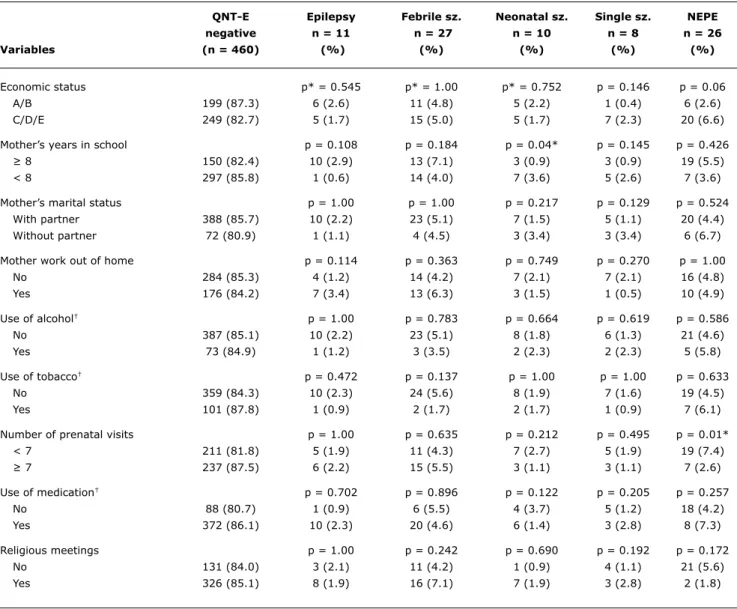
The description of social determinants is presented in Table 3. The sample consisted of a population group of mothers with medium to low educational level, of which 48.5% concluded high school, 29.9% concluded basic education, and 5.7% were illiterate. In addition, 63% were housewives without any other profession, 55% belonged to the low social stratus (C/D/E) and lived in suburbs with less health facilities and with lesser availability of goods and services. Regular presence in religious meetings was high (70.4%), with a predominance of Catholic Church (70%), followed by evangelical churches (26%). Considering the use of health facilities, we have observed that 69.3% used the city network of primary care centers, 25.7% used predominantly emergency care facilities and 13.8% were covered by the system of Family Health Care teams.
The bivariate analysis showed signiicant differences of
mother’s years in school in the group of neonatal seizures (p = 0.04), and less perinatal visits in the group of NEPE (p = 0.01) (Table 3). The model of multivariate analysis did not show any association between social determinants and epilepsy (Table 4).
Discussion
According to Hauser, studies that determine prevalence of epilepsy are important tools for determination of health care needs and may allow hypothesis generation, even though they also may be misleading if used for etiologic studies or to provide information on prognosis. Studies to verify incidence of epilepsy are necessary for proper evaluation of etiologic factors, and incidence cohorts are the most appropriate groups to evaluate prognosis.1 Based on this
Age of type of epilepsy eeg and/or
Patient Sex irst seizure* (etiology) neuroimaging Treatment
1 F 36 Focal symptomatic EEG with slow basal PHB
(hypoxic ischemic background activity, encephalopathy) right focal interictal discharges
2 F 24 Generalized symptomatic EEG with generalized PHB
(hypoxic ischemic encephalopathy) epileptic activity
3 M 11 Generalized idiopathic EEG with slow basal PHB
background activity
4 M 12 Generalized EEG with interictal PHB
generalized discharges
5 M 48 Generalized Normal EEG No AED†
6 F 24 Generalized idiopathic EEG with slow basal CBZ
background, normal CT scan
7 F 6 Generalized symptomatic Normal EEG VPA
(hypoxic ischemic encephalopathy)
8 M 16 Generalized idiopathic Normal CT and EEG PHB
9 M 30 Focal Ictal EEG with CBZ
left rolandic discharges
10 F 24 Benign rolandic epilepsy EEG with left PHB
rolandic discharges, normal CT scan
11 F 22 Generalized symptomatic EEG with interictal OXC
(CNS malformation) generalized discharges table 1 - Characteristics of patients diagnosed with epilepsy
AED = antiepileptic drugs; CBZ = carbamazepine; CNS = central nervous system; CT = computerized tomography; EEG = electroencephalogram; F = female; M = male; OXC = oxcarbazepine; PHB = Phenobarbital; VPA = valproate.
* In months.
† Patient never used regular medication.
Prevalence / Incidence (patients-month)/ Incidence (48 months)/
event n 10,000 patients 100,000 100,000 patients
Epilepsy 11 65.2 11.85 7.0 (3.0-12.0)
Febrile seizures 27 160.0 29.1 16.0 (11.0-24.0)
Other seizures 18 106.7 19.39 11.0 (7.0-17.0)
NEPE 26 154.1 28.0 15.0 (10.0-23.0)
Total 82 486.1 88.34 49.0 (39.0-60.0)
table 2 - Incidence and prevalence of epilepsy, seizures and NEPE in the birth cohort (48th month of follow-up)
RR (raw) RR (adjusted)
Variable (95%CI) p (95%CI) P
Medium-low income 1.56 (0.48-5.05) 0.55 1.12 (0.27-4.70) 0.87
Mother < 8 years in school 0.19 (0.02-1.49) 0.11 5.12 (0.63-41.49) 0.13
Single mother 1.97 (0.26-15.16) 1.00 0.50 (0.62-4.05) 0.52
Mother housewife 2.79 (0.83-9.41) 0.12 0.36 (0.09-1.43) 0.15
Use of alcohol during pregnancy 1.89 (0.25-14.58) 1.00 0.60 (0.07-4.88) 0.64 Use of tobacco during pregnancy 2.70 (0.35-20.87) 0.47 0.42 (0.50-3.47) 0.42
Irregular prenatal care 1.13 (0.34-3.77) 1.00 1.42 (0.36-5.54) 0.62
Qnt-e epilepsy Febrile sz. neonatal sz. Single sz. nePe
negative n = 11 n = 27 n = 10 n = 8 n = 26
Variables (n = 460) (%) (%) (%) (%) (%)
Economic status p* = 0.545 p* = 1.00 p* = 0.752 p = 0.146 p = 0.06
A/B 199 (87.3) 6 (2.6) 11 (4.8) 5 (2.2) 1 (0.4) 6 (2.6)
C/D/E 249 (82.7) 5 (1.7) 15 (5.0) 5 (1.7) 7 (2.3) 20 (6.6)
Mother’s years in school p = 0.108 p = 0.184 p = 0.04* p = 0.145 p = 0.426
≥ 8 150 (82.4) 10 (2.9) 13 (7.1) 3 (0.9) 3 (0.9) 19 (5.5)
< 8 297 (85.8) 1 (0.6) 14 (4.0) 7 (3.6) 5 (2.6) 7 (3.6)
Mother’s marital status p = 1.00 p = 1.00 p = 0.217 p = 0.129 p = 0.524
With partner 388 (85.7) 10 (2.2) 23 (5.1) 7 (1.5) 5 (1.1) 20 (4.4)
Without partner 72 (80.9) 1 (1.1) 4 (4.5) 3 (3.4) 3 (3.4) 6 (6.7)
Mother work out of home p = 0.114 p = 0.363 p = 0.749 p = 0.270 p = 1.00
No 284 (85.3) 4 (1.2) 14 (4.2) 7 (2.1) 7 (2.1) 16 (4.8)
Yes 176 (84.2) 7 (3.4) 13 (6.3) 3 (1.5) 1 (0.5) 10 (4.9)
Use of alcohol† p = 1.00 p = 0.783 p = 0.664 p = 0.619 p = 0.586
No 387 (85.1) 10 (2.2) 23 (5.1) 8 (1.8) 6 (1.3) 21 (4.6)
Yes 73 (84.9) 1 (1.2) 3 (3.5) 2 (2.3) 2 (2.3) 5 (5.8)
Use of tobacco† p = 0.472 p = 0.137 p = 1.00 p = 1.00 p = 0.633
No 359 (84.3) 10 (2.3) 24 (5.6) 8 (1.9) 7 (1.6) 19 (4.5)
Yes 101 (87.8) 1 (0.9) 2 (1.7) 2 (1.7) 1 (0.9) 7 (6.1)
Number of prenatal visits p = 1.00 p = 0.635 p = 0.212 p = 0.495 p = 0.01*
< 7 211 (81.8) 5 (1.9) 11 (4.3) 7 (2.7) 5 (1.9) 19 (7.4)
≥ 7 237 (87.5) 6 (2.2) 15 (5.5) 3 (1.1) 3 (1.1) 7 (2.6)
Use of medication† p = 0.702 p = 0.896 p = 0.122 p = 0.205 p = 0.257
No 88 (80.7) 1 (0.9) 6 (5.5) 4 (3.7) 5 (1.2) 18 (4.2)
Yes 372 (86.1) 10 (2.3) 20 (4.6) 6 (1.4) 3 (2.8) 8 (7.3)
Religious meetings p = 1.00 p = 0.242 p = 0.690 p = 0.192 p = 0.172
No 131 (84.0) 3 (2.1) 11 (4.2) 1 (0.9) 4 (1.1) 21 (5.6)
Yes 326 (85.1) 8 (1.9) 16 (7.1) 7 (1.9) 3 (2.8) 2 (1.8)
table 3 - Comparison of social determinants in patients with QNT-E negative and positive
NEPE = non-epileptic paroxysmal events; QNT = Questionnaire of Neurologic Tracking for Epilepsy; sz. = seizure. * p < 0.05.
† During pregnancy.
Table 4 - Social determinants of patients with epilepsy (n = 11), multivariate analysis
References
1. Hauser WA, Annegers JF, Kurland LT. Incidence of epilepsy
and unprovoked seizures in Rochester, Minnesota: 1935-1984. Epilepsia. 1993;34:453-68.
2. Breivik N, Reiher T. Epilepsy in children in the Sunnmore District.
Tidsskr Nor Laegeforen 2008;128:2049-51.
3. Durá-Travé T, Yoldi-Petri ME, Gallinas-Victoriano F. Incidence of epilepsies and epileptic syndromes among children in Navarre,
Spain: 2002 through 2005. J Child Neurol. 2008;23:878-82.
4. Durá-Travé T, Yoldi-Petri ME, Gallinas-Victoriano F. Epilepsy in
children in Navarre, Spain: epileptic seizure types and epileptic
syndromes. J Child Neurol. 2007;22:823-8.
5. Freitag CM, May TW, Pfäflin M, König S, Rating D. Incidence of
epilepsies and epileptic syndromes in children and adolescents:
a population-based prospective study in Germany. Epilepsia. 2001;42:979-85.
6. Beilmann A, Napa A, Hämarik M, Sööt A, Talvik I, Talvik T. Incidence of childhood epilepsy in Estonia. Brain Dev. 1999;21:166-74. 7. Caraballo R, Cersósimo R, Galicchio S, Fejerman N. Epilepsies
during the irst year of life. Rev Neurol. 1997;25:1521-4. 8. Onsurbe-Ramires I, Hérnandez-Rodrigues M, Aparicio-Meix
JM, Carrascosa-Romero C. Incidence of epilepsy and epileptic syndromes in children in the province of Alabacete. An Esp Pediatr. 1999;51:154-8.
9. Doose H, Sitepu B. Childhood epilepsy in a German city. Neuropediatrics. 1983;14:220-4.
10. Eriksson KJ, Koivikko MJ. Prevalence, classiication, and severity
of epilepsy and epileptic syndromes in children. Epilepsia. 1997;38:1275-82.
Prospective incidence studies help in the proper selection of cases and the exclusion of non-epileptic disorders.4 This
was observed in this study, as before clinical evaluation 553 children (32.8%) had a positive QNT-E, but in the end only
11 cases of epilepsy were conirmed. Most of the instruments
used had open questions, which increased the sensibility for positive cases. Furthermore, they cannot differentiate NEPE that often occur in the pediatric population.
Many previous prevalence and incidence studies of epilepsy have been published before, with results varying from 0.9 to 57 cases per 1,000 inhabitants for prevalence, and 26 to 190 cases per 100,000 inhabitants for incidence.1-16 Most of these variations are due to
methodological differences, as deinition of epilepsy,
diagnose criteria, or prospective or retrospective evaluation of data.27 In this study, data were prospectively collected,
deinitions were previously determined based on ILAE
recommendations,22,26 and all positive cases screened with
the questionnaire were submitted to clinical evaluation for
diagnostic conirmation.
In this birth cohort, a very low incidence and prevalence of epilepsy was reported. A predominance of idiopathic epilepsy in relation to symptomatic was observed (64%), results similar to previous reports.8,12,13 However, other
authors have observed a predominance of cryptogenic and/or symptomatic epilepsy.2,3,6,7,14,15 Differences
among studies might be due to the fact that some cases
could not be classiied into the detailed categories of ILAE classiication.28
Furthermore, a predominance of generalized epilepsy (63%) was also reported. In previous studies assessing only child population, some authors have reported a predominance of focal epilepsy2,3,5,8,11-14 and others of
generalized,6,7,9,10,15 as in our study.
It is important to say that the two steps of our study allowed us to identify patients with seizures that could not
be classiied as epilepsy, namely febrile seizures, neonatal
seizures and single seizures, and that had higher prevalence
and incidence than epilepsy. In addition, the identiication of
NEPE, such as breath-holding spells, allowed us to disclose misdiagnosed cases.
Considering the social determinants analyzed in this study, we were able to identify a predominantly low-income and very religious population, with few years of formal education. However, after the model of multivariate analysis, none of these determinants could be related to epilepsy and seizures. Possible explanations might be due to the low incidence of epilepsy observed, and also to the fact that, although belonging to the medium-low socioeconomic level of the society, the majority of the study population had access to health facilities from primary to tertiary care.
In a previous study developed in southern Brazil, a higher prevalence of seizures was reported (45.2/1,000
children), and the absence of tap water and precarious
housing were signiicantly associated with the outcome.29
Differently from our study, this one was performed in one single section of the city, considered very poor. In other two epilepsy population surveys developed in southeast Brazil
(São Paulo), it was observed, in children aged from 0 to
4 years, a lifetime prevalence of epilepsy of 2.8 per 1,000 children, and of active epilepsy of 2.3 per 1,000 children, which was a little lower than the outcomes reported in our study.30,31
In conclusion, a low incidence rate of epilepsy was
reported in this speciic birth cohort population, in contrast
to almost a double incidence of febrile seizures and NEPE. Additionally, the achievement of an accurate diagnosis of epilepsy in developing countries is a challenge, and misdiagnosis should be avoided in order to establish the correct treatment. Moreover, population-based studies assessing the prevalence of epilepsy are relevant to better planning of health care activities.
Acknowledgements
We acknowledge gratefully Rodrigo Guerra Casarin,
Josevane Conte, Maria Lucia Dal Magro, Stela Maris Zanette, Vagner José de Albuquerque, Dayane Lodi de Oliveira, Aniele
11. Oka E, Ohtsuka Y, Yoshinaga H, Murakami N, Kobayashi K, Ogino T. Prevalence of childhood epilepsy and distribution of epileptic
syndromes: a population-based survey in Okayama, Japan.
Epilepsia. 2006;47:626-30.
12. Kwong KL, Chak WK, Wong SN, So KT. Epidemiology of childhood epilepsy in a cohort of 309 Chinese children. Pediatr Neurol. 2001;24:276-82.
13. Berg AT, Shinnar S, Levy SR, Testa FM. Newly diagnosed epilepsy in
children: presentation at diagnosis. Epilepsia. 1999;40:445-52.
14. Waaler PE, Blom BH, Skeidsvoll H, Mykletun A. Prevalence,
classiication, and severity of epilepsy in children in western
Norway. Epilepsia. 2000;41:802-10.
15. Ramos Lizana J, Carrasco Marina L, Vázquez López M, Calvo Bonachera C, Cassinello Garcia E. Epidemiology of epilepsy in
pediatric age: types of epileptic crises and epileptic syndromes.
An Esp Pediatr. 1996;45:256-60.
16. Camield CS, Camield PR, Gordon K, Wirrell E, Dooley JM. Incidence
of epilepsy in childhood and adolescence: a population-based study
in Nova Scotia from 1977 to 1985. Epilepsia. 1996;37:19-23. 17. Forsgren L. Prospective incidence study and clinical characterization of
seizures in newly referred adults. Epilepsia. 1990;31:292-301. 18. United Nations Development Program for Brazil. Millennium
Development Goals. 2000. http://www.undp.org/mdg/basics. shtml. Access: nov, 10, 2009.
19. WHO. A Conceptual Framework for Action on the Social Determinants of Health. Geneve: Commission on Social Determinants of Health; 2007.
20. Brazil. The Brazilian Institute of Geography and Statistics. 2000’s Demographic Cense. http://www.ibge.gov.br. 2009. Access: Nov, 10, 2009.
21. Geib LT, Nunes ML. The incidence of sudden death syndrome in a cohort of infants. J Pediatr (Rio J.) 2006;82:21-6.
22. Guidelines for epidemiologic studies on epilepsy. Commission
on Epidemiology and Prognosis, International League Against
Epilepsy. Epilepsia. 1993;34:592-6.
23. Fernandes JG, Schmidt MI, Tozzi S, Sander JW. Validation and comparison of screening questionnaires for populational studies of epileptic seizures. Epilepsia. 1992;33:S132-3.
24. Shorvon SD, Hart YM, Sander JW, van Andel F. The Management of Epilepsy in Developing Countries: An ICEBERG (International Community-Based Epilepsy Research Group) Manual. London: Royal Society of Medicine Services, 1991.
Correspondence: Magda L Nunes
Serviço de Neurologia, Hospital São Lucas Av. Ipiranga, 6690, sala 220
CEP 90610-000 – Porto Alegre, RS – Brazil Tel.: +55 (51) 3339.4936
Fax: +55 (51) 3339.4936 E-mail: [email protected]
25. World Health Organization. Research protocol for measuring the prevalence of neurological disorders in developing countries. Neuroscience Program. Geneva. WHO, 1981.
26. Proposal for revised clinical and electroencephalographic
classiication of epileptic seizures. From the Commission on Classiication and Terminology of the International League Against
Epilepsy. Epilepsia. 1981;22:489-501.
27. Sander JW, Shorvon SD. Incidence and prevalence studies in
epilepsy and their methodological problems: a review. J Neurol Neurosurg Psychiatry. 1987;50:829-39.
28. Engel J Jr; International League Against Epilepsy (ILAE). A proposed diagnostic scheme for people with epileptic seizures
and with epilepsy: report of the ILAE Task Force on Classiication
and Terminology. Epilepsia. 2001;42:796-803.
29. Abib CR, Mendoza-Sassi RA, Bech-Nappi J, Stein AT. Prevalence
of seizures and associated factors in children under ive living in
a deprived municipality of southern Brazil. Arq Neuropsiquiatr. 2007;65:581-6.
30. Noronha AL, Borges MA, Marques LH, Zanetta DM, Fernandes PT, de Boer H, et al. Prevalence and pattern of epilepsy treatment in different socieconomic classes in Brazil. Epilepsia. 2007;48:880-5.