ARTIGO ARTICLE
1 Laboratório de Epidemiologia, Universidade do Extremo Sul Catarinense. Av. Universitária 1105, Pinheirinho. 88.806-000 Criciuma SC. [email protected]
2 Universidade Fronteira Sul.
A randomized clinical trial on the effects of remote
intercessory prayer in the adverse outcomes of pregnancies
Ensaio clínico randomizado sobre os efeitos
da oração intercessória nos desfechos adversos da gestação
Resumo Este artigo tem por objetivo investigar se a oração intercessória influencia os desfechos ad-versos das mulheres grávidas. Foi realizado ensaio clínico randomizado duplo-cego com uma popu-lação de 564 gestantes que frequentavam Serviço de pré-natal de serviço público de saúde. As ges-tantes foram aleatoriamente designadas para gru-po de intercessão ou grugru-po controle (n = 289 gru-por grupo). Foram avaliados os seguintes parâmetros: índice de Apgar, tipo de parto, peso ao nascer. A idade média das mulheres foi de 25,1 anos (±7,4) e a idade gestacional média foi de 23,4 semanas (± 8,1). A média de anos de escolaridade foi de 8,1 anos (± 3,1). As mulheres que receberam inter-venção (Oração intercessória) e grupo controle exibiram um número similar de eventos adversos, com p não significativo. Não encontramos dife-rença significativa entre os desfechos adversos na gestação entre os grupos que receberam oração in-tercessória e no grupo controle.
Palavras-chave Oração intercessória, Ensaio
clí-nico randomizado, Gestantes, Macrossomia, Ap-gar, Baixo peso
Abstract The scope of this article was to investi-gate whether intercessory prayer (IP) influences the adverse outcomes of pregnancies. A double-blind, randomized clinical trial was conducted with 564 pregnant women attending a prenatal public health care service. The women were ran-domly assigned to an IP group or to a control group (n = 289 per group). They were simultaneously and randomly assigned to practice prayer off-site or not. The following parameters were evaluated: Apgar scores, type of delivery and birth weight. The mean age of the women was 25.1 years of age (± 7.4), and the average gestational age was 23.4 weeks (± 8.1). The average number of years of schooling for the women was 8.1 years (± 3.1). The women in the IP and control groups present-ed a similar number of adverse mpresent-edical events with non-significant p. No significant differences were detected in the frequency of adverse outcomes in pregnant women who practiced IP and those in the control group.
Key words Intercessory prayer, Randomized
cli-nical trial, Pregnant women, Excess birth weight, Apgar scores, Birth weight
Maria Inês da Rosa 1
Fabio Rosa Silva 1
Bruno Rosa Silva 1
Luciana Carvalho Costa 1
Angela Mendes Bergamo 1
Napoleão Chiaramonte Silva 1
Lidia Rosi de Freitas Medeiros 1
Iara Denise Endruweit Battisti 2
Rosa MI
Introduction
Praying for help and healing is a fundamental practice in most societies; however, the object to which these prayers are directed varies among the religions in the world1. Ninety five percent of
Americans claim to believe in God, and 58% re-port that religion forms is a very imre-portant part of their lives2.Many Americans also use religious
activity to cope with stressful life events, such as, a diagnosis of cancer3. Although religion is
im-portant to many patients, physicians tend to ig-nore the religious beliefs of their patients when taking care of them4.
In 2001, the US National Center for Comple-mentary and Alternative Medicine defined “fron-tier medicine” as a group of therapies “for which there is no plausible biomedical explanation”5.
There are many different forms of prayer, such as, organized prayer to God according to an ad-vanced belief system, individual sporadic prayer, spiritual healing, meditation and thanksgiving. Prayers can be spoken from within the frame-work of a variety of faiths and also by individu-als who do not ascribe to a particular, formalized belief system.
Many studies claim to have demonstrated the effectiveness of intercessory prayer(IP) in im-proving disease6,7. Byrd6 measured the efficacy of
IP in curing diseases. They found that 14% of the subjects who practiced IP and 22% of the sub-jects in the control group had a poor outcome during hospitalization, and this difference was statistically significant.
However, many of these claims are not ade-quately supported.One meta-analysis of 14 con-trolled studies concluded that there is no scientif-ically discernible treatment effect for IP8.
Addi-tional reports in the literature are inconclusive, and the general consensus in the field is that the current evidence is compelling enough to war-rant further investigation. Although the results of individual studies suggest a positive treatment effect of IP, most of the studies do not support this claim because the evidence does not support a recommendation either in favor or against prac-ticing IP9.Therefore, the aim of this study was to
investigate whether IP had an effect on the ad-verse outcomes of a group of pregnant women.
Methods
Trial design
We conducted a double blind, randomized controlled trial with 564 pregnant women attend-ing a prenatal care public health service clinic be-tween February 2008 and December 2008. The study was approved by the University of Extremo Sul Catarinense Ethics Committee. All partici-pants signed an informed consent.
Participants
Pregnant women (578) were enrolled into the study. The exclusion factor was being pregnant for over 37 weeks because of the proximity of the delivery could not do the intervention on time.
Intervention
A group of six women, who were selected to pray for nine consecutive days, the same pray for all pregnant women from the intervention group. The group of women who practiced IP was coor-dinated by a theologian, who led a prayer asking for a good delivery and a healthy newborn.
Outcomes
The outcomes analyzed were as follows: type of delivery, Apgar scores, birth weight and mac-rossomy. The independent variables analyzed were: age, length of gestation, associated diseas-es, belief in God and religion. All variables were dichotomized.
Sample size
Based on Byrd’s study6 we evaluated the table
that represents the calculation for the different proportions using the chi-square test to compare the proportions of dichotomous variables10.
Based on this evaluation, we found that, consid-ering a bidirectional alpha = 0.05 and beta = 0.20, the difference between the proportions was 10%, for a total number of 289 women per group. In this study 578 pregnant women were enrolled at baseline.
Randomization
numbers to the subjects. After enrollment was complete, a staff member used a random num-ber table to assign study codes to each of the subjects’ enrollment numbers. These codes were then randomized by a computer. Only this re-searcher had knowledge of who was in the treat-ed group, and control group and this research was who contacted the coordinator of the group of intercessors providing the first name of the pregnant woman. The patients were then simul-taneously and randomly assigned to practice or not to practice prayer off-site. Half of the pa-tients were randomly assigned to the IP group, and the other half was assigned to the control group (n = 289 per group).
Blinding
This study was double blind. None pregnant woman knew if would receive intercessory prayer or not. There searcher also had no knowledge of who was the group that received the intervention and who did not. The IP group coordinator was blinded to the identity of the subjects, with only the subjects’ first name being provided.
Statistical analysis
The baseline continuous variables were com-pared using the Student t-test. The baseline and outcome categorical variables were compared using the chi-square test. Risk ratios and 95%
CIs were used for the comparison of the groups. A Poisson robust regression model was used to evaluate whether baseline covariates, were asso-ciated with the occurrence of complications in the delivery and to assess the consistency of the unadjusted and final models. Pre-specified cova-riates were included in model, and variables with P-values of less than 0.05 were retained in the final models. Statistical analyses were performed using STATA version 9 software.
Results
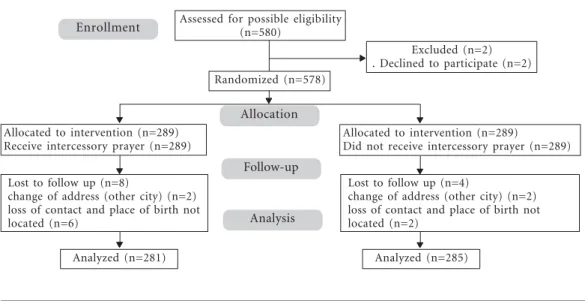
Eight pregnant women from the IP group and five from the control group were lost during fol-low-up. Therefore, our final analysis included 281 pregnant women from the IP group and 285 preg-nant women from the control group (Figure1).
The mean age of the women was 25.1 years old (± 7.4), and the average gestational age was 23.4 weeks (± 8.1). The average years of school-ing for the women was 8.1 years (± 3.1). As shown in Table 1, the two groups of women had similar baseline characteristics. The only difference be-tween the groups was the number of abortions that they had previously undergone (P = 0.007). Both groups of women had a similar num-ber of serious medical adverse events, including spontaneous abortion (p = 0.53), intrauterine death and stillbirth (p = 0.30), low Apgar score (p = 0.34), preterm birth (p = 0.33), small size
Enrollment
Allocation
Follow-up
Analysis
Assessed for possible eligibility (n=580)
Excluded (n=2) . Declined to participate (n=2) Randomized (n=578)
Allocated to intervention (n=289)
Did not receive intercessory prayer (n=289)
Analyzed (n=285) Analyzed (n=281)
Allocated to intervention (n=289) Receive intercessory prayer (n=289)
Lost to follow up (n=8)
change of address (other city) (n=2) loss of contact and place of birth not located (n=6)
S S S S S
SSSSS
Lost to follow up (n=4)
change of address (other city) (n=2) loss of contact and place of birth not located (n=2)
S SS SS S SS SS S SS SS
S S S S S S S S S S S S S S S
Rosa MI
for gestational age (p = 0.62), macrossomy (p = 0.09), cesarean delivery (p = 0.68) and malfor-mation (p = 0.99) (Table 2).
Characteristic
Age
2 - 34 years
< 19 years > 35 years Age (mean ± s.d.) Gestational age
> 33 weeks 25 - 32 weeks 13 - 24 weeks < 12 weeks
Gestational age (mean ± s.d.) Education
Elementary school educ. Incomplete secondary educ. Marital status
Married/partner Single/Separated Previous pregnancy (yes) Previous abortions (yes) Religion
None Catholic Gospel Other
Table 1. Baseline characteristics of the subjects.
Control Group (n= 285)
167 (58.8%) 117 (41.2%) 25.58 ± 7.53
59 (20.9%) 71 (25.2%) 123 (43.6%) 29 (10.3%) 24.13 ± 8.09
173 (60.9%) 111 (39.1%)
244 (85.9%) 40 (14.1%) 159 (55.8%) 52 (18.3%)
22 (7.8%) 168 (50.2%) 90 (31.7%) 4 (1.4%)
Prayer group (n= 281)
160 (57.1%) 120 (42.9%) 24.63 ± 7.27
45 (16.1%) 60 (21.5%) 141 (50.5%) 33 (11.8%) 22.59 ± 8.06
164 (58.4%) 117 (41.6%)
236 (84.0%) 45 (16.0%) 149 (53.0%) 29 (10.3%)
26 (9.3%) 168 (59.8%) 81 (28.9%) 6 (2.1%)
* Using chi-square test.
Characteristics
Apgar score at 5 min 0-3
4-7 8-10 Preterm (yes) Birth weight
Small for gestational age (10th percentile)
Macrossomy (> 4000g) Birth weight (mean ± s.d.) Type of delivery
Vaginal Cesarean
Table 2. Outcome of the patients.
Control Group (n= 285)
1 (0.5%) -191 (99.5%)
13 (6.0%)
15 (7.8%) 12 (6.3%) 3218,59 ± 516,88
109 (50.9%) 105 (49.1%)
Prayer group (n= 281)
1 (0.6%) 2 (1.1%) 178 (98.3%)
8 (3.9%)
12 (6.5%) 5 (2.7%) 3248,65 ± 517,19
108 (52.9%) 96 (47.1%)
* Using chi-square test.
p-value*
0.344 0.330
0.628 0.099 0,575
0.681 Discussion
Distant IP appears to have no significant effect on the outcome of pregnant women. This rigorously designed blind, randomized controlled trial con-ducted with pregnant women showed no signifi-cant effect in adverse outcomes of distant IP. How-ever, there are numerous challenges when design-ing and conductdesign-ing a study of IP. First, because there is no accepted scientific basis for the effects of IP on illness, it is very difficult to select a biolog-ically relevant patient outcome to study in a clin-ical trial. Also, the selected outcome may not be associated with the effects of IP, making it difficult to interpret the results of such a study. Second, the duration of IP that should be practiced to observe an effect is not known, which is due, in part, to the lack of a biological basis for the effects of IP. Investigations of the potential therapeutic effects of IP have been conducted on a variety of health areas including: cardiology6,11,12,diabetes13,
alcoholism14, mental health15, arthritis16,
infec-tions17 and fertility18. Additionally, because the type
(interces-sory prayer) only includes the IP provided by the intercessors, not the effect or result of communi-cation with God. Fourth, documentation of how and when IP is practiced and the inclusion of a specific intention may interfere with the usual prac-tice of the intercessors. The IP pracprac-ticed during a clinical trial may be different from the IP usually conducted by the intercessors, limiting the inter-pretation of the results. Given these challenges, it is not surprising that previous studies of IP are controversial18,19.
Only a few clinical trials have found an asso-ciation between remote prayer and adverse out-comes (generally defined as intermediate clinical endpoints, self-reported health status, morbidi-ty or mortalimorbidi-ty). In a trial of 393 coronary care unit (CCU) patients, Byrd6 found a statistically
significant positive effect between Christian prayer “to a Judeo-Christian God” and six out of 26 outcome variables, as well as with a global hos-pital course score. Harris et al.11 replicated Byrd’s
findings, finding no effect on 31 additional clini-cal variables. However, Harris et al.11 developed a
CCU course score specific to their study, which improved significantly (by 10%) in the subjects who prayed.
A recent systematic review of the literature described multiple randomized trials in which other interventions versus personal, focused, committed and organized IP (guided by interces-sors holding some belief that they are praying to God or a god) were compared. The review de-scribed prayer that was offered on behalf of any-one with health problems and included ten stud-ies (7646 total patients). A comparison of IP plus standard care versus standard care alone revealed that there was no clear effect of IP on death; the effect of IP on death was not statistically signifi-cant, and the data were heterogeneous [6 domized controlled trials (RCTs), n = 6784, ran-dom-effects, RR: 0.77, CI: 0.51 to 1.16, I2: 83%]. Additionally, there was no significant difference between the groups with respect to their general clinical state (5 RCTs, n = 2705, RR intermediate or bad outcome: 0.98, CI: 0.86 to 1.11). Four stud-ies found no effect of IP on re-admission to the CCU (4 RCTs, n = 2644, RR: 1.00, CI: 0.77 to 1.30), and two other trials found that IP had no effect on re-hospitalization rate (2 RCTs, n = 1155, RR: 0.93, CI: 0.71 to 1.22). Overall, the review
con-cluded that, although the findings are equivocal and some of the results suggest a positive treat-ment effect of IP, most studies do not reach this conclusion, and the evidence does not support a recommendation either for or against the use of IP. We are not convinced that further trials of IP should be undertaken and rather suggest that any resources available for such a trial should be used to investigate other questions in healthcare9.
Jør-gensen et al.20 made a critical analysis of the above
mentioned systematic review saying that, “this Cochrane Reviews article, which evaluates a mix-ture of theological and scientific arguments, is unsound and unhelpful and would, if accepted, make all scientific endeavors meaningless. The re-view fails badly to live up to the high standards required for Cochrane Reviews, and we therefore suggest it be withdrawn”. Our negative findings do not imply that therapeutic relationships and positive therapeutic intent do not have beneficial treatment effects for individual patients. Rather, we suggest that additionally studies using differ-ent methodological approaches are required.
The evidence-based medicine (EBM) move-ment was established to combat capricious rea-soning in clinical care, particularly arguments from authorities in the field. The critique of au-thority and appraisal of evidence remain EBM’s core values and should be revisited in this era of EBM’s maturity and influence. We are now faced with a new form of under-questioned authority and evidence from well-designed and method-ologically appraised RCTs. The evidence from RCTs is now prized, even when it is incapable of providing meaningful information, particularly when the underlying causal theory is inscrutable. The evidence obtained from experimental trials in support of remote IP provides us with an il-lustrative view that highlights systematic scien-tific blind spots in the institutions of EBM. At its core, medicine, including evidence-based medi-cine, is based on theory. Thus, EBM must culti-vate greater capacity to address the crucial role of theory in both the generation and use of experi-mental evidence21.
This study was designed, conducted and re-ported in accordance with the Consolidated Stan-dards of Reporting Trials (CONSORT)22. The
Rosa MI
Collaborators
FR Silva, MI Rosa, designed the study, drafted the manuscript and analyzed the data. BR Silva, AM Bergamo, LC Costa, R Azevedo and IDE Battisti conceptualized the study, interpreted the data and critically evaluated the manuscript. LR Medeiros, NC Silva and MI Rosa revised and crit-ically evaluated the manuscript.
Aviles JM, Whelan SE, Hernke DA, Williams BA, Kenny KE, O’Fallon WM, Kopecky SL. Intercessory prayer and cardiovascular disease progression in a coronary care unit population: A randomized con-trolled trial. Mayo Clin Proc 2001; 76(12):1192-1198. Wirth D, Mitchekk B. Complementary healing ther-apy for patients with Type 1 Diabetes Mellitus. J Sci
Explor 1994; 8(3):350-361.
O’Laoire S. An experimental study of the effects of distant, intercessory prayer on self-esteem anxiety, and depression. Altern Ther Health Med 1973; 3(6):38-53.
Matthews DA, Marlowe SM, MacNutt FS. Effects of intercessory prayer on patients with rheumatoid arthritis. South Med J 2000; 93(12):1177-1786. Leibovici L. Effects of remote, retroactive interces-sory prayer on outcomes in patients with blood-stream infection: A randomized controlled trial. Br
Med J 2001; 323(7327):1450-1451.
Cha KY, Wirth DP, Lobo RA. Does prayer influence the success of in vitro fertilization-embryo trans-fer? Report of a masked, randomized trial. J Reprod Med 2001; 46(9):781-787.
Dusek JA, Sherwood JB, Friedman R, Myers P, Bethea CF, Levitsky S, Hill PC, Jain MK, Kopecky SL, Mueller PS, Lam P, Benson H, Hibberd PL. Study of the Therapeutic Effects of Intercessory Prayer (STEP): study design and research methods.
Am Heart J 2002; 143(4):577-584.
Oldnall AS. On the absence of spirituality in nursing theories and models. J Adv Nurs 1995; 21(3):417-418. Jørgensen KJ, Hróbjartsson A, Gøtzsche PC. Di-vine Intervention? A Cochrane review on interces-sory prayer gone beyond science and reason. J Negat
Results Biomed 2009; 8:7.
Giacomini M. Theory-Based Medicine and the Role of Evidence Why the Emperor Needs New Clothes, Again. Perspect Biol Med 2009; 52(2):234-251. Moher D, Schulz KF, Altman D. The CONSORT statement: revised recommendations for improv-ing the quality of reports of parallel-group rand-omized trials. JAMA 2001; 285(15):1987-1991. Schulz KF, Altman DG, Moher D, CONSORT Group. CONSORT 2010 Statement: Updated guidelines for reporting parallel group randomised trials. J Clin
Epidemiol 2010; 63(8):834-840
Artigo apresentado em 20/06/2012 Aprovado em 17/09/2012
Versão final apresentada em 02/10/2012 12.
13.
14.
15.
16.
17.
18.
19. 20.
21.
22.
23. References
Spivak CD. Hebrew prayers for the sick. Ann Med Hist 1917;1:83-85.
Gallup G. Religion in America 2000. Princeton: Prin-ceton Religious Research Center; 2000.
Eisenberg DM, Davis RB, Ettner SL, Appel S, Wilkey S, Van Rompay M, Kessler RC. Trends in alterna-tive medicine use in the United States, 1990-1997: results of a follow-up national survey. JAMA 1998; 280(18):1569-1575.
Maugan TA, Wadland WC. Religion and family medicine: a survey of physicians and patients. J
Fam Pract 1991; 32(2):210-213.
Straus S, Nahin R. Minutes of the Sixth Meeting. Bethesda: National Center for Complementary and Alternative Medicine; (Feb 5)2001. [serial on the Internet]. [cited 2013 Jun 21]. Available from: http:/ /nccam.nih.gov/about/naccam/minutes/2001 feb.htm?nav=gsa
Byrd RC. Positive therapeutic effects of intercesso-ry prayer in a coronaintercesso-ry care unit population. South
Med J 1988; 81(7):826-829.
Krucoff MW, Crater SW, Green CL, Maas AC, Ses-kevich JE, Lane JD, Loeffler KA, Morris K, Bashore TM, Koenig HG. Integrative noetic therapies as adjuncts to percutaneous intervention during un-stable coronary syndromes: Monitoring and Actu-alization of Noetic Training (MANTRA) feasibility pilot. Am Heart J 2001; 142(5):760–769.
Masters KS, Spielmans GI, Goodson ST. Are there demonstrable effects of distant intercessory prayer? A meta-analytic review. Ann Behav Med 2006; 32(1):21-26.
Roberts L, Ahmed I, Hall S. Intercessory prayer for the alleviation of ill health. Cochrane Database
Sys-tem Rev 2000; (2):CD0003688.
Browner WS, Newman TB, Cummings SR, New-man TB. Estimating sample size and power: the nitty-gritty. In: Hulley SB, Cummings SR, Browner WS, Grady D, Hearst N, Newman TB. Designing Clinical Research. 3th Edition. Philadelphia:
Linp-pincott, Williams & Wilkins; 2001. p. 65-93. Harris WAS, Gowda M, Kolb JW. Strychacz CP, Vacek JL, Jones PG, Forker A, O’Keefe JH, McCal-lister BD. A randomized, controlled trial of the ef-fects of remote, intercessory prayer on outcomes in patients admitted to the coronary care unit. Arch
Intern Med 2000; 159(19):2273-2278.
1. 2. 3.
4.
5.
6.
7.
8.
9.
10.
11.
Acknowledgments