Dement Neuropsychol 2017 June;11(2):202-205
202
202 Transient Gerstmann syndrome as manifestation of stroke João et al.
Case Report
Transient Gerstmann syndrome
as manifestation of stroke
Case report and brief literature review
Rafael Batista João1, Raquel Mattos Filgueiras2, Marcelo Lucci Mussi3, João Eliezer Ferri de Barros4
ABSTRACT. Gerstmann Syndrome (GS) is a rare neurological condition described as a group of cognitive changes corresponding to a tetrad of symptoms comprising agraphia, acalculia, right-left disorientation and finger agnosia. It is known that some specific brain lesions may lead to such findings, particularly when there is impairment of the angular gyrus and adjacent structures. In addition, the possibility of disconnection syndrome should be considered in some cases. The purpose of this article is to report a case of a young, cardiac patient, non-adherent to treatment, who presented with a stroke in which transient clinical symptoms were compatible with the tetrad of GS. The case report is followed by a discussion and brief review of the relevant literature.
Key words: Gerstmann syndrome, disconnection syndrome, insular cortex, parietal lobe, frontal lobe.
SÍNDROME DE GERSTMANN TRANSITÓRIA COMO MANIFESTAÇÃO DE ACIDENTE VASCULAR ENCEFÁLICO: RELATO DE CASO E BREVE REVISÃO DE LITERATURA
RESUMO. A síndrome de Gerstmann (SG) é uma condição neurológica rara, caracterizada por um grupo de alterações cognitivas que correspondem a uma tétrade composta por agrafia, acalculia, desorientação direita-esquerda e agnosia para dedos. Sabe-se que certas lesões encefálicas específicas podem levar a tais achados, particularmente quando ocorre acometimento do giro angular e estruturas adjacentes. Além disso, a possibilidade de síndrome de desconexão deve ser considerada em alguns casos. O propósito deste artigo é relatar o caso de um paciente jovem cardiopata e não aderente ao tratamento que se apresentou com uma síndrome encéfalo-vascular associada a alterações clínicas transitórias compatíveis com a tétrade da SG. Este relato de caso é acompanhado de discussão e breve revisão de dados pertinentes da literatura.
Palavras-chave: síndrome de Gerstmann, síndrome de desconexão, córtex insular, lobo parietal, lobo frontal.
INTRODUCTION
G
erstmann’s syndrome (GS) is a rare clini-cal condition that has been extensively studied by neuroscience researchers, particu-larly in the ield of neuropsychology. Clas-sically, this syndrome comprises a tetrad of symptoms: acalculia, agraphia, inger agnosia and right-left disorientation.1 he literature documents that lesions in the dominant hemisphere can result in these cognitive changes,2 which are occasionally associated with aphasic disorders.3 We report a case of transient GS in a young adult patient.CASE REPORT
A 43-year-old male right-handed patient, a student in use of illegal anabolic steroids with a 2-year history of mitral valve replacement (biological) and atrial ibrillation without regular follow-up, presented at the emer-gency room with complaints compatible with sudden onset of language impairments and right sensorimotor hemiparesis with facio-brachial predominance. On admission assess-ment, vital signs were stable and the blood glucose test ruled out hypo or hyperglycemia. he general clinical exam revealed irregular
This study was conducted at the Hospital Municipal Dr Jose de Carvalho Florence, Sao José dos Campos, SP, Brazil.
1,2,3,4Hospital Municipal Dr Jose de Carvalho Florence, Sao José dos Campos, SP, Brazil.
Rafael Batista João. Avenida Juscelino Kubischek, 5490 / 145 – 12215-380 São José dos Campos SP – Brazil. E-mail: [email protected]
Disclosure: The authors report no conflicts of interest.
Received January 05, 2017. Accepted in final form March 23, 2017.
Dement Neuropsychol 2017 June;11(2):202-205
203
João et al. Transient Gerstmann syndrome as manifestation of stroke
heartbeat, systolic murmur in the mitral region (3+/6+) radiating to the left midaxillary line, and no other abnormalities. On the neurological exam performed around 6 hours after ictus (a few minutes after patient arrival at hospital), the patient was alert, collaborative in performing the exam and spatially and temporally well-oriented. he strength exam revealed labial commissure deviation to the left and paresis of the proximal right upper limb (strength grade IV+). Results on coordina-tion and sensory tests of all modalities were normal.
Neuropsychological assessment revealed aphasia characterized by low luency (speech output of less than 10 words per minute); repetition inability; diiculty in naming simple objects and in spontaneous naming on word-list generation task (fewer than 12 animals per minute); absence of ideomotor apraxia for transitive and intransitive gestures; agraphia characterized by dif-iculty writing letters and words spontaneously, dictated or copied; acalculia for low complexity addition and sub-traction sums; inger agnosia (inability to follow com-mand to move speciic inger of one hand upon touching of inger on opposite hand by examiner, in addition to diiculty recognizing ingers of own hand) and right-left disorientation, for example, when requested to point to right foot with left hand.
Cranial computed tomography (CT) exam on admis-sion was normal while electrocardiogram disclosed irregular rhythm and absence of p wave, with no isch-emic changes. It is important to note that no echocar-diographer was available at the time to provide an emer-gency assessment.
At the time the patient was seen by the neurology team, he was considered ineligible for endovenous thrombolysis owing to the time interval of over four
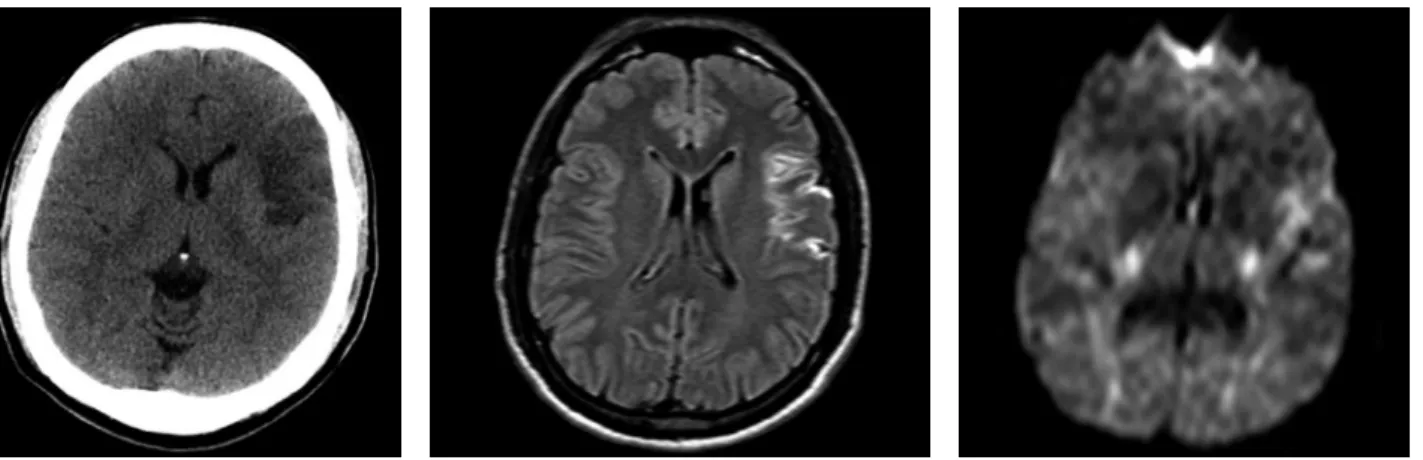
and a half hours between the onset of clinical symptoms and arrival at the emergency room. Submitted to clinical support, the patient attained a stable condition with-out complications. Approximately 30 hours after clinical symptoms onset, the patient had good general health status and no motor deicits. Another neuropsychologi-cal assessment revealed preserved comprehension, abil-ity to produce complete simple and complex sentences, occasionally associated with diiculty in expression and in naming simple objects, and no abnormalities in writing letters, words or complete sentences, exhibit-ing preserved right-left orientation and exhibit-inger gnosia in response to the same prompts given in the admissions exam. Cranial CT performed 72 hours post-ictus revealed a hypodense area in the left inferior frontal lobe (Figure 1). Brain Magnetic Resonance Imaging (MRI) performed during outpatient follow-up disclosed hypersignal and restricted difusion in the left anterior and posterior insular cortex (Figures 2 and 3), with sparing of the topography corresponding to the angular and supramar-ginal gyri. During follow-up, the patient was referred for neuropsychological rehabilitation and to the outpatient clinic in use of warfarin as a secondary prophylactic.
DISCUSSION
In 1924, Austrian neurologist Joseph Gerstmann described the case of a 53-year-old patient presenting with agraphia, acalculia, right-left disorientation and diiculty moving speciic ingers when requested by the examiner, clinical indings related to cerebrovascular syndrome with left hemisphere involvement.2
hree years later, the same author reported two simi-lar cases exhibiting constructional apraxia, anomia for colors and diiculty reading numbers but not words.4
Figure 1. Cranial Computed Tomography in axial section showing hypodense area in the left inferior frontal gyrus topography.
Figure 2. Brain Magnetic Resonance Imaging (FLAIR) in axial section showing hypersignal in the left an-terior and posan-terior insular cortex topography, with sparing of the left angular and supramarginal gyri.
Dement Neuropsychol 2017 June;11(2):202-205
204 Transient Gerstmann syndrome as manifestation of stroke João et al. However, it was in 1940, when Gerstmann’s work was published in English, that the syndrome became known in the global academic milieu. In that same year, GS was characterized by the tetrad comprising: agraphia, acalcu-lia, inger agnosia and right-left disorientation.1
In the decades that followed, a strong relationship between lesions in the dominant hemisphere and GS was conirmed, more speciically in the angular gyrus of the parietal lobe.5-8 Lesions in this gyrus are associ-ated predominantly with the symptoms of agraphia and acalculia.9
In 1984, Morris et al. reported the case of a patient with transient indings compatible with GS after stimula-tion of the posterior perisylvian region, more speciically in the transition between the angular and supramarginal gyri.10 In 2003, Roux et al. found abnormalities involv-ing writinvolv-ing, calculatinvolv-ing and involv-inger recognition usinvolv-ing the brain mapping technique in the left angular gyrus of 6 right-handed patients submitted to tumor resection.11
Even in cases where the angular gyrus is spared, lesions immediately subcortical to this area, or involv-ing the mesial occipital cortex or splenium of the corpus callosum, may also lead to agraphia and/or acalculia.12 In addition, in cases of GS with sparing of the classi-cally involved areas, the hypothesis of disconnection syndrome involving lesions to association ibers joining diferent cortical and subcortical regions should also be considered.13
Seven years ago, Rusconi et al. revisited various aspects of GS, including their irst description and the importance of the applicability of the concept of the dis-connection syndrome in this context. he authors stated that certain recent studies employing the neurofunc-tional imaging technique, such as those performed using tractography, suggest that the group of clinical symp-toms of GS perhaps should not be attributed exclusively to one speciic neuronal group.14 his evidence again brought to the fore criticisms of Gerstmann made by some authors, such as Critchley, in the mid-1960s, when the localizing value of the syndrome was questioned.15
In view of these considerations, it is noteworthy to mention the insular cortex and its interaction with other areas. his structure has a reciprocal connection with the parietal operculum, anterior inferior parietal cortex, somatosensory cortex, retroinsular parietal region,16 orbitofrontal and pre-frontal cortex, frontal operculum and eferent pathways to the inferior fron-tal gyrus and Brodmann’s areas 6 and 12.17 As is known, lesions located immediately deep to the insular cortex, more precisely in the extreme capsule, may cause discon-nection of short association ibers between frontal and
parietal operculae and lead to disruption of frontopari-etal circuitry.18,19
In 2014, a case was reported of an elderly patient with dyscalculia, dysgraphia and right-left confusion (with-out inger agnosia) secondary to ischemic injury of the left posterior insula and temporal-parietal operculum, without lesions of the angular and supramarginal gyri.19
Recently, several articles have suggested a relation-ship between the frontal lobe and GS. In 2013, Heymi Lee et al. published two cases in which Brain MRI dis-closed middle and inferior frontal gyri and basal ganglia impairment as a result of ischemic stroke with hemor-rhagic transformation in the irst case, and involvement of the inferior frontal gyrus, pars opercularis and trian-gularis secondary to the compression efect by glioma in the second case. Neurological exams in both patients revealed the four typical symptoms of GS.20
In 2016, Eun-Ju Lee et al. published two cases of patients that had clinical symptoms compatible with the GS tetrad, where ischemic lesion of the left medial frontal lobe was found on Brain MRI, with sparing of the angular and supramarginal gyri and adjacent structures. In these articles, the authors attributed the indings to the possibility of disconnection between the association ibers and suggested the importance of the cortical and subcortical regions of the left frontal lobe in the phys-iopathogenesis of GS, given there is a strong connection between these areas and the parietal lobe.21
Our review of the literature lead us to believe that the changes initially observed on the patient’s neuro-logical exam may have been attributed to mechanisms related to the disconnection syndrome secondary to ischemic injury of the territories of association ibers between frontal and parietal lobes, given that lesions were present in the inferior frontal gyrus and insular cortex of the dominant hemisphere.
Considering that the middle cerebral artery irrigates the insular cortex and segments of the frontal and pari-etal lobe, an alternative hypothesis for this case might be the possible occurrence of reperfusion in the penum-bra area after clinical management.
Dement Neuropsychol 2017 June;11(2):202-205
205
João et al. Transient Gerstmann syndrome as manifestation of stroke
REFERENCES
1. Gerstmann J. Syndrome of finger agnosia, disorientation for right and left, agraphia and acalculia. Arch Neurol Psychiatry 1940;44:398-407. 2. Kinsbourne M, Warrington EK. A study of finger agnosia. Brain 1962;
85:47-66.
3. Gerstmann J. Fingeragnosie. Eine umschriebene Störung der Orien-tierung am eigenen Körper. Wien Klin Wochenschr 1924;40:1010-2. 4. Gerstmann J. Fingeragnosie und Agraphie—ein neues Syndrom. Arch
Psychiatr Nervenkr Z Gesamte Neurol Psychiatr 1927;108:152-77. 5. Mayer-Gross W. Some observations on apraxia. Proc R Soc Med
1935;28:1203-12.
6. Roeltgen DP, Sevush S, Heilman KM. Pure Gerstmann’s syndrome. Arch Neurol 1983;40:46-7.
7. Mazzoni M, Pardossi L, Cantini R, Giorgetti V, Arena R. Gerstmann syndrome: a case report. Cortex 1990;26:459-67.
8. Tucha O, Steup A, Smely C, Lange KW. Toe agnosia in Gerstmann syndrome. J Neurol Neurosurg Psychiatry 1997;63:399-403.
9. Greenblatt SH. Alexia without agraphia or hemianopsia. Anatomical analysis of an autopsied case. Brain 1973;96:307-16.
10. Morris HH, Lüders H, Lesser RP, Dinner DS, Hahn J. Transient neuro-psychological abnormalities (including Gerstmann’s syndrome) during cortical stimulation. Neurology 1984;34:877-83.
11. Roux FE, Boetto S, Sacko O, Chollet F, Tremoulet M. Writing, calcu-lating, and finger recognition in the region of the angular gyrus: a cortical stimulation study of Gerstmann syndrome. J Neurosurg 2003;99(4): 716-27.
12. Friedman R, Wren DE, Albert ML. Alexia. In: Heilman KM, Valenstein E,
editors. Clinical neuropsychology. New York: Oxford University Press; 1993:49-73.
13. Catani M, Mesulam M. What is a disconnection syndrome? Cortex 2008; 44;8:911-3.
14. Rusconi E, Pinel P, Dehaene S, Kleinschmidt A. The enigma of Gerst-mann’s syndrome revisited: a telling tale of the vicissitudes of neuropsy-chology. Brain. 2009;133(2):320-32.
15. Critchley M. The enigma of Gerstmann’s syndrome. Brain 1966;89: 183-99.
16. Augustine JR. Circuitry and functional aspects of the insular lobe in primates including humans. Brain Res Brain Res Rev. 1996;22:229-44. 17. Augustine JR. The insular lobe in primates including humans. Neurol
Res. 1985;7(1):2-10.
18. Fernández-Miranda J, Rhoton A, Kakizawa Y, Choi C, Álvarez-Linera J. The claustrum and its projection system in the human brain: a microsurgical and tractographic anatomical study. J Neurosurg. 2008; 108(4):764-74.
19. Bhattacharyya, S.; Cai, X.; Klein, J. P. Dyscalculia, Dysgraphia, and Left Right Confusion from a Left Posterior Peri-Insular Infarct. Behav Neurol 2014;2014: 823591:1-4.
20. Lee H, Park HS, Kim M, Lee Y, Chin J, Kim YH. Clinical Progress of Gerstmann’s Syndrome with Left Frontal Lobe Lesion: Two Cases. Dement Neurocog Disord 2013;12(4):114-8.