Brief Communication
Comunicação Breve
Correspondence address: Kátia Nemr
Rua Cipotânea, 51, Cidade Universitária, São Paulo (SP), Brasil, CEP: 05360-000. E-mail: [email protected]
Received: 06/25/2014
Accepted: 10/20/2014
Study carried out at the Laboratory for Investigation in Voice, Department of Physical Therapy, Speech Language Pathology and Audiology and Occupational Therapy, School of Medicine, Universidade de São Paulo – USP – São Paulo (SP), Brazil.
(1) Department of Physical Therapy, Speech Language Pathology and Audiology and Occupational Therapy, School of Medicine, Universidade de São Paulo – USP – São Paulo (SP), Brazil.
(2) Department of Otorhinolaryngology, School of Medicine, Universidade de São Paulo – USP – São Paulo (SP), Brazil.
(3) Hospital das Clínicas, School of Medicine, Department of Otorhinolaryngology, Universidade de São Paulo – USP – São Paulo (SP), Brazil.
Financial support: Conselho Nacional de Desenvolvimento Cientíico e Tecnológico – CNPq.
Katia Nemr
1Glaucia Verena Sampaio de Souza
1Marcia Simões-Zenari
1Domingos Hiroshi Tsuji
2Adriana Hachiya
2Gislaine Ferro Cordeiro
2Guilherme Pecoraro Nunes
3María Eugenia Dajer
3Descritores
Voz Distúrbios da Voz Fonoterapia Idoso Saúde do Idoso Envelhecimento Cognição
Keywords
Voice Voice Disorders Speech Therapy Aged Health of the Elderly Aging Cognition
Cognitive Vocal Program applied to individuals with
signals presbylarynx: preliminary results
Programa Vocal Cognitivo aplicado a indivíduos com
sinais de presbilaringe: resultados preliminares
ABSTRACT
Purpose: To propose and verify the feasibility of a vocal program intervention in patients with presbylarynx signs with or without vocal complaints. Method: Among 20 elder participants of the current research, 3 female patients with median age of 67 years were chosen for the pilot study. Laryngological examination, vocal recording with CAPE-V (Consensus Auditory-Perceptual Evaluation of Voice) protocol, and Screening Protocol of Risk of Dysphonia (SPRD) were conducted before and after the program intervention. They joined the Cognitive Vocal Program for presbyphonia based on the genetic epistemology by Jean Piaget associated with vocal techniques based on scientiic literature. This program is structured with six sessions and each one of them is focused in different aspects of vocal production. Results: After the program intervention, some aspects such as loudness, coordination between breathing and speaking, accuracy in articulatory movements, jitter, and harmonics-to-noise ratio improved with parameters within the expected range for the age group. Three female participants were observed for better vocal quality, higher fundamental frequency, and better maximum phonation time. In two cases, tension related to loudness elevation and better scores on SPRD was observed. Using by high-speed laryngeal image, we also observed reduction of presbylarynx signs, and remarkable improvement in glottis closure competence and mucosal wave movement of the patients with and without vocal complaints. Conclusion: The preliminary results suggest encouraging prospects for the proposal with improvement in the aspects analyzed. This program was well designed and did not require any further adjustments.
RESUMO
INTRODUCTION
Aging may lead do vocal changes such as reduced intensity,
increased jitter, changes in vocal quality, decrease of maximum
phonation time and diadochokinesia, and lower pitched voice
for women and higher pitched voice for men, characterizing
presbyphonia
(1,2). Elders with adapted voice are those who present
vocal quality with a tendency to instability —slight breathiness
and roughness may be observed, the average fundamental
fre-quency of women is around 180 Hz and that of men is around
140 Hz, women’s pitch tends to get lower whereas men’s go
higher, vocal extension is reduced, the identiication of gender by
voice may be compromised, and the vocal intensity tends to be
reduced — as well as loudness, the breathing is more supericial,
with an impact on the pneumophonoarticulatory coordination
and on the maximum phonation time, which would be around
10 s among women and 15 s among men; vocal attack may be
breathy
(3). It is believed that the effects of aging on the voice
may be minimized or delayed with speech therapy
(2,4)and that
a proposal based on the genetic epistemology by Jean Piaget in
association with vocal techniques in speech therapy contribute to
therapeutic success
(5,6). The objective of this study was to propose
and verify the effectiveness of a speech language intervention
called Cognitive Vocal Program (CVP) for individuals with
presbylarynx signs with or without vocal complaints.
METHODS
This is a longitudinal study approved by the ethics
commit-tee of the School of Medicine (No. 120.831). This preliminary
phase (predicted total of 20 elderly of both gender) comprised 3
women (aged 65–69 years); of them, 2 had vocal complaints and
1 was diagnosed with presbilarynx according to the
otorhinolar-yngological evaluation using a high-speed videolaryngoscopy.
For this study, the following pre- and post-program assessment
data were selected: high-speed videolaryngoscopy, tasks of the
Consensus Auditory-Perceptual Evaluation of Voice (CAPE-V)
(7)
recorded in an acoustically treated room (Audacity software,
external USB 5.1 3D soundboard, internal digital ampliier
Class B 3D Sound, and AKG-520 headset
microphone), and
Dysphonia Risk Screening Protocol (DRSP)
(8). This
instru-ment was developed by the service and had its applicability
proved among women, children, and elderly, for both clinical
and preventive actions; it presents a proposal for calculating
the score, granting points to negative answers, considering the
more negative the answer is, the higher the score is.
The format of the program, as well as the elected vocal
techniques, was based on the literature
(9-11), and the
cognitive-based repetitive dynamic visual stimuli were cognitive-based on the
genetic epistemology by Jean Piaget
(5,6,12). The full program is
presented in Chart 1.
Cognitive Vocal Program (CVP) — Presbyphonia
This program was designed to be developed along with patients with vocal changes with hypofunctional components: presbyphonia or signs of presbylarynx with or without vocal complaint.
Justification: the training program present exercises which address respiratory aspects for better pneumophonoarticulatory coordination, and glottal source and filter exercise which are usually used in the vocal alterations above, in order to have a better phonatory adjustment.
Program
1. Laryngological assessment at the Ambulatório de Otorrinolaringologia of the teaching hospital;
2. Speech Language assessment applied with the General and Specific Dysphonia Risk Evaluation Protocol for Elderly, Voice Life Quality Questionnaire, recording of tasks of the CAPE-V with subsequent perceptive-auditory evaluation and acoustic analysis;
3. Six weekly sessions with duration of one hour each, sequentially, with possibility of one justified absence, with possibility for replacement session;
4. Immediate reevaluation: Speech Language reevaluation with the same procedures of the evaluation, to be carried out in the following week to the end of the program.
Post-program follow-up
1. Speech Language reevaluation after four weeks of the end of the program; conducting of necessary guidance; 2. Speech Language reevaluation three months after the last reevaluation with necessary guidance;
3. Speech Language/Otorhinolaryngological reevaluation six months after the last reevaluation with necessary guidance.
General guidance for the sessions
Distribution of aspects focused throughout the program:
• Introduction: 1st session; • Breathing: 1st and 2nd sessions; • Source: 3rd and 4th sessions; • Filter: 5th session;
• Conclusion: 6th session.
Time distribution in each session:
1st part: cognitive backup and muscle preparation (15 minutes);
2nd part: exercises (30 minutes) — preparation/explanations of the block/completion
3rd part: backup of worked aspects/house guidance (15 minutes).
First session
Objective: introduction and breathing.
1. Methodology of the program.
2. Video and explanation on the physiology of phonation, integration between systems — breathing, glottal source and filter/resonance — and
on vocal aging.
3. Explanation on vocal well-being: hydration, nutrition, vocal abuse, drugs, smoking/alcohol, sleep, physical activity. 4. Exercises:
a. Cervical relaxation/stretching: extension of the neck to the right and left, forth and back, head lateralization to the right and left, arm
extension, shoulder elevation and rotation; 15’’ each movement; interval between movements: one inhale followed by an exhale producing breathing sounds \f\ and \v\ (once each);
b. Costodiaphragmatic breathing pattern with exercises of air prolongation at one, two and three tempos with sounds of /f/. Perform the complete sequence twice.
5. Extra session tasks (to be noted in a specific protocol):
a. The same exercises performed in the session (same execution and duration time) – three times a day;
b. Observe and take notes of vocal habits, vocal abuses and factors which interfere positively or negatively on the voice.
Second session
Objective: Breathing.
1. Review of the extra session tasks (participants hand in a filled out worksheet and solve doubts).
2. Video and review of the main aspects with emphasis on breathing. 3. Exercises:
a. Cervical relaxation/stretching as in the first session;
b. Breathing in costodiaphragmatic pattern with exercises of air prolongation in one, two and three times with sounds of /f/. Complete
sequence twice;
c. Breathing in costodiaphragmatic pattern and pneumophonoarticulatory coordination with unvoiced and voiced lip and teeth fricative
emissions /f/ and /v/, alveolar emissions /s/ and /z/ and high and medium anterior vowels /i/ and /é/ in maximum phonation time. Vowels must be pronounced at higher intensity. Complete sequence twice.
4. Extra session tasks (to be noted at a specific protocol):
a. The same exercises performed in the session (same execution and duration time) – three times a day;
b. Observe and take notes of vocal habits, vocal abuses and facts which interfere positively or negatively on the voice.
Third session
Objective: Glottal source.
1. Review of the extra session tasks (participants hand in a filled out worksheet and solve doubts).
2. Video and review of the main aspects with emphasis on glottal source. 3. Exercises:
a. Cervical relaxation/stretching of the first session;
b. Exercises with emphasis on breathing of the second session; c. Exercises of vibrant sounds with the tongue:
• In usual frequency and intensity, with maximum phonation time between three and five minutes; • Ascending and descending glissando in maximum phonation time between three and five minutes;
• Ascending and descending glissando associated to the emission of the vowel /a/ with a progressive increase on intensity; three times
ascending and three times descending.
4. Extra session tasks (to be noted at a specific protocol):
a. The same exercises performed in the session (same execution and duration time) – three times a day;
b. Observe and take notes of vocal habits, vocal abuses and facts which interfere positively or negatively on the voice.
Fourth session
Objective: Glottal source.
1. Review of the extra session tasks (participants hand in a filled out worksheet and solve doubts).
2. Video and review of the main aspects with emphasis on glottal source.
3. Exercises:
a. Cervical relaxation/stretching of the first session;
b. Exercises with emphasis on breathing of the second session; c. Exercises with emphasis on glottal source of the third session; d. Exercises for glottal firmness:
• Plosive sounds: /p/ and /b/ followed by the vowels, isolated /pa/ and /ba/ ten times each, repetition of syllables /papapa/, /bababa/; • /b/ prolonged ten times;
• Counting of numbers with progressive increase in intensity, sequence from one to ten. 4. Extra session tasks (to be noted at a specific protocol):
a. The same exercises performed in the session (same execution and duration time), three times a day;
b. Observe and take notes of vocal habits, vocal abuses and facts which interfere positively or negatively on the voice.
Fifth session
Objective: Resonance/articulation.
1. Review of the extra session tasks (participants hand in a filled out worksheet and solve doubts).
2. Video and review of the main aspects with emphasis on resonance. 3. Exercises:
a. Cervical relaxation/stretching of the first session;
b. Exercises with emphasis on breathing of the second session;
c. Exercises with emphasis on glottal glottal source of the third and fourth sessions; d. Humming
• In usual frequency and intensity and maximum phonation time – ten times; • In usual frequency and intensity, maximum phonation time and staccato – ten times; • Ascending and descending glissando – ten times;
• Associated to repetition of syllables “eieiei”, “aiaiai” with wide opening of the mouth – five times each. 4. Extra session tasks (to be noted at a specific protocol):
a. The same exercises performed in the session (same execution and duration time) – three times a day;
b. Observe and take notes of vocal habits, vocal abuses and facts which interfere positively or negatively on the voice.
Sixth session
Objective: Conclusion.
1. Review of the extra session tasks (participants hand in a filled out worksheet and solve doubts).
2. Video and overall review of the issues discussed in the sessions. 3. Exercises:
a. Cervical relaxation/stretching of the first session;
b. Exercises with emphasis on breathing of the second session;
c. Exercises with emphasis on glottal source of the third and fourth sessions; d. Exercises with emphasis on resonance of the fifth session.
4. Talk about the changes observed at the end of the program, facts which interfere positively or negatively on the voice.
5. Reevaluation scheduling.
The perceptual-auditory and acoustic pre- and post
inter-vention vocal indings were compared using the blind analysis
made by two speech language pathologists with intrajudgment
reliability of more than 80%
(13,14). We also considered the scores
obtained with the DRSP using the self-evaluation visual
ana-log scale, laryngoana-logical indings, evaluation of the repetitive
stimuli (carried out subjectively by the participants and the
therapist), and the adherence to the program.
RESULTS
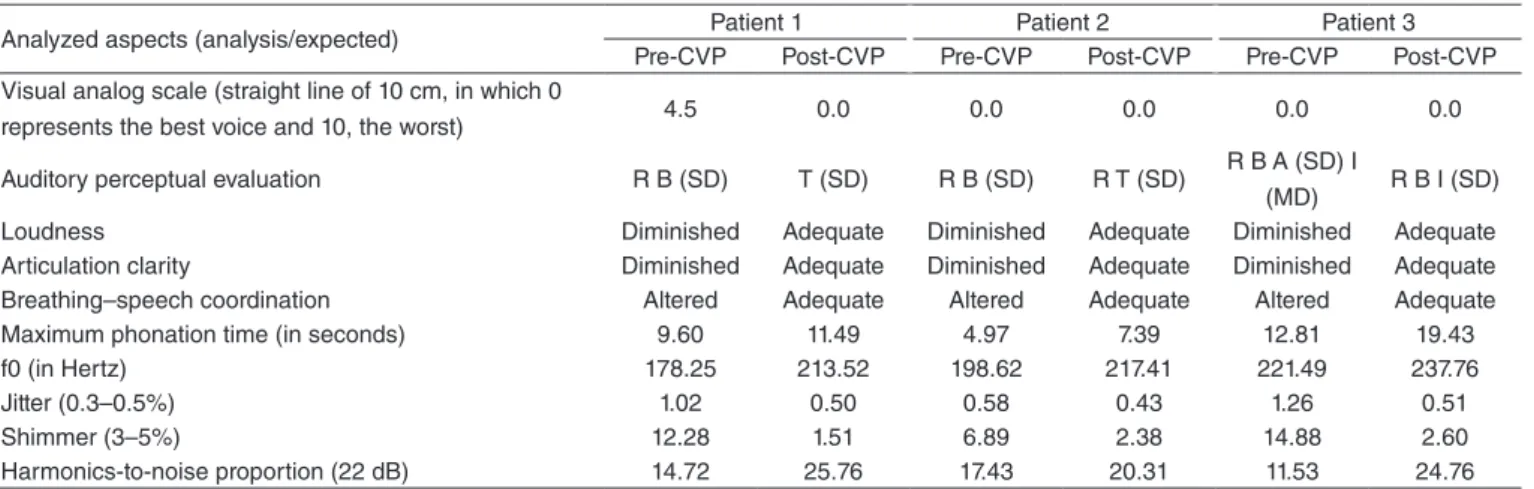
Table 1 presents the parameters assessed in relation to
vo-cal quality in pre- and post-CVP moments. The spectroscopy
showed better deined and highly numbered harmonics; in
ad-dition to the intensity increase, there was an improvement in the
score of two and a worsening in the score of one DRSP. After
the program, loudness, pneumophonoarticulatory coordination,
articulation clarity, jitter, and harmonics-to-noise proportion
improved, becoming such parameters remained within the
expected limit for this age range. For these three participants,
an evolution in vocal quality was observed. In two of them, a
tension associated with the increase of loudness was veriied
.
In all three of them, an increase in fundamental frequency and
an improvement in maximum phonation time were observed.
The DRSP score of two patients presented better results. Using
laryngoscopy, we observed a reduction in the signals of
presby-larynx with better glottal closure and movement of the mucosal
wave among all elderly women. The repetition of concepts
based on the genetic epistemology was considered positive by
participants and therapists.
DISCUSSION
The three patients initially presented vocal changes,
regardless voice complaints, with pre-program changes
compatible to the presence of presbyphonia
(1,2). The high
ad-herence proved itself relevant to achieve the results, though
they shall be more objectively measured in the project’s
follow-up. The improvements observed in loudness,
pneu-mophonoarticulatory coordination, maximum phonation
time, and articulation clarity provided better communicative
effectiveness. Vocal instability, in one of the cases, became
mild, which contributed to the phonatory pleasantness.
The initial vocal complaint ceased at the post-CVP moment,
with greater comfort when speaking and more pleasant voice.
Despite the scarce normative data on high-speed laryngoscopy
in elderly
(15,16), the improvements observed at the post-CVP
moment reinforced the indings of the perceptive-auditory
and acoustic evaluation. The results corroborate studies that
indicate speech therapy may minimize or delay the effects
of presbyphonia
(2,4). Despite the roughness, breathiness, and
asthenia remaining slightly altered, an improvement through
the CAPE-V scores was observed. The development of a
slight tension in two participants may have contributed to the
increase of intensity and the decrease of vocal breathiness,
but, so that there is no long-term negative vocal impact in this
aspect, it will be monitored in revaluations.
Vocal improvement was also observed in relation to the
rise of f0, which minimized characteristic presbyphonia vocal
aspects among women. The evaluation presented in the DRSP
score corroborates the observed higher body/vocal
conscious-ness, which led participants to change their lifestyles and habits
related to the use of their voice. It is noteworthy that all of them
joined the program and the aspects related to it will be subject
to a speciic research.
The emphasis on fundamented cognition in genetic
episte-mology
(12), already success total in use with total laryngectomy
elderly patients
(5), may be considered one of the positive
dif-ferences of this proposal.
CONCLUSION
The preliminary results point to encouraging perspectives in
relation to the proposal with improvements on the analyzed
as-pects. The proposed program proved feasible, well designed, and
did not require many adjustments for the continuity of the project.
*KN participated in the coordination and conception of the project, the analysis and interpretation of the data, and the writing and inal review of the article; GVSS was responsible for the collection of the data and the writing of the article; MSZ supervised the collection and took part in the analysis and interpretation of the data, the critical review of the content, and the inal review of the article; DHT, AH, and GFC took part in the conception of the project and supervised data collection; GPN and MED supervised data collection.
REFERENCES
1. Nascimento LT, Silva AF, Santos FS, Costa MR, Pereira RO. Presbifonia e disfonia na terceira idade: compreendendo os sinais típicos e atípicos. Rev Soc Bras Fonoaudiol. 2011;suplemento especial:1293.
2. Vasconcelos SV, Mello RJV, Silva HJ. Efeitos do envelhecimento e do fumo nas pregas vocais: uma revisão sistemática. ACTA ORL. 2009;27(1):9-14. 3. Behlau M, Azevedo R, Pontes P. Conceito de voz normal e classiicação
das disfonias. In: Behlau M. Voz: o livro do especialista, 1. Rio de Janeiro: Revinter, 2001. p. 53-79.
4. Siracusa MGP, Oliveira G, Madazio G, Behlau M. Efeito imediato do exercício de sopro sonorizado na voz do idoso. J Soc Bras Fonoaudiol. 2011;23(1):27-31.
5. Nemr NK. A epistemologia genética de Jean Piaget na reabilitação vocal do laringectomizado [tese]. São Paulo: Universidade de São Paulo; 2000. 6. Nemr K, Ramozzi-Chiarottino Z. Fatores cognitivos na adaptação vocal
após laringectomia total. Rev Bras Otorrinolaringol. 2002;68(6):805-10. 7. Behlau M. Consensus Auditory – Perceptual Evaluation of Voice
(CAPE-V), ASHA 2003. Refletindo sobre o novo/Nex reflexions. Rev Soc Bras Fonoauldiol. 2004;9(3):187-9.
8. Simões-Zenari M, Bonim ACC, Nemr K. Proposta de protocolo de anamnese fonoaudiológica para a clínica de voz. In: 19º Congresso Brasileiro e 8º Congresso Internacional de Fonoaudiologia; 2011 Out 30-Nov 2; São Paulo. São Paulo: SBFa; 2011; 942.
9. Ferreira LM, Annunciato NF. Envelhecimento vocal e neuroplasticidade. In: Pinho SMR, organizador. Fundamentos em fonoaudiologia: tratando os distúrbios da voz. 2a ed. Rio de Janeiro: Guanabara-Koogan, 2003. p. 117-37.
Analyzed aspects (analysis/expected) Patient 1 Patient 2 Patient 3
Pre-CVP Post-CVP Pre-CVP Post-CVP Pre-CVP Post-CVP Visual analog scale (straight line of 10 cm, in which 0
represents the best voice and 10, the worst) 4.5 0.0 0.0 0.0 0.0 0.0
Auditory perceptual evaluation R B (SD) T (SD) R B (SD) R T (SD) R B A (SD) I
(MD) R B I (SD)
Loudness Diminished Adequate Diminished Adequate Diminished Adequate Articulation clarity Diminished Adequate Diminished Adequate Diminished Adequate
Breathing–speech coordination Altered Adequate Altered Adequate Altered Adequate
Maximum phonation time (in seconds) 9.60 11.49 4.97 7.39 12.81 19.43
f0 (in Hertz) 178.25 213.52 198.62 217.41 221.49 237.76
Jitter (0.3–0.5%) 1.02 0.50 0.58 0.43 1.26 0.51
Shimmer (3–5%) 12.28 1.51 6.89 2.38 14.88 2.60
Harmonics-to-noise proportion (22 dB) 14.72 25.76 17.43 20.31 11.53 24.76
Table 1. Pre- and post-cognitive vocal program evaluation for presbyphonia
10. Behlau M, Madazio G, Feijó D, Azevedo R, Gielow I, Rehder MI. Aperfeiçoamento vocal e tratamento fonoaudiológico das disfonias. In: Behlau M, organizador. Voz: o livro do especialista. Rio de Janeiro: Revinter, 2005. Vol. II. p. 409-519.
11. Allali A, Le Huche F. A voz: tratamento dos distúrbios vocais. 3a ed. Porto Alegre: ArtMed, 2006.
12. Piaget J. Fazer e compreender. São Paulo: Melhoramentos, 1978. 13. Silva RSA, Simões-Zenari M, Nemr NK. Impacto de treinamento
auditivo na avaliação perceptivo-auditiva da voz realizada por estudantes de Fonoaudiologia. J Soc Bras Fonoaudiol. 2012;24(1):19-25.
14. Nemr K, Simões-Zenari M, Cordeiro GF, Tsuji D, Ogawa AI, Ubrig MT, et al. GRBAS and Cape-V scales: high reliability and consensus when applied at different times. J Voice. 2012;26(6):812.e17-22.
15. Yamauchi A, Imagawa H, Yokonishi H, Nito T, Yamasoba T, Goto T, et al. Evaluation of vocal fold vibration with an assessment form for high-speed digital imaging: comparative study between healthy young and elderly subjects. J Voice. 2012;26(6):742-50.