Opportunities for Conservation Agriculture in the EU Common Agricultural Policy 2014-2020
Basch G1&2, González-Sánchez EJ2&3&4, Gómez McPherson H5, Kassam A6 1
Institute of Mediterranean and Environmental Sciences. Universidade de Évora, Apartado 92, P-7002-554 Évora, Portugal.
Corresponding author: [email protected]
2
European Conservation Agriculture Federation (ECAF). www.ecaf.org Rond Point Schumann 6, box 5. Brussels, Belgium
3
Spanish Association for Conservation Agriculture – Living Soils (AEAC.SV).
www.agriculturadeconservacion.org Centro IFAPA Alameda del Obispo, Avda.
Menéndez Pidal s/n. E-14004 Córdoba, Spain 4
ETSIAM. www.uco.es/etsiam University of Córdoba. Campus de Rabanales, Córdoba. Spain
5
Institute for Sustainable Agriculture. IAS-CSIC, Apdo. 4084. E-14080 Córdoba, Spain 6
School of Agriculture, Policy and Development, University of Reading, United Kingdom
Keywords: Conservation agriculture, European Union, Common Agricultural Policy, CAP, agri-environment
Introduction
In the past, many relevant European Union (EU) documents made reference to the environmental problems caused by agriculture. In those papers, the concept of Conservation Agriculture (CA) as a possible solution was either omitted or timidly named, although sustainable agriculture was proclaimed as an objective of the EU in the Amsterdam treaty in 1999. EU’s position regarding several worldwide environmental problems, i.e. climate change, water and soil threats, is well known. However, to which extent these positions will be reflected in EU agricultural and environmental policies and concrete and binding measures in all member states for the period of 2014-2020 is still an open question.
Through its Common Agricultural Policy (CAP) EU claims to address the main concerns of its agriculture and rural development. In this context, EU launched a Communication (COM (2010) 672 final) named “The CAP towards 2020. Meeting the
food, natural resources and territorial challenges of the future”. Based on this paper we
analyse the deliverables that CA could provide to achieve the overall objectives established for the CAP in the horizon 2014-2020.
The CAP 2020
Europe is about to redefine its Common Agriculture Policy (CAP) for the near future. The question is whether this redefinition is more a fine-tuning of the existing CAP or whether thorough changes can be expected. Looking back to the last revision of CAP the most notable change is, undoubtedly, the concern about EU and global food security. The revival of the interest in agricultural production became already evident
global food security” are the first topic to appear in the list of justifications for the need for a CAP reform. Other challenges mentioned in this list such as sustainable
management of natural resources, climate change and its mitigation, improvement of competitiveness to withstand globalization and rising price volatility, etc. are not new but apparently considered worthwhile to be maintained and reappraised.
Referring to the concepts of the EU 2020 Strategy, the Commission wants CAP to contribute to the Smart Growth by increasing resource efficiency and improving competitiveness, to Sustainable Growth by maintaining the food, feed and renewable production base and to Inclusive Growth by unlocking economic potential in rural areas. In its communication to the European Parliament, the Council, the European Economic and Social Committee and the Committee of the Regions, the European Commission (2010) defines 3 general objectives for the future CAP:
Objective 1: Viable food production
Objective 2: Sustainable management of natural resources and climate action Objective 3: Balanced territorial development
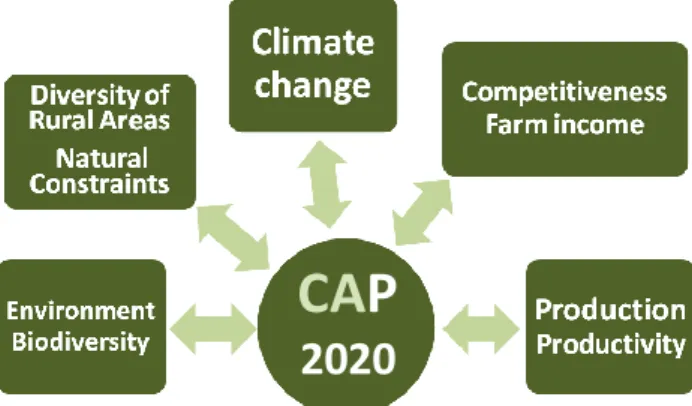
Figure 1 resumes, in more detail, the objectives of the EU Commission proposal for the new CAP 2020. Viable food production, in simple terms, means that EU farmers are given the means to produce the same or even more food at lower costs to meet the growing demand of food, feed, fibre and biofuels and the competition from a globalized world market, and that consumers can buy food at acceptable prices and quality.
Sustainable management of natural resources and climate action means matching agricultural production with the simultaneous protection of soil, water, biodiversity, etc., and expects that agriculture contributes to the mitigation of greenhouse gases. Finally, balanced territorial development includes the maintenance and diversity of production and that, despite severe natural constraints, especially in terms of soils and climate, agricultural activity is secured, which seems only viable through the adoption of low cost and probably extensive production systems.
Figure 1: Main objectives to be met by the revision of the Common Agricultural Policy (CAP)
CA
P
The Sustainable Crop Production Intensification approach proposed by the Plant Production and Protection Division (AGP) of the Food and Agriculture Organization of the United Nations (2011) goes in the same direction focussing on the need to feed a growing population while coping with an increasingly degraded environment and uncertainties resulting from climate change. This concept is supposed to provide “opportunities for optimizing crop production per unit area, taking into consideration the range of sustainability aspects including potential and/or real social, political, economic and environmental impacts”. But what does this mean in practice and how can the proposed CAP 2020 objectives be made compatible with each other?
At the moment, it appears that the EU Commission wants to adjust the way of EU agriculture towards sustainability, in its holistic meaning. This means the search for the best compromise between the different dimensions of sustainability, which are
economy, ecology and community (farmers and consumers). Today, in commercial farming there probably will be no single production system that can claim to be the “sustainable system”. Obviously, the definition of the before mentioned best
compromise depends on the priorities established. Now, with regard to the priorities defined in the revision of the CAP, what requirements should agricultural production systems meet to provide not the optimal but the best solution?
In practical terms, they should be productive both with regard to total production and per unit of land. They are expected to be resource efficient, which means to produce more with less, especially what soil and water, but also other inputs such as fertilizers, plant protection products, energy and labour are concerned. The achievement of these two goals would not only contribute to competitiveness and economic sustainability but also to environmental protection and biodiversity. Furthermore, sustainable production systems have to reduce as much as possible off-site transport of soil and water and the nutrients and plant protection products contained in eroded sediments and surface runoff. Diversity and maintenance of agricultural activity in less favoured regions are only achievable if production systems are competitive, that is cost extensive and productive at the same time.
The concomitant approach towards all these objectives requires a production process, which respects as best as possible natural conditions while taking advantage of the knowledge and means at hand to potentiate productivity while esteeming and improving the environment and the production base for future generations. This is the veracious meaning of agricultural sustainability and Sustainable Crop Production Intensification, which are best achieved through the concept of Conservation Agriculture (CA) based on three basic principles: a) minimal soil disturbance, b) permanent soil cover and c) crop diversity in the form of well balanced and wide crop rotations.
Discussion. The role of Conservation Agriculture
CA refers to the above mentioned set of practices which permits agricultural land use while changing the soil’s composition, structure and natural biodiversity as little as possible, thus defending it from degradation processes. The soil is kept protected from erosion and surface runoff; soil aggregates are stabilised, organic matter and the fertility level naturally increase, and less surface soil compaction occurs. Furthermore, the
better economical result at the end of the season in most of CA fields. Therefore and regarding the three Objectives of the new CAP, CA principles allow achieving the goals by:
Objective 1: Viable food production
o providing similar or even higher yields through improvements in soil structure, organic matter and overall soil fertility;
o increasing cost effectiveness by reducing inputs in form of machinery, energy, labour and fertilizers.
Objective 2: Sustainable management of natural resources and climate action o reducing runoff and erosion through better aggregate stability and
protective cover of the soil by crops or crop residues;
o diminishing off-site damage of infra-structures and pollution of water bodies through less runoff and a much reduced sediment load;
o maintaining in-field and off-site biodiversity through the absence of destructive soil disturbance, protective soil shelter and less off-site transport of contaminants;
o mitigating CO2 emissions through reduced fuel consumption and sequestration of atmospheric carbon into soil organic matter;
o increasing the share of green water through better infiltration and water holding capacity and decreasing unproductive losses through
evaporation.
Objective 3: Balanced territorial development
o maintaining the diversity of rural landscape through enhanced crop diversity and cover crops;
o maintaining disfavoured rural areas under production through economically viable production methods.
The fact that CA is successfully applied under very different climate conditions should be an indicator that there is a potential for the adoption of CA in Europe too. Since its foundation in 1999, the European Conservation Agriculture Federation (ECAF) (2011) struggles for the widespread adoption of CA in its 15 member countries. Whereas in a few countries a moderate success could be verified (Spain, Finland), most of the others lag far behind in its adoption (Basch et al. 2008).
The opportunity for CAP measures underpinning the adoption of the principles of CA for mainstream agriculture (via Pilar I or Pilar II of the CAP measures) is the best European farmers have ever faced. More and more scientific papers support the use of CA in Europe and more and more farms are successfully implementing CA (Arvidsson, 2010, Álvaro-Fuentes et al. 2008, Basch et al., 2008, Tebrügge and Böhrnsen, 1997, Basch et al., 1995). Hopefully this solid scientific and empirical evidence will not be invisible for EU policy makers.
Álvaro-Fuentes, J., López, M.V., Cantero-Martinez, C., Arrúe, J.L., 2008. Tillage effects on soil organic carbon fractions in Mediterranean dryland agroecosystems. Soil Sci. Soc. Am. J. 72, 541-547.
Arvidsson, J., 2010. Energy use efficiency in different tillage systems for winter wheat on a clay and silt loam in Sweden. Eur. J. Agron. 33, 250-256.
Basch, G., Carvalho, M., Düring, R.-A., Martins, R. 1995. Displacement of herbicides under different tillage systems. In: Tebrügge, F., Böhrnsen, A. (Eds.), Experience with the Applicability of No-tillage Crop Production in the West-European Countries. Proceedings of the EC-Workshop II:, Wissenschaftlicher Fachverlag, 35428 Langgöns, Germany, pp. 25-38.
Basch, G., Geraghty, J., Streit, B., Sturny, W.G., 2008. No-tillage in Europe – State of the Art: Constraints and Perspectives. In: Goddard, T., Zoebisch, M.A., Gan, Y., Ellis, W., Watson, A., Sombatpanit, S. (Eds.), No-Till Farming Systems Book. Special Publication No 3. World Association of Soil and Water Conservation, Thailand, pp. 159-168.
European Commission, 2010. The CAP towards 2020: Meeting the food, natural resources and territorial challenges of the future.
http://ec.europa.eu/agriculture/cap-post-2013/communication/index_en.htm
European Conservation Agriculture Federation (ECAF), 2011. http://www.ecaf.org
(accessed June 14, 2011)
Food and Agriculture Organization of the United Nations, 2011.
http://www.fao.org/agriculture/crops/core-themes/theme/spi/en/ (accessed June 14,
2011)Tebrügge, F., Böhrnsen, A., 1997. Crop yields and economic aspects of no-tillage compared to plough no-tillage: Results of long-term soil no-tillage field
experiments in Germany. In: Tebrügge, F., Böhrnsen, A. (Eds.), Experience with the Applicability of No-tillage Crop Production in the West-European Countries. Proceedings of the EC Workshop-IV., Wissenschaftlicher Fachverlag, 35428 Langgöns, Germany, pp. 25-43.