EUROPEAN ORGANIZATION FOR NUCLEAR RESEARCH (CERN)
CERN-EP/2016-273 2017/02/23
CMS-EXO-16-008
Search for heavy resonances decaying to tau lepton pairs in
proton-proton collisions at
√
s
=
13 TeV
The CMS Collaboration
∗Abstract
A search for heavy resonances that decay to tau lepton pairs is performed using proton-proton collisions at√s = 13 TeV. The data were collected with the CMS de-tector at the CERN LHC and correspond to an integrated luminosity of 2.2 fb−1. The observations are in agreement with standard model predictions. An upper limit at 95% confidence level on the product of the production cross section and branching fraction into tau lepton pairs is calculated as a function of the resonance mass. For the sequential standard model, the presence of Z0 bosons decaying into tau lepton pairs is excluded for Z0 masses below 2.1 TeV, extending previous limits for this final state. For the topcolor-assisted technicolor model, which predicts Z0bosons that pref-erentially couple to third-generation fermions, Z0masses below 1.7 TeV are excluded, representing the most stringent limit to date.
Published in the Journal of High Energy Physics as doi:10.1007/JHEP02(2017)048.
c
2017 CERN for the benefit of the CMS Collaboration. CC-BY-3.0 license
∗See Appendix A for the list of collaboration members
1
1
Introduction
The standard model (SM) of particle physics is a successful theory that can explain many exper-imental observations involving weak, electromagnetic, and strong interactions. Nevertheless, it cannot be an ultimate theory of nature since it fails, for instance, to provide an explanation for the mass of neutrinos and lacks a particle candidate for dark matter. Many models of physics beyond the SM have therefore been proposed. Such models often predict new heavy particles that could be observed at the CERN LHC.
A straightforward way to extend the SM gauge structure is to include an additional U(1) group with an associated neutral gauge boson, denoted Z0. The universality of couplings is not nec-essary for new gauge bosons. Indeed, models exist that incorporate generation-dependent couplings, resulting in Z0 bosons that preferentially decay into fermions of the third genera-tion [1, 2]. Such models motivate a search for Z0resonances that decay to a pair of τ leptons. In particular, extensions to the SM proposed as an explanation for the high mass of the top quark predict Z0bosons that typically couple to third-generation fermions [2]. Examples are the topcolor-assisted technicolor (TAT) models [3, 4]. A widely used benchmark model in searches for Z0 bosons is the sequential standard model (SSM) [5], which predicts a neutral spin-1 Z0 boson, denoted Z0SSM, with the same couplings to quarks and leptons as the SM Z boson. Results of direct searches for heavy ττ resonances in proton-proton (pp) collisions at either
√
s= 7 or 8 TeV have been reported by the ATLAS and CMS Collaborations and exclude Z0SSM masses below 2.0 TeV [6–8]. The most stringent mass limits on Z0SSMproduction, set by ATLAS and CMS in searches for a narrow resonance decaying into an e+e− or µ+
µ− pair, are 3.4 [9]
and 3.2 [10] TeV, respectively.
In this paper we report on a search for physics beyond the SM in events containing a pair of high transverse momentum (pT) oppositely charged τ leptons. Four ττ final states, τeτµ,
τeτh, τµτh, and τhτh, are selected, where τ`(` = e, µ) and τhrefer to the leptonic and hadronic
decay modes of the τ lepton, respectively. The study is based on a data sample of pp collisions at√s = 13 TeV recorded with the CMS detector at the LHC. The sample corresponds to an integrated luminosity of 2.2 fb−1.
2
The CMS experiment
The central feature of the CMS apparatus is a superconducting solenoid, of 6 m internal diam-eter, providing a field of 3.8 T. Within the field volume are the inner tracker, the crystal electro-magnetic calorimeter (ECAL), and the brass and scintillator hadron calorimeter (HCAL). The inner tracker is composed of a pixel detector and a silicon strip tracker, and measures charged-particle trajectories in the pseudorapidity range|η| <2.5. The finely segmented ECAL consists
of nearly 76 000 lead-tungstate crystals that provide coverage up to|η| = 3.0. The HCAL
con-sists of a sampling calorimeter, which utilizes alternating layers of brass as an absorber and plastic scintillator as an active material, covering the range|η| <3, and is extended to|η| <5
by a forward hadron calorimeter. The muon system covers|η| < 2.4 and consists of four
sta-tions of gas-ionization muon detectors installed outside the solenoid and sandwiched between the layers of the steel return yoke. A detailed description of the CMS detector, together with a definition of the coordinate system and relevant kinematic variables, is given elsewhere [11]. Events of interest are selected using a two-tiered trigger system [12]. The first level (L1), com-posed of custom hardware processors, uses information from the calorimeters and muon de-tectors to select events at a rate of around 100 kHz within a time interval of less than 4 µs. The
2 3 Object reconstruction and identification
second level, known as the high-level trigger (HLT), consists of a farm of processors running a version of the full event reconstruction software optimized for fast processing, and reduces the event rate to less than 1 kHz before data storage.
3
Object reconstruction and identification
A particle-flow (PF) algorithm [13, 14] is used to combine information from all CMS subde-tectors in order to reconstruct and identify individual particles in the event: muons, electrons, photons, and charged and neutral hadrons. The resulting set of particles is used to reconstruct the τh candidates, jets, missing transverse momentum, and the isolation variables described
below. The primary vertex of an event is chosen to be the reconstructed vertex with the largest p2
T sum of associated tracks.
The τeand τµ are reconstructed and identified with the usual techniques for muons and
elec-trons. Electrons are reconstructed as energy deposits in the ECAL associated with tracks in the tracking detector [10, 15]. Requirements on energy deposits in the calorimeter and on the num-ber of hits in the inner tracker are imposed to distinguish electrons produced in hard scattering processes from charged pions and from electrons produced through photon conversions. Muons are reconstructed using the inner tracker and the muon detectors [16, 17]. Quality re-quirements, based on the minimum number of hits in the inner tracker and muon detectors, are applied to suppress backgrounds from the decays-in-flight of light-flavor hadrons, and from hadron shower remnants that reach the muon system.
Both the electron and muon selections impose an isolation requirement to suppress both jets er-roneously identified as leptons and genuine leptons from hadron decays. The isolation criterion for light leptons is based on the variable I`, which is the scalar pT sum, divided by the lepton
pT, of charged and neutral PF candidates within a cone of radius∆R= √
(∆η)2+ (∆φ)2 =0.3
around the lepton direction at the interaction vertex, where φ is the azimuthal angle. The sum excludes the lepton under consideration as well as charged particles from additional pp in-teractions within the same or a nearby bunch crossing (“pileup”). The contribution of neutral particles from pileup is accounted for by subtracting from the isolation sum a term given by the scalar pT sum of charged hadrons from pileup vertices that appear within the isolation cone,
multiplied by a factor of 0.5 to account for the ratio of neutral to charged hadron production. The isolation criterion is I` <0.15.
The τhcandidates are reconstructed using the hadrons-plus-strips algorithm [18, 19], which is
designed to optimize the performance of τh reconstruction and identification by considering
specific τ lepton decay modes. Individual hadronic τ decay modes are reconstructed sepa-rately. The signatures distinguished by the algorithm are: a single charged hadron, a charged hadron plus up to two neutral pions, and three charged hadrons. Reconstructed τh leptons
are required to be isolated to reduce background from misidentified light-quark or gluon jets. The isolation criterion for τh leptons is based on the scalar pT sum Sτ of charged and neutral
PF candidates within a cone of radius∆R= 0.5 around the τhdirection, excluding the τh can-didate and charged tracks from pileup. The contribution of neutral particles from pileup is accounted for by subtracting from Sτ the scalar pT sum of charged particles from pileup
in-teractions that appear within a cone of radius∆R = 0.8 around the τh candidate, multiplied
by a factor of 0.2 [19]. The factor of 0.2 is chosen to render the τhidentification efficiency
in-sensitive to the level of pileup. The isolation criterion is Sτ < 0.8 GeV. The τhcandidates are
further distinguished from electrons and muons using dedicated algorithms, referred to as dis-criminators. The algorithm to discriminate a τh lepton from an electron utilizes observables
3
that quantify the compactness and shape of energy deposits in the ECAL, to distinguish elec-tromagnetic from hadronic showers, in combination with observables that are sensitive to the amount of bremsstrahlung radiation emitted along the highest pT track of the τh candidate,
and observables that are sensitive to the overall particle multiplicity. The discriminator against muons requires that no hits in the muon system be matched to the τhcandidate. For a τhwith
pT > 20 GeV and|η| <2.1, the identification efficiency is approximately 55%. The probability
for a light-quark or gluon jet, electron, and muon to be misidentified as a τhis approximately
1%, 0.2%, and 0.03%.
The jets are reconstructed using the anti-kT jet algorithm [20, 21] with a distance parameter of
0.4. In order to tag jets from b quark decays, the combined secondary vertex (CSVv2) algorithm at the loose working point is used [22, 23]. This algorithm is based on the reconstruction of secondary vertices, together with track-based lifetime information. For b quark jets with pT >
30 GeV and|η| <2.4, the identification efficiency is approximately 85%, while the probability
for a light-quark or gluon (charm quark) jet to be misidentified as a b quark jet is approximately 10% (20%).
The missing transverse momentum vector~pTmiss is defined as the negative of the vector sum of transverse momenta of all PF candidates reconstructed in the event. The magnitude of this vector is referred to as Emiss
T . The raw ETmissvalue is modified to account for corrections to the
energy scale of all the reconstructed jets in the event [24]. Events that contain large values of ETmissas a consequence of instrumental effects, such as calorimeter noise, beam halo, or jets near nonfunctioning channels in the calorimeters, are removed from the analysis.
4
Signal and background Monte Carlo samples
The most important sources of background arise from the production of Drell–Yan events (Z/γ∗ → τ+τ−), W bosons in association with one or more jets (W+jets), top quark pairs
(tt), quantum chromodynamics (QCD) multijet events, and diboson events (WW, WZ, ZZ). Although the Drell–Yan background peaks around the Z pole mass, its tail extends into the high-mass region where a signal might be present. The W+jets events are characterized by an isolated lepton from the decay of the W boson and an uncorrelated jet misidentified as a light lepton or τhlepton. Background from tt events contains one or two b quark jets, in addition to
isolated τ`or τhcandidates. Background from diboson events produces isolated leptons if the
gauge bosons decay leptonically. Should the gauge bosons decay hadronically, one of the jets may be misidentified as a τhlepton. Finally, QCD multijet background is characterized by jets
with low charged-track multiplicity that can be misidentified as τ` or τhcandidates.
Monte Carlo (MC) event generators are used to simulate the signal and SM backgrounds. The Drell–Yan, W+jets, and tt processes are generated with the MADGRAPH5 aMC@NLO pro-gram [25]. The PYTHIA 8.2 program is used to generate the diboson and signal events [26]. The signal events are generated with Z0 masses ranging from 0.5 to 3.0 TeV, with a step size of 0.5 TeV. The expected signal yields are rescaled to next-to-leading order (NLO) accuracy us-ing a K-factor of 1.3 [10]. The electroweak NLO corrections are small in the range of masses considered. The SM samples are normalized using the most accurate cross section calculations currently available [25, 27–37], generally with NLO or next-to-next-leading order (NNLO) ac-curacy. The NNPDF 3.0 [38] parton distribution functions (PDF) are used, and all simulated samples use thePYTHIAprogram with the CUETP8M1 tune [39] to describe parton showering and hadronization. The simulation of pileup is performed by superimposing minimum bias interactions onto the hard scattering process, matching the pileup profile in data. The mean number of interactions in a single bunch crossing in the analysed data set is approximately 14.
4 5 Event selection
The MC-generated events are propagated through a GEANT4-based simulation [40] of the CMS apparatus.
5
Event selection
The requirements described below define the signal region. A new heavy neutral gauge boson decaying into a τ lepton pair would be characterized by an excess above the SM expectation for the rate of events with two high-pT, oppositely charged, isolated τ lepton candidates.
Single-lepton triggers are used to select τeτµ, τeτh, and τµτhevents, while a trigger requiring at least
two τh candidates at the L1 and HLT levels is used to select τhτh events. The triggers are
designed to allow the use of the background estimation methods outlined in Section 6. Elec-trons (muons) are required to have pT > 35(30)GeV. The τh candidates are required to have
pT >20 and 60 GeV in the τ`τhand τhτhchannels, respectively. The τ lepton candidate pTis
de-fined by the vector pTsum of its visible decay products. Both τ` and τhcandidates must have |η| < 2.1 and satisfy isolation requirements to mitigate background from misidentified jets.
The pT thresholds on the τe, τµ, and τhcandidates are chosen such that the trigger efficiency is
about 90% or higher in each channel considered.
The ττ pairs are formed from oppositely charged candidates with ∆R(τ1, τ2) > 0.5. The τh
charge is reconstructed from the sum of the charges of the associated tracks used to recon-struct the decay mode and is required to be ±1. Owing to the large invariant mass of the
ττ resonances assumed for this study, the two τ candidates are expected to be back-to-back.
Events are therefore required to satisfy cos∆φ(τ1, τ2) < −0.95. An additional requirement of
ETmiss > 30 GeV is applied to preferentially select events with neutrinos from the τ lepton de-cays rather than apparent EmissT due to mismeasurement of jet pT. The signal efficiency of this
requirement is 85% efficiency or more, depending on the Z0boson mass. The direction of~pmiss
T is required to be consistent with the expectation for a pair of high-pT τ
lepton decays, to reduce the background from events with W bosons (primarily W+jets and tt events). This requirement is implemented through a variable known as “CDF-ζ” [41], referred to below as the ζ variable. This variable is defined by considering a unit vector, denoted the ˆζ
axis, along the bisector between the pTdirections of the two τ lepton candidates. Two projection
variables for the visible τ lepton decay products and~pTmiss are then constructed: pvis.ζ = (~pτ1
T + ~pτ2 T) ·ζˆ and pζ = (~p τ1 T + ~p τ2
T + ~pTmiss) ·ζˆ. In contrast to signal events in which pvis.ζ and pζ
are strongly correlated, these two variables are nearly independent in events with a W boson because in this case the direction and magnitude of~pTmissare correlated with those of the lepton, but not with those of the jet. Events are selected by requiring ζ = pζ −3.1pvis.ζ > −50 GeV.
Residual contributions from tt events are reduced by selecting events without a tagged b jet. To distinguish more effectively between signal and background events, the visible τ lepton energies and momenta Eτi and~pτi (with i = 1, 2), along with~pTmiss, are used to reconstruct a
mass value m, defined as
m(τ1, τ2,~pTmiss) = q (Eτ1+Eτ2+E miss T )2− (~pτ1 + ~pτ2 + ~p miss T )2. (1)
We do not apply a selection requirement on the mass variable of Eq. (1), but instead utilize it to search for a broad enhancement in the m(τ1, τ2,~pTmiss)distribution consistent with new physics.
The product of signal acceptance and efficiency for Z0 → ττ events varies with the Z0 boson
mass. The τµτh and τhτh channels provide the largest product of acceptance and efficiency,
5
acceptance and efficiency amounts to 6.3, 13, and 14%, respectively, for m(Z0SSM)= 0.5, 1.5, and 3.0 TeV.
6
Background estimation
To estimate the background contributions in the signal region, techniques based on data con-trol regions are employed wherever possible. The strategy when using such a technique is to modify the standard event selection requirements in order to define samples enriched with events from specific sources of background. These control regions are used to model the m(τ1, τ2,~pTmiss)shape of the backgrounds and to measure the probability for an event to satisfy
the selection requirements. Contributions from additional background sources in a given con-trol region are subtracted using their predictions from simulation. The background estimation methods based on data control regions are validated by determining the ability of the method, applied to simulated samples, to predict correctly the true number of background events and the shape of the m(τ1, τ2,~pTmiss)distribution. In some cases, for backgrounds with misidentified
leptons, the background estimation methods are also validated with the data. In such tests, the agreement between the relevant quantities is always within the statistical uncertainties, and is at the level of 20% or better, depending on the channel. In cases where an approach based on a data control region is not possible, or for backgrounds with small expected contributions, we rely on simulation. For the most relevant SM contributions evaluated from simulation, we verify that the MC prediction is in agreement with the data in background-enhanced regions. The QCD multijet background is relevant for both the τhτh and τ`τh channels, where it
rep-resents more than 80% or 20% of the total background, respectively. The contribution from QCD multijet events in the τeτµ channel is approximately 5% (< 1%) for m(τ1, τ2,~pTmiss) >
85(300)GeV. In the τhτh final state, this background is evaluated from the like-sign ττ mass
distribution (> 98% purity of QCD multijet events), which is scaled using the opposite-sign-to-like-sign ratio measured in a control region where the EmissT requirement is inverted (EmissT <
30 GeV). In the τeτhfinal state, the QCD multijet background is evaluated using the mass shape
reconstructed from a data sample with a nonisolated τh. This mass shape is weighted by the
probability for a jet to satisfy the τh isolation criterion, which is measured from a sample of like-sign ττ candidates. The systematic uncertainties in these estimates are discussed in Sec-tion 7.
Background from W+jets events is important in the τ`τhchannels, representing about 40 (45)%
of the total background when` is an electron (muon). The contribution from W+jets events in the τeτµ and τhτh channels is <1% for m(τ1, τ2,~pTmiss) > 300 GeV. To estimate this
back-ground, we take the mass distribution of events selected in data with one nonisolated τh,
sub-tract the QCD multijet background as determined from a data control region, subsub-tract other backgrounds as determined from simulation, and weight the distribution by the probability for a jet to satisfy the τhisolation criterion. This probability is measured in a data control region
for which the ζ and cos∆φ(τ1, τ2)requirements are inverted (ζ < −50 GeV or cos∆φ> −0.95).
The sample used to determine the QCD multijet contribution to the W+jets control region con-tains a small expected contribution from W+jets events, which is subtracted using simulation. The systematic uncertainties in these estimates are discussed in Section 7.
The tt background is relevant for the τeτµchannel, where it represents more than 30% (70%) of
the total background for m(τ1, τ2,~pTmiss) >85 (300) GeV. Its contribution to the other channels is <2% (<15%) for m(τ1, τ2,~pTmiss) >85(300)GeV. High-purity samples of tt events are obtained
by requiring the presence of at least one b-tagged jet with pT > 20 GeV. The tt prediction
6 7 Systematic uncertainties
statistical uncertainty of∼8% in the ratio of the simulated to the observed yield. Thus the tt prediction in the signal region is based on simulation with an additional systematic uncertainty of 8%.
The SM Drell–Yan background contributes to all final states, ranging from about 10% of the total background in the τhτh channel to 40% in the other channels. It is estimated from
sim-ulation, after comparing the expectations from simulation with data in low-mass control re-gions where no signal is expected [6], specifically rere-gions where ETmiss < 30 GeV, and either m(τ1, τ2) <100 GeV (τhτhchannel) or m(τ1, τ2,~pTmiss) <200 GeV (the other channels). The data
and simulation are found to be in agreement within the systematic uncertainties discussed in Section 7.
The remaining backgrounds described in Section 4 are estimated using simulation.
7
Systematic uncertainties
The main source of systematic uncertainty is the uncertainty in the estimation of the back-ground, due to the limited number of events in the data control regions. This results in uncer-tainties ranging from 8% for the contribution from dominant backgrounds such as that from W+jets events in the τ`τhchannels, to 68% for the small contribution of QCD multijet events in
the τµτhchannel. Nondominant backgrounds in the control regions, including the resulting
un-certainties in the control sample purities, make a minor contribution to the overall systematic uncertainty.
The efficiencies for electron and muon reconstruction, identification, and triggering have an uncertainty of approximately 2%, measured using Z → `+`− events [15, 17]. For the
uncer-tainty in the description by the simulation of the identification efficiency for high-pT electrons
(muons), an uncertainty of 6% (7%), independent of pT, is assigned, as described in Ref. [10].
The systematic uncertainty on τh trigger efficiency is 5% per τh candidate, as measured with
Z→τµτhevents triggered by single-muon triggers. Systematic effects associated with τh
iden-tification are measured using the visible ττ mass distribution around the Z boson peak as well as off-mass-shell virtual W bosons selected with a single τhcandidate and large EmissT [19]. The
resulting uncertainty is 6% per τhcandidate. An additional systematic uncertainty, which
dom-inates for high-pT τh candidates, is related to the confidence that the MC simulation correctly
models the identification efficiency, and is validated with high-pT jet and electron candidates
that produce τh-like signatures in the detector. This additional uncertainty increases linearly with pT and amounts to 20% per τh candidate at pT = 1 TeV (correlated between both
candi-dates in the τhτh channel), resulting in an uncertainty of 4% (10%) for a reconstructed mass of
0.5 TeV in the τ`τh(τhτh) channel, and 12% (25%) for a mass of 2 TeV. The uncertainty in the
inte-grated luminosity measurement is 2.7% [42]. Uncertainties that affect the m(τ1, τ2,~pTmiss)mass
shape include the electron, muon, and τhenergy scales, and the jet and EmissT energy scales and
resolutions. The uncertainty in the probability for a light quark or gluon jet to be misidentified as a b quark jet (20%) is also considered, and has a ∼3% effect on the signal acceptance and a negligible effect on the m(τ1, τ2,~pTmiss)mass shape. The uncertainty in the signal acceptance
associated with the PDFs is evaluated in accordance with the PDF4LHC recommendations [43] and amounts to a few percent.
The systematic uncertainties in the W+jets, Drell–Yan, QCD multijet, and tt background nor-malizations are approximately 9% (9%), 10% (19%), 68% (20%), and 8% (8%), respectively, in the τ`τh (τhτh) channel. The total systematic uncertainty in the SM background yield ranges
7
normalization uncertainties have a fully correlated effect across all mass bins, while the shape uncertainties account for systematic migrations of expected yields among neighboring bins in m(τ1, τ2,~pTmiss).
8
Results
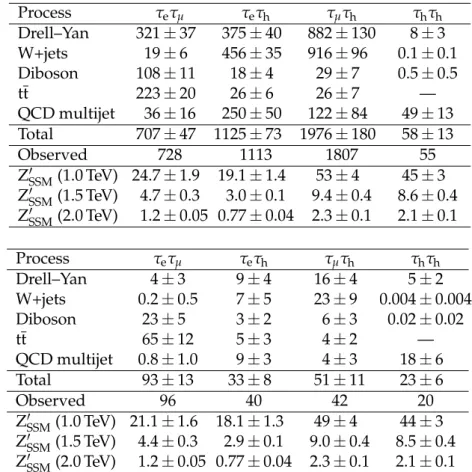
The upper section of Table 1 lists the estimated background yields and the total number of observed events for each channel, integrated over all values of reconstructed mass. The lower section of Table 1 lists the results for m(τ1, τ2,~pTmiss) > 300 GeV, where the signal is primarily
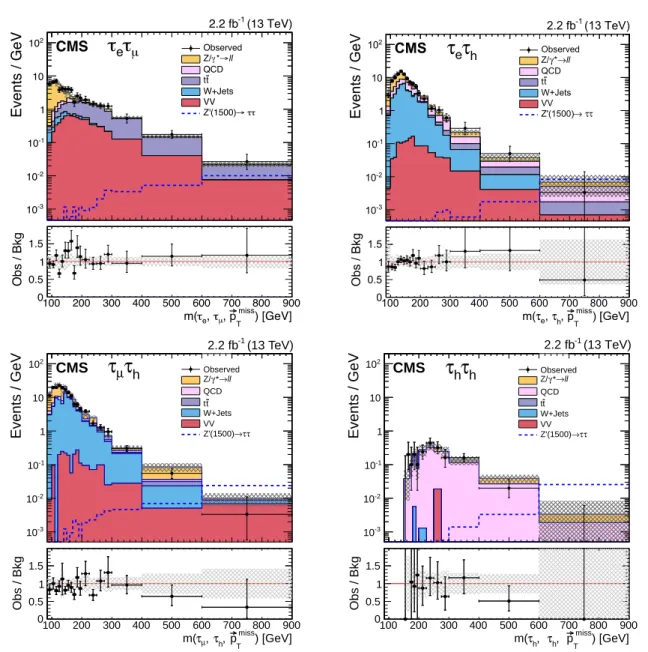
expected. The distributions of m(τ1, τ2,~pTmiss)are shown in Fig. 1 for all four channels.
Table 1: Numbers of events observed in data compared to the expected background yields and to the predicted numbers of signal events for Z0SSMmasses of 1.0, 1.5, and 2.0 TeV. The upper section of the table presents the inclusive yields. The lower section presents the yields after the requirement m(τ1, τ2,~pTmiss) >300 GeV. The uncertainties quoted in the background yields
represent the combined statistical and systematic uncertainties.
Process τeτµ τeτh τµτh τhτh Drell–Yan 321±37 375±40 882±130 8±3 W+jets 19±6 456±35 916±96 0.1±0.1 Diboson 108±11 18±4 29±7 0.5±0.5 tt 223±20 26±6 26±7 — QCD multijet 36±16 250±50 122±84 49±13 Total 707±47 1125±73 1976±180 58±13 Observed 728 1113 1807 55 Z0SSM(1.0 TeV) 24.7±1.9 19.1±1.4 53±4 45±3 Z0SSM(1.5 TeV) 4.7±0.3 3.0±0.1 9.4±0.4 8.6±0.4 Z0SSM(2.0 TeV) 1.2±0.05 0.77±0.04 2.3±0.1 2.1±0.1 Process τeτµ τeτh τµτh τhτh Drell–Yan 4±3 9±4 16±4 5±2 W+jets 0.2±0.5 7±5 23±9 0.004±0.004 Diboson 23±5 3±2 6±3 0.02±0.02 tt 65±12 5±3 4±2 — QCD multijet 0.8±1.0 9±3 4±3 18±6 Total 93±13 33±8 51±11 23±6 Observed 96 40 42 20 ZSSM0 (1.0 TeV) 21.1±1.6 18.1±1.3 49±4 44±3 ZSSM0 (1.5 TeV) 4.4±0.3 2.9±0.1 9.0±0.4 8.5±0.4 ZSSM0 (2.0 TeV) 1.2±0.05 0.77±0.04 2.3±0.1 2.1±0.1
The observed mass spectra shown in Fig. 1 do not reveal evidence for new particles decaying to τ lepton pairs. We proceed to set upper limits on the product of the signal cross section and the branching fraction for a Z0boson decaying to a τ lepton pair. The modified frequentist con-struction CLs[44–46] is used to determine these upper limits at 95% confidence level (CL) as a
function of the Z0mass for each ττ final state. For each decay channel, and for each bin of recon-structed mass above 85 GeV, the observed number of events is fitted by a Poisson distribution whose mean is the sum of the total SM expectation, determined as described in Section 6, and a potential signal contribution determined from simulation. Systematic uncertainties are imple-mented as nuisance parameters, which are profiled, and modeled with gamma or log-normal
8 8 Results Events / GeV -3 10 -2 10 -1 10 1 10 2 10 (13 TeV) -1 2.2 fb CMS
τ
eτ
µ Observed ll → * γ Z/ QCD t t W+Jets VV τ τ → Z'(1500) ) [GeV] miss T p , µ τ , e τ m( 100 200 300 400 500 600 700 800 900 Obs / Bkg 0 0.5 1 1.5 Events / GeV -3 10 -2 10 -1 10 1 10 2 10 (13 TeV) -1 2.2 fb CMSτ
eτ
h Observed ll → * γ Z/ QCD tt W+Jets VV τ τ → Z'(1500) ) [GeV] miss T p , h τ , e τ m( 100 200 300 400 500 600 700 800 900 Obs / Bkg 0 0.5 1 1.5 ) [GeV] miss T p , h τ , µ τ m( 100 200 300 400 500 600 700 800 900 Obs / Bkg 0 0.5 1 1.5100200300400500600700800900
Events / GeV -3 10 -2 10 -1 10 1 10 2 10 Observed ll → * γ Z/ QCD t t W+Jets VV τ τ → Z'(1500) CMS -1 (13 TeV) 2.2 fb hτ
µτ
) [GeV] miss T p , h τ , h τ m( 100 200 300 400 500 600 700 800 900 Obs / Bkg 0 0.5 1 1.5100200300400500600700800900
Events / GeV -3 10 -2 10 -1 10 1 10 2 10 Observed ll → * γ Z/ QCD t t W+Jets VV τ τ → Z'(1500) CMS 2.2 fb-1 (13 TeV) hτ
hτ
Figure 1: Observed m(τ1, τ2,~pTmiss)distribution in the signal region compared to the expected
SM backgrounds for the (top left) τeτµ, (top right) τeτh, (bottom left) τµτh, and (bottom right)
τhτh channels. The dashed histogram shows the distribution expected for a Z0SSM boson with
mass 1500 GeV. The rightmost bins also include events with m(τ1, τ2,~pTmiss) > 900 GeV, and
are normalized to the displayed bin width. The lower panel shows the ratio of the observed number of events to the total background prediction. The shaded bands represent the total uncertainty in the background prediction.
9 m(Z') [GeV] 500 1000 1500 2000 2500 3000 ) [pb] ττ → (Z' Β Z') x → (pp σ 2 − 10 1 − 10 1 10 Observed 1 s.d. ± Expected 2 s.d. ± Expected NLO SSM σ NLO TAT σ
CMS
(13 TeV) -1 2.2 fb µ τ e τ m(Z') [GeV] 500 1000 1500 2000 2500 3000 ) [pb] ττ → (Z' Β Z') x → (pp σ 2 − 10 1 − 10 1 10 Observed 1 s.d. ± Expected 2 s.d. ± Expected NLO SSM σ NLO TAT σCMS
(13 TeV) -1 2.2 fb h τ e τ m(Z') [GeV] 500 1000 1500 2000 2500 3000 ) [pb] ττ → (Z' Β Z') x → (pp σ 2 − 10 1 − 10 1 10 Observed 1 s.d. ± Expected 2 s.d. ± Expected NLO SSM σ NLO TAT σCMS
(13 TeV) -1 2.2 fb h τ µ τ m(Z') [GeV] 500 1000 1500 2000 2500 3000 ) [pb] ττ → (Z' Β Z') x → (pp σ 2 − 10 1 − 10 1 10 Observed 1 s.d. ± Expected 2 s.d. ± Expected NLO SSM σ NLO TAT σCMS
(13 TeV) -1 2.2 fb h τ h τ m(Z') [GeV] 500 1000 1500 2000 2500 3000 ) [pb] τ τ → (Z' Β Z') x → (pp σ 2− 10 1− 10 1 10 Observed 1 s.d.± Expected 2 s.d.± Expected NLO SSMσ NLO TATσCMS
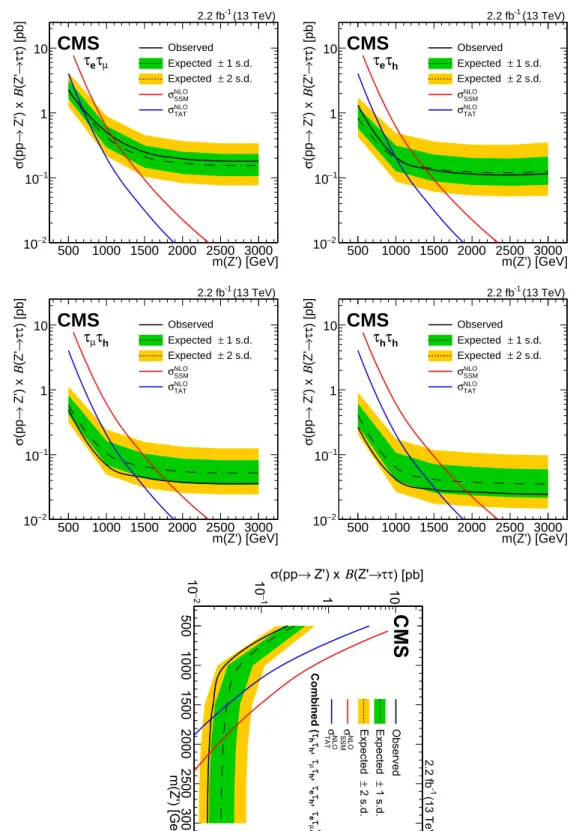
(13 TeV)-1 2.2 fb ) µτ eτ, heτ τ, hµτ τ, hτ hτ Combined (Figure 2: The observed 95% CL upper limits on the product of the cross section and branching fraction into τ lepton pairs as a function of the Z0 mass m(Z0)(solid black lines), for the (top left) τeτµ, (top right) τeτh, (middle left) τµτh, and (middle right) τhτhfinal states, and (bottom)
for the combination of the four channels. The expected limits (dash-dotted lines) with one and two standard deviation (s.d.) uncertainty bands are also shown. The predictions of the NLO theory cross sections in the SSM and TAT models are represented by the red (lighter) and blue (darker) solid curves, respectively.
10 9 Summary
priors for normalization parameters and Gaussian priors for shape uncertainties.
Figure 2 shows the observed and expected limits on the product of the cross section and the branching fraction for the decays into τ lepton pairs as functions of the Z0mass, together with the theoretical predictions from the SSM and TAT models. The shaded bands represent one and two standard deviation uncertainty intervals in the expected limits obtained using a large sam-ple of pseudo-experiments where the pseudodata are generated from distributions correspond-ing to the background-only hypothesis. The upper limit on the cross section times branchcorrespond-ing fraction σ(pp→Z0) B(Z0 →ττ)corresponds to the point where the observed limit crosses the
theory curve. In the TAT model the gauge group structure is characterized by a reduced cou-pling to light fermions (1stand 2nd generations) and an enhanced coupling to heavy fermions (3rdgeneration). Because light quark annihilation (e.g. uu→Z0) is the dominant Z0production
mechanism at the LHC, the cross section σ(pp→Z0)in the TAT model is suppressed (relative to that in the SSM model) because of the reduced coupling to light quarks. On the other hand, the branching fractionB(Z0 →ττ)in the TAT model is enhanced as a result of the stronger
cou-pling to τ leptons. With the TAT parameters in Refs. [3, 4], the suppression in the cross section outweighs the increase of the branching fraction. Overall, the product of the cross section and branching fraction σ(pp→Z0) B(Z0 →ττ)in the TAT model is approximately one-third of the
value in the SSM model. Combining the four final states, we exclude Z0SSMand Z0TAT models with masses less than 2.1 TeV (1.9 TeV expected) and 1.7 TeV (1.5 TeV expected), respectively, at 95% CL.
9
Summary
A search for heavy resonances decaying to a tau lepton pair has been performed by the CMS experiment, using a data sample of proton-proton collisions at√s = 13 TeV collected in 2015, corresponding to an integrated luminosity of 2.2 fb−1. The tau leptons are reconstructed in their decays to an electron (τe) and muon (τµ), and in their hadronic decays (τh). The observed
invariant mass spectra in the τµτh, τeτh, τhτh, and τeτµ channels are measured and are found
to be consistent with expectations from the standard model. Upper limits at 95% confidence level are derived for the product of the cross section and branching fraction for a Z0 boson decaying to a tau lepton pair, as a function of the Z0 mass. The presence of Z0bosons decaying to a tau lepton pair is excluded for Z0 masses below 2.1 TeV in the sequential standard model. This is the first search for heavy resonances decaying to a tau lepton pair using events from proton-proton collisions at√s = 13 TeV, already extending previous limits [6–8] for this final state using the data sample collected in 2015. In the topcolor-assisted technicolor model, which predicts Z0 bosons that exhibit enhanced couplings to third-generation fermions, the presence of Z0bosons decaying to a tau lepton pair is excluded for Z0masses below 1.7 TeV, resulting in the most stringent limit to date.
Acknowledgments
We congratulate our colleagues in the CERN accelerator departments for the excellent perfor-mance of the LHC and thank the technical and administrative staffs at CERN and at other CMS institutes for their contributions to the success of the CMS effort. In addition, we gratefully acknowledge the computing centers and personnel of the Worldwide LHC Computing Grid for delivering so effectively the computing infrastructure essential to our analyses. Finally, we acknowledge the enduring support for the construction and operation of the LHC and the CMS detector provided by the following funding agencies: BMWFW and FWF (Austria); FNRS
References 11
and FWO (Belgium); CNPq, CAPES, FAPERJ, and FAPESP (Brazil); MES (Bulgaria); CERN; CAS, MoST, and NSFC (China); COLCIENCIAS (Colombia); MSES and CSF (Croatia); RPF (Cyprus); SENESCYT (Ecuador); MoER, ERC IUT, and ERDF (Estonia); Academy of Finland, MEC, and HIP (Finland); CEA and CNRS/IN2P3 (France); BMBF, DFG, and HGF (Germany); GSRT (Greece); OTKA and NIH (Hungary); DAE and DST (India); IPM (Iran); SFI (Ireland); INFN (Italy); MSIP and NRF (Republic of Korea); LAS (Lithuania); MOE and UM (Malaysia); BUAP, CINVESTAV, CONACYT, LNS, SEP, and UASLP-FAI (Mexico); MBIE (New Zealand); PAEC (Pakistan); MSHE and NSC (Poland); FCT (Portugal); JINR (Dubna); MON, RosAtom, RAS, and RFBR (Russia); MESTD (Serbia); SEIDI and CPAN (Spain); Swiss Funding Agencies (Switzerland); MST (Taipei); ThEPCenter, IPST, STAR, and NSTDA (Thailand); TUBITAK and TAEK (Turkey); NASU and SFFR (Ukraine); STFC (United Kingdom); DOE and NSF (USA). Individuals have received support from the Marie-Curie program and the European Research Council and EPLANET (European Union); the Leventis Foundation; the A. P. Sloan Founda-tion; the Alexander von Humboldt FoundaFounda-tion; the Belgian Federal Science Policy Office; the Fonds pour la Formation `a la Recherche dans l’Industrie et dans l’Agriculture (FRIA-Belgium); the Agentschap voor Innovatie door Wetenschap en Technologie (IWT-Belgium); the Ministry of Education, Youth and Sports (MEYS) of the Czech Republic; the Council of Science and In-dustrial Research, India; the HOMING PLUS program of the Foundation for Polish Science, cofinanced from European Union, Regional Development Fund, the Mobility Plus program of the Ministry of Science and Higher Education, the National Science Center (Poland), contracts Harmonia 2014/14/M/ST2/00428, Opus 2013/11/B/ST2/04202, 2014/13/B/ST2/02543 and 2014/15/B/ST2/03998, Sonata-bis 2012/07/E/ST2/01406; the Thalis and Aristeia programs cofinanced by EU-ESF and the Greek NSRF; the National Priorities Research Program by Qatar National Research Fund; the Programa Clar´ın-COFUND del Principado de Asturias; the Rachada-pisek Sompot Fund for Postdoctoral Fellowship, Chulalongkorn University and the Chula-longkorn Academic into Its 2nd Century Project Advancement Project (Thailand); and the Welch Foundation, contract C-1845.
References
[1] P. Langacker, “The physics of heavy Z0gauge bosons”, Rev. Mod. Phys 81 (2009) 1199, doi:10.1103/RevModPhys.81.1199, arXiv:0801.1345.
[2] K. R. Lynch, S. Mrenna, M. Narain, and E. H. Simmons, “Finding Z0bosons coupled preferentially to the third family at LEP and the Tevatron”, Phys. Rev. D 63 (2001) 035006, doi:10.1103/PhysRevD.63.035006, arXiv:hep-ph/0007286. [3] C. T. Hill, “Topcolor Assisted Technicolor”, Phys. Lett. B 345 (1995) 483,
doi:10.1016/0370-2693(94)01660-5, arXiv:hep-ph/9411426.
[4] K. Lane, “A new model of topcolor-assisted technicolor”, Phys. Lett. B 433 (1998) 96, doi:10.1016/S0370-2693(98)00708-4, arXiv:hep-ph/9805254.
[5] G. Altarelli, B. Mele, and M. Ruiz-Altaba, “Searching for new heavy vector bosons in p ¯p colliders”, Z. Phys. C 45 (1989) 109, doi:10.1007/BF01556677.
[6] CMS Collaboration, “Search for high-mass resonances decaying into τ-lepton pairs in pp collisions at√s=7 TeV”, Phys. Lett. B 716 (2012) 82,
12 References
[7] ATLAS Collaboration, “A search for high-mass resonances decaying to τ+τ−in pp
collisions at√s = 7 TeV with the ATLAS detector”, Phys. Lett. B 719 (2013) 242, doi:10.1016/j.physletb.2013.01.040, arXiv:1210.6604.
[8] ATLAS Collaboration, “A search for high-mass resonances decaying to τ+τ−in pp
collisions at√s = 8 TeV with the ATLAS detector”, JHEP 07 (2015) 157, doi:10.1007/JHEP07(2015)157, arXiv:1502.07177.
[9] ATLAS Collaboration, “Search for high-mass new phenomena in the dilepton final state using proton–proton collisions at√s=13 TeV with the ATLAS detector”, (2016). arXiv:1607.03669. Submitted to Phys. Lett. B.
[10] CMS Collaboration, “Search for narrow resonances in dilepton mass spectra in proton-proton collisions at√s=13 TeV and combination with 8 TeV data”, (2016). arXiv:1609.05391. Submitted to Phys. Lett. B.
[11] CMS Collaboration, “The CMS experiment at the CERN LHC”, JINST 3 (2008) S08004, doi:10.1088/1748-0221/3/08/S08004.
[12] CMS Collaboration, “The CMS trigger system”, (2016). arXiv:1609.02366. Submitted to JINST.
[13] CMS Collaboration, “Particle-Flow Event Reconstruction in CMS and Performance for Jets, Taus, and MET”, CMS Physics Analysis Summary CMS-PAS-PFT-09-001, 2009. [14] CMS Collaboration, “Commissioning of the Particle-flow Event Reconstruction with the
first LHC collisions recorded in the CMS detector”, CMS Physics Analysis Summary CMS-PAS-PFT-10-001, 2010.
[15] CMS Collaboration, “Performance of electron reconstruction and selection with the CMS detector in proton-proton collisions at√s=8 TeV”, J. Instrum. 10 (2015) P06005,
doi:10.1088/1748-0221/10/06/P06005.
[16] CMS Collaboration, “Performance of CMS muon reconstruction in pp collision events at√ s =7 TeV”, J. Instrum. 7 (2012) P10002, doi:10.1088/1748-0221/7/10/P10002. [17] CMS Collaboration, “Muon Reconstruction and Identification Improvements for Run-2
and First Results with 2015 Run Data”, CMS Detector Performance Summary CMS-DP-15-015, 2015.
[18] CMS Collaboration, “Reconstruction and identification of τ lepton decays to hadrons and
τneutrino at CMS”, JINST 11 (2016) P01019,
doi:10.1088/1748-0221/11/01/P01019, arXiv:1510.07488.
[19] CMS Collaboration, “Performance of reconstruction and identification of τ leptons in their decays to hadrons and τ neutrino in LHC Run-2”, CMS Physics Analysis Summary CMS-PAS-TAU-16-002, 2016.
[20] M. Cacciari, G. P. Salam, and G. Soyez, “The anti-ktjet clustering algorithm”, JHEP 04
(2008) 063, doi:10.1088/1126-6708/2008/04/063, arXiv:0802.1189.
[21] M. Cacciari, G. P. Salam, and G. Soyez, “FastJet user manual”, Eur. Phys. J. C 72 (2012) 1896, doi:10.1140/epjc/s10052-012-1896-2, arXiv:1111.6097.
References 13
[22] CMS Collaboration, “Identification of b-quark jets with the CMS experiment”, J. Instrum. 8(2013) P04013, doi:10.1088/1748-0221/8/04/P04013.
[23] CMS Collaboration, “Identification of b quark jets at the CMS Experiment in the LHC Run 2”, CMS Physics Analysis Summary CMS-PAS-BTV-15-001, 2016.
[24] CMS Collaboration, “Performance of the CMS missing transverse momentum reconstruction in pp data at√s=8 TeV”, J. Instrum. 10 (2015) P02006,
doi:10.1088/1748-0221/10/02/P02006.
[25] J. Alwall et al., “The automated computation of tree-level and next-to-leading order differential cross sections, and their matching to parton shower simulations”, JHEP 07 (2014) 079, doi:10.1007/JHEP07(2014)079, arXiv:1405.0301.
[26] T. Sj ¨ostrand et al., “An introduction to PYTHIA 8.2”, Comput. Phys. Commun. 191 (2015) 159, doi:10.1016/j.cpc.2015.01.024, arXiv:1410.3012.
[27] S. Alioli, P. Nason, C. Oleari, and E. Re, “NLO single-top production matched with shower in POWHEG: s- and t-channel contributions”, JHEP 09 (2009) 111,
doi:10.1088/1126-6708/2009/09/111, arXiv:0907.4076. [Erratum: doi:10.1007/JHEP02(2010)011].
[28] E. Re, “Single-top Wt-channel production matched with parton showers using the POWHEG method”, Eur. Phys. J. C 71 (2011) 1547,
doi:10.1140/epjc/s10052-011-1547-z, arXiv:1009.2450.
[29] T. Melia, P. Nason, R. Rontsch, and G. Zanderighi, “W+W−, WZ and ZZ production in
the POWHEG BOX”, JHEP 11 (2011) 078, doi:10.1007/JHEP11(2011)078, arXiv:1107.5051.
[30] M. Beneke, P. Falgari, S. Klein, and C. Schwinn, “Hadronic top-quark pair production with NNLL threshold resummation”, Nucl. Phys. B 855 (2012) 695,
doi:10.1016/j.nuclphysb.2011.10.021, arXiv:1109.1536.
[31] M. Cacciari et al., “Top-pair production at hadron colliders with next-to-next-to-leading logarithmic soft-gluon resummation”, Phys. Lett. B 710 (2012) 612,
doi:10.1016/j.physletb.2012.03.013, arXiv:1111.5869.
[32] P. B¨arnreuther, M. Czakon, and A. Mitov, “Percent Level Precision Physics at the Tevatron: First Genuine NNLO QCD Corrections to q ¯q→t¯t+X”, Phys. Rev. Lett. 109 (2012) 132001, doi:10.1103/PhysRevLett.109.132001, arXiv:1204.5201. [33] M. Czakon and A. Mitov, “NNLO corrections to top-pair production at hadron colliders:
the all-fermionic scattering channels”, JHEP 12 (2012) 054, doi:10.1007/JHEP12(2012)054, arXiv:1207.0236.
[34] M. Czakon and A. Mitov, “NNLO corrections to top pair production at hadron colliders: the quark-gluon reaction”, JHEP 01 (2013) 080, doi:10.1007/JHEP01(2013)080, arXiv:1210.6832.
[35] M. Czakon, P. Fiedler, and A. Mitov, “Total Top-Quark Pair-Production Cross Section at Hadron Colliders Through O(α4S)”, Phys. Rev. Lett. 110 (2013) 252004,
14 References
[36] R. Gavin, Y. Li, F. Petriello, and S. Quackenbush, “W Physics at the LHC with FEWZ 2.1”, Comput. Phys. Commun. 184 (2013) 208, doi:10.1016/j.cpc.2012.09.005,
arXiv:1201.5896.
[37] R. Gavin, Y. Li, F. Petriello, and S. Quackenbush, “FEWZ 2.0: A code for hadronic Z production at next-to-next-to-leading order”, Comput. Phys. Commun. 182 (2011) 2388, doi:10.1016/j.cpc.2011.06.008, arXiv:1011.3540.
[38] NNPDF Collaboration, “Parton distributions for the LHC Run II”, JHEP 04 (2015) 040, doi:10.1007/JHEP04(2015)040, arXiv:1410.8849.
[39] CMS Collaboration, “Event generator tunes obtained from underlying event and multiparton scattering measurements”, Eur. Phys. J. C 76 (2016) 155,
doi:10.1140/epjc/s10052-016-3988-x, arXiv:1512.00815.
[40] GEANT4 Collaboration, “GEANT4—a simulation toolkit”, Nucl. Instrum. Meth. A 506 (2003) 250, doi:10.1016/S0168-9002(03)01368-8.
[41] CDF Collaboration, “Search for Neutral MSSM Higgs Bosons Decaying to τ pairs in p ¯p collisions at√s=1.96 TeV”, Phys. Rev. Lett. 96 (2006) 011802,
doi:10.1103/PhysRevLett.96.011802, arXiv:hep-ex/0508051.
[42] CMS Collaboration, “CMS Luminosity Measurement for the 2015 Data Taking Period”, CMS Physics Analysis Summary CMS-PAS-LUM-15-001, 2015.
[43] J. Butterworth et al., “PDF4LHC recommendations for LHC Run II”, J. Phys. G 43 (2016) 023001, doi:10.1088/0954-3899/43/2/023001, arXiv:1510.03865.
[44] T. Junk, “Confidence level computation for combining searches with small statistics”, Nucl. Instrum. Meth. A 434 (1999) 435, doi:10.1016/S0168-9002(99)00498-2, arXiv:hep-ex/9902006.
[45] A. L. Read, “Presentation of search results: the CLstechnique”, J. Phys. G 28 (2002) 2693,
doi:10.1088/0954-3899/28/10/313.
[46] ATLAS and CMS Collaborations, “Procedure for the LHC Higgs boson search combination in Summer 2011”, Technical Report CMS-NOTE-2011-005, ATL-PHYS-PUB-2011-11, 2011.
15
A
The CMS Collaboration
Yerevan Physics Institute, Yerevan, Armenia V. Khachatryan, A.M. Sirunyan, A. Tumasyan Institut f ¨ur Hochenergiephysik, Wien, Austria
W. Adam, E. Asilar, T. Bergauer, J. Brandstetter, E. Brondolin, M. Dragicevic, J. Er ¨o, M. Flechl, M. Friedl, R. Fr ¨uhwirth1, V.M. Ghete, C. Hartl, N. H ¨ormann, J. Hrubec, M. Jeitler1, A. K ¨onig, I. Kr¨atschmer, D. Liko, T. Matsushita, I. Mikulec, D. Rabady, N. Rad, B. Rahbaran, H. Rohringer, J. Schieck1, J. Strauss, W. Waltenberger, C.-E. Wulz1
Institute for Nuclear Problems, Minsk, Belarus O. Dvornikov, V. Makarenko, V. Zykunov
National Centre for Particle and High Energy Physics, Minsk, Belarus V. Mossolov, N. Shumeiko, J. Suarez Gonzalez
Universiteit Antwerpen, Antwerpen, Belgium
S. Alderweireldt, E.A. De Wolf, X. Janssen, J. Lauwers, M. Van De Klundert, H. Van Haevermaet, P. Van Mechelen, N. Van Remortel, A. Van Spilbeeck
Vrije Universiteit Brussel, Brussel, Belgium
S. Abu Zeid, F. Blekman, J. D’Hondt, N. Daci, I. De Bruyn, K. Deroover, S. Lowette, S. Moortgat, L. Moreels, A. Olbrechts, Q. Python, S. Tavernier, W. Van Doninck, P. Van Mulders, I. Van Parijs Universit´e Libre de Bruxelles, Bruxelles, Belgium
H. Brun, B. Clerbaux, G. De Lentdecker, H. Delannoy, G. Fasanella, L. Favart, R. Goldouzian, A. Grebenyuk, G. Karapostoli, T. Lenzi, A. L´eonard, J. Luetic, T. Maerschalk, A. Marinov, A. Randle-conde, T. Seva, C. Vander Velde, P. Vanlaer, R. Yonamine, F. Zenoni, F. Zhang2 Ghent University, Ghent, Belgium
A. Cimmino, T. Cornelis, D. Dobur, A. Fagot, G. Garcia, M. Gul, I. Khvastunov, D. Poyraz, S. Salva, R. Sch ¨ofbeck, A. Sharma, M. Tytgat, W. Van Driessche, E. Yazgan, N. Zaganidis Universit´e Catholique de Louvain, Louvain-la-Neuve, Belgium
H. Bakhshiansohi, C. Beluffi3, O. Bondu, S. Brochet, G. Bruno, A. Caudron, S. De Visscher, C. Delaere, M. Delcourt, B. Francois, A. Giammanco, A. Jafari, P. Jez, M. Komm, V. Lemaitre, A. Magitteri, A. Mertens, M. Musich, C. Nuttens, K. Piotrzkowski, L. Quertenmont, M. Selvaggi, M. Vidal Marono, S. Wertz
Universit´e de Mons, Mons, Belgium N. Beliy
Centro Brasileiro de Pesquisas Fisicas, Rio de Janeiro, Brazil
W.L. Ald´a J ´unior, F.L. Alves, G.A. Alves, L. Brito, C. Hensel, A. Moraes, M.E. Pol, P. Rebello Teles
Universidade do Estado do Rio de Janeiro, Rio de Janeiro, Brazil
E. Belchior Batista Das Chagas, W. Carvalho, J. Chinellato4, A. Cust ´odio, E.M. Da Costa, G.G. Da Silveira5, D. De Jesus Damiao, C. De Oliveira Martins, S. Fonseca De Souza, L.M. Huertas Guativa, H. Malbouisson, D. Matos Figueiredo, C. Mora Herrera, L. Mundim, H. Nogima, W.L. Prado Da Silva, A. Santoro, A. Sznajder, E.J. Tonelli Manganote4, A. Vilela Pereira
Universidade Estadual Paulistaa, Universidade Federal do ABCb, S˜ao Paulo, Brazil
16 A The CMS Collaboration
P.G. Mercadanteb, C.S. Moona, S.F. Novaesa, Sandra S. Padulaa, D. Romero Abadb, J.C. Ruiz Vargas
Institute for Nuclear Research and Nuclear Energy, Sofia, Bulgaria
A. Aleksandrov, R. Hadjiiska, P. Iaydjiev, M. Rodozov, S. Stoykova, G. Sultanov, M. Vutova University of Sofia, Sofia, Bulgaria
A. Dimitrov, I. Glushkov, L. Litov, B. Pavlov, P. Petkov Beihang University, Beijing, China
W. Fang6
Institute of High Energy Physics, Beijing, China
M. Ahmad, J.G. Bian, G.M. Chen, H.S. Chen, M. Chen, Y. Chen7, T. Cheng, C.H. Jiang, D. Leggat, Z. Liu, F. Romeo, S.M. Shaheen, A. Spiezia, J. Tao, C. Wang, Z. Wang, H. Zhang, J. Zhao
State Key Laboratory of Nuclear Physics and Technology, Peking University, Beijing, China Y. Ban, G. Chen, Q. Li, S. Liu, Y. Mao, S.J. Qian, D. Wang, Z. Xu
Universidad de Los Andes, Bogota, Colombia
C. Avila, A. Cabrera, L.F. Chaparro Sierra, C. Florez, J.P. Gomez, C.F. Gonz´alez Hern´andez, J.D. Ruiz Alvarez, J.C. Sanabria
University of Split, Faculty of Electrical Engineering, Mechanical Engineering and Naval Architecture, Split, Croatia
N. Godinovic, D. Lelas, I. Puljak, P.M. Ribeiro Cipriano, T. Sculac University of Split, Faculty of Science, Split, Croatia
Z. Antunovic, M. Kovac
Institute Rudjer Boskovic, Zagreb, Croatia
V. Brigljevic, D. Ferencek, K. Kadija, S. Micanovic, L. Sudic, T. Susa University of Cyprus, Nicosia, Cyprus
A. Attikis, G. Mavromanolakis, J. Mousa, C. Nicolaou, F. Ptochos, P.A. Razis, H. Rykaczewski, D. Tsiakkouri
Charles University, Prague, Czech Republic M. Finger8, M. Finger Jr.8
Universidad San Francisco de Quito, Quito, Ecuador E. Carrera Jarrin
Academy of Scientific Research and Technology of the Arab Republic of Egypt, Egyptian Network of High Energy Physics, Cairo, Egypt
E. El-khateeb9, S. Elgammal10, A. Mohamed11
National Institute of Chemical Physics and Biophysics, Tallinn, Estonia B. Calpas, M. Kadastik, M. Murumaa, L. Perrini, M. Raidal, A. Tiko, C. Veelken Department of Physics, University of Helsinki, Helsinki, Finland
P. Eerola, J. Pekkanen, M. Voutilainen
Helsinki Institute of Physics, Helsinki, Finland
J. H¨ark ¨onen, T. J¨arvinen, V. Karim¨aki, R. Kinnunen, T. Lamp´en, K. Lassila-Perini, S. Lehti, T. Lind´en, P. Luukka, J. Tuominiemi, E. Tuovinen, L. Wendland
17
Lappeenranta University of Technology, Lappeenranta, Finland J. Talvitie, T. Tuuva
IRFU, CEA, Universit´e Paris-Saclay, Gif-sur-Yvette, France
M. Besancon, F. Couderc, M. Dejardin, D. Denegri, B. Fabbro, J.L. Faure, C. Favaro, F. Ferri, S. Ganjour, S. Ghosh, A. Givernaud, P. Gras, G. Hamel de Monchenault, P. Jarry, I. Kucher, E. Locci, M. Machet, J. Malcles, J. Rander, A. Rosowsky, M. Titov, A. Zghiche
Laboratoire Leprince-Ringuet, Ecole Polytechnique, IN2P3-CNRS, Palaiseau, France
A. Abdulsalam, I. Antropov, S. Baffioni, F. Beaudette, P. Busson, L. Cadamuro, E. Chapon, C. Charlot, O. Davignon, R. Granier de Cassagnac, M. Jo, S. Lisniak, P. Min´e, M. Nguyen, C. Ochando, G. Ortona, P. Paganini, P. Pigard, S. Regnard, R. Salerno, Y. Sirois, T. Strebler, Y. Yilmaz, A. Zabi
Institut Pluridisciplinaire Hubert Curien, Universit´e de Strasbourg, Universit´e de Haute Alsace Mulhouse, CNRS/IN2P3, Strasbourg, France
J.-L. Agram12, J. Andrea, A. Aubin, D. Bloch, J.-M. Brom, M. Buttignol, E.C. Chabert, N. Chanon, C. Collard, E. Conte12, X. Coubez, J.-C. Fontaine12, D. Gel´e, U. Goerlach, A.-C. Le Bihan, K. Skovpen, P. Van Hove
Centre de Calcul de l’Institut National de Physique Nucleaire et de Physique des Particules, CNRS/IN2P3, Villeurbanne, France
S. Gadrat
Universit´e de Lyon, Universit´e Claude Bernard Lyon 1, CNRS-IN2P3, Institut de Physique Nucl´eaire de Lyon, Villeurbanne, France
S. Beauceron, C. Bernet, G. Boudoul, E. Bouvier, C.A. Carrillo Montoya, R. Chierici, D. Contardo, B. Courbon, P. Depasse, H. El Mamouni, J. Fan, J. Fay, S. Gascon, M. Gouzevitch, G. Grenier, B. Ille, F. Lagarde, I.B. Laktineh, M. Lethuillier, L. Mirabito, A.L. Pequegnot, S. Perries, A. Popov13, D. Sabes, V. Sordini, M. Vander Donckt, P. Verdier, S. Viret
Georgian Technical University, Tbilisi, Georgia T. Toriashvili14
Tbilisi State University, Tbilisi, Georgia D. Lomidze
RWTH Aachen University, I. Physikalisches Institut, Aachen, Germany
C. Autermann, S. Beranek, L. Feld, A. Heister, M.K. Kiesel, K. Klein, M. Lipinski, A. Ostapchuk, M. Preuten, F. Raupach, S. Schael, C. Schomakers, J. Schulz, T. Verlage, H. Weber, V. Zhukov13 RWTH Aachen University, III. Physikalisches Institut A, Aachen, Germany
A. Albert, M. Brodski, E. Dietz-Laursonn, D. Duchardt, M. Endres, M. Erdmann, S. Erdweg, T. Esch, R. Fischer, A. G ¨uth, M. Hamer, T. Hebbeker, C. Heidemann, K. Hoepfner, S. Knutzen, M. Merschmeyer, A. Meyer, P. Millet, S. Mukherjee, M. Olschewski, K. Padeken, T. Pook, M. Radziej, H. Reithler, M. Rieger, F. Scheuch, L. Sonnenschein, D. Teyssier, S. Th ¨uer
RWTH Aachen University, III. Physikalisches Institut B, Aachen, Germany
V. Cherepanov, G. Fl ¨ugge, F. Hoehle, B. Kargoll, T. Kress, A. K ¨unsken, J. Lingemann, T. M ¨uller, A. Nehrkorn, A. Nowack, I.M. Nugent, C. Pistone, O. Pooth, A. Stahl15
Deutsches Elektronen-Synchrotron, Hamburg, Germany
M. Aldaya Martin, T. Arndt, C. Asawatangtrakuldee, K. Beernaert, O. Behnke, U. Behrens, A.A. Bin Anuar, K. Borras16, A. Campbell, P. Connor, C. Contreras-Campana, F. Costanza, C. Diez Pardos, G. Dolinska, G. Eckerlin, D. Eckstein, T. Eichhorn, E. Eren, E. Gallo17,
18 A The CMS Collaboration
J. Garay Garcia, A. Geiser, A. Gizhko, J.M. Grados Luyando, P. Gunnellini, A. Harb, J. Hauk, M. Hempel18, H. Jung, A. Kalogeropoulos, O. Karacheban18, M. Kasemann, J. Keaveney, C. Kleinwort, I. Korol, D. Kr ¨ucker, W. Lange, A. Lelek, J. Leonard, K. Lipka, A. Lobanov, W. Lohmann18, R. Mankel, I.-A. Melzer-Pellmann, A.B. Meyer, G. Mittag, J. Mnich,
A. Mussgiller, E. Ntomari, D. Pitzl, R. Placakyte, A. Raspereza, B. Roland, M. ¨O. Sahin, P. Saxena, T. Schoerner-Sadenius, C. Seitz, S. Spannagel, N. Stefaniuk, G.P. Van Onsem, R. Walsh, C. Wissing
University of Hamburg, Hamburg, Germany
V. Blobel, M. Centis Vignali, A.R. Draeger, T. Dreyer, E. Garutti, D. Gonzalez, J. Haller, M. Hoffmann, A. Junkes, R. Klanner, R. Kogler, N. Kovalchuk, T. Lapsien, T. Lenz, I. Marchesini, D. Marconi, M. Meyer, M. Niedziela, D. Nowatschin, F. Pantaleo15, T. Peiffer,
A. Perieanu, J. Poehlsen, C. Sander, C. Scharf, P. Schleper, A. Schmidt, S. Schumann, J. Schwandt, H. Stadie, G. Steinbr ¨uck, F.M. Stober, M. St ¨over, H. Tholen, D. Troendle, E. Usai, L. Vanelderen, A. Vanhoefer, B. Vormwald
Institut f ¨ur Experimentelle Kernphysik, Karlsruhe, Germany
M. Akbiyik, C. Barth, S. Baur, C. Baus, J. Berger, E. Butz, R. Caspart, T. Chwalek, F. Colombo, W. De Boer, A. Dierlamm, S. Fink, B. Freund, R. Friese, M. Giffels, A. Gilbert, P. Goldenzweig, D. Haitz, F. Hartmann15, S.M. Heindl, U. Husemann, I. Katkov13, S. Kudella, P. Lobelle Pardo,
H. Mildner, M.U. Mozer, Th. M ¨uller, M. Plagge, G. Quast, K. Rabbertz, S. R ¨ocker, F. Roscher, M. Schr ¨oder, I. Shvetsov, G. Sieber, H.J. Simonis, R. Ulrich, J. Wagner-Kuhr, S. Wayand, M. Weber, T. Weiler, S. Williamson, C. W ¨ohrmann, R. Wolf
Institute of Nuclear and Particle Physics (INPP), NCSR Demokritos, Aghia Paraskevi, Greece
G. Anagnostou, G. Daskalakis, T. Geralis, V.A. Giakoumopoulou, A. Kyriakis, D. Loukas, I. Topsis-Giotis
National and Kapodistrian University of Athens, Athens, Greece S. Kesisoglou, A. Panagiotou, N. Saoulidou, E. Tziaferi
University of Io´annina, Io´annina, Greece
I. Evangelou, G. Flouris, C. Foudas, P. Kokkas, N. Loukas, N. Manthos, I. Papadopoulos, E. Paradas
MTA-ELTE Lend ¨ulet CMS Particle and Nuclear Physics Group, E ¨otv ¨os Lor´and University, Budapest, Hungary
N. Filipovic
Wigner Research Centre for Physics, Budapest, Hungary
G. Bencze, C. Hajdu, P. Hidas, D. Horvath19, F. Sikler, V. Veszpremi, G. Vesztergombi20, A.J. Zsigmond
Institute of Nuclear Research ATOMKI, Debrecen, Hungary N. Beni, S. Czellar, J. Karancsi21, A. Makovec, J. Molnar, Z. Szillasi Institute of Physics, University of Debrecen
M. Bart ´ok20, P. Raics, Z.L. Trocsanyi, B. Ujvari
National Institute of Science Education and Research, Bhubaneswar, India
19
Panjab University, Chandigarh, India
S. Bansal, S.B. Beri, V. Bhatnagar, R. Chawla, U.Bhawandeep, A.K. Kalsi, A. Kaur, M. Kaur, R. Kumar, P. Kumari, A. Mehta, M. Mittal, J.B. Singh, G. Walia
University of Delhi, Delhi, India
Ashok Kumar, A. Bhardwaj, B.C. Choudhary, R.B. Garg, S. Keshri, S. Malhotra, M. Naimuddin, N. Nishu, K. Ranjan, R. Sharma, V. Sharma
Saha Institute of Nuclear Physics, Kolkata, India
R. Bhattacharya, S. Bhattacharya, K. Chatterjee, S. Dey, S. Dutt, S. Dutta, S. Ghosh, N. Majumdar, A. Modak, K. Mondal, S. Mukhopadhyay, S. Nandan, A. Purohit, A. Roy, D. Roy, S. Roy Chowdhury, S. Sarkar, M. Sharan, S. Thakur
Indian Institute of Technology Madras, Madras, India P.K. Behera
Bhabha Atomic Research Centre, Mumbai, India
R. Chudasama, D. Dutta, V. Jha, V. Kumar, A.K. Mohanty15, P.K. Netrakanti, L.M. Pant, P. Shukla, A. Topkar
Tata Institute of Fundamental Research-A, Mumbai, India
T. Aziz, S. Dugad, G. Kole, B. Mahakud, S. Mitra, G.B. Mohanty, B. Parida, N. Sur, B. Sutar Tata Institute of Fundamental Research-B, Mumbai, India
S. Banerjee, S. Bhowmik24, R.K. Dewanjee, S. Ganguly, M. Guchait, Sa. Jain, S. Kumar, M. Maity24, G. Majumder, K. Mazumdar, T. Sarkar24, N. Wickramage25
Indian Institute of Science Education and Research (IISER), Pune, India
S. Chauhan, S. Dube, V. Hegde, A. Kapoor, K. Kothekar, S. Pandey, A. Rane, S. Sharma Institute for Research in Fundamental Sciences (IPM), Tehran, Iran
H. Behnamian, S. Chenarani26, E. Eskandari Tadavani, S.M. Etesami26, A. Fahim27, M. Khakzad, M. Mohammadi Najafabadi, M. Naseri, S. Paktinat Mehdiabadi28, F. Rezaei Hosseinabadi, B. Safarzadeh29, M. Zeinali
University College Dublin, Dublin, Ireland M. Felcini, M. Grunewald
INFN Sezione di Baria, Universit`a di Barib, Politecnico di Baric, Bari, Italy
M. Abbresciaa,b, C. Calabriaa,b, C. Caputoa,b, A. Colaleoa, D. Creanzaa,c, L. Cristellaa,b, N. De Filippisa,c, M. De Palmaa,b, L. Fiorea, G. Iasellia,c, G. Maggia,c, M. Maggia, G. Minielloa,b, S. Mya,b, S. Nuzzoa,b, A. Pompilia,b, G. Pugliesea,c, R. Radognaa,b, A. Ranieria, G. Selvaggia,b,
L. Silvestrisa,15, R. Vendittia,b, P. Verwilligena
INFN Sezione di Bolognaa, Universit`a di Bolognab, Bologna, Italy
G. Abbiendia, C. Battilana, D. Bonacorsia,b, S. Braibant-Giacomellia,b, L. Brigliadoria,b, R. Campaninia,b, P. Capiluppia,b, A. Castroa,b, F.R. Cavalloa, S.S. Chhibraa,b, G. Codispotia,b, M. Cuffiania,b, G.M. Dallavallea, F. Fabbria, A. Fanfania,b, D. Fasanellaa,b, P. Giacomellia, C. Grandia, L. Guiduccia,b, S. Marcellinia, G. Masettia, A. Montanaria, F.L. Navarriaa,b, A. Perrottaa, A.M. Rossia,b, T. Rovellia,b, G.P. Sirolia,b, N. Tosia,b,15
INFN Sezione di Cataniaa, Universit`a di Cataniab, Catania, Italy
S. Albergoa,b, M. Chiorbolia,b, S. Costaa,b, A. Di Mattiaa, F. Giordanoa,b, R. Potenzaa,b, A. Tricomia,b, C. Tuvea,b
20 A The CMS Collaboration
INFN Sezione di Firenzea, Universit`a di Firenzeb, Firenze, Italy
G. Barbaglia, V. Ciullia,b, C. Civininia, R. D’Alessandroa,b, E. Focardia,b, V. Goria,b, P. Lenzia,b, M. Meschinia, S. Paolettia, G. Sguazzonia, L. Viliania,b,15
INFN Laboratori Nazionali di Frascati, Frascati, Italy L. Benussi, S. Bianco, F. Fabbri, D. Piccolo, F. Primavera15
INFN Sezione di Genovaa, Universit`a di Genovab, Genova, Italy
V. Calvellia,b, F. Ferroa, M. Lo Veterea,b, M.R. Mongea,b, E. Robuttia, S. Tosia,b
INFN Sezione di Milano-Bicoccaa, Universit`a di Milano-Bicoccab, Milano, Italy
L. Brianza15, M.E. Dinardoa,b, S. Fiorendia,b, S. Gennaia, A. Ghezzia,b, P. Govonia,b, M. Malberti,
S. Malvezzia, R.A. Manzonia,b,15, D. Menascea, L. Moronia, M. Paganonia,b, D. Pedrinia, S. Pigazzini, S. Ragazzia,b, T. Tabarelli de Fatisa,b
INFN Sezione di Napolia, Universit`a di Napoli ’Federico II’b, Napoli, Italy, Universit`a della
Basilicatac, Potenza, Italy, Universit`a G. Marconid, Roma, Italy
S. Buontempoa, N. Cavalloa,c, G. De Nardo, S. Di Guidaa,d,15, M. Espositoa,b, F. Fabozzia,c, F. Fiengaa,b, A.O.M. Iorioa,b, G. Lanzaa, L. Listaa, S. Meolaa,d,15, P. Paoluccia,15, C. Sciaccaa,b, F. Thyssen
INFN Sezione di Padova a, Universit`a di Padova b, Padova, Italy, Universit`a di Trento c,
Trento, Italy
P. Azzia,15, N. Bacchettaa, M. Bellatoa, L. Benatoa,b, M. Biasottoa,30, D. Biselloa,b, A. Bolettia,b, R. Carlina,b, P. Checchiaa, M. Dall’Ossoa,b, P. De Castro Manzanoa, T. Dorigoa, S. Fantinela, F. Gasparinia,b, U. Gasparinia,b, A. Gozzelinoa, S. Lacapraraa, M. Margonia,b, A.T. Meneguzzoa,b, J. Pazzinia,b, N. Pozzobona,b, P. Ronchesea,b, E. Torassaa, M. Zanetti,
P. Zottoa,b, G. Zumerlea,b
INFN Sezione di Paviaa, Universit`a di Paviab, Pavia, Italy
A. Braghieria, A. Magnania,b, P. Montagnaa,b, S.P. Rattia,b, V. Rea, C. Riccardia,b, P. Salvinia, I. Vaia,b, P. Vituloa,b
INFN Sezione di Perugiaa, Universit`a di Perugiab, Perugia, Italy
L. Alunni Solestizia,b, G.M. Bileia, D. Ciangottinia,b, L. Fan `oa,b, P. Laricciaa,b, R. Leonardia,b,
G. Mantovania,b, M. Menichellia, A. Sahaa, A. Santocchiaa,b
INFN Sezione di Pisaa, Universit`a di Pisab, Scuola Normale Superiore di Pisac, Pisa, Italy
K. Androsova,31, P. Azzurria,15, G. Bagliesia, J. Bernardinia, T. Boccalia, R. Castaldia, M.A. Cioccia,31, R. Dell’Orsoa, S. Donatoa,c, G. Fedi, A. Giassia, M.T. Grippoa,31, F. Ligabuea,c, T. Lomtadzea, L. Martinia,b, A. Messineoa,b, F. Pallaa, A. Rizzia,b, A. Savoy-Navarroa,32, P. Spagnoloa, R. Tenchinia, G. Tonellia,b, A. Venturia, P.G. Verdinia
INFN Sezione di Romaa, Universit`a di Romab, Roma, Italy
L. Baronea,b, F. Cavallaria, M. Cipriania,b, D. Del Rea,b,15, M. Diemoza, S. Gellia,b, E. Longoa,b, F. Margarolia,b, B. Marzocchia,b, P. Meridiania, G. Organtinia,b, R. Paramattia, F. Preiatoa,b, S. Rahatloua,b, C. Rovellia, F. Santanastasioa,b
INFN Sezione di Torino a, Universit`a di Torino b, Torino, Italy, Universit`a del Piemonte
Orientalec, Novara, Italy
N. Amapanea,b, R. Arcidiaconoa,c,15, S. Argiroa,b, M. Arneodoa,c, N. Bartosika, R. Bellana,b,
C. Biinoa, N. Cartigliaa, F. Cennaa,b, M. Costaa,b, R. Covarellia,b, A. Deganoa,b, N. Demariaa, L. Fincoa,b, B. Kiania,b, C. Mariottia, S. Masellia, E. Migliorea,b, V. Monacoa,b, E. Monteila,b, M.M. Obertinoa,b, L. Pachera,b, N. Pastronea, M. Pelliccionia, G.L. Pinna Angionia,b, F. Raveraa,b,
21
A. Romeroa,b, M. Ruspaa,c, R. Sacchia,b, K. Shchelinaa,b, V. Solaa, A. Solanoa,b, A. Staianoa, P. Traczyka,b
INFN Sezione di Triestea, Universit`a di Triesteb, Trieste, Italy S. Belfortea, M. Casarsaa, F. Cossuttia, G. Della Riccaa,b, A. Zanettia Kyungpook National University, Daegu, Korea
D.H. Kim, G.N. Kim, M.S. Kim, S. Lee, S.W. Lee, Y.D. Oh, S. Sekmen, D.C. Son, Y.C. Yang Chonbuk National University, Jeonju, Korea
A. Lee
Chonnam National University, Institute for Universe and Elementary Particles, Kwangju, Korea
H. Kim
Hanyang University, Seoul, Korea J.A. Brochero Cifuentes, T.J. Kim Korea University, Seoul, Korea
S. Cho, S. Choi, Y. Go, D. Gyun, S. Ha, B. Hong, Y. Jo, Y. Kim, B. Lee, K. Lee, K.S. Lee, S. Lee, J. Lim, S.K. Park, Y. Roh
Seoul National University, Seoul, Korea
J. Almond, J. Kim, H. Lee, S.B. Oh, B.C. Radburn-Smith, S.h. Seo, U.K. Yang, H.D. Yoo, G.B. Yu University of Seoul, Seoul, Korea
M. Choi, H. Kim, J.H. Kim, J.S.H. Lee, I.C. Park, G. Ryu, M.S. Ryu Sungkyunkwan University, Suwon, Korea
Y. Choi, J. Goh, C. Hwang, J. Lee, I. Yu Vilnius University, Vilnius, Lithuania V. Dudenas, A. Juodagalvis, J. Vaitkus
National Centre for Particle Physics, Universiti Malaya, Kuala Lumpur, Malaysia
I. Ahmed, Z.A. Ibrahim, J.R. Komaragiri, M.A.B. Md Ali33, F. Mohamad Idris34, W.A.T. Wan Abdullah, M.N. Yusli, Z. Zolkapli
Centro de Investigacion y de Estudios Avanzados del IPN, Mexico City, Mexico
H. Castilla-Valdez, E. De La Cruz-Burelo, I. Heredia-De La Cruz35, A. Hernandez-Almada,
R. Lopez-Fernandez, R. Maga ˜na Villalba, J. Mejia Guisao, A. Sanchez-Hernandez Universidad Iberoamericana, Mexico City, Mexico
S. Carrillo Moreno, C. Oropeza Barrera, F. Vazquez Valencia Benemerita Universidad Autonoma de Puebla, Puebla, Mexico S. Carpinteyro, I. Pedraza, H.A. Salazar Ibarguen, C. Uribe Estrada Universidad Aut ´onoma de San Luis Potos´ı, San Luis Potos´ı, Mexico A. Morelos Pineda
University of Auckland, Auckland, New Zealand D. Krofcheck
University of Canterbury, Christchurch, New Zealand P.H. Butler
22 A The CMS Collaboration
National Centre for Physics, Quaid-I-Azam University, Islamabad, Pakistan
A. Ahmad, M. Ahmad, Q. Hassan, H.R. Hoorani, W.A. Khan, A. Saddique, M.A. Shah, M. Shoaib, M. Waqas
National Centre for Nuclear Research, Swierk, Poland
H. Bialkowska, M. Bluj, B. Boimska, T. Frueboes, M. G ´orski, M. Kazana, K. Nawrocki, K. Romanowska-Rybinska, M. Szleper, P. Zalewski
Institute of Experimental Physics, Faculty of Physics, University of Warsaw, Warsaw, Poland K. Bunkowski, A. Byszuk36, K. Doroba, A. Kalinowski, M. Konecki, J. Krolikowski, M. Misiura, M. Olszewski, M. Walczak
Laborat ´orio de Instrumenta¸c˜ao e F´ısica Experimental de Part´ıculas, Lisboa, Portugal
P. Bargassa, C. Beir˜ao Da Cruz E Silva, A. Di Francesco, P. Faccioli, P.G. Ferreira Parracho, M. Gallinaro, J. Hollar, N. Leonardo, L. Lloret Iglesias, M.V. Nemallapudi, J. Rodrigues Antunes, J. Seixas, O. Toldaiev, D. Vadruccio, J. Varela, P. Vischia
Joint Institute for Nuclear Research, Dubna, Russia
V. Alexakhin, P. Bunin, M. Gavrilenko, I. Golutvin, I. Gorbunov, V. Karjavin, G. Kozlov, A. Lanev, A. Malakhov, V. Matveev37,38, V. Palichik, V. Perelygin, M. Savina, S. Shmatov,
S. Shulha, N. Skatchkov, V. Smirnov, A. Zarubin
Petersburg Nuclear Physics Institute, Gatchina (St. Petersburg), Russia
L. Chtchipounov, V. Golovtsov, Y. Ivanov, V. Kim39, E. Kuznetsova40, V. Murzin, V. Oreshkin, V. Sulimov, A. Vorobyev
Institute for Nuclear Research, Moscow, Russia
Yu. Andreev, A. Dermenev, S. Gninenko, N. Golubev, A. Karneyeu, M. Kirsanov, N. Krasnikov, A. Pashenkov, D. Tlisov, A. Toropin
Institute for Theoretical and Experimental Physics, Moscow, Russia
V. Epshteyn, V. Gavrilov, N. Lychkovskaya, V. Popov, I. Pozdnyakov, G. Safronov, A. Spiridonov, M. Toms, E. Vlasov, A. Zhokin
Moscow Institute of Physics and Technology A. Bylinkin38
National Research Nuclear University ’Moscow Engineering Physics Institute’ (MEPhI), Moscow, Russia
R. Chistov41, M. Danilov41, V. Rusinov
P.N. Lebedev Physical Institute, Moscow, Russia
V. Andreev, M. Azarkin38, I. Dremin38, M. Kirakosyan, A. Leonidov38, S.V. Rusakov, A. Terkulov
Skobeltsyn Institute of Nuclear Physics, Lomonosov Moscow State University, Moscow, Russia
A. Baskakov, A. Belyaev, E. Boos, V. Bunichev, M. Dubinin42, L. Dudko, A. Ershov, A. Gribushin, V. Klyukhin, O. Kodolova, I. Lokhtin, I. Miagkov, S. Obraztsov, V. Savrin, A. Snigirev
Novosibirsk State University (NSU), Novosibirsk, Russia V. Blinov43, Y.Skovpen43, D. Shtol43