Deep Eutectic Solvents aqueous solutions as efficient media for
the solubilisation of hardwood xylans
Eduarda S. Morais
[a], Patrícia V. Mendonça
[b], Jorge F. J. Coelho
[b], Mara G. Freire
[a], Carmen S.R.
Freire
[a], João A. P. Coutinho
[a]and Armando J. D. Silvestre
[a]*
This work contributes to the development of integrated
lignocellulosic-based biorefineries by the pioneering
exploitation of hardwood xylans solubilisation and extraction using deep eutectic solvents (DES). DES formed by choline chloride, and urea or acetic acid, were initially appraised as solvents for commercial xylan as a model compound. The effect of temperature, and the molar ratio and DES aqueous solutions concentration were evaluated and optimized using a response surface methodology. The results obtained demonstrate the potential of these solvents with 328.23 g/L of xylan solubilisation using 66.7 wt% DES in water at 80 °C. Furthermore, xylans can be recovered by precipitation from the DES aqueous media in yields above 90%. The detailed characterization of the xylans recovered after solubilisation in aqueous DES demonstrated that during this process there is elimination of 4-O-methyl groups from 4-O-methylglucuronic acids moieties, as well as cleavage of uronic acids (15%) from the xylan backbone. The similar Mw
values of both pristine and recovered xylans confirmed the success of the reported procedure. The DES recovery and reutilization in four additional extraction cycles was also demonstrated. Finally, the successful extraction of xylans from
Eucalyptus globulus wood using aqueous solutions of DES was
demonstrated.
Introduction
The depletion of fossil resources and the environmental concerns associated to their massive consumption has led to the search of alternatives, aiming at supplying society with sustainable energy/fuels, chemicals and materials. The biorefinery concept, as an integrated approach for the conversion of biomass into commodities and fine chemicals,[1–3] emerged as a promising solution, yet requiring a paradigm change given both the intrinsic nature of biomass and the requirement for more sustainable conversion processes. The use of green solvents, both for extraction/fractionation and conversion of biomass, are amongst the main challenges faced to develop new sustainable processes based on biomass. The so called Deep Eutectic Solvents (DES), first reported by Abbot et al. in 2004,[4] are composed of at least an hydrogen bond acceptor (HBA) and a hydrogen bond donor (HBD) species, which when mixed establish strong hydrogen bond interactions and form eutectic mixtures, with a melting point
lower than the starting compounds alone, often becoming liquid at conditions close to room temperature.[5–8] The eutectic mixture composed of choline chloride and urea has attracted significant attention as a reference DES due to its unique properties.[9] DES features, along with their straightforward preparation, turned them into ideal media for a variety of applications, such as catalysis, organic synthesis, electrochemistry, materials chemistry, and extraction processes,[5,8,10,11] including biomass fractioning and processing.[7]
Their potential as green solvents attracted a growing interest due to their resemblance to ionic liquids (ILs),[12] known for their potential in biomass pre-treatment and fractionation.[12,13] Furthermore, some limitations of ILs (e.g. complexity of preparation, cost and poor biodegradability) can be overcome by DES,[2] and particularly by the so-called Natural Deep Eutectic Solvents (NADES), where both the HBA and HBD are of natural origin (sugars, choline chloride, glycols and natural organic acids, etc).[10,14] NADES have been considered by the Confederation of European Paper Industries (CEPI),[15] as ”…the most promising
platform for the future fractionation of biomass…aiming at improving added value and reduce the CO2 emissions as the main
objective of this sector to achieve a European low-carbon bio-economy by 2050”.
In particular, the potential of DES and NADES for the extraction of bioactive components from biomass has been demonstrated, e.g. in the extraction of low molecular bioactive phenolic compounds from different biomass sources.[16–20] However, the main challenge is to use these solvents for the fractionation of the major components of lignocellulosic biomass, namely lignin and polysaccharides. A few studies have reported the potential of NADES in lignin dissolution[21] and depolymerization,[22–24] as well as on polysaccharides dissolution.[25,26] However, considering that hydrogen bonding is an essential aspect in DES formation, as well as in the solubility and processing behaviour of polysaccharides, it might be expected that DES will have the ability to efficiently disrupt the intermolecular hydrogen bonding of polysaccharides, promoting therefore their efficient solubilisation/processing. Moreover, pure DES often present high viscosities, which can be considered as an obstacle to their application. The possibility of using them in aqueous solutions can be seen as a promising alternative, and it has already been demonstrated that DES aqueous solutions may perform better than pure DES.[14,21] Considering the potential of DES and NADES as promising alternative solvents and the importance of the woods based pulping industry, it is of high relevance to study their application in the fractionation of these woods components, namely as alternative to the harsh conditions used in current pulping processes. In this context, and following our interest on wood and particularly hardwood macromolecular components solubilisation using greener solvents,[21] in this work, we aim at performing a study on the solubility of the most abundant hemicelluloses present in hardwoods, namely xylans, in DES and their aqueous
[a]E. S. Morais, Dr. M. G. Freire, Dr. C. S. R. Freire, Prof. J. A. P. Coutinho and
Prof. A. J. D. Silvestre*
CICECO – Aveiro Institute of Materials, Chemistry Department, University of Aveiro, Portugal;
E-mail address: [email protected]; Tel: +351 234370701
[b]P. V. Mendonça and Prof. J. F. J. Coelho
CEMMPRE, Department of Chemical Engineering, University of Coimbra, 3030-790 Coimbra, Portugal
Supporting Information: [DES information, experimental details of the solubility assays, NMR analysis, MALDI-Tof/MS analysis experimental points used in the factorial planning, model equations, xylan solubility results obtained
experimentally and respective calculated values and statistical analysis connected to the response surface methodology, further experimental details]. For this article is given via link at the end of the document.
solutions. Several conditions were tested, namely HBD and HBA molar ratio, temperature, and DES concentration in aqueous solution, which were object of optimization using a response surface methodology approach. This study was performed using a commercially available beechwood xylan. Finally, the best conditions were applied in the evaluation of the DES potential for the extraction of xylans from E. globulus wood, given the fact that this is currently one of the most important hardwoods for pulp production.[27]
Results and Discussion
Xylan solubility assays
Xylan from beechwood was used (structure in Figure 1) for these assays. The different DES used in the xylan solubility assays were prepared according to the experimental section (the details and NMR spectra can be found in Table S1 and Figure S1). The first solubility assays were carried out with choline chloride: acetic acid (ChCl:AA), at a molar ratio of 1:2, at fixed temperature conditions (90 °C). This combination of HBA:HBD was chosen due to its similarity with choline acetate, an ionic liquid with a good performance in xylan dissolution.[13] However, the solubility results obtained with pure ChCl:AA and its aqueous solutions (maximum of ~62 mg/g with 35 wt% of DES in water) were significantly lower than those obtained with the analogue IL (206 ±5.7 mg/g).[13] This suggests that beyond the structural similarity between the selected DES and the IL, the different donor/acceptor nature of the components may strongly influence the solubility, although the pH effect cannot be discarded since the choline acetate solution has a pH of 8 while the DES solution display pH values of 1-3 (Table S2).
Figure 1. Basic structure of the repeating unit of xylan.
In a next step, the solubility of xylans in ChCl and urea (ChCl:U) based DES was tested, for the molar ratio of 1:2, 1:1 and 2:1, at 90°C. The results obtained, shown in Figure 2 and Tables S3-S4, are also compared with those obtained with choline acetate and a 1.67 M aqueous NaOH solution (the solvent used in the conventional extraction of hemicelluloses).
The combinations with the 1:2 HBA:HBD molar ratio presents the best performance to dissolve xylans. The highest xylan solubility (304 ±8.7 mg/g) was obtained with a 50 wt% of ChCl:U (1:2), surpassing in 40% the solubility in a 83.3 wt% choline acetate aqueous solution. Most importantly, the solubility of xylan in 50 wt% ChCl:U (1:2) is similar to that obtained in conventional media (316 ±1.9 mg/g) (in 1.67 M aqueous NaOH solution), further highlighting the potential of DES as alternative solvent media for xylans solubilisation and for their extraction from biomass sources. This is particularly important when considering the milder pH
conditions (pH ~8), which can be a determining factor regarding the integrity of both xylan and the remaining wood components, and also the equipment maintenance. Moreover, the milder conditions used with DES aqueous solutions for wood fractionation may decrease the occurrence of side reactions during the wood pre-treatment that in some cases might be inhibitory for further biochemical downstream processing.[28] As for the effect of water, the results could not allow for a conclusion.
Figure 2. Solubility of xylan in ChCl:U (1:2 ■, 1:1 ■, 2:1 ■), 1.67M aqueous NaOH ■ and Choline Acetate 83.3 (wt%) ■ at 90 °C .
After the promising results obtained with aqueous ChCl:U (1:2), the effect of temperature was investigated at 70, 80 and 90 °C. The temperatures were kept high to decrease the DES solutions viscosity and since these are important for wood treatment.[29] However, the temperatures used in conventional processes are usually considerably higher (e.g. around 160 °C[30]) when compared to those proposed here. Therefore, it is expected that a decrease in the extraction temperatures can be achieved using DES.
Figure 3. Solubility of xylan in aqueous ChCl:U (1:2) at different percentages
and different temperatures (70 ■, 80 ■ and 90 °C ■).
Interesting xylan solubility results were obtained by combining different aqueous solutions with variable percentages of ChCl:U (1:2) and different temperatures, as shown in Figure 3 (and Table S5). As can be seen in Figure 3, 301 ±14 mg/mL of xylan could be dissolved using 80 wt% of DES aqueous solutions at 70 °C, 328 ± 29 mg/mL with 66.7 wt% DES aqueous solutions at 80 °C, and 321 ±18 mg/mL with 50 wt% DES aqueous solutions at 90 °C. These results further show that there is an inverse relationship
between temperature and DES concentration, which means that at higher temperatures we can use less concentrated DES solutions, while lower temperatures require higher percentages of DES to maximize the solubility of xylans. This interesting relationship can be important regarding the optimization of efficiency, sustainability and versatility of a process for the extraction of xylans.
In order to understand the influence of individual HBD and HBA aqueous solutions over the solubility of xylan, an assay using only 50 wt% aqueous solutions of urea or of ChCl was carried out at 90 °C in order to compare with the results obtained with the corresponding DES aqueous solution (Figure 4).
Figure 4. Xylan solubility in 50% aqueous solutions of ChCl, Urea and
ChCl:Urea (1:2) at 90°C.
Overall, the aqueous solutions of ChCl or of Urea do not lead to the same xylan solubility as that obtained with ChCl:U aqueous solutions. Although it cannot be confirmed if the DES is maintained in such aqueous media, there is a synergy effect resulting from the presence of both components; yet, the solubility enhancement seems to mainly result from a hydrotropic mechanism. Hydrotropes are a class of amphiphilic compounds capable of increasing the solubility of solutes in solution, with
recent studies proposing the co-agregation of solutes with hydrotropes.[31] Hydrotropy has already been proposed for other studies also using DES for biomass fractionation.[21]
Xylan solubilisation optimization by a response surface methodology (RSM)
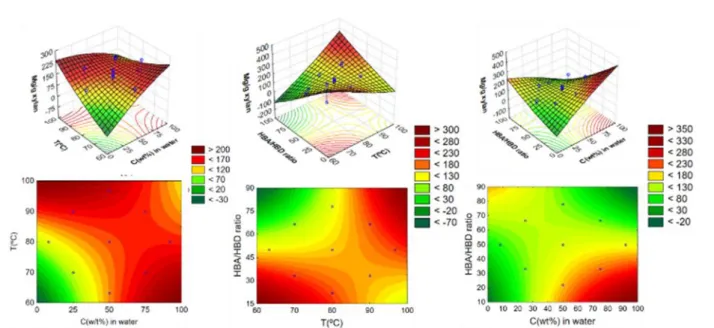
In order to optimize the solubility of xylans in ChCl:U so that it can be successfully used in the extraction of xylans from wood, a RSM approach was used. This methodology allows the exploitation of the relationship between the response (mg/g of xylan solubilised) and the independent variables/conditions which influence xylan solubility. A 23 (3 factors and 2 levels) factorial planning was executed. The parameters studied were the DES concentration in water (C, (%wt)), temperature (T, °C) and HBA:HBD ratio (R, (wt HBA/wt DES). The influence of these three variables on the xylan solublization is illustrated in Figure 5. Variance analysis (ANOVA) was used to estimate the statistical significance of the variables and their interactions. The experimental points used in the factorial planning, the model equation, the extraction yield of HMR obtained experimentally and the respective calculated values, and the correlation coefficients obtained, as well as all the statistical analyses, are shown in Tables S6-10.
As can be seen in Figure 5, and as previously demonstrated in the solubility assays, by playing with the different variables we can obtain similar extraction efficiencies. This is shown in the case of DES concentration and temperature, since by increasing the value of one condition the value of the other can be decreased while maintaining the xylan solubility. The same applies to the HBA:HBD ratio and temperature, however in this case higher HBA:HBD ratios require higher temperatures. However, for high DES concentrations, that result in higher xylan solubility, lower HBA:HBD ratios are preferred. Thus, the response surface design suggests as more appropriate solvents those composed of lower HBA:HBD ratios and high temperatures/lower DES concentrations or lower temperatures/higher DES concentrations.
Figure 5. Response surface (top) and contour plots (bottom) of the xylan solubility using ChCl:U with the combined effects of: (i) DES concentration in water (C)
This trend and dependence further demonstrates the process flexibility and its extensive tailoring possibilities. The Pareto chart in Figure S2 confirms the importance of the combined conditions. In summary, from the combination of the results reported in Figure 5, and those obtained in the initial solubility assays shown in Figures 1 and 2, the conditions corresponding to a 1:2 HBA:HBD ratio and 90°C/50 wt% of DES, 80°C/66.7 wt% of DES and 70°C/80 wt% of DES appear as the optimal conditions and solvents that maximize the xylan solubility. These conditions were further used for the extraction studies from E. globulus biomass described below.
Xylan recovery from DES aqueous solutions
The recovery of xylan from the DES aqueous solutions was studied and the recovered material was compared with the pristine material. To this end, 1 g of xylan was dissolved in 4 g of 50 wt% aqueous ChCl:U (1:2), at 90 °C. At these conditions the assay was far from saturation, meaning that all of the xylan was properly solubilized. After the complete dissolution of xylan, 5 g of absolute ethanol were added and an immediate precipitation of xylan was observed (Figure S3). The samples were then filtrated and washed with ethanol and acetone, and once again with ethanol, in order assure that the DES was completely removed from the xylan sample. The samples were then dried in a ventilated oven at 40 °C overnight and weighted, allowing to obtain recovery yields of 92 ± 4.6 %.
Characterization of the xylan recovered from DES aqueous solutions
In order to confirm the integrity and purity of the isolated xylan, the precipitated material was first analyzed by FTIR-ATR (Figure 5), showing a spectroscopic profile similar to the pristine xylan and in agreement with published data for this polysaccharide,[32] namely an absorption band between 897 – 890 cm-1 associated to the glyosidic bond β-(1→4) between the xylopiranose units of the main xylan chain, the intense absorption bands at 1200-1000 cm-1 corresponding to the C-OH elongation vibrations, and the band of maximum absorption in 1041-1035 cm-1, which corresponds to the C–O–C stretching of pyranoid-ring xylans. The bands observed between 1600-1500 cm-1 correspond to the C-C bond and the bands present at 1450-1400 cm-1 corresponds to C-H bend. As for the bands in the 3700-3408 cm-1 region, they correspond to the CO-H elongation vibrations. Furthermore, and as seen from Figure. 6, the band position on the IR spectra and their width indicates that the bands result from the OH groups vibrations involved in inter- and intramolecular OH bonds and the vibrations of the CH and CH2 groups.[33] Furthermore, the FTIR-ATR of the recovered material does not reveal contaminations with the DES used in the extraction process (Figure 6). The absence of DES contaminations was further confirmed through elemental analysis in the isolated xylan, which revealed a nitrogen content below 0.02 wt%.
The recovered xylan was further analysed and compared to pristine xylan by both 1H and 13C NMR and MALDI-TOF/MS. In the case of 1H NMR, the pristine xylan presents the typical resonances of the 4-OCH3 and of H-1 in the
4–O−methyl-D-glucuronic acid moiety (4-O-Methy-α-D-GlcpA), around δ 3.23 and 5.18 ppm, respectively, and of all the different protons of the non-substituted β-D-xylopyranose ((1→4)-β-D-Xylp) residues between δ 4.36 and δ 2.62 ppm.[34] In the case of the recovered xylan the resonance assigned to the 4-OCH3 is absent suggesting the elimination of this group with the formation of an hexenuronic moiety or the complete removal of 4-O-methyl-α-D-GlcpA. In the13C NMR spectra (Figure S4 and Table S11), the same applies, with all the typical peaks of xylan displayed for both samples, for all the carbons present in (1→4)-β-D-Xylp and 4-O-Methy-α-D-GlcpA units, with the exception of the signal corresponding to 4– OCH3 in agreement with the above observation based on 1H NMR spectra.[35]
Figure 6. FTIR-ATR spectra of commercial (pristine) xylan, and of the xylan
recovered from the DES solutions and of the DES (ChCl:U (1:2)).
As for the MALDI-TOF/MS spectra (Figure S5) they were essentially similar for both pristine and recovered xylans, also in agreement with published data for this type of hemicelluloses.[36] Both spectra show peaks with regular intervals of m/z= 132, corresponding to the loss of xylose units. Additionally, the peaks with intervals of m/z=44 and also m/z=190 correspond respectively, to the loss of CO2 from 4-O-methylglucuronic acid, and loss of 4-O-methylglucuronic acid residues. The absence of the m/z=190 difference in the recovered xylan; is in agreement with the NMR data and shows that 4-O-methylglucuronic acid groups are lost during the solubilisation/precipitation process.[36] The analysis of pristine and recovered xylans in terms of their uronic acids content showed a decrease from 13 to 11 wt%. Although we have no data for the commercial xylan used, these values are in the same range as those reported for other commercial sources.[37,38] Despite the elimination of 4-OCH
3 from 4-O-methyl-α-D-GlcpA, the NMR and MS results show that only 15% of uronic acids are being removed from the xylan backbone, while the 1H NMR data did not reveal any acetyl groups in both pristine and recovered xylans.
In order to confirm the preservation of the molecular weight of the recovered and the pristine xylans, these were finally submitted to SEC analysis using a 0.1M sodium acetate aqueous solution as the eluent. The results show that both xylans have molecular
weight values in the same range (Figure 7) and SEC traces that are similar to the ones reported in the literature for birch wood xylan,[39] with a bimodal molecular weight distribution. The SEC traces also show that high molecular weight xylan fraction is preserved (same Mw values), while a small fraction of low molecular weight population is lost during the solubilisation/recovery process.
Figure 7. SEC profiles of the pristine and recovered xylans.
In conclusion the various characterization technics clearly show that apart from the removal of 4-O-Methy-α-D-GlcpA units the xylan structure is largely preserved during the DES solubilisation/recovery process.
NADES recyclability
The last step in order to achieve a sustainable xylan extraction process based on DES was to evaluate the possibility of recovering and recycling the solvent. Thus, after the xylan precipitation, ethanol and water were removed in a rotary evaporator and the resulting DES residue was analysed by 1H and 13C NMR (Figure S6), showing that the DES was successfully recovered from the assays and can be reused in xylans extraction. This was demonstrated by using the same DES in four extraction cycles (Figure 8). During this cyclic process, the DES aqueous solution gained a slightly brownish color due to the dissolution of low molecular weight compounds that are not fully precipitated using ethanol (e.g. phenolic compounds, furfural or other furanic compounds). However, this effect did not affect significantly the xylan solubilisation and recovery. At least two recycling cycles can be made without decreasing significantly the xylan solubility (less than 5% decrease).
Figure 8. Xylan dissolution and recovery yields using recycled
ChCl:U (1:2) aqueous solutions under optimized conditions.
Proof of concept: Extraction of xylan from E. globulus wood
Extraction assays were conducted using pre-treated E. globulus wood saw dust pre-extracted with both ethanol/toluene to remove extractives.[40] The best conditions identified above for xylan solubilisation (90°C, 1:2 HBA:HBD ratio and 50 wt% of DES in water) and the fixed extraction time of 24h and two different solid:liquid ratios (r=0.1 and r=0.04) were used. Extraction with an aqueous 1.67M NaOH solution was used for comparative purposes. After extraction, xylans were precipitated, washed and dried as reported in the experimental section. The extraction yields are shown in Table 2. It is important to remark that E.
globulus biomass has typically about 14 wt% of hemicellulose.[41] The assays corresponding to a S/L ratio of 0.1 lead to extraction yields far below those expected for this wood.
As can be seen from Table 1, a S/L ratio of 0.04 allows to obtain an extraction yield of 15 %, performing even better than aqueous NaOH and water (12 and 7 wt%, respectively), as expected from the solubility assays.
Table 1. Xylan extraction yields (wt xylan/wt of dry wood) with ChCl:U, aqueous
NaOH, and water at 90°C, extraction time of 24h, at two solid-liquid ratios.
Solvent S/L ratio=0.1 S/L ratio=0.04
Yield (%) ± deviation Yield (%) ± deviation
ChCl:U (1:2) 3.1 0.83 14.8 0.61
NaOH 1.67 M 4.2 1.27 12.3 2.00
Water 1.7 0.09 7.9 1.39
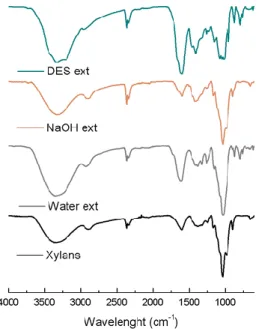
Finally, the isolated xylans were characterized by FTIR (Figure 9), showing that in the case of the samples extracted with aqueous DES, there are some contaminations with other polysaccharides, most probably pectin and starch (1112 cm -1 and 998 cm-1), both known to be present in E. globulus wood,[42,43] and prone to solubilise in DES.[25,44]
Figure 9. FTIR-ATR spectra of the xylan samples extracts obtained from E. globulus wood extraction.
These final results serve to demonstrate the potential of ChCl:U aqueous solutions for biomass pre-treatment and xylans extraction. Although further process optimization and refinement is still needed, it was herein showed that aqueous solutions of DES in milder conditions of temperature and pH, than those used currently with alkaline aqueous solutions, are promising alternative solvents and processes for the xylan extraction.
Conclusions
The work here presented demonstrates the possibility of using aqueous solutions of DES for the solubilisation/extraction of xylans. The results obtained with ChCl:U are far superior to those obtained in previous works using ILs and are comparable to those obtained with harsh treatments using aqueous alkaline solutions. A DES molar ratio of 1:2 (HBA:HBD) leads the best results. Furthermore, by a RSM optimization, we confirmed the presence of relevant relationships between temperature and concentration of DES, which can be tailored to achieve similar solubility results (about 310 mg/g of xylan). The xylan recovery was also successfully achieved with high yields (above 90%).The structural characterization showed that, during the extraction/recovery process, there is elimination of methyl groups from 4-O-methylglucuronic acids moieties, as well as the cleavage of uronic acids (15%) from the pristine xylan structure. Finally, the SEC traces show that high molecular weight fraction of the xylan is preserved in terms of its Mw values, while a small fraction of low molecular weight population is lost during the solubilisation/recovery process.
The DES used could also be successfully recycled, up to four cycles, with a decrease of 5% on the xylan solubility in the first
two. The application of the optimized aqueous solutions of DES for the extraction of hemicelluloses from E. globulus wood was successfully achieved, with a yield of 14.81±0.61%, higher than the yields obtained with water or alkali solutions.
This work provides an important contribution to the understanding of the use DES in wood fractioning processes, especially in what regards xylans extraction from hardwood, and opens promising perspectives for the development of integrated biorefineries where DES might play a central role. Furthermore, the conditions optimized with the commercial beechwood xylan were successfully applied to the extraction of xylans from Eucalyptus
globulus hardwood being expected that their application to other
hardwoods can also be easily optimized. Further work will be focused in a better understanding of the dissolution process and in optimizing the DES and remaining operational conditions for the extraction of hemicelluloses from E. globulus wood.
Experimental Section
Chemicals
Choline Chloride (ChCl) was used as HBA and Urea (U) and Acetic acid (AA) were used as HBDs (Table S1). Their water content was measured through a Metrohm 831 Karl Fisher coulometer, in order to guarantee the correct molar proportion in the preparation of DES. Xylan from beechwood, obtained from Sigma (≥90%), was used as model compound for the solubility assays. Choline Acetate, from Iolitec with >99% purity, was used as a starting reference for the solubility assays.[13]
DES preparation
The different DES prepared for this study are presented in Table 2. The humidity of the different DES precursors (HBA and HBD) was taken in account regarding their preparation and was measured with using a Metrohm 831 Karl Fisher coulometer. They were weighted and placed in sealed glass vials with constant stirring and heated until a transparent liquid was formed. After the liquid formation, the mixture was kept at this temperature for one hour before being allowed to return to room temperature. Their compositions were confirmed by NMR. The 1H NMR and 13C NMR spectra were recorded using a Bruker Avance 300 at 300.13 MHz and 75.47 MHz, respectively, using deuterated water as solvent and trimethylsilyl propanoic acid (TMSP) as internal reference (results illustrated in Figure S2 for ChCl:U (1:2)).
The DES aqueous solutions (0, 5, 15, 25, 35, 50, 66.7, 75, 80, 83.3 and 100 wt %) were prepared by diluting the neat DES in deionized water. The pH of the DES aqueous solutions (Table S2) was measured at 25.0 ± 0.01 °C using a Metrohm 827 pH meter equipment with an uncertainty of ± 0.01. The calibration of the pH meter was carried out with two buffer solutions (pH of 4.00 and 7.00). Furthermore, the density of the aqueous solutions was also measured at atmospheric pressure and in the temperature range from 0 to 30 °C using an automated SVM 3000 Anton Paar rotational Stabinger viscometer-densimeter (temperature uncertainty: ± 0.02 K; absolute density uncertainty: ± 5 × 10⁻⁴ g cm-3).
Table 2. List of DES prepared for this study.
DES Molar ratios
(HBA:HBD) Melting Point (°C) ChCl:Acetic Acid 1:2 22.1 ChCl:Urea 1:2 12.2 1:1 55.7 2:1 142.5 Xylan characterization
The pristine beechwood and recovered xylans from the solubility assays and also the xylan extracted from E. globulus wood were characterized by measuring their acetylation degree and uronic acid content. The acetylation degree was measured through the integration of the corresponding 1H NMR resonances (at 2.2 ppm).[45]
For uronic acids content quantification about 1-2 mg of xylan were weighted and added to 0.400 ml 72% aqueous H2SO4 and left to react for 3 h at room temperature. Then, 2.2 mL of distilled water were added and the samples were heated at 100°C for 2.5h in order to promote hydrolysis. The hydrolyzed sample was then diluted in 3 mL. To quantify uronic acids in the sample a calibration curve, in the range of 20-200 µg/mL, was prepared with glucuronic acid. For all concentrations and samples a blank was prepared. To each sample 3.0 mL of 50 mM sodium borate in concentrated H2SO4 (95%)was added and put at 100°C during 10 minutes. Then the samples were put in an ice bath and 100 µL of
m-phenylphenol 0.15% (m/v) in 0.5% (m/v) NaOH were added.
The samples and blanks were left in the dark during 30 minutes and their absorbance was measured at 520 nm.[46,47]
Xylan solubility assays
Xylan form beechwood was added in excess to 2.0 ± 0.1 g of pure DES, DES aqueous solutions, ChCl, Urea, Choline Acetate aqueous solution, aqueous NaOH 1.67 M and pure water. The solvents and pure xylan were put in sealed glass vials and allowed to equilibrate at constant temperature (70, 80 and 90 °C) with stirring (800 rpm) in a stirring plate with heat control Agimatic-N Sensoterm II from P-selecta and a specific aluminum disk to support the sealed glass vials with a stirring bar. Since the obtained solutions presented a high viscosity it was not possible to separate the different phases and so the glass vials were put in an aired oven at the temperature of the assays overnight, in order to equilibrate and for the undissolved xylan to deposit in the bottom of the vials. Then, the concentration of dissolved xylan in the different solvents was measured by FTIR-ATR, following a similar approach to the one followed by Soares et al. [21,48] for the quantification of dissolved lignin, but using in this case using the xylan band at 1045 cm-1 typical of C-OH stretching and C-O-C deformation in polysaccharides.[33] A FTIR system Spectrum BX, PerkinElmer, equipped with a single horizontal Golden Gate ATR cell (attenuated total reflectance) and a diamond crystal was used for the measurements. All data was recorded at room temperature, in the range of 4000 - 600 cm-1 by accumulating 32 scans with a resolution of 4 and interval of 1 cm-1. At least three individual samples were analysed for each mixture and temperature.
Calibration curves were made for each DES, IL, ChCl, Urea and aqueous solutions tested (Figures S8 to S12).
Response Surface methodology (RSM)
A RSM was applied to simultaneously analyse various factors (operational conditions) and to identify the most significant parameters, which enhance the xylan dissolution. In a 2k surface response methodology there are k factors that contribute to a different response, and the data are treated according to a second order polynomial equation:
𝑦 = 𝛽0+ ∑ 𝛽𝑖𝑋𝑖+ ∑ 𝛽𝑖𝑖𝑋𝑖2+ ∑𝑖<𝑗𝛽𝑖𝑗𝑋𝑖𝑋𝑗 (1)
where 𝑦 is the response variable and 𝛽0, 𝛽𝑖 , 𝛽𝑖𝑖 and 𝛽𝑖𝑗 are the
adjusted coefficients for the intercept, linear, quadratic and interaction terms, respectively, and 𝑋𝑖 and 𝑋𝑗 are independent
variables. This model allows the drawing of surface response curves and through their analysis the optimal conditions can be determined [49]. The 23 factorial planning has been defined by the central point (zero level), the factorial points (1 and −1, level one) and the axial points (level α) The axial points are encoded at a distance α from the central point:
𝛼 = (2𝑘)1/4 (2)
ChCl:U was selected to perform a 23 factorial planning with the aim of optimizing the future extraction yield of xylans. The 23 factorial planning used is provided in the Supporting Information. The obtained results were statistically analysed with a confidence level of 95%. Student’s t-test was used to check the statistical significance of the adjusted data. The adequacy of the model was determined by evaluating the lack of fit, the regression coefficient (and the F-value obtained from the analysis of variance (ANOVA) that was generated. The Statsoft Statistica 10.0© software was used for all statistical analyses and representing the response surfaces and contour plots. Furthermore, Matlab 2015b, The MathWorks, was used to confirm the response surfaces and contour plots obtained.
Xylan recovery from aqueous DES solutions
Xylan recovery from aqueous DES was tested after the solubility assays by adding the same weight ethanol to the DES solution and left stirring at 800 rpm for 24 hours. All assays were made in triplicate. After that, the precipitated material was washed with ethanol and acetone for analytical purposes. The recovered solid was then vacuum filtrated using nylon Whatman 0.45 µm pore filters. The recovered xylan was then put in a 40°C ventilated oven overnight and weighted. Both the pristine and recovered xylan (after DES dissolution and precipitation) were analysed using nuclear magnetic resonance (NMR). The 1H NMR and 13C NMR spectra were recorded using a Bruker Avance 300 at 300.13 MHz and 75.47 MHz, respectively, using deuterated water as solvent and trimethylsilyl propanoic acid (TMSP) as internal reference. Matrix-assisted laser desorption ionization time-of-flight mass spectrometry (MALDI-ToF-MS) analysis were performed using a Bruker Daltonik Autoflex III smartbean MALDI-TOF-MS mass spectrometer from the Centro de Apoio Tecnológico e de
Investigação in Vigo (CACTI). Ions formed upon irradiation by a smartbeam nitrogen laser (337 nm) using an accelerating potential of 20 kV and a frequency of 200 Hz. Averaging 3500 laser shots collected across the whole sample spot surface by rastering in the range m/z 700-4000 produced each mass spectrum. The laser irradiance was set to 45-60 % (relative scale 0-100) arbitrary units according to the corresponding threshold required for the applied matrix system. Low molecular ion gating was set to 650 Da to remove the ions below this value arising from the matrix and their clusters or other unknown contaminants. All spectra were adquired and treated using the FlexControl 3.0 and FlexAnalysis 3.0 softwares (Bruker Daltonik, Bremen, Germany), respectively. The dried-droplet sample preparation technique was used, applying 1 µL of 2,5-dihydroxybenzoic acid (DHB) matrix solution (10 mg/mL in 50% ACN/0.1% TFA, v/v) directly on a MTP AnchorChip™ 800/384 TF MALDI target (Bruker Daltonik, Bremen Germany). Then, before drying the matrix solution, 1 µL of sample (10 mg/mL in NaOH 1M) was added and allowed to dry at room temperature. External mass calibration was performed with a calibration standard (Bruker Daltonik, Bremen Germany) for the range m/z 700-4000 (9 mass calibrant points): 0.5 mL of calibrant solution and DHB matrix previously mixed in an Eppendorf tube (1:2, v/v) were applied directly on the target and allowed to dry at room temperature.
Both pristine and recovered xylans were analyzed by a size exclusion chromatography (SEC) system equipped with an online degasser, a refractive index (RI) detector and a set of columns comprising a Shodex OHpak G guard column, OHpak SB-802.5HQ and OHpak SB-804HQ columns. The xylans were eluted at a flow rate of 0.5 mL/min with 0.1 M sodium acetate (aq)/0.02% NaN3). Before the injection (50 µL), the samples were filtered through a nylon membrane with 0.20 µm pores. The system was calibrated with narrow PEG standards and the polymer molecular weights (MnSEC) and Ð (Mw/Mn) were determined by conventional calibration using Clarity software version 2.8.2.648. The samples were injected four times. Elemental analyses of both pristine and recovered xylans were performed on a Leco Truspec 630-200-200 equipment with a sample size up to 10mg, combustion furnace temperature of 1075 °C and afterburner temperature of 850 °C.
Hemicellulose extraction from E. globulus wood biomass
Extraction assays from E. globulus pre-extracted biomass (with ethanol/toluene) were carried out using the best conditions accordingly with the solubility assays performed previously. Two solid/liquid ratios were used, 0.1 and 0.04. The assays were carried out in a Radleys Tech carousel and the temperature was fixed at 90°C and the agitation at 600 rpm to ensure the constant agitation of the biomass. After the 24h extraction the biomass was separated from the solvent through vacuum filtration with a cellulose filter and ethanol in excess (twice the volume of the filtrate) was added in order to precipitate the hemicelluloses. After the precipitation occurred, the samples were filtered again using a nylon Whatman filter of 0.45 µm pore and the precipitate was dried in a ventilated oven overnight. The samples were then weighted and taken to FTIR-ATR in order to confirm the hemicelluloses structure. Triplicates were made for all extractions.
Acknowledgements
This work was developed in the scope of the project CICECO-Aveiro Institute of Materials (Ref. FCT UID/CTM/50011/2013), financed by national funds through the FCT/MEC and co-financed by FEDER under the PT2020 Partnership Agreement. The research leading to reported results has received funding from Fundação para a Ciência e Tecnologia FCT through the projects DeepBiorefinery (PTDC/AGR-TEC/1191/2014) and MultiBiorefinery (POCI-01-0145-FEDER-016403) and through C. Freire Researccher contract (IF/01407/2012), and from the European Research Council under the European Union’s Seventh Framework Programme (FP7/2007-2013)/ERC grant agreement no. 337753.
Conflict of Interest
The authors declare no conflict of interest.
Keywords: xylans • deep eutectic solvents • extraction •
biorefinery • green solvents
References
[1] F. Cherubini, Energy Convers. Manag. 2010, 51, 1412–1421. [2] F. Pena-Pereira, J. Namiesnik, ChemSusChem Rev. 2014, 7, 1784–
1800.
[3] H. M. N. Iqbal, G. Kyazze, T. Keshavarz, Bioresources 2013, 8, 3157–3176.
[4] A. P. Abbott, D. Boothby, G. Capper, D. L. Davies, R. K. Rasheed, JACS Artic. 2004, 126, 9142–9147.
[5] S. Khandelwal, Y. K. Tailor, M. Kumar, J. Mol. Liq. 2016, 215, 345– 386.
[6] A. Farrán, C. Cai, M. Sandoval, Y. Xu, J. Liu, M. J. Hernáiz, R. J. Linhardt, Chem. Rev. 2015, 115, 6811–53.
[7] B. Tang, K. Ho, Monatsh hem 2013, 144, 1427–1454.
[8] Q. Zhang, K. De Oliveira Vigier, S. Royer, F. Jérôme, Chem. Soc. Rev. 2012, 41, 7108–46.
[9] C. F. Araujo, J. A. P. Coutinho, M. N. Nolasco, S. F. Parker, P. J. A. Ribeiro-Claro, B. I. G. Soares, P. D. Vaz, PCCP 2017, DOI 10.1039/C7CP01286A.
[10] M. Francisco, A. van den Bruinhorst, M. C. Kroon, Angew. Chem. Int. Ed. Engl. 2013, 52, 3074–85.
[11] X. Tang, M. Zuo, Z. Li, H. Liu, C. Xiong, X. Zeng, ChemSusChem
2017, 10, 2696–2706.
[12] H. Passos, M. G. Freire, J. A. P. Coutinho, Green Chem. 2014, 16, 4786–4815.
[13] F. Cheng, H. Wang, G. Chatel, G. Gurau, R. D. Rogers, Bioresour. Technol. 2014, 164, 394–401.
[14] Y. Dai, J. van Spronsen, G.-J. Witkamp, R. Verpoorte, Y. H. Choi, Anal. Chim. Acta 2013, 766, 61–8.
[15] CEPI /Unfold The Future, “The Two Team Project report,” 2013. [16] A. García, E. Rodríguez-Juan, G. Rodríguez-Gutiérrez, J. J. Rios, J.
Fernández-Bolaños, Food Chem. 2016, 197, 554–61. [17] V. M. Paradiso, A. Clemente, C. Summo, A. Pasqualone, F.
Caponio, Data Br. 2016, 8, 553–6.
[18] H. E. Park, B. Tang, K. H. Row, Anal. Lett. 2014, 47, 1476–1484. [19] K. Pang, Y. Hou, W. Wu, W. Guo, W. Peng, K. N. Marsh, Green
Chem. 2012, 14, 2398 – 2401.
[20] Z. Wei, X. Qi, T. Li, M. Luo, W. Wang, Y. Zu, Y. Fu, Sep. Purif. Technol. 2015, 149, 237–244.
[21] B. Soares, D. J. P. Tavares, J. L. Amaral, J. D. Silvestre, C. Sofia, R. Freire, J. A. P. Coutinho, ACS Sustain. Chem. Eng. 2017, 5, 4056–4065.
[22] D. Di Marino, D. Stöckmann, S. Kriescher, S. Stiefel, M. Wessling, Green Chem. 2016, 18, 6021–6028.
[23] A. K. Kumar, B. S. Parikh, M. Pravakar, Environ. Sci. Pollut. Res. Int. 2016, 23, 9265–75.
[24] C. Alvarez-Vasco, R. Ma, M. Quintero, M. Guo, S. Geleynse, K. Ramasamy K., M. Wolcott, X. Zhang, Green Chem. 2016, 2016, 1– 3.
[25] M. Zdanowicz, T. Spychaj, H. Mąka, Carbohydr. Polym. 2016, 140, 416–23.
[26] J. M. Chem, B. Ding, J. Cai, J. Huang, L. Zhang, Y. Chen, X. Shi, J. Mater. Chem. 2012, 22, 5801–5809.
[27] A. Hillman, D.C., Rooks, Solutions! 2002, 85.
[28] L. J. Jönsson, C. Martín, Bioresour. Technol. 2016, 199, 103–112. [29] J. Helmerius, Integration of a Hemicelluloses Extraction Step into a
Forest Biorefinery for Production of Green Chemicals, 2010.
[30] M. Andre, C. Lopes, K. G. João, A. R. C. Morais, E. B.- Ł, R. B.- Ł, Sustain. Chem. Process. 2013, 1, 1–31.
[31] V. Dhapte, P. Mehta, St. Petersbg. Polytech. Univ. J. Phys. Math.
2016, 000, 1–12.
[32] R. Sun, J. M. Fang, P. Rowlands, J. Bolton, J. Agric. Food Chem.
1998, 46, 2804–2809.
[33] M. Hesse, H. Meier, B. Zeeh, Spectroscopic Methods in Organic Chemistry, Thieme New York, 1997.
[34] D. V Evtuguin, J. L. Toma, A. M. S. Silva, C. P. Neto, 2003, 338, 597–604.
[35] S. N. Sun, T. Q. Yuan, M. F. Li, X. F. Cao, F. Xu, Q. Y. Liu, Cellul. Chem. Technol. 2012, 46, 165–176.
[36] Y. Nakahara, K. Yamauchi, J Wood Sci 2014, 60, 225–231. [37] Megazymes, “XYLAN (Beechwood) (Lot 171004a),” n.d.
[38] B. V Mccleary, P. Mcgeough, Appl. Biochem. Biotechnol. 2015, 177, 1152–1163.
[39] N. M. L. Hansen, D. Plackett, S. Girault, A. Mourran, R. Pirri, J. C. Razet, L. Leibler, M. D. Wood, B. Jastorff, C. L. Liotta, et al., Polym. Chem. 2011, 2, 2010.
[40] I. Mota, P. C. R. Pinto, C. Novo, G. Sousa, O. Guerreiro, A. R. Guerra, M. F. Duarte, E. Rodrigues, Ind. Eng. Chem. Res. 2012, 5, 6991–7000.
[41] C. Neto, A. Silvestre, D. Evtuguin, C. Freire, P. Pinto, A. Santiago, P. Fardim, B. Holmbom, Nord. Pulp Pap. Res. Jorunal 2004, 19, 513–520.
[42] S. A. Lisboa, D. V Evtuguin, P. Neto, Holzforschung 2007, 61, 478– 482.
[43] B. Coetzee, H. A. Schols, W. Francois, Holzforschung 2011, 65, 327–331.
[44] V. Den Bruinhorst, D. Croon, Nat. Prod. Chem. Res. 2016, 4, 1–5. [45] L. Chanhui, Q. Teng, R. Zhong, Z.-H. Ye, Plant Signal. Behav.
2014, 9, 1–4.
[46] N. Blumenkrantz, G. Asboe-Hansen, Anal. Biochem. 1973, 54, 484– 489.
[47] R. Bastos, E. Coelho, M. A. Coimbra, Carbohydr. Polym. 2015, 124, 322–330.
[48] B. Soares, J. Luis, M. G. Freire, A. J. D. Silvestre, C. S. R. Freire, J. A. P. Coutinho, EWLP - Eur. Work. Lignocellul. Pulp, June 28-July 1, 2016 - Autrans, Fr. 2016, 1–4.
[49] M. I. I. Rodrigues, A. Francisco, Planejamento de Experimentos E Optimização de Processos, Campinas, Brazil, 2005.
Entry for the Table of Contents (Please choose one layout)
Layout 1:
FULL PAPER
Choline chloride:urea aqueous solutions present exceedingly good capabilities of solubilising hardwood xylans, thus having a great potential for the extraction of these
polysaccharides from hardwoods in an integrated biorefinery context.
E. S. Morais, P. V. Mendonça, J. F. J. Coelho, M. G. Freire, C. S. R. Freire, J. A. P. Coutinho, and, A. J. D. Silvestre*
Page No. – Page No.
Deep Eutectic Solvents aqueous solutions as efficient media for the solubilisation of hardwood xylans