EUROPEAN ORGANIZATION FOR NUCLEAR RESEARCH (CERN)
CERN-PH-EP/2012-329 2013/03/12
CMS-EXO-11-009
Search for contact interactions in µ
+
µ
−
events in pp
collisions at
√
s
=
7 TeV
The CMS Collaboration
∗Abstract
Results are reported from a search for the effects of contact interactions using events with a high-mass, oppositely-charged muon pair. The events are collected in
proton-proton collisions at √s = 7 TeV using the Compact Muon Solenoid detector at the
Large Hadron Collider. The data sample corresponds to an integrated luminosity of
5.3 fb−1. The observed dimuon mass spectrum is consistent with that expected from
the standard model. The data are interpreted in the context of a quark- and muon-compositeness model with a left-handed isoscalar current and an energy scale
param-eterΛ. The 95% confidence level lower limit on Λ is 9.5 TeV under the assumption of
destructive interference between the standard model and contact-interaction ampli-tudes. For constructive interference, the limit is 13.1 TeV. These limits are comparable to the most stringent ones reported to date.
Submitted to Physical Review D
c
2013 CERN for the benefit of the CMS Collaboration. CC-BY-3.0 license
∗See Appendix A for the list of collaboration members
1
1
Introduction
The existence of three families of quarks and leptons might be explained if these particles are composed of more fundamental constituents. In order to confine the constituents (often re-ferred to as “preons” [1, 2]) and to account for the properties of quarks and leptons, a new
strong gauge interaction, metacolor, is introduced. Below a given interaction energy scaleΛ,
the effect of the metacolor interaction is to bind the preons into metacolor-singlet states. For
parton-parton center-of-mass energy less thanΛ, the metacolor force will manifest itself in the
form of a flavor-diagonal contact interaction (CI) [3, 4]. In the case where both quarks and lep-tons share common constituents, the Lagrangian density for a CI leading to dimuon final states can be written as Lql =(g02/Λ2){ηLL(¯qLγµqL)(µ¯LγµµL) +ηLR(¯qLγµqL)(µ¯RγµµR) +ηRL(¯uRγµuR)(µ¯LγµµL) +ηRL(¯dRγµdR)(µ¯LγµµL) +ηRR(¯uRγµuR)(µ¯RγµµR) +ηRR(¯dRγµdR)(µ¯RγµµR)}, (1)
where qL= (u, d)Lis a left-handed quark doublet, uRand dRare right-handed quark singlets,
and µL and µR are left- and right-handed muons. By convention, g20/4π = 1. The parameter
Λ characterizes the compositeness energy scale. The parameters ηij allow for differences in
magnitude and phase among the individual terms. Lower limits on Λ are set separately for
each term with ηij taken, by convention, to have a magnitude of one.
The dimuons from the subprocesses for standard model (SM) Drell–Yan (DY) [5] production and from CI production can have the same helicity state. In this case, the scattering amplitudes
are summed, resulting in an interference term in the cross section for pp → X+µ+µ−, as
illustrated schematically in Fig. 1.
The differential cross section corresponding to the combination of a single term in Eq. 1 with DY production can be written as
dσCI/DY dMµµ = dσ DY dMµµ −ηij I Λ2 +η 2 ij C Λ4, (2)
where Mµµ is the invariant dimuon mass, I is due to interference, and C is purely due to the
CI. Note that ηij = +1 corresponds to destructive interference and ηij = −1 to constructive
interference. The processes contributing to the cross section in Eq. (2) are denoted collectively
by “CI/DY”. The difference dσCI/DY/dMµµ−dσDY/dMµµis the signal we are searching for in
this paper.
!
!
!
!
!
!
!
!
!
q µ+ ¯ q γ/Z µ−+
q µ+ ¯ q µ− Λ!
!
!
!
!
!
!
!
!
2 1Figure 1: Schematic representation of the addition of DY (left) and CI (right) amplitudes, for
2 2 Predictions of the left-left isoscalar model
The contact interaction model used for this analysis is the left-left isoscalar model (LLIM) [4],
which corresponds to a left-handed current interaction described by the first term of Lql in
Eq. (1). The LLIM is the conventional benchmark for CI in the dilepton channel. For this analysis, all initial-state quarks are assumed to be composite.
Previous searches for CI in the dijet and dilepton channels have all resulted in limits on the
com-positeness scaleΛ. Searches have been reported from experiments at LEP [6–10], HERA [11,
12], the Tevatron [13–18], and recently from the ATLAS [19–22] and CMS [23–25] experiments
at the LHC. The best limits in the LLIM dimuon channel areΛ> 9.6 TeV for destructive
inter-ference andΛ>12.9 TeV for constructive interference, at the 95% confidence level (CL) [22].
In this paper, we report a search for CI in the dilepton channel produced in pp collisions at
√
s = 7 TeV using the Compact Muon Solenoid (CMS) detector at the Large Hadron Collider
(LHC). The data sample corresponds to an integrated luminosity of 5.3 fb−1.
2
Predictions of the left-left isoscalar model
The basic features of the LLIM dimuon mass spectra are demonstrated with a generator-level
simulation usingPYTHIA [26], with appropriate kinematic selection criteria that approximate
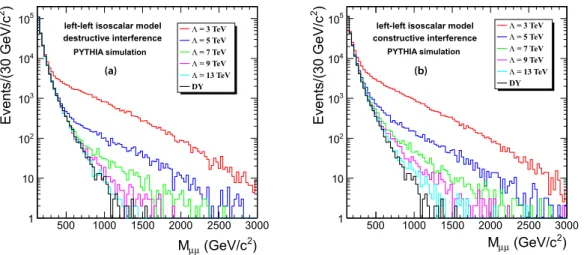
the acceptance of the detector. Figures 2(a) and 2(b) show the LLIM dimuon mass spectra for
different values of Λ for destructive and constructive interference, respectively. The curves
illustrate that with increasing mass the CI leads to a less steeply falling yield relative to DY
production, with the effect steadily increasing with decreasingΛ. For a given value of Λ, the
event yield is seen to be larger for constructive interference compared to the destructive case,
with the relative difference increasing withΛ.
For the results presented in this paper, the analysis is limited to a dimuon mass range from
) 2 (GeV/c µ µ M 500 1000 1500 2000 2500 3000 ) 2 Events/(30 GeV/c 1 10 2 10 3 10 4 10 5 10 = 3 TeV Λ = 5 TeV Λ = 7 TeV Λ = 9 TeV Λ = 13 TeV Λ DY
destructive interferenceleft-left isoscalar model
PYTHIA simulation (a) ) 2 (GeV/c µ µ M 500 1000 1500 2000 2500 3000 ) 2 Events/(30 GeV/c 1 10 2 10 3 10 4 10 5 10 Λ = 3 TeV = 5 TeV Λ = 7 TeV Λ = 9 TeV Λ = 13 TeV Λ DY
constructive interferenceleft-left isoscalar model
PYTHIA simulation
(b)
Figure 2: Simulated dimuon mass spectra using the left-left isoscalar model for different values
ofΛ for (a) destructive interference and (b) constructive interference. The events are generated
using the PYTHIA Monte Carlo program with kinematic selection requirements that
approxi-mate the acceptance of the detector. AsΛ increases, the effects of the CI are reduced, and the
event yield approaches that for DY production. The model predictions are shown over the full
mass range, although the model is not valid as Mµµc2approachesΛ. The integrated luminosity
3
200 to 2000 GeV/c2. The lower mass is sufficiently above the Z-peak so that a deviation from
DY production would be observable. The highest dimuon mass observed is between 1300 and
1400 GeV/c2 and, for the values of Λ where the limits are set, less than one event is expected
for dimuon masses above 2000 GeV/c2. In order to limit the mass range in which the detector
acceptance has to be evaluated, we therefore choose an upper mass cutoff of 2000 GeV/c2. To
optimize the limit onΛ, a minimum mass Mµµminis varied between the lower and upper mass
values, as described in Section 6.
3
CMS detector
The central feature of the CMS apparatus is a superconducting solenoid of 6 m internal diam-eter, providing a magnetic field of 3.8 T. Within the field volume are a silicon pixel and strip tracker, a lead tungstate crystal electromagnetic calorimeter, and a brass/scintillator hadron calorimeter. Muons are measured in gas-ionization detectors embedded in the steel flux-return yoke. Extensive forward calorimetry complements the coverage provided by the barrel and endcap detectors. A detailed description of the CMS detector can be found in Ref. [27].
The tracker and muon detector are important sub-systems for this measurement. The tracker
measures charged particle trajectories within the range|η| <2.5, where pseudorapidity η =
−ln[tan(θ/2)], and polar angle θ is measured from the beam axis. The tracker provides a
transverse momentum (pT) resolution of about 1% at a few tens of GeV/c to 10% at several
hundred GeV/c [28], where pT is the component of momentum in the plane perpendicular to
the beam axis. Tracker elements include about 1400 silicon pixel modules, located close to the beamline, and about 15 000 silicon microstrip modules, which surround the pixel system. Tracker detectors are arranged in both barrel and endcap geometries. The muon detector prises a combination of drift tubes and resistive plate chambers in the barrel region and a com-bination of cathode strip chambers and resistive plate chambers in the endcap regions. Muons
can be reconstructed in the range|η| <2.4.
For the trigger path used in this analysis, the first level (L1) selects events with a muon candi-date based on a sub-set of information from the muon detector. The trigger muon is required
to have|η| <2.1 and pT above a threshold that was raised to 40 GeV/c by the end of the
data-taking period. This cut has little effect on the acceptance for muon pairs with masses above
200 GeV/c2. The small effect is included in the simulation. The high level trigger (HLT) refines
the L1 selection using the full information from both the tracker and muon systems.
4
Event selection criteria
This analysis uses the same event selection as the search for new heavy resonances in the dimuon channel, discussed in Ref. [29]. Each muon track is required to have a signal (“hit”) in at least one pixel layer, hits in at least nine strip layers, and hits in at least two muon
de-tector stations. Both muons are required to have pT > 45 GeV/c. To reduce the cosmic ray
background, the transverse impact parameter of the muon with respect to the beamspot is re-quired to be less than 0.2 cm. In order to suppress muons coming from hadronic decays, a
tracker-based isolation requirement is imposed such that the sum of pTof all tracks, excluding
the muon and within a cone surrounding the muon, is less than 10% of the pTof the muon. The
cone is defined by the condition∆R =p(∆η)2+ (∆φ)2 = 0.3, where φ is the azimuthal angle
of a track, and the differences∆η and ∆φ are determined with respect to the muon’s direction.
4 5 Simulation of SM and CI dimuon production
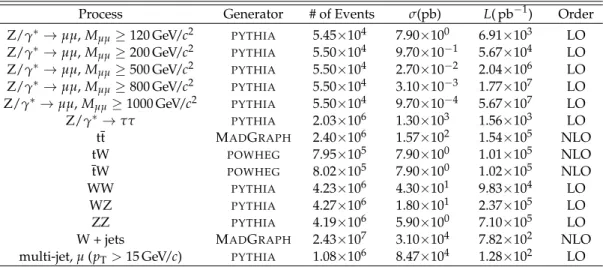
Table 1: Description of event samples with detector simulation. The cross section σ and inte-grated luminosity L are given for each sample generated.
Process Generator # of Events σ(pb) L( pb−1) Order
Z/γ∗→µµ, Mµµ≥120 GeV/c2 PYTHIA 5.45×10⁴ 7.90×100 6.91×10³ LO Z/γ∗→µµ, Mµµ≥200 GeV/c2 PYTHIA 5.50×10⁴ 9.70×10⁻¹ 5.67×10⁴ LO Z/γ∗→µµ, Mµµ≥500 GeV/c2 PYTHIA 5.50×10⁴ 2.70×10⁻² 2.04×10⁶ LO Z/γ∗→µµ, Mµµ≥800 GeV/c2 PYTHIA 5.50×10⁴ 3.10×10⁻³ 1.77×10⁷ LO Z/γ∗→µµ, Mµµ≥1000 GeV/c2 PYTHIA 5.50×10⁴ 9.70×10⁻⁴ 5.67×10⁷ LO Z/γ∗→ττ PYTHIA 2.03×10⁶ 1.30×10³ 1.56×10³ LO tt MADGRAPH 2.40×10⁶ 1.57×10² 1.54×10⁵ NLO tW POWHEG 7.95×10⁵ 7.90×100 1.01×10⁵ NLO tW POWHEG 8.02×10⁵ 7.90×100 1.02×10⁵ NLO WW PYTHIA 4.23×10⁶ 4.30×101 9.83×10⁴ LO WZ PYTHIA 4.27×10⁶ 1.80×101 2.37×10⁵ LO ZZ PYTHIA 4.19×10⁶ 5.90×100 7.10×10⁵ LO
W + jets MADGRAPH 2.43×10⁷ 3.10×10⁴ 7.82×10² NLO
multi-jet, µ (pT>15 GeV/c) PYTHIA 1.08×10⁶ 8.47×10⁴ 1.28×10² LO
from a common vertex. To suppress cosmic ray muons that are in time with the collision event,
the angle between the two muons must be smaller than π−0.02 radians. At least one of the
reconstructed muons must be matched (within∆R <0.2 and∆pT/pT < 1) to the HLT muon
candidate.
If an event has more than two muons passing the above requirements, then the two highest-pT
muons are selected, and the event is retained only if these muons are oppositely charged. Only
three such events are observed with selected dimuon mass above 200 GeV/c2, and in all three
cases, the dimuon mass is less than 300 GeV/c2. Thus, events with multiple dimuon candidates
play essentially no role in the analysis.
5
Simulation of SM and CI dimuon production
This section describes the method used to simulate the mass distribution from the CI/DY pro-cess of Eq. (2), including the leading-order (LO) contributions from DY and CI amplitudes, their interference, the effects of next-to-leading-order (NLO) QCD and QED corrections, and the re-sponse of the detector. The predicted number of CI/DY events is the product of the generated number of CI/DY events, a QCD K-factor, a QED K-factor, and a factor denoted as “acceptance
times migration” (A×M). The factor A×M is determined from the detector simulation of DY
events, as explained below in Section 5.2. The simulation of background due to non-DY SM processes is also described.
5.1 Event samples with detector simulation
A summary of the event samples used for simulation of the detector response to various
physics processes is presented in Table 1. The event generators used are PYTHIA, with the
CTEQ6.6M implementation [30] of parton distribution functions (PDF),POWHEG[31–33], and
MADGRAPH5 [34]. The detector simulation is based on GEANT4 [35].
5.2 Detector acceptance times mass migration
To simplify the analysis, we use the detector simulation for DY events to determine the detector response for CI/DY events, which have a behavior similar to that for DY events for the large
5.2 Detector acceptance times mass migration 5 ) 2 (GeV/c min µ µ M 200 400 600 800 1000 1200 1400 1600 Acceptance x Migration 0.8 0.85 0.9 0.95 CMS simulation
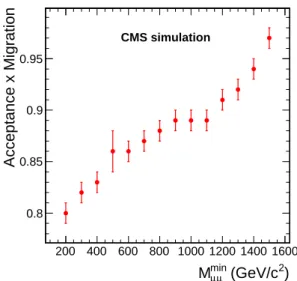
Figure 3: Acceptance times migration, A×M, versus Mminµµ . Corresponding values and
uncer-tainties are given in Table 2. The error bars indicate statistical unceruncer-tainties based on simulation of the DY process. The systematic uncertainty is 3% as explained in the text. The increase of
A×M at lower mass is due to the increase in acceptance, while at higher mass, it is dominated
by the growth in mass resolution. Since the cross section falls steeply with mass, events tend to migrate from lower to higher mass over a range determined by the mass resolution.
times migration (A×M) is given by the ratio of the number of DY events reconstructed with
mass above Mminµµ to the number of DY events generated with mass above Mminµµ . Some of the
reconstructed events have been generated with mass below Mminµµ because of the smearing due
to the mass reconstruction, which has a resolution of 6.5% at masses around 1000 GeV/c2, rising
to 12% at 2000 GeV/c2. The dependence of A×M on Mminµµ is plotted in Fig. 3 and values are
given in Table 2. The increase of A×M at lower mass is due to the increase in acceptance, while
at higher mass, it is dominated by the growth in mass resolution. Since the cross section falls steeply with mass, events tend to migrate from lower to higher mass over a range determined by the mass resolution.
To validate that the A×M factor based on DY production is applicable to CI/DY production,
we compare event yields predicted using the A×M factor with those predicted using a
simu-lation of CI/DY production. The study is performed for the cases of constructive interference
with Λ = 5 and 10 TeV, which represent a wide range of possible CI/DY cross sections. The
results differ by at most 3%, consistent with the statistical precision of the study. The systematic
uncertainty in A×M is conservatively assigned this value.
5.2.1 Event pileup
During the course of the 2011 data taking period, the luminosity increased with time, resulting in an increasing “event pileup”, the occurrence of multiple pp interactions recorded by the de-tector as a single event. The dependence of reconstruction efficiency on event pileup is studied by weighting simulated events so that the distribution of the number of reconstructed primary vertices per event matches that in data. The reconstruction efficiency is found to be insensitive to the variations in event pileup encountered during the data taking period.
6 5 Simulation of SM and CI dimuon production
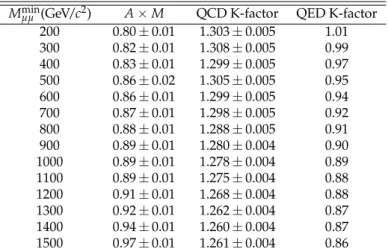
Table 2: Multiplicative factors used in the prediction of the expected number of events from the CI/DY process. The uncertainties shown are statistical. The systematic uncertainty is 3% for
A×M and 3% for the QCD factor, as explained in the text. The uncertainty in the QED
K-factor is dominated by the systematic uncertainty that is assigned as the size of the correction,
|(QED K-factor)−1|, to allow for systematic uncertainty in the generator.
Mµµmin(GeV/c2) A×M QCD K-factor QED K-factor
200 0.80±0.01 1.303±0.005 1.01 300 0.82±0.01 1.308±0.005 0.99 400 0.83±0.01 1.299±0.005 0.97 500 0.86±0.02 1.305±0.005 0.95 600 0.86±0.01 1.299±0.005 0.94 700 0.87±0.01 1.298±0.005 0.92 800 0.88±0.01 1.288±0.005 0.91 900 0.89±0.01 1.280±0.004 0.90 1000 0.89±0.01 1.278±0.004 0.89 1100 0.89±0.01 1.275±0.004 0.88 1200 0.91±0.01 1.268±0.004 0.88 1300 0.92±0.01 1.262±0.004 0.87 1400 0.94±0.01 1.260±0.004 0.87 1500 0.97±0.01 1.261±0.004 0.86
5.3 Higher-order strong and electromagnetic corrections
Since we use the leading-order generatorPYTHIAto simulate the CI/DY production, we must
determine a QCD K-factor which takes into account higher-order initial-state diagrams. Under the assumption that the QCD K-factor is the same for DY and CI/DY events, we determine the QCD K-factor as the ratio of DY events generated using the next-to-leading-order generator
MC@NLO [36] to those generated using PYTHIA. The MC@NLO generator is used with the
same PDF set as used withPYTHIA. The resulting QCD K-factor as a function of Mminµµ is given
in Table 2. The large sizes of the simulated event samples result in statistical uncertainties less than 0.5%. The systematic uncertainty is assigned the value 3%, the size of the correction [37] between next-to-next-to-leading order (NNLO) and NLO DY cross sections. For SM processes other than DY production, the QCD K-factor is found, independent of dimuon mass, from
the ratio of the cross section determined usingMC@NLOto the cross section determined from
PYTHIA.
The effect of higher-order electromagnetic processes on CI/DY production is quantified by a mass-dependent QED K-factor determined using the HORACE generator [38]. The values of
the QED K-factor, as a function of Mminµµ , are given in Table 2. The systematic uncertainty is
assigned as the size of the correction,|(QED K-factor)−1|, since the effect of higher-order QED
corrections on the new physics of CI is unknown.
5.4 Non-DY SM backgrounds
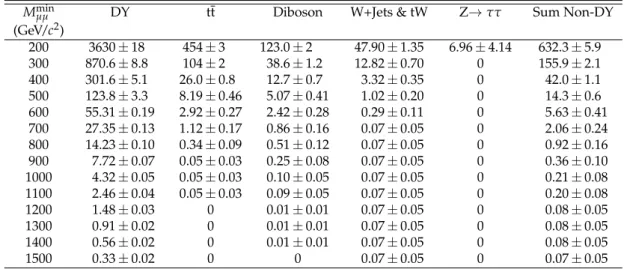
Using the samples of simulated events listed in Table 1, event yields are predicted for various non-DY SM background processes, as shown in Table 3. The yields are given as a function of
Mmin
µµ and they are scaled to the integrated luminosity of the data, 5.28±0.12 fb
−1 [39]. For
comparison, the expected yields are also shown for DY events. The relevant backgrounds, in decreasing order of importance, are tt, diboson (WW/WZ/ZZ), W (including W+jets and
tW), and Z→ ττproduction. The background from multi-jet events is studied using both the
simulation sample listed in Table 1 and control samples from data, as reported in Ref. [29]. The results of either method indicate that no multi-jet background events are expected for
non-5.5 Predicted event yields 7
Table 3: Expected event yields for DY and non-DY SM backgrounds. The uncertainties shown are statistical. A systematic uncertainty of 2.2% arises from the determination of integrated luminosity [39].
Mminµµ DY tt Diboson W+Jets & tW Z→ττ Sum Non-DY
(GeV/c2) 200 3630±18 454±3 123.0±2 47.90±1.35 6.96±4.14 632.3±5.9 300 870.6±8.8 104±2 38.6±1.2 12.82±0.70 0 155.9±2.1 400 301.6±5.1 26.0±0.8 12.7±0.7 3.32±0.35 0 42.0±1.1 500 123.8±3.3 8.19±0.46 5.07±0.41 1.02±0.20 0 14.3±0.6 600 55.31±0.19 2.92±0.27 2.42±0.28 0.29±0.11 0 5.63±0.41 700 27.35±0.13 1.12±0.17 0.86±0.16 0.07±0.05 0 2.06±0.24 800 14.23±0.10 0.34±0.09 0.51±0.12 0.07±0.05 0 0.92±0.16 900 7.72±0.07 0.05±0.03 0.25±0.08 0.07±0.05 0 0.36±0.10 1000 4.32±0.05 0.05±0.03 0.10±0.05 0.07±0.05 0 0.21±0.08 1100 2.46±0.04 0.05±0.03 0.09±0.05 0.07±0.05 0 0.20±0.08 1200 1.48±0.03 0 0.01±0.01 0.07±0.05 0 0.08±0.05 1300 0.91±0.02 0 0.01±0.01 0.07±0.05 0 0.08±0.05 1400 0.56±0.02 0 0.01±0.01 0.07±0.05 0 0.08±0.05 1500 0.33±0.02 0 0 0.07±0.05 0 0.07±0.05
DY background is large, but the absolute yield is much smaller than that for DY background.
5.5 Predicted event yields
Using the methods described above, the sum of the event yields for the CI/DY process and the non-DY SM backgrounds, for the integrated luminosity of the data sample, are predicted as a
function of Mmin
µµ andΛ. The predicted event yields for destructive and constructive
interfer-ence are given in Tables 4 and 5.
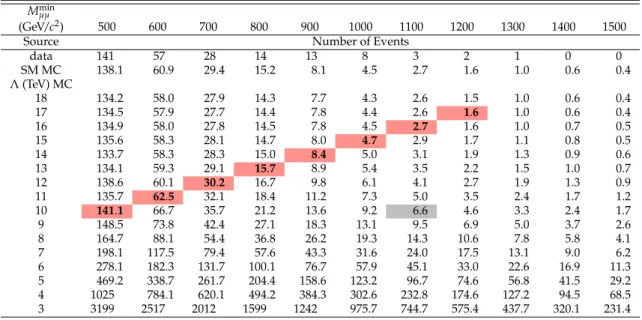
For destructive interference, there is a region of the Mminµµ -Λ parameter space where the
pre-dicted number of events is less than for SM production. This “reduced-yield” region is
indi-cated in Table 4. The region of parameter space, Mminµµ > 600 GeV/c2andΛ ≤ 12 TeV, where
our expected limit is most stringent (see Fig. 5(a)), lies outside the reduced-yield region. For constructive interference, the predicted number of events is always larger than for SM produc-tion.
6
Expected and observed lower limits on
Λ
6.1 Dimuon mass distribution from data
The observed numbers of events versus Mminµµ are given in Table 4. The observed distribution
of Mµµ is plotted in Fig. 4 along with the expected distributions from the SM and for CI/DY
plus non-DY SM processes, for three illustrative values ofΛ. The data are consistent with the
predictions from the SM, dominated by DY production.
6.2 Limit-setting procedure
Since the data are consistent with the SM, we set lower limits onΛ in the context of the LLIM.
The expected and observed 95% CL lower limits onΛ are determined using the CLS
modified-frequentist procedure described in [40, 41], taking the profile likelihood ratio as a test statistic [42]. The expected mean number of events for a signal from CI is the difference of the number
of CI/DY events expected for a givenΛ, and the number of DY events. The expected mean
number of background events is the sum of events from the DY process and the non-DY SM backgrounds. The observed and expected numbers of events are given in Tables 4 and 5.
8 6 Expected and observed lower limits onΛ
Table 4: Observed and expected number of events for illustrative values of Mminµµ . The expected
yields are shown for SM production and for the sum of CI/DY production (for destructive
interference and for a given Λ) and non-DY SM backgrounds. For each column of Mminµµ , the
expected yield for CI/DY + non-DY SM production that is just above that expected for SM production is highlighted in red. Entries above the highlighted ones correspond to values of Λ for which the expected yield is less than that for SM production, because of the destructive interference term in the cross section. As discussed in Section 6.3, the best expected limit is
obtained for Mminµµ = 1100 GeV/c2. For this choice, the expected event yield is highlighted in
gray that corresponds to the value of Λ closest to the observed 95% CL lower limit on Λ of
9.5 TeV (9.7 TeV expected). Mmin
µµ
(GeV/c2) 500 600 700 800 900 1000 1100 1200 1300 1400 1500
Source Number of Events
data 141 57 28 14 13 8 3 2 1 0 0 SM MC 138.1 60.9 29.4 15.2 8.1 4.5 2.7 1.6 1.0 0.6 0.4 Λ (TeV) MC 18 134.2 58.0 27.9 14.3 7.7 4.3 2.6 1.5 1.0 0.6 0.4 17 134.5 57.9 27.7 14.4 7.8 4.4 2.6 1.6 1.0 0.6 0.4 16 134.9 58.0 27.8 14.5 7.8 4.5 2.7 1.6 1.0 0.7 0.5 15 135.6 58.3 28.1 14.7 8.0 4.7 2.9 1.7 1.1 0.8 0.5 14 133.7 58.3 28.3 15.0 8.4 5.0 3.1 1.9 1.3 0.9 0.6 13 134.1 59.3 29.1 15.7 8.9 5.4 3.5 2.2 1.5 1.0 0.7 12 138.6 60.1 30.2 16.7 9.8 6.1 4.1 2.7 1.9 1.3 0.9 11 135.7 62.5 32.1 18.4 11.2 7.3 5.0 3.5 2.4 1.7 1.2 10 141.1 66.7 35.7 21.2 13.6 9.2 6.6 4.6 3.3 2.4 1.7 9 148.5 73.8 42.4 27.1 18.3 13.1 9.5 6.9 5.0 3.7 2.6 8 164.7 88.1 54.4 36.8 26.2 19.3 14.3 10.6 7.8 5.8 4.1 7 198.1 117.5 79.4 57.6 43.3 31.6 24.0 17.5 13.1 9.0 6.2 6 278.1 182.3 131.7 100.1 76.7 57.9 45.1 33.0 22.6 16.9 11.3 5 469.2 338.7 261.7 204.4 158.6 123.2 96.7 74.6 56.8 41.5 29.2 4 1025 784.1 620.1 494.2 384.3 302.6 232.8 174.6 127.2 94.5 68.5 3 3199 2517 2012 1599 1242 975.7 744.7 575.4 437.7 320.1 231.4
Systematic uncertainties in the predicted signal and background event yields are estimated from a variety of sources and included as nuisance parameters in the limit-setting procedure. Significant sources of systematic uncertainty are given in Table 6. The uncertainty in the in-tegrated luminosity is described in Ref. [39]. The uncertainty in the CI/DY acceptance is ex-plained in Section 5.2. The uncertainties in the prediction of backgrounds depend on the value
of Mminµµ . These uncertainties are given in Table 6 for the values of Mµµmin chosen for limits on
Λ with destructive and constructive interference. The PDF uncertainty in the expected yield of DY events is evaluated using the PDF4LHC procedure [43]. The uncertainties in the QED and QCD K-factors are explained in Sec. 5.3. The uncertainty from non-DY backgrounds is due to the statistical uncertainty associated with the simulated event samples. The systematic
uncer-tainties which decrease the limit onΛ by the largest amounts are the uncertainties on the PDF
and QED K-factor. When both these uncertainties are set to zero, the limit for destructive in-terference is increased by 0.4% and the limit for constructive inin-terference is increased by 3.0%. Thus, the systematic uncertainties degrade the limits by only small amounts.
We considered possible systematic uncertainties in modeling the detector response by com-paring kinematic distributions between data and simulation of DY and non-DY SM processes. There are no differences in these distributions that could lead to significant systematic uncer-tainties through their effect on selection efficiency and mass resolution.
6.3 Results for limits onΛ 9
Table 5: Observed and expected number of events as in Table 4. Here CI/DY predictions are for constructive interference. Shown with gray highlighting is the expected event yield
corre-sponding to the value ofΛ closest to the observed 95% CL lower limit on Λ of 13.1 TeV (12.9 TeV
expected) for Mµµminselected to be 800 GeV/c2.
Mµµmin
(GeV/c2) 400 500 600 700 800 900 1000 1100 1200 1300 1400
Source Number of Events
data 338 141 57 28 14 13 8 3 2 1 0 SM MC 343.6 138.1 60.9 29.4 15.2 8.1 4.5 2.7 1.6 1.0 0.6 Λ ( TeV) MC 18 359.2 147.7 67.8 34.1 18.7 10.6 6.4 4.0 2.5 1.6 1.1 17 358.9 149.3 69.1 35.1 19.3 11.1 6.7 4.3 2.7 1.8 1.2 16 365.2 153.7 70.3 36.1 20.2 11.7 7.2 4.6 3.0 2.0 1.3 15 365.6 156.3 71.9 37.2 20.9 12.3 7.6 4.9 3.1 2.1 1.4 14 368.5 154.9 74.6 39.1 22.4 13.3 8.4 5.5 3.6 2.4 1.7 13 377.8 164.4 77.9 41.7 24.2 14.7 9.4 6.3 4.2 2.9 2.0 12 379.2 170.5 82.5 45.2 26.9 16.7 11.0 7.4 5.0 3.5 2.4 11 388.9 174.6 88.6 49.9 30.4 19.3 12.9 8.8 6.1 4.2 3.0 10 406.0 184.5 97.9 57.1 36.0 23.7 16.2 11.3 7.9 5.6 4.0 9 440.3 214.8 113.2 68.8 44.8 30.3 21.2 15.0 10.7 7.7 5.5 8 470.0 237.1 138.2 87.7 59.6 41.6 29.9 21.8 15.7 11.4 8.1 7 563.9 307.3 181.0 120.4 86.7 62.1 44.8 31.5 23.3 16.9 12.3 6 696.8 415.0 269.2 187.3 136.9 101.7 75.3 57.4 41.8 30.7 23.2 5 1007 675.0 467.8 345.8 268.0 202.3 153.3 116.9 87.3 64.6 47.0 4 1839 1346 997.4 765.1 586.6 451.1 349.6 266.8 200.3 147.8 109.5 3 4800 3762 2861 2251 1754 1358 1041 791.0 597.1 453.6 338.5
Table 6: Systematic uncertainties affecting the limit onΛ, evaluated for the values of Mminµµ that
provide the best expected limits for constructive and destructive interference.
Uncertainty (%)
Source const. destr.
integrated luminosity 2.2 2.2
acceptance times migration (A×M) 3.0 3.0
PDF 13.0 16.0
QED K-factor 9.0 11.8
QCD K-factor 3.0 3.0
DY MC statistics 1.2 1.6
non-DY backgrounds 1.1 2.9
6.3 Results for limits onΛ
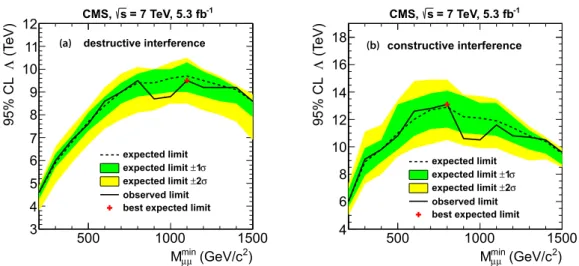
The observed and expected lower limits onΛ at 95% CL as a function of Mminµµ for destructive
and constructive interference are shown in Figs. 5(a) and 5(b). The value of Mminµµ , chosen to
maximize the expected sensitivity, is 1100 GeV/c2 for destructive interference, and 800 GeV/c2
for constructive interference. The observed (expected) limit is 9.5 TeV (9.7 TeV) for destructive interference and 13.1 TeV (12.9 TeV) for constructive interference. The variations in the observed limits lie almost entirely within the 1-σ (standard deviation) uncertainty bands in the expected limits, consistent with statistical fluctuations. The number of expected events corresponding to
the observed limits onΛ are highlighted in Tables 4 and 5.
7
Summary
The CMS detector is used to measure the invariant mass distribution of µ+µ−pairs produced in
pp collisions at a center-of-mass energy of 7 TeV, based on an integrated luminosity of 5.3 fb−1.
The invariant mass distribution in the range 200 to 2000 GeV/c2is found to be consistent with
10 7 Summary
)
2(GeV/c
µ µM
200 400 600 800 1000 1200 1400 1600 1800 2000)
2Events/(20 GeV/c
-4 10 -3 10 -2 10 -1 10 1 10 2 10 3 10 4 10 -1 = 7 TeV, 5.3 fb s CMS, data = 8 TeV (const.) Λ = 8 TeV (destr.) Λ = 10 TeV (const.) Λ = 10 TeV (destr.) Λ = 12 TeV (const.) Λ = 12 TeV (destr.) Λ DY t t tW diboson τ τ → Z W+JetsFigure 4: Observed spectrum of Mµµ and predictions for SM and CI/DY plus non-DY SM
production. Predictions are shown for three illustrative values ofΛ, for constructive and
de-structive interference. The error bars for data are 68% Poisson confidence intervals.
are interpreted in the context of a quark- and muon-compositeness model with a left-handed
isoscalar current and an energy scale parameterΛ. The 95% confidence level lower limit on Λ
is 9.5 TeV under the assumption of destructive interference between the standard model and contact-interaction amplitudes. For constructive interference, the limit is 13.1 TeV. These limits are comparable to the most stringent ones reported to date.
Acknowledgements
We congratulate our colleagues in the CERN accelerator departments for the excellent perfor-mance of the LHC and thank the technical and administrative staffs at CERN and at other CMS institutes for their contributions to the success of the CMS effort. In addition, we gratefully acknowledge the computing centres and personnel of the Worldwide LHC Computing Grid for delivering so effectively the computing infrastructure essential to our analyses. Finally, we acknowledge the enduring support for the construction and operation of the LHC and the CMS detector provided by the following funding agencies: BMWF and FWF (Austria); FNRS and FWO (Belgium); CNPq, CAPES, FAPERJ, and FAPESP (Brazil); MEYS (Bulgaria); CERN; CAS, MoST, and NSFC (China); COLCIENCIAS (Colombia); MSES (Croatia); RPF (Cyprus); MoER, SF0690030s09 and ERDF (Estonia); Academy of Finland, MEC, and HIP (Finland); CEA and CNRS/IN2P3 (France); BMBF, DFG, and HGF (Germany); GSRT (Greece); OTKA and NKTH (Hungary); DAE and DST (India); IPM (Iran); SFI (Ireland); INFN (Italy); NRF and WCU (Korea); LAS (Lithuania); CINVESTAV, CONACYT, SEP, and UASLP-FAI (Mexico); MSI (New Zealand); PAEC (Pakistan); MSHE and NSC (Poland); FCT (Portugal); JINR (Armenia, Belarus, Georgia, Ukraine, Uzbekistan); MON, RosAtom, RAS and RFBR (Russia); MSTD (Ser-bia); SEIDI and CPAN (Spain); Swiss Funding Agencies (Switzerland); NSC (Taipei); ThEP, IPST and NECTEC (Thailand); TUBITAK and TAEK (Turkey); NASU (Ukraine); STFC (United Kingdom); DOE and NSF (USA).
Re-References 11 ) 2 (GeV/c min µ µ M 500 1000 1500 (T eV ) Λ 9 5% C L 3 4 5 6 7 8 9 10 11 12 expected limit σ 1 ± expected limit σ 2 ± expected limit observed limit best expected limit
-1 = 7 TeV, 5.3 fb s CMS, destructive interference (a) ) 2 (GeV/c min µ µ M 500 1000 1500 (T eV ) Λ 9 5% C L 4 6 8 10 12 14 16 18 expected limit σ 1 ± expected limit σ 2 ± expected limit observed limit best expected limit
-1 = 7 TeV, 5.3 fb s CMS, constructive interference (b)
Figure 5: Observed and expected limits as a function of Mmin
µµ for (a) destructive interference
and (b) constructive interference. The value of Mmin
µµ , chosen to maximize the expected
sensitiv-ity, is 1100 GeV/c2for destructive interference, and 800 GeV/c2for constructive interference. The
observed (expected) limit is 9.5 TeV (9.7 TeV) for destructive interference and 13.1 TeV (12.9 TeV)
for constructive interference. The observed limit at the value chosen for Mminµµ is indicated with
a red plus sign. The variations in the observed limits lie almost entirely within the 1-σ bands, consistent with statistical fluctuations.
search Council (European Union); the Leventis Foundation; the A. P. Sloan Foundation; the Alexander von Humboldt Foundation; the Belgian Federal Science Policy Office; the Fonds pour la Formation `a la Recherche dans l’Industrie et dans l’Agriculture (FRIA-Belgium); the Agentschap voor Innovatie door Wetenschap en Technologie (IWT-Belgium); the Ministry of Education, Youth and Sports (MEYS) of Czech Republic; the Council of Science and Industrial Research, India; the Compagnia di San Paolo (Torino); and the HOMING PLUS programme of Foundation for Polish Science, cofinanced from European Union, Regional Development Fund.
References
[1] J. C. Pati, A. Salam, and J. Strathdee, “Are quarks composite?”, Phys. Lett. B 59 (1975) 265, doi:10.1016/0370-2693(75)90042-8.
[2] J. C. Pati, A. Salam, and J. Strathdee, “Are quarks composite?”, preprint IC/75/139, addendum, Int. Centre Theor. Phys., (1975).
[3] E. J. Eichten, K. D. Lane, and M. E. Peskin, “New Tests for Quark and Lepton
Substructure”, Phys. Rev. Lett. 50 (1983) 811, doi:10.1103/PhysRevLett.50.811. [4] E. Eichten et al., “Supercollider Physics”, Rev. Modern Phys. 56 (1984) 579,
doi:10.1103/RevModPhys.56.579.
[5] S. D. Drell and T. M. Yan, “Massive Lepton-Pair Production in Hadron-Hadron Collisions at High Energy”, Phys. Rev. Lett. 25 (1970) 316, doi:10.1103/PhysRevLett.25.316.
[6] ALEPH Collaboration, “Fermion pair production in e+e−collisons at 189–209 GeV and
constraints on physics beyond the standard model”, Eur. Phys. J. C 49 (2007) 411,
12 References
[7] DELPHI Collaboration, “Measurement and interpretation of fermion-pair production at LEP energies above the Z resonance”, Eur. Phys. J. C 45 (2006) 589,
doi:10.1140/epjc/s2005-02461-0.
[8] L3 Collaboration, “Search for manifestations of new physics in fermion-pair production at LEP”, Phys. Lett. B 489 (2000) 81, doi:10.1016/S0370-2693(00)00887-X.
[9] OPAL Collaboration, “Production of fermion-pair events in e+e−collisions at 161 GeV
centre-of-mass energy”, Phys. Lett. B 391 (1997) 221, doi:10.1016/S0370-2693(97)81627-9.
[10] OPAL Collaboration, “Tests of the standard model and constraints on new physics from measurements of fermion-pair production at 189–209 GeV at LEP”, Eur. Phys. J. C 33 (2004) 173, doi:10.1140/epjc/s2004-01595-9.
[11] H1 Collaboration, “Search for Contact Interactions in e±p Collisions at HERA”, Phys.
Lett. B 705 (2011) 52, doi:10.1016/j.physletb.2011.09.109.
[12] ZEUS Collaboration, “Search for contact interactions, large extra dimensions and finite quark radius in ep collisions at HERA”, Phys. Lett. B 591 (2004) 23,
doi:10.1016/j.physletb.2004.03.081.
[13] CDF Collaboration, “Search for New Gauge Bosons in ¯pp Collisions at√s =1.8 TeV”,
Phys. Rev. Lett. 68 (1992) 1463, doi:10.1103/PhysRevLett.68.1463.
[14] CDF Collaboration, “Limits on Quark-Lepton Compositeness Scales from Dileptons Produced in 1.8 TeV p ¯p Collisions”, Phys. Rev. Lett. 79 (1997) 2198,
doi:10.1103/PhysRevLett.79.2198.
[15] CDF Collaboration, “Search for Quark-Lepton Compositeness and a Heavy W Boson
Using the eν Channel in p ¯p Collisions at√s=1.8 TeV”, Phys. Rev. Lett. 87 (2001) 231803,
doi:10.1103/PhysRevLett.87.231803.
[16] CDF Collaboration, “Search for Z0 →e+e−Using Dielectron Mass Angular Distribution”,
Phys. Rev. Lett. 96 (2006) 211801, doi:10.1103/PhysRevLett.96.211801.
[17] D0 Collaboration, “Measurement of the High-Mass Drell-Yan Cross Section and Limits on Quark-Electron Compositeness Scales”, Phys. Rev. Lett. 82 (1999) 4769,
doi:10.1103/PhysRevLett.82.4769.
[18] D0 Collaboration, “Measurement of Dijet Angular Distribution at√s =1.96 TeV and
Searches for Quark Compositeness and Extra Spatial Dimensions”, Phys. Rev. Lett. 103 (2009) 191803, doi:10.1103/PhysRevLett.103.191803.
[19] ATLAS Collaboration, “Search for quark contact interactions in dijet angular
distributions in pp collisions at√s=7 TeV measured with the ATLAS detector”, Phys.
Lett. B 694 (2011) 327, doi:10.1016/j.physletb.2010.10.021.
[20] ATLAS Collaboration, “Search for contact interactions in dimuon events from pp
collision at√s=7 TeV with the ATLAS detector”, Phys. Rev. D 84 (2011) 011101,
doi:10.1103/PhysRevD.84.011101.
[21] ATLAS Collaboration, “Search for contact interactions in dimuon events from pp
collisions at√s=7 TeV with the ATLAS Detector”, Phys. Lett. B 712 (2012) 40,
References 13
[22] ATLAS Collaboration, “Search for contact interactions and large extra dimensions in
dilepton events from pp collisions at√s =7 TeV with the ATLAS detector”, (2012).
arXiv:1211.1150v1.
[23] CMS Collaboration, “Search for Quark Compositeness with the Dijet Centrality Ratio in
pp Collisions at√s=7 TeV”, Phys. Rev. Lett. 105 (2010) 262001,
doi:10.1103/PhysRevLett.105.262001.
[24] CMS Collaboration, “Search for quark compositeness in dijet angular distributions from
pp collisions at√s =7 TeV”, JHEP 1205 (2012) 055,
doi:10.1007/JHEP05(2012)055.
[25] CMS Collaboration, “Search for anomalous production of highly boosted Z bosons
decaying to dimuons in pp collisions at√s =7 TeV”, (2012). arXiv:1210.0867.
Submitted to Phys. Lett. B.
[26] T. Sj ¨ostrand, S. Mrenna, and P. Z. Skand, “PYTHIA 6.4 physics and manual”, JHEP 05 (2006) 026, doi:10.1088/1126-6708/2006/05/026.
[27] CMS Collaboration, “The CMS experiment at the CERN LHC”, JINST 03 (2006) S08004, doi:10.1088/1748-0221/3/08/S08004.
[28] CMS Collaboration, “Performance of CMS muon reconstruction in pp collision events at√
s =7 TeV”, J. Instrum. 7 (2012) P10002, doi:10.1088/1748-0221/7/10/P10002.
[29] CMS Collaboration, “Search for narrow resonances in the dilepton mass spectra in pp
Collisions at√s=7 TeV”, Phys. Lett. B 714 (2012) 158,
doi:10.1016/j.physletb.2012.06.051.
[30] P. M. Nadolsky et al., “Implications of CTEQ global analysis for collider observables”, Phys. Rev. D 78 (2008) 013004, doi:10.1103/PhysRevD.78.013004.
[31] P. Nason, “A new method for combining NLO QCD with shower Monte Carlo algorithms”, JHEP 11 (2004) 040, doi:10.1088/1126-6708/2004/11/040. [32] S. Frixione, P. Nason, and C. Oleari, “Matching NLO QCD computations with Parton
Shower simulations: the POWHEG method”, JHEP 11 (2007) 070,
doi:10.1088/1126-6708/2007/11/070.
[33] S. Alioli et al., “NLO vector-boson production matched with shower in POWHEG”, JHEP 07 (2008) 060, doi:10.1088/1126-6708/2008/07/060.
[34] J. Alwall et al., “MadGraph 5: going beyond”, JHEP 06 (2011) 128, doi:10.1007/JHEP06(2011)128, arXiv:1106.0522.
[35] GEANT4 Collaboration, “GEANT4—a simulation toolkit”, Nucl. Instrum. Meth. A 506 (2003) 250, doi:10.1016/S0168-9002(03)01368-8.
[36] S. Frixione and B. R. Webber, “Matching NLO QCD computations and parton shower simulations”, JHEP 06 (2002) 029, doi:10.1088/1126-6708/2002/06/029.
[37] G. Balossini et al., “Electroweak and QCD corrections to Drell–Yan processes”, Acta Phys. Polon. B 39 (2008) 1675, arXiv:0805.1129v1.
14 References
[38] C. M. Carloni Calame et al., “Precision electroweak calculation of the production of a high transverse-momentum lepton pair at hadron colliders”, JHEP 10 (2007) 109, doi:10.1088/1126-6708/2007/10/109.
[39] CMS Collaboration, “Absolute Calibration of the Luminosity Measurement at CMS: Winter 2012 Update”, CMS Physics Analysis Summary CMS-PAS-SMP-12-008, (2012).
[40] A. L. Read, “Presentation of search results: the CLstechnique”, J. Phys. G 28 (2002) 2693,
doi:10.1088/0954-3899/28/10/313.
[41] T. Junk, “Confidence level computation for combining searches with small statistics”, Nucl. Instrum. Meth. A 434 (1999) 435, doi:10.1016/S0168-9002(99)00498-2. [42] T. Junk, “Sensitivity, Exclusion and Discovery with Small Signals, Large Backgrounds,
and Large Systematic Uncertainties”, CDF Report CDF/DOC/STATISTICS/PUBLIC/8128, (2007).
[43] M. Botje et al., “The PDF4LHC Working Group Interim Recommendations”, (2011).
15
A
The CMS Collaboration
Yerevan Physics Institute, Yerevan, Armenia
S. Chatrchyan, V. Khachatryan, A.M. Sirunyan, A. Tumasyan
Institut f ¨ur Hochenergiephysik der OeAW, Wien, Austria
W. Adam, E. Aguilo, T. Bergauer, M. Dragicevic, J. Er ¨o, C. Fabjan1, M. Friedl, R. Fr ¨uhwirth1,
V.M. Ghete, J. Hammer, N. H ¨ormann, J. Hrubec, M. Jeitler1, W. Kiesenhofer, V. Kn ¨unz,
M. Krammer1, I. Kr¨atschmer, D. Liko, I. Mikulec, M. Pernicka†, B. Rahbaran, C. Rohringer,
H. Rohringer, R. Sch ¨ofbeck, J. Strauss, A. Taurok, W. Waltenberger, G. Walzel, E. Widl,
C.-E. Wulz1
National Centre for Particle and High Energy Physics, Minsk, Belarus
V. Mossolov, N. Shumeiko, J. Suarez Gonzalez
Universiteit Antwerpen, Antwerpen, Belgium
M. Bansal, S. Bansal, T. Cornelis, E.A. De Wolf, X. Janssen, S. Luyckx, L. Mucibello, S. Ochesanu, B. Roland, R. Rougny, M. Selvaggi, Z. Staykova, H. Van Haevermaet, P. Van Mechelen, N. Van Remortel, A. Van Spilbeeck
Vrije Universiteit Brussel, Brussel, Belgium
F. Blekman, S. Blyweert, J. D’Hondt, R. Gonzalez Suarez, A. Kalogeropoulos, M. Maes, A. Olbrechts, W. Van Doninck, P. Van Mulders, G.P. Van Onsem, I. Villella
Universit´e Libre de Bruxelles, Bruxelles, Belgium
B. Clerbaux, G. De Lentdecker, V. Dero, A.P.R. Gay, T. Hreus, A. L´eonard, P.E. Marage, A. Mohammadi, T. Reis, L. Thomas, G. Vander Marcken, C. Vander Velde, P. Vanlaer, J. Wang
Ghent University, Ghent, Belgium
V. Adler, K. Beernaert, A. Cimmino, S. Costantini, G. Garcia, M. Grunewald, B. Klein, J. Lellouch, A. Marinov, J. Mccartin, A.A. Ocampo Rios, D. Ryckbosch, N. Strobbe, F. Thyssen, M. Tytgat, P. Verwilligen, S. Walsh, E. Yazgan, N. Zaganidis
Universit´e Catholique de Louvain, Louvain-la-Neuve, Belgium
S. Basegmez, G. Bruno, R. Castello, L. Ceard, C. Delaere, T. du Pree, D. Favart, L. Forthomme,
A. Giammanco2, J. Hollar, V. Lemaitre, J. Liao, O. Militaru, C. Nuttens, D. Pagano, A. Pin,
K. Piotrzkowski, N. Schul, J.M. Vizan Garcia
Universit´e de Mons, Mons, Belgium
N. Beliy, T. Caebergs, E. Daubie, G.H. Hammad
Centro Brasileiro de Pesquisas Fisicas, Rio de Janeiro, Brazil
G.A. Alves, M. Correa Martins Junior, D. De Jesus Damiao, T. Martins, M.E. Pol, M.H.G. Souza
Universidade do Estado do Rio de Janeiro, Rio de Janeiro, Brazil
W.L. Ald´a J ´unior, W. Carvalho, A. Cust ´odio, E.M. Da Costa, C. De Oliveira Martins, S. Fonseca De Souza, D. Matos Figueiredo, L. Mundim, H. Nogima, V. Oguri, W.L. Prado Da Silva, A. Santoro, L. Soares Jorge, A. Sznajder
Universidade Estadual Paulistaa, Universidade Federal do ABCb, S˜ao Paulo, Brazil
T.S. Anjosb, C.A. Bernardesb, F.A. Diasa,3, T.R. Fernandez Perez Tomeia, E.M. Gregoresb,
C. Laganaa, F. Marinhoa, P.G. Mercadanteb, S.F. Novaesa, Sandra S. Padulaa
Institute for Nuclear Research and Nuclear Energy, Sofia, Bulgaria
V. Genchev4, P. Iaydjiev4, S. Piperov, M. Rodozov, S. Stoykova, G. Sultanov, V. Tcholakov,
16 A The CMS Collaboration
University of Sofia, Sofia, Bulgaria
A. Dimitrov, R. Hadjiiska, V. Kozhuharov, L. Litov, B. Pavlov, P. Petkov
Institute of High Energy Physics, Beijing, China
J.G. Bian, G.M. Chen, H.S. Chen, C.H. Jiang, D. Liang, S. Liang, X. Meng, J. Tao, J. Wang, X. Wang, Z. Wang, H. Xiao, M. Xu, J. Zang, Z. Zhang
State Key Lab. of Nucl. Phys. and Tech., Peking University, Beijing, China
C. Asawatangtrakuldee, Y. Ban, S. Guo, Y. Guo, W. Li, S. Liu, Y. Mao, S.J. Qian, H. Teng, D. Wang, L. Zhang, B. Zhu, W. Zou
Universidad de Los Andes, Bogota, Colombia
C. Avila, J.P. Gomez, B. Gomez Moreno, A.F. Osorio Oliveros, J.C. Sanabria
Technical University of Split, Split, Croatia
N. Godinovic, D. Lelas, R. Plestina5, D. Polic, I. Puljak4
University of Split, Split, Croatia
Z. Antunovic, M. Kovac
Institute Rudjer Boskovic, Zagreb, Croatia
V. Brigljevic, S. Duric, K. Kadija, J. Luetic, S. Morovic
University of Cyprus, Nicosia, Cyprus
A. Attikis, M. Galanti, G. Mavromanolakis, J. Mousa, C. Nicolaou, F. Ptochos, P.A. Razis
Charles University, Prague, Czech Republic
M. Finger, M. Finger Jr.
Academy of Scientific Research and Technology of the Arab Republic of Egypt, Egyptian Network of High Energy Physics, Cairo, Egypt
Y. Assran6, S. Elgammal7, A. Ellithi Kamel8, M.A. Mahmoud9, A. Radi10,11
National Institute of Chemical Physics and Biophysics, Tallinn, Estonia
M. Kadastik, M. M ¨untel, M. Raidal, L. Rebane, A. Tiko
Department of Physics, University of Helsinki, Helsinki, Finland
P. Eerola, G. Fedi, M. Voutilainen
Helsinki Institute of Physics, Helsinki, Finland
J. H¨ark ¨onen, A. Heikkinen, V. Karim¨aki, R. Kinnunen, M.J. Kortelainen, T. Lamp´en, K. Lassila-Perini, S. Lehti, T. Lind´en, P. Luukka, T. M¨aenp¨a¨a, T. Peltola, E. Tuominen, J. Tuominiemi, E. Tuovinen, D. Ungaro, L. Wendland
Lappeenranta University of Technology, Lappeenranta, Finland
K. Banzuzi, A. Karjalainen, A. Korpela, T. Tuuva
DSM/IRFU, CEA/Saclay, Gif-sur-Yvette, France
M. Besancon, S. Choudhury, M. Dejardin, D. Denegri, B. Fabbro, J.L. Faure, F. Ferri, S. Ganjour, A. Givernaud, P. Gras, G. Hamel de Monchenault, P. Jarry, E. Locci, J. Malcles, L. Millischer, A. Nayak, J. Rander, A. Rosowsky, I. Shreyber, M. Titov
Laboratoire Leprince-Ringuet, Ecole Polytechnique, IN2P3-CNRS, Palaiseau, France
S. Baffioni, F. Beaudette, L. Benhabib, L. Bianchini, M. Bluj12, C. Broutin, P. Busson, C. Charlot,
N. Daci, T. Dahms, L. Dobrzynski, R. Granier de Cassagnac, M. Haguenauer, P. Min´e, C. Mironov, I.N. Naranjo, M. Nguyen, C. Ochando, P. Paganini, D. Sabes, R. Salerno, Y. Sirois, C. Veelken, A. Zabi
17
Institut Pluridisciplinaire Hubert Curien, Universit´e de Strasbourg, Universit´e de Haute Alsace Mulhouse, CNRS/IN2P3, Strasbourg, France
J.-L. Agram13, J. Andrea, D. Bloch, D. Bodin, J.-M. Brom, M. Cardaci, E.C. Chabert, C. Collard,
E. Conte13, F. Drouhin13, C. Ferro, J.-C. Fontaine13, D. Gel´e, U. Goerlach, P. Juillot, A.-C. Le
Bihan, P. Van Hove
Centre de Calcul de l’Institut National de Physique Nucleaire et de Physique des Particules, CNRS/IN2P3, Villeurbanne, France
F. Fassi, D. Mercier
Universit´e de Lyon, Universit´e Claude Bernard Lyon 1, CNRS-IN2P3, Institut de Physique Nucl´eaire de Lyon, Villeurbanne, France
S. Beauceron, N. Beaupere, O. Bondu, G. Boudoul, J. Chasserat, R. Chierici4, D. Contardo,
P. Depasse, H. El Mamouni, J. Fay, S. Gascon, M. Gouzevitch, B. Ille, T. Kurca, M. Lethuillier, L. Mirabito, S. Perries, V. Sordini, Y. Tschudi, P. Verdier, S. Viret
Institute of High Energy Physics and Informatization, Tbilisi State University, Tbilisi, Georgia
Z. Tsamalaidze14
RWTH Aachen University, I. Physikalisches Institut, Aachen, Germany
G. Anagnostou, S. Beranek, M. Edelhoff, L. Feld, N. Heracleous, O. Hindrichs, R. Jussen, K. Klein, J. Merz, A. Ostapchuk, A. Perieanu, F. Raupach, J. Sammet, S. Schael, D. Sprenger,
H. Weber, B. Wittmer, V. Zhukov15
RWTH Aachen University, III. Physikalisches Institut A, Aachen, Germany
M. Ata, J. Caudron, E. Dietz-Laursonn, D. Duchardt, M. Erdmann, R. Fischer, A. G ¨uth, T. Hebbeker, C. Heidemann, K. Hoepfner, D. Klingebiel, P. Kreuzer, C. Magass, M. Merschmeyer, A. Meyer, M. Olschewski, P. Papacz, H. Pieta, H. Reithler, S.A. Schmitz, L. Sonnenschein, J. Steggemann, D. Teyssier, M. Weber
RWTH Aachen University, III. Physikalisches Institut B, Aachen, Germany
M. Bontenackels, V. Cherepanov, Y. Erdogan, G. Fl ¨ugge, H. Geenen, M. Geisler, W. Haj Ahmad, F. Hoehle, B. Kargoll, T. Kress, Y. Kuessel, A. Nowack, L. Perchalla, O. Pooth, P. Sauerland, A. Stahl
Deutsches Elektronen-Synchrotron, Hamburg, Germany
M. Aldaya Martin, J. Behr, W. Behrenhoff, U. Behrens, M. Bergholz16, A. Bethani, K. Borras,
A. Burgmeier, A. Cakir, L. Calligaris, A. Campbell, E. Castro, F. Costanza, D. Dammann, C. Diez Pardos, G. Eckerlin, D. Eckstein, G. Flucke, A. Geiser, I. Glushkov, P. Gunnellini, S. Habib, J. Hauk, G. Hellwig, H. Jung, M. Kasemann, P. Katsas, C. Kleinwort, H. Kluge, A. Knutsson,
M. Kr¨amer, D. Kr ¨ucker, E. Kuznetsova, W. Lange, W. Lohmann16, B. Lutz, R. Mankel, I. Marfin,
M. Marienfeld, I.-A. Melzer-Pellmann, A.B. Meyer, J. Mnich, A. Mussgiller, S. Naumann-Emme, J. Olzem, H. Perrey, A. Petrukhin, D. Pitzl, A. Raspereza, P.M. Ribeiro Cipriano, C. Riedl,
E. Ron, M. Rosin, J. Salfeld-Nebgen, R. Schmidt16, T. Schoerner-Sadenius, N. Sen, A. Spiridonov,
M. Stein, R. Walsh, C. Wissing
University of Hamburg, Hamburg, Germany
C. Autermann, V. Blobel, J. Draeger, H. Enderle, J. Erfle, U. Gebbert, M. G ¨orner, T. Hermanns, R.S. H ¨oing, K. Kaschube, G. Kaussen, H. Kirschenmann, R. Klanner, J. Lange, B. Mura, F. Nowak, T. Peiffer, N. Pietsch, D. Rathjens, C. Sander, H. Schettler, P. Schleper, E. Schlieckau, A. Schmidt, M. Schr ¨oder, T. Schum, M. Seidel, V. Sola, H. Stadie, G. Steinbr ¨uck, J. Thomsen, L. Vanelderen
18 A The CMS Collaboration
Institut f ¨ur Experimentelle Kernphysik, Karlsruhe, Germany
C. Barth, J. Berger, C. B ¨oser, T. Chwalek, W. De Boer, A. Descroix, A. Dierlamm, M. Feindt,
M. Guthoff4, C. Hackstein, F. Hartmann, T. Hauth4, M. Heinrich, H. Held, K.H. Hoffmann,
S. Honc, I. Katkov15, J.R. Komaragiri, P. Lobelle Pardo, D. Martschei, S. Mueller, Th. M ¨uller,
M. Niegel, A. N ¨urnberg, O. Oberst, A. Oehler, J. Ott, G. Quast, K. Rabbertz, F. Ratnikov, N. Ratnikova, S. R ¨ocker, A. Scheurer, F.-P. Schilling, G. Schott, H.J. Simonis, F.M. Stober, D. Troendle, R. Ulrich, J. Wagner-Kuhr, S. Wayand, T. Weiler, M. Zeise
Institute of Nuclear Physics ”Demokritos”, Aghia Paraskevi, Greece
G. Daskalakis, T. Geralis, S. Kesisoglou, A. Kyriakis, D. Loukas, I. Manolakos, A. Markou, C. Markou, C. Mavrommatis, E. Ntomari
University of Athens, Athens, Greece
L. Gouskos, T.J. Mertzimekis, A. Panagiotou, N. Saoulidou
University of Io´annina, Io´annina, Greece
I. Evangelou, C. Foudas, P. Kokkas, N. Manthos, I. Papadopoulos, V. Patras
KFKI Research Institute for Particle and Nuclear Physics, Budapest, Hungary
G. Bencze, C. Hajdu, P. Hidas, D. Horvath17, F. Sikler, V. Veszpremi, G. Vesztergombi18
Institute of Nuclear Research ATOMKI, Debrecen, Hungary
N. Beni, S. Czellar, J. Molnar, J. Palinkas, Z. Szillasi
University of Debrecen, Debrecen, Hungary
J. Karancsi, P. Raics, Z.L. Trocsanyi, B. Ujvari
Panjab University, Chandigarh, India
S.B. Beri, V. Bhatnagar, N. Dhingra, R. Gupta, M. Kaur, M.Z. Mehta, N. Nishu, L.K. Saini, A. Sharma, J.B. Singh
University of Delhi, Delhi, India
Ashok Kumar, Arun Kumar, S. Ahuja, A. Bhardwaj, B.C. Choudhary, S. Malhotra, M. Naimuddin, K. Ranjan, V. Sharma, R.K. Shivpuri
Saha Institute of Nuclear Physics, Kolkata, India
S. Banerjee, S. Bhattacharya, S. Dutta, B. Gomber, Sa. Jain, Sh. Jain, R. Khurana, S. Sarkar, M. Sharan
Bhabha Atomic Research Centre, Mumbai, India
A. Abdulsalam, R.K. Choudhury, D. Dutta, S. Kailas, V. Kumar, P. Mehta, A.K. Mohanty4,
L.M. Pant, P. Shukla
Tata Institute of Fundamental Research - EHEP, Mumbai, India
T. Aziz, S. Ganguly, M. Guchait19, M. Maity20, G. Majumder, K. Mazumdar, G.B. Mohanty,
B. Parida, K. Sudhakar, N. Wickramage
Tata Institute of Fundamental Research - HECR, Mumbai, India
S. Banerjee, S. Dugad
Institute for Research in Fundamental Sciences (IPM), Tehran, Iran
H. Arfaei, H. Bakhshiansohi21, S.M. Etesami22, A. Fahim21, M. Hashemi, H. Hesari, A. Jafari21,
M. Khakzad, M. Mohammadi Najafabadi, S. Paktinat Mehdiabadi, B. Safarzadeh23, M. Zeinali22
INFN Sezione di Baria, Universit`a di Barib, Politecnico di Baric, Bari, Italy
19
N. De Filippisa,c,4, M. De Palmaa,b, L. Fiorea, G. Iasellia,c, L. Lusitoa,b, G. Maggia,c,
M. Maggia, B. Marangellia,b, S. Mya,c, S. Nuzzoa,b, N. Pacificoa,b, A. Pompilia,b, G. Pugliesea,c, G. Selvaggia,b, L. Silvestrisa, G. Singha,b, R. Venditti, G. Zitoa
INFN Sezione di Bolognaa, Universit`a di Bolognab, Bologna, Italy
G. Abbiendia, A.C. Benvenutia, D. Bonacorsia,b, S. Braibant-Giacomellia,b, L. Brigliadoria,b,
P. Capiluppia,b, A. Castroa,b, F.R. Cavalloa, M. Cuffiania,b, G.M. Dallavallea, F. Fabbria,
A. Fanfania,b, D. Fasanellaa,b,4, P. Giacomellia, C. Grandia, L. Guiduccia,b, S. Marcellinia,
G. Masettia, M. Meneghellia,b,4, A. Montanaria, F.L. Navarriaa,b, F. Odoricia, A. Perrottaa,
F. Primaveraa,b, A.M. Rossia,b, T. Rovellia,b, G.P. Sirolia,b, R. Travaglinia,b
INFN Sezione di Cataniaa, Universit`a di Cataniab, Catania, Italy
S. Albergoa,b, G. Cappelloa,b, M. Chiorbolia,b, S. Costaa,b, R. Potenzaa,b, A. Tricomia,b, C. Tuvea,b
INFN Sezione di Firenzea, Universit`a di Firenzeb, Firenze, Italy
G. Barbaglia, V. Ciullia,b, C. Civininia, R. D’Alessandroa,b, E. Focardia,b, S. Frosalia,b, E. Galloa,
S. Gonzia,b, M. Meschinia, S. Paolettia, G. Sguazzonia, A. Tropianoa
INFN Laboratori Nazionali di Frascati, Frascati, Italy
L. Benussi, S. Bianco, S. Colafranceschi24, F. Fabbri, D. Piccolo
INFN Sezione di Genovaa, Universit`a di Genovab, Genova, Italy
P. Fabbricatorea, R. Musenicha, S. Tosia,b
INFN Sezione di Milano-Bicoccaa, Universit`a di Milano-Bicoccab, Milano, Italy
A. Benagliaa,b,4, F. De Guioa,b, L. Di Matteoa,b,4, S. Fiorendia,b, S. Gennaia,4, A. Ghezzia,b,
S. Malvezzia, R.A. Manzonia,b, A. Martellia,b, A. Massironia,b,4, D. Menascea, L. Moronia,
M. Paganonia,b, D. Pedrinia, S. Ragazzia,b, N. Redaellia, S. Salaa, T. Tabarelli de Fatisa,b
INFN Sezione di Napoli a, Universit`a di Napoli ’Federico II’ b, Universit`a della Basilicata (Potenza)c, Universit`a G. Marconi (Roma)d, Napoli, Italy
S. Buontempoa, C.A. Carrillo Montoyaa, N. Cavalloa,c, A. De Cosaa,b,4, O. Doganguna,b,
F. Fabozzia,c, A.O.M. Iorioa,b, L. Listaa, S. Meolaa,d,25, M. Merolaa, P. Paoluccia,4
INFN Sezione di Padovaa, Universit`a di Padovab, Universit`a di Trento (Trento)c, Padova, Italy
P. Azzia, N. Bacchettaa,4, D. Biselloa,b, A. Brancaa,b,4, R. Carlina,b, P. Checchiaa, F. Gasparinia,b,
U. Gasparinia,b, A. Gozzelinoa, K. Kanishcheva,c, S. Lacapraraa, I. Lazzizzeraa,c, M. Margonia,b,
A.T. Meneguzzoa,b, J. Pazzinia, N. Pozzobona,b, P. Ronchesea,b, F. Simonettoa,b, E. Torassaa,
M. Tosia,b,4, A. Triossia, S. Vaninia,b, S. Venturaa, P. Zottoa,b
INFN Sezione di Paviaa, Universit`a di Paviab, Pavia, Italy
M. Gabusia,b, S.P. Rattia,b, C. Riccardia,b, P. Torrea,b, P. Vituloa,b
INFN Sezione di Perugiaa, Universit`a di Perugiab, Perugia, Italy
M. Biasinia,b, G.M. Bileia, L. Fan `oa,b, P. Laricciaa,b, A. Lucaronia,b,4, G. Mantovania,b,
M. Menichellia, A. Nappia,b†, F. Romeoa,b, A. Sahaa, A. Santocchiaa,b, A. Spieziaa,b, S. Taronia,b
INFN Sezione di Pisaa, Universit`a di Pisab, Scuola Normale Superiore di Pisac, Pisa, Italy
P. Azzurria,c, G. Bagliesia, J. Bernardinia, T. Boccalia, G. Broccoloa,c, R. Castaldia,
R.T. D’Agnoloa,c, R. Dell’Orsoa, F. Fioria,b,4, L. Fo`aa,c, A. Giassia, A. Kraana, F. Ligabuea,c,
T. Lomtadzea, L. Martinia,26, A. Messineoa,b, F. Pallaa, A. Rizzia,b, A.T. Serbana,27, P. Spagnoloa, P. Squillaciotia,4, R. Tenchinia, G. Tonellia,b,4, A. Venturia, P.G. Verdinia
20 A The CMS Collaboration
INFN Sezione di Romaa, Universit`a di Romab, Roma, Italy
L. Baronea,b, F. Cavallaria, D. Del Rea,b, M. Diemoza, C. Fanellia,b, M. Grassia,b,4, E. Longoa,b,
P. Meridiania,4, F. Michelia,b, S. Nourbakhsha,b, G. Organtinia,b, R. Paramattia, S. Rahatloua,b,
M. Sigamania, L. Soffia,b
INFN Sezione di Torino a, Universit`a di Torino b, Universit`a del Piemonte Orientale (No-vara)c, Torino, Italy
N. Amapanea,b, R. Arcidiaconoa,c, S. Argiroa,b, M. Arneodoa,c, C. Biinoa, N. Cartigliaa,
M. Costaa,b, N. Demariaa, C. Mariottia,4, S. Masellia, E. Migliorea,b, V. Monacoa,b, M. Musicha,4,
M.M. Obertinoa,c, N. Pastronea, M. Pelliccionia, A. Potenzaa,b, A. Romeroa,b, M. Ruspaa,c,
R. Sacchia,b, A. Solanoa,b, A. Staianoa, A. Vilela Pereiraa
INFN Sezione di Triestea, Universit`a di Triesteb, Trieste, Italy
S. Belfortea, V. Candelisea,b, F. Cossuttia, G. Della Riccaa,b, B. Gobboa, M. Maronea,b,4,
D. Montaninoa,b,4, A. Penzoa, A. Schizzia,b
Kangwon National University, Chunchon, Korea
S.G. Heo, T.Y. Kim, S.K. Nam
Kyungpook National University, Daegu, Korea
S. Chang, D.H. Kim, G.N. Kim, D.J. Kong, H. Park, S.R. Ro, D.C. Son, T. Son
Chonnam National University, Institute for Universe and Elementary Particles, Kwangju, Korea
J.Y. Kim, Zero J. Kim, S. Song
Korea University, Seoul, Korea
S. Choi, D. Gyun, B. Hong, M. Jo, H. Kim, T.J. Kim, K.S. Lee, D.H. Moon, S.K. Park
University of Seoul, Seoul, Korea
M. Choi, J.H. Kim, C. Park, I.C. Park, S. Park, G. Ryu
Sungkyunkwan University, Suwon, Korea
Y. Cho, Y. Choi, Y.K. Choi, J. Goh, M.S. Kim, E. Kwon, B. Lee, J. Lee, S. Lee, H. Seo, I. Yu
Vilnius University, Vilnius, Lithuania
M.J. Bilinskas, I. Grigelionis, M. Janulis, A. Juodagalvis
Centro de Investigacion y de Estudios Avanzados del IPN, Mexico City, Mexico
H. Castilla-Valdez, E. De La Cruz-Burelo, I. Heredia-de La Cruz, R. Lopez-Fernandez, R. Maga ˜na Villalba, J. Mart´ınez-Ortega, A. Sanchez-Hernandez, L.M. Villasenor-Cendejas
Universidad Iberoamericana, Mexico City, Mexico
S. Carrillo Moreno, F. Vazquez Valencia
Benemerita Universidad Autonoma de Puebla, Puebla, Mexico
H.A. Salazar Ibarguen
Universidad Aut ´onoma de San Luis Potos´ı, San Luis Potos´ı, Mexico
E. Casimiro Linares, A. Morelos Pineda, M.A. Reyes-Santos
University of Auckland, Auckland, New Zealand
D. Krofcheck
University of Canterbury, Christchurch, New Zealand
21
National Centre for Physics, Quaid-I-Azam University, Islamabad, Pakistan
M. Ahmad, M.H. Ansari, M.I. Asghar, H.R. Hoorani, S. Khalid, W.A. Khan, T. Khurshid, S. Qazi, M.A. Shah, M. Shoaib
National Centre for Nuclear Research, Swierk, Poland
H. Bialkowska, B. Boimska, T. Frueboes, R. Gokieli, M. G ´orski, M. Kazana, K. Nawrocki, K. Romanowska-Rybinska, M. Szleper, G. Wrochna, P. Zalewski
Institute of Experimental Physics, Faculty of Physics, University of Warsaw, Warsaw, Poland
G. Brona, K. Bunkowski, M. Cwiok, W. Dominik, K. Doroba, A. Kalinowski, M. Konecki, J. Krolikowski
Laborat ´orio de Instrumenta¸c˜ao e F´ısica Experimental de Part´ıculas, Lisboa, Portugal
N. Almeida, P. Bargassa, A. David, P. Faccioli, P.G. Ferreira Parracho, M. Gallinaro, J. Seixas, J. Varela, P. Vischia
Joint Institute for Nuclear Research, Dubna, Russia
I. Belotelov, P. Bunin, I. Golutvin, I. Gorbunov, A. Kamenev, V. Karjavin, G. Kozlov, A. Lanev, A. Malakhov, P. Moisenz, V. Palichik, V. Perelygin, M. Savina, S. Shmatov, V. Smirnov, A. Volodko, A. Zarubin
Petersburg Nuclear Physics Institute, Gatchina (St. Petersburg), Russia
S. Evstyukhin, V. Golovtsov, Y. Ivanov, V. Kim, P. Levchenko, V. Murzin, V. Oreshkin, I. Smirnov, V. Sulimov, L. Uvarov, S. Vavilov, A. Vorobyev, An. Vorobyev
Institute for Nuclear Research, Moscow, Russia
Yu. Andreev, A. Dermenev, S. Gninenko, N. Golubev, M. Kirsanov, N. Krasnikov, V. Matveev, A. Pashenkov, D. Tlisov, A. Toropin
Institute for Theoretical and Experimental Physics, Moscow, Russia
V. Epshteyn, M. Erofeeva, V. Gavrilov, M. Kossov, N. Lychkovskaya, V. Popov, G. Safronov, S. Semenov, V. Stolin, E. Vlasov, A. Zhokin
Moscow State University, Moscow, Russia
A. Belyaev, E. Boos, V. Bunichev, M. Dubinin3, L. Dudko, A. Ershov, A. Gribushin, V. Klyukhin,
O. Kodolova, I. Lokhtin, A. Markina, S. Obraztsov, M. Perfilov, A. Popov, L. Sarycheva†,
V. Savrin, A. Snigirev
P.N. Lebedev Physical Institute, Moscow, Russia
V. Andreev, M. Azarkin, I. Dremin, M. Kirakosyan, A. Leonidov, G. Mesyats, S.V. Rusakov, A. Vinogradov
State Research Center of Russian Federation, Institute for High Energy Physics, Protvino, Russia
I. Azhgirey, I. Bayshev, S. Bitioukov, V. Grishin4, V. Kachanov, D. Konstantinov, A. Korablev,
V. Krychkine, V. Petrov, R. Ryutin, A. Sobol, L. Tourtchanovitch, S. Troshin, N. Tyurin, A. Uzunian, A. Volkov
University of Belgrade, Faculty of Physics and Vinca Institute of Nuclear Sciences, Belgrade, Serbia
P. Adzic28, M. Djordjevic, M. Ekmedzic, D. Krpic28, J. Milosevic
Centro de Investigaciones Energ´eticas Medioambientales y Tecnol ´ogicas (CIEMAT), Madrid, Spain
22 A The CMS Collaboration
Llatas, N. Colino, B. De La Cruz, A. Delgado Peris, D. Dom´ınguez V´azquez, C. Fernandez Bedoya, J.P. Fern´andez Ramos, A. Ferrando, J. Flix, M.C. Fouz, P. Garcia-Abia, O. Gonzalez Lopez, S. Goy Lopez, J.M. Hernandez, M.I. Josa, G. Merino, J. Puerta Pelayo, A. Quintario Olmeda, I. Redondo, L. Romero, J. Santaolalla, M.S. Soares, C. Willmott
Universidad Aut ´onoma de Madrid, Madrid, Spain
C. Albajar, G. Codispoti, J.F. de Troc ´oniz
Universidad de Oviedo, Oviedo, Spain
H. Brun, J. Cuevas, J. Fernandez Menendez, S. Folgueras, I. Gonzalez Caballero, L. Lloret Iglesias, J. Piedra Gomez
Instituto de F´ısica de Cantabria (IFCA), CSIC-Universidad de Cantabria, Santander, Spain
J.A. Brochero Cifuentes, I.J. Cabrillo, A. Calderon, S.H. Chuang, J. Duarte Campderros,
M. Felcini29, M. Fernandez, G. Gomez, J. Gonzalez Sanchez, A. Graziano, C. Jorda, A. Lopez
Virto, J. Marco, R. Marco, C. Martinez Rivero, F. Matorras, F.J. Munoz Sanchez, T. Rodrigo, A.Y. Rodr´ıguez-Marrero, A. Ruiz-Jimeno, L. Scodellaro, M. Sobron Sanudo, I. Vila, R. Vilar Cortabitarte
CERN, European Organization for Nuclear Research, Geneva, Switzerland
D. Abbaneo, E. Auffray, G. Auzinger, P. Baillon, A.H. Ball, D. Barney, J.F. Benitez, C. Bernet5,
G. Bianchi, P. Bloch, A. Bocci, A. Bonato, C. Botta, H. Breuker, T. Camporesi, G. Cerminara, T. Christiansen, J.A. Coarasa Perez, D. D’Enterria, A. Dabrowski, A. De Roeck, S. Di Guida, M. Dobson, N. Dupont-Sagorin, A. Elliott-Peisert, B. Frisch, W. Funk, G. Georgiou, M. Giffels, D. Gigi, K. Gill, D. Giordano, M. Giunta, F. Glege, R. Gomez-Reino Garrido, P. Govoni, S. Gowdy, R. Guida, M. Hansen, P. Harris, C. Hartl, J. Harvey, B. Hegner, A. Hinzmann, V. Innocente, P. Janot, K. Kaadze, E. Karavakis, K. Kousouris, P. Lecoq, Y.-J. Lee, P. Lenzi, C. Lourenc¸o, T. M¨aki, M. Malberti, L. Malgeri, M. Mannelli, L. Masetti, F. Meijers, S. Mersi, E. Meschi, R. Moser, M.U. Mozer, M. Mulders, P. Musella, E. Nesvold, T. Orimoto, L. Orsini, E. Palencia Cortezon, E. Perez, L. Perrozzi, A. Petrilli, A. Pfeiffer, M. Pierini, M. Pimi¨a,
D. Piparo, G. Polese, L. Quertenmont, A. Racz, W. Reece, J. Rodrigues Antunes, G. Rolandi30,
C. Rovelli31, M. Rovere, H. Sakulin, F. Santanastasio, C. Sch¨afer, C. Schwick, I. Segoni,
S. Sekmen, A. Sharma, P. Siegrist, P. Silva, M. Simon, P. Sphicas32, D. Spiga, A. Tsirou,
G.I. Veres18, J.R. Vlimant, H.K. W ¨ohri, S.D. Worm33, W.D. Zeuner
Paul Scherrer Institut, Villigen, Switzerland
W. Bertl, K. Deiters, W. Erdmann, K. Gabathuler, R. Horisberger, Q. Ingram, H.C. Kaestli,
S. K ¨onig, D. Kotlinski, U. Langenegger, F. Meier, D. Renker, T. Rohe, J. Sibille34
Institute for Particle Physics, ETH Zurich, Zurich, Switzerland
L. B¨ani, P. Bortignon, M.A. Buchmann, B. Casal, N. Chanon, A. Deisher, G. Dissertori, M. Dittmar, M. Doneg`a, M. D ¨unser, J. Eugster, K. Freudenreich, C. Grab, D. Hits, P. Lecomte,
W. Lustermann, A.C. Marini, P. Martinez Ruiz del Arbol, N. Mohr, F. Moortgat, C. N¨ageli35,
P. Nef, F. Nessi-Tedaldi, F. Pandolfi, L. Pape, F. Pauss, M. Peruzzi, F.J. Ronga, M. Rossini, L. Sala,
A.K. Sanchez, A. Starodumov36, B. Stieger, M. Takahashi, L. Tauscher†, A. Thea, K. Theofilatos,
D. Treille, C. Urscheler, R. Wallny, H.A. Weber, L. Wehrli
Universit¨at Z ¨urich, Zurich, Switzerland
C. Amsler, V. Chiochia, S. De Visscher, C. Favaro, M. Ivova Rikova, B. Millan Mejias, P. Otiougova, P. Robmann, H. Snoek, S. Tupputi, M. Verzetti
23
Y.H. Chang, K.H. Chen, C.M. Kuo, S.W. Li, W. Lin, Z.K. Liu, Y.J. Lu, D. Mekterovic, A.P. Singh, R. Volpe, S.S. Yu
National Taiwan University (NTU), Taipei, Taiwan
P. Bartalini, P. Chang, Y.H. Chang, Y.W. Chang, Y. Chao, K.F. Chen, C. Dietz, U. Grundler, W.-S. Hou, Y. Hsiung, K.Y. Kao, Y.J. Lei, R.-W.-S. Lu, D. Majumder, E. Petrakou, X. Shi, J.G. Shiu, Y.M. Tzeng, X. Wan, M. Wang
Cukurova University, Adana, Turkey
A. Adiguzel, M.N. Bakirci37, S. Cerci38, C. Dozen, I. Dumanoglu, E. Eskut, S. Girgis,
G. Gokbulut, E. Gurpinar, I. Hos, E.E. Kangal, T. Karaman, G. Karapinar39, A. Kayis Topaksu,
G. Onengut, K. Ozdemir, S. Ozturk40, A. Polatoz, K. Sogut41, D. Sunar Cerci38, B. Tali38,
H. Topakli37, L.N. Vergili, M. Vergili
Middle East Technical University, Physics Department, Ankara, Turkey
I.V. Akin, T. Aliev, B. Bilin, S. Bilmis, M. Deniz, H. Gamsizkan, A.M. Guler, K. Ocalan, A. Ozpineci, M. Serin, R. Sever, U.E. Surat, M. Yalvac, E. Yildirim, M. Zeyrek
Bogazici University, Istanbul, Turkey
E. G ¨ulmez, B. Isildak42, M. Kaya43, O. Kaya43, S. Ozkorucuklu44, N. Sonmez45
Istanbul Technical University, Istanbul, Turkey
K. Cankocak
National Scientific Center, Kharkov Institute of Physics and Technology, Kharkov, Ukraine
L. Levchuk
University of Bristol, Bristol, United Kingdom
F. Bostock, J.J. Brooke, E. Clement, D. Cussans, H. Flacher, R. Frazier, J. Goldstein, M. Grimes,
G.P. Heath, H.F. Heath, L. Kreczko, S. Metson, D.M. Newbold33, K. Nirunpong, A. Poll,
S. Senkin, V.J. Smith, T. Williams
Rutherford Appleton Laboratory, Didcot, United Kingdom
L. Basso46, K.W. Bell, A. Belyaev46, C. Brew, R.M. Brown, D.J.A. Cockerill, J.A. Coughlan,
K. Harder, S. Harper, J. Jackson, B.W. Kennedy, E. Olaiya, D. Petyt, B.C. Radburn-Smith, C.H. Shepherd-Themistocleous, I.R. Tomalin, W.J. Womersley
Imperial College, London, United Kingdom
R. Bainbridge, G. Ball, R. Beuselinck, O. Buchmuller, D. Colling, N. Cripps, M. Cutajar, P. Dauncey, G. Davies, M. Della Negra, W. Ferguson, J. Fulcher, D. Futyan, A. Gilbert, A. Guneratne Bryer, G. Hall, Z. Hatherell, J. Hays, G. Iles, M. Jarvis, G. Karapostoli, L. Lyons,
A.-M. Magnan, J. Marrouche, B. Mathias, R. Nandi, J. Nash, A. Nikitenko36, A. Papageorgiou,
J. Pela4, M. Pesaresi, K. Petridis, M. Pioppi47, D.M. Raymond, S. Rogerson, A. Rose, M.J. Ryan,
C. Seez, P. Sharp†, A. Sparrow, M. Stoye, A. Tapper, M. Vazquez Acosta, T. Virdee, S. Wakefield,
N. Wardle, T. Whyntie
Brunel University, Uxbridge, United Kingdom
M. Chadwick, J.E. Cole, P.R. Hobson, A. Khan, P. Kyberd, D. Leggat, D. Leslie, W. Martin, I.D. Reid, P. Symonds, L. Teodorescu, M. Turner
Baylor University, Waco, USA
K. Hatakeyama, H. Liu, T. Scarborough
The University of Alabama, Tuscaloosa, USA