Predicting the Chances of Live Birth for Couples Undergoing
In Vitro Treatments Using Decision Trees
Bruna Estácio da Veiga
1, Fernando Ferreira
2, José
Manuel Fonseca
3UNINOVA
Faculdade de Ciências e Tecnologia, Universidade Nova de Lisboa
Caparica, Portugal
1 email: [email protected] 2 email: [email protected] 3 email: [email protected]
José Luis Metello
CIRMA – Centro de Infertilidade e Reprodução Medicamente Assistida
Hospital Garcia de Orta E.P.E. Almada, Portugal email: [email protected]
Abstract —In developed countries, the prevalence of infertility
ranges from 3.5% to 16.7%. There are several factors that affect the success rate of in vitro treatments and so every couple has a singular probability of success which can be predicted. As these treatments are complex and expensive with a variable probability of success, the most common question asked by in vitro fertilization patients is ‘‘What are my chances of conceiving?”. Classical statistics and artificial intelligence models have been published in the literature. So far, artificial intelligent prediction models are not aimed at live birth but rather at pregnancy and use undergoing treatment features. The main aim of this study is to develop a classification tree model that estimates the chance of a live birth before In Vitro Fertilization (IVF) treatments. This decision tree might result in a new clinical support system that helps physicians to deal with the couple's expectations.
Keywords-artificial intelligence; decision tree; machine learning; in vitro; infertility.
I. INTRODUCTION
Artificial Intelligence (AI) is a promising tool for a wide range of applications in Medicine. AI is a “branch of computer science that attempts to both understand and build intelligent entities, often instantiated as software programs” [1]. Clinical Decision Support Systems (CDSS) have been developed to help enhance patient care and improve clinical outcome prediction. The first generation of AI systems relied on clinical knowledge and the computation of vigorous decision rules. Nowadays, AI in healthcare has reached machine learning techniques that can rely on complex interactions [2]. When the CDSS are trained with classified data and recognize patterns in those data, they constitute a type of IA named supervised learning. CDSS should be integrative and understandable, which are attributes of decision trees. Although CDSS are very helpful, these systems produce outputs that respond to the question “what?”. However, the responsibility to know “why” belongs to the physicians [3].
One of the clinical areas where CDSS could be of great support to physicians is in predicting the output of in vitro treatments. According to the study performed by Boivin et al. [4], the prevalence of infertility ranged from 3.5% to 16.7% in developed countries. Based on these authors’
estimates, 72.4 million women are currently infertile, and, of these, 40.5 million are currently seeking infertility medical care [4]. For Portugal, most recent data estimated that 9.8% of couples are infertile [5].
Infertility is defined as a clinical condition “characterized by the failure to establish a clinical pregnancy after 12 months of regular, unprotected sexual intercourse or due to an impairment of a person's capacity to reproduce either as an individual or with his/her partner” [6].
Nowadays, the two most recurrent Medically Assisted Reproduction (MAR) techniques are In Vitro Fertilization (IVF) and its subtype Intracytoplasmatic Sperm Injection (ICSI). According to the European Society of Human Reproduction and Embryology, the number of MAR cycles between 1997 and 2014 increased by 13%, reaching 776556 cycles in Europe in 2015 [7]. Although the probability of having a live birth is low with IVF, there are more and more people using this type of treatment. In fact, this probability may increase by up to 30% to 40% with MAR techniques [8]. In Portugal, the last report of MAR shows that the treatment success rate varies between 25-30% [9]. MAR treatments entail issues, such as stress, anxiety, or depression due to time and money involved [10]–[14]. Furthermore, these treatments may result in medical complications, such as ovarian hyperstimulation syndrome or premature births [15].
Pondering complications and benefits, the couple may decide if it is their will to proceed or not with treatment. In that way, infertile couples usually ask clinicians about their chances of conceiving.
There are several factors involved in predicting the output of in vitro treatments. Female’s age and infertility diagnosis are usually the main factors physicians take into account [16]. However, hormone doses, physiological factors, and sperm quality are couple’ characteristics that interfere with the estimate of the success probability [17].
As the chances of in vitro treatment success depend on various factors and those factors are often correlated, there are many models in the literature that try to predict infertility treatment output for couples undergoing IVF-ICSI [8][16][26][18]–[25].
Traditional statistic models, such as binary logistic regression, are very common in in vitro treatment’s outcome prediction. The first predictive model ever built in this
context is from Templeton et al. in 1996 using a logistic regression model to predict the probability of live birth for an individual woman using the woman’s age, number of previous live birth or pregnancies not resulting in a live birth and whether these were a result of previous IVF treatments, female causes of infertility, duration of infertility and the number of previous unsuccessful IVF treatments [16]. Since then, many authors used logistic regression to predict the chances of live birth for couples undergoing IVF-ICSI[18]– [20][22][27]. The majority of the developments resided in adding new variables, such as serum Anti-Müllerian Hormone (AMH) value [19], Body Mass Index (BMI), or ethnicity [18]. Although logistic regression is the most recurrent approach to binary output problems and usually has high discriminatory ability, a major limitation is a need for the dataset features to be independent of each other [28].
Data mining techniques are another possible approach to this predicting problem. In 1998, Jurisica et al. proposed a model based on k-nearest neighbors classifiers [23]. They used a case-based reasoning system that exploits past experiences to suggest possible modifications to an IVF treatment plan in order to improve overall success rates. They built an interactive system for physicians that uses both pre-treatment features and also ongoing treatment features. This model’s accuracy was 60.6%. In 2011, Guh et al. [24] developed a hybrid intelligence method that integrates genetic algorithm and decision learning techniques for knowledge mining. Their study counted on 70 different attributes (before and after treatment features) and had an accuracy of 72,3%. A complete study from Güvenir et al. [25] in 2015 compared the RIMARC (Ranking Instances by Maximizing the Area under ROC curve) algorithm with naive Bayes classifier and random forest and concluded that RIMARC has a potential to be used successfully to estimate the probability of success in medical treatment. RIMARC algorithm is based on pre-treatment features, and their output feature was clinical pregnancy. RIMARC’s accuracy was 84.4%. Hafiz et al. [8] published in 2017 a comparative study between five classifiers based on before and after treatment features: support vector machines, adaptive boosting (Adaboost), recursive partitioning (RPART), random forests (RF) and one nearest neighbour (1NN) and concluded that RPART and RF had the highest values of Area Under ROC Curve (AUC) (0,82 and 0,84, respectively). In 2016 Milewska et al. [26] used classification trees to obtain a group of patients characterized most likely to get pregnant while using in vitro fertilization. However, they used undergoing treatment features, such as quality of oocytes obtained by the stimulation. For the training group, the area under ROC (Receiver Operating Characteristic) curve (AUC) was 0.75–0.76, while for the validation group, it was from 0.66 to 0.68. Trimarchi et al. [29] findings obtained from more traditional statistical approaches seem to validate the results obtained by the data mining techniques both in terms of accuracy and number of variables considered. More recently, Tran et al. [30] created a deep learning model named IVY, which was an objective and fully automated system that predicts the probability of fetal heart pregnancy directly from raw time-lapse videos
without the need for any manual morphokinetic annotation or blastocyst morphology assessment. They achieved an AUC of 0.93 [95% CI 0.92–0.94] in 5-fold stratified cross-validation.
In data mining of clinical data, it is wanted to provide models understandable to humans once it is imperative that physicians understand the conclusions, and that can explain it to their patients [3]. In other words, decision trees are graphical, allowing easy visualization and computationally translate the typical human reasoning in which the process is of eliminating hypotheses corresponding to the tests performed on each node. Therefore, the decision tree learning technique can be more useful in this context once it can create a model in terms of intuitively transparent if-then rules [31].
This study aims to develop, for a Portuguese hospital, a validated decision tree model that estimates the chances of live birth on couples before they start their IVF non-donor cycle on pre-treatment. The work presented in this short paper is only part of the whole study done. The ultimate goal is to use the most accurate model for the development of a clinical support interface. Other models based on logistic regressions and bayesian classifiers were developed. In addition, further data are pending collection for validation.
This paper is structured in introduction, methods, results, discussion, and conclusion. After presenting the problem in the introduction section, the chosen method to build the decision tree will be described, in the next section. The results section contains the tree model, which is analysed in discussion section. At the end of this paper, there is a conclusion section that summarizes the key points of this paper.
II. METHODS
This was a retrospective study of the data from 39 cycles. The cycles were performed between 2012 and 2016 in the Centro de Infertilidade e Reprodução Medicamente Assistida (CIRMA) at Hospital Garcia de Orta, E.P.E., Almada, Portugal.
After approval from the Hospital’s Ethics Committee for Health, it was considered as a primary outcome the existence of live birth (at least one baby was born alive and survived for more than 1 month). Pregnancy was not considered as an output because the aim of this study was to predict the success of the treatment which is not complete measurable with pregnancy due to miscarriages.
In terms of the baseline characteristics used to develop the Portuguese model and taking into account the literature in this area [16][32][33], we used the following features: woman’s and man’s age (years), duration of infertility (months), cause of infertility (categorised as diagnosis of tubal, endometriosis, disovulation, male factor, both female and male factor, multiple female factors, unexplained or other), woman’s and man’s BMI (Kg/m2), serum anti-Müllerian hormone (AMH) (ng/mL), Antral Follicle Count (AFC) (number of follicles), woman’s and man’s ethnicity (Asian, Caucasian, Gipsy, Indian, Black or Mixed), woman’s and man’s smoking status (never, previous, present) and
woman’s and man’s previous live births (yes or no). This was the complete set of features available on the database.
Data was pre-processed aiming to find missing values and for that reason, two cases were not considered for that model. In other words, the model was constructed with data from 737 couples.
To build the decision tree, we used the Salford Predictive Modeler’s CART® (Classification and Regression Trees) modeling software from Minitab Statistical Software. The CART methodology was developed in the ’80s by Leo Breiman, Jerome Friedman, R.A. Olshen and Charles Stone and was first presented in their paper from 1984 [34]. The CART modeling engine, Salford Predictive Modeler’s implementation of CART, is the only decision tree software embodying the original proprietary code. Their method allows the construction of binary decision trees and so CART only asks yes/no questions [35]. Binary trees can be specifically applied in this context because the output is binary (with or without live birth), adjusting better to the form of human reasoning.
CART analysis generates simple and practical clinical decision rules. Every value of each variable is considered as a potential split (parent nodes), and the CART method divides the selected range of variables to obtain an optimal binary split into two subgroups (child nodes)[34]. From this, CART analysis generated an optimal classification tree (minimal cost tree), and numerical rank for each input used to build the tree by relative importance. The software took into account that the database is unbalanced once option DATA was chosen in the priors of model setup. Gini impurity criterion was adopted as the node splitting rule. CART performed ten-fold cross-validation, and AUC was used to evaluate the accuracy of the model and compare it to the logistic regression model.
III. RESULTS
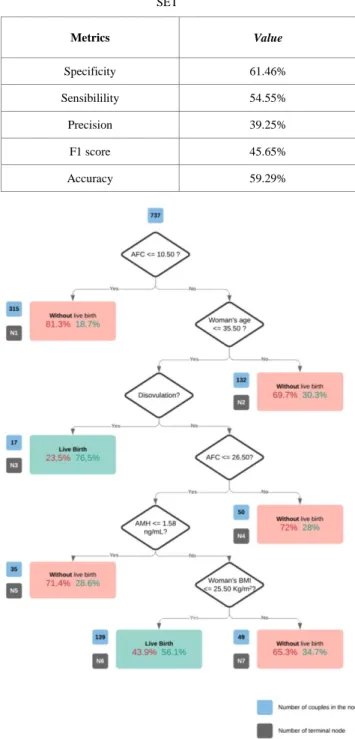
The CART analysis showed that the best discriminators for classification were AFC, AMH, female’s age, infertility cause, and female’s BMI. Figure 1 shows the optimal tree generated by this analysis, which means the tree with minimal cost generated by CART software. The tree has six splits and produces seven terminal nodes. Only two terminal nodes result in live birth class: node 3 and node 6. Node 3 includes the couples with values of AFC>10.50, female’s age≤35.5 years and disovulation as a cause of infertility. Node 6 represents the couples with AFC between 10.50 and 26.50, female’s age≤35.5 years, AMH>1.58 ng/mL, female’s BMI ≤ 25.50 Kg/m2 and with a cause of infertility which is not disovulation. The prevalence of live birth in these two nodes were 76.5% and 56.1%, respectively. Terminal nodes 1,2,4,5 and 7, obtained from the optimal tree, are determined as a group of couples without a live birth.
Table I shows the confusion matrix (also known as an error matrix) on the test set, allowing visualization of the performance of the model in terms of correct/incorrect classified cases. Table II reports the evaluation metrics on the test set. The AUC test for the discriminatory ability of the final prediction model is 0.68021 on train set and 0.59621 on the test set.
TABLE I. DECISION TREE EVALUATION METRICS ON TEST SET
TABLE II. DECISION TREE EVALUATION METRICS ON TEST SET Actual class Total Correct Percentage Predicted class No live birth N = 416 Live birth N = 321 No live Birth 506 61.46% 311 195 Live Birth 231 54.55% 105 126 Metrics Value Specificity 61.46% Sensibilility 54.55% Precision 39.25% F1 score 45.65% Accuracy 59.29%
Figure 1. The CART live birth prediction model for couples undergoing in vitro fertilization.
In Figure 1, blue tags indicate the number of couples in the node; Grey tags indicates the number of the terminal node (N); The red percentage indicates the percentage of couples in the node without live birth; The green percentage indicates the percentage of couples in the node with live birth.
In the next section, the results obtained will be discussed. IV. DISCUSSION
To our knowledge, this is the first decision tree reported in the literature for live birth IVF-ICSI prediction that accounts only on pre-treatment data from couples. The created tree provides the possibility of defining groups of couples for whom the probability of live birth is very small or very high. The overall rate of at least one live birth was 31.4% a priori and this tree returns a range of probabilities of success (green percentages represented in Figure 1) from 18.7% to 76.5%. This is the optimal tree computed by CART, and the features selected as better splitters were mainly woman’s characteristics. The only man’s characteristic that integrates this tree appears in “disovulation?” question which divides couples according to infertility cause.
The initial if question “AFC≤10.50?” splits the initial sample of 737 couples in two groups according to levels of AFC: AFC lower or equal to 10.50 classifies couples automatically with “No live birth” (Node 1) once only 18.7% of couples in that condition achieve a live birth. This result corroborates older literature findings in which women with low values of AFC had more difficulty to have success in IVF-ICSI [18][36].
Going down the tree, the group of women with a value of AFC higher than 10.50 are split according to their age: if the female’s age is higher than 35.50 years then the tree classifies that group with “No live birth” (Node 2) because 69.7% of couples from our database did not achieve live birth. This result also agrees with literature because of the loss of fertility with aging in women, mainly due to the decrease of gamete’s quantity and quality over the years [16][33][37].
Continuing down the tree, couples with younger women (female’s age lower than 35.50 years) are parcelled out according to infertility cause. Couples in which women have disovulation are classified with “Live Birth” once 76.5% of couples in the Node 3 conditions accomplished a live birth. The tree continues with the remaining causes of infertility (tubal, endometriosis, male factor, both female and male factor, multiple female factors, unexplained or other). Once IVF/ICSI has higher success rates on male factor [38][39] and disovulation, we expected that the male factor was also a tree splitter.
Next, AFC values split the couples with all of the infertility causes mentioned before, which were not disovulation. Thus, AFC is used two times as a splitter in this tree, thus becoming the most important splitter according to CART software scoring variables output. Node 4 classifies women with AFC higher than 26.50 follicles with “No live
birth”. This was not expected according to literature [18][36]. However, this result shows that AFC is not sufficient as an ovarian reserve marker and that is why AMH appears as next splitter.
Node 5 classifies women with values of AMH serum lower than 1.58 ng/mL with “No live birth” since 71.4% of 35 women in that node did not reach the live birth. This result about AMH reinforces La Marca [19] results in which probabilities of live birth are higher on women with AMH 0.4ng/mL-<2.8 ng/mL and even higher on the group with AMH≥2.8 ng/mL. The value 1.58 ng/mL is in the middle category of La Marca study.
Continuing down the tree, women with higher values of AMH are split according to their BMI. Again, following the previous conditions of the tree, if the female’s BMI is higher than 25.50 Kg/m2, then the prevalence of no live birth is 65.3%. In that way, it is better to have a value of female’s BMI lower than 25.50 Kg/m2 (taking into account all of the previous conditions that lead to Nodes 6 and 7). According to Adolphe Quetelet scale of BMI used worldwide [40], a BMI higher than 25 Kg/m2 is related to pre-obesity and lower than that value is associated with normal weight. Various studies showed that overweight women have ovulatory problems and increased risks of abortion [41][42].
To our knowledge, since this is the first decision tree in this context with only pre-treatment features and with live birth as output, we do not have any direct possible comparison with other models especially in terms of variables included in the final model and AUC values. However, we can indirectly compare with models referred in introduction section, namely RIMARK, RF, RPART and 1NN and observe that they have much higher values of accuracy. Milewska et al’s model [26] with decision trees also has higher accuracy than our model because they used under treatment features and their output was “pregnancy” and not live birth.
An advantage of decision trees is that they are easily readable and understandable. Using such a proposed approach, it becomes easy for doctors to explain to couples their situation following the decision tree until the terminal node. On the other hand, classic logistic regressions result from computation coefficients that, most likely, will be far from intuitive to explain to all patients.
In future work, we plan to investigate the “without live birth” nodes in order to further analyze the causes of in vitro treatments unsuccess. Furthermore, we intend to collect more data to validate our model, possibly improve accuracy, and explore other artificial intelligence algorithms with deep learning approach.
V. CONCLUSION
In this study, clinical and lifestyle factors of 737 infertile couples were used to create a classification decision tree. This tree incorporates the five optimal features to provide a probability of live birth due to IVF-ICSI: AFC, female’s age, AMH, infertility cause, and female’s BMI. Decision trees building allows that the variables might be dependent and so this method gives successful results in terms of
evaluating these variables together and bringing up relations between variables. Furthermore, decision trees are intuitive and easier to explain to patients.
As we said before, the work presented in this short paper is only part of the whole study done. The ultimate goal is to use the most accurate model for the development of a clinical support interface. Also, further data are pending collection for validation. In that way, this decision tree might result in a new clinical support system that helps physicians to deal with the couple's expectations.
ACKNOWLEDGMENTS
We thank the Portuguese Foundation for Science and Technology FCT/ MCTES - UID/EEA/00066/2019 (JF).
Portions of the information contained in this publication are printed with permission of Minitab, LLC. All such material remains the exclusive property and copyright of Minitab, LLC. All rights reserved.
REFERENCES
[1] K.-H. Yu, A. L. Beam, and I. S. Kohane, “Artificial intelligence in healthcare,” Nat. Biomed. Eng., vol. 2, no. 10, pp. 719–731, Oct. 2018.
[2] R. C. Deo, “Machine Learning in Medicine,” PMC Author Manuscr., vol. 132, no. 20, pp. 1920–1930, 2018.
[3] Lobo, L, “Artificial Intelligence and Medicine,” Artif. Intell. Med., vol. 69, no. 2, pp. 1–19, 1979.
[4] J. Boivin, L. Bunting, J. A.Collins, and K. G.Nygren, “International estimates of infertility prevalence and treatment-seeking: potential need and demand for infertility medical care,” Hum. Reprod., vol. 22, no. 10, pp. 1506–1512, 2007.
[5] J. L. Silva-Carvalho and A. Santos, “Estudo Afrodite: Caracterização da infertilidade em Portugal (Vol. 1. Estudo na Comunidade),” Porto Fac. Med. da Univ. do …, p. 74, 2009. [6] F. Zegers-Hochschild et al., “The international glossary on
infertility and fertility care, 2017,” Hum. Reprod., vol. 32, no. 9, pp. 1786–1801, 2017.
[7] A. N. Andersen et al., “Assisted reproductive technology and intrauterine inseminations in Europe, 2005: Results generated from European registers by ESHRE,” Hum. Reprod., vol. 24, no. 6, pp. 1267–1287, 2009.
[8] B. N. J. Pegah Hafiz, Mohtaram Nematollahi, and Reza Boostani, “Predicting implantation outcome of in vitro fertilization and intracytoplasmic sperm injection using data mining techniques,” Int. J. Fertil. Steril., vol. 11, no. 3, pp. 184–190, 2017.
[9] Conselho Nacional de Procriação Medicamente Assistida, “Relatório da Atividade Desenvolvida pelos Centros de PMA em 2015,” vol. 2015, p. 27, 2015.
[10] “Portuguese Fertility Association.” [Online]. Available: http://www.apfertilidade.org/. [retrieved: September, 2019]. [11] N. Karaca et al., “Effect of IVF failure on quality of life and
emotional status in infertile couples,” Eur. J. Obstet. Gynecol. Reprod. Biol., vol. 206, pp. 158–163, 2016.
[12] S. Maroufizadeh, E. Karimi, S. Vesali, and R. Omani Samani, “Anxiety and depression after failure of assisted reproductive treatment among patients experiencing infertility,” Int. J. Gynecol. Obstet., vol. 130, no. 3, 2015.
[13] V. Valoriani et al., “Differences in psychophysical well-being and signs of depression in couples undergoing their first consultation for assisted reproduction technology (ART): an
Italian pilot study,” Eur. J. Obstet. Gynecol. Reprod. Biol., vol. 197, pp. 179–185, Feb. 2016.
[14] M. Heredia, J. M. Tenías, R. Rocio, F. Amparo, M. A. Calleja, and J. C. Valenzuela, “Quality of life and predictive factors in patients undergoing assisted reproduction techniques,” Eur. J. Obstet. Gynecol. Reprod. Biol., vol. 167, no. 2, pp. 176–180, 2013.
[15] R. Paulson, “In Vitro Fertilization,” UpToDate, pp. 379–386, 2018.
[16] A. Templeton, J. K. Morris, and W. Parslow, “Factors that affect outcome of in-vitro fertilisation treatment,” Lancet, vol. 348, no. 9039, pp. 1402–1406, 1996.
[17] M. M. A. Alireza Zarinara, Hojjat Zeraati, Koorosh Kamali, Kazem Mohammad, and Parisa Shahnazari, “Models predicting success of infertility treatment: A systematic review.,” J. Reprod. Infertil., vol. 17, no. 2, pp. 68–81, 2016. [18] R. K. Dhillon et al., “Predicting the chance of live birth for
women undergoing IVF: A novel pretreatment counselling tool,” Hum. Reprod., vol. 31, no. 1, pp. 84–92, 2016.
[19] A. La Marca et al., “Anti-Müllerian hormone-based prediction model for a live birth in assisted reproduction,” Reprod. Biomed. Online, vol. 22, no. 4, pp. 341–349, 2011.
[20] S. M. Nelson and D. A. Lawlor, “Predicting live birth, preterm delivery, and low birth weight in infants born from in vitro fertilisation: A prospective study of 144,018 treatment cycles,” PLoS Med., vol. 8, no. 1, 2011.
[21] E. R. Te Velde et al., “Comparison of two models predicting IVF success; The effect of time trends on model performance,” Hum. Reprod., vol. 29, no. 1, pp. 57–64, 2014. [22] J. A. Leijdekkers et al., “Predicting the cumulative chance of
live birth over multiple complete cycles of in vitro fertilization: an external validation study,” Hum. Reprod., vol. 62, no. August, pp. 1–12, 2018.
[23] I. Jurisica, J. Mylopoulos, J. Glasgow, H. Shapiro, and R. F. Casper, “Case-based reasoning in IVF: Prediction and knowledge mining,” Artif. Intell. Med., vol. 12, no. 1, pp. 1– 24, 1998.
[24] R. S. Guh, T. C. J. Wu, and S. P. Weng, “Integrating genetic algorithm and decision tree learning for assistance in predicting in vitro fertilization outcomes,” Expert Syst. Appl., vol. 38, no. 4, pp. 4437–4449, 2011.
[25] H. A. Güvenir, G. Misirli, S. Dilbaz, O. Ozdegirmenci, B. Demir, and B. Dilbaz, “Estimating the chance of success in IVF treatment using a ranking algorithm,” Med. Biol. Eng. Comput., vol. 53, no. 9, pp. 911–920, 2015.
[26] A. J. Milewska, D. Jankowska, and U. Cwalina, “Prediction of Infertility Treatment Outcomes Using Classification Trees,” Stud. LOGIC, Gramm. Rhetor., vol. 47, no. 60, pp. 7– 19, 2016.
[27] D. J. McLernon, E. W. Steyerberg, E. R. Te Velde, A. J. Lee, and S. Bhattacharya, “Predicting the chances of a live birth after one or more complete cycles of in vitro fertilisation: Population based study of linked cycle data from 113 873 women,” BMJ, vol. 355, 2016.
[28] E. Vittinghoff, D. Glidden, S. Shiboski, and C. McCulloch, Regression Methods in Biostatistics: Linear, Logistic, Survival and Repeated Measures Models. Springer, 2005. [29] L. G. J. R. Trimarchi, J. Goodside, L. Passmore, T.
Silberstein, L. Hamel, “Comparing data mining and logistic regression for predicting IVF outcome,” Abstr. 59th Annu. Meet. Am. Soc. Reprod. Med., vol. 80, 2003.
[30] D. Tran, S. Cooke, P. J. Illingworth, and D. K. Gardner, “Deep learning as a predictive tool for fetal heart pregnancy following time-lapse incubation and blastocyst transfer,” Hum. Reprod., vol. 34, no. 6, pp. 1011–1018, 2019.
[31] J. Han, M. Kamber, and J. Pei, Data mining: concepts and techniques, 3rd ed. Morgan Kaufmann Publishers is, 2012.
[32] A. Zarinara, H. Zeraati, K. Kamali, K. Mohammad, and M. M. A. Parisa Shahnazari, “Models predicting success of infertility treatment: A systematic review.,” J. Reprod. Infertil., vol. 17, no. 2, pp. 68–81, 2016.
[33] M. Vander Borght and C. Wyns, “Fertility and infertility: Definition and epidemiology,” Clin. Biochem., vol. 62, no. February, pp. 2–10, 2018.
[34] L. Breiman, J. H. Friedman, R. A. Olshen, and C. J. Stone, CART: Classification and Regression Trees. Wadsworth, Belmont.
[35] R. Timofeev, “Classification and Regression Trees (CART) Theory and Applications,” Humboldt University, Berlin, 2004.
[36] K. Keane, V. F. Cruzat, S. Wagle, N. Chaudhary, P. Newsholme, and J. Yovich, “Specific ranges of anti-Mullerian hormone and antral follicle count correlate to provide a prognostic indicator for IVF outcome,” Reprod. Biol., vol. 17, no. 1, pp. 51–59, 2017.
[37] A. Templeton, “Infertility and the establishment of pregnancy--overview,” Br. Med. Bull., vol. 56, no. 3, pp. 577–587, 2000.
[38] A. C. Van Steirteghem et al., “Higher success rate by intracytoplasmic sperm injection than by subzonal insemination . Report of a second series of 300 consecutive treatment cycles,” Hum. Reprod., vol. 8, no. 7, pp. 1055– 1060, 1993.
[39] M. Alikani, M. Sc, A. Adler, B. Sc, and Z. Rosenwaks, “Intracytoplasmic sperm injection : a novel treatment for all forms of male factor infertility,” Fertil. Steril., vol. 63, no. 6, pp. 1231–1240, 1995.
[40] World Health Organization, “Body mass index - BMI,” 2019. [Online]. Available: http://www.euro.who.int/en/health- topics/disease-prevention/nutrition/a-healthy-lifestyle/body-mass-index-bmi. [retrieved: September, 2019].
[41] D. Best and S. Bhattacharya, “Obesity and fertility,” Horm. Mol. Biol. Clin. Investig., vol. 24, no. 1, pp. 1–6, 2015. [42] R. J. Norman, “Impact of obesity on female fertility and
fertility treatment,” Women’s Heal., vol. 4, no. Future Medicine, pp. 183–194, 2008.