Cícero Beto Freire
I, Ricardo Freitas Dias
I, Paulo Adriano Schwingel
I, Eduardo Eriko Tenório de França
II,
Flávio Maciel Dias de Andrade
III, Emilia Chagas Costa
IV, Marco Aurélio de Valois Correia Junior
II Universidade de Pernambuco, Course of Physiotherapy. Petrolina-PE, Brazil.
II Department of Health of the State of Pernambuco, Hospital Agamenon Magalhães. Recife-PE, Brazil. III Universidade Católica de Pernambuco, Center for Life Sciences and Health. Recife-PE, Brazil.
IV Universidade Federal de Pernambuco, Course of Physical Education. Vitória-PE, Brazil.
Submitted: 04-11-2014 Approved: 03-12-2014
ABSTRACT
Objective: the objective was to assess the level of physical activity (LPA) and the quality of life QL of the professionals who work in ICU.
Method: this was a cross-sectional study carried out in Adult ICUs. LPA was assessed by the International Questionnarie of Physical Activity – short form (IQPA-SF) and the QL by the Medical Outcomes Study 36 (SF-36) questionnaire. Results: it was classifi ed active 50.89% out of a total of 59 professionals. Nursing technicians were considered the most active with 60.6%. The QL of the professionals who were considered active were better when compared to inactives, with statistical differences to the category of physical aspects limitation, social aspects and mental health. The working hours were higher than recommend, the physicians were higher than the physical therapist, nurses and technicians nurses (p=0.046). Conclusion: physically active professionals who work in ICU had higher quality of life probably why have lower hours of work and consequently more free time to engage in physical activity.
Key words: Phisycal Activity; Burnout Professional; Humanization of Hospital Services; Quality of Life; Sedentary Lifestyle; Intensive Care Unit.
Marco Aurélio de Valois Correia Junior E-mail: [email protected]
CORRESPONDING AUTHOR
INTRODUCTION
The Intensive Care Unit (ICU) is a hospital sectors with par-ticular characteristics such as working indoors, the constant contact with suffering, pain and death, and a permanent state of alertness(1-2). Many times, these characteristics can present
factors or circumstances that affect the health and quality of life (QOL) of professionals working in these environments(3-9).
Quality of life is a term that has been explored in several studies with a wide range of concepts. Hence, it relates to various aspects of human life such as health, family, social relationships, work, stable financial condition, environment, among others(7,10-11).
People seek different paths to reach the QOL, including those working in ICUs. However, these professionals undergo alcohol use, smoking, poor diet and extensive working hours in a very unhealthy environment, often having to work in mul-tiple jobs to meet their wage needs, overcoming their work-load and consequently having less time for leisure and fam-ily life, which ends up distancing them from their goals(10-12).
Work has a direct relationship with QOL because it is where workers spend most of their lives, having an impact on their well-being even in their times off work(10-13).
Along with other factors, physical activity (PA) is defended as an important element in promoting health and QOL of the popu-lation(14-19). There are many benefits, whether physical or mental,
such as reduction in the levels of anxiety, depression and an-ger(14-19). Researches have given special attention to analysis of the
physical activity level (PAL) in different populations(14-19).
Howev-er, little has been studied about physical activity and the quality of life of different professionals working in intensive care units.
Although these health professionals know the benefits of PA, they are not able to adhere to an effective program due to lack of time or incentive(16,20-23). Many still exchange their
leisure time for work, leaving physical exercise practice in the background and becoming sedentary people.
Physically active people show greater vigor and willing-ness to perform their daily and professional activities, besides demonstrating less fatigue and improved cognitive level. PA also helps to improve interpersonal relationships such as those with family and socially at work, thus, improving the quality of life(16-19). This study aimed to evaluate the PAL and the QOL
of professionals working in ICUs in the cities of Petrolina and Juazeiro located in the region of the sub-middle São Francisco.
METHODS
This was a descriptive cross-sectional study, carried out in some adult ICUs clinics in the cities of Petrolina and Juazeiro (state of BA) from July to September 2011 and approved by the Research ethics committee in humans of the Professor Fernando Figueira Institute of Integrative Medicine – IMIP (nº 2206-11).
These two cities are located in a sub-region of the São Fran-cisco Valley called sub-middle São FranFran-cisco, and together they have about 500,000 inhabitants(24). This region has seven
adult ICUs, of which two are philanthropic civil institutions and five private, totaling 56 beds. Four hospitals refused to participate in the research. The three hospitals included in the study have 57.14% of beds in the region.
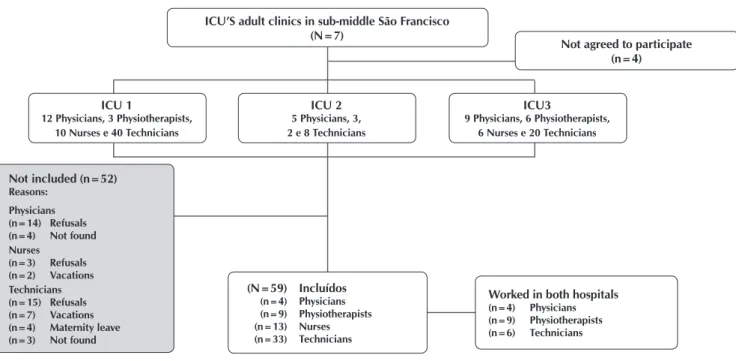
Professionals aged above 18 years and working in the ICUs of these hospitals were included. All professionals on maternity leave, vacation or sick leave in the period of interviews and those who refused to participate, or did not sign the consent form were excluded. Figure 1 shows the research flow of the ICU.
Personal data were collected through a form with informa-tion such as name, age, gender, professional category, work-ing hours, workwork-ing time in the ICU, alcohol use, smokwork-ing, to-tal body weight and height. The body mass index (BMI) was
Figure 1 - Flow of professionals in the study
ICU’S adult clinics in sub-middle São Francisco (N=7)
Not agreed to participate (n=4)
ICU3
9 Physicians, 6 Physiotherapists, 6 Nurses e 20 Technicians
ICU 2
5 Physicians, 3, 2 e 8 Technicians
(N=59) Incluídos
(n=4) Physicians (n=9) Physiotherapists (n=13) Nurses (n=33) Technicians
Worked in both hospitals
(n=4) Physicians (n=9) Physiotherapists (n=6) Technicians
Not included (n=52)
Reasons:
Physicians (n=14) Refusals
(n=4) Not found
Nurses (n=3) Refusals (n=2) Vacations Technicians (n=15) Refusals (n=7) Vacations
(n=4) Maternity leave
(n=3) Not found
ICU 1
calculated using anthropometric measurements according to the standard formula mass (kg)/height (m)2. Professionals were
also asked directly about their opinion in case the company of-fered incentive programs aimed at physical activity in general, such as exercise in the workplace and going to work by bicycle.
The International Physical Activity Questionnaire (IPAQ) in its short version, translated and validated in Brazil was used to as-sess the level of physical activity(25). The questions are related to
the time the respondent spent doing physical activity in the previ-ous week. The analysis of results is done according to the criteria of frequency and duration. The population was classified into five categories, namely: very active (practicing vigorous PA ≥ 5 days/week and ≥ 30 minutes per session; or vigorous ≥ 3 days/ week and ≥ 20 minutes per session + moderate and/or walking ≥ 5 days/week and ≥ 30 minutes per session); active (practicing vigorous PA ≥ 3 days/week and ≥ 20 minutes per session; or moderate or walking ≥ 5 days/week and ≥ 30 minutes per ses-sion; or any grouped activity ≥ 5 days/week and 150 minutes/ week (walking + moderate + vigorous); irregularly active, which was divided into irregularly active A (those practicing PA 5 days/ week or with duration of 150 minutes per week), and irregularly active B (those who did not meet any of the recommended cri-teria regarding frequency nor duration); or sedentary (those who did not perform any physical activity for at least 10 continuous minutes during the week). The individuals considered active in this study were those classified as very active and active. The inactive individuals were those irregularly active and sedentary.
The quality of life was assessed using the questionnaire of QOL – Short Form Health Survey – SF-36, translated and validated in Brazil(26). This is a generic instrument for assessing
QOL that includes 36 items in eight components: functional capacity, physical aspects, pain, general health, vitality, social
functioning, emotional aspects and mental health. In the cal-culation of each component, the final score ranged from 0 to 100, where 0 is the worst and 100 is the best result for each component. The questionnaires were administered by the same previously trained investigator during the interview that lasted no longer than 30 minutes.
The Microsoft Office Excel 2007 and the GraphPad Prism 4 were used for statistical analysis. The Kolmogorov-Smirnov test was applied to test the normality assumption. The chi-square test, Fisher’s exact test, and the chi-square test with Yates cor-rection when appropriate were used to evaluate the differences between proportions. The comparison between the means was performed using the t-test and One-way ANOVA for parametric variables and the Kruskal-Wallis test, the Dunn’s post-test and the Mann-Whitney test for nonparametric variables. All conclu-sions were based on a significance level of 5%.
RESULTS
In total, 59 professionals were interviewed, of which four physicians, nine physiotherapists, 13 nurses and 33 nursing technicians. Table 1 shows that physicians had longer working hours when compared to physiotherapists, nurses and nursing technicians (p = 0.04).
Among the studied population, 50.85% were considered as active. The nursing technicians presented themselves as those who most practiced physical activity, followed by phys-iotherapists, nurses and physicians. None of the professionals were smokers and nurses were the greatest users of alcoholic beverages. Females were more prevalent among nursing tech-nicians when compared to physiotherapists, nurses and physi-cians (Table 1).
Table 1 - Age, body mass index (BMI) and working hours of the health professionals of ICU, Petrolina and Juazeiro-BA, July-September 2011
Variables Physician Fisioterapeuta (n = 9)
Enfermeiro (n = 13)
Técnico
(n = 33) Valor de p*
Age (years) 33.5±5.5 28.9±3.7 29.9±4.8 31.6±6.4 0.41
BMI (Kg/m2) 26.7±1.4 23.3±3.9 27.2±6.5 24.1±3.7 0.11
Working hours (h) 80.5±12.6a 65.3±18.6b 66.9±22b 56.0±19.0b 0.04
Gender, n(%)
Female 2 (50.0) 7(77.8) 10(76.9) 33(100)
<0.001
Male 2 (50.0) 2(22.2) 3(23.1) 0(0)
Physical activities, n(%)
Active 1 (25.0) 4 (44.0) 5 (38.5) 20 (60.6)
0.35
Inactive 3 (75.0) 5(55.6) 8 (61.5) 13 (39.4)
Smoking, n(%)
Yes 0(0) 0(0) 0(0) 0(0)
-No 4(100) 9(100) 13(100) 33(100)
Alcohol use, n(%)
Yes 0(0) 3(33.3) 6(46.2) 9(27.3)
0.32
No 4(100) 6(66.7) 7(53.8) 24(72.7)
BMI = Body mass index; Technician = nursing technician. The variables are expressed as mean ± standard deviation and absolute and relative frequencies. *P values obtained from Oneway ANOVA, chi-square and Fisher’s exact tests.
There was no statistical difference among professions in the scores regarding the eight studied domains of the SF-36 questionnaire. Table 2 shows data on age, BMI, working hours and QOL of professionals characterized as active and inac-tive. Individuals considered active had shorter working hours (56.4 ± 20.9 hours versus 66.8 ± 18.1 hours; p = 0.04) and higher scores in all SF-36 domains, with statistical difference in domains of limitation by physical aspects (89.3 ± 23.3 ver-sus 73.3 ± 33.4; p = 0.01), social functioning (86.2 ± 15.9
versus 75.7 ± 20.2; p = 0.03) and mental health (85.0 ±
11.9 versus 76.8 ± 14.3; p = 0.02), when compared to inac-tive individuals.
When asked about using a bicycle as a means of transporta-tion to work and an alternative to physical activity practice, 45 (76.27%) of professionals responded affirmatively. Regarding activity in the workplace, 58 (98.3%) were in favor (data not shown in tables).
DISCUSSION
Although the study sample is composed of health profes-sionals that know the benefits of PA practice, a high propor-tion of inactive individuals was found (49.15%), which was associated with quality of life and working hours. In addition, health professionals of the ICUs in the sub-middle San Fran-cisco region work more hours than the maximum limit of 44
hours per week established by the Consolidation of Labor Laws (CLT - Consolidação das Leis do Trabalho)(27).
It is a consensus that the practice of PA is directly related to health promotion and the prevention of chronic noncom-municable diseases (NCDs) such as heart disease, cancer, hypertension, diabetes mellitus and obesity(14-23). The stressful
routine in the ICU environment, where professionals work in a state of constant attention, living with suffering, pain and death, associated with working hours that often exceed labor laws regulations, low wages and lack of exercise can directly affect the health of these individuals, consequently affecting their QOL(3,6-7). The ICU is perceived by staff, patients and
families as one of the most aggressive and traumatic environ-ments in the hospital(3-4,6-9).
Much of these professionals’ lives is spent in these hospi-tal settings, mainly due to the long working hours. Studies, especially in the nursing area, have shown that QOL is
as-sociated with the conditions offered in these loca-tions(4,6-9,12-13) and, when coupled with a sedentary
lifestyle, it can influence the health-disease process. A sedentary lifestyle, along with smoking and bad eating habits are risk factors for the development or worsening of NCDs(14-23). All professionals in this
study had an average of over 55 hours per week. The quality of life of the professionals evaluated was considered acceptable when compared with the nursing staff in the operating room from anoth-er hospital, who had a score of around 100 in the eight domains of the SF-36, suggesting a good state of health and QOL(28).
The analyzed professionals had a weekly work-load far above the 44 hours allowed by law(27).
Phy-sicians had the longest work hours (80.5 ± 12.6 hours) compared to nursing technicians (56.0 ± 19.0), physiotherapists (65.3 ± 18.6) and nurses (66.9 ± 22). A possible explanation for this finding is that nursing technicians working in a single job already have a weekly workload of more or less 48 hours, so they are able to have a maximum of two other jobs. As physicians in the area have a contract of up to 12 hours, they can work in more than a job, or even increase their shift hours in the same job and thereby, increase their working hours. Another important issue was that about 61% of participants had more than a job, which is considered one of the physical and psychological stress factors for workers in the health area(9,12).
The results of this study have shown that volun-teers considered as active had better scores on the SF-36 domains when compared to the inactive, as well as low-er working hours. The fact that physically active professionals have shorter working hours may have contributed to having more free time to practice physical activities and consequent-ly, present a better quality of life. The ratio between active and inactive in this research was 50.85% versus 49.15%, similar to the results found by other authors (50.6% of active and 49.4% of inactive) who also used the IPAQ to evaluate the
Table 2 - Age, body mass index (BMI), working hours, and domain of the SF-36 quality of life questionnaire according to the level of physical activity of the professionals evaluated
Variables
Level of physical activity
P value Active
(n = 30)
Inactive (n = 29)
Age (years) 32.2±6.0 29.7±5.2 0.98
BMI (Kg/m2) 24.9±3.8 24.8±5.2 0.54
Working hours 56.4±20.9 66.8±18.1 0.04
Functional capacity 83.2±17.3 81.7±16.8 0.74
Physical aspects 89.3±23.3 73.3±33.4 0.01
Pain 69.5±23.8 68.3±21.9 0.84
General health 83.2±14.3 76.0±19.4 0.11
Vitality 70.3±13.1 65.7±19.1 0.28
Social functioning 86.2±15.9 75.7±20.2 0.03
Emotional aspects 84.4±28.7 81.6±32.8 0.66
Mental health 85.0±11.9 76.8±14.3 0.02
Notes:
REFERENCES
1. Stacy KM. Progressive care units: different but the same. Crit Care Nurse. 2011;31(3):77-83.
2. Baasch D, Laner AS. Os significados do trabalho em uni-dades de terapia intensiva de dois hospitais brasileiros. Ciênc Saúde Coletiva. 2011;16(Suppl 1):1097-105.
3. Abreu RMD, Gonçalves RMDA, Simões ALA. Motivos atribuídos por profissionais de uma Unidade de Terapia Intensiva para ausência ao trabalho. Rev Bras Enferm. 2014;67(3):386-93.
4. Schmidt DRC, Paladini MC, Pais CBJD, Oliveira AR. Qua-lidade de vida no trabalho e burnout em trabalhadores de enfermagem de Unidade de Terapia Intensiva. Rev Bras Enferm. 2013;66(1):13-7.
5. Campos JF, David HSL. Avaliação do contexto de traba-lho em terapia intensiva sob o olhar da psicodinâmica do trabalho. Rev Esc Enferm USP [Internet]. 2011 [acesso em 29 de julho de 2014];45(2):363-8. Disponível em: http:// www.scielo.br/pdf/reeusp/v45n2/v45n2a08.pdf
6. Shimizu HE, Couto DT, Merchan-Hamann E. Pra-zer e sofrimento em trabalhadores de enfermagem de Unidade de Terapia Intensiva. Rev Latinoam Enferm. 2011;19(3):565-72.
7. Santos FD, Cunha MHF, Robazzi MLCC, Pedrão LJ, Silva LAS, Terra FS. O estresse do enfermeiro nas uni-dades de terapia intensiva adulto: uma REVIEW da
literatura. SMAD Rev Eletrônica Saúde Mental Alcool Drog . 2010;6(1):1-16.
8. Silveira RS, Funck CR, Lunardi VL, Silveira JT, Avila LI, Lunar-di Filho WD, et al . Percepção dos trabalhadores de enfer-magem acerca da satisfação no contexto do trabalho na UTI. Enferm Foco (Brasília) [Internet]. 2012 [acesso em 29 de ju-lho de 2014];3(2):93-6. Disponível em: http://revista.portal-cofen.gov.br/index.php/enfermagem/article/view/262/150
9. Cecere DBB, Silveira RS, Duarte CR, Fernandes GFM. Compromisso ético no trabalho da enfermagem no cená-rio da internação hospitalar. Enferm Foco (Brasília) [Inter-net]. 2010 [acesso em 29 de julho de 2014];1(2):46-50. Disponível em: http://revista.portalcofen.gov.br/index. php/enfermagem/article/view/13/14
10. Fogaça MC, Carvalho WB, Nogueira-Martins LA. Estudo preliminar sobre a qualidade de vida de médicos e en-fermeiros intensivistas pediátricos e neonatais. Rev Esc Enferm USP [Internet]. 2010 [acesso em 29 de julho de 2014];44(3):708-12. Disponível em: http://www.scielo. br/pdf/reeusp/v44n3/22.pdf
11. Fernandes JS, Miranzi SSC, Iwamoto HH, Tavares DMS, Santos CB. A relação dos aspectos profissionais na quali-dade de vida de enfermeiros das equipes saúde da famí-lia. Rev Esc Enferm USP [Internet]. 2012 [acesso em 29 de julho de 2014];46(2):404-12. Disponível em: http://www. scielo.br/pdf/reeusp/v46n2/a19v46n2.pdf
PAL among employees of a higher education institution in Ba-hia(29). The data presented here differ slightly from those
pre-sented in the National Survey by Household Sample (PNAD - Pesquisa Nacional por Amostra de Domicílios), which con-sidered about 36% of the Brazilian population as active(30).
The practice of PA brings great benefits to the daily and pro-fessional activities of people, such as cognitive improvement, tackling stress, anxiety and depression, improvement of inter-personal relationships, as well as more energy and less fatigue throughout the working life(10-11,17,21-23). When professionals
were directly asked about the implementation of PA practice incentive programs, such as going to work by bicycle, 76.27% were in favor and 23.73% against, justifying the negative an-swer by distance, weather of the region or transportation to another job. Regarding exercise in the workplace, 98.3% were in favor and 1.7% against.
A possible limitation of this study may be related to the du-ration of interviews. Since the studied population has a frantic service routine without free time, it was difficult to administer questionnaires, which was done in the few minutes available, sometimes interrupted and restarted in opportune moments. Another fact that called attention was the low participation mainly of physicians. This can be explained by the greater number of refusals of physicians to participate, and because of their employment engagements in one, two or even in the three hospitals involved in the study.
This was the first research aiming to trace the physical profile and assess the QOL of health professionals working in ICUs of the sub-middle São Francisco, a region in broad development in the sector of health service provision. Hence, it was possible to draw a diagnosis of the level of physical activity and quality of life of these professionals, pointing out that interventions to the health of this population are needed, especially with regard to physical inactivity and long working hours. Studies establish-ing cause and effect relations are necessary to identify possible determinants of inactivity in this population, and also to evalu-ate the benefits of incentive programs to PA practice, both for professionals as for health institutions.
CONCLUSION
The health professionals working in the ICUs of the São Francisco sub-middle region and classified as active have bet-ter QOL and shorbet-ter working hours compared to the inactive professionals.
ACKNOWLEDGEMENTS
12. Alves EF. O significado de qualidade de vida para cuida-dores de enfermagem de uma unidade de terapia intensiva adulto. Mundo Saúde [Internet]. 2013 [acesso em 29 de julho de 2014];37(4):458-63. Disponível em: http://www. saocamilo-sp.br/pdf/mundo_saude/155558/A11.pdf
13. Lopes CCP, Ribeiro TP, Martinho NJ. Síndrome de Bur-nout e sua relação com a ausência de qualidade de vida no trabalho do enfermeiro. Enferm Foco (Brasília) [Inter-net]. 2012 [acesso em 29 de julho de 2014];3(2):97-101. Disponível em: http://revista.portalcofen.gov.br/index. php/enfermagem/article/view/264/151
14. Ministério da Saúde (BR). Plano de ações estratégicas para o enfretamento das doenças crônicas não transmissíveis (DCNT) no Brasil 2011-2022 [Internet]. Brasília (DF): Ministério da Saúde; 2011 [acesso em 29 de julho de 2014]. Disponível em: http://actbr.org.br/uploads/conteu-do/918_cartilha_dcnt.pdf
15. Simão AF, Precoma DB, Andrade JP, Correa Filho H, Sa-raiva JFK, Oliveira GMM, et al . I Diretriz Brasileira de Prevenção Cardiovascular. Arq Bras Cardiol. 2013;101(6 Suppl 2):1-63.
16. Freitas AR, Carneseca EC, Paiva CE, Paiva BSR. Impacto de um programa de atividade física sobre a ansiedade, de-pressão, estresse ocupacional e síndrome de Burnout dos profissionais de enfermagem no trabalho. Rev Latinoam Enferm. 2014;22(2):332-6.
17. Silva RS, Silva I, Silva RA, Souza L, Tomasi E. Atividade física e qualidade de vida. Ciênc Saúde Coletiva [Inter-net]. 2010 [acesso em 29 de julho de 2014];15(1):115-20. Disponível em: http://www.scielosp.org/pdf/csc/v15n1/ a17v15n1.pdf
18. Brunori EHFR, Cavalcante AMRZ, Lopes CT, Lo-pes JL, Barros ALBL. Tabagismo, consumo de álol e atividade física: associações na síndrome co-ronariana aguda. Acta Paul Enferm [Internet]. 2014 [acesso em 29 de julho de 2014];27(2):165-72. Dispo-nível em: http://www.scielo.br/scielo.php?pid=S0103--21002014000200013&script=sci_arttext
19. Pucci GCMF, Rech CR, Fermino RC, Reis RS. Associação entre atividade física e qualidade de vida em adultos. Rev Saúde Pública. 2012,46(1):166-79.
20. Hanzelmann RS, Passos JP. Imagens e representações da enfermagem acerca do stress e sua influência na ati-vidade laboral. Rev Esc Enferm USP [Internet]. 2010 [acesso em 29 de julho de 2014];44(3):694-701. Dispo-nível em: http://www.scielo.br/scielo.php?pid=S0080--62342010000300020&script=sci_arttext
21. Grande AJ, Silva V, Manzatto LRTBX, Martins GC, Vilela
Júnior GB. Comparação de intervenções de promoção à saúde do trabalhador: ensaio clínico controlado randomi-zado por cluster. Rev Bras Cineantropom Desempenho Hum. 2013;15(1):27-37.
22. Chan CW, Perry L. Lifestyle health promotion interven-tions for the nursing workforce: a systematic review. J Clin Nurs. 2012;21(15-16):2247-61.
23. World Health Organization. Reducing risks and prevent-ing disease: population-wide interventions [Internet]. [place unknown]: WHO; 2010 [cited 2013 June 17]. Available from: http://www.who.int/nmh/publications/ ncd_report_chapter4.pdf
24. censo2010.ibge.gov.br/sinopse [Internet]. [S.l.]; IBGE; 2010 [atualizado em 02 de fevereiro de 2015; acesso em 29 de julho de 2014]. Disponível em: www.censo2010. ibge.gov.br/sinopse
25. Craig CL, Marshall AL, Sjöström M, Bauman AE, Booth ML, Ainsworth BE, et al . International physical activity questionnaire: 12-Country reliability and validity. Med Sci Sports Exerc. 2003;35(08):1381-95.
26. Ciconelli RM, Ferraz MB, Santos W, Meinão I, Qua-resma MR. Tradução para a língua portuguesa e vali-dação do questionário genérico de avaliação de qua-lidade de vida SF-36 (Brasil SF-36). Rev Bras Reumatol. 1999;39(3):143-50.
27. Brasil. Decreto-Lei n.º 5.452, de 1º de maio de 1943. Aprova a Consolidação das leis do trabalho [Internet]. Di-ário Oficial da União 09 ago 1943 [acesso em 29 julho de 2014]. Disponível em: http://www.planalto.gov.br/cci-vil_03/Decreto-Lei/Del5452.htm#art478§2
28. Oler FG, Jesus AF, Barboza DB, Domingos NAM. Quali-dade de vida da equipe de enfermagem do centro cirúr-gico. Arq Ciênc Saúde [Internet]. 2005 [acesso em 29 de julho de 2014];12(2):102-10. Disponível em: http://www. cienciasdasaude.famerp.br/racs_ol/Vol-12-2/8.pdf
29. Rocha SV, Pie ACS, Cardoso JP, Amorim CR, Carneiro LRV, Vilela ABA. Nível de atividade física entre funcio-nários de uma instituição de ensino superior da Bahia. Ulbra Movimento Rev Educ Fís [Internet]. 2011 [acesso em 29 de julho de 2014];2(1):16-29. Disponível em: file:///C:/Users/Cliente/Downloads/Dialnet-NivelDeAtiv-idadeFisicaEntreFuncionariosDeUmaInstit-3637450.pdf