Practice of physical activity
during leisure time and common
mental disorders among
residents of a municipality of
Northeast Brazil
Prática de atividade física no lazer e
transtornos mentais comuns entre
residentes de um município do
Nordeste do Brasil
Saulo Vasconcelos Rocha
I,IITânia Maria de Araújo
IIIMaura Maria Guimarães de Almeida
IVJair Sindra Virtuoso Júnior
VI Programa de Pós-Graduação em Educação Física / Universidade Federal de Santa Catarina
II Departamento de Saúde - Núcleo de Estudos em Saúde da População / Universidade Estadual do Sudoeste da Bahia
III Universidade Estadual de Feira de Santana- Programa de Pós-Graduação em Saúde Coletiva
IV Departamento de Saúde- Universidade Estadual de Feira de Santana V Universidade Federal do Triângulo Mineiro- Programa de Pós-Graduação em Educação Física, Programa de Pós-Graduação em Atenção a Saúde
Correspondence:Saulo Vasconcelos Rocha. Departamento de Saúde Coletiva da Universidade Estadual de Feira de Santana – UEFS. Avenida José Moreira Sobrinho S/N, Jequiezinho, Jequié, BA CEP: 45200-000. E-mail: [email protected]
Abstract
Objective: To analyze the association betwe-en physical activity during leisure time and common mental disorders among residents in urban areas of Feira de Santana City, Bahia. Methods: A cross-sectional study was conducted in a representative sample from the urban population. A sample of 3,597 individuals aged 15 years or older (71.4% female) was studied. A questionnaire gathered information about sociodemogra-phic information, self-reported diseases, screening for mental disorders, lifestyle habits and physical activity during leisure time. To evaluate common mental disorders (CMD) the Self-Reporting Questionnaire (SRQ-20) was used. To analyze the associa-tion between leisure physical activity (ac-tive/inactive) and CMD, prevalence ratios (PR) and their respective 95% confidence intervals were estimated by using multiple logistic regression and the Delta method. Results: We found a frequency of 27.7% of individuals who were active during leisure time. The prevalence of CMD was lower among those active in leisure time, after adjustment by sex, age, income, education, alcohol consumption and smoking (PR = 0.78; 95% CI0.70 to 0.87). Conclusion: The population of Feira de Santana city has a high frequency of individuals insufficiently active during leisure, and this condition was associated with higher prevalence of CMD. Actions directed to mental health programs must encourage physical activity among the population, considering the association of this behavior with low prevalence of com-mon mental disorders.
Resumo
Objetivo: Analisar a associação entre a prática de atividade física no lazer e trans-tornos mentais comuns entre residentes de áreas urbanas de Feira de Santana, Bahia. Métodos: Estudo epidemiológico de corte transversal com amostra representativa da população urbana de Feira de Santana, Bahia, constituída de 3.597 indivíduos com 15 anos ou mais de idade (71,4% do sexo feminino) da população urbana. Foi utiliza-do um questionário contenutiliza-do informações sobre aspectos sociodemográficos, doenças referidas, hábitos de vida e atividades físicas no lazer. Para triagem de transtornos men-tais comuns (TMC) foi utilizado o SRQ-20. Para avaliar a associação entre atividade física no lazer (ativo/inativo) e TMC foram estimadas as razões de prevalência e seus respectivos intervalos de confiança por meio de regressão logística múltipla e uso do método Delta. Resultados: Encontrou-se uma frequência de 27,7% de indivíduos considerados ativos no lazer. A prevalência de TMC foi menor entre os indivíduos ati-vos no lazer, após o ajuste, num modelo de regressão logística múltipla, por sexo, faixa etária, renda, escolaridade, consumo abusi-vo de bebidas alcoólicas e tabagismo) (RP = 0.78 [0,70 - 0,87]). Conclusão: A população do município de Feira de Santana apresen-ta uma elevada frequência de indivíduos inativos no lazer, e essa condição estava associada a maior prevalência de TMC. As ações direcionadas à saúde mental devem priorizar programas que favoreçam o in-centivo à prática de atividade física entre a população do município, considerando a associação desse comportamento com a prevenção de transtornos mentais comuns.
Palavras-chave: Atividade física. Saúde mental. Aptidão física. Atividades de Lazer. População Urbana.
Introduction
Psychological disorders are one of the main problems faced by the world at pres-ent, affecting the health of populations and placing a great burden on public health. The World Health Organization (WHO)1 points
out that one in every four people will have a mental disorder in a certain stage of life.
Common mental disorders (CMD) are characterized by symptoms such as fatigue, forgetfulness, insomnia, difficulty in concentrating, headaches and somatic complaints2. These diseases have stood
out as the most prevalent mental disorders. Prospective cross-sectional studies have shown a strong association between mental health problems and low physical activity levels3;4;5.
Physical activity is an aspect responsible for directly acting on psychological factors (distraction, self-efficacy and social interac-tion) and physiological factors (increase in neurotransmission of endorphins)6.
Leisure time physical activities, espe-cially when practiced in group, promote the formation of social relationships. In these activities, mutual support among par-ticipants has an important protective effect against mental health problems6.
Although the benefits of physical activity practice for mental health main-tenance are emphasized in the literature, the production of empirical evidence on the relationship between physical activity and mental health factors is still limited. This lack of empirical data is particularly relevant when considering the production of information derived from population-based studies5.
The present study aimed to analyze the association between leisure time physical activity and common mental disorders among residents living in urban areas of the city of Feira de Santana, BA, Brazil.
maintenance, thus providing resources for health care policies in this city.
Methods
The data of the present study de-rived from the household survey en-titled “Caracterização da Saúde Mental do Município de Feira de Santana, Bahia” (Characterization of Mental Health in the City of Feira de Santana, Bahia), per-formed by the Epidemiology Center of the
Universidade Estadual de Feira de Santana
in 2007. A cross-sectional study was con-ducted with a representative sample of the population aged 15 years or more liv-ing in the urban areas of the city of Feira de Santana, as defined by the Instituto Brasileiro de Geografia e Estatística (IBGE – Brazilian Institute of Geography and Statistics)7 of this city.
Feira de Santana is 116 km far from Salvador, the capital city of the state of Bahia. This is the second largest city in the state, the 31st largest city in Brazil, and the
13th most populous city in this country,
ex-cluding the capital cities. In 2007, the popu-lation of this city was 571,997 inhabitants7.
An estimated prevalence of mental common disorders of 25% (according to the WHO1), sampling error of 3% and
con-fidence interval of 95% were considered to calculate the sample size. Based on these parameters, the sample totaled 800 indi-viduals. When the effect of the study design (cluster sampling) and refusals and losses of approximately 20% were taken into consid-eration, the final sample size was comprised of 1,920 individuals.
The selection of study areas was per-formed by stratified sampling per sub-district, adopting random procedures based on census data from the Fundação Instituto Brasileiro de Geografia e Estatística
(Brazilian Institute of Geography and Statistics Foundation)7, where the
house-hold was the sample unit. All individuals aged 15 years or more were considered to be eligible for this study. Researchers es-tablished that up to three visits would be
conducted to reduce possible losses. As the present study was not specifically designed to study the association between leisure time physical activity and common mental disorders, the sample size was recal-culated to observe whether the study had sufficient strength to assess this associa-tion. The following parameters were used to estimate the sample size: an estimated frequency of common mental disorders ex-pected among individuals exposed (inactive during leisure time) of 33.3%; an estimated frequency of common mental disorders expected among non-exposed individuals (active during leisure time) of 19.7%; a 95% confidence interval; and power of 80%. Based on these parameters, the sample was set at 456 individuals. The parameters of frequency expected for the event studied were determined according to the database analyzed.
The study sample was comprised of 3,597 individuals, 71.4% of which were females and 28.6% were males of the ur-ban population aged more than 15 years who lived in the city of Feira de Santana. Consequently, the number of individuals studied was higher than the sample size re-quired to evaluate the association analyzed. Data were collected with a questionnaire that included structured questions about socio-demographic aspects (sex, age group, marital status, ethnicity, level of education, income), lifestyle habits (smoking and alco-hol drinking), leisure time physical activity and mental health (CMD). This question-naire was applied to eligible residents from the households selected, using individual interviews conducted by previously trained interviewers. A manual of conduct and procedures was designed to standardize data collection.
the intensity of physical effort involved in metabolic equivalents of task (MET): light (<3 METs), moderate (3-6 METs) and vigor-ous (>6 METs)8.
Based on the classification of types of activities, two groups were established for comparison: one with individuals who were active during leisure time and another with inactive individuals. Participants who ranked their physical effort during leisure time as moderate (walking, cycling, dance lessons or physical activity for at least two hours per week) or vigorous (running, gymnastics, swimming, games played with a ball or physical activity for at least four hours per week) were considered to be active. Individuals were inactive when they reported not participating in light physical activities during leisure time (card games, chess, dominoes, slow walking, for at least two hours per week). The procedure used to define/categorize active and inactive participants was similar to those of other studies found in the literature9;10;11.
Common mental disorders (CMD), the response variable investigated, were asses-sed by the Self-Reporting Questionnaire (SRQ-20). This instrument was developed by the World Health Organization (WHO)1 and
validated by Mari and Williams12 in Brazil. It
aims to assess the level of suspected mental disorder, not providing a specific diagnosis of the existing type of disorder. Studies on SRQ-20 validation conducted in Brazil have shown good performance of this instru-ment13 to assess psychological morbidity. A
cut-off point of seven or more positive res-ponses was used to define suspected CMD, a procedure adopted and recommended in other studies14;15.
Income was assessed through a question about participants’ mean monthly income, which was grouped according to the num-ber of minimum wages in the analysis (up to one minimum wage and one minimum wage or more).
Alcohol abuse was defined according to the following conditions: men who reported drinking more than two drinks of alcoholic beverages per day and women who reported
drinking more than one drink of alcoholic beverages per day in the last 30 days.
Smoking was categorized as follows: Smokers – individuals who smoked at least 100 cigarettes throughout life and smoked at the time of study; and Non-smokers – those who did not meet these criteria.
In addition, the type of physical activity performed was analyzed to better characte-rize leisure time activities (soccer, gymnas-tics, swimming, walking, yoga).
Socio-demographic characteristics and lifestyle habits were included in the analy-sis as co-variables. The selection of these co-variables was performed according to studies on mental health that emphasized social determinants (expressed in variables such as level of education and income) as important predictors of health status. Age and sex are also variables frequently asso-ciated with psychological morbidity.
The frequencies of socio-demographic data (sex, age group, marital status, ethni-city, level of education, income), lifestyle habits (smoking and alcohol abuse) and leisure time physical activity were analyzed and the prevalence of CMD was estimated. Prevalence ratios (PR) and respective 95% confidence intervals were used to assess the association between variables of interest (leisure time physical activity and CMD, analyzed in a dichotomous way – ac-tive/inactive and with CMD/without CMD, respectively). Pearson’s chi-square test was used to analyze the statistical significance, adopting a significance level of p≤0.05. The co-variables included in the analysis were the previously mentioned socio-demo-graphic characteristics and lifestyle habits (alcohol abuse and smoking).
A multiple logistic regression analysis (MLRA) was performed to assess the simul-taneous effect of the variables studied, when confounding variables were adjusted at the same time, thus enabling the behavior of the outcome variable to be predicted while the co-variables studied are simultaneously present14.
and Lemeshow16, including the following
stages: 1st) Selection of variables based on
study objectives and literature review; 2nd)
Verification of model assumptions; 3rd)
Pre-selection of variables (univariate analysis) to be included in the analysis through the verisimilitude ratio test, adopting a p--value 0.25; 4th) Simultaneous analysis of
all preselected variables with the assess-ment of the association measures with and without the variable under study, using the backward procedure. The criterion of sig-nificance of p<0.10 was adopted to obtain the final model.
First-order interaction terms were tes-ted, including the main exposure variable and each of the co-variables included in the analysis. The change in effect was analyzed by the verisimilitude ratio test, adopting a significance level of 20%.
The magnitude of variation of the es-timated coefficients of the main exposure variable and CMD was observed to analyze potentially confounding variables by intro-ducing other variables in the model. The effect on the main association was assessed by observing whether the co-variables pro-duced changes of approximately 10% in this association through the comparison betwe-en the complete model and the model wi-thout the potential confounding variables. A variation higher than 10% in the estimated coefficient of the main predictor indicated the presence of confounding. After this presence was observed, the final model was adjusted for confounding variables.
Considering the fact that the prevalence of CMD estimated in the study population was high (29.6%), becoming more distant from the parameters estimated for OR (odds ratio), the estimates of PR (prevalence ra-tios) and their respective confidence inter-vals were calculated, using the Delta method procedures developed by Oliveira et al.17.
The assessment of the performance of the final model obtained was performed using goodness-of-fit and analyses of ROC curve and influential values. The Le Cessie-van Houwelingen-Copas-Hosmer test16 was
used to assess the goodness-of-fit of the
model, whose purpose is to observe whether this model adjusts the data satisfactorily. The area under the ROC curve was used to identify the model and the analysis of the influence of co-variable patterns was assessed by making a comparison between the estimate of the parameters obtained by eliminating patterns of co-variables consi-dered to be influential and the estimate of parameters obtained by maintaining these patterns.
The database was developed with the use of the Epidata software, version 3.1b, and analyses were performed with the SPSS (version 9.0) and R software programs, version 2.7.2.
This research project followed the ethi-cal principles of the Declaration of Helsinki
and Resolution 196/96 of the Conselho
Nacional de Saúde (National Health Council). Research protocols were evalua-ted and approved by the Human Research
Ethics Committee of the Universidade
Estadual de Feira de Santana (Official Opinion 042/06) and participants signed an informed consent form.
Results
The characteristics of the sample are shown in Table 1. A higher percentage of wo-men was observed (71.4%). The 15 to 29 year age group (38.9%) and the group of married individuals or those cohabitating (48.7%) were the ones that predominated. With regard to income and level of education, 81.7% earned less than one minimum wage and 47.2% had completed primary school. In terms of behavioral characteristics, 11.8% reported smoking and 28.1% drank an excessive amount of alcohol (Table 1).
age groups, with an income higher than one minimum wage and with a lower level of education.
The frequency of leisure time physical activity was higher among individuals who reported drinking an excessive amount of alcohol and lower among smokers.
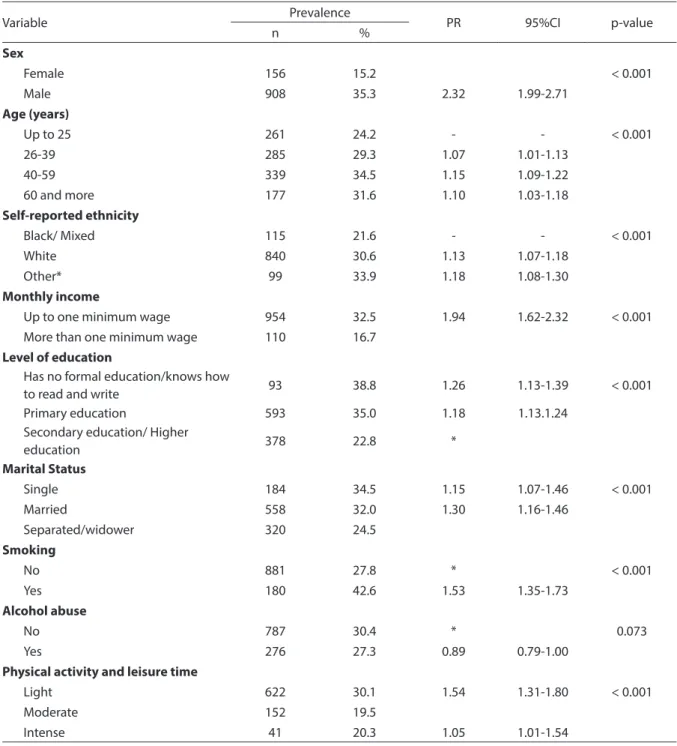
The overall prevalence of CMD among
participants was 29.6%. The assessment of prevalence of CMD according to socio--demographic characteristics and lifestyle habits is shown in Table 3. The prevalence of CMD was higher in women (35.3%). With regard to age group, this prevalence incre-ased with age. Individuals with an income lower than or equal to one minimum wage
Table 1 - Distribution of residents in urban areas according to sociodemographic characteristics and lifestyle habits, Feira de Santana, BA, 2007.
Tabela 1 - Distribuição dos residentes em áreas urbanas segundo características sociodemográicas e hábitos de vida, Feira de Santana, BA, 2007.
Variable Frequency
n %
Sex
Female 2569 71.4
Male 1028 28.6
Age (years)
Up to 25 1078 30.0
26-39 972 27.0
40-59 983 27.4
60 and more 561 15.6
Self-reported ethnicity
Black/ Mixed 2741 76.9
White 532 14.9
Other* 292 8.2
Marital Status
Single 1305 36.4
Married 1743 48.7
Separated/widower 533 14.9
Level of education
Has no formal education/knows how to read and write 240 6.7
Primary education 1656 46.2
Secondary education/ Higher education 1692 47.1
Monthly income
Up to one minimum wage 2938 81.7
More than one minimum wage 658 18.3
Smoking
No 3169 88.2
Yes 423 11.8
Alcohol abuse
No 2586 71.9
Yes 1010 28.1
Physical activity and leisure time
Active 981 27.3
Inactive 2616 72.7
*Indian and asian / *Indígena e amarela
per month had a higher prevalence of CMD (32.5%), when compared to those who ear-ned more than one minimum wage (16.7%). Individuals who had a low level of education (38% had no formal education) and lived without a partner (separated/widowed) had
a higher prevalence of CMD.
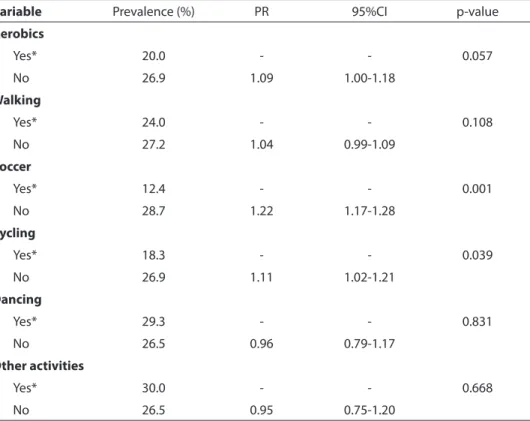
The estimates of CMD according to type of physical activity performed during leisure time showed that only soccer (p=0.001) and cycling (p=0.039) were statistically associa-ted with the occurrence of CMD (Table 4).
Table 2 - Physical activity during leisure time according to sociodemographic characteristics and lifestyle habits, Feira de Santana, BA, 2007.
Tabela 2 - Prática de atividades físicas no lazer segundo características sociodemográicas e hábitos de vida, Feira de Santana, BA, 2007.
Variable Active during leisure time p-value
n %
Sex
Female 481 46.8 < 0.001
Male 500 19.5
Age (years)
Up to 25 367 34.0 < 0.001
26-39 267 27.5
40-59 243 24.7
60 and more 103 18.4
Self-reported ethnicity
Black/ Mixed 161 30.3 0.021
White 747 27.3
Other* 62 21.2
Monthly income
Up to one minimum wage 277 42.1 < 0.001 More than one minimum wage 704 24.0
Level of education
Has no formal education/knows how to read and write
546 33.0 < 0.001
Primary education 404 23.9
Secondary education/ Higher education 29 12.1
Marital Status
Single 436 33.4 < 0.001
Married 441 25.3
Separated/widower 100 18.8
Smoking
No 636 28.1 0.002
Yes 89 21.0
Alcohol abuse
No 636 24.6 <0.001
Yes 345 34.2
*Indian and asian / *Indígena e amarela
**Smoking - Yes: being a smoker or have smoked 100 or more cigarettes in his/her lifetime; No: never having smoking or had smoked up to 99 cigarettes in his/her lifetime / **Fumo - Sim: ser fumante ou ter fumado 100 ou mais cigarros durante a vida; Não: nunca ter fumado ou ter fumado até 99 cigarros na vida.
The analysis of change in effect did not identify a relationship between leisure time physical activity and the variables analyzed (socio-demographic characteristics and lifestyle habits).
The analysis of the crude association be-tween leisure time physical activity (active and inactive) and CMD revealed that expo-sed individuals, i.e. those active during lei-sure time, had a prevalence of CMD that was
Table3- Prevalence of Common Mental Disorders according to sociodemographic and behavioral characteristics and physical activity during leisure time. Feira de Santana, BA, 2007.
Tabela 3 - Prevalência de Transtornos Mentais Comuns de acordo com características sociodemográicas, comportamentais e
prática de atividade física no lazer. Feira de Santana, BA, 2007.
Variable Prevalence PR 95%CI p-value
n %
Sex
Female 156 15.2 < 0.001
Male 908 35.3 2.32 1.99-2.71
Age (years)
Up to 25 261 24.2 - - < 0.001
26-39 285 29.3 1.07 1.01-1.13
40-59 339 34.5 1.15 1.09-1.22
60 and more 177 31.6 1.10 1.03-1.18
Self-reported ethnicity
Black/ Mixed 115 21.6 - - < 0.001
White 840 30.6 1.13 1.07-1.18
Other* 99 33.9 1.18 1.08-1.30
Monthly income
Up to one minimum wage 954 32.5 1.94 1.62-2.32 < 0.001 More than one minimum wage 110 16.7
Level of education
Has no formal education/knows how
to read and write 93 38.8 1.26 1.13-1.39 < 0.001
Primary education 593 35.0 1.18 1.13.1.24
Secondary education/ Higher
education 378 22.8 *
Marital Status
Single 184 34.5 1.15 1.07-1.46 < 0.001
Married 558 32.0 1.30 1.16-1.46
Separated/widower 320 24.5
Smoking
No 881 27.8 * < 0.001
Yes 180 42.6 1.53 1.35-1.73
Alcohol abuse
No 787 30.4 * 0.073
Yes 276 27.3 0.89 0.79-1.00
Physical activity and leisure time
Light 622 30.1 1.54 1.31-1.80 < 0.001
Moderate 152 19.5
Intense 41 20.3 1.05 1.01-1.54
17% lower than that of inactive individuals (Table 5) at statistically significant levels.
Apart from the main exposure variable, the final model obtained in the multiple logistic regression analysis included the following co-variables: sex, age group, inco-me, alcohol abuse and smoking. The inverse association between physical activity and occurrence of CMD maintained its signifi-cance after adjusting for these confounding variables (Table 5). Individuals who were active during leisure time (performing mo-derate to vigorous physical activities) had a lower prevalence of CMD than inactive individuals (not performing physical activi-ties or performing light physical activiactivi-ties) and this prevalence was 22% lower in the first group.
Assessment of goodness-of-fit of the model, as performed by the Le Cessie-van Houwelingen-Copas-Hosmer test (p=
0.1855) and the area under the ROC curve (ROC =0.6586), showed that this model ad-justed the data satisfactorily.
Discussion
The majority of participants were ca-tegorized as inactive during leisure time. Evidence in the literature indicate that a great part of the population do not meet the current recommendations with regard to physical activities. When only physical activities performed during leisure time are assessed, the prevalence of physical inactivity is higher.3;5;10
The prevalence of CMD in the popu-lation studied was 29.6%. Other studies found results similar to those observed in the present study. Puertas, Rios and Valle Fortes18 found a prevalence of CMD of 27.2%
in the population living in the suburbs of
Table 4 - Prevalence of CMD according to type of physical activity during leisure time and CMD, Feira de Santana, BA, Brazil, 2007
Tabela 4 – Prevalência de TMC segundo tipo de atividade física praticada no lazer e TMC, Feira de Santana, BA, 2007.
Variable Prevalence (%) PR 95%CI p-value
Aerobics
Yes* 20.0 - - 0.057
No 26.9 1.09 1.00-1.18
Walking
Yes* 24.0 - - 0.108
No 27.2 1.04 0.99-1.09
Soccer
Yes* 12.4 - - 0.001
No 28.7 1.22 1.17-1.28
Cycling
Yes* 18.3 - - 0.039
No 26.9 1.11 1.02-1.21
Dancing
Yes* 29.3 - - 0.831
No 26.5 0.96 0.79-1.17
Other activities
Yes* 30.0 - - 0.668
No 26.5 0.95 0.75-1.20
cities of Colombia. Ludermir, Melo Filho19
(2002) reported a prevalence of 35% among individuals aged 15 years or more who lived in the city of Olinda, PE, Brazil.
However, Fortes, Villano, Lopes20 found
a higher prevalence (56%) among users ca-red for in the Family Health Program of the city of Petrópolis, RJ. Researchers observed that the CMD are a serious public health problem. The set of data on the mental health status of the populations of Brazil generated until now reveals that the situa-tion is very alarming and points to the need to reflect on the creation, implementation and monitoring of far-reaching mental health policies. In this sense, the present study sought to produce knowledge about a factor that may contribute to mental health promotion and protection: physical activity during leisure time.
The results found in this study sup-port the hypothesis that individuals who are active during leisure time have lower prevalences of CMD than inactive ones. In addition, they show that factors such as age, age group, income, level of education, alcohol abuse and smoking are associated with CMD. It should be noted that these variables were also relevant for physical activity or inactivity during leisure time. The relevance of socio-demographic factors and lifestyle habits for mental health has been consistently observed in the literature18,19,20.
With regard to alcohol abuse, it could be assumed that the formation of social net-works during leisure time physical activities may promote the excessive use of alcohol
and other illicit drugs. The frequency of participation in physical activities during leisure time was higher among individuals who drank an excessive amount of alcohol, in a survey conducted with the population who lived in the city of Pelotas, RS21, and in a
study conducted by Gomes et al.22 with users
of the Family Health Program who lived in the city of Guanambi, BA, which also cor-roborated the findings of the present study. The type of physical activity was associ-ated with the prevalence of CMD in the case of soccer and cycling exclusively. Soccer and cycling have different characteristics in terms of the energetic system used (an-aerobic alactic and (an-aerobic, respectively) and in terms of the characteristics of the activity. Soccer is a group activity, whereas cycling can be performed alone, although it is common for people to gather in groups to perform this activity during leisure time, thus promoting social interaction6;23;24.
The literature indicates that changes in ß-endorphin concentrations, which are responsible for the feeling of well-being and important in CMD treatment, as a response to exercising are influenced by the type/ intensity/volume of physical effort25;26, as
evidenced in the present study.
Leisure time physical activity was inversely associated with CMD. Current evidence corroborates this finding. Wiles et al.3 observed that individuals who were
active during leisure time were 46% less likely to have suspected CMD at the end of a five-year period. Zaitune et al.27 identified
a positive association between CMD and
Table 5 - Prevalence Ratios Crude and adjusted* and conidence intervals (95%) between physical activity during leisure and TMC, Feira de Santana, BA, 2007.
Tabela 5 - Razões de prevalências bruta e ajustadas* e intervalos de coniança (95%) entre atividade física no lazer e TMC, Feira de Santana, BA, 2007.
CMD
PRcrude [ 95%CI] p-value PRadjusted [95%CI] p-value
Physical activity and leisure time
Inactive 1 <0.001 1 <0.001
Active 0.83 (0.79-0.86) 0.78 (0.70-0.87)
physical inactivity during leisure time in the elderly population of the city of Campinas, SP. Considering certain CMD markers in a survey conducted with elderly individuals of the city of Florianópolis, SC, Benedetti et al.28 found that physically inactive
individu-als were 2.74 and 2.38 times more likely to have dementia and depression, respectively, than active individuals.
Leisure time physical activity pro-motes social interaction and self-efficacy; improves depressive symptoms, anxiety and tolerance to stress; and increases self-esteem and the feeling of well-being6;29;30;31.
In this sense, public health strategies aimed at the adoption of an active lifestyle can contribute to a reduction in mental health problems31.
One of the limitations of this study was its cross-sectional design, as this prevents implicit causal relationships between vari-ables studied from being established.
The instrument used to analyze leisure time physical activity was not specifically constructed to investigate physical activity, but rather a population survey primarily aimed at analyzing the mental health status of residents living in the city’s urban areas, which could be an important limitation to this study. The analysis of leisure time physical activity was defined after data collection and there was no validation, nor was the questionnaire’s test-retest agree-ment verified with this purpose. However, a pilot study was conducted to analyze and reconstruct the questions of the question-naire. In addition, selection bias may have occurred, especially with regard to the num-ber of women in the sample, well above the expected number when compared to men. Although random selection methods have been used and conducts have been estab-lished to prevent losses (three visits) in the sample composition, they do not appear to have been efficient to reduce losses of males. Nonetheless, it should be emphasized that data on leisure time physical activity and CMD with regard to sex found in this study are similar to the results observed in the literature. In this sense, although the
occurrence of possible selection bias cannot be disregarded, this does not seem to be the factor responsible for the results obtained. On the other hand, even if possible limitations to this study are taken into consideration, it should be emphasized that a population-based study was con-ducted, investigating a significant number of individuals, and that it adopted data collection and analysis procedures which were recognized as valid. In addition, the foundation for the main association studied (leisure time physical activity and CMD) found in the literature shows that the results observed support the evidence on explana-tory models of development of CMD in the population, providing useful information for public health policies and actions.
Conclusions
Participation in leisure time physical activities was associated with the preva-lence of CMD. This prevapreva-lence was lower among physically active individuals, when compared to inactive ones.
Evidence on the association between physical activity practice and psychological disorders is an important aspect that will support the redefinition of mental health promotion policies in the city of Feira de Santana.
Similarly to several cities in Latin America, Feira de Santana does not have a sufficient number of public spaces for physical activities during leisure time, nor does it offer public policies to promote this practice. The few existing spaces are restricted to the city’s central areas, so that individuals living in the suburbs do not have access to leisure facilities.
and health programs aimed at behavioral changes and the adoption of an active lifestyle.
Authors declared there were no conflicts of interest.
References
1. World Health Organization. Bull World Health Organ
2001; 79(2): 161-70.
2. Goldberg, D.; Huxley, P. Common mental disorders: a bio-social model. London: Tavistock; 1992.
3. Wiles NJ, Haase AM, Gallacher J, Lawlor DA, Lewis G. Physical activity and Common Mental Disorder: Results from the Caerphilly Study. Am J Epidemiol 2007; 165: 946-54.
4. Benedetti TRB, Borges LJ, Petroski EL, Gonçalves LHT. Atividade física e estado de saúde mental de idosos. Rev
Saúde Pública 2008; 42(2): 302-7.
5. Ademoli AN, Azevedo. Padrões de atividade física de pessoas com transtornos mentais e de comportamento.
Ciência e Saúde Coletiva 2009; 14(1): 243-51.
6. Peluso MAM, Andrade LHSG. Physical activity and mental health: the association between exercise and mood. Clinics2005; 60: 61-70.
7. IBGE – Instituto Brasileiro de Geografia e Estatística.
Censo demográfico de 1999/2000. Brasília; 2006.
8. Chodzko-Zajko WJ, Proctor DN, Fiatarone Singh MA, Minson CT, Nigg CR, Salem GJ et al. American College of Sports Medicine position stand. Exercise and physical activity for older adults. Med Sci Sports Exerc 2009, 41(7): 1510-30.
9. Masson CR, Dias-da-Costa JS, Olinto MTA, Meneghel S, Costa CC, Bairros F et al. Prevalência de sedentarismo em mulheres adultas da cidade de São Leopoldo , Rio Grande do Sul, Brasil. Cad Saúde Pública 2005; 21(6): 1685-94.
10. Gerber M, Puhse U. “Dont crack under pressure!” – Do leisure time physical activity and self-esteem moderate the relationship between scholl-based stress and psychosomatic complaints? J Psychosomatic Research
2008; 65: 363.
11. Pitanga FJG, Lessa I. Associação entre inatividade física no tempo livre e internações hospitalares em adultos na cidade de Salvador – Brasil. Rev Bras Cineantropom
Desempenho Hum 2008; 10(4): 347-53.
12. Mari JJ, Williams P. A validity study of a psychiatric screening questionnaire (SRQ-20) in primary care in the city of São Paulo. Br J Psychiatry 1986; 148: 23-6.
13. Santos KOB, Araújo TM, Oliveira NF. Estrutura fatorial e consistência interna do Self-Reporting Questionnaire
(SRQ-20) em população urbana. Cad Saúde Pública
2009; 25(1): 214-22.
14. Araújo TM, Aquino E, Menezes G, Santos CO, Aguiar L. Aspectos psicossociais do trabalho e distúrbios psíquicos menores entre trabalhadores de enfermagem.
Rev Saúde Pública 2003; 37: 424-33.
15. Sobrinho CLN, Carvalho FM, Bonfim TAS, Cirino AS, IS Ferreira. Working conditions and health of doctors in Salvador, Brazil. Rev Assoc Med Bras 2006; 52: 97-102.
16. Hosmer DW, Lemeshow S. Applied logistic regression. 2nd ed. New York: John Wiley & Sons; 2000.
17. Oliveira NF, Santana VS, Lopes AA. Razões de proporções e uso do método delta para intervalos de confiança em regressão logística. Rev Saúde Pública 1997; 31(1): 90-9.
18. Puertas G, Ríos C, Del Valle H. Prevalencia de trastornos mentales comunes en barrios marginales urbanos con población desplazada en Colombia. Rev Panam Salud
Publica 2006; 20(5): 324-30.
19. Ludermir AB, Melo Filho DA. Condições de vida e estrutura ocupacional associadas a transtornos mentais comuns. Rev Saúde Pública 2002; 36(2): 213-21.
20. Fortes S, Villano LAB, Lopes CS. Nosological profile and prevalence of common mental disorders of patients seen at the Family Health Program (FHP) units in Petrópolis, Rio de Janeiro. Rev Bras Psiquiatr 2008; 30(1): 32-7.
21. Dias-da-Costa JS, Hallal PC, Wells JC, Daltoe T, Fuchs SC, Menezes AM et al. Epidemiology of leisure-time physical activity: a population-based study in Southern Brazil.
Cad Saude Publica 2005; 21(1): 275-82.
22. Gomes et al. Inatividade física habitual e fatores associados em população nordestina atendida pela Estratégia Saúde da Família. Rev Bras Cineantropom
Desempenho Hum 2009, 11(4): 365-72.
23. Reevers JB, Darville RL. Social contact patters and satisfaction with retirement ok woman in dual cereer families. J Aging Human Dev 1994; 39(2): 163-75.
24. Camargo RAA, Bueno SMV. Lazer, a vida além do trabalho para uma equipe de futebol entre
25. Goldfarb AH, Hatfield BD, Armstrong D, Potts J. Plasma beta-endorphin concentration: response to intensity and duration of exercise. Med Sci Sports Exerc 1990; 22(2): 241-4.
26. Cunha GS, Ribeiro JL, Oliveira AR. Levels of Beta-Endorphin In Response to Exercise and Overtraining.
Arq Bras Endrocrinol Metab 2008; 52(4): 589-98.
27. Zaitune MPA, Barros MBA, César CLG, Carandina L, Goldbaum M. Fatores associados ao sedentarismo no lazer em idosos, Campinas, São Paulo, Brasil. Cad Saúde
Pública 2007; 23(6): 1329-38.
28. Benedetti TRB, Borges LJ, Petroski EL, Gonçalves LHT. Atividade física e estado de saúde mental de idosos. Rev
Saúde Pública 2008, 42(2): 302-7.
29. Reijneveld, Westhoff, Hopman-Rock. Promotion of health and physical activity improves the mental health of elderly immigrants: results of a group randomized controlled trial among Turkish immigrants in the Netherlands aged 45 and over. J Epidemiol Community
Health 2003; 57: 405-11.
30. Cunha IC, Peixoto MRG, Garden PCB, Alexandre VP. Fatores associados à prática de atividade física na população adulta de Goiânia: monitoramento por meio de entrevistas telefônicas. Rev Bras Epidemiol 2008; 11(3): 495-504.
31. Rohrer JE, Pierce Júnior JR, Blackburn C. Lifestyle and mental health. Prev Med 2005; 40(4): 438-43.