RESEARCH
Matheus Sousa Marques Carvalho
I, Daniela Furtado Rodrigues de Andrade
I,
Álvaro Francisco Lopes de Sousa
II, Andréia Rodrigues Moura da Costa Valle
I,
Daniela Reis Joaquim Freitas
III, Glicia Cardoso Nascimento
I, Denise de Andrade
II, Evandro Watanabe
III Universidade Federal do Piauí, Postgraduate Program in Nursing. Teresina, Piauí, Brazil. II Universidade de São Paulo, Ribeirão Preto College of Nursing,
Postgraduate Program in Fundamental Nursing. Ribeirão Preto, São Paulo, Brazil.
III Universidade Federal do Piauí, Postgraduate Program in Life Sciences. Teresina, Piauí, Brazil.
How to cite this article:
Carvalho SM, Andrade DFR, Sousa AFL, Valle ARMC, Freitas DRJ, Nascimento GC, et al. Nasal colonization with Staphylococcus aureus in nursing students: ground for monitoring. Rev Bras Enferm [Internet]. 2016;69(6):984-9. DOI: http://dx.doi.org/10.1590/0034-7167-2016-0210
Submission: 06-16-2015 Approval: 07-17-2016
ABSTRACT
Objective: to monitor bacterial strains of Staphylococcus aureus that are resistant or not to oxacillin in nursing undergraduate students, with an emphasis on the process of colonization. Method: cross-sectional prevalence study carried out with 138 nursing students. The biological samples of the nasal cavity were collected in June 2015, by means of sterile swabs, which were subsequently submitted to confi rmatory tests of catalase and coagulase. Isolated Staphylococcus aureus had their sensitivity profi le determined by means of the Kirby Bauer method. Descriptive, univariate and bivariate analyses were performed. Results: the prevalence of Staphylococcus aureus was 21.7. Regarding the resistance profi le, 24.1% of strains were resistant to oxacillin, with ampicillin being the antimicrobial with the greatest resistance (82.8%). Conclusion: the nasal cavity is an important bacterial fl ora of S. aureus in nursing students. The profi le of isolated strains highlights the increase of Staphylococcus aureus resistance to antimicrobials such as oxacillin.
Descriptors Staphylococcus Aureus; Nursing; Infection; Monitoring; Nursing students.
RESUMO
Objetivo: monitorar as cepas de Staphylococcus aureus resistentes ou não à oxacilina, entre estudantes da graduação em enfermagem, com ênfase no processo de colonização. Método: estudo transversal de prevalência, realizado com 138 estudantes de Enfermagem. As amostras biológicas da cavidade nasal foram coletadas em junho de 2015, utilizando-se swabs estéreis, posteriormente submetidos a testes confi rmatórios de catalase e coagulase. Os Staphylococcus aureus isolados tiveram seus perfi s de sensibilidade determinados por meio da técnica de Kirby Bauer. Foram realizadas análises descritivas, univariadas e bivariadas. Resultados: a prevalência de Staphylococcus aureus foi de 21,7. Com relação ao perfi l de resistência, 24,1% das cepas se mostraram resistentes à oxacilina, sendo a ampicilina o antimicrobiano com maior resistência (82,8%). Conclusão: a cavidade nasal é importante reservatório de S. aureus em estudantes de Enfermagem. O perfi l das linhagens isoladas evidencia o aumento da resistência de Staphylococcus aureus a antimicrobianos, como a oxacilina.
Descritores: Staphylococcus Aureus; Enfermagem; Infecção; Monitorização; Estudantes de Enfermagem.
RESUMEN
Objetivo: monitorear las cepas de Staphylococcus aureus resistentes o no a oxacilina entre estudiantes de curso de graduación en enfermería, con énfasis en el proceso de colonización. Método: estudio transversal de prevalencia, realizado con 138 estudiantes de Enfermería. Muestras biológicas de la cavidad nasal recolectadas en junio de 2015, utilizándose swabs estériles, sometidos
Nasal colonization with
Staphylococcus aureus
in nursing students: ground for monitoring
INTRODUCTION
Staphylococcus aureus is one of the most frequent causing factors of infections in healthcare environments. This gram-positive, spherical and pyogenic bacteria is characterized by its high capacity to quickly disseminate among people and in dif-ferent environments, as well as by the capacity to infect healthy or immunocompromised individuals, exponentially increasing morbi-mortality rates, very often with a severe prognosis as a result of the change in the antimicrobial resistance profile(1-2).
The S. aureus transmission occurs by direct (especially hands) or indirect contact (contaminated surfaces or fomites), especially the colonization in which the individual becomes the carrier of the microorganism, without necessarily showing characteristic signs and symptoms of infection (asymptomatic carrier) (3-5).
Colonization is pointed as a risk factor for the development of infections related to health care, especially when it concerns S. aureus. The nasopharyngeal microbiota represents the primary site of colonization for this pathogenic agent. It is estimated that this bacteria is part of the skin transient microbiota of one third of the general population, and this prevalence may vary greatly, especially in Brazil, where there are no systematic data on colo-nization rates among the general population(6-7).
When it comes to health professionals and students, colo-nization rates range from 20 to 40%, with high percentages of multi-resistant strains, especially among health profession-als who work in hospitprofession-als and are a great source of infection, more particularly to patients treated by them every day(3-5,8).
Clinical practice among students of life sciences is part of the teaching-learning process and exposure to occupational risks is inherent to it, since there are different types of care provided to patients. As nursing undergraduate students move further along the school program and go deeper into the complexity of care practices, whether they are in hospitals or other healthcare settings, they become microbial carriers, and Staphylococcus aureus is a major concern(8-10).
This issue has been widely discussed; nevertheless, the dissemination of methicillin-resistant Staphylococcus aureus (MRSA) among students has been growing gradually, despite the epidemiological monitoring efforts made to determine the rates and control its dissemination. Therefore, other studies aimed at the isolation of the microorganism and the identifica-tion of the species are necessary, since there is no consensus on the positivity rates of strains and on the susceptibility pro-file of isolated Staphylococcus aureus to antibiotics in specific regions and population groups(7-11).
This information is essential so preventive and therapeutic measures can be successfully directed, regardless of signs and clinical symptoms of infection. In view of the above, the ob-jective is to monitor bacterial strains of Staphylococcus aureus that are resistant to oxacillin or not in nursing undergraduate students, with an emphasis on the process of colonization and thus relate the characterization of these students in terms of age, gender, comorbidities, term, among other variables.
METHOD
This is a cross-sectional study of the prevalence of Staphy-lococcus aureus in the nasal cavity of nursing students.
Study population
The study included students from the Nursing Program of the Federal University of Piauí. The aforementioned course started in 1973 and offers 40 seats per semester. The study sample totaled 138 students, with an average of 15 students per term. The choice of this course was due to the fact that nursing students develop part of their academic training in hospital, outpatient or laboratory settings.
Students who agreed to participate in the study were informed about the objectives of the study and, after signing of a free and informed consent form, a questionnaire was applied in which the following variables were assessed: gender, age, marital sta-tus, academic term, internship (curricular or extracurricular), means of transportation used and the presence of comorbidi-ties. Students who had been under antimicrobials for the last 30 days before the collection of biological samples were excluded.
Collection, isolation and microbiological procedures
The biological samples taken from the nasal cavity of stu-dents were collected in June 2015, with the help of sterile wooden swabs (Labor import), by means of friction in circular movements in both nasal cavities. After collection, the mate-rial was transported to the microbiology laboratory in a box, at room temperature, for a maximum period of one hour, in tubes (5 mL - 10.50x90 mm) containing Luria Bertani Miller (LB Miller) (KASVI, Curitiba, Mato Grosso, Brazil). After that, the samples were incubated at 36° C for 24 hours.
After this period, the samples were cultured in flat petri dishes (disposable polystyrene plates, 90 x 15 mm) contain-ing salted mannitol agar (HiMedia Laboratories Pvt Ltd, Mum-bai, India). After the incubation period (24 hours at 36° C in the oven), the samples were analyzed. Those which had a Álvaro Francisco Lopes de Sousa E-mail: [email protected]
CORRESPONDING AUTHOR
posteriormente a tests confirmatorios de catalasa y coagulasa. Se determinaron perfiles de sensibilidad de los Staphylococcus aureus aislados mediante técnica de Kirby Bauer. Fueron realizados análisis descriptivos, univariados y bivariados. Resultados: la prevalencia de Staphylococcus aureus fue de 21,7. Respecto al perfil de resistencia, 24,1% de las cepas se mostraron resistentes a oxacilina, resultando la ampicilina el antimicrobiano con mayor resistencia (81,8%). Conclusión: la cavidad nasal constituye importante reservorio de S. aureus en estudiantes de Enfermería. El perfil de las cepas aisladas evidencia un aumento de resistencia del Staphylococcus aureus a antimicrobianos como oxacilina.
Staphylococcus aureus growth in gold color were transferred to a Brain-heart infusion medium (BHI) (HiMedia Laborato-ries Pvt Ltd, Mumbai, India). The colonies that were positive for mannitol agar and which were subsequently cultured in BHI were examined for their colony morphology by means of Gram staining, and the samples which had a morphology that corresponded to S. aureus were submitted to confirma-tory tests of catalase (hydrogen peroxide), Gram staining and coagulase test (Laborclin, Vargem Grande, Pinhais, Paraná).
The isolated Staphylococcus aureus had their sensitivity profile determined by means of the Kirby Bauer method, fol-lowing the Clinical and Laboratory Standards Institute (CLSI) criteria(12). The following antimicrobials were used: ampicillin,
oxacillin, tetracycline and chloramphenicol. The diameters of incubation halos were interpreted after 24 hours of incubation at 36° C, in Müller-Hinton agar (HiMedia Laboratories Pvt Ltd, Mumbai, India). Still as control test, bacteria with pheno-types resistant to oxacillin isolated by means of the disc dif-fusion technique were submitted to a ciprofloxacin sensitivity test. All antimicrobials had their sensitivity tested with a S. aureus control strain (ATCC 25923).
Statistical analysis
Initially, a manual organization of questionnaires was done, followed by double typing into Microsoft Excel 2010, and im-port to the Statistical Package for the Social Sciences - SPSS for Windows (version 20.0). With this data, descriptive, univariate and bivariate analyses were performed. With regard to categori-cal variables, a Chi-square test was performed and the signifi-cance level was p≤0.05, with a confidence interval (CI) of 95%.
Ethical aspects
The initial research project was submitted to the apprecia-tion of a research ethics committee and received a favorable opinion. The study performance respected all ethical precepts that rule human research.
RESULTS
A total of 138 nursing students participated in the study, with a predominance of women (113/81.9%) aged between 17 and 20 years old (52/37.7%). About 80% of the students used public transportation (Table 1), and 89.9% of partici-pants reported they did not have recent comorbidities.
Students were distributed over nine academic terms. We chose to group them in blocks, by similarities. In the initial terms (1st to 3rd), students carried out their activities in labora-tories only. From the 4th to the 6th term, the hospital internships were frequent and intensive, and in the last three terms, students performed their duties in both primary health care and in the hospital network. Most of them (88/63.8%) carried out some internship at the time, and nearly half of them were participating or had participated in an extracurricular internship. Regarding the last time they had been in a hospital setting, most of them (86.9%) reported a period shorter than 60 days (Table 2).
Cultures were submitted to confirmatory tests of catalase and coagulase. The prevalence of Staphylococcus aureus (positive
coagulase) was 21.7%. Regarding the resistance profile, 24.1% of Staphylococcus aureus strains were resistant to oxacillin. For ampicillin, the profile was 82.8% of resistance (Table 3).
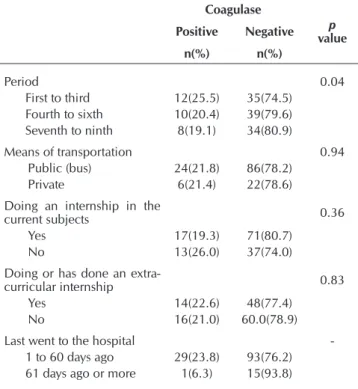
In the investigation of the statistical correlation between colonization by Staphylococcus aureus and other indepen-dent variables, only the block or term attended was statisti-cally significant (p = 0.04) (Table 4).
Table 1 – Distribution of students, regarding sociodemo-graphic variables, Teresina, Piauí, Brazil, 2015
Variables n(%) X̄
±
IC 95% Mín.-max.Age (in years-old) 21.4 2.5 21.0-21.8 17-34
17 to 20 52(37.7) 21 to 25 77(55.8)
26 to 30 8(5.8) Over 30 1(0.7) Gender
Male 26(18.8) Female 112(81.2)
Color of the skin
White 28(20.3)
Asian 5(3.6) Brown 86(62.3)
Black 19(13.8) Means of transportation
Public 110(79.7) Private 28(20.3)
Score: X̄=mean, ±= standard deviation, IC 95% = confidence interval, Min-max= minimum and maximum.
Table 2 – Distribution of students, regarding training vari-ables (N=138), Teresina, Piauí, Brazil, 2015
Variables n %
Current period
First to third 47 34.1
Fourth to sixth 49 35.5
Seventh to ninth 42 30.5
Doing an internship in the current subjects
Yes 88 63.8
No 50 36.2
Doing or has done an extracurricular internship
Yes 62 44.9
No 76 55.1
Last went to a hospital
1 to 10 days ago 94 68.1
11 to 60 days ago 26 18.8
DISCUSSION
The results of this study highlighted the presence of multi-resistant Staphylococcus aureus in the nasal cavity, with a prevalence within the limits reported in the literature (20% to 40%)(5,13).
Staphylococcus aureus is considered a persistent member of the human endogenous microbiota. It behaves as one of the main virulent agents, when it comes to infectious pro-cesses of serious repercussions, and has long been the main responsible for infections related to health care in hospitals, being increasingly found within communities with reports of multi-resistance(14).
The nostrils are the main site for S. aureus colonization. Most of the time, this colonization is asymptomatic and has great clinical importance, especially when it comes to health professionals who may transmit the strains through contami-nated hands or even through the air(13-15).
Nursing students play an important role in the epidemiol-ogy and the pathogenesis of the infection and may act as a source of dissemination of the S. aureus, in both the commu-nity and the hospital environment, but also in the transporta-tion of bacteria from one environment to another(5,16).
Students of the initial terms (1st to 3rd) who have not begun their extracurricular internship in hospitals and primary health care units had a prevalence of S. aureus above 50%, which can indicate the presence of the pathogenic agent and prob-ably of the community-acquired MRSA, a fact that has been pointed out in other studies as an emerging dissemination(17-18).
The course attended has nine blocks or academic terms, with basic subjects taught in the initial terms which do not include the participation of students in settings of provision
Table 3 – Profile of susceptibility to antimicrobials of isolated Staphylococcus aureus strains in nursing students, Tere-sina, Piauí, Brazil, 2015
Variables n %
Catalase
Positive 135 97.8
Negative 3 2.2
Coagulase
Positive 30 21.7
Negative 108 78.3
Antibiogram
Yes 29 21.0
No 109 79.0
Oxacillin-sensitive
Sensitive 14 48.3
Intermediate 8 27.6
Resistant 7 24.1
Tetracycline-sensitive
Sensitive 22 75.9
Intermediate 1 3.4
Resistant 6 20.7
Chloramphenicol-sensitive
Sensitive 27 93.1
Intermediate 2 6.9
Resistant -
-Ampicillin-sensitive
Sensitive 5 17.2
Intermediate -
-Resistant 24 82.8
Performed a ciprofloxacin sensitivity test
Yes 6 20.7
No 23 79.3
Ciprofloxacin-sensitive
Sensitive 2 28.6
Intermediate -
-Resistant 5 71.4
Table 4 – Distribution of results of Staphylococcus aureus (coagulase +/-), according to sociodemographic curricular variables, Teresina, Piauí, Brazil, 2015
Coagulase
p value
Positive Negative
n(%) n(%)
Age Group 0.73
17 to 21 18(22.8) 61(77.2) 22 and over 12(20.3) 47(79.7)
Color of the skin 0.15
White 3(10.7) 25(89.3) Asian 1(20.0) 4(80.0) Brown 24(27.9) 62(72.1) Black 2(10.5) 17(89.2)
Gender 0.16
Male 3(11.5) 23(88.5) Female 27(24.1) 85(75.9)
Coagulase
p value
Positive Negative
n(%) n(%)
Period 0.04
First to third 12(25.5) 35(74.5) Fourth to sixth 10(20.4) 39(79.6) Seventh to ninth 8(19.1) 34(80.9)
Means of transportation 0.94 Public (bus) 24(21.8) 86(78.2)
Private 6(21.4) 22(78.6)
Doing an internship in the
current subjects 0.36
Yes 17(19.3) 71(80.7)
No 13(26.0) 37(74.0)
Doing or has done an
extra-curricular internship 0.83
Yes 14(22.6) 48(77.4) No 16(21.0) 60.0(78.9)
Last went to the hospital -1 to 60 days ago 29(23.8) 93(76.2) 61 days ago or more 1(6.3) 15(93.8)
Note: Confidence interval (CI) of 95%. The p-value was obtained by the Chi-square test. The significance level was defined at p≤0.05.
To be continued
of services. In the subsequent terms, the initial contact with such settings takes place, which is required by the vocational subjects, with a predominance of hospitals.
In this study, a high prevalence of colonization was ob-served precisely in the initial terms. From the third term on, when contact with healthcare environments begins, the preva-lence increases (43.8%) and grows gradually over the subse-quent terms, associated with high prevalence and resistance. When we analyze the positive samples only, 84.5% of stu-dents were doing an internship in hospitals, that is, the con-tact with the hospital environment had a crucial significance for positive results(19-20).
The mean of days of the last contact with a hospital en-vironment among colonized individuals was 9.2 days, and among non-colonized individuals it was 41.7 days, which shows a relationship between the nearness of the last contact with hospital microbiota and the presence of colonization.
Regarding the analysis of the antimicrobials sensitivity pro-file, a high resistance to ampicillin was observed (91.1%), which contrasted with the high sensitivity to tetracycline and chloramphenicol (84.4%). Greater prominence was given to the resistance to oxacillin (ORSA), with 40% of resistance and 42.2% of intermediates, a significant percentage since it concerns asymptomatic individuals. A study carried out with nursing students found only 8.8% of samples which were re-sistant to oxacillin(20-22).
Efforts must be made in order to implement rules and routines aimed at controlling the dissemination of S. aureus strains among students and health professionals, since eradi-cation and control are very difficult to achieve after they have settled within a community. In this context, in view of the high morbi-mortality and the exponential growth of microbial resistance cases, the implementation of control strategies is recommended(23).
In this context, nasal decolonization of health professionals who are epidemiologically related to the transmission of S. aureus, by means of topical mupirocin, is recommended by
most guidelines of international health agencies(7). However,
there are few studies conducted by life sciences students that highlight the benefits of this therapy.
Limitations and contributions to nursing
The main limitations to this study are inherent to the re-search design. Cross-sectional studies do not allow for the fol-low-up of subjects, which would help assess the incidence of S. aureus throughout the course in the same individual. How-ever, finding the prevalence rate by means of cross-sectional studies and its relationship with clinical and training variables may indicate the need for further follow-up studies with the purpose of investigating risk and protection factors.
Considering that most of nursing students’ training is car-ried out in direct contact with patients and that there are still controversies regarding the benefits of antimicrobial interven-tion in colonized individuals, the epidemiological monitoring of incidence of S. aureus strains and the susceptibility profiles of isolated strains, it is essential to establish preventive and therapeutic measures.
CONCLUSIONS
The nasal cavity is an important bacterial flora of S. aureus and MRSA. The prevalence of colonization by the Staphylo-coccus aureus in the nasal cavity of nursing students of the higher education institution studied was 21.4%. This study recalls the importance of upper airways in the transmission and contamination of pathogenic microorganisms, and points out the need to provide a national picture of the occurrence of S. aureus sensitive and resistant to oxacillin in health profes-sionals and students.
The high incidence of antimicrobial-resistant Staphylococ-cus aureus, especially to oxacillin, reinforces the event of multi-resistant strains in the community, indicating the need for studies that assess the phenotypes and genotypes respon-sible for this bacterial resistance.
REFERENCES
1. Brooks GF, Butel JS, Butel GS, Morse SA. Os estafiloco-cos. In: Microbiologia Médica. 21th ed. Salvador: Guana-bara Koogan; 2000.
2. Corey GR, Rubinstein E, Stryjewski ME, Bassetti M, Barri-ere SL. Potential role for telavancin in bactBarri-eremic infections due to gram-positive pathogens: focus on staphylococcus aureus. Clin Infect Dis [Internet]. 2015[cited 2016 May 05];60(5):787–96. Available from: http://cid.oxfordjournals. org/content/60/5/787.long
3. Tong SY, Davis JS, Eichenberger E, Holland TL, Fowler VG. Staphylococcus aureus infections: Epidemiology, patho-physiology, clinical manifestations, and management. Clin Microbiol Rev [Internet]. 2015[cited 2016 May 05];28(3): 603–61. Available from: http://cmr.asm.org/content/28/ 3/603.long
4. Davis MF, Iverson SA, Baron P, Vasse A, Silbergeld EK, Lauten-bach E, et al. Household transmission of methicillin-resistant Staphylococcus aureus and other staphylococci. The Lancet Infect Dis [Internet]. 2012[cited 2016 May 05];12(9):703e716. Available from: http://www.thelancet.com/journals/laninf/ article/PIIS1473-3099(12)70156-1/abstract
5. Silva ECBF, Samico TM, Cardoso RR, Rabelo MA, Bezerra NAM, Melo FL, et al . Colonização pelo Staphylococcus aureus em profissionais de enfermagem de um hospital escola de Pernambuco. Rev Esc Enferm USP [Internet]. 2012[cited 2016 May 05];46(1):132-7. Available from: http://www.scielo.br/pdf/reeusp/v46n1/v46n1a18.pdf
7. Oliveira AC, Paula AO. Decolonization of Staphylococ-cus aureus carriers: indications, advantages and limita-tions. Texto Contexto Enferm [Internet]. 2012[cited 2016 May 05];21(2):448-57. Available from: http://www.scielo. br/pdf/tce/v21n2/en_a25v21n2.pdf
8. Sousa AFL, Queiroz AAFLN, Oliveira LB, Moura MEB, Batista OMA, Andrade D. Representações sociais da enfer-magem sobre biossegurança: saúde ocupacional e o cuidar prevencionista. Rev Bras Enferm. 2016;69(5). In press.
9. Moraes GM, Cohrs FM, Batista REA, Grinbaum RS. In-fection or colonization with resistant microorganisms: identification of predictors. Acta Paul Enferm [Internet]. 2013[cited 2016 May 05];26(2):185-91. Available from: http://www.scielo.br/pdf/ape/v26n2/en_v26n2a13.pdf
10. Renushri ASN, Veena K. Inducible Clindamycin Resis-tance in Staphylococcus aureus isolated from nursing and pharmacy students. J Lab Physicians [Internet]. 2011[cited 2016 May 05];3(2):89-92. Available from: http://www. ncbi.nlm.nih.gov/pmc/articles/PMC3249724/
11. Yassin N, Hassan A. Nasal carriage of methicillin-resis-tant/sensitive Staphylococcus aureus among students in Faculty of Medical Sciences, Duhok University. Adv Trop Med Pub Health Int [Internet]. 2013[cited 2016 May 05];3(2):65-72. Available from: http://www.scopemed. org/fulltextpdf.php?mno=37345
12. Clinical and Laboratory Standards Institute- CLSI. Padroni-zação dos Testes de Sensibilidade a Antimicrobianos por Disco-difusão, Approved standard. 10th ed, 2014.
13. Bastos VMP, Norberg NA, Oliveira JTM, Sanches FG, Bar-reto Jr OS, Serra-Freire NM. Comparação da incidência, da prevalência da colonização, e da resistência de Staphylo-coccus aureus em diferentes populações humanas. Rev Uniabeu [Internet]. 2013[cited 2016 May 05];6(13):28-39. Available from: http://www.uniabeu.edu.br/publica/index. php/RU/article/view/919
14. Sollid JUE, Furberg AS, Hanssen AM, Johannessen M. Staphylococcus aureus: determinants of human car-riage. Infect Genet Evol [Internet]. 2014[cited 2016 May 11];21:531-41. Available from: http://www.sciencedirect. com/science/article/pii/S1567134813000932
15. Senn L, Basset P, Nahimana I, Zanetti G, Blanc DS. Which anatomical sites should be sampled for screening of meth-icillin-resistant Staphylococcus aureus carriage by cul-ture or by rapid PCR test? Clin Microbiol Infect [Internet]. 2012[cited 2016 May 05];18(2):E31-3. Available from: http://www.clinicalmicrobiologyandinfection.com/article/
S1198-743X(14)61353-7/pdf
16. Kim OS, Yim J, Jeon M. Rates of Staphylococcus aureus and Methicillin-resistant Staphylococcus aureus nasal car-riage infections among nursing students. Intern J Bio-Scienc Bio-Techn [Internet]. 2015[cited 2016 May 05];7(5):21-32. Available from: http://www.sersc.org/journals/IJBSBT/vol7_ no5/3.pdf
17. Vaidyaa P, Pawarc G, Krishnamurthyd N. Community ac-quired MRSA infections: three recent cases and an overview of CA-MRSA infections. Pediat Infect Dis. 2015;7(1):8-12.
18. Mediavilla JR, Chen L, Mathema B, Kreiswirth BN. Global epidemiology of community-associated methicillin resis-tant Staphylococcus aureus (CA-MRSA). Curr Opin Micro-biol [Internet]. 2012[cited 2016 May 05];15(5):588-95. Available from: http://www.sciencedirect.com/science/ article/pii/S136952741200118X
19. Bellows C, Smith A, Wheeler J, Morici L. Nasal carriage of methicillin-resistant Staphylococcus aureus among stu-dents at a Louisiana medical university. Braz J Infect Dis [Internet]. 2013[cited 2016 May 05];17(1):118-9. Available from: http://www.ncbi.nlm.nih.gov/pubmed/23290475
20. Rodríguez-Avial C, Alvarez-Novoa A, Losa A, Picazo JJ. Significant increase in the colonization of Staphylococcus aureus among medical students during their hospital prac-tices. Enferm Infecc Microbiol Clin [Internet]. 2013[cited 2016 May 05];31(8):516-9. Available from: http://www. ncbi.nlm.nih.gov/pubmed/23182842
21. Ribeiro IF, Silva SFR, Ribeiro TR, Rocha MMNP, Stolp AMV. Identificação de Staphylococcus aureus e Staphylo-coccus aureus resistente à meticilina em estudantes uni-versitários. Ciênc Farm Básica Apl [Internet]. 2014[cited 2016 May 05];35(2):299-302. Available from: http:// serv-bib.fcfar.unesp.br/seer/index.php/Cien_Farm/article/ view/2774/2774
22. Faria ST, Piekarski ACR, Tognim MCB, Borelli SD, Beden-do J. Phenotypic and genotypic profile of Staphylococ-cus aureus isolated in nursing students, 2008. Acta Paul. Enferm [Internet]. 2011[cited 2016 May 05];24(2):213-8. Available from: http://www.scielo.br/pdf/ape/v24n2/ en_09.pdf