Validation to Portuguese of the Debriefi ng Experience Scale
Validação para a língua portuguesa da Debriefi ng Experience Scale
Validación para la lengua portuguesa de la Debriefi ng Experience Scale
Rodrigo Guimarães dos Santos Almeida
I, Alessandra Mazzo
I, José Carlos Amado Martins
II,
Verónica Rita Dias Coutinho
II, Beatriz Maria Jorge
I, Isabel Amélia Costa Mendes
II Universidade de São Paulo, Ribeirão Preto College of Nursing, Postgraduate Program in Fundamental Nursing. Ribeirão Preto, São Paulo, Brazil.
II Escola Superior de Enfermagem de Coimbra, Scientifi c-Pedagogical Unit of Medical/Surgical Nursing. Coimbra, Portugal.
How to cite this article:
Almeida RGS, Mazzo A, Martins JCA, Coutinho VRD, Jorge BM, Mendes IAC. Validation to Portuguese of the Debriefing Experience Scale. Rev Bras Enferm [Internet]. 2016;69(4):658-64. DOI: http://dx.doi.org/10.1590/0034-7167.2016690413i
Submission: 02-16-2015 Approval: 11-01-2015
ABSTRACT
Objective: to translate and validate to Portuguese the Debriefi ng Experience Scale jointly with individuals that used
high-fi delity simulation in learning. Method: methodological and exploratory study for an instrument translation and validation. For the validation process, the event “III Workshop Brazil – Portugal: Care Delivery to Critical Patients” was created. Results: 103 nurses attended. Validity and reliability of the scale, the correlation pattern among variables, the sampling adequacy test, and the sphericity test showed good results. Since there was no relationship among the groups established in the exploratory factor analysis, the option was to follow the division established by the original version. Conclusion: the version of the instrument was called Escala de Experiência com oDebriefi ng. The results showed good psychometric properties and a good potential for use. However, further studies will contribute to consolidate the validity of the scale and strengthen its potential use.
Descriptors: Simulation; Teaching; Nursing Education; Patient Simulation; Debriefi ng.
RESUMO
Objetivo: traduzir e validar para língua portuguesa a Debriefi ng Experience Scale junto a indivíduos que utilizaram a simulação de
alta fi delidade na sua formação. Método: estudo do tipo metodológico, exploratório de tradução e validação de instrumento. Para o processo de validação criou-se o evento: III Workshop Brasil – Portugal: Atendimento ao Paciente Crítico. Resultados: participaram 103 enfermeiros. A validade e fi delidade da escala, o padrão de correlação entre as variáveis, o teste de adequação amostral e o teste de esfericidade apresentaram bons resultados. Por não haver nexo entre os agrupamentos estabelecidos na análise fatorial exploratória optou-se por seguir a divisão estabelecida pela versão original. Conclusão: o instrumento foi denominado: Escala de Experiência com o Debriefi ng. Os resultados constataram boas propriedades psicométricas e um bom potencial de utilização, porém futuros trabalhos contribuirão para consolidar a validade da escala e reforçar o seu potencial de utilização.
Descritores: Simulação; Ensino; Educação em Enfermagem; Simulação de Paciente; Debriefi ng.
RESUMEN
Objetivo: traducir y validar para el portugués la Debriefi ng Experience Scale con individuos que utilizaron la simulación de alta
fi delidad en su formación. Método: estudio metodológico, exploratorio de traducción y validación de instrumento. Para el proceso de validación, se organizó el evento III Workshop Brasil – Portugal: Atención del Paciente Crítico. Resultados: Participaron 103 enfermeros. La validez y fi delidad de la escala, el estándar de correlación entre las variables, el test de adecuación muestral y el test de esfericidad expresaron buenos resultados. Por no existir nexo entre los agrupamientos establecidos en el análisis factorial exploratorio, se optó por seguir la división determinada por la versión original. Conclusión: el instrumento fue retitulado como Escala de Experiencia con el Debriefi ng. Los resultados constataron buenas propiedades psicométricas y buen potencial de utilización, aunque trabajos futuros contribuirán a consolidar la validez de la escala y reforzarán su potencial de utilización.
Descriptores: Simulación; Enseñanza; Educación en Enfermería; Simulación de Paciente; Debriefi ng.
INTRODUCTION
In the last few years, higher education — particularly in the health care area — has gone through several conceptual and methodological changes, aimed at improving learning and teach-ing techniques. Among these changes, the use of simulation as a pedagogical strategy has been gaining significance in training pro-fessionals, as well as improving those already in the job market(1).
Therefore, higher education institutions (HEI) have gradu-ally sought to use simulation as a teaching resource for better preparing students in getting internship and entering the job market, respecting the bioethical aspects and humanization of health care(2). In nursing, HEIs play an important role teaching
future professionals, and it is crucial to have investments for developing skills to bring forth creativity and ability to change the realities of local and global health, as well as its practices in different complexity levels of health care, with responsibil-ity and commitment(3).
In the current context, professors have been constantly challenged to turn learning spaces into substantial experienc-es, capable of sharpening the students’ perceptive capacity, sensitiveness, intuition, imagination, and creativity, thus help-ing them become more than mere task makers(4).
For the learning field, simulation has its theoretical ground based on meaningful learning, as proposed by David Ausubel in the 1960s. In this constructivist approach, human cognitive processes for building knowledge occur as an assimilation of new meanings, by valuing previous individual experiences(5-6).
The field of nursing has been applying this learning strategy for years; however, with the advent of science and technology using increasingly realistic simulators through virtual reality, this strategy has been strengthened because it collaborates on building substantial knowledge(7). This is particularly true for
high-fidelity simulation, since it provides realism, satisfaction, self-confidence, motivation, technical skills, reflection on the practice, and transferring skills to the participants(8).
The option of simulation as a pedagogical strategy requires detailed preparation regarding planning, structuring, and pro-fessional qualification for achieving the objectives set out, since the availability of technological resources by itself does not guarantee good results(9).
According to Jeffries(10), the simulation strategy must follow
a design pattern; in other words, well-defined parameters for projecting, implementing, and evaluating its characteristics. According to the author, the simulation strategy must be struc-tured as per the following design:
• Objectives: characteristics of the setting to be simulated, described along with the purpose to be achieved. In this item, professors establish what they expect the partici-pants to accomplish during the simulated situation; • Reliability: veracity of the setting to be simulated, which
must be carefully crafted for compatibility with the con-tent already studied and the materials available for car-rying it out. A list of all materials and equipment nec-essary for accomplishing the proposed setting must be provided;
• Problem-solving: it involves the complexity of the set-ting, which must be in line with the level of competence developed in the classroom;
• Student support: the tips provided to students in order to better assimilate the setting. They are orally briefed by the professor and/or the facilitator, visibly projected on screens or even watched and voiced by the simulator; • Debriefing: reflective discussion session, in which
par-ticipants and professors address positive facts and areas for improving in the setting, always establishing a rela-tionship between theory and practice.
A setting may be considered well-elaborated and realistic when it allows a physical evaluation to be carried out by the in-dividual, training technical skills, and critical thinking related to the role the nurse performed facing the simulated situation(11-12).
Debriefing is the most important component in the simu-lation, and it has been the subject of extensive research re-garding its execution. There are studies showing its origins back during war periods, when soldiers returning from their missions expressed their positive experiences aiming at for-mulating new battle strategies(13). It is a discussion on what
took place within the setting, with the aim of encouraging the trainee to think over the experiences, perceptions, decision making, and clinical competences. Participants are invited to describe what happened, what they did, and how they reacted to solve the proposed situation; video and audio recording of the setting can be used by professors during debriefing, with the purpose of strengthening the recollection of the activity(14).
There are several ways for conducting a debriefing; how-ever, according to Lederman(15) this component must follow 7
elements: 1. Debriefer; 2. Questioning the participants; 3. Ex-perience with simulated setting; 4. ExEx-perience impact; 5. Rec-ollection of facts; 6. Reporting improvements; 7. Time frame. The first and the second items are related to the questions made to the participants about performance in the setting, the third refers to the familiarity with the proposed setting; the fourth deals with feelings experienced during performance, the fifth addresses the recollection of positive and negative facts carried out, the sixth makes reference to improvements that can be implemented in future settings, and the seventh is related to the time frame, which can be used soon after the implementation of the activity – or subsequently – without, nevertheless, having a time frame too long.
Since it is a teaching strategy still in expansion, studies that evaluate its characteristics and specificities are so far scarce and limited. Thus, the current article presents the validation of a specific tool for evaluating experience with debriefing.
The Debriefing Experience Scale was developed in the United States by Reed(17), aimed at measuring the experience
of nursing students in debriefing. The scale consists of 20 items. It is divided into two subscales; the first is related to the evaluation of the experience with debriefing, answered in a Likert scale of 5 points and non-applicable when the state-ment is not related to the simulated activity; the second is called importance of the item, also answered in a Likert scale of 5 points. The Debriefing Experience Scale is further divided into four domains: Analyzing thoughts and feelings; learn-ing to make connections; ability of the professor conductlearn-ing debriefing; professor’s appropriate guidance. The validation study of this tool was carried out with 130 nursing students, whereas 125 were female and 5 were male with a mean age of 22.2 years. The results showed that Cronbach’s alpha corre-sponded to 0.93 for the experience with the debriefing items and 0.91 for the importance of the item scale.
Given the context shown, the current study proposes to translate and validate to Portuguese a tool capable of measur-ing the debriefmeasur-ing experience in individuals that used high-fidelity simulation for learning, with the aim of better under-standing this simulation component as a pedagogical strategy.
METHOD
A methodological study for the validation and translation of an instrument to Portuguese was conducted, in conformity with the Portuguese new spelling rules, which after the au-thors’ permission, was submitted to evaluation and approved by a research ethics committee. This study was developed in two phases, both with the participation of Brazilian and Portu-guese researchers. The first phase consisted of the translation of the tool, following the criterion proposed by Ferrer et al.(18).
After the tool was translated into Portuguese, two certified in-structors reached a consensus of the first version. This version was submitted to a committee of experts, and seven nurses specialized in fundamental nursing, all experts in simulation as pedagogical strategy, were invited to participate; however, only four attended the meeting. After clarifying the study ob-jective, the experts formalized their consent by signing an in-formed consent form. The tool items were classified as valid and non-valid. The Content Validity Index (CVI)(19) was
calcu-lated and items with CVI of 100% had their translation main-tained in the final version of the tool, whereas items with CVI lower than 80% underwent slight language modifications. Continuing this process, the tool was back-translated by two professors, one expert and another native English speaker, for comparison with the original version. After verifying that the meaning of the tool had not been changed, the semantic vali-dation and a pretest were accomplished by ten nursing gradu-ates who had already experienced simulation as a teaching strategy. The pretest showed that all of them understood the tool properly.
The second phase was the validation of the tool. For this phase, the event: “III Workshop Brazil – Portugal: Care Deliv-ery to Critical Patients” was created, promoted by a Brazilian educational institution in partnership with a Portuguese edu-cational institution.
Nurses were invited to participate in this workshop, wheth-er professionally active or not, holding any graduate degree or not, with or without simulation experience in teaching practice. This free event was disseminated in the print and electronic press, offering 180 places for registration on the institution’s website. The participants were offered the pos-sibility of choosing the best day to take part in the event, with 60 participants on each day. All places were filled in advance. Later, through e-mails, prior reading material was forwarded to the registered participants.
Of 180 participants who registered, 103 attended the event. The workshop was repeated for three consecutive days, with the same program from 8:30 am to 6 pm. The event included first a theoretical class about care delivery to critical patients and simulation, with all the content offered by Brazilian and Portuguese faculty with expertise in the area.
The participants in this event were invited to participate in the research and manifested their acceptance by signing an informed consent form. To characterize the subjects, a tool was developed including the following variables: age, gender, year of undergraduate course conclusion, years of experience, employment bond, and experience with simulated teaching. After the theoretical content presentation, still in the morning, the participants were divided into three groups, whereas each group was submitted to three skill training workshops. During the entire workshop, low, medium, and high-fidelity simula-tion and patient simulasimula-tion were used as teaching-learning methodology. During the afternoon, each group was submit-ted to three different simulasubmit-ted situations, relasubmit-ted to care de-livery to critical patients in a specific situation.
After taken all phases of the event, the participants were joined in an auditorium where they filled out the scale tool. The data were coded in Excel spreadsheets and analyzed us-ing the software Statistical Package for the Social Sciences (version 22 for Windows).
RESULTS
In the first phase of the study, questions 2, 18, 19 and 20 obtained CVI scores lower than 80%, so the language formu-lation was modified. The word facilitator was replaced by
professor, since simulation activities in the United States are developed by professors, instructors, and facilitators (all with different roles); however, in Brazil and Portugal, all these roles are performed by the professor, which justifies this change. Af-ter this adaptation, the rest of the process happened regularly.
The final version of the scale is described in Box 1. In the second phase, among the 103 nurses who partici-pated in the workshop, 100% agreed to participate in the re-search and made up the study sample.
As for education, on average, the year of undergraduate course conclusion was 2005, whereas 64 (62.1%) held or were taking a Latu Senso master’s program, 20 (19.4%) held or were taking a Ph.D., and none had taken any kind of spe-cialization. Concerning their professional activity, 77 (74.8%) were professionally active, namely 48 (46.6%) in clinical nurs-ing, 23 (22.3%) as professors, and 6 (5.8%) as service man-agers. As for experience in simulated teaching, 52 (50.5%) indicated they were not familiar with simulation as a teaching strategy and 51 (49.5%) said they were familiar.
Concerning the validity and reliability of the scale, the correlation variables, verified using the correla-tion matrix, showed 44% of correlation higher than 0.30. The sampling adequacy test, applying Kaiser-Meyer-Olkin was 0.83, Bartlett’s spheric-ity test was <0.001, and the anti-image matrix ranged be-tween 0.81 and 0.95.
As for the extraction of the factors, total explained variance showed three ei-genvalues higher than 1.00, with a cumulative percent-age that explained more than 68.0% of total vari-ance, suggesting that the scale could be divided into three factors.
Concerning the factor ro-tation, the communality test demonstrated that only item two obtained lower value than 0.50 (0.46). However, due to the proximity with the optimal value, this item was maintained in the scale. To verify the scale factors, the procedure was carried out according to the original authors, and an exploratory factor analysis with octhogo-nal rotation was applied. The analysis showed the follow-ing groupfollow-ing items among the factors: Factor 1: items 1, 2, 5, 6, 7, 10, 11, 12, 17;
Factor2: items 8, 13, 14, 15, 16, 18, 19, and 20; Factor3: items 3, 4, and 9. The results of this analysis were very dif-ferent from the findings in the English version, with no ap-parent connection among the groupings; in other words, with the mathematical proposal not making any rational sense. Taking into consideration the sample size and characteristics, in both the original study (nursing stu-dents) and the current study, it was decided to follow the division established by the original version.
Internal consistency was checked with Cronbach’s alpha, and it is described in Table 1.
Tables 2 and 3 show the descriptive statistical data related to the Escala de Experiência com oDefriefing and the importance of the item.
Box 1 – Description of the Escala de Experiência com o Debriefing items, Brazil, 2014
Item
Factor 1) Analisando os pensamentos e sentimentos
1. O debriefing me ajudou a analisar meus pensamentos.
2. O professor reforçou aspectos do comportamento da equipe de saúde.
3. O ambiente de debriefing foi fisicamente confortável.
4. Sentimentos incorretos foram resolvidos por meio do debriefing.
Factor 2) Aprendendo e fazendo conexões
5. O debriefing ajudou-me a fazer conexões na minha aprendizagem.
6. O debriefing foi útil para processar a experiência de simulação.
7. O debriefing proporcionou-me oportunidades de aprendizagem.
8. O debriefing ajudou-me a encontrar um significado na simulação.
9. As minhas dúvidas da simulação foram respondidas pelo debriefing.
10. Tornei-me mais consciente de mim mesmo durante a sessão de debriefing.
11. O debriefing ajudou-me a esclarecer problemas.
12. O debriefing ajudou-me a fazer conexões entre teoria e situações da vida real.
Factor 3) Habilidade do professor em conduzir o debriefing
13. O professor permitiu-me tempo suficiente para verbalizar meus sentimentos antes dos comentários.
14. Na sessão de debriefing o professor fez os esclarecimentos corretos.
15. O debriefing forneceu um meio para eu refletir sobre minhas ações durante a simulação.
16. Eu tive tempo suficiente para esclarecer meus questionamentos.
17. Na sessão de debriefing o professor foi um especialista na temática desenvolvida na simulação.
Factor 4) Orientação apropriada do professor
18. O professor ensinou a quantidade certa durante a sessão de debriefing.
19. O professor realizou uma avaliação construtiva da simulação durante o debriefing.
DISCUSSION
The Portuguese version of the Debriefing Experience Scale was called Escala de Experiência com o Debriefing.
Psychometric tests showed high correlation among the variables and a good sampling adequacy for the study. The total variance explained in this study showed that the scale could be divided into three factors, diverging from the origi-nal scale.
While carrying out the exploratory factor analysis with oc-thogonal rotation, the items formed a quite unexpected group; however, since there was no explanation among the studies in the area, the findings from the original version were main-tained. A justification for this unexpected grouping might be related to the characteristics of the studied sample, since the validation of the original version was carried out by under-graduate nursing students, whereas this was conducted by nursing professionals. Consequently, due to the divergence among the studied groups, further studies, developed jointly with students and professionals, should be carried out to bet-ter clarify the division of these groups.
Another influence that may be questioned is the sampling size. Although the sample number in the study was similar to the original validation study, several debates have been raised regarding this item, without reaching a consensus. Gorsuch(20)
suggests that, in order to carry out a factor analysis, the sample has to include at least 5 participants per variable and a total of at least 200 subjects. Crocker and Algina(21) recommend using
10 subjects per variable, with a minimum of 100 subjects in total. Guadagnoli and Velicer(22) claim that the required size
Table 1 – Internal consistency of the Escala de Experiência
com o Debriefing (N = 103), Ribeirão Preto, São Paulo, Brazil, 2014
Experience with debriefing
Importance of the item
Factor 1 0.68 0.84
Factor 2 0.91 0.92
Factor 3 0.85 0.92
Factor 4 0.83 0.86
Overall Scale 0.94 0.96
Table 2 – Descriptive statistical data of the Escala de
Ex-periência com o Debriefing factors (N = 103), Ribeirão Preto, São Paulo, Brazil, 2014
Factor 1 Factor 2 Factor 3 Factor 4
Mean 4.53 4.74 4.65 4.66
Median 4.75 5.00 4.80 5.00
Standard deviation 0.52 0.37 0.46 0.49
Variance 0.27 0.14 0.22 0.24
Minimum 3.00 3.00 3.00 3.00
Maximum 5.00 5.00 5.00 5.00
Percentis 25 4.25 4.62 4.40 4.33
50 4.75 5.00 4.80 5.00
75 5.00 5.00 5.00 5.00
Table 3 – Descriptive statistical data of the importance of
the item scale factors (N = 103), Ribeirão Preto, São Paulo, Brazil, 2014
Factor 1 Factor 2 Factor 3 Factor 4
Média 4.76 4.84 4.86 4.86
Mediana 5.00 5.00 5.00 5.00
Desvio Padrão 0.38 0.31 0.30 0.32
Variância 0.14 0.09 0.09 0.10
Mínimo 3.00 3.88 4.00 3.67
Máximo 5.00 5.00 5.00 5.00
Percentis 25 4.50 4.87 5.00 5.00
50 5.00 5.00 5.00 5.00
75 5.00 5.00 5.00 5.00
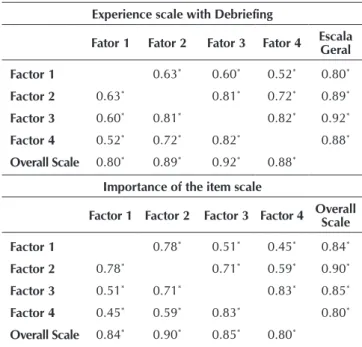
Table 4 – Matrix of Pearson correlations between the Escala
de Experiência com o Debriefing and the impor-tance of the item scale (N = 103), Ribeirão Preto, São Paulo, Brazil, 2014
Experience scale with Debriefing
Fator 1 Fator 2 Fator 3 Fator 4 Escala Geral
Factor 1 0.63* 0.60* 0.52* 0.80*
Factor 2 0.63* 0.81* 0.72* 0.89*
Factor 3 0.60* 0.81* 0.82* 0.92*
Factor 4 0.52* 0.72* 0.82* 0.88*
Overall Scale 0.80* 0.89* 0.92* 0.88*
Importance of the item scale
Factor 1 Factor 2 Factor 3 Factor 4 Overall
Scale
Factor 1 0.78* 0.51* 0.45* 0.84*
Factor 2 0.78* 0.71* 0.59* 0.90*
Factor 3 0.51* 0.71* 0.83* 0.85*
Factor 4 0.45* 0.59* 0.83* 0.80*
Overall Scale 0.84* 0.90* 0.85* 0.80*
Note: Significant correlation at 0.01.
for a sample depends on the factor loading obtained. Comrey and Lee(23) establish as classification that: samples with 50
in-dividuals are very small, 100 are small, 200 are reasonable, 300 are good, 500 are very good, and 1,000 or more are ex-cellent. Pasquali(24) adopts as necessary 10 subjects per tool
item, whereas any factor analysis with less than 200 subjects can be hardly considered adequate.
As for internal consistency, the results were better than the findings found in the original version in the experience debriefing scale, as well as the importance of the item scale, confirming the consistency of the scale. The internal consis-tency of the factors also showed good results, except for fac-tor 1 that was lower (0.68), but with an acceptable value for exploratory studies(25). Regarding Pearson(26) correlation test,
all factors yield to strong correlation in both the debriefing experience scale and the importance of the item scale.
Regarding descriptive statistics, the participants showed better averages in factor 2, followed by factors 4, 3, and 1, and evaluated factor 3 as the most important item followed by factors 4, 2, and 1. Such results, however, must be further addressed by studies with a different approach.
CONCLUSION
Since simulation is a pedagogical strategy that has been growing among learning methodologies, the attempt to under-stand its various components and make them measurable can help improving specific fields such as debriefing, considered the main component of simulation.
In this study, the Debriefing Experience Scale was trans-lated and validated to Portuguese, now called Escala de Ex-periência com o Debriefing. The findings in this studied group showed good psychometric results, except for the factor analy-sis that needs further studies.
The limitation of this study regards its sampling size. How-ever, further studies will contribute to consolidate its validity, and strengthen simulation among learning strategies.
FUNDING
The authors thank the participants and the Coordination for the Improvement of Higher Education Personnel (CAPES) for the funding provided during research.
REFERENCES
1. Lapkin S, Levett-Jones T. A cost–utility analysis of medium vs. high-fidelity human patient simulation manikins in nurs-ing education. J Clin Nurs [Internet]. 2011[cited 2015 Feb 12];20(35):43-52. Available from: http://onlinelibrary.wiley. com/doi/10.1111/j.1365-2702.2011.03843.x/abstract
2. Schiavenato M. Reevaluating simulation in nursing educa-tion: beyond the human patient simulator. J Nurs Educ [In-ternet]. 2009[cited 2014 Oct 26];48(7):388-94. Available from: http://www.ncbi.nlm.nih.gov/pubmed/19634264
3. Ventura CAA, Mendes IAC, Wilson LL, Godoy S, Tamí-Mau-ry I, Zárate-Grajales R, et al. Global health competencies ac-cording to nursing faculty from Brazilian higher education institutions. Rev Latino-Am Enfermagem [Internet]. 2014[cit-ed 2014 Oct 26];22(2):179-86. Available from: http://www. scielo.br/pdf/rlae/v22n2/0104-1169-rlae-22-02-00179.pdf
4. Terra MG, Goncalves LHT, Santos EKA, Erdmann AL. Sen-sibility in the relations and interactions of teaching and learning to Be and Do nursing. Rev Latino-Am Enfermagem [Internet]. 2010[cited 2014 Oct 26];18(2):64-71. Available from: http://www.scielo.br/pdf/rlae/v18n2/10.pdf
5. Moreira MA. Mapas conceituais e aprendizagem signifi-cativa. São Paulo: Centauro Editora; 2010.
6. Gomes AP, Rôças G, Dias-Coelho UC, Carvalho PO, Siquei-ra-Batista R. Ensino de ciências: dialogando com David Ausubel. Rev Ciênc Ideias [Internet]. 2010[cited 2014 Oct 26];1(1):23-31. Available from: http://revistascientificas.ifrj. edu.br:8080/revista/index.php/reci/article/viewFile/28/69
7. Leigh GT. High fidelity patient simulation and nursing stu-dents’ self-efficacy: a review of the literature. Int J Nurs Schol-arsh [Internet]. 2008[cited 2014 Oct 26];5(1):1-17. Available from: http://www.degruyter.com/view/j/ijnes.2008.5.issue-1/
ijnes.2008.5.1.1613/ijnes.2008.5.1.1613.xml
8. Baptista RCN, Martins JCA, Pereira MFCR, Mazzo A. Simu-lação de Alta-Fidelidade no Curso de Enfermagem: ganhos percebidos pelos estudantes. Rev Enf Ref [Internet]. 2014[cit-ed 2014 Oct 26];4(1):135-44. Available from: http://www. scielo.mec.pt/pdf/ref/vserIVn1/serIVn1a15.pdf
9. Howard V, Ross C, Mitchell A, Nelson,G. Human patient simulators and interactive case studies: A comparative analysis of learning outcomes and student perceptions. Comput Inform Nurs [Internet]. 2010[cited 2014 Oct 26];28(1):42-8. Available from: http://www.ncbi.nlm.nih. gov/pubmed/19940620
10. Jeffries P. Simulation in nursing education: from concep-tualization to evaluation. New York: National League for Nursing Editora; 2007.
11. Bricker DJ, Pardee CJ. Nurse experts jump-start clinical simulation in rehabilitation nursing: supporting new grad-uate transition to competence. Nurs Educ Perspect [In-ternet]. 2011[cited 2014 Oct 26];32(1):34-46. Available from: http://www.ncbi.nlm.nih.gov/pubmed/21473480
12. Liaw SY, Rethans JJ, Scherpbier AJJA, Piyanee KY. Rescuing A Patient In Deteriorating Situations (RAPIDS): a simulation-based educational program on recognizing, responding and reporting of physiological signs of deterioration. Re-suscitation [Internet]. 2011[cited 2014 Oct 26];82(9):1224-30. Available from: http://www.resuscitationjournal.com/ article/S0300-9572%2811%2900274-7/abstract
13. Pearson M, Smith D. Debriefing in experience-based learning. Reflection: Turning experience into learning. 1986, 69-84.
Validação da Escala de Avaliação do Debriefing associa-do à Simulação (EADaS). Rev Enf Ref [Internet]. 2014[cit-ed 2014 Oct 26];4(2):41-50. Available from: http://www. scielo.mec.pt/pdf/ref/vserIVn2/serIVn2a05.pdf
15. Lederman LC. Debriefing: toward a systematic assess-ment of theory and practice. Simulat Gaming [Internet]. 1992[cited 2014 Oct 26];2(1):145–59. Available from: http://multibriefs.com/briefs/aspeorg/Debriefing2.pdf
16. Liaw SY, Chen FG, Klainin P, O’Brien A, Samarasekera DD. Developing clinical competency in crisis event man-agement: an integrated simulation problem-based learn-ing activity. Adv Health Sci Educ [Internet]. 2010[cited 2014 Oct 26];15(3):403-13. Available from: http://link. springer.com/article/10.1007%2Fs10459-009-9208-9
17. Reed SY. Debriefing experience scale: development of a tool to evaluate the student learning experience in debrief-ing. Clinic Simul Nurs [Internet]. 2012[cited 2014 Oct 26];8(6):211-7. Available from: http://www.nursingsimulati on.org/article/S1876-1399%2811%2900251-9/abstract
18. Ferrer M, Alonso J, Prieto L, Plaza V, Monsó E, Marrades R, et al. Validity and reliability of the St George´s Respira-tory Questionnaire alter adaptation to a different language and culture: the Spanish example. Eur Respir J [Internet]. 1996[cited 2014 Oct 26];9(6):1160-6. Available from: http://erj.ersjournals.com/content/9/6/1160.long
19. Polit DF, Beck CT. The Content validity index: are you sure you know what’s being reported? critique and rec-ommendations. Res Nurs Health [Internet]. 2006[cited 2014 Oct 26];29(5):489-97. Available from: http://www. ncbi.nlm.nih.gov/pubmed/16977646
20. Gorsuch RL. Factor analysis. 2. ed. Hillsdale: Lawrence Erlbaum Associates; 1983.
21. Crocker L, Algina J. Introduction to classical and modern test theory. New York: Holt, Rinehartand Winston; 1986.
22. Guadagnoli E, Velicer WF.Relation of sample size to the stability of component patterns. Psychol Bull [Internet]. 1988[cited 2014 Oct 26];103(1): 26575. Available from: http://psycnet.apa.org/journals/bul/103/2/265/.
23. Comrey AL, Lee HB. A first course in factor analysis. Hills-dale: Erlbaum; 1992.
24. Pasquali L. Instrumentos psicológicos: manual prático de elaboração. Brasília: LabPAM; 1999.
25. Hair JF. Multivariate data analysis. New Jersey (EUA): Prentice Hall, 1998.