Mariana Mapelli de Paiva
I, Darlene Mara dos Santos Tavares
II Universidade Federal do Triângulo Mineiro, Postgraduate Program in Health Care. Uberaba, Minas Gerais, Brazil.
How to cite this article:
Paiva MM, Tavares DMS. Physical and psychological violence against the elderly: prevalence and associated factors. Rev Bras Enferm. 2015;68(6):727-33. DOI: http://dx.doi.org/10.1590/0034-7167.2015680606i
Submission: 01-13-2015 Approval: 07-22-2015
ABSTRACT
Objective: to verify the prevalence and associated factors to physical and psychological violence against elderlies and trace the sociodemographic and clinical indicators of this population. Method: household survey conducted in 729 elderlies Uberaba - MG. Data were analyzed by Chi-square test and logistic regression (p < 0,05). Results: the prevalence of elderly on violence was 20.9%, and 5.9% to 20.9% for physical and psychological. Among them prevailed women; with 60├80 years; no education; with income, with their partner as the primary aggressor; negative self-perception of health, hospitalization in the last year and presence of multimorbidities. The violence has been associated with have 60├80 years, living with your partner and dependence for instrumental activities of daily living. Conclusion: reinforces the need for early identifi cation of domestic violence and invest in both the old protective actions and in maintaining functional capacity and social inclusion.
Key words: Aged; Elder Abuse; Geriatric Nursing.
RESUMO
Objetivo: verifi car a prevalência e os fatores associados à violência física e psicológica contra idosos e traçar o perfi l sociodemográfi co e dos indicadores clínicos dessa população. Método: inquérito domiciliar conduzido com 729 idosos de Uberaba - MG. Os dados foram analisados pelo teste Qui-quadrado e regressão logística (p < 0,05). Resultados: a prevalência de idosos sob violência foi de 20,9%, sendo 5,9% para física e 20,9% para psicológica. Entre eles, prevaleceram mulheres, com idade entre 60├80anos, sem escolaridade, com renda, tendo como principal agressor o cônjuge; com autopercepção negativa de saúde; hospitalização no último ano; e presença de multimorbidades. A violência associou-se a ter 60├80 anos, morar com o cônjuge e dependência para atividades instrumentais de vida diária. Conclusão: reforça-se a necessidade de identifi car precocemente a violência doméstica e investir em ações de proteção da idosa, na manutenção da capacidade funcional e inserção social.
Descritores: Idoso, Maus-Tratos ao Idoso, Enfermagem Geriátrica
RESUMEN
Objetivo: determinar la prevalencia y los factores asociados a la violencia física y psicológica contra las personas mayores y trazar el perfi l sociodemográfi co y los indicares clínicos de esta población. Método: la averiguación domiciliar fue conducida con 729 personas mayores de Uberaba - MG. Los datos se analizaron mediante la prueba de Chi-cuadrado y regresión logística (p < 0,05). Resultados: La prevalencia de los ancianos de la violencia fue de 20,9%, y el 5,9% a 20,9% para su desarrollo físico y psicológico. Entre ellos prevalecido las mujeres; 60├80anos edad; sin educación; con los ingresos, con el cónyuge agresor primario; la autopercepción negativa de la salud, la hospitalización en el último año y presencia de multimorbidades. La violencia se ha asociado con 60├80anos, vive con el cónyuge y la dependencia para las actividades instrumentales de la vida diaria. Conclusión: reforzase la necesidad de la identifi cación precoz de la violencia doméstica e invertir tanto en las antiguas acciones de protección y en el mantenimiento de la capacidad funcional y la inclusión social.
Palabras clave: Anciano; Maltrato al Anciano; Enfermería Geriátrica.
Physical and psychological violence against the elderly:
prevalence and associated factors
Violência física e psicológica contra idosos: prevalência e fatores associados
La violencia física y psicológica contra las personas mayores: prevalencia y factores asociados
Darlene Mara dos Santos Tavares E-mail: [email protected]
INTRODUCTION
Population aging has become a global reality, and in Brazil is happening in an accelerated rate, imposing changes in social poli-cies and new challenges to public health(1). Among them, there is the violence against the elderly, since it reaches all levels of society and can lead to emotional disorders, isolation, guilt and denial, physical trauma and deaths(2-3). Maltreatment of elderly people are physical, psychological, sexual, abandonment, ne-glect, financial abuse and self-neglect violence(4).
Different prevalence of violence against elderly people are observed in national and international investigations. Study in 524 cities found that 67.7% of the elderly were victims of physi-cal violence and 29.1% were victims of psychologiphysi-cal violence(5). Research in 2009 and 2010 conducted in a health clinic in Recife found that 20.8% of elderlies reported having experienced at least one type of violence(1). In the United States, a research with 5,777 elderly respondents, 11.4% reported having been victims of vio-lence, of which 4.6% suffered psychological violence and 1.6%, physical violence(6).
Despite the methodological differences of the aforementioned studies and classification type of violence used, the results show the relevance of the elderly against violence situation at the na-tional and internana-tional scene. It is difficult to measure the preva-lence of viopreva-lence based on definitions and concepts that show changes across sectors and cultures(7). In addition, in Brazil, more studies are still necessary to know the magnitude of the problem, because of the hidden nature of violence(2,8), especially against the elderly, since early identification and risk factors allow the system-atization care and the development of preventive actions.
It is noteworthy that the national and international scientific literature has described as major risk factors for violence: female gender (1.5), aged between 60├80 years old(1,6,9), married(2,6,9) and living accompanied(2). In this study, it is intended to broaden the discussion about the factors associated with physical and psycho-logical violence in the elderly population, including the analysis of functional capacity. It is considered that their dependency can be an overload factor for caregivers, as well as limiting for social participation and then predisposing to violence.
In this context, health professionals play an important role cop-ing violence for prevention, early identification and/or in the care of victimized elderly(8). It should be noted that nurses in primary health care and, specifically, nurses of the Family Health Strategy are inserted a health care model that privileges the above activities.
This investigation aimed to determine the prevalence of physi-cal and psychologiphysi-cal violence, characterizing elderly under vio-lence related to socio-demographic variables, housing arrange-ment and clinical indicators, and analyzing the factors associated with physical and psychological violence. Thus, this study aims to contribute to increase knowledge about the topic and support public policies directed at elderly victims of violence.
METHOD
Home, analytical, observational, cross sectorial survey, de-veloped with elderly residents in the urban area of the city of Uberaba, Minas Gerais.
To calculate the sample size, a prevalence of violence 40% (2), an accuracy of 3.5% and 95% of confidence interval was considered for a finite population of 36,703 elderly, getting a sample of 738 people. It was considered a sampling loss of 20%, and the maximum number of interviews attempts was 923.
To select the elderly people, the sampling technique by conglomerate in multiple stages was used. In the first stage, there was the arbitrary drawing of 50% of the census sectors of the city through systematic sampling, organizing a single list of sectors, identifying the district to which they belong. There are 409 urban census sectors in the city of Uberaba, Minas Gerais, and there were 204 selected. The Sample In-terval (SI) was calculated using the formula: SI = total census sectors/number of selected census sectors. The first census sector was drawn randomly and the other, according to SI(2); the list of sectors was ordered in ascending numerical order for the purposes of the draw.
In the second stage, the number of elderly people to be inter-viewed (N = 738) was divided by the number of census sectors of the city (204), resulting in 3.62 interviews for each census sector, which was approached to four elderlies by census sector.
Inclusion criteria were being 60 years old or older, live in the urban area of the city of Uberaba, Minas Gerais, not present cog-nitive decline. Sectors without elderly people, sectors without homes and sectors that has not completed the number of elderly were excluded. Thus, there were 729 elderlies interviewed.
Data were collected at home, in the period from January to April 2014, through direct interview. Cognitive decline was assessed using the Mini-Mental State Examination (MMSE), translated and validated in Brazil(10). Socio-demographic data and clinical and health indicators were collected by instru-ments built by the Research Group on Public Health.
Functional capacity was assessed performing activities of daily living. For Basic Activities of Daily Living (BADL), the In-dependence in Activities of Daily Living Scale (Katz scale) was used, developed by Katz (1963) and adapted to the Brazilian reality(11). The Instrumental Activities of Daily Living (IADL) were assessed by Lawton and Brody Scale (1969), adapted in Brazil(12).
The violence was evaluated by the Conflict Tactics Scales instrument, translated and validated in Brazil(13).
The study variables were: socio-demographic (gender, age, education, marital status, housing arrangement); clinical and health indicators (self-perception of current health, number of self-reported morbidities, and hospitalization in the last 12 months); functional capacity to BADL and IADL; and physical and psychological violence (yes, no).
After collecting the data and the correction of interviews by field supervisors, a spreadsheet in Excel® was built. Data were processed in double-entry computers. Subsequently, the consis-tency between the databases was carried out and, when neces-sary there was correction, seeking information in the original interview. The data were imported into the software Statistical Package for The Social Sciences - SPSS, version 17.0.
occurrence of violence, the logistic regression model was used. The tests were considered significant when p <0.05.
The project was approved by the Ethics Committee on Hu-man Beings Research of the Federal University of Triângulo Mi-neiro through the Protocol 573,833. The interview began only after the consent of the interviewee signing the Consent Form.
RESULTS
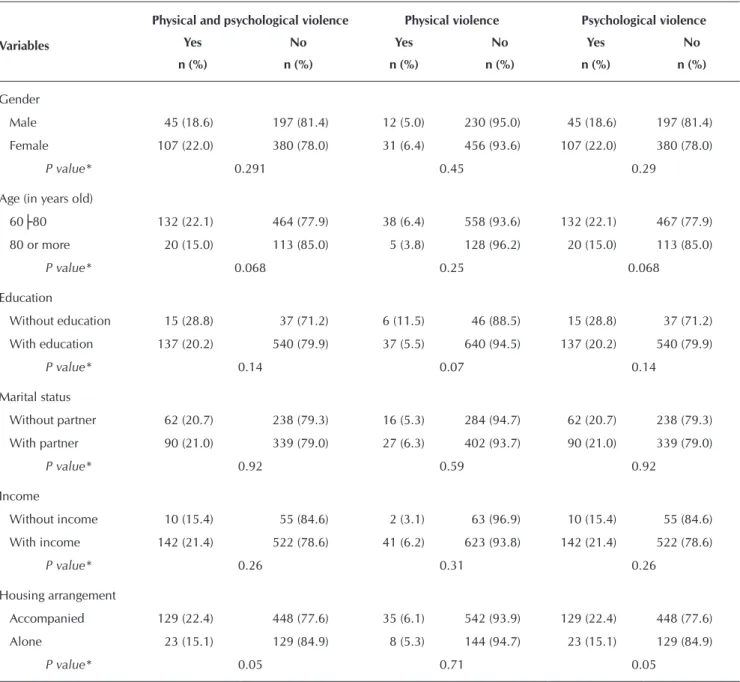
The prevalence of physical and psychological violence was 20.9% (n = 152); of these, 20.9% (n = 152) were under psy-chological violence and 5.9% (n = 43) under physical violence. There was a higher percentage of elderlies who underwent phys-ical and psychologphys-ical violence and physphys-ical and psychologphys-ical
stratified for females’ 60├80 years old, without education, with a partner, with income and living accompanied (Table 1).
Table 1 shows the sociodemographic and economic data of the study population.
Stratification of the housing arrangement was held for the elderly under physical and psychological violence, and the highest percentage were for those living with a partner (29.1%), followed by those who lived with the caregiver (25%), children (21.6%) and other arrangements (21.4%). Comparing the groups, the largest proportion of elderly people who were under physical and psychological violence was related to living with their partner (p <0.001) and did not live with grandchildren (p = 0.038) and daughter or son in law (p = 0.013).
Table 1 - Distribution of elderly under physical and psychological violence according to socio-demographic and economic variables and violence type, Uberaba, Minas Gerais, Brazil, 2014
Variables
Physical and psychological violence Physical violence Psychological violence
Yes No Yes No Yes No
n (%) n (%) n (%) n (%) n (%) n (%)
Gender
Male 45 (18.6) 197 (81.4) 12 (5.0) 230 (95.0) 45 (18.6) 197 (81.4)
Female 107 (22.0) 380 (78.0) 31 (6.4) 456 (93.6) 107 (22.0) 380 (78.0)
P value* 0.291 0.45 0.29
Age (in years old)
60├80 132 (22.1) 464 (77.9) 38 (6.4) 558 (93.6) 132 (22.1) 467 (77.9)
80 or more 20 (15.0) 113 (85.0) 5 (3.8) 128 (96.2) 20 (15.0) 113 (85.0)
P value* 0.068 0.25 0.068
Education
Without education 15 (28.8) 37 (71.2) 6 (11.5) 46 (88.5) 15 (28.8) 37 (71.2)
With education 137 (20.2) 540 (79.9) 37 (5.5) 640 (94.5) 137 (20.2) 540 (79.9)
P value* 0.14 0.07 0.14
Marital status
Without partner 62 (20.7) 238 (79.3) 16 (5.3) 284 (94.7) 62 (20.7) 238 (79.3)
With partner 90 (21.0) 339 (79.0) 27 (6.3) 402 (93.7) 90 (21.0) 339 (79.0)
P value* 0.92 0.59 0.92
Income
Without income 10 (15.4) 55 (84.6) 2 (3.1) 63 (96.9) 10 (15.4) 55 (84.6)
With income 142 (21.4) 522 (78.6) 41 (6.2) 623 (93.8) 142 (21.4) 522 (78.6)
P value* 0.26 0.31 0.26
Housing arrangement
Accompanied 129 (22.4) 448 (77.6) 35 (6.1) 542 (93.9) 129 (22.4) 448 (77.6)
Alone 23 (15.1) 129 (84.9) 8 (5.3) 144 (94.7) 23 (15.1) 129 (84.9)
P value* 0.05 0.71 0.05
Among those under physical violence, the highest percent-age were those living with the caregiver (25%), followed by living with partners (7.8%). Most of the elderlies who were under physical violence did not live with their grandchildren (p = 0.04), compared to those who did not suffer violence.
Regarding the elderly under psychological violence, it was found that the highest percentage were to
those living with a partner (29.1%), caregiver (25%), children (21.6%) and other arrangements (21.4%). The highest proportion of elderly under psychological violence is related to living with their partner (p <0.001) and did not live with grandchildren (p = 0.038) and daughter or son in law (p = 0.013).
Most elderlies under physical and psychological violence and stratified to physical and psychologi-cal presented negative perception of health, were hospitalized in the last year, had multi-morbidities, were independent to carry out the BADL and de-pendents to IADL. Comparing the groups, elderlies under physical and psychological violence (p = 0.005), and only physical violence (p <0.001) and only psychological violence (p = 0.01) had a pro-portionally greater negative perception of health, since those under physical and psychological vio-lence (p = 0.009) and only psychological violence (p = 0.009) reported having been hospitalized more often last year than those who did not suffer violence (Table 2).
Table 2 shows the distribution of clinical variables and health and functional capacity of the elderly under physical and psycho-logical violence.
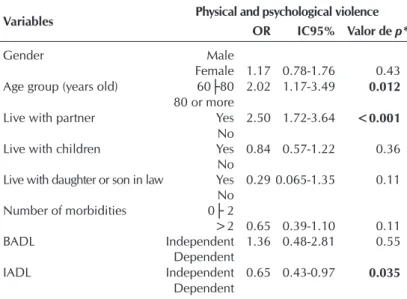
The physical and psychological violence is associated to age between 60├80 years old, to live with their partners and dependent for instrumental activities of daily living (Table 3).
Table 2 - Distribution of clinical indicators and functional capacity of the elderly under physical and psychological violence, Uberaba, Minas Gerais, Brazil, 2014
Variables
Physical and psychological violence Physical violence Psychological violence
Yes No Yes No Yes No
n (%) n (%) n (%) n (%) n (%) n (%)
Health awareness
Negative 102 (24.5) 314 (75.5) 36 (8.7) 380 (91.3) 102 (24.5) 314 (75.5)
Positive 50 (16.0) 263 (84.0) 7 (2.2) 306 (97.8) 50 (16.0) 263 (84.0)
P value* 0.005 <0.001 0.01
Hospitalization in the last year
Yes 38 (29.2) 92 (70.8) 12 (8.5) 119 (91.5) 38 (29.2) 92 (70.8)
No 114 (19.0) 485 (81.0) 31 (5.3) 567 (94.7) 114 (19.0) 485 (81.0)
P value* 0.009 0.17 0.009
Morbidities
0├ 2 22 (16.2) 114 (83.8) 5 (3.7) 131 (96.3) 22 (16.2) 114 (83.8)
>2 130 (21.9) 463 (78.1) 38 (6.4) 555 (93.6) 130 (21.9) 463 (78.1)
P value* 0.14 0.22 0.14
BADL
Independent 147 (21.0) 554 (79.0) 42 (6.0) 659 (94.0) 147 (21.0) 554 (79.0)
Dependent 5 (17.9) 23 (82.1) 1 (3.6) 27 (96.4) 5 (17.9) 23 (82.1)
P value* 0.69 0.57 0.69
IADL
Independent 54 (17.9) 247 (82.1) 13 (4.3) 288 (95.7) 54 (17.9) 247 (82.1)
Dependent 98 (22.9) 330 (77.1) 30 (7.0) 384 (93.0) 98 (22.9) 330 (77.1)
P value* 0.11 0.13 0.11
Source: Fundação Instituto Brasileiro de Geografia e Estatística - IBGE.
Table 3 - Final logistic regression Model for the variables associated with the physical and psychological violence among el-derly people of Uberaba, Minas Gerais, Brazil, 2014
Variables Physical and psychological violence OR IC95% Valor de p*
Gender Male
Female 1.17 0.78-1.76 0.43
Age group (years old) 60├80 2.02 1.17-3.49 0.012
80 or more
Live with partner Yes 2.50 1.72-3.64 <0.001
No
Live with children Yes 0.84 0.57-1.22 0.36
No
Live with daughter or son in law Yes 0.29 0.065-1.35 0.11 No
Number of morbidities 0├ 2
>2 0.65 0.39-1.10 0.11
BADL Independent 1.36 0.48-2.81 0.55
Dependent
IADL Independent 0.65 0.43-0.97 0.035
Dependent
Table 3 shows the final logistic regression model for the variables associated with the risk of physical and psychologi-cal violence.
DISCUSSION
The prevalence of physical and psychological violence obtained in this study was similar to a national survey(1) and higher to international studies research(6,14).
The higher prevalence of psychological violence the physi-cal was similar to other studies(2,6,14). This fact expresses the violence cycle because, in general, before the physical vio-lence, the aggressor threatens the victim or commits psycho-logical violence that sometimes is neglected(15).
As in this study, elderly women showed the highest per-centage of physical and psychological violence, only physi-cal and only psychologiphysi-cal in national studies(1-2) and interna-tional studies(6,9,16). These data show the gender relationship in which the duties of the man and woman were built histori-cally marked by asymmetry and hierarchy between them and performed daily. It also reveals the culture of discrimination against women(17). One of the favorable moments for the iden-tification of violence against women is during the nursing con-sultation, where there is possibility of strengthening the bond between patient and nurse.
Similar age group results were found in national(1,17) and international studies(6,9,16), in which the elderly under physical and psychological violence were between 60├80 years old.
Regarding to education, similar results were found for both physical violence and psychological violence in a research conducted with elderly people from Recife, where elderlies without education (26.15%) were the main victims(1). On the other hand, other national and international research found that violence was more frequent among those with educa-tion(2,9). Although there is no consensus in the scientific lit-erature regarding the education, it is not assumed that older people with no education are more susceptible to violence(1).
For marital status, the findings in national(2) and interna-tional(6,9) studies corroborate the results of this research where the highest percentage of elderly victims of violence were married. This result confirms gender violence, and among the causes of the non-prosecution of complaints of violence among women, adult and elderly are embarrassed to expose that are subjected to abuse by their partners; promises of no longer being attacked; and the hope of returning to the old love(18).
A national study of elderlies also had a higher percentage of physical and psychological violence among those who had an income(1). One of the most common forms of abuse of the elderly is the related to the financial situation, in which there are attempts of the family to get the sources of income of the elderly or their property and savings(19).
As in this research, the elderly people under violence lived accompanied (1- 2,17). This may be related to family dishar-mony and bad or conflicting relationships between members, generating risk factors for violence against the elderlies(20). Among the support network for violence cases, there is the
Family Health Strategy (ESF), in which it is possible to diag-nose cases of domestic violence through the health profes-sional team and take actions to prevent and integration, con-sidering the individual, family and community(21).
The fact that the violence is more common among married and the partner being the main aggressor, corroborates other studies(2-3). Violence by partners is linked to their acceptance by women and also to the hierarchical gender relationship, such as the “right” of one of them monitor properties and be-haviors of the other (22), and emotional dependence(3).
As for the self-perception of health, international studies with elderlies from North Carolina, United States, found re-lationship between those under violence and the negative perception of health(14). The negative self-perception of health may be linked to the consequences caused by violence, such as frustration, pain, fear, depression and trauma(23). One of the strategies for nurses contribute in facing the consequenc-es caused by violence are group activiticonsequenc-es. Thus, the nurse encourages members to find collective strategies for dealing with problems experienced by them, and the recognition of potential in the community(24). Furthermore, during nursing consultation, the nurse can also identify situations of vio-lence, because of the proximity and the time spent during the consultation.
The presence of greater number of morbidities in the elder-ly undergoing physical and psychological violence was also found in national(17) and international studies(6). The diseases were considered a possible risk factor for violence due to in-creased caregiver burden, whether formal or informal, involv-ing a larger number of medical visits and health care for the elderly, as well as more responsibility to the elderly(25).
Hospitalization added to the care required by the presence of diseases, can also predispose complications unrelated to the original reason for admission. This may require more care from family members to the elderly and leave them more vul-nerable to violence(8). As for the relationship between hospi-talization, morbidity and violence, there are few studies(6,17,25) complicating possible explanations.
With regard to functional capacity, it was found a percent-age similar in a research conducted with elderly people who suffered some kind of violence, physical and/or psychologi-cal, in the city of Recife, in which 20.91% were independent for BADL and 26.17 % were dependent on IADL(1). The loss of functional capacity for IADL limited social participation of the elderlies independently, restricting them to their home con-text. It may also decrease their interaction with people other than their relatives, hindering the demand for health services and specialized services for complaint when they are under violence.
scientific literature reports that the main victims are the oldest elderly people due to functional and cognitive limitations(1).
Therefore, during nursing care, it is necessary to consider the age group of the elderly, as well as their difficulties and limitations. And from this information, nurses should promote activities for information and prevention of violence.
The violence associated with the fact that the elderlies living with their partner corroborates national(1-2,9) and international studies(9). Violence by partners is linked to their acceptance and hierarchical gender norms, such as the right to monitor properties and behaviors of the other(22), and emotional dependence(3).
Unlike the results obtained in this research, other studies show the association between functional capacity for BADL and violence(16,20). IADL support the daily life of the elderly at home and especially in the community, with a greater level of com-plexity to their implementation(26-27). These characteristics may be one explanation for the dependence on IADL be associated with violence in the elderly limitations to maintain a support network and seek assistance to get out of a violent situation.
CONCLUSION
The prevalence of physical and psychological violence among the elderly was 20.9%, representing 20.9% for psy-chological violence and 5.9% for physical violence. The char-acteristics of the elderly under physical and psychological vio-lence and physical and psychological stratified were similar, prevailing women 60├80 years old, with education, income, and the partner as the main aggressor.
The highest proportion of elderly under physical and psy-chological violence refers to those living with their partners; they had negative self-perception of health; they were hospi-talized in the last year; and had a higher number of comor-bidities compared to those who were not victims of violence. Physical and psychological violence linked to elderly of 60├80 years old; the fact that elderly women live with a part-ner; and being dependent for IADL, reinforce the need for early identification of domestic violence and invest in both
elderly of protective actions and in the maintenance of func-tional capacity and social inclusion.
The results of this study add knowledge to the topic, consid-ering the inclusion in the analysis of variables little explored in national and international studies, such as health percep-tion, hospitalization in the last year, the number of morbidities and functional capacity. Thus, this study contributed to the strengthening of public policies of coping violence and being a tool for planning health actions.
FUNDING
This article is the result of a project funded by the State of Minas Gerais Research Support Foundation (Fundação de Amparo à Pesquisa do Estado de Minas Gerais - FAPEMIG) entitled ‘Falls and violence against the elderly in Uberaba – MG’ APQ-02035-14.
REFERENCES
1. Duque AM, Leal MCC, Marque APO, Eskinazi FMV, Du-que AM. [Violence against the elderly in the home envi-ronment: prevalence and associated factors (Recife, State of Pernambuco)]. Ciênc Saúde Colet [Internet]. 2012[cited 2014 Nov 12];17(8):2199-2208. Available from: http:// www.scielo.br/pdf/csc/v17n8/30.pdf Portuguese.
2. Apratto Júnior PC. The domestic violence against the elderly within the Family Health Program of Niterói (RJ, Brazil). Ciênc Saúde Colet [Internet] 2010 Set[cited 2014 Nov 15];15(6):2983-2995. Available from: http://www. scielo.br/pdf/csc/v15n6/a37v15n6.pdf Portuguese.
3. Sanches PARA, Lebrão ML, Duarte YAO. [Violence against aged people: a new issue]? Saude Soc [Internet]. 2008[cited 2014 Oct 23];17(3):90-100. Available from: http://www.scielo. br/pdf/sausoc/v17n3/10.pdf Portuguese.
4. Souza ER, Minayo MCS. [The insertion of the violence against elderly theme at health care public policies in Brazil]. Ciênc Saúde Colet [Internet]. 2010 Set[cited 2014 Nov 15]15(6): 2659-2668. Available from: http://www. scielo.br/pdf/csc/v15n6/a02v15n6.pdf Portuguese.
5. Mascarenhas MDM, Andrade SSCA, Neves ACMN, Pedrosa AAG, Silva MMA, Malta DC. [Violence against the elderly: analysis of the reports made in the health sector – Brazil], 2010. Ciênc Saúde Colet [Internet]. 2012[cited 2014 Nov 15]17(9):2331-2341. Available from: http://www.scielo.br/ pdf/csc/v17n9/a14v17n9.pdf Portuguese.
6. Acierno R, Hernandez MA, Amstadter AB, Resnick HS, Steve K, Muzzy W, Kilpatrick DG. Prevalence and Corre-lates of Emotional, Physical, Sexual, and Financial Abuse and Potential Neglect in the United States: The National
ERRATUM
Article “Physical and psychological violence against the elderly: prevalence and associated factors”, with number of DOI: http://dx.doi.org/10.1590/0034-7167.2015680606i, published in the journal Re-vista Brasileira de Enfermagem, v68(6):727-33, on page 732, it is added::
“FUNDING
Elder Mistratment Study. Am J Public Heatlth [Internet]. 2010 Feb[cited 2014 Nov 12];100(2): 292-7. Available from: http://www.ncbi.nlm.nih.gov/pmc/articles/PMC2804623/ pdf/292.pdf
7. Instituto de Mayores y Servicios Sociales Malos tratos a personas mayores. Organização Mundial de Saúde: Ma-drid; Espanha. 2007.
8. Oliveira AAV, Trigueiro DRSG, Fernandes MGM, Silva AO. [Elderly maltreatment: integrative review of the lit-erature]. Rev Bras Enferm [Internet]. 2013 Feb[cited 2014 Sep 14];66(1):128-33. Available from: http://www.scielo. br/pdf/reben/v66n1/v66n1a20.pdf Portuguese.
9. Strasser SM, Smith M, Weaver M, Zheng S, Cao Y. Screening for elder abuse mistreatment among older adults seeking le-gal assistance services. West J Emerg Med [Internet]. 2013 Aug[cited 2014 May 12]; 14(4):309-315. Available from: http://www.ncbi.nlm.nih.gov/pmc/articles/PMC3735377/ pdf/i1936-900X-14-4-309.pdf
10. Bertolucci PHF, Brucki SMD, Campacci SR, Juliano Y. The Mini-Mental State Examination in a outpatient population: in-fluence of literacy. Arq Neuro-Psiquiatr. 1994 Mar;52(1):1-7.
11. Lino, VTS, Perreira SEM, Camacho LAB, et al. Cross-cultural adaptation of the Independence in Activities of Daily Living Index (Katz Index). Cad Saúde Pública [Internet]. 2008[cited 2014 May 12];24(1):103-12. Available from: http://www. scielo.br/pdf/csp/v24n1/09.pdf
12. Santos RL, Virtuoso Júnior JS. [Reliability of the Brazil-ian version of the Scale of Instrumental Activities of Daily Living]. Rev Bras Prom Saúde [Internet]. 2008[cited 2013 Nov 12];21(4):290-296. Available from: http://ojs.unifor.br/ index.php/RBPS/article/view/575/2239 Portuguese.
13. Hasselmann M, Reichenehim ME. Cross-cultural adaptation of the Portuguese version of the Conflict Tactics Scales Form R (CTS-1) used to assess marital violence: semantic and mea-surement equivalence. Cad Saúde Pública [Internet]. 2003 Aug[cited 2013 Nov 12];19(4):1083-93. Available from: http://www.scielo.br/pdf/csp/v19n4/16857.pdf Portuguese.
14. Amstadter AB, Zajac K, Strachan M, Hernandez MA, Kil-patrick DG, Acierno R. Prevalence and correlates of elder mistreatment in South Carolina: the South Carolina elder mistreatment study. J Interpers Violence [Internet]. 2011[cited 2014 Jun 12];26(15):2947-72. Available in: http://www.ncbi. nlm.nih.gov/pmc/articles/PMC4182959/
15. Melo ZM, Silva DM, Caldas MT. Intrafamilial violence: crim-inal acts against women in Recife’s Metropolitan Area. Psicol Estud. [Internet]. 2009[cited 2014 Jun 12];14(1):111-9. Avail-able from: http://www.scielo.br/pdf/pe/v14n1/a14v14n1.pdf
16. Pérez-Cárceles MD, Rubio L, Pereniguez JE, Pérez-Flores D, Osuna E, Luna A. Suspicion of Elder abuse in South Eastern Spain: The extent and risk factors. Arch Geron-tol Geriatr [Internet]. 2009[cited 2013 Nov 12];49: 132-137. Available from: http://www.aggjournal.com/article/ S0167-4943(08)00121-0/abstract
17. Nogueira CF, Freitas MC, Almeida PC. [Violence against elderly in Fortaleza, Ceará State: a documental analysis].
Rev Bras Geriatr Gerontol. [Internet] 2011[cited 2014 Jul 12];14(3):543-554. Available from: http://www.scielo.br/ pdf/rbgg/v14n3/v14n3a14.pdf Portuguese.
18. Deeke LP, Boing AF, Oliveira WF, Coelho EBS. [Dynamics of domestic violence: an analysis from the perspective of the attacked woman and her partner’s discourses]. Saúde Soc [Internet] 2009 Jun[cited 2013 Nov 12];18(2):248-58. Avail-able from: http://www.scielo.br/pdf/sausoc/v18n2/08.pdf Portuguese.
19. Florêncio MVL, Ferreira Filha MO, Sá LDA. [Violence against the elderly: ethical and political dimensions of an ascen-dant problematic]. Revista Eletrônica de Enfermagem. [Inter-net] 2007[cited 2014 Apr 12];9(2):847-57. Available from: https://www.fen.ufg.br/fen_revista/v9/n3/pdf/v9n3a23.pdf Portuguese.
20. Johannesen M, Logiudice, D. Elder abuse: a systematic review of risk factors in community-dwelling elders. Age Ageing [In-ternet]. 2013[cited 2014 Jul 12];42(22):292-298. Available from: http://ageing.oxfordjournals.org/content/42/3/292.long
21. Ministério da Saúde (BR). Temática prevenção de violên-cia e cultura da paz III. Brasília: Organização Pan-Ameri-cana de Saúde [Internet]. 2008[cited 2014 Mar 12]; Avail-able from: http://bvsms.saude.gov.br/bvs/publicacoes/pai nel_indicadores_sus_n5_p1.pdf
22. D’Oliveira AFPL, Schraiber LB, França-Junior I, Ludermir AB, Portella AP, Diniz CS et al. Factors associated with inti-mate partner violence against Brazilian women. Rev Saúde Pública [Internet]. 2009 Apr[cited 2014 May 12];43(2):299-311. Available from: http://www.scielo.br/pdf/rsp/v43n2/ en_7172.pdf
23. Silva RF, Paixão GPN, Rebouças TCS, Alves MB, Salva-do MA, Silva RS. O perfil da violência notificada contra idosos na microrregião de senhor do Bonfim-BA. Revis-ta Eletrônica da Fainor [Internet]. 2014[cited 2014 Nov 12];7(1):171-183. Available from: http://srv02.fainor.com. br/revista/index.php/memorias/article/view/266/180
24. Costa MC, Lopes MJM. Elements of comprehensiveness in the Professional health practices provided to rural women victims of violence. Rev Esc Enferm USP [Internet]. 2012 Oct[cited 2014 Oct 12];46(5): 1087-1094. Available from: http://www.scielo.br/pdf/reeusp/v46n5/en_08.pdf
25. Tejada-Hernandez MA, Amstadter A, Muzzy W, Acierno R. The National Elder Mistreatment Study: Race and Ethnicity Findings. J Elder Abuse Negl [Internet]. 2013[cited 2014 Apr 12]; 25(4):281-293. Available from: http://www.ncbi.nlm. nih.gov/pmc/articles/PMC3694735/pdf/nihms438874.pdf
26. Alves LC, Leite IC, Machado CJ. The concept and measure-ment of functional disability in the elderly population: a lit-erature review. Ciênc Saúde Colet [Internet]. 2008[cited 2014 May 12];13(4):1199-1207. Available from: http://www.scielo. br/pdf/csc/v13n4/16.pdf