www.bjorl.org
Brazilian
Journal
of
OTORHINOLARYNGOLOGY
ORIGINAL
ARTICLE
Facial
trauma
among
victims
of
terrestrial
transport
accidents
夽
Sérgio
d’Avila
a,∗,
Kevan
Guilherme
Nóbrega
Barbosa
a,
Ítalo
de
Macedo
Bernardino
a,
Lorena
Marques
da
Nóbrega
a,
Patrícia
Meira
Bento
a,
Efigênia
Ferreira
e
Ferreira
baUniversidadeEstadualdaParaíba(UEPB),CampinaGrande,PB,Brazil bUniversidadeFederaldeMinasGerais(UFMG),BeloHorizonte,MG,Brazil
Received5December2014;accepted15May2015 Availableonline6November2015
KEYWORDS
Forensicdentistry; Accidentstraffic; Facialinjuries; Face
Abstract
Introduction:Indevelopingcountries,terrestrialtransportaccidents---TTA,especiallythose involvingautomobilesandmotorcycles---areamajorcauseoffacialtrauma,surpassingurban violence.
Objective:Thiscross-sectionalcensusstudyattemptedtodeterminefacialtraumaoccurrence with terrestrialtransport accidentsetiology, involvingcars, motorcycles, oraccidents with pedestriansinthenortheasternregionofBrazil,andexaminevictims’socio-demographic char-acteristics.
Methods:MorbiditydatafromforensicservicereportsofvictimswhosoughtcarefromJanuary toDecember2012wereanalyzed.
Results:Altogether, 2379reports were evaluated,of which 673were related to terrestrial transportaccidentsand103involvedfacialtrauma.Threepreviouslytrainedandcalibrated researchers collecteddata using a specificform.Facial traumaoccurrence rate was 15.3% (n=103).Themostaffectedagegroupwas20---29years(48.3%),andmorementhanwomen were affected(2.81:1). Motorcycleswere involvedinthemajorityofaccidentsresultingin facialtrauma(66.3%).
Conclusion:The occurrence offacial traumainterrestrial transportaccident victims tends toaffectagreaterproportionofyoungandmalesubjects,andthemostprevalentaccidents involvemotorcycles.
© 2015Associac¸ãoBrasileira de Otorrinolaringologiae CirurgiaCérvico-Facial. Publishedby ElsevierEditoraLtda.Allrightsreserved.
夽 Pleasecitethisarticleas:d’AvilaS,BarbosaKGN,BernardinoIM,daNóbregaLM,BentoPM,eFerreiraEF.Facialtraumaamongvictims
ofterrestrialtransportaccidents.BrazJOtorhinolaryngol.2016;82:314---20.
∗Correspondingauthor.
E-mail:[email protected](S.d’Avila).
http://dx.doi.org/10.1016/j.bjorl.2015.10.004
1808-8694/©2015Associac¸ãoBrasileiradeOtorrinolaringologia eCirurgiaCérvico-Facial. PublishedbyElsevierEditoraLtda.All rights
PALAVRAS-CHAVE
Odontologiaforense; Acidentesde trânsito;
Traumatismosfaciais; Face
Traumasfaciaisentrevítimasdeacidentesdetransporteterrestre
Resumo
Introduc¸ão: Nospaísesemdesenvolvimento,osacidentesdetransporteterrestre(ATTs)são umadasprincipaiscausasdetraumafacial,superandooscasosdeviolênciaurbana, especial-menteaquelesenvolvendoautomóveisemotocicletas.
Objetivo: Oobjetivodesteestudotransversalcensitáriofoideterminaraocorrênciadetraumas faciaiscometiologiadeacidentedetransporteterrestre(ATT):automóveis,motocicletasou atropelamentos,emumacidadedoNordestedoBrasil.
Método: Foramanalisadososdadosdemorbidadeemlaudosdeumservic¸oforensedevítimas queprocuraramoservic¸odejaneiroadezembrode2010.
Resultados: Aotodo,foramavaliados2.379laudos;673eramreferentesaATTs,e103 apre-sentaramtraumasfaciais.Acoletadedadosfoirealizadaportrêspesquisadorespreviamente treinadosecalibrados,sendoelaboradoumformulárioespecíficoparacoletadasinformac¸ões contidasnoslaudos.Destes,15,3%(n=103)sofreramtraumafacial.Afaixaetáriapredominante paraoseventosdetraumafacialfoide20-29anos(48,3%),acometendomaishomensdoque mulheres(2,81:1).Amotocicletafoioprincipaltipodeveículocomenvolvimentodevítimas (66,3%).
Conclusões: Aocorrênciadetraumasfaciaisem vítimasdeacidentedetransporteterrestre tendeaafetar,emmaiorproporc¸ão,indivíduoshomensejovens,commaiorprevalênciapara osacidentesenvolvendomotocicletas.
©2015Associac¸ãoBrasileiradeOtorrinolaringologiaeCirurgiaCérvico-Facial.Publicado por ElsevierEditoraLtda.Todososdireitosreservados.
Introduction
In developing countries, terrestrial transport accidents (TTAs),especiallythoseinvolvingautomobilesand motorcy-cles,areoneofthemaincausesoffacialtrauma,surpassing evencasesofurbanviolence.1---4Facialtraumaprevalence
haslargernegativesocialconsequencesasit isrelatedto lowerproductivityandhigherlossofworktimerates com-paredtoothermorbiditiessuchasheartdiseaseandcancer.5
Among the types of vehicles involved in accidents, motorcycleshavecausedalargenumberoftrafficdeaths, primarilybecauseitisameansoftransportationthatdoes notensurethedriver’ssafety,leadingtomultipletraumas. Incorrectuseofpersonalprotectiveequipment,particularly helmets,cancauseseriousinjuriestovictims’faces.5---7
Drugandalcohol useisrelatedtoTTAoccurrence8,9;in
addition,thenumberofvehiclesincitieshasbeen increas-ing,putting moreindividuals at risk.10,11 Studies aimedat
identifying facial trauma highlight the need for improv-ingpublicroadsafetypolicies,which inturncouldreduce traffic-relatedmorbidityandmortality.12,13
Facialinjuriesareconsideredaseriouspublichealthissue inbothdevelopedanddevelopingcountries.Thus, examin-ingfactorsassociatedwithfacialinjuriesfromTTAscanhelp determineprognosis,identifygroups atrisk,andestablish measures tominimizeeconomic, emotional,psychological andsocialimpactsoftheseevents.
Given the high prevalence of trauma resulting from trafficaccidents,thisstudyaimedtodetermine the socio-demographic characteristics and the occurrence rate of facialtraumawitha TTAetiologyinvolving cars, motorcy-cles,mopeds,andpedestriansadmittedtoaforensicunitin northeasternBrazil.
Methods
A cross-sectional census study was performed using 2379 reports of victims who sought the Department of Foren-sicMedicineandDentistry’sservices,CampinaGrande,PB, a city with approximately 687,545 inhabitants in north-eastern Brazil, from January to December 2012. Among these, 673 reports had experienced TTAs. The 103 indi-viduals who suffered facial injuries were included in the sample.
Thereportswereoriginallywrittenbyprofessionalswho actedasmedical and/or dentistry experts at the timeof examination. The reports, noting the extent of damage caused by the trauma, were completed during the cor-pus delicti examination conductedindependently. Legible reportsofindividualswhowerealiveatthetimeof exam-ination were included. Illegible reports required a more thoroughanalysisbytheexpertphysicianorsurgeon-dentist whowasondutyatthetimeofdatacollection.Thus,0.2% ofallreports wereexcludedbecauseof incomprehensible rawdata.
Thereportisanofficialdocumentusedtoapplyforthe PersonalInjuriesCausedbyMotorVehiclesinsurance.Thisis acompulsoryannualcontractbetweenthestateand insur-ancecompanies,paidannuallybycarownerswhenrenewing theirautomobilelicense,withthemainpurposeof compen-satingtrafficaccidentvictims.
DatawereanalyzedusingSPSS,version20.0(SPSSInc., Chicago,IL,USA);frequencydistributionswereusedto char-acterizesocio-demographicandTTA-relateddataforfacial traumavictims.Theassociationbetweenindependent varia-blesandtheoccurrenceoffacialtraumawasexaminedusing Fisher’sexactprobabilitytestandPearson’schi-squaretest at5%significance.Multivariateanalysiswasperformedusing Poissonregression.
ThisstudywasregisteredattheNationalSystemofEthics onResearch;itwassubmittedtoandapprovedunder Coun-cilofAlumniAssociationExecutivesn◦ 0652.0.133.000-11, anditwasauthorizedbythedirector oftheForensicUnit responsible for the safekeeping of victims’ reports. The study followed the guidelines explained in the ‘‘STROBE Statement’’.14
Results
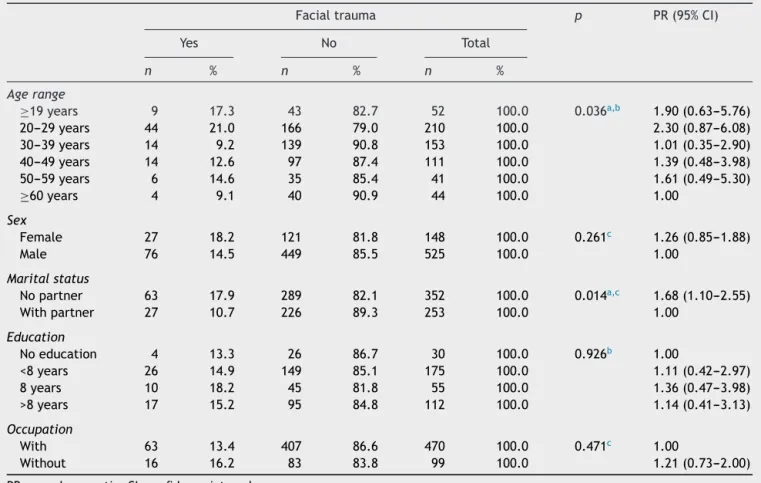
Facialinjurieswereobservedin103cases(15.3%).Table1
shows the socio-demographic data with bivariateanalysis of facial trauma for TTA cases. The age group with the highest number of facial trauma events was 20---29 years
(48.3%,n=44).Menweremorelikelytobeinvolved,witha male---femaleratioof2.81:1.Mostvictimsoffacialtrauma were unmarried (70%, n=63) and had less than 8 years ofeducation.Ageandmaritalstatuswereassociatedwith facialtraumainthebivariateanalysis.
The majority of TTA cases with facial trauma victims involved motorcycles (66.3%, n=65). Accidents occurred most frequently onSaturdays (20.2%, n=20), followed by Sundays(18.2%,n=18);regardingmonth,Juneand Septem-ber had the highest frequency (13.1% each, n=13). Most accidentsoccurredatnight,between18:00to23:59(41.9%,
n=36).The bivariateanalysisof facialtrauma occurrence andTTA-relatedvariablesindicatednosignificantstatistical association(Table2).
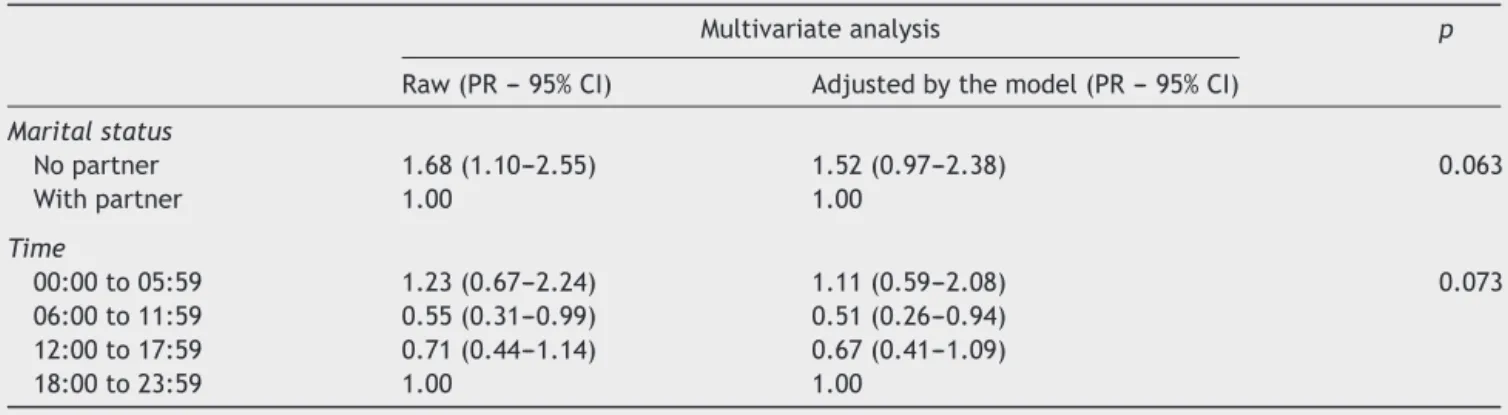
MultivariateanalysisfromthePoissonregressionshowed no significant association for variables included in the model. Althoughage wassignificantin thebivariate anal-ysis,itcouldnotbeadjustedinthemultivariatemodeldue tothelargenumberofcategories(Table3).
Withregardtotheanatomicallocationoffacialtrauma, there were more multiple traumas (47.6%); however, in isolation, the frontal region was most affected (21.4%) (Table4).
Table1 Bivariateanalysisoftheoccurrenceoffacialtraumaandsocio-demographiccharacteristicsofvictimsofterrestrial transportaccidents.
Facialtrauma p PR(95%CI)
Yes No Total
n % n % n %
Agerange
≥19years 9 17.3 43 82.7 52 100.0 0.036a,b 1.90(0.63---5.76)
20---29years 44 21.0 166 79.0 210 100.0 2.30(0.87---6.08)
30---39years 14 9.2 139 90.8 153 100.0 1.01(0.35---2.90)
40---49years 14 12.6 97 87.4 111 100.0 1.39(0.48---3.98)
50---59years 6 14.6 35 85.4 41 100.0 1.61(0.49---5.30)
≥60years 4 9.1 40 90.9 44 100.0 1.00
Sex
Female 27 18.2 121 81.8 148 100.0 0.261c 1.26(0.85---1.88)
Male 76 14.5 449 85.5 525 100.0 1.00
Maritalstatus
Nopartner 63 17.9 289 82.1 352 100.0 0.014a,c 1.68(1.10---2.55)
Withpartner 27 10.7 226 89.3 253 100.0 1.00
Education
Noeducation 4 13.3 26 86.7 30 100.0 0.926b 1.00
<8years 26 14.9 149 85.1 175 100.0 1.11(0.42---2.97)
8years 10 18.2 45 81.8 55 100.0 1.36(0.47---3.98)
>8years 17 15.2 95 84.8 112 100.0 1.14(0.41---3.13)
Occupation
With 63 13.4 407 86.6 470 100.0 0.471c 1.00
Without 16 16.2 83 83.8 99 100.0 1.21(0.73---2.00)
PR,prevalenceratio;CI,confidenceinterval.
aStatisticaldifferenceat5%.
b Fisher’sexacttest.
c Chi-squaretest.
Table2 Bivariateanalysisbetweenfacialtraumaanddatarelatedtotheoccurrenceofterrestrialtransportaccidents.
Facialtrauma p PR(95%CI)
Yes No Total
n % n % n %
Typeofaccident
Motorcycle 65 14.9 372 85.1 437 100.0 0.712a 1.15(0.62---2.13)
Automotive 23 17.0 112 83.0 135 100.0 1.31(0.66---2.61)
Runningover 10 13.0 67 87.0 77 100.0 1.00
Day
Monday 11 14.9 63 85.1 74 100.0 0.588a 1.12(0.56---2.25)
Tuesday 11 12.4 78 87.6 89 100.0 0.93(0.46---1.88)
Wednesday 11 12.5 77 87.5 88 100.0 0.94(0.47---1.90)
Thursday 15 17.4 71 82.6 86 100.0 1.32(0.70---2.47)
Friday 13 13.8 81 86.2 94 100.0 1.04(0.54---2.03)
Saturday 20 21.3 74 78.7 94 100.0 1.61(0.90---2.87)
Sunday 18 13.2 118 86.8 136 100.0 1.00
Month
January 11 18.6 48 81.4 59 100.0 0.790b 1.57(0.65---3.77)
February 5 10.9 41 89.1 46 100.0 0.92(0.31---2.70)
March 10 17.2 48 82.8 58 100.0 1.45(0.59---3.56)
April 4 9.1 40 90.9 44 100.0 0.77(0.24---2.46)
May 4 10.0 36 90.0 40 100.0 0.84(0.26---2.69)
June 13 15.5 71 84.5 84 100.0 1.30(0.55---3.07)
July 4 10.0 36 90.0 40 100.0 0.84(0.26---2.69)
August 9 19.6 37 80.4 46 100.0 1.65(0.66---4.09)
September 13 19.4 54 80.6 67 100.0 1.64(0.70---3.82)
October 8 13.6 51 86.4 59 100.0 1.14(0.44---2.95)
November 11 18.3 49 81.7 60 100.0 1.55(0.64---3.71)
December 7 11.9 52 88.1 59 100.0 1.00
Timeoftheaccident
00:00to05:59 11 22.0 39 78.0 50 100.0 0.073a 1.23(0.67---2.24)
06:00to11:59 14 9.9 127 90.1 141 100.0 0.55(0.31---0.99)
12:00to17:59 25 12.8 171 87.2 196 100.0 0.71(0.44---1.14)
18:00to23:59 36 17.9 165 82.1 201 100.0 1.00
PR,Prevalenceratio;CI,confidenceinterval.
a Fisher’sexacttest.
b Chi-squaretest.
Font:NUMOL:2012.
Table3 Poissonmultivariateregressionforanalysisofpercentageoffacialinjurybasedonindependentvariablesincludedin themodel.
Multivariateanalysis p
Raw(PR---95%CI) Adjustedbythemodel(PR---95%CI)
Maritalstatus
Nopartner 1.68(1.10---2.55) 1.52(0.97---2.38) 0.063
Withpartner 1.00 1.00
Time
00:00to05:59 1.23(0.67---2.24) 1.11(0.59---2.08) 0.073
06:00to11:59 0.55(0.31---0.99) 0.51(0.26---0.94) 12:00to17:59 0.71(0.44---1.14) 0.67(0.41---1.09)
18:00to23:59 1.00 1.00
Table 4 Distribution of anatomical location of facial traumainthevictimsofterrestrialtransportaccidents.
Facialregionaffected n %
Frontal 22 21.4
Oral 9 8.7
Orbital 7 6.8
Zygomatic 7 6.8
Masseteric 6 5.8
Nasal 3 2.9
Polytrauma 49 47.6
Font:NUMOL:2012.
Discussion
Studies in forensic medicine departments are rare since mostdealwithmortalityandmorbiditydataobtainedfrom hospitals.Thus,thepresentstudy providesdiffering infor-mation.
The victims considered highlight thedifferences which mayoccurwhenweobservedatafortreatmentatforensic medicalanddentalservices,inwhichtheindividualclaims his/hercitizen’srights,or inhealthservices,inwhichthe aimistoremedyinjurytohealth.
Thisstudysuggeststhatfacialtraumacases---registered inaforensicunit---arenotrareandtheiroccurrenceis high-estamongyoungpeople,especiallythosebetween20and29 years.AsimilarstudyconductedinPortugalfounda11.6% prevalenceof facialtrauma ina forensicinstitute, arate consistentwiththe15.3%reportedin thepresent study.15
Youngpeoplearemorelikelytobeinaccidentsthatresult infacialtrauma.1,3,16---19Theyparticipatemoreintenselyin
sociallifecomparedtochildren,adults,andelderly individ-uals,andarethereforemore likelytoface TTAsinvolving fractures and facial trauma.2 Additionally, young people
presenttrafficbehaviorsthatincreasetheriskofaccidents, suchasimmaturity,inexperienceandrecklessness.20
Otherriskfactorsforfacialtraumathatyoungpeopleare morelikelytobeexposedtoincludecontactsports,alcohol andrecreationaldrugs.20 Astudyconductedin Brazilwith
victimsoffacialtraumadeterminedthatthosebetween21 and30yearsareatriskforfacialtrauma.6
Regardinggender, menweremorelikelytobeTTA vic-tims, consistent with previous studies.3,4,21 In Brazil,1---4
Africa21 andtheUnitedArabEmirates,22 themale---female
ratiooffacialtraumacasestendstobehigherthaninmore developedcountrieslikeGermany,17theUnitedStates18and
Switzerland.23Thisisbecauseindevelopingcountries,men,
more than women, are involved in active economic life, which exposes them torisk factors suchas unsafetraffic behavior.6,21
Thebivariateanalysisinthepresentstudyrevealedthat theoccurrenceoffacialtraumawasassociatedwithmarital status;asignificantlylargenumberofunmarriedindividuals experienced facialtrauma. However,this association was notsupportedbythemultivariateanalysis.Othervariables suchas educationand employment werenot significantly associatedwithfacialtraumainanyoftheanalyses.Despite theabsenceofastatisticalassociation,unmarried individ-ualsweremost likelytobeinvolved in violentsituations,
andmosthadalowlevelofeducation.Thisloweducational level maybeareflection of thesocioeconomicconditions of theregionunderstudy,where accesstoeducationwas delayed due to educationalpolicy failures and inefficient healthpolicyimplementation.24,25
The majority of accidents recorded involved motorcy-cles,followedbyautomobiles.Themotorcycleisthemost unsafevehicle, asthe rider’s body is exposed and unpro-tected,makinghim/herextremelyvulnerabletoaccidents thatcouldresultinmorbidityordeath.5InBrazil,the
num-beroffatalmotorcycleaccidentsincreasedby754%within adecadeandcontinuestoincreaseeveryyear.26
This increased morbidity and mortality in traffic is explained byreckless driving,mainly resulting from alco-hol use.9,27 In addition, with the increased number of
motorcyclesin Brazil, thelikelihood ofaccidents hasalso increased.In1998,thenumberofthemotorcyclesinBrazil was 2,542,732; this increased to 9,410,110 in 2007, cor-responding toapproximately4970 motorcyclesper 10,000 inhabitants.26
Inthisstudy,accidentsoccurredmorefrequentlyon Sat-urdaysandSundays,whichareweekenddayswhenpeople aremore likelytoconsumealcohol.This may explainthe highnumberofalcohol-relatedaccidentsandconsequently, theoccurrenceoffacialtrauma.JuneandSeptemberwere themonths withthe mostnumberof facialtrauma cases. The cityhostsa popularevent everyJune,resultinginan increaseinthenumberofpeopleinthecityandthus increas-ingthelikelihoodofTTAoccurrences.
TTAsresultinginfacialtraumamainlyoccurredatnight between 18:00 to23:59. This may be a reflection of the greater number of social activities involving alcohol con-sumption that take placeduring this time, resultingin a greaternumberofaccidents.
Regardingtheanatomicallocationoffacialtrauma, poly-trauma wasmost common.The biomechanicsof collisions affectstraumaprofiles;fallsathighspeedinvolving motor-cyclistsoftenaffectthecervicalspineandrelatedareas.28,29
Itisthereforeunsurprisingthatseveralareaswereaffected. In isolation, the major affected areas were the frontal and oral regions. Typically, trauma location depends on the lesion severity.1 In accidents involving fractures, the
mandibleregionismorelikelytobeaffected.18,22,30Inthis
study, all cases of mandibular fractures were involved in otherregionsandwereincludedaspolytrauma.Softtissue injuries affect areas around the jaw,such as oral, nasal, andzygomaticregions.6Theoccurrenceoffacialtraumacan
complicateindividuals’healthsinceitcancausedeformities infacephysiognomyandemotionalsequelae.
Alimitationofthiscross-sectionalstudyisthatitcould notestablish causalrelationships.Becauseof thisregion’s socioeconomic background, there is nointegrated system ofepidemiologicalsurveillancebetweenstationsofpolice, forensic services,andemergencyunits athospitals. Thus, theprevalenceoffacialtrauma,althoughconsideredhigh, may be an underestimation sinceseveral individuals may have been directly forwarded to receive hospital care, bypassingforensicservices.
examinedcasesofindividualsadmittedtosurgeryand trau-matologydepartments.
Future research that aims at identifying differences betweencasesoffacialtraumaadmittedtoemergencyand forensicservicesis necessary.Inaddition,although itwas not possible toestimate the impactand consequencesof theseaccidents(asthereportsdidnotincludethis informa-tion),itisessentialtocarryoutsurveystoaccuratelyassess theeffectofmorbidityonvictims’qualityoflife.
This study examined the characteristics of TTAs and theirvictims,focusingonfacialtraumadistributionpatterns amongvictimsadmittedtoaforensicservice.Moreover,it isapioneeringresearchinthisgeographicalregion.31
These results could be usedto help authorities create an integratednetwork for epidemiologicalmonitoring and for planningprevention,rehabilitation, andsocialsupport programsforvictimsofTTA-relatedtrauma.
Conclusions
This study emphasizes that Brazilian authorities need to paygreater attentiontoroadsafety. Regulatorylaws may reducethenumberofTTAsandtheresultingmorbidityand mortality.
The occurrence of facialtraumas inTTA victims is not rare;itisobservedmorefrequentlyinyoungindividualsand men,andismostlikelytoinvolvemotorcycles.
Funding
ThisstudywasfundedbyConselhoNacionalde Desenvolvi-mentoCientífico eTecnológico(CNPq), aBrazilianscience promotionagency,andsupportedbyCoordenac¸ãoNacional deAperfeic¸oamentodePessoaldeNívelSuperior(CAPES).
Conflicts
of
interest
Theauthorsdeclarenoconflictsofinterest.
References
1.CarvalhoTB,CancianLR,MarquesCG,PiattoVB,ManigliaJV, MolinaFD.Sixyearsoffacialtraumacare:anepidemiological analysisof355cases.BrazJOtorhinolaryngol.2010;76:565---74.
2.Chrcanovic BR, Abreu MH, Freire-Maia B, Souza LN. 1,454 mandibularfractures:a3-yearstudyinahospitalinBelo Hori-zonte,Brazil.JCraniomaxillofacSurg.2012;40:116---23.
3.MaliskaMC,LimaJúniorSM,GilJN.Analysisof185maxillofacial fracturesinthestateofSantaCatarina,Brazil.BrazOralRes. 2009;23:268---74.
4.MatosFP,ArnezMF,SverzutCE,TrivellatoAE.Aretrospective studyofmandibularfractureina40-monthperiod.IntJOral MaxillofacSurg.2010;39:10---5.
5.ChengAS,NgTG,LeeHC.Acomparisonofthehazard percep-tionabilityofaccident-involvedandaccident-freemotorcycle riders.AccidAnalPrev.2011;43:1464---71.
6.LelesJL,dosSantosEJ,JorgeFD,daSilvaET,LelesCR.Risk fac-torsformaxillofacialinjuriesinaBrazilianemergencyhospital sample.JApplOralSci.2010;18:23---9.
7.LiuBC,IversR,NortonR,BoufousS,BlowsS,LoSK.Helmets forpreventinginjuryinmotorcycleriders.CochraneDatabase SystRev.2008;23:1---37.
8.AfzaliS,SalehA,SeifRabieiMA,TaheriK.Frequencyof alco-hol and substance abuseobserved indriverskilled intraffic accidentsinHamadan,Iran.ArchIranMed.2013;16:240---2.
9.DeBoniR,BozzettiMC,HilgertJ,SousaT,VonDiemenL, Ben-zano D,et al. Factors associatedwithalcohol and druguse amongtrafficcrashvictimsinsouthernBrazil.AccidAnalPrev. 2011;43:1408---13.
10.La TorreG, VanBeeckE,Quaranta G, Mannocci A, Ricciardi
W.Determinantsofwithin-countryvariationintrafficaccident
mortalityinItaly:ageographicalanalysis.IntJHealthGeogr.
2007;6:49,http://dx.doi.org/10.1186/1476-072X-6-49.
11.Rivas-RuizF,Perea-MillaE,Jimenez-PuenteA.Geographic
vari-abilityoffatalroadtrafficinjuriesinSpainduringtheperiod
2002---2004:anecologicalstudy.BMCPublicHealth.2007;7:266,
http://dx.doi.org/10.1186/1471-2458-7-266.
12.Olasoji HO, Tahir A, Arotiba GT. Changing picture of facial fractures in northern Nigeria. Br J Oral Maxillofac Surg. 2002;40:140---3.
13.AdsettL,ThomsonWM,KieserJA,TongDC.Patternsandtrends infacialfracturesinNewZealandbetween1999and2009.NZ DentJ.2013;109:142---7.
14.MaltaM,CardosoLO,BastosFI,MagnaniniMMF,daSilvaCMFP. Strobeinitiative:guidelinesonreportingobservationalstudies. RevSaudePublica.2010;44:559---65.
15.Caldas IM, Magalhães T, Afonso A, Matos E. Orofacial dam-ageresultingfrom roadaccidents. DentTraumatol. 2008;24: 410---5.
16.Atilgan S, Erol B, YamanF, Yilmaz N, Ucan MC. Mandibular fractures: a comparative analysis between young and adult patients in the southeast region ofTurkey. J Appl Oral Sci. 2010;18:17---22.
17.Bormann KH, Wild S, Gellrich NC, Kokemüller H, Stühmer C, Schmelzeisen R, et al. Five-year retrospective study of mandibular fractures in Freiburg, Germany: incidence, eti-ology, treatment,and complications. JOralMaxillofac Surg. 2009;67:125---35.
18.ErdmannD,FollmarKE,DebruijnM,BrunoAD,JungSH,Edelman D,etal.Aretrospectiveanalysisoffacialfractureetiologies. AnnPlastSurg.2008;60:398---403.
19.Lee JH, Cho BK, Park WJ. A 4-year retrospective study of facial fractures on Jeju, Korea. J Craniomaxillofac Surg. 2010;38:192---6.
20.Santos AMR, Moura MEB, Nunes BMVT, Leal CFS, Teles JBM. Profile of motorcycle accident victims treated at a public hospitalemergencydepartment.CadSaudePublica.2008;24: 1927---38.
21.Mohajerani SH, Asghari S. Pattern of mid-facial fracturesin Tehran,Iran.DentTraumatol.2011;27:131---4.
22.AlAhmedHE,JaberMA,AbuFanasSH,KarasM.Thepattern ofmaxillofacialfracturesinSharjah,UnitedArabEmirates:a reviewof230cases.OralSurgOralMedOralPatholOralRadiol Endod.2004;98:166---70.
23.LiegerO,ZixJ,KruseA,IizukaT.Dentalinjuriesinassociation withfacialfractures.JOralMaxillofacSurg.2009;67:1680---4.
24.AnjosKC,EvangelistaMRB,SilvaJS,ZumiottiAV.Apatient vic-timofcartrafficviolence:ananalysisofsocioeconomicprofile, accidentcharacteristicsandSocialServicesinterventioninthe emergencyroom.ActaOrtopBras.2007;15:262---6.
25.Santos JLG, Garlet ER, Figueira RB, Lima SBS, Prochnow AG. Accidents and violence: characteristics of the medical caresintheemergencyroom’suniversityhospital.SaudeSoc. 2008;17:211---8.
26.NationalCouncilofHealthSecretaries.Violenceontraffic: epi-demicdeathsofmotorcyclistsworriesthepublichealth.Jdo Conass.2009;42:13---6.
28.Hinds JD, Allen G, Morris CG. Trauma and motorcyclists: born to be wild, bound to be injured. Injury. 2007;38: 1131---8.
29.Zamani-Alavijeh F, Niknami S, Bazargan M, Mohammadi E, Montazeri A, Ahmadi F, et al. Accident-related risk behav-iors associated with motivationsfor motorcycleuse in Iran: a country with very high traffic deaths. Traffic Inj Prev. 2009;10:237---42.
30.BatistaAM,FerreiraF,deO,MarquesLS,Ramos-JorgeML, Fer-reiraMC.Riskfactorsassociatedwithfacialfractures.BrazOral Res.2012;26:119---25.