ABSTRACT
http://dx.doi.org/10.1590/1678-7757201302188
different operating systems: an ex vivo study
1, Michelli de Medeiros BUENO2 3, Marco Antonio
!"4, Carlos Augusto de Oliveira FERNANDES5
1- DDS, MSc, PhD, Sobral School of Dentistry, Federal University of Ceará and School of Pharmacy, Dentistry and Nursing, Federal University of Ceará, Fortaleza, CE, Brazil.
2- DDS, Brazilian Dental Association, Ceará Section, Fortaleza, CE, Brazil.
3- DDS, MSc, Sobral School of Dentistry, Federal University of Ceará, Fortaleza, CE, Brazil.
4- DDS, MSc, PhD, Associate Professor, Department of Operative Dentistry, Endodontics and Dental Materials, Bauru School of Dentistry, University of São Paulo, Bauru, SP, Brazil.
5- DDS, MSc, PhD, School of Pharmacy, Dentistry and Nursing, Federal University of Ceará, Fortaleza, CE, Brazil.
Corresponding address: Bruno Carvalho de Vasconcelos - Universidade Federal do Ceará - Curso de Odontologia de Sobral - Departamento de Endodontia Rua Stanislau Frota s/n, Bloco da Tecnologia, Centro - 62010-560 - Sobral - CE - Brazil - Phone and Fax: +55 88 36132603 - e-mail: [email protected]
#$ #%%&'%(# )$* +%&';##<)$=> ?%&';
O
bjective: The aim of this study was to evaluate, ex vivo root canal length measurement devices (ERCLMDs) with different operating systems: the Root ZX, Mini Apex Locator, Propex II, iPex, and RomiApex A-15, and the possible and Methods: Forty-two mandibular bicuspids had their real canal lengths (RL) previously determined. Electronic measurements were performed 1.0 mm short of the apical foramen (-1.0), followed by measurements at the apical foramen (0.0). The data resulting from the comparison of the ERCLMD measurements and the RL were evaluated by the Wilcoxon !"# performed at 0.0 and -1.0, the precision rates for the ERCLMDs were: 73.5% and 47.1% (Root ZX), 73.5% and 55.9% (Mini Apex Locator), 67.6% and 41.1% (Propex II), 61.7% and 44.1% (iPex), and 79.4% and 44.1% (RomiApex A-15), respectively, considering ±0.5 mm of tolerance. Regarding the mean discrepancies, no differences were observed at 0.0; $&'*+$/2!#8< more discrepant readings short of the apical foramen than the other devices, except for the Propex II, which had intermediate results. When the ERCLMDs measurements at -1.0 were ''* +==*+! +$& higher discrepancies in their readings. Conclusions: Under the conditions of the present study, all the ERCLMDs provided acceptable measurements at the 0.0 position. However, $&' 2!#8< differences for the Propex II, iPex, and RomiApex A-15.Key words: Endodontics. Tooth apex, anatomy & histology. Odontometry methods. Dental equipment. Electric impedance.
INTRODUCTION
Precise root canal length determination using the apical constriction or the apical foramen (AF) as references is an extremely relevant factor for
the success of endodontic treatments10,11,21,23.
Electronic root canal length measurement devices @2!#8<B purpose12,15,18,26,28, achieving precision percentages
upwards of 80% ex vivo2,4,6,9,17-20,23-26 and in
vivo8,23,27,29,30.
two frequency-based measurement system that emits an all-digital signal, which according to its manufacturers, leads to improved precision. Another ERCLMD, the iPex (NSK, Tochigi, Japan), based on a multi-frequency principle, was launched in 2008. However, little information is available fact that it utilizes two different signal frequencies. Both the Mini Apex Locator and the iPex have demonstrated satisfactory clinical results, despite the relative lack of information on their operating mechanisms, especially with regards to how these devices electronically interpret the impedance values obtained in the different frequencies during measurements within the canal4,16,18,23,24,26.
Recently launched in the market, the RomiApex A-15 (Romidan Ltd., Kyriat Ono, Israel) and the Propex II (Dentsply/Maillefer, Ballaigues, Switzerland), measure the working length by calculating the mean square root values of the impedance at two different frequencies (0.5 and
8.0 kHz), measured separately6,13,14. The devices
compare the results obtained with reference values positions. Thus, differing from most ERCLMDs, the RomiApex A-15 and the Propex II operate by detecting the energy of the signal, rather than
its amplitude14. Although these devices seem
promising, at the present there are no studies in the available literature evaluating the precision
of the RomiApex A-15, both ex vivo and in vivo.
As for the Propex II, at the present, its precision
has only been evaluated ex vivo at the foramen
level, with satisfactory results6,14. Despite being
based on similar operating systems, these devices have different electronic components with distinct layouts, and the possible variations due to these differences are still unknown. Regardless of their operating mechanisms, ERCLMDs have been extensively evaluated, demonstrating satisfactory
4-7,9,12,13,15,19,26. Nevertheless, some authors suggest
the adoption of working length measurements short of the apical foramen in order to preserve the vitality of the foraminal tissues and possibly allow for the formation of a biological seal via the pulp tissue cells
present in the cement canal2,24,27. However, recent
studies show that the precision of some ERCLMDs is negatively affected in measurements short of the mean distances to the working length in their
measurements24,26. Nevertheless, the effects of this
protocol of ERCLMD utilization are still unknown for some operating mechanisms employed by several of the devices currently in use, such as the Mini Apex Locator, the RomiApex A-15 and the Propex II.
With this in mind, the aim of the present study was to evaluate the performance of the Root ZX,
the Mini Apex Locator, the Propex II, the iPex and the RomiApex A-15, all ERCLMDs with different operation systems, both at levels 1.0 mm short of the AF (-1.0 mm) and at the AF (0.0 mm).
MATERIAL AND METHODS
Forty-two single-rooted human mandibular bicuspids with completely formed roots and referred for extraction for orthodontic reasons were selected. This study was approved by the Ethics Committee of the Federal University of Ceará, Brazil under protocol number 099/11, prior to the sample collection. All the teeth were healthy, corresponded [\= did not exhibit sharp curvatures.
The coronal access was performed using #1012 and #3081 high speed diamond burs (KG Sorensen, Barueri, Brazil) under constant irrigation. When ^ anatomical references for the rubber stops. The + _&' `$
(Dentsply/Maillefer, Ballaigues, Switzerland) to
^ the foraminal patency. Two teeth did not meet these criteria and were excluded from the study. The remaining specimens were numbered and had their real lengths (RL) determined with #10 `$ were visualized at the apical foramen opening under 16x magnification using an operating microscope (DF Vasconcellos, São Paulo, Brazil). | ^ stop was measured by a digital caliper with ±0.01 mm resolution (FNCL; Worker Gage, Esteio, Brazil).
| `$} lengths for each canal was also recorded.
The coronal and middle thirds were prepared `~~''@^ 2 B 5.0 mm short of the RL, under irrigation with 2.5% sodium hypochlorite. Next, the excess solution was removed but the canals remained moist. The root apices were embedded in alginate (Jeltrate II; <* B + immediately placed in a plastic container, along with 2!#8<^
per container, to ensure that the alginate remained
canal and measured. The measurements at the apical foramen level were conducted in the same ^*2 postion and/or 0.0 were displayed. Measurements were considered concluded only after 05 seconds of stability.
The mean values obtained were compared to the RL and RL -1.0 mm in order to calculate the mean error (discrepancy) of each device, in millimeters, at the two positions relative to the apical foramen. Negative and positive values were assigned for measurements under or over the previously determined RLs, respectively. Considering the non-parametric nature of the data presented by the $ $ $ analyses were carried out by the Wilcoxon test for the comparisons between both levels (0.0 mm and -1.0 mm) for each ERCLMD measurement and by the Friedman test for comparisons among the 2!#8<^ level established at 5%.
RESULTS
The diameters of the root canals at the real canal length ranged between 150 μm and 350 μm, presenting 250 μm as the mean value.
Table 1 presents the mean error (absolute values of discrepancies), in millimeters, between the electronic measurements and the previously established RL and RL -1.0 mm. Comparison of the measurements at 0.0 mm and -1.0 mm, using the Propex II, the iPex, and the RomiApex $&
(P<0.05), which was not observed for the Root ZX
and the Mini Apex Locator (P>0.05). Regardless
2!#8< differences in the precision were also detected between the measurements taken at 0.0 mm and -1.0 mm (P>0.05).
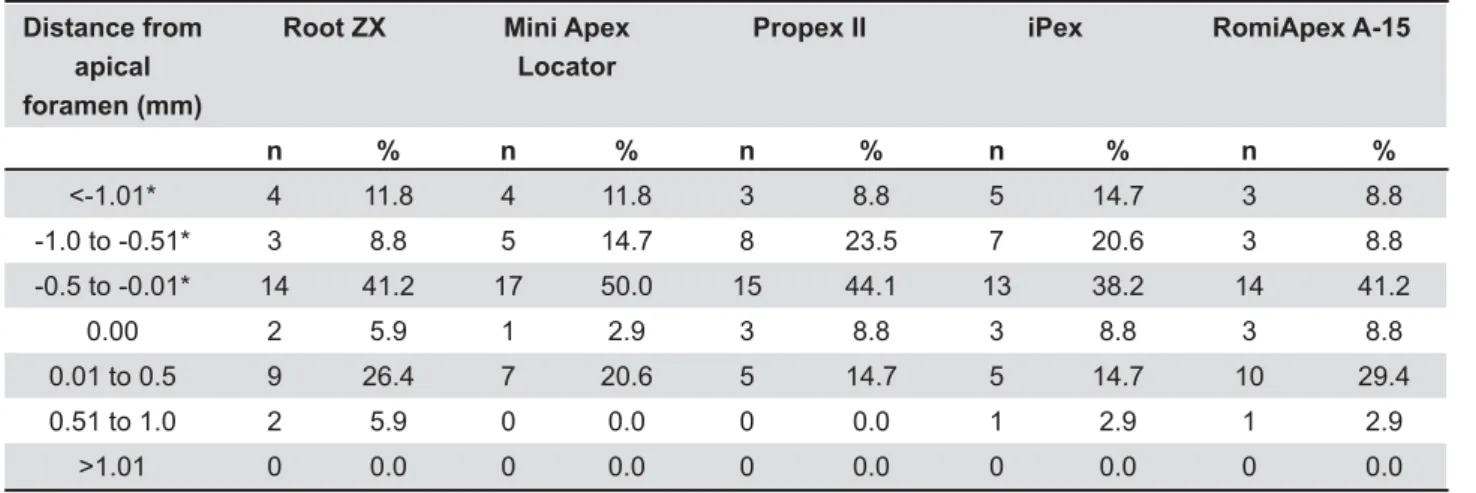
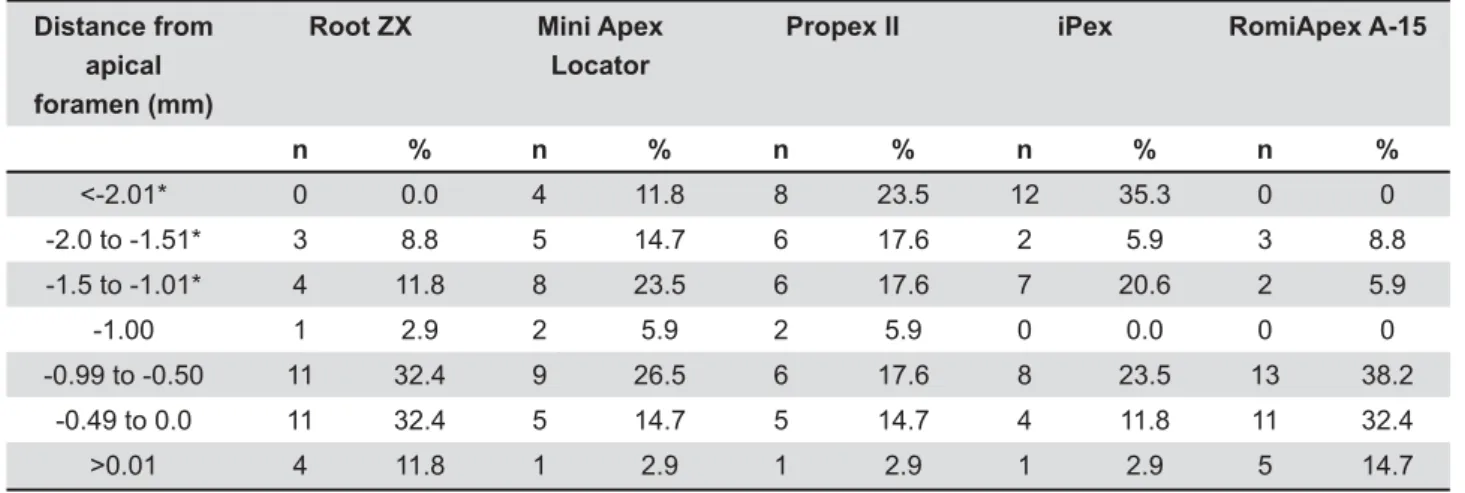
Tables 2 and 3 lists the distribution of measurements obtained from all devices at the 0.0 mm and -1.0 mm levels, respectively. Considering the measurements performed at the 0.0 mm level, the occurrence of determinations beyond and at
Device 0.0 -1.0
Q SD Mean Ranks Q SD Mean Ranks
Root ZX 0.39a,A 0.29 0.43 0.61a,A 0.35 0.62
Mini Apex Locator 0.40a,A 0.32 0.50 0.61a,A 0.53 0.61
Propex II 0.39a,A 0.30 0.50 0.80b,AB 0.41 0.81
iPex 0.47a,A 0.43 0.54 1.01b,B 0.55 1.01
RomiApex A-15 0.38a,A 0.27 0.39 0.68b,A 0.38 0.66
a,b
device according to the Wilconxon test (P<.05)
A,B
position according to the Friedman test (P<.05)
Table 1- Distance (mm) from device measurements to 0.0 and -1.0
Distance from apical foramen (mm)
)V Mini Apex
Locator
Propex II iPex RomiApex A-15
n % n % n % n % n %
<-1.01* 4 11.8 4 11.8 3 8.8 5 14.7 3 8.8 -1.0 to -0.51* 3 8.8 5 14.7 8 23.5 7 20.6 3 8.8 -0.5 to -0.01* 14 41.2 17 50.0 15 44.1 13 38.2 14 41.2
0.00 2 5.9 1 2.9 3 8.8 3 8.8 3 8.8 0.01 to 0.5 9 26.4 7 20.6 5 14.7 5 14.7 10 29.4 0.51 to 1.0 2 5.9 0 0.0 0 0.0 1 2.9 1 2.9
>1.01 0 0.0 0 0.0 0 0.0 0 0.0 0 0.0 ! "
the apical foramen were determined at 32.9% and 5.9% (Root ZX), 20.6% and 2.9% (Mini Apex Locator), 14.7% and 8.8% (Propex II), 17.6% and 8.8% (iPex), and 32.3% and 8.8% (RomiApex A-15), respectively (Table 2).
DISCUSSION
Although the results from the ex vivo studies
should not be simply extrapolated to a clinical
setting, they still provide valuable information8.
= ^ ^ of devices with the same patient. Furthermore,
ex vivo tests allow, as performed in the present study, the maintenance of all controlled conditions by using fresh alginate to simulate the periapical
tissue conditions1, by maintaining the canals moist
with a NaOCl solution during the acquirement of
the measurements8,26,28-30, by verifying the patency
of each canal14,28$3, and measuring the
$4,9,22,25.
The values obtained for the measurements at the apical foramen level corroborate with previous studies, showing precision rates of approximately 90% (Root ZX at 88.2%, Mini Apex Locator at 88.2%, Propex II at 91.2%, iPex at 85.3%, and RomiApex A-15 at 91.2%), assuming a tolerance
margin of ±1.0 mm19,23,26. Some authors, however,
consider this margin to be excessive,
over-estimating the precision of the devices4,19,26,30.
In fact, when the tolerance margin was set at ±0.5 mm, we observed marked reductions in the precision of all ERCLMDs (73.6% for the Root ZX, 73.5% for the Mini Apex Locator, 67.6% for the Propex II, 61.7% for the iPex, and 79.4% for the
RomiApex A-15), also reported by Pascon, et al.19
(2009) and Vasconcelos, et al.26 (2010). Thus,
considering the risks of over-estimation of the precision of the devices, it seems more accurate to consider the tolerance margin of ±0.5 mm.
The mean error values showed that regardless of the operating system utilized, all the tested devices had a higher precision at the apical foramen level (0.0 mm), corroborating with previous evaluations for the Root ZX (0.39±0.29 mm)4,6,7,12,13,17,19,26, the
Mini Apex Locator (0.40±0.32 mm)4,7, the Propex
II (0.39±0.30 mm)6,12,13, and the iPex (0.47±0.43
mm)16,23,26. As highlighted for the RomiApex A-15,
no previous studies with a similar design evaluating show that this device had the lowest mean error values among all the tested ERCLMDs (0.38±0.27 mm) suggesting that systems based on the evaluation of the energy of the signal, instead of its amplitude, may result in extremely reliable measurements. Considering these values, special attention should be given to the fact that, in order to prevent the compensation between positive and negative readings, the mean error values have
been calculated as its absolute values (modulus),
representing the real error value produced by the devices.
For the measurements at the -1.0 mm level, all devices suffered a reduction in their mean error values. Previous studies presented similar values for the Root ZX at this position2,24,26, which despite presenting a slight increase in its mean error value (from 0.39 mm to 0.61 mm), it can still be considered a precise device for measurements at the -1.0 mm level. Similarly, the results for the iPex corroborate with a previous evaluation, where a great variation in the mean error values were found in the measurements conducted -1.0
mm short of the AF26. In the present study, the
mean discrepancy of the iPex rose from 0.47 mm to 1.01 mm, corresponding as the worst result
among the tested devices (P<0.05). For some
reason, still unclear due to the relative lack of information regarding the operation of the iPex, it seems that the precision of this multi-frequency
! " #$%
Distance from apical foramen (mm)
)V Mini Apex
Locator
Propex II iPex RomiApex A-15
n % n % n % n % n %
<-2.01* 0 0.0 4 11.8 8 23.5 12 35.3 0 0 -2.0 to -1.51* 3 8.8 5 14.7 6 17.6 2 5.9 3 8.8 -1.5 to -1.01* 4 11.8 8 23.5 6 17.6 7 20.6 2 5.9 -1.00 1 2.9 2 5.9 2 5.9 0 0.0 0 0 -0.99 to -0.50 11 32.4 9 26.5 6 17.6 8 23.5 13 38.2
-0.49 to 0.0 11 32.4 5 14.7 5 14.7 4 11.8 11 32.4 >0.01 4 11.8 1 2.9 1 2.9 1 2.9 5 14.7
device is greatly affected when the instruments do not reach the AF. One possible hypothesis is that its operating system interprets the capacitance and the resistance separately at some instances, which would explain its loss of reliability when these factors are absent when determining the position of the instruments within the canals.
The other ERCLMDs, until now, had not been tested at positions short of the AF. The Mini Apex Locator, the Propex II, and the RomiApex A-15 also presented increases in their mean error values from 0.40 mm to 0.61 mm, from 0.39 mm to 0.80 mm, and from 0.38 mm to 0.68 mm, respectively. The results provided by the Mini Apex Locator, despite the limited technical information available, suggest that its mechanism may be quite similar to that of the Root ZX, since the devices displayed analogous behavior at different levels. This was also observed in previous studies, where these devices were submitted to different root canal preparations or in the presence of different irrigating solutions4,7,9. The Propex II and the RomiApex A-15 presented ^ measurements at both levels (0.0 mm and -1.0
mm) (P<0.05). This behavior suggests that
although these ERCLMDs rely on energy signals and not on their amplitude, their accuracy is reduced during complicating factors, such as not reaching the AF. This may be explained by the loss of resistance data, similarly to what might have occurred to the iPex.
The results demonstrated the importance of conducting electronic canal length measurements at either at the apical constriction or at the major AF, structures that cannot be differentiated clinically24,28. Nevertheless, the Mini Apex Locator, together with the Root ZX (which operates by calculating the impedance at two different frequencies) had a smaller loss of precision when the tip was positioned 1.0 mm short of the AF. On the other hand, the iPex (a multi-frequency device), the Propex II and the RomiApex A-15 (devices that operate by detecting B of precision.
CONCLUSION
Under the conditions of the present study, all the ERCLMDs provided acceptable measurements at the position of 0.0. However, at the -1.0 position, the ERCLMDs had a lower precision, with statistically * +==*+
RomiApex A-15.
REFERENCES
1- Baldi JV, Victorino FR, Bernardes RA, Moraes IG, Bramante CM, != ^ of electronic apex locators. J Endod. 2007;33:476-9.
2- Bernardes RA, Duarte MAH, Vasconcelos BC, Moraes IG, Bernardineli N, Garcia RB, et al. Evaluation of precision length determination with 3 electronic apex locators: Root ZX, Elements Diagnostic Unit, RomiApex D-30. Oral Surg Oral Med Oral Pathol Oral Radiol Endod. 2007;104:e91-4.
3- Brito-Júnior M, Camilo CC, Moreira-Júnior G, Pecora JD, Sousa- <2 $ electronic apex locators. J Appl Oral Sci. 2012;20:538-43. 4- Camargo EJ, Zapata RO, Medeiros PL, Bramante CM, != $ accuracy of length determination with four electronic apex locators. J Endod. 2009;35:1300-2.
5- Carvalho AL, Moura-Netto C, Moura AA, Marques MM, Davidowics H. Accuracy of three electronic apex locators in the presence of different irrigating solutions. Braz Oral Res. 2010;24:394-8. 6- Cianconi L, Angotti V, Felici R, Conte G, Mancini M. Accuracy of three electronic apex locators compared with digital radiography: an ex vivo study. J Endod. 2010;36:2003-7.
7- D’Assunção FL, Albuquerque DS, Salazar-Silva JR, Santos
VC, Sousa JC. Ex vivo
of repeatability of three electronic apex locators using a simple mounting model: a preliminary report. Int Endod J. 2010;43:269-74.
8- Duran-Cidreu F, Stober E, Mercandé M, Vera J, Garcia M, Bueno R, et al. Comparison of in vivo and in vitro readings when testing the accuracy of the Root ZX apex locator. J Endod. 2012;38;236-9. 9- Ebrahim AK, Wadachi R, Suda H. Ex vivo evaluation of the ability of four different electronic apex locators to determine the working length in teeth with various foramen diameters. Aust Endod J. 2006;51:258-62.
10- Genç Ö, Alaçam T, Kayaoglu G. Evaluation of three instrumentation techniques at the precision of apical stop and apical sealing of obturation. J Appl Oral Sci. 2011;19:350-4. 11- Gomes-Filho JE, Hopp RN, Bernabé PF, Nery MJ, Otoboni-Filho < $ 22 canal disruption and obturation. J Appl Oral Sci. 2008;16:345-9. 12- Jung IY, Yoon BH, Lee SJ. Comparison of the reliability of “0.5” and “APEX” mark measurements in two frequency-based electronic apex locators. J Endod. 2011;37:49-52.
13- Mancini M, Felici R, Conti G, Constantine M, Cianconi L. Accuracy of three electronic apex locators in anterior and posterior teeth: an ex vivo study. J Endod. 2011;37:684-7.
14- Miletic V, Beljic-Ivanovic, Ivanovic V. Clinical reproducibility of three electronic apex locators. Int Endod J. 2011;44:769-76. 15- Nekoofar MH, Ghandi MM, Hayes SJ, Dummer PMH. The fundamental operating principles of electronic root canal length measurement devices. Int Endod J. 2006;39:595-609.
16- Nelson-Filho P, Romualdo PC, Bonifacio KC, Leonardo MR, Silva RA, Silva LA. Accuracy of the iPex multi-frequency electronic apex locator in primary molar: an ex vivo study. Int Endod J. 2011;44:303-6.
17- Orosco FA, Bernardineli N, Garcia RB, Bramante CM, Duarte MAH, Moraes IG. In vivo accuracy of conventional and digital determination by Root ZX. J Appl Oral Sci. 2012;20:522-5. &$* 8 8[!!