ABSTRACT
translucency of ceramic veneers
Daiana Kelly Lopes HERNANDES1, Cesar Augusto Galvão ARRAIS2, Erick de LIMA3, Paulo Francisco CESAR3, José
$XJXVWR52'5,*8(61
1- Universidade de Guarulhos, Departamento de Odontologia Restauradora, Guarulhos, SP, Brasil. 2- Universidade Estadual de Ponta Grossa, Departamento de Dentística, Ponta Grossa, PR, Brasil.
3- Universidade de São Paulo, Faculdade de Odontologia, Departamento de Materiais Odontológicos, São Paulo, SP, Brasil.
Corresponding address: José Augusto Rodrigues - CEPPE - Universidade Guarulhos - UnG - Praça Tereza Cristina, 229 - Guarulhos - SP - 07023-070 - Brazil - Phone/Fax: +55 11 24641758 - e-mail: [email protected]
6XEPLWWHG'HFHPEHU0RGL¿FDWLRQ0DUFK$FFHSWHG$SULO
O
bjective: This in vit ro study evaluated the effect of two different shades of resin cement (RC- A1 and A3) layer on color change, translucency parameter (TP), and chroma of low (LT) and high (HT) translucent reinforced lithium disilicate ceramic laminates. Material and Methods: One dual-cured RC (Variolink II, A1- and A3-shade, Ivoclar Vivadent) wasμ
ceramic discs was measured according to CIEL*a*b* system with a standard illuminant
nm, equipped with an integrating sphere. The color difference between black (B) and white (W) background readings was used for TP analysis, while chroma was calculated by the formula C*
ab=(a
*2+b*2)½
The results were evaluated by two-way ANOVA followed by Tukey's post hoc test. Results:
difference in TP was noted between ceramic discs with A1- and those with A3-shade cement. Ceramic with underlying RC showed lower TP than discs without RC. HT ceramics showed lower chroma than LT ceramics, regardless of the resin cement shade. The presence of A3-shade RC resulted in higher chroma than the presence of A1-shade RC. Conclusions: Darker underlying RC layer promoted more pronounced changes in ceramic translucency, chroma, and shade of high translucent ceramic veneers. These differences may not be clinically differentiable.
Ke yw or ds: Resin cements. Ceramics. Color. Dental veneers.
I N TROD UCTI ON
The desire for a beautiful smile has increased, and porcelain veneers have become a valuable treatment for patients seeking better esthetics in anterior teeth. Fractured, discolored or slightly misaligned teeth can be successfully improved
with ceramic veneers1. However, ceramic material
selection for this type of treatment should be
will depend on porcelain contains, which is different in function of brand, and also on thickness, color,
texture, and shape. Also, the thickness of the underlying resin luting agent plays an important role1,4,5,11,27.
Ceramic laminate veneers thickness range from 0.5 to 1.0 mm, therefore, minimally invasive preparation is required11. However, previous studies
demonstrated that ceramic thickness should be at
13,22,26. Given the reduced
selection is a complex challenge during porcelain veneer manufacturing, as clinicians usually select ceramic shade based solely on the shade of adjacent
complex depends on the combination of factors such as ceramic restoration underlying tooth structure and resin cement (RC) layer1,9.
Most studies evaluating the effect of the cementation on the final restoration shade demonstrated that the final restoration shade depending on the thickness and shade of ceramic veneers and luting agents to match to what the
selection1,3,8,9,11,13,19
led to the development of resin luting agents with different shades to allow clinicians to select the proper cement shade for laminate veneers to
1. Nevertheless, other
ceramics2,26. Therefore, the effects of the underlying
remains controversial, since it seems to vary according to the ceramic material and RC used9,11.
Besides hue, value, and chroma, the total transmittance of a ceramic restoration is a key
be carefully considered during material selection16.
Although total transmittance of porcelain veneers is relatively high, especially if compared with porcelain-fused-to-metal restorations, manufacturers have recently developed ceramic systems with varying transmittance (also called high and low translucency materials) in order to offer a better range of light transmission for different clinical situations.
The total transmittance of a ceramic material depends on the absorption and scattering of the incident light. Thus, if most of the light passing through the ceramic is intensely scattered or diffusely reflected, the transmittance will be low and consequently the material will have an opaque appearance. On the other hand, if only part of the light is scattered and the majority is transmitted (high transmittance), the material appears translucent. It is plausible to assume that
ceramic layers. For all these reasons, the variation in the translucency of all ceramic restorations adds another level of complexity to the color matching process, although little information is available in the literature regarding the effects of the underlying RC on the color and translucency of the ceramic veneer, such as transmittance, shade, and chroma, of highly translucent ceramics.
The purpose of this i n v i t r o study was to
of resin cement (A1 and A3) layers on the color difference, translucency, and chroma parameters of lithium disilicate ceramic veneers with either high (HT) or low translucency (LT). The null hypotheses were that: a) the color difference promoted by the RC under the HT ceramics is not different from that observed in LT ceramics, regardless of the cement shade; b) there is no difference in the translucency and chroma parameters between HT and LT ceramics when a RC layer is placed under the ceramic plate.
M ATERI AL AN D M ETH OD S
Spe cim e n pr e pa r a t ion
To simulate laboratory-processed laminated
specimens were fabricated according to the manufacturer’s instructions using lost-wax and heat-pressed techniques (IPS Empress EP 600 press furnace, Ivoclar Vivadent, Schaan, Liechtenstein) for two shades of a lithium disilicate glass-ceramic material (IPS e.max Press HT and LT, A2 shade, n=5/each; Ivoclar Vivadent, Schaan, Liechtenstein). All samples were produced in custom-made rubber molds with 15 mm in diameter and 1.0 mm thick.
silicon carbide abrasive papers under running water
digital micrometer (Ultra-Cal Mark III, Fowler-High Precision Tools & Measuring Instruments, Newton, Massachusetts, USA). Subsequently, all specimens were cleaned in an ultrasonic bath (Vita-Sonic II, VITA Zahnfabrik H. Rauter GmbH & Co, Bad Säckingen, German) for 5 min and no additional treatment or adhesive procedures were made.
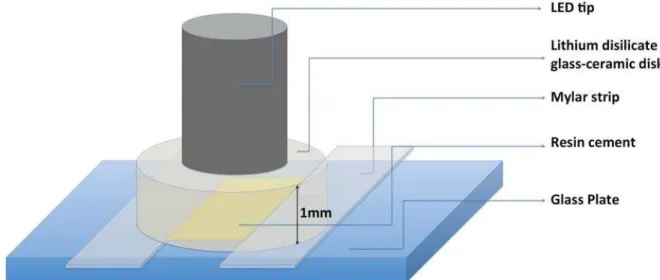
A Mylar strip was positioned over a glass plate and two adhesive tape strips (3M) were placed over the Mylar strip to act as spacer, ensuring standard thickness for all cements. The RC Variolink II (Figure 1), Base (shades A1 or A3; Ivoclar Vivadent, Schaan, Liechtenstein), and catalyst (A1 or A3, respectively; Ivoclar Vivadent, Schaan, Liechtenstein) were mixed and applied to the glass plate, and the disk-shaped specimen was placed over them to create a RC layer with approximately
100 μm thick underneath the ceramic disc (Figure
2). The samples were photo-activated through ceramic with a LED source (Radii Plus; 2000 mW/ cm2, SDI Limited, Bayswater, Victoria, Australia).
The LED was applied for one minute to ensure polymerization of both cement shades.
D e t e r m in a t ion of color a n d t r a n slu ce n cy The color of discs was measured, before and after RCs placement, according to the CIEL*a*b* system,
Inc., Chiyoda-ku, Tokyo, Japan), operating in the
equipped with an integrating sphere. The color of each experimental group was measured over different backgrounds as described below in three coordinate dimensions of L* [from 0 [black] to 100
* 1
* 0)
2+(a* 1
* 0)
2+(b* 1
* 0)
2]½
in which the subscripted 0 represents the color
without cement (control) and the subscripted 1 represents the ceramic color with the respective underlying cement. Both measurements were performed using white background (standard calibration tile with CIE L*=92.95, a*=-0.78, b*=3.57L). Under uncontrolled clinical conditions, average color differences below 3.3 are unnoticeable, due to match in the oral environment. Then, to
of 3.3 was selected as the clinically unacceptable threshold in this study11,12,15,17,18,20.
The translucency parameter (TP) of each specimen was determined by calculating the difference in color between readings over black (standard calibration tile with CIE L*=24.58, a*=0.27, b*=2.58) and white (same tile used for
TP= [(L* B–L
* W)
2 + (a* B–a
* W)
2+(b* B–b
* W)
2]½
in which the subscripts B and W refer to measurements
as the color difference of a material of a given thickness over white and black backgrounds, and corresponds directly to regular visual assessments. A TP value of zero corresponds to a completely opaque material and the greater the TP value, the higher the actual translucency of the material11,14.
In addition, the chroma parameter of all groups
was calculated using the following formula27:
C* ab=(a
* 2+b
* 2)
½.
Product (Manufacturer) Composition (Batch Number) Type of material
Variolink II low viscosity (Ivoclar Vivadent, Schaan,
Liechtenstein)
3DVWHRIGLPHWKDFU\ODWHVLQRUJDQLF¿OOHUV \WWHUELXPWULÀXRULGHLQLWLDWRUVVWDELOL]HUVDQGSLJPHQWV
Bis-GMA; TEGDMA; UDMA; benzoyl peroxide. (A1-shade base paste: P05721; A1-(A1-shade catalyst paste:
P84939 / A3-shade base paste: M24812; A3-shade catalyst paste: M01202)
Resin luting cement
IPS e.max Press shade LT and HT
(Ivoclar Vivadent, Schaan, Liechtenstein)
SiO2, Al2O3, ZnO2, Na2O, K2O, ZrO, CaO, P2O5ÀXRULGH and pigments
Pressed ceramic, low glass content (lithium disilicate
Abbreviations: TEGDMA: triethylene glycol dimethacilate; Bis GMA: bisphenol A diglycidyl ether methacrylate; UDMA: urethane dimethacrylate
Figure 1- Brand, composition, and batch number of the materials
St a t ist ica l a n a lysis
The two-way ANOVA in a multivariate general linear model was used to detect significant differences between groups, with the factors “ceramic translucency”, “cement shade” and the interaction between them, followed by Tukey’s
post - hoc test at a pre-set alpha of 5%. Post - hoc
power test was performed for both factors. The data were analyzed by a personal statistical software (Statistics 19, SPSS Inc, IBM Company, Armonk, New York, USA).
RESULTS
factors ceramic translucency and cement shade (p<0.0001) with power higher than 90%, but no
was detected (p>0.05) for any of the evaluated
of LT ceramic, regardless of RC shade. Also, the
used than when A1-shade cement was placed under the ceramics, regardless of ceramic translucency (Table 1).
than that of LT ceramics, regardless of the presence
between ceramic discs with A1-shade RC and those with A3-shade cement. However, TP was
RC layer in comparison to that observed in ceramic discs without RC (Table 2). On the other hand, the
that of LT ceramic, regardless of the RC shade.
chroma of ceramics with A1-shade RC and that of ceramics without an underlying RC layer. However, the presence of A3-shade RC layer resulted in higher chroma than that obtained in the presence of A1-shade RC layer or without underlying RC (Table 3).
D I SCUSSI ON
ceramics were higher than those observed in LT ceramics. Also, the use of A3-shade RC under the
Cement shade LT HT Average of each cement
A1 1.46 (0.35) 1.93 (0.31) 1.69 (0.40)a
A3 2.55 (0.37) 3.04 (0.27) 2.79 (0.40)b
Average of each ceramic 2.00 (0.67)A 2.49 (0.65)B
Table 1-&RORUGLIIHUHQFHǻ(LQ/7DQG+7FHUDPLFVDIWHUFHPHQWLQVHUWLRQVWDQGDUGGHYLDWLRQVWKHPHDQVIROORZHG
E\GLIIHUHQWOHWWHUV>XSSHUFDVHOHWWHUVZLWKLQWKHFROXPQVFHUDPLFDQGORZHUFDVHOHWWHUVZLWKLQWKHURZVFHPHQW@DUH VLJQL¿FDQWO\GLIIHUHQWS
Cement shade LT HT Average of each cement
No cement 17.04 (0.48) 17.87 (0.46) 17.46 (1.12)b
A1 15.42 (0.27) 16.14 (0.42) 15.78 (0.75)a
A3 15.34 (0.56) 16.46 (0.77) 15.90 (0.92)a
Average of each ceramic 15.93 (0.91)A 16.82 (0.94)B
Table 2- Translucency parameter (TP) means (standard deviations) of LT and HT ceramics before and after cement insertion. The means followed by different letters [upper case letters within column (ceramic) and lower case letters within
URZFHPHQW@DUHVLJQL¿FDQWO\GLIIHUHQWS
Cement shade LT HT Average of each cement
No cement 21.44 (1.25) 17.47 (0.13) 19.46 (2.25)b
A1 21.62 (0.99) 18.97 (0.98) 19.85 (1.98)b
A3 22.73 (1.20) 19.86 (0.36) 21.29 (1.73)a
Average of each ceramic 21.93 (1.22)A 18.47 (1.08)B
Table 3- Mean of C*
ab (standard deviations) of LT and HT ceramics before and after placement of RC with different shades.
The means followed by different letters [upper case letters within the columns (ceramic) and lower case letters within the
A1-shade RC, regardless of ceramic translucency.
that the change in color promoted by the RC under the HT ceramics is not different from that observed in LT ceramics regardless of the cement shade was
restorations with thicknesses lower than 2.0 mm are susceptible to color changes depending on the RC shade10,13,24,25. In agreement with our results, Chen,
et al.9 (2015) observed that resin cements can
(IPS e.Max Press, LT A3) and the extent of this effect varies according to the resin cement shades. However, it should be pointed out that the lithium disilicate glass ceramics evaluated in this study are more translucent than other ceramic types (e.g.
3,11,
therefore it is expected that the effects of underlying RC layer on the restoration shade should be less
11
(2015) observed in a multilayered glass-ceramic veneers that color changes for body and cervical regions were not affected by resin color or ceramic thickness, but the incisal area was affected. The higher translucency of lithium disilicate ceramics is a consequence of its unique microstructure containing large amount of a glassy phase and a relatively translucent crystal (lithium disilicate, Li2Si2O5)1.
The presence of a RC layer under LT ceramics led to an average color change of 1.46 and 2.55 for A1- and A3-shade RC layers, respectively. On the other hand, for the HT ceramics, the presence of A1- and A3-shade RC layers under the ceramics promoted an average color change of 1.93 and 3.04, respectively. The clinical impact of such changes in color remains controversial. Some studies have shown that
can be visually perceived only by 50% of human
observers7,21,23, while others demonstrated that
the population in general distinguishes differences
3.312,20. On the other hand, Seghi, et al.21 (1989)
2.0 in monochromatic porcelain specimens may be correctly judged by 100% of observers. Also, Paris, et al.18
consider their results not clinically differentiable. Therefore, as the color changes observed in this study are within this threshold, the differences caused by cements could be detected by a human eye but could still be clinically acceptable15,17,18,20.
Besides the change in color observed in the evaluated ceramics with an underlying RC layer,
also observed, so the second alternative hypothesis
RC layer under the ceramic laminate did decrease ceramic translucency, while the use of A3-shade RC under both ceramics increased the chroma.
layer under the ceramic veneer may help mask the color of the underlying tooth substrate. However, it should be pointed out that, regardless of the presence of cement, HT ceramics always exhibited higher translucency than LT ceramics. Indeed, HT ceramics showed the closest TP values (17.87) to human enamel (18.7), as measured in a study that evaluated tooth substrates under the same conditions as in this study (1-mm thick specimens)9.
Therefore, it is important for clinicians to be able to predict the translucency of ceramic laminates when the RC is placed under them, instead of relying solely on the original translucency of such products.
Color changes were measured in ideal conditions by a spectrophotometer, so the small differences observed could be barely detected by the human
eye27. Three dimensional objects produce a
two-dimensional image via perspective projection on
the retina6. The image varies with distance from
the center of the projection. Even when equated for size, the nose looks relatively larger and the ears smaller as the distance decreases. However, it is worth noting that, along with the change in ceramic shade observed in here, we also observed
chroma. Therefore, it is reasonable to assume that all those changes together may result in perceptible and unacceptable differences by the human eye in comparison to the color and translucency of the adjacent teeth. Only further studies evaluating a simulated clinical situation comparing restored
speculation.
In this study, only one ceramic shade (A2) and one ceramic type with variable translucency were evaluated, so the results cannot be extrapolated to other ceramic types and shades. Moreover, although the use of cement base paste solely rather than the mixture between catalyst and base pastes is recommended for the cementation of ceramic veneers, the base and catalyst pastes of the RC were mixed and applied to the ceramic disc. This was done to ensure that the best polymerization was achieved in all specimens, as it can affect the resin shade28.
Based on the current results, to achieve optimal aesthetic results, clinicians must be aware not only of the color and translucency of ceramics, but also of the effects of the underlying RC layer on their optical properties, since other cement shades and ceramic combinations could produced clinically unacceptable color change10. Considering that this
shades may change the color, translucency, and chroma of ceramic laminates, care should be taken when selecting the RC shade. This issue deserves more attention when high translucent ceramic laminates are associated with darker shade RCs.
CON CLUSI ON
Within the limits of this study, it can be concluded that since HT ceramic are more translucent than LT
ceramic translucency, chroma, and shade. Although some of these differences may not be clinically differentiable, care must be taken in the selection
possible.
REFEREN CES
shades of resin luting cement on the color of ceramic veneers. Dent Mater J. 2012;31(3):354-61.
2- Azer SS, Ayash GM, Johnston WM, Khalil MF, Rosenstiel SF.
all-ceramic crowns. J Prosthet Dent. 2006;96(6):397-401. 3 - B a rat h V S, Fab e r F J, We s t l a n d S, N i e d e r m e i e r W. Spectrophotometric analysis of all-ceramic materials and their interaction with luting agents and different backgrounds. Adv Dent Res. 2003;17:55-60.
4- Blackman RB. Ceramic shade prescriptions for work authorizations. J Prosthet Dent. 1982;47(1):28-35.
5- Brewer JD, Akers CK, Garlapo DA, Sorensen SE. Spectrometric
ceramic restorations. J Dent Res. 1985;64(1):74-7.
6- Bryan R, Perona P, Adolphs R. Perspective distortion from interpersonal distance is an implicit visual cue for social judgments of faces. PLoS One. 2012;7(9):e45301.
7- Canay S, Cehreli MC. The effect of current bleaching agents on the color of light-polymerized composites in vit ro. J Prosthet Dent. 2003;89:474-8.
8- Chang J, Da Silva JD, Sakai M, Kristiansen J, Ishikawa-Nagai S. The optical effect of composite luting cement on all ceramic crowns. J Dent. 2009;37(12):937-43.
2015;59(3):172-7.
10- Chu FC, Chow TW, Chai J. Contrast ratios and masking ability of three types of ceramic veneers. J Prosthet Dent. 2007;98(5):359-64.
M, Akan E, et al. Evaluation of different thickness, die color, and resin cement shade for veneers of multilayered CAD/CAM blocks. J Prosthodont. 2015. doi: 10.1111/jopr.12367.
12- Douglas RD, Steinhauer TJ, Wee AG. Intraoral determination of the tolerance of dentists for perceptibility and acceptability of shade mismatch. J Prosthet Dent. 2007;97(4):200-8.
13- Dozic A, Kleverlaan CJ, Meegdes M, van der Zel J, Feilzer AJ.
ceramic restorations. J Prosthet Dent. 2003;90(6):563-70. 14- Johnston WM. Color measurement in dentistry. J Dent. 2009;37(Suppl 1):e2-6.
Oper Dent. 2008;33(4):386-91.
16- Kelly JR, Nishimura I, Campbell SD. Ceramics in dentistry: historical roots and current perspectives. J Prosthet Dent. 1996;75(1):18-32.
17- O'Brien WJ, Boenke KM, Groh CL. Coverage errors of two shade guides. Int J Prosthodont. 1991;4(1):45-50.
18- Paris S, Schwendicke F, Keltsch J, Dörfer C, Meyer-Lueckel H.
in vit ro. J Dent. 2013;41(Suppl 5):e28-34.
19- Rigoni P, Amaral FL, França FM, Basting RT. Color agreement
pastes and with resin cements. Braz Oral Res. 2012;26(6):516-22. 20- Ruyter IE, Nilner K, Moller B. Color stability of dental composite resin materials for crown and bridge veneers. Dent Mater. 1987;3(5):246-51.
21- Seghi RR. Effects of instrument-measuring geometry on colorimetric assessments of dental porcelains. J Dent Res. 1990;69(5):1180-3.
22- Seghi RR, Hewlett ER, Kim J. Visual and instrumental colorimetric assessments of small color differences on translucent dental porcelain. J Dent Res. 1989;68(12):1760-4.
23- Shokry TE, Shen C, Elhosary MM, Elkhodary AM. Effect of core and veneer thicknesses on the color parameters of two all-ceramic systems. J Prosthet Dent. 2006;95(2):124-9.
24- Shono NN, Al Nahedh HN. Contrast ratio and masking ability of three ceramic veneering materials. Oper Dent. 2012;37(4):406-16.
25- Turgut S, Bagis B. Effect of resin cement and ceramic thickness
in vit ro study. J Prosthet Dent. 2013;109(3):179-86.
cement thickness on the masking of various types of opaque posts. J Prosthet Dent. 2000;83(4):412-7.
27- Watanabe H, Covey D. Esthetic restorative material shade changes due to photopolymerization. Gen Dent. 2008;56(3):260-6.