Images in Clinical Hematology
372 Rev Bras Hematol Hemoter. 2013;35(5):372-3
Idiopathic cytopenia of undetermined signiicance and systemic lupus erythematosus
Romelia Pinheiro Gonçalves Fernando Barroso Duarte Maritza Cavalcante Barbosa
Universidade Federal do Ceará – UFC, Fortaleza, CE, Brazil
Conlict-of-interest Disclosure:
The authors declare no competing inancial
interest
Submitted: 5/10/2013 Accepted: 5/31/2013
Corresponding author:
Romelia Pinheiro Gonçalves Universidade Federal do Ceará – UFC
Rua Capitão Francisco Pedro, 1210, Rodolfo Teóilo
60430-370 Fortaleza, CE, Brazil
www.rbhh.org or www.scielo.br/rbhh
DOI: 10.5581/1516-8484.20130068
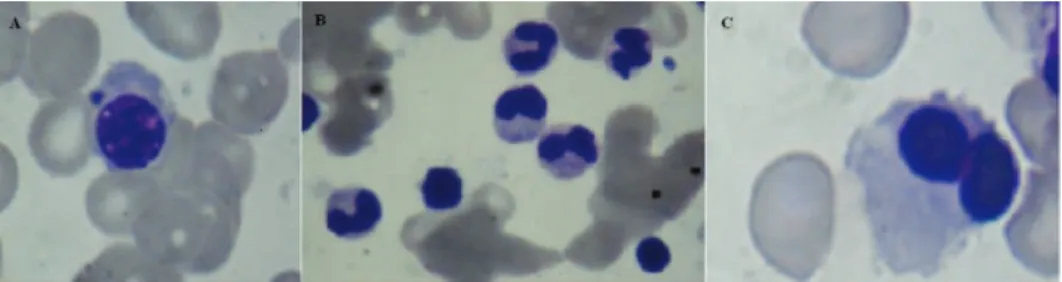
Idiopathic cytopenia of undetermined signiicance (ICUS) is characterized as less than 10% of dysplasias with less than 5% blasts in the bone marrow, however, it may be present heterogeneously. Until the present, only a small number of cases have been published and knowledge about the mechanisms and prognosis is scarce(1). Systemic lupus erythematosus (SLE) is an autoimmune disease that affects multiple organ systems, including the bone marrow(2). Data on changes in the bone marrow in patients with SLE are scarce and inconsistent, but mainly involve hypoplasia, hyperplasia, vasculitis, lymphocytosis/plasmacytosis, myeloibrosis, pure red cell aplasia and dyserythropoiesis. Dysplastic changes in all hematopoietic lineages and peripheral cytopenias have also been described in SLE patients; however, they seem to be reversible with remission of the disease(2,3). Figure 1 illustrates a case of one 18-year-old female patient with persistent refractory cytopenia and mild dysplasia in the three hematopoietic lineages compatible with ICUS. After three years of follow up she was strongly positive for antinuclear antibodies and evolved with glomerulonephritis, characterizing SLE. Figures 2A & B illustrate the cytogenetic analysis with karyotyping by G-band and Fluorescence in situ Hybridization (FISH) for 5q- negative.
Figure 1 – Dysplastic changes of the erythroid, granulocytic and megakaryocytic lineages in bone marrow
aspirate
(A) Dyserythropoiesis; (B) Dysgranulopoiesis; (C) Dysmegakaryopoiesis: May-Grunwald-Giemsa staining. Magniication: 100x
Figure 2 – Cytogenetic analysis
373
Idiopathic cytopenia of undetermined signiicance and systemic lupus erythematosus
Rev Bras Hematol Hemoter. 2013;35(5):372-3 References
1. Valent P, Bain BJ, Bennett JM, Wimazal F, Sperr WR, Mufti G, et al. Idiopathic cytopenia of undetermined signiicance (ICUS) and idiopathic dysplasia of uncertain signiicance (IDUS), and their distinction from low risk MDS. Leuk Res. 2012;36(1):1- 5.
2. Oka Y, Kameoka J, Hirabayashi Y, Takahashi R, Ishii T, Sasaki T, et al. Reversible bone marrow dysplasia in patients with systemic lupus erythematosus. Intern Med. 2008;47(8):737-42.
3. Valent P, Horny HP, Bennett JM, Fonatsch C, Germing U, Greenberg P, et al. Deinitions and standards in the diagnosis and treatment of the myelodysplastic syndromes: Consensus statements and report from a working conference. Leuk Res. 2007;31(6):727-36.