rev bras hematol hemoter. 2016;38(1):55–57
w w w . r b h h . o r g
Revista
Brasileira
de
Hematologia
e
Hemoterapia
Brazilian
Journal
of
Hematology
and
Hemotherapy
Special
article
Hemolytic
vascular
inflammation:
an
update
Nicola
Conran
a,∗,
Camila
Bononi
Almeida
baUniversidadeEstadualdeCampinas(UNICAMP),Campinas,SP,Brazil
bInstitutoIsraelitadeEnsinoePesquisaAlbertEinstein(IIEPAE),SãoPaulo,SP,Brazil
a
r
t
i
c
l
e
i
n
f
o
Articlehistory:
Received6October2015 Accepted6October2015
Availableonline28November2015
Intravascularhemolysiscanoccur inanumberofdiseases, includingsepsis,malariaandthehemolyticanemias[sickle cell disease (SCD), paroxysmal nocturnal hemoglobinuria, etc.],aswellasfollowingcertaineventssuchasmismatched transfusions.Thepathophysiologicalsignificanceof intravas-cularhemolysis had been largely ignoredin diseases such asSCDsaveforitseffectonredcellnumbers,however, rel-ativelyrecent studies haveshed lightonthe majoreffects thathemolyticprocesseshaveonvascularbiology,particularly onthe endothelium,inflammatoryprocessesandoxidative stress.
Under normal circumstances, hemoglobin (Hb) is con-tainedintheredbloodcells(RBCs),andemployedprimarily foroxygen transport. However,the destruction of RBC (i.e. hemolysis)resultsintherelease ofHbinto thecirculation. Ifthis hemoglobinisnotneutralizedimmediatelyinto less toxicmetabolitesbyspecializedscavengerproteins,suchas haptoglobin and hemopexin, as canoccur whenextensive hemolysisoverwhelms innate protective mechanisms, this cell-freeHbcauseschaos.1Thepotentialextentofthis
dam-agewasperhapsfirstrecognizedwhenReiteretal.2showed
that the decompartmentalization of Hb into the plasma significantlyimpairsvascularnitric oxide(NO) bioavailabil-ity, potentially facilitating vasoconstriction and alterations
∗ Correspondingauthorat:CentrodeHematologiaeHemoterapia,UniversidadeEstadualdeCampinas(Unicamp),RuaCarlosChagas,
480,BarãoGeraldo,13081-970Campinas,SP,Brazil. E-mailaddress:[email protected](N.Conran).
in blood flow, as well asinducing endothelial dysfunction and plateletactivation.3,4 Whilethe contributionof
hemol-ysisandsubsequentNOdepletiontomanifestationsofSCD, suchaspulmonaryhypertension,hasbeendisputed,5more
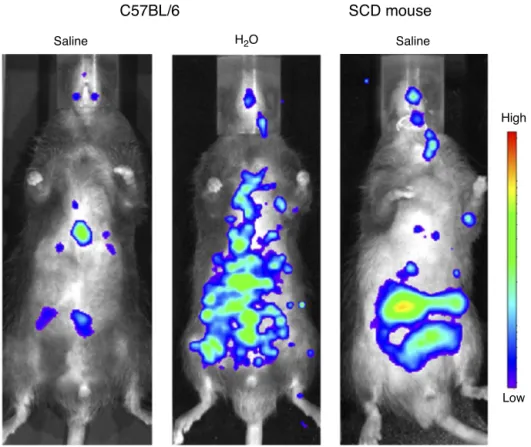
recent evidencehashighlighted the significanteffects that intravascularhemolysishasoninflammatoryprocesses.The inductionofacutehemolyticeventsinC57BL/6mice(using intravenouswaterinjections,resultinginplasmalevelsof cell-freeHbthatweresimilartothoseseeninmicewithSCD)was foundtoinducearapidand extensivesystemicand vascu-larinflammatory response(within15min).Thisispossibly mediatedbyvascularNOconsumption,andleadstoextensive systemicinflammation(Figure1)andleukocyterecruitment tothebloodvessels.6Giventheevidencethatinflammation
andleukocyteadhesiontotheendotheliumcaninitiateand propagatevaso-occlusiveprocesses,7,8itisreasonableto
con-cludethatvascularinflammatoryprocessesthataretriggered byacuteintravascularhemolyticeventsmaybeof pathophy-siologicalsignificanceinSCDaswellasintheotherdiseases ormedicaleventsinwhichtheyoccur.
Once oxyhemoglobin hasreacted withNO inthe blood vessel,Hb-Fe3+isformedandcanaccumulatebothinthe
cir-culation andintissues.9 In asecondaryHb-mediatedtoxic
mechanism,Hb-Fe3+releasesdamaginghemin,ahydrophobic
http://dx.doi.org/10.1016/j.bjhh.2015.10.004
56
revbrashematolhemoter.2016;38(1):55–57C57BL/6
Saline Saline
High
Low H2O
SCD mouse
Figure1–QuantificationofsystemicinflammationinvivousingtheIVISLuminaSystem®(CaliperLifeSciences,MA). Imagesobtained15minafterintravenousinjectionsofsalineorwater(150L)inC57BL/6miceandachimericsicklecell
diseasemouse.Achemiluminescentprobe(XenoLightRedijectInflammationProbe;PerkinElmer,MA)wasinjectedinthe
mousetoquantifymyeloperoxidaseproductionofactivatedphagocytesandneutrophils.Similardatawereoriginally reportedinreference6.
moleculeshowntoinduceneutrophilextracellulartrap(NET) production, stimulate inflammasome formation and cause toll-like receptor (TLR)-4-mediated vaso-occlusion in mice withSCD, as well as lipoprotein oxidation.10–13 These
sec-ondaryinflammatoryandoxidativeeffectsofheminappear tooccurinalessimmediate,6butprobablymoresustained
manner,causingtissuedamageandendothelialdysfunction, aswellassustainingleukocyteactivationinthebloodvessels.9
Hemolysis,therefore,representsamajordisease mecha-nismandfailuretoneutralizeHbafteritsreleasefromtheRBC canresultinvascularinflammationandorgandysfunction, potentially contributingtoclinical complications that have beenassociatedwithhemolyticdiseases,suchaspriapism, pulmonaryhypertensionandlegulcers.14
Conflicts
of
interest
Theauthorsdeclarenoconflictsofinterest.
Acknowledgments
TheauthorsaregratefultoLucasEduardoBotelhodeSouza and Prof.Dr. Dimas Tadeu Covasfor assistance with IVIS experiments depicted herein. The IVIS experiments were fundedbyFAPESP(grants2008/50582-3;11/50959-7[CBA]).
r
e
f
e
r
e
n
c
e
s
1.SchaerDJ,VinchiF,IngogliaG,TolosanoE,BuehlerPW.
Haptoglobin,hemopexin,andrelateddefensepathways-basic
science,clinicalperspectives,anddrugdevelopment.Front
Physiol.2014;5:415.
2.ReiterCD,WangX,Tanus-SantosJE,HoggN,CannonRO3rd,
SchechterAN,etal.Cellfreehemoglobinlimitsnitricoxide
bioavailabilityinsickle-celldisease.NatMed.
2002;8(12):1383–9.
3.GladwinMT,CrawfordJH,PatelRP.Thebiochemistryofnitric
oxide,nitrite,andhemoglobin:roleinbloodflowregulation.
FreeRadicBiolMed.2004;36(6):707–17.
4.HelmsCC,MarvelM,ZhaoW,StahleM,VestR,KatoGJ,etal.
Mechanismsofhemolysis-associatedplateletactivation.J
ThrombHaemost.2013;11(12):2148–54.
5.BunnHF,NathanDG,DoverGJ,HebbelRP,PlattOS,RosseWF,
etal.Pulmonaryhypertensionandnitricoxidedepletionin
sicklecelldisease.Blood.2010;116(5):687–92.
6.AlmeidaCB,SouzaLE,LeonardoFC,CostaFT,WerneckCC,
CovasDT,etal.Acutehemolyticvascularinflammatory
processesarepreventedbynitricoxidereplacementora
singledoseofhydroxyurea.Blood.2015;126(6):
711–20.
7.TurhanA,WeissLA,MohandasN,CollerBS,FrenettePS.
Primaryroleforadherentleukocytesinsicklecellvascular
occlusion:anewparadigm.ProcNatlAcadSciUSA.
revbrashematolhemoter.2016;38(1):55–57
57
8. FrenettePS.Sicklecellvasoocclusion:heterotypic,
multicellularaggregationsdrivenbyleukocyteadhesion.
Microcirculation.2004;11(2):167–77.
9. SchaerDJ,BuehlerPW,AlayashAI,BelcherJD,VercellottiGM.
Hemolysisandfreehemoglobinrevisited:exploring
hemoglobinandheminscavengersasanovelclassof
therapeuticproteins.Blood.2013;121(8):1276–84.
10.ChenG,ZhangD,FuchsTA,ManwaniD,WagnerDD,Frenette
PS.Heme-inducedneutrophilextracellulartrapscontributeto
thepathogenesisofsicklecelldisease.Blood.
2014;123(24):3818–27.
11.BelcherJD,ChenC,NguyenJ,MilbauerL,AbdullaF,Alayash
AI,etal.HemetriggersTLR4signalingleadingtoendothelial
cellactivationandvaso-occlusioninmurinesicklecell
disease.Blood.2014;123(3):377–90.
12.DutraFF,AlvesLS,RodriguesD,FernandezPL,deOliveiraRB,
GolenbockDT,etal.Hemolysis-inducedlethalityinvolves
inflammasomeactivationbyheme.ProcNatlAcadSciUSA.
2014;111(39):E4110–8.
13.SchaerDJ,BuehlerPW.Cell-freehemoglobinandits
scavengerproteins:newdiseasemodelsleadingthewayto
targetedtherapies.ColdSpringHarbPerspectMed.2013;3(6),
pii:a013433.
14.ConranN.Intravascularhemolysis:adiseasemechanismnot