Deported Mexican migrants:
health status and access to care
Migrantes mexicanos deportados:
exploração do estado de saúde e
acesso a serviços de saúde
I Centro de Investigación en Evaluación y Encuestas. Instituto Nacional de Salud Pública. Cuernavaca (Mor), México II Departamento de Estudios de Población. El
Colegio de la Frontera Norte. Tijuana, Baja California, México
III Facultad de Economía y Relaciones Internacionales. Universidad Autónoma de Baja California. Tijuana, Baja California, México
Correspondência | Correspondence: Ietza Bojorquez-Chapela
Senior Researcher
Departamento de Estudios de Población Colegio de la Frontera Norte
Km. 18.5, Carretera Escénica Tijuana-Ensenada, San Antonio del Mar
C.P. 22560 Tijuana (Baja California), México E-mail: [email protected]
Received: 8/24/2013 Approved: 3/2/2014
Artigo disponível em português e inglês em: www.scielo.br/rsp
ABSTRACT
OBJECTIVE: To describe the health status and access to care of forced-return Mexican migrants deported through the Mexico-United States border and to compare it with the situation of voluntary-return migrants.
METHODS: Secondary data analysis from the Survey on Migration in Mexico’s Northern Border from 2012. This is a continuous survey, designed
to describe migration lows between Mexico and the United States, with a
mobile-population sampling design. We analyzed indicators of health and access to care among deported migrants, and compare them with voluntary-return migrants. Our analysis sample included 2,680 voluntary-voluntary-return migrants, and 6,862 deportees. We employ an ordinal multiple logistic regression model, to compare the adjusted odds of having worst self-reported health between the studied groups.
RESULTS: As compared to voluntary-return migrants, deportees were less likely to have medical insurance in the United States (OR = 0.05; 95%CI 0.04;0.06). In the regression model a poorer self-perceived health was found to be associated with having been deported (OR = 1.71, 95%CI 1.52;1.92), as well as age (OR = 1.03, 95%CI 1.02;1.03) and years of education (OR = 0.94 95%CI 0.93;0.95).
CONCLUSIONS: According to our results, deportees had less access to care while in the United States, as compared with voluntary-return migrants. Our
results also showed an independent and statistically signiicant association
between deportation and having poorer self-perceived health. To promote the health and access to care of deported Mexican migrants coming back from the United States, new health and social policies are required.
DESCRIPTORS: Emigration and Immigration. Mexico. United States. Health Services Accessibility. Health Evaluation. Health Inequalities.
Julián Alfredo Fernández-NiñoI
Carlos Jacobo Ramírez-ValdésII
Diego Cerecero-GarciaII,III
The deportation of Mexican migrants from the United States (US) has increased in the past years. From 2003 to 2009, according to Mexico’s National Migration Institute, there were between 525,000 and 600,000 deportations.a In 2012 alone, 369,492
persons were deported from the US to Mexico.b
Most of them were deported through the Mexico-US border, arriving into cities where they lacked social
or family support networks, and facing dificult situa -tions including social stigmatization, lack of employ-ment, and violence.4,12
RESUMO
OBJETIVO: Analisar o estado de saúde e o acesso aos serviços de saúde de imigrantes mexicanos deportados na fronteira entre México e Estados Unidos.
MÉTODOS: Foram analisados dados secundários do Inquérito sobre Migração na Fronteira do Norte do México de 2012. O inquérito é contínuo e desenhado
para descrever luxos migratórios na fronteira entre México e Estados Unidos com amostra de população móvel. Foram analisados indicadores de saúde e
de acesso aos serviços de saúde dos imigrantes deportados em comparação aos imigrantes que retornaram voluntariamente. Nossa amostra análise incluiu 2.680 migrantes de retorno voluntário, e 6.862 deportados. Foi utilizado modelo de regressão logística ordinal para comparar as probabilidades da pior autopercepção de saúde entre os grupos estudados.
RESULTADOS: Em comparação com os migrantes de retorno voluntário, deportados foram menos propensos a ter seguro médico em os Estados Unidos (OR = 0,05, IC95% 0,04;0,06). No modelo de regressão uma pior saúde auto-percebida foi associado com ser deportado (OR = 1,71, IC95% 1,52;1,92), bem como a idade (OR = 1,03, IC95% 1,02;1,03) e os anos de escolaridade (OR = 0,94, IC95% 0,93;0,95).
CONCLUSÕES: De acordo com nossos resultados, deportados tinha menos acesso aos cuidados, enquanto em os Estados Unidos, em comparação com os migrantes de retorno voluntário. Nossos resultados também mostraram uma
associação independente e estatisticamente signiicativa entre a deportação e ter
pior saúde auto-percebida. Novas políticas de saúde pública são necessárias para promover a saúde e o acesso aos serviços de saúde nos imigrantes mexicanos deportados dos Estados Unidos.
DESCRITORES: Migração Internacional. México. Estados Unidos. Acesso aos Serviços de Saúde. Avaliação em Saúde. Desigualdades em Saúde.
INTRODUCTION
While in the US, Mexican migrants (and Latinos/ Hispanics in general) have less access to health services, as well as lower socioeconomic status and worse job-related conditions, as compared to non-Hispanic whites. This in turn is associated with poorer health. Mexican migrants also face cultural, economic and language barriers to healthcare access.7,c,d As a result, they tend
to postpone the search for medical care,e using other
informal therapeutic itineraries instead such as self-medication or telephone consultation with relatives, sometimes with negative health consequences.11 All of
a París Pombo MD. Procesos de repatriación: experiencias de las personas devueltas a México por las autoridades estadounidenses. Tijuana, B.C.: Woodrow Wilson International Center for Scholars/ El Colegio de la Frontera Norte; 2010 [cited 2014 Mar 20]. Available from: http:// www.wilsoncenter.org/sites/default/files/PARIS%20POMBO%20PAPER.pdf
b México. Secretaria de Gobernación. Repatriación de mexicanos. 2012 [cited 2013 Jul 14]. Available from: http://www.politicamigratoria. gob.mx/es_mx/SEGOB/Repatriacion_de_mexicanos_2012
c U.S. Department of Health and Human Services, Agency for Healthcare Research and Quality. National Healthcare Disparities Report 2012. Rockville (MD): AHRQ; 2013 [cited 2014 Mar 20]. Available from: http://www.ahrq.gov/research/findings/nhqrdr/nhdr12/nhdr12_prov.pdf d Salgado de Snyder N, González T, Bojorquez I, Infante C. Migración México-Estados Unidos: consecuencias para la salud. Cuernavaca: Instituto Nacional de Salud Pública; 2007. (Colección Perspectivas en Salud Pública).
the above is exacerbated in the case of undocumented migrants.1,4,5 As many of them are undocumented
migrants, deportees are thus part of a more disadvan-taged group in terms of health and health care access.
On the other hand, a signiicant proportion of them have
a long history of residence in the US.f For those who
are deported after many years of living in that country, some of whom went there as children and have inte-riorized the US culture, forced return means a serious disruption in their lives.3 Other deportees are caught
within hours or days of crossing the border into the US, and they can still be suffering the health consequences of a long and risky journey. Also, deportees might not receive appropriate health care during detention prior to deportation.4
Because of the above, deportees might be at risk of diverse health conditions, and at the same time lack access to the required health services. Information about returning migrants’ health is needed in order to inform
policies aimed at their social integration.15 While some
studies have started to document some health risks faced by Mexican deportees,1 the information currently
available is still scarce.
The aim of this study was to analyze the general health status and access to health services of Mexican migrants deported through the Mexico-United States border.
METHODS
We conducted a secondary data analysis from the 2012
Encuesta de Migración en la Frontera Norte de México
(EMIF-N – Survey on Migration in Mexico’s Northern Border), a periodic survey designed to describe
migra-tory lows at the Mexico-US border. The detailed meth -odology of the survey is described elsewhere.f Briely,
it is based on mobile-population sampling methods, selecting space-time points at which in-transit persons 15 years of age or older are invited to participate, if they
fulil inclusion criteria. EMIF-N is an administrative
survey conducted by the Mexican government in order
to obtain statistical data, and no personal identiication
information is collected as part of it. The EMIF-N’s questionnaire includes sociodemographic information, and questions related to migratory experience, employ-ment, and other variables. The questionnaires and other documentation are available elsewhere.f
As part of EMIF-N, different population lows are
surveyed. For this article, we analyzed data from two
of those lows: deportees, and those entering Mexico from the US. The sampling points for the irst low are
the places right at the border through which migrants
are deported. The second low is sampled at different
points in the border cities, including border crossings, and also bus and airplane terminals. At those places, potential respondents are asked where they come from, and where they were born, and they are included in the sample if they come from the US and were born in
Mexico. The second low can include both deportees,
and migrants who return to Mexico voluntarily.
The main indicator of health status for this analysis was self-perceived health, measured through the
ques-tion: “Generally, how would you rate your health?”
For descriptive statistics, we categorized answers as very good/good versus fair/bad/very bad. For the inal
regression model, we employed the original conigura -tion of the variable in a 5-point Likert scale.
We also analyzed the presence or absence, during the past 15 days, of one or more of the following
symp-toms of physical and emotional health: fever, diarrhea,
cough, despair, sadness and lack of interest in things.
For those who had worked while in the US, we analyzed the presence or absence of health insurance at work. We also analyzed the presence or absence of other sources of health insurance in the US, including Medicare, Medicaid, and private insurance. Another indicator was the presence or absence of health insurance in Mexico, either public or private. Questions about health insur-ance in Mexico were only asked in the deportees’ ques-tionnaire, so analyses of this variable were limited to this group.
Also, we analyzed having versus not having received medical care, given the need. The analysis in this case was limited to 1,432 respondents (15.2% of the sample), who reported having required medical attention during their last stay in the US.
We compared deportees to voluntary-return migrants. We considered as deportees all persons surveyed
by EMIF-N as part of the deportees low, and those
entering Mexico from the US who answered the
question “What is your main reason for returning to Mexico?” with the option “I was returned by the Border Patrol”. We considered as voluntary-return migrants
those who answered the same questions with other
options (lack of job, insuficient income, violence or
insecurity, did not like it, health reasons, wanting to live/work in Mexico, family visit, vacation or holiday, retiring, fear of deportation, discrimination). Those who
selected the option “other” were excluded, as in this
case it was not possible to distinguish between volun-tary and forced return.
We explored the distribution of variables in the whole sample, and by comparison groups, with frequency
Table 1. Characteristics of return migrants, by comparison group.a Mexico’s Northern Border, 2012.
Variable
Voluntary return migrants Deported
p (N = 2,680)a (N = 6,862)
n % or median (interquartile range) n
% or median (interquartile range)
Male 1,717 64.1 5,846 85.2 < 0.01
Age 43 (33-53) 28 (22-36) < 0.01
Years of education 9 (6-12) 9 (6-9) < 0.01
Marital status
Married/Living with partner 2,012 75.1 4,125 60.1
Single 423 15.8 2,403 35.0 < 0.01
Divorced/Separated 159 5.9 300 4.4
Widowed 86 3.2 32 0.5
Months in US (median, interquartile range) 8 (3-24) 0.23 (0.10-12) < 0.01 Self-perceived health (Fair/Bad/Very bad) 356 13.3 520 7.8 < 0.01
≥ 1 physical symptom 229 8.5 671 10.0 0.03
≥ 1 emotional symptom 193 7.2 2,071 30.9 < 0.01 Had health insurance at work in the USb 713 36.2 129 9.2 < 0.01 Had other health insurance in the USc 1,460 55.0 87 4.2 < 0.01
Received medical care while in the US (if required) 596 70.8 328 62.6 < 0.01
Has health insurance in Mexicod NA 1,532 34.9 NA NA: Not applicable
a Sample size can vary between comparisons due to missing data. b Limited to those who had worked while in the US.
c Including medicare, medicaid, private insurance. d The question was asked of the deportee sample only. tables and measures of central tendency and dispersion. We tested the association between comparison group (deportees versus voluntary-return migrants) and the indicators of health status and access to care by means of logistic regression models, adjusted by age, gender and years of schooling. Finally, we adjusted an ordinal logistic regression model (proportional odds model), with self-perceived health in a 5-point Likert scale as the dependent variable. The model’s assumptions were tested with Brant’s test of parallel regression.
We expected that the length of time spent in the US would have a differential effect on the health of deportees and voluntary return migrants. While many studies have reported that time in the receiving country tends to have a negative impact on migrants’ health,d
we expected that for deportees this effect would be increased, as their condition of undocumented migrants would expose them to more stress and worse living conditions in general. Also, deportees with a long stay in the US could resent the effect of forced displace-ment, separation from family and friends, and lack
of identiication with the country they were returning
to, more than voluntary return migrants.3 To test this
hypothesis, we included an interaction between time in the US (< 10 versus≥ 10 years) and comparison group in the regression.9
RESULTS
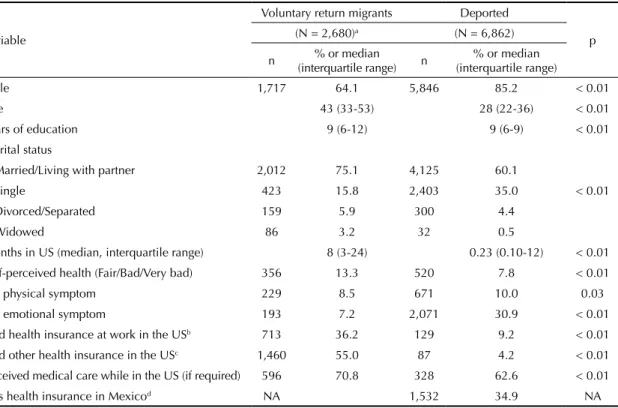
The analysis sample included 2,680 voluntary-return migrants, and 6,862 deportees. Table 1 shows the general characteristics of the sample in each
compar-ison group. Statistically signiicant differences were
observed for all variables. As compared to voluntary-return migrants, deportees were more likely to be male, younger and of lesser educational attainment. While a higher percent of voluntary-return migrants perceived their health as fair/bad/very bad, this difference disap-peared after adjusting by age and other covariables (Tables 2 and 4). Deportees were more likely to have experienced at least one physical or emotional symptom in the past 15 days.
Access to care was also different between groups. While 36.2% of voluntary-return migrants who worked in the US had health insurance, only 9.2% of
deportees had this beneit. When considering other
sources of health insurance, including Medicare, Medicaid and others, the difference was over 50
percentage points. Sixty-ive per cent of deportees
Table 2. Associations between deportation, and indicators of health and access to care.a Mexico’s Northern Border, 2012.
Variable Odds ratio 95%CI
Self-perceived health (Fair/Bad/Very bad) 1.21 1.00;1.47
≥ 1 physical symptom 1.12 0.92;1.35
≥ 1 emotional symptom 5.52 4.62;6.60 Had health insurance at work in the USb 0.20 0.16;0.25 Had other health insurance in the USc 0.05 0.04;0.06
Received medical care while in the US (if required) 0.94 0.71;1.25 a All comparisons adjusted by age, gender, and years of education.
b Limited to those who had worked while in the US (N = 3,783). c Including medicare, medicaid, private insurance.
Table 3. Ordinal logistic multiple regression model for self-perceived health: Model 1.a Mexico’s Northern Border, 2012.
Variable Odds ratio 95%CI p
Deportee (reference: voluntary return) 1.71 1.52;1.92 < 0.01 Lived in the US ≥ 10 years 1.18 0.81;1.73 0.39
Interaction deporteeb lived in the US ≥ 10 years 0.68 0.44;1.03 0.07
Gender (male) 0.93 0.84;1.04 0.20
Age (years)c 1.03 1.02;1.03 < 0.01 Years of educationc 0.94 0.93;0.95 < 0.01
Cut 1 -0.43 -0.71;-0.14
Cut 2 3.08 2.79;3.38
Cut 3 5.77 5.39;6.15
Cut 4 8.58 7.56;9.60
a Proportional odds model. Dependent variable: self-perceived health in ordinal Likert scale (higher score indicates worst perceived health).
b Multiplicative term between Deportee and lived in the US ≥ 10 years. c As continuous variables.
Table 2 shows the odds ratios (OR) associated with deportation, with different indicators of health status and access to care as dependent variables. Deportees were more likely to perceive their health as fair/bad/ very bad (OR = 1.21; 95%CI 1.00;1.47), and also to report emotional symptoms (OR = 5.52; 95%CI 4.62;6.60). On the other hand, they were less likely to have medical insurance in the US (OR = 0.05; 95%CI 0.04;0.06) and also to receive care given the need (OR = 0.94; 95%CI 0.71;1.25), although this last
comparison did not reach statistical signiicance.
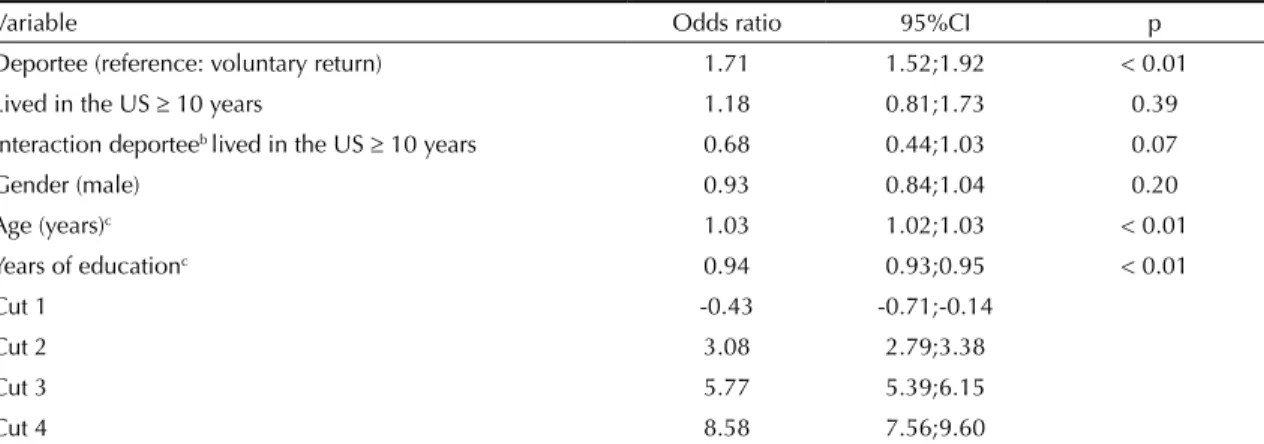
The model in Table 3 again showed a direct associa-tion between being deported and reporting poorer self-perceived health (OR = 1.71; 95%CI 1.52;1.92). The interaction between comparison group and time in the US (< 10 versus≥ 10 years) had a p-value of 0.07, which can be considered significant in tests of hypothesis for interaction.9 As indicated by
the OR for the interaction (0.68), contrary to the authors’ hypothesis, time in the US was protective for deportees, while it increased the possibility of having worse self-perceived health among voluntary-return migrants (OR = 1.18). Considering that this
could relect that, among deportees, those who had
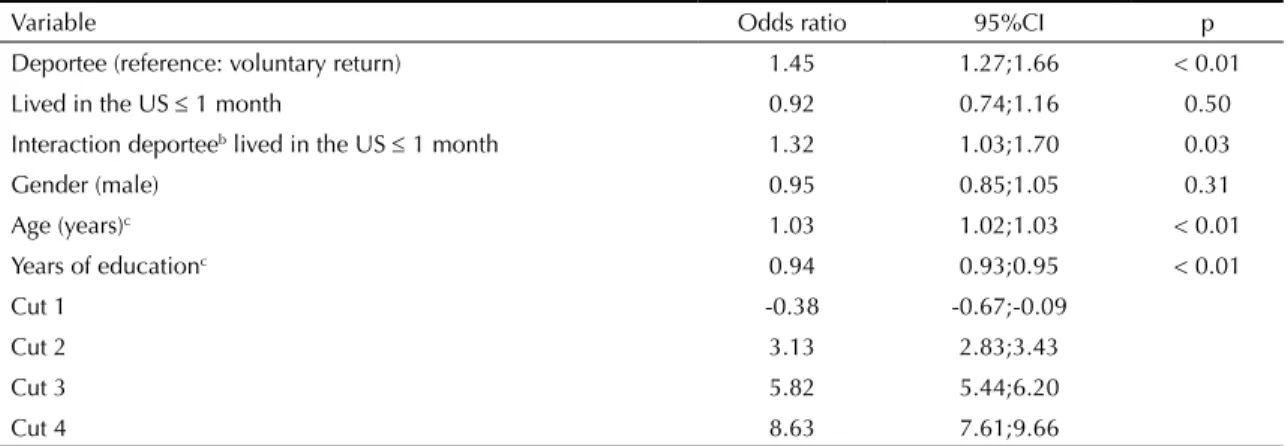
stayed in the US for only a few days might be actu-ally resenting the impacts of their migratory journey, we adjusted a model with time in the US categorized as ≤ 1 month (1) versus > 1 month (0). The results are shown in Table 4. According to the model results, among deportees a stay of one month or less increased the odds of reporting worse self-perceived health. In both models, the cut-off points of the latent variable followed the expected proportional increase.
DISCUSSION
According to our results, deportees had less access to care while in the US, as compared with voluntary-return migrants. The difference was observed even for
medical insurance beneits among those who worked,
Table 4. Ordinal logistic multiple regression model for self-perceived health: Model 2.a Mexico’s Northern Border, 2012.
Variable Odds ratio 95%CI p
Deportee (reference: voluntary return) 1.45 1.27;1.66 < 0.01
Lived in the US ≤ 1 month 0.92 0.74;1.16 0.50 Interaction deporteeb lived in the US ≤ 1 month 1.32 1.03;1.70 0.03
Gender (male) 0.95 0.85;1.05 0.31
Age (years)c 1.03 1.02;1.03 < 0.01
Years of educationc 0.94 0.93;0.95 < 0.01
Cut 1 -0.38 -0.67;-0.09
Cut 2 3.13 2.83;3.43
Cut 3 5.82 5.44;6.20
Cut 4 8.63 7.61;9.66
a Ordinal logistic regression model. Dependent variable: self-perceived health in ordinal Likert scale (higher score indicates worst perceived health).
b Multiplicative term between deportee and lived in the US ≥ 10 years. c As continuous variables.
National Health and Nutrition Survey.g The percentage
was even lower for deportees who had lived in the US for a longer period. The Latino/Hispanic population in the US is known to generally have limited health care access18,h and this disadvantage remains even after
adjusting for socioeconomic status.6 The reasons behind
this low coverage include both economic disadvan-tage, and geographic, cultural and linguistic barriers to effective access.7,d However, even within this group
deportees seem to come from a particularly vulnerable population. Mexico’s health system faces an impor-tant challenge in this regard. While some efforts have been made to increase health care access for Mexican migrants,20 they usually do not take into account the
special situation of deportees. Including both forced and voluntary return migrants in Mexico’s future universal coverage scheme8 will be increasingly important, if
the number of Mexicans coming back from the US continues to grow.
Our results also showed an independent and statistically
signiicant association between deportation and having
poorer self-perceived health. Diverse situations could explain the difference between deportees and voluntary-return migrants in this regard, among them that their undocumented migrant status places them at risk of worse living and work conditions.1,4,19 The inding that
for deportees a stay of 10 or more years in the US was protective, while a stay of one month or less increased the possibility of worse self-perceived health, could mean that, among this group, those who had stayed in that country for only a few days were actually resenting the impacts of a dangerous border crossing.
Self-perceived (bad) health at the time on return to Mexico is the expression of an accumulation of vulner-abilities.4 Perceived health has been associated with
mortality in longitudinal studies,21 correlated with
biomedical indicators of health status,14 and is also
a general indicator of well-being, expressing subjec-tivity and idiosyncratic health ideals.2 On the other
hand, deportation was also associated with increased odds of reporting emotional symptoms. Self-report of health and mental health symptoms have been shown to
inluence each other, so our results might also indicate
the experience of a set of health problems, including somatic as well as mental aspects.16 In both senses, our
results point not only to the need for health care initia-tives directed at return migrants, but to the importance of developing adequate policies for their economic, social and psychosocial inclusion.15
While the literature documents the dificulties that immi -grants face in countries of arrival, few studies have so far addressed the health of forced-return migrants. Among these, a recent study reported experiences of encultura-tive stress among Salvadoran deportees,10 and a series of
studies on HIV risk among Mexican deportees show that the contextual conditions can increase or protect against risk-taking.13 Also, although forced displacement due to
conlict or natural disasters is not the same phenomenon
as deportation, it shares its aspects of non-voluntariness and uncertainty. Among displaced populations, mental health problems have also been shown to increase.17 Our
study adds to this literature by documenting not only the
health problems, but also the health access dificulties
faced by forced-return migrants. All of the above stresses the need to develop global policies to offer health-care services to these populations.
g Instituto Nacional de Salud Pública; Secretaría de Salud. Encuesta Nacional de Salud y Nutrición 2012: resultados nacionales: síntesis ejecutiva. Cuernavaca, Mexico; 2012.
One limitation of our study is the secondary use of EMIF-N data, which are collected with more general purposes and do not include precise indicators of health or access to care. In this sense, our analysis constitutes a preliminary exploration, which should be enriched by other, ad hoc studies. One interesting aspect would be to describe the health status and access to care of return migrants longitudinally, as our data was collected at
the time of entry into Mexico, and thus cannot relect
the positive or negative changes with time after return.
Health is a right, and a social justice issue which should be considered in all policies.i Research on the
health of deportees and voluntary-return migrants is necessary to inform policies aimed to the well-being of this population.
1. Amuedo-Dorantes C, Puttitanun T, Martinez-Donate AP. How do tougher immigration measures affect unauthorized immigrants? Demography. 2013;50(3):1067-91. DOI:10.1007/s13524-013-0200-x
2. Bombak AE, Bruce SG. Self-rated health and ethnicity: focus on indigenous populations. Int J Circumpolar Health. 2012;71:18538. DOI:10.3402/ijch.v71i0.18538
3. Brotherton DC, Barrios L. Displacement and stigma: the social-psychological crisis of the deportee. Crime Media Cult. 2009;5(1):29-55. DOI:10.1177/1741659008102061
4. Davies AA, Borland RM, Blake C, West HE. The dynamics of health and return migration. PLoS Med. 2011;8(6):e1001046. DOI:10.1371/journal.pmed.1001046
5. Heyman JM, Nunez GG, Talavera V. Healthcare access and barriers for unauthorized immigrants in El Paso County, Texas. Fam Community Health. 2009;32(1):4-21. DOI:10.1097/01.FCH.0000342813.42025.a3
6. Huang ZJ, Yu SM, Ledsky R. Health Status and Health Service Access and Use among Children in U.S. Immigrant Families. Am J Public Health. 2006;96(4):634-64. DOI: 10.2105/AJPH.2004.049791
7. Juckett G. Caring for Latino patients. Am Fam Physician. 2013;87(1):48-54.
8. Knaul FM, Gonzalez-Pier E, Gómez-Dantés O, Garcia-Junco D, Arreola-Ornelas H, Barraza-Lloréns M, et al. Hacia la cobertura universal en salud: protección social para todos en México. Salud Publica Mex. 2013;55(2):207-35. DOI:10.1590/S0036-36342013000200013
9. McClelland GH, Judd CM. Statistical difficulties of detecting interactions and moderator effects. Psychol Bulletin. 1993;114(2):376-90. DOI:10.1037/0033-2909.114.2.376
10. Negy C, Reig-Ferrer A, Gaborit M, Ferguson C. Psychological Homelessness and Enculturative Stress among US-Deported Salvadorans: A Preliminary Study with a Novel Approach. J Immigr Minor Health. 2014 [Epub ahead of print]. DOI:10.1007/s10903-014-0006-y
11. Nigenda G, Ruiz-Larios JA, Bejarano-Arias RA, Alcalde-Rabanal JE, Bonilla-Fernández P. Análisis de las alternativas de los migrantes mexicanos en Estados Unidos de América para atender sus problemas de salud. Salud Publica Mex. 2009;51(5):407-16. DOI:10.1590/S0036-36342009000500008
12. Ojeda VD, Robertson AM, Hiller SP, Lozada R, Cornelius W, Palinkas LA, et al. A qualitative view of drug use behaviors of Mexican male injection drug users deported from the United States. J Urban Health. 2011;88(1):104-17. DOI:10.1007/s11524-010-9508-7
13. Pinedo M, Burgos JL, Ojeda VD. A critical review of social and structural conditions that influence HIV risk among Mexican deportees. Microbes Infect. 2014 Feb 26. pii: S1286-4579(14)00020-3. doi: 10.1016/j. micinf.2014.02.006. Siriwardhana C, Stewart R. Forced migration and mental health: prolonged internal displacement, return migration and resilience. Int Health. 2013;5(1):19-23. DOI:10.1093/inthealth/ihs014.
14. Quesnel-Vallée A. Self-rated health: caught in the crossfire of the quest for ‘true’ health?. Int J Epidemiol. 2007;36(6):1161-4. DOI:10.1093/ije/dym236
15. Ruben R, Van Houte M, Davids T. What determines the embeddedness of forced-return migrants? Rethinking the role of pre- and post-return assistance. Int Migr Rev. 2009;43(4):908-37. DOI:10.1111/j.1747-7379.2009.00789.x
16. Schmitz N, Lesage A, Wang J. Should psychological distress screening in the community account for self-perceived health status? Can J Psychiatry. 2009;54(8):526-33.
17. Siriwardhana C1, Stewart R. Forced migration and mental health: prolonged internal displacement, return migration and resilience. Int Health. 2013 Mar;5(1):19-23. DOI:10.1093/inthealth/ihs014.
18. Smedley BD, Stith AY, Nelson AR, editors. Unequal treatment: confronting racial and ethnic disparities in health care. Washington (DC): The National Academies Press; 2003.
19. Smith-Nonini S. The illegal and the dead: are Mexicans renewable energy?.Med Anthropol. 2011;30(5):454-74. DOI:10.1080/01459740.2011.577045
20. Vargas Bustamante A, Laugesen M, Caban M, Rosenau P. United States-Mexico cross-border health insurance initiatives: Salud Migrante and Medicare in Mexico. Rev Panam Salud Publica. 2012;31(1):74-80. DOI:10.1590/S1020-49892012000100011
21. Yu ES, Kean YM, Slymen DJ, Liu WT, Zhang M, Katzman R. Self-perceived health and 5-year mortality risks among the elderly in Shanghai, China. Am J Epidemiol. 1998;147(9):880-90. DOI:10.1177/0164027599213002.
REFERENCES