26
ABSTRACT:Introduction: Since 2003, the access to medication has been increasing in Brazil and particularly in São Paulo. The present study aimed to analyze the access to medication obtained in the public sector and the socioeconomic diferences in this access in 2003 and 2008. Also, we explored the diference in access to medication from 2003 to 2008. Method: Data were obtained from two cross-sectional population-based household surveys from São Paulo, Brazil (ISA-Capital 2003 and ISA-Capital 2008). Concentration curve and concentration index were calculated to analyze the associations between socioeconomic factors and access to medication in the public sector. Additionally, the diferences between 2003 and 2008 regarding socioeconomic characteristics and access to medication were studied. Results: Access to medication was 89.55% in 2003 and 92.99% in 2008, and the proportion of access to medication did not change in the period. Access in the public sector increased from 26.40% in 2003 to 48.55% in 2008 and there was a decrease in the concentration index between 2003 and 2008 in access to medication in the public sector. Conclusions: The indings indicate an expansion of Brazilian Uniied Health System (Sistema Único de Saúde) users, with the inclusion of people of higher socioeconomic position in the public sector. As the SUS gives more support to people of lower socioeconomic position in terms of medication provision, the SUS tends to equity. Nevertheless, universal coverage for medication and equity in access to medication in the public sector are still challenges for the Brazilian public health system.
Keywords: Healthcare disparities. Medication systems. Equity in health. Equity in access. Pharmaceutical services. Universal access to health care services.
Access to medication in the Public Health
System and equity: populational
health surveys in São Paulo, Brazil
Acesso a medicamentos pelo Sistema Único de Saúde e equidade: inquéritos
de base populacional em São Paulo, Brasil
Camila Nascimento MonteiroI, Reinaldo José GianiniI,II, Marilisa Berti de Azevedo BarrosIII, Chester Luiz Galvão CesarIV, Moisés GoldbaumI
ORIGINAL ARTICLE / ARTIGO ORIGINAL
IDepartment of Preventive Medicine, School of Medicine, Universidade de São Paulo – São Paulo (SP), Brazil. IISchool of Medicine, Pontifícia Universidade Católica de São Paulo – Sorocaba (SP), Brazil.
IIISchool of Medicine, Universidade Estadual de Campinas– Campinas (SP), Brazil. IVSchool of Public Health, Universidade de São Paulo– São Paulo (SP), Brazil.
Corresponding author: Camila Nascimento Monteiro. Universidade de São Paulo. Avenida Dr. Arnaldo, 455, Cerqueira César, CEP 01246-903, São Paulo, SP, Brasil. E-mail: [email protected]
INTRODUCTION
The public health care system in Brazil is universal and aims to provide vaccination, phar-maceutical care, general practice, medical specialists, hospital care, dental care and others
health care services to all1. The Brazilian Uniied Health System (Sistema Único de Saúde – SUS)
is a dynamic and complex health system which aims to provide comprehensive, universal,
preventive and curative care through the provision of health services1,2.
The pharmaceutical care system in Brazil is one of the most complex services in the
world3,4. In 1998, the government approved the National Medicines Policy5, based on
Pharmaceutical Assistance Reorientation, in an attempt to promote access to, and the rational use of, medicines. The public sector covers medication that is listed as “essential medication”, i.e. medication to treat the most prevalent diseases in Brazil and included in
Ministry of Health pharmaceutical care list, the National Essential Medicines List (Rename)4.
Medications included in Rename are considered basic and indispensable for most population health problems. Rename should also guide the standardization, prescription and supply of
medicines, mainly within SUS5,6.
Universal access to essential medication was standardized by SUS in 1998 and there has
been an increase in the supply of medication for health care since this date4. Brazilian national
pharmaceutical policies since 1998 include programs which aim to improve access to
medi-cation in Brazilsuch as the Generic Drug Policy7 and the Programa Farmácia Popular do Brasil
(Popular Drugstore program)3,4, and also Dose Certa 8, Remédio em casa 9 and HiperDia10.
RESUMO:Introdução: Desde 2003, o acesso da população a medicamentos tem aumentado no Brasil e particularmente em São Paulo. O estudo visou analisar o acesso a medicamentos obtidos do setor público e as desigualdades socioeconômicas nesse acesso em 2003 e em 2008. Método: Os dados são provenientes dos inquéritos domiciliares de saúde ISA-Capital, realizados na cidade de São Paulo em 2003 e em 2008. Foi feita Regressão Logística para analisar os fatores associados ao acesso a medicamentos. A análise das desigualdades no acesso a medicamentos foi feita a partir da Curva de Concentração e Índice de Concentração. Adicionalmente, as diferenças entre os anos de 2003 e 2008 com relação às características socioeconômicas e ao acesso a medicamentos foram estudadas.
Resultados: O acesso a medicamentos foi 89,55% em 2003 e 92,99% em 2008. O acesso a medicamentos pelo setor público aumentou de 26,40% em 2003 para 48,55% em 2008 e foi maior na população com menor poder aquisitivo, porém houve mudança no índice de concentração entre 2003 e 2008. Conclusões: Os achados indicam a expansão da clientela do Sistema Único de Saúde na cobertura de medicamentos, com a entrada da população com maior poder aquisitivo no setor público. O acesso continua maior na população com menor poder aquisitivo, o que sugere que o SUS tenta a equidade na provisão de medicamentos. Entretanto, a cobertura universal para gastos com medicamentos essenciais e a equidade no acesso a medicamentos pelo setor público ainda são desaios para o SUS.
28
Despite these public programs to improve access to medication, guaranteeing access to
essential medicines is still a challenge in Brazil6. Access is inluenced by sociodemographic
and socioeconomic factors11. Among the socioeconomic factors, cost is one of the main
barriers to obtaining medication12. Within the health care budget in Brazil, around 30% of
health care expenditure is on medication12. The proportion of medication expenditure on
the low income population is signiicantly higher than that spent on the high income
pop-ulation12,13. This may relect the socioeconomic and health inequalities in Brazil generally
and particularly in São Paulo, which has considerable and persistent inequalities, with a Gini
Coeicient14 of 0.57 in 1991, 0.62 in 2000 and 0.65 in 201013.
There has been an increase in the provision of medication in the public sector due to
the programs mentioned above and income disparities in access to medication3,5,6. It is
important to analyze medication coverage in the public sector in relation to socioeco-nomic inequalities. The present study aimed to analyze access to medication and socio-economic diferences in access to medication covered by the public sector in São Paulo in 2003 and in 2008. In addition, the study explored the diference in access to medica-tion from 2003 to 2008.
METHODS
Data comes from two cross-sectional population-based household surveys Inquéritos de
Saúde no município de São Paulo (ISA-Capital) 2003 and ISA-Capital 2008, that investigated the living conditions, health status and access to health care services of non-institutional-ized residents of São Paulo, Brazil.
The methodologies used in the two surveys were based on probability samples15,16.
In 2003, 60 sectors were randomly sampled from the 264 census tracts, previously selected
by the Instituto Brasileiro de Geograia e Estatística (IBGE)17 for the Brazilian Household Survey.
In 2008, 70 sectors were randomly sampled from the 267 census tracts selected by the IBGE18
for the Brazilian Household Survey.
In 2003, the census tracts were stratified according to education level (lower, middle, higher), defined by the educational level of the head of each household. The desired number of tracts was then selected. In the second stage, households were sampled from the selected tracts in order to obtain an adequate sample size for each domain. The domains were based on gender (male, female) and age group (< 1 year, 1 – 11 years, 12 – 19 years, 20 – 59 year, > 60 years). In 2008, the census tracts were stratified accord-ing to age and gender.
The surveys were inanced by the Municipal Health Secretary of São Paulo. Researchers
from three universities in São Paulo state (Universidade de São Paulo, Universidade Estadual de
Campinas and Universidade Estadual Paulista “Júlio de Mesquita Filho”) participated in the sur-veys. The Research Ethics Committee of the University of São Paulo approved the design and conduct of the study.
The design and characteristics of ISA-Capital 2003 and ISA-Capital 2008 are described in detail at: http://www.fsp.usp.br/isa-sp
The following demographic factors were examined: age (0 – 11 years, 12 – 19 years, 20 – 59 years and 60 or more) and gender.
The socioeconomic factors studied were: ethnicity (Caucasian when respondents reported white and non-Caucasian when respondents reported black/mixed/other), housing condition, education (0 – 3, 4 – 11 and 12 or more years of study), income
(monthly family income per head), classified as ≤ 2.00, > 2.00 to 4.99 and ≥ 5.00
min-imum legal wage (mlw), in 2003 and in 2008. In 2008, the variable “having a private health plan” was also studied.
We did not adjust the variable monthly family income per head (income) for inlation. The minimum legal wage in 2003 was R$ 240.00, and in 2008, R$ 415.00. Housing condi-tion was divided into adequate or inadequate; it was considered adequate when the house had piped water from the public network, had electric lighting, was connected to the sewer system and had an internal lavatory. When any of these factors was not present, the hous-ing was considered inadequate.
The outcomes considered in this study were:
• Access to medication prescribed in the health care service – respondents who
had used health care services in the last two weeks were asked whether they had been prescribed medication and whether they had had access to medication. Respondents were categorized as “had access to medication prescribed in health care service” and “did not have access to medication prescribed in health care service”. If more than one medication was prescribed and the respondent had access to at least one of them, it was categorized as “had access to medication prescribed in health care service”.
• Access to medication in the public sector – we are interested in whether the prescribed
medications were inanced by the public sector (SUS) or by the private sector (e.g. private health insurance). Respondents who had used health care services in the previous two weeks and had had access to medication were asked whether this medication was provided by the public or private sector.
The samples ISA-Capital 2003 and ISA-Capital 2008 were weighted to compensate for the diferent selection probabilities. Weighting was done at the individual level, the sec-tors were weighted for access to diferent sampling fractions in the strata. The diferences between 2003 and 2008 regarding socioeconomic characteristics/health status and access
30
Crude and adjusted logistic regressions were used to explore the associations between socioeconomic factors/health status and access to medication in the public sector. The model 0 represents the crude odds ratio (OR) between socioeconomic factors and access to
medi-cation and model 1 was adjusted by age and gender. Signiicance was judged using α = 0.05.
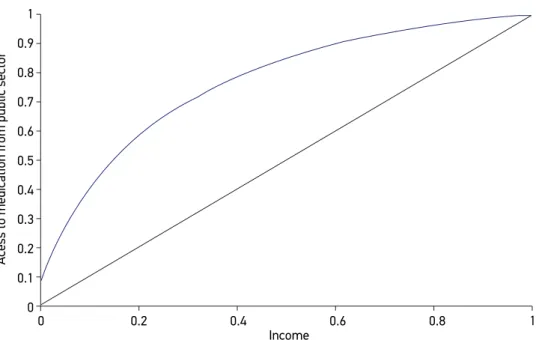
A concentration curve adjusted for sociodemographic factors was used to explore the associations between income and access to medication in the public sector. On the graph, a straight diagonal line represents perfect equality of distribution; the concentration curve line beneath or above shows the reality of the distribution. The concentration curve is a function of the cumulative proportion of ordered individuals mapped onto the
correspond-ing cumulative proportion of their size; a larger area implies major inequality19. In the
pres-ent study, the concpres-entration curve plots cumulative income by access to medication in the public sector adjusted for age, gender and chronic disease.
Concentration index (ci), which is directly related to concentration curve, was used to measure the degree of socioeconomic inequalities in access to medication in the public sec-tor in 2003 and in 2008. The concentration index is deined as twice the area between the concentration curve and the line of equality (the 45-degree line). If there is no socioeco-nomic-related inequality, the concentration index is zero. The convention is that the index takes a negative value when the curve lies above the line of equality, indicating a dispropor-tionate concentration of the health variable among the poor, and a positive value when it
lies below the line of equality20.
Concentration curve and concentration index were analyzed as indicated by Wagstaf
et al.21. Analyses were carried out in Stata 12.0 using the survey package, which considers
the efects of complex study design and allows the diferent weights of the observations to be embedded.
RESULTS
Table 1 shows the descriptive results of the sample and diferences between 2003 and 2008. Socioeconomic factors and health status did not change between 2003 and 2008. Access to medication was high in 2003 (89.55%) and in 2008 (92.99%). Access to medication in the public sector increases from 26.40% in 2003 to 48.55% in 2008, and the change is signiicant. Table 2 shows access to medication in the public sector in 2003 and in 2008 by categories of education, income, housing condition and ethnicity. Access to medication in the public sector adjusted for age and gender was higher in non-Caucasians in 2003. In 2008, access in the public sector was higher in people with lower education, lower income and in those without a private health plan.
Table 1. Characteristics of the ISA-Capital 2003 and ISA-Capital 2008 respondents living in the city of São Paulo, Brazil.
Socioeconomic and sociodeographic
factors and Access to medication 2003n (%)
2008
n (%)
Diference 2003-2008 (p-value)*
Sociodemographic factors
Age group (years) 0.254
0 – 11 843 (19.78) 580 (19.73)
12 – 19 847(15.05) 605 (12.15)
20 – 59 795 (54.76) 1162 (57.00)
≥ 60 872 (10.42) 924 (11.12)
Gender 0.347
Male 1678 (47.46) 1444 (47.44)
Female 1679 (52.54) 1827 (52.56)
Socioeconomic factors
Ethnicity 0.111
Caucasian 2138 (65.08) 2002 (61.94)
Non-caucasian 1146 (34.92) 1263 (38.06)
Education (years of study) 0.278
0 – 3 620 (13.61) 9.12 (487)
4 – 11 2300 (67.59) 2375 (71.18)
12+ 389 (18.80) 389 (19.69)
Income (minimum legal wage) 0.521
≤ 2 1130 (35.77) 1243 (39.19)
> 2 to 5 867 (28.88) 839 (31.14)
≥ 5 900 (35.36) 644 (29.66)
Housing condition
Adequate 2688 (80.05) 2742 (85.83) 0.217
Inadequate 669 (19.95) 529 (14.17)
Access to medication
Access to medication prescribed in health care service 354 (89.55) 287 (92.99) 0.175
Access to medication in public sector 102 (26.40) 137 (48.55) 0.001
32
2003 2008
Access to medication
in private sector
(n = 252)
n (%)
Access to medication in
public sector
(n = 102)
n (%)
Access to medication in public sectora –
Crude OR
(95%CI)
Access to medication in public sectora – Adjusted ORb
(95%CI)
Access to medication
in private sector
(n = 150)
n (%)
Access to medication in
public sector
(n = 137)
n (%)
Access to medication in public sectora –
Crude OR
(95%CI)
Access to medication in public sectora – Adjusted ORb
(95%CI)
Educationc
0 – 3 40 (66.60) 29 (33.40) 1 1 17 (41.98) 24 (58.02) 1 1
4 – 11 163 (68.18) 72 (31.82) (0.43 – 2.02)0.93 (0.42 – 2.27)0.98 108 (46.81) 108 (53.19) (0.37 – 1.84)0.82 (0.25 – 1.57)0.63
≥ 12 46 (100) 0 - - 25 (80.05) 4 (19.95) (0.06 – 0.56)0.18 (0.03 – 0.42)0.12
Incomec
≤ 2 24 (69.75) 18 (30.25) 1 1 16 (40.45) 23 (59.55) 1 1
2.1 – 4.99 93 (70.99) 46 (29.01) (0.37 – 2.80)0.94 (0.43 – 2.01)0.93 72 (47.97) 72 (52.03) (0.29 – 1.84)0.74 (0.25 – 1.82)0.67
≥ 5 101 (83.45) 17 (16.55) (0.18 – 1.17)0.40 (0.15 – 1.15)0.41 35 (77.01) 9 (22.99) (0.06 – 0.70)0.20 (0.05 – 0.73)0.20
Housing condition
Adequate 217 (74.49) 79 (25.51) 1 1 137 (53.33) 108 (46.67) 1 1
Inadequate 35 (67.35) 23 (32.65) (0.66 – 3.03)1.41 (0.61 – 3.03)1.36 14 (35.86) 29 (64.14) (0.95 – 4.41)2.04 (0.93 – 4.49)2.05
Ethnicity
Caucasian 178 (81.23) 53 (18.77) 1 1 103 (55.47) 75 (44.53) 1 1
Non-caucasian 73 (61.31) 49 (38.69) (1.38 – 5.39)2.74 (1.40 – 5.31)2.71 48 (45.30) 62 (54.70) (0.62 – 2.72)1.52 (0.93v2.84)1.48
Private health pland
No 45 (26.30) 120 (73.70) 1 1
Yes 106 (84.80) 17 (15.20) (0.03 – 0.13)0.06 (0.03 – 0.1200.05
Table 2. Crude and adjusted logistic regression for access to medication in the public sector and socioeconomic characteristics. São Paulo, 2003 and 2008.
a The focus of the present study is on access in the public sector. bAdjusted by age and gender. c Missings were excluded. d People with private health plan also can use
Figure 2. Access to medication from public sector adjusted for age, and gender. Concentration curve. 2008. 1
1 0.9
Acess to medication fr
om public sector
0.8
0.7
0.6
0.5
0.4
0.3
0.2
0.1
0
0.8 Income
0.6 0.4
0.2 0
1
1 0.9
Acess to medication fr
om public sector
0.8
0.7
0.6
0.5
0.4
0.3
0.2
0.1
0
0.8 Income
0.6 0.4
0.2 0
34
DISCUSSION
Access to medication has been improving in Brazil. Among the aims of the Brazilian Health System is a decrease in the socioeconomic disparities between individuals, which includes equity in access to medication. Deeper knowledge about access to, and coverage of, medication is important to inform public policies to achieve this aim.
We acknowledge several limitations to this study. The small study population can be inferred from our analyses. As our data only relate to medication prescribed in the health care service, the study of access to medication is limited to this population. We do not know about the reasons for lack of access to medication and we are not able to discuss the qual-ity of pharmaceutical care in the public sector in this study. Finally, we do not know about medication costs, or if the medication prescribed is “high cost” or “low cost”. If more than one medication was prescribed and the respondent had access to at least one of them, they were categorized as “access to medication prescribed in health care service”, but it is pos-sible the respondent was prescribed an expensive medication and a cheaper one but only had access to the cheaper item.
Education, income and housing condition did not change between 2003 and 2008. Although several economic changes have been occurring in Brazil since 2003, the socioeconomic char-acteristics did not change between 2003 and 2008. We did not observe any of these changes in São Paulo during the short period 2003 – 2008 in the present study.
Access to medication obtained in both the public and private sector was very high in both years (89.55 and 92.99%, respectively), and the proportion of access to medication did not change between 2003 and 2008. Similar results were found in a study of another
capi-tal in Brazil, which shows access to medication in general was 95.8%22. Access to
medica-tion has a high impact on health services because it is a basic ingredient of the therapeutic process. This access must be adequate, timely, good quality, equitably distributed and
ei-ciently organized23.
There was an increase in the proportion of access to medication in the public sector, from 26.40 in 2003 to 48.55 in 2008, and it was signiicant. Many factors may have inlu-enced this increase in access to medication. Among them, the expansion of health policies for medication provision, changes in income distribution in population and judicialization of pharmaceutical care.
Health policies, such as Generic Drug Policy, HiperDia, Popular Drugstore program, Dose
Certa and Remédio em casa, have inluenced the increase in access to medication3,5-7. These
pro-grams ofer medication at lower cost or cost-free to people at all levels of income. In some cases, there are problems such as program overlaps and unclear deinition of
responsibil-ities of municipalresponsibil-ities and states in medication provision6; nevertheless, the programs for
medication provision have increased access to medication in São Paulo and also promoted
the decrease in inequalities in access to medication4,5.
Although it is a less signiicant inluence, the judicialization of pharmaceutical care also
the number of lawsuits concerning access to medication brought against the State Health
Department since the creation of SUS25. Deiciencies in access of SUS users to essential
med-ication and also in access to drugs not included in Ministry of Health pharmaceutical care
lists are solved, in most cases, by the legal process 24,25. The judicialization of pharmaceutical
care, mainly for higher cost medication, has inluenced the decrease in inequality. There are
currently 392,000 lawsuits demanding action relating to health in Brazil26; most are for
medi-cation and have been brought by both the lower income and higher income populations24,25.
There has been an increase in the number of private health plans in Brazil1, particularly
in São Paulo. There has also been an increase in private health plans which cover only the
doctor’s consultation12,13, which can increase the use of the public sector to obtain
medica-tion; people can see a doctor in the private sector and get medication from the public sec-tor. According to our study, almost half the population had a private health plan in 2008. Nowadays, 60.00% of the population of São Paulo (6.7 million of people) have a private
health plan12,13. Among them, there are plans with high cost and low cost that do not cover
provision of medication. People with these plans obtain their medication in the public sector. Access to medication in the public sector was 48.55% in 2008. These results show similar access in the public sector to that found in another state capital in Brazil in 2009, which shows
access to medication among the elderly through the public sector to be 50.30%22. A study in
Ribeirão Preto, São Paulo State in Brazil, showed provision of medication in the public
sec-tor was 60.3%27. Similar results were also found by a Brazilian study of 11 cities, that showed
only 55.40% of the medication investigated was available in public health services28. According
Silva et al.29, among people that used health care service in Brazil, 56.70% were in the public
sector (and 43.30% in the private sector). The authors studied use of the health care service including consultations, hospitalizations and vaccination. A similar result was found by
Gomez-Dantés et al.30, who studied the availability of some essential drugs at primary health care units
of the public sector in Mexico and found a low supply of essential drugs in the health units. The change in concentration index from -0,63 in 2003 to -0,52 in 2008 indicates that there was an expansion of SUS users. The higher income population started to use the SUS or the inclusion in the public sector of the population that previously only used the private sector can explain the increasing use of the public sector to obtain medication.
However, despite the increase in access to medication in the public sector by higher socioeconomic groups between 2003 to 2008, the lower socioeconomic groups were much more often covered by the public sector than the higher socioeconomic groups. Access to medication in the public sector was greater among those with lower income and among non-Caucasians in 2003, and among those with lower education, lower income, inadequate housing condition, non-Caucasians and those without private health plans in 2008.
Coverage of medication in the public sector is very important, particularly in the lower income population as in some cases these people cannot buy medication and depend on SUS. Designing a universal health insurance system is a complicated process and success depends on organizational and inancial arrangements. In order to be a universal system, it is important that access to health care services, and particularly to medication, expand in
36
In order to achieve equity, equal access is seen as equal use for those in equal need32.
People of low socioeconomic position are also likely to need more coverage by the public sector. Therefore, if inequalities in access to health care are of interest, it is important that the public sector attends people of lower income in order to adjust for this unequal need. The results of the present study show that the lower income population are supported by SUS to access medication and therefore the SUS tends to equity and is trying to universal-ize access to medication.
CONCLUSIONS
The present study provides insights into the socioeconomic factors associated with access to medication in the public sector and access to medication in São Paulo. Knowledge about inequal-ities in access to medication in the public sector is important to inform health policies to con-tribute to reducing inequalities in health care services use and must be investigated more deeply. The indings indicate that access to medication was high in the period studied, and people with lower education and lower income are supported by SUS to get medication, therefore the SUS tends to equity and is trying to universalize access to medication. Otherwise, the provision of medication in the public sector increased from 2003 to 2008, with SUS coverage expansion to include people with higher income. Implementation and expansion of pub-lic programs for medication provision also contribute to explaining the increase. However, universal coverage of medication and equity in access to medication in the public sector are still challenges to SUS.
M Goldbaum, MBA Barros and CLG Cesar would like to thank CNPq for the produc-tivity scholarship 1D.
1. Paim J, Travassos C, Almeida C, Bahia L, Macinko J. The Brazilian health system: history, advances, and challenges. Lancet 2011; 377(9779): 1778-97. 2. Victora CG, Barreto ML, Carmo Leal M, Monteiro
CA, Schmidt MI, Paim J, et al. Health conditions and health-policy innovations in Brazil: the way forward. Lancet 2011; 377(9779): 2042-53.
3. Santos-Pinto CDB, Costa NR, Osorio-de-Castro CGS. The “Farmácia Popular do Brasil” program and aspects of public provision of medications in Brazil. Ciênc. Saúde Coletiva 2011; 16(6): 2963-73.
4. Magarinos-Torres R, Pepe VLE, Oliveira MA, Osorio-de-Castro CGS. Essential medications and the selection process in management practices of pharmaceutical services in Brazilian states and municipalities. Ciênc Saúde Coletiva 2014; 19(9): 3859-68.
5. Brasil. Lei 3.916, 30 Oct 1998. Política Nacional de Medicamentos [Nacional Policy of Medication]. Diário Oicial da União. 1998.
6. Paniz VMV, Fassa AG, Facchini LA, Piccini RX, Tomasi E, Thumé E. Free access to hypertension and diabetes medicines among the elderly: a reality yet to be constructed. Cad Saúde Pública 2010; 26(6): 1163-74. 7. Dias CRC, Romano-Lieber NS. Generic drug policy implementation in Brazil. Cad Saúde Pública 2006; 22(8): 1661-9.
9. Programa Remédio em Casa. Prefeitura de São Paulo. Disponível em: www.prefeitura.sp.gov.br/cidade/ secretarias/saude/programas/index.php?p=5875 (Acessado em 15 de fevereiro de 2015).
10. HiperDia. Disponível em: http://datasus.saude.gov. br/sistemas-e-aplicativos/epidemiologicos/hiperdia (Acessado em 09 de abril de 2015).
11. Jiang M, Zhou Z, Wu L, Shen Q, Bing L, Wang X, et al Y. Medicine prices, availability, and afordability in the Shaanxi Province in China: implications for the future. Int J Clin Pharm 2015; 37(1): 12-7.
12. Brazilian Institute of Geography and Statistics (IBGE). Pesquisa de Orçamento familiar – POF, 2008 – 2009. Composição do gasto familiar per capita privado direto em saúde, por decil de renda. Disponível em: ibge.gov.br (Acessado em 15 de janeiro de 2015). 13. Brasil. Datasus. Disponível em: http://tabnet.datasus.
gov.br/cgi/ibge/censo/cnv/ginisp.def (Acessado em 20 de janeiro de 2015).
14. Donaldson D, Weymark JA. A single-parameter generalization of the Gini indices of inequality. J Econ Theory 1980; 22: 67-86.
15. Alves MCGP, Escuder MML. Plano de amostragem. In: Cesar CLG, Carandina L, Alves MCGP, Barros MBA, Goldbaum M. Saúde e condição de vida em São Paulo. São Paulo: USP/FSP; 2005. p. 38-52. 16. Alves MCGP, Escuder MML. Plano de amostragem
do ISA-Capital 2008. Disponível em: http://www.fsp. usp.br/isa-sp/pdf/planoamostral2008.pdf (Acessado em 15 de janeiro de 2015).
17. Instituto Brasileiro de Geograia e Estatística (IBGE). Census 2000. Characteristics of the population and households. SEADE; 2000.
18. Instituto Brasileiro de Geografia e Estatística (IBGE). Brazilian Household Survey-PNAD 2002. SEADE; 2003.
19. Dardanoni V, Forcina A. Inference for concentration curve orderings. Econ J 1999; 2: 49-75.
20. O’Donnell O, Doorslaer E, Wagstaf A, Lindelow M. The Concentration Index. In: Analyzing Health Equity Using Household Survey Data. The World Bank Institute, Washington; 2008. p. 95-108. 21. Wagstaf A, Van Doorslaer E, O’Donnell O, Lindelow
M. The Concentration Index: Quantitative Techniques for Health Equity Analysis-Technical Note #7. In: Quantitative techniques for health equity analysis: a
series of 20 technical notes. Washington: The World Bank; 2003.
22. Aziz MM, Calvo MC, Schneider IJC, Xavier AJ, d’Orsi E. Prevalence and factors associated with access to medication among the elderly in a city in southern Brazil: a population-based study. Cad Saúde Pública 2011; 27(10): 1939-50.
23. Organización Mundial de la Salud. Cómo desarrollar y aplicar una política farmacéutica nacional. 2a ed. Genebra: OMS; 2002.
24. Messeder AM, Osorio-de-Castro CGS, Luiza VL. Can court injunctions guarantee access to medicines in the public sector? The experience in the State of Rio de Janeiro, Brazil. Cad Saúde Pública 2005; 21(2): 525-34. 25. Sant’Ana JMB, Pepe VLE, Osorio-de-Castro CGS, Ventura M. Essential drugs and pharmaceutical care: relection on the access to drugs through lawsuits in Brazil. Rev Panam Salud Publica 2011; 29(2): 138-44. 26. Campos BS. Rare diseases: Contributions for a National
Policy. Interfarma 2013; 5: 5-28.
27. Santos V, Nitrini SMOO. Prescription and patient-care indicators in healthcare services. Rev Saúde Pública 2004; 38(6): 819-34.
28. Karnikowski MG, Nobrega OT, Naves JO, Silver LD. Access to essential drugs in 11 Brazilian cities: a community-based evaluation and action method. J Public Health Policy 2004; 25: 288-98.
29. Silva ZP, Ribeiro MCSA, Barata RB, Almeida MF. Socio-demographic proile and use patterns of the public healthcare system (SUS), 2003- 2008. Ciênc Saúde Coletiva 2011; 16(9): 3807-16.
30. Gómez-Dantés O, Garrido-Latorre F, Tirado-Gómez LL, Ramírez DMC. Abastecimiento de medicamentos en unidades de primer nivel de atención de la Secretaría de Salud de México. Salud Pública Méx 2001; 43(3): 224-32.
31. Petrera M, Valdivia M, Jimenez E, Almeida G. Equity in health and health care in Peru, 2004–2008. Rev Panam Salud Publica 2013; 33(2):131-6.
32. World Health Organization. Glossary of terms. Available from: http://www.who.int/hia/about/ glos/en/index1.html (Acessed at April 15, 2015).