Development of nursing management competencies: guidelines for continuous education services
* Extracted from the dissertation
“Desenvolvimento de competências gerenciais dos enfermeiros pelos serviços de educação permanente,” Programa de Pós-Graduação em Enfermagem, Universidade Federal do Paraná, 2013.
1 Universidade Federal do Paraná, Programa de Pós-Graduação em Enfermagem, Curitiba, PR, Brazil.
2 Universidade Federal do Paraná, Departamento de Enfermagem, Curitiba, PR, Brazil.
ABSTRACT
Objective: Developing continuing education guidelines for the development of nursing management competencies along with the members of the Center of Nursing Continuing Education of Parana. Method: A qualitative research outlined by the action research method, with a sample consisting of 16 nurses. Data collection was carried out in three stages and data were analyzed according to the thematic analysis technique. Results: It was possible to discuss the demands and diiculties in developing nursing management competencies in hospital organizations and to collectively design a guideline. Conclusion: he action research contributed to the production of knowledge, conirming the need and the importance of changing the educational processes and evaluations, based on methodologies and instruments for professional development in accordance with human resource policies and contemporary organizational policies.
DESCRIPTORS
Education, Nursing, Continuing; Professional Competence; Nursing, Supervisory; Nursing Administration Research.
Development of nursing management competencies:
guidelines for continuous education services*
Desenvolvimento de competências gerenciais do enfermeiro: diretriz para serviços de educação permanente
Desarrollo de competencias de gestión del enfermero: directriz para servicios de educación permanente
Priscila Meyenberg Cunha Sade1, Aida Maris Peres2
Received: 10/31/2014 Approved: 08/29/2015
ORIGINAL ARTICLE DOI: 10.1590/S0080-623420150000600016
INTRODUCTION
Currently the demands of the working world have been increasingly requiring an entrepreneurial proile from pro-fessionals. In the health area, and in particular with regard to nurses, their training and their daily professional practice follow the same tendencies supported by the perspective of competencies-ability that one has to take initiatives (not just being limited to predetermined activities), understand and master new situations at work, take responsibility and be recognized for their actions(1).
he development of competencies during academic training does not guarantee the renewal of the practice. Perfecting these practices should be a personal commit-ment of nurses and employing organizations through forming a network of continuous knowledge. his possi-bility enables management competencies to be demysti-ied as an ability and a natural talent, since they can be acquired resulting from the combination of capabilities, organized practices and knowledge that can be built from academic training and more permanently in professional Nursing practice(2-3).
In this perspective, considerations arise that go against the National Continuing Education Policy, which advo-cates that the educational process is as much of a respon-sibility of the institutional sphere as the individual sphere. Continuous education can be viable if it is focused on continuous updating that seeks to innovate and meet the needs of the working world, as long as the institution along with professionals are committed to facilitating the planning, participating and also developing education actions(3).
Some studies have indicated the need for the mobiliza-tion of nursing management competencies at an academic education level, and that they relate to the demands of the working world(4-6). However, the debate is still scarce with regard to investigations on continuing education for nursing management practice in the employment/work context(2-3). Added to this, the Center for Nurses Continuing Edu-cation of Parana (NEEP/PR), an independent non-proit nursing organization which evaluates the continuing edu-cation of the Health services in the state of Paraná, has highlighted their concerns about the lack of thematic ap-proach of management competencies in continuing educa-tion for nurses.
he starting point for this study took place during the presentation of these concerns to NEEP/PR, when other members of this organization voiced their dissatisfaction against the management nursing education at the academic level and the way training activities were being carried out in hospital organizations, as efective changes in nursing management practices were not being observed. herefore, it was considered important to identify the demands and establish strategies which would culminate in this study aimed at designing a continuing education guideline for the development of nursing management competencies along with members of NEEP/PR.
METHOD
his is a qualitative research using the action research method(7) carried out at NEEP/PR. he study sample con-sisted of 16 nurses who were part of this organization in 2013. he inclusion criteria adopted were: nurses being per-manent members of NEEP/PR with regular participation in monthly meetings (with no more than three absences in a period of 12 months), accepting participation in the study by signing the Informed Consent Form (IC) and being registered to a continuing education service of a hos-pital organization. he following were applied as exclusion criteria: nurses who declined to participate in the study, nursings members of NEEP/PR who did not regularly participate in meetings (with more than three absences in a period of 12 months) and other professionals invited to attend meetings as guests.
Data collection was carried out in three steps: Step 1: semi-structured interviews – between January/2012 and March/2013; Step 2: Discussion Seminar – March/2013; Step 3: Planning Seminars – between April/2013 and June/2013. Semi-structured interviews included the characteriza-tion data of all participants and those related to the iden-tiication of demands, responses to meet these demands, problems, and suggestions for improving the development of management competencies of continuing education ser-vices within the reasoning of continuing education(7). To ensure anonymity, the dialogues of the participants were transcribed and coded with a capital letter “E” and numbers determined by the order of the interviews, for example, E1, E2, E3, and so on.
he data obtained from the interviews were translated in the form of a qualitative study focused on registered units, numbered in units of signiicance, classiied and ag-gregated into categories, concluding with the preparation of a synthesis report.
he summary report proposes the presentation of the results obtained to create a collective information efect or ‘self-awareness’ in the organization about its problems over a short period of time(7-8). he report presentation to the participants aimed at giving feedback on the information which they generated, as well as providing a space for col-lective dialogue.
In the seminar discussion, participants met to consider the results and the overall situation portrayed by them dur-ing the interviews, and to determine two or three areas of priority activity in research and action(8). his event was held in April 2013 and 12 nurses participated. In this seminar, we presented a model of planning, training and develop-ment(9) to support the guideline, in order to design an action plan for a Continuing Education program for the develop-ment of competencies.
Development of nursing management competencies: guidelines for continuous education services
development of continuing education guidelines for the development of nursing management competencies in hos-pital organizations(9).
Data from the semi-structured interviews and discus-sion seminars and planning were analyzed according to the content analysis technique, in the thematic approach(10). he organization of the content analysis had three stages: pre-analysis, material exploration and treatment of results.
We emphasize that this study is in accordance with the guidelines and ethical standards of research involving hu-mans. he project was submitted to the Committee of Ethics in Research for the Health Sciences Sector of the Universi-dade Federal do Paraná (CEP SCS/UFPR) and approved under protocol number CAAE: 06903612.8.0000.0102.
RESULTS
All research participants were nurses from hospitals. he age range was 25-50 years, with a mean age of 34 years. Regarding the highest degree, there was a prevalence of specialization. he longest training time was 28 years and the shortest was 1.5 years. he actuation time in ongoing or Continuous Education ranged between 4 and 96 months. here was a predominance of assistance in professional practice of the participants focused on education, before being assigned to the current activity. It is noteworthy to highlight that two nurses, one a nursing manager and an-other nurse responsible for Competency in Hospital In-fection Control (CHIC), also had Continuous Education coordinating activities as part of their function.
he themes that emerged from the empirical categories of this study were: management competencies that require development; diiculties encountered in the development of management competencies; and collective construc-tion of guidelines as a strategy for development of nursing competencies.
ManageMentcoMpetenciesthatrequiredevelopMent
Participants cited leadership and continuing education as management competencies that require improvement in the context of their hospital organizations, which are de-mands of continuing education service under their respon-sibility:
(...) team leadership, this is the most diicult. Be-cause nowadays in the university (...) they have no practical experience of coordinating a team (...) (E2).
(...) for me the biggest diiculty is for nurses to understand that they are responsible for their team’s continuing education, (...) the technicians (really) follow the leader. (E3).
DifficultiesintheDevelopmentofnursing managementcompetenciesinthehospital organizations
he diiculties listed by the research participants for the development of nursing management competencies in
hospital organizations were: dissociation between teaching and practice; the lack of commitment of nursing profession-als; the lack of human, physical and inancial resources; and lack of hierarchical support.
he dissociation between teaching and practice became clear from participants reporting that newly graduated nurses or those with little experience did not come prepared to play their managerial functions, generating training and development demands for continuing education services:
(... ) they come unprepared (...) Sometimes they even understand the theory, but because of the short training time, or even unprepared teachers (...) they are now in need of this fellowship, and need to be following others. hey cannot perform their most important role, which is to follow the technician who is coming to their team and those that are already on the team (E2).
And the new nurses who arrive [negative facial expression], the younger they are, the more un-prepared they are (E3).
Research participants also mentioned the Lack of com-mitment of nursing professionals in participating in the struc-turing and planning of training promoted by the continuing education service:
Adherence is very complicated, in the two months that I’ve been working with the teams, the nurs-es do not participate (E13).
I invited the nurses from the neonatal and the pediatric units to structure a training session (...). I sent the irst e-mail in March, and to this date [May] I have not received an answer. We have a lot of diiculty with training adherence of supervisors and managers, which really com-plicates the process (E14).
Other diiculties cited by the participants correspond to the Lack of human, physical and inancial resources for the development of nursing management competencies:
(...) We lack human, and physical resources, a spe-ciic budget for education, inancial incentives for the professional seeking to improve in their area (...) (E5).
he lack of hierarchical support was also raised by some participants, considered of great importance in the develop-ment process of nursing managedevelop-ment competencies:
he biggest problem we face is the vertical hier-archy. In the sense that we are pointing to the solution, but we do not have support from senior managements. his represents the lack of support (...) (E4).
collectiveconstructionofguidelinesasastrategy forthedevelopMentofnursingcoMpetencies
he collective construction of the guidelines took place in Planning Seminars A and B. In Planning Seminar A, participants chose the following as main points: partner-ships with a human resources/psychologist service or out-sourced companies; the need for a continuous competen-cies’ development project; and involvement of directors and management:
A project that would last all year long, so they would get involved and develop competencies. Something that would be permanent (E8).
When you can have this partnership [between HR, psychologist or outsourced companies], it is very productive. And I think it should involve more people; involve the hospital board, the HR management (E8).
(...) associating other managers to work in a mul-tidisciplinary way, to develop better work (E1). It is worth mentioning that in Planning Seminar A, the title, objective and the outline of the steps of the guideline structure were deined, considering description, action and accomplishment time of its dimensions.
Based on the data from the interviews from the Discus-sion Seminars and Planning Seminar A, a draft guideline was submitted in Planning Seminar B in order to conirm the relevance of its content, and also to have adjustments, revisions and improvements made by the group. hese were related to setting deined management competencies, using active teaching methodologies and speciic tools for evalu-ating the program, and as a recommendation, to map the nursing competencies.
We would irst need to agree on a deinition of these competencies (E6).
Participative teaching methodology, present the content, and based on these contents, work with role-playing, with workshops, scientiic meet-ings, discussion groups (E3).
Allow a moment of relection for the group, with organizing modules involving similar groups (E8).
Align it [the evaluation] with indicators, using reaction evaluation and critical analysis, in or-der to be able to show the importance and impact of education (E16).
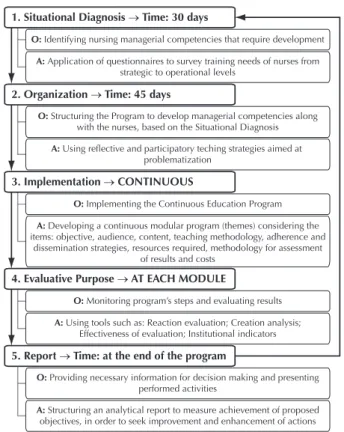
Finally, in the Planning Seminar C, the guidelines which were validated and approved by the group are conig-ured in a Continuing Education program that follows these steps: situation analysis, design, implementation, evaluative purpose and report (Figure 1). he purpose of the guide-lines were deined as: to promote continuous improvement, based on meaningful learning in the development of nurs-ing management competencies, in response to the needs of internal and external environments of organizations and the
demands of these professionals, from the perspective of the Continuing Education Policy.
2. Organization → Time: 45 days
3. Implementation → CONTINUOUS
4. Evaluative Purpose → AT EACH MODULE
5. Report → Time: at the end of the program
O: Structuring the Program to develop managerial competencies along with the nurses, based on the Situational Diagnosis
A: Using reflective and participatory teching strategies aimed at problematization
A: Developing a continuous modular program (themes) considering the items: objective, audience, content, teaching methodology, adherence and
dissemination strategies, resources required, methodology for assessment of results and costs
O: Implementing the Continuous Education Program
O: Monitoring program’s steps and evaluating results
A: Using tools such as: Reaction evaluation; Creation analysis; Effectiveness of evaluation; Institutional indicators
O: Providing necessary information for decision making and presenting performed activities
A: Structuring an analytical report to measure achievement of proposed objectives, in order to seek improvement and enhancement of actions
Legend: O - Objective, A - Action 1. Situational Diagnosis → Time: 30 days
O: Identifying nursing managerial competencies that require development
A: Application of questionnaires to survey training needs of nurses from strategic to operational levels
Figure 1 – Diagram summarizing the guidelines for the devel-opment of nursing management competencies – Curitiba, PR, Brazil, 2013.
DISCUSSION
From the participants’ dialogues it becomes clear that
leadership development is the most required among the nursing management competencies in the work process of hospital organizations(11-12). To meet this demand, the con-tinuous education service should use the strategy of Con-tinuing Education, which provides space for thinking and creating a favorable scenario for professional development in the workplace, considered complex and absorbing for many of the nursing professionals.
In the context of hospital organizations in the studied scenario, the urgency in adopting leadership development programs and continuous education projects is evident, in order to prepare nurses to play the leadership role, and based on the establishment of an eicient communication process that stimulates autonomy, co-responsibility and the appreciation for leaders and collaborators(13).
Development of nursing management competencies: guidelines for continuous education services
occurring in the working world and which should be consid-ered as a strategy for the qualiication of the worker(2-3,14-15). Some participants pointed out the diiculty of nurses in their organizations to understand that in addition to being able to learn how to learn, they have the duty and commit-ment to educating the professionals under their responsibil-ity. Above all, provide relevant training to their team so that its members learn new concepts, attitudes, solutions, and ideas, thereby modifying habits and behaviors and becom-ing more efective in what they do(16-17).
However, it is known that due to the complexity of healthcare organizations, the nurse having only the inten-tion to develop their team is not enough. his responsibility needs to be shared with institutional support. Based on this and according to the statements of the research participants, it is imperative that nurses discuss and rethink their role as educators, and that organizations assert their commitment to managerial development of their employees by investing in ongoing education as a resource which will boost the auton-omy and personal, professional and organizational growth(15). he diiculties encountered by continuous education ser-vices in developing nursing management competencies were: the dissociation between teaching and practice; the lack of professional nursing commitment; the lack of human, physi-cal and inancial resources; and lack of hierarchiphysi-cal support. Research participants reported that nurses arrive un-prepared to act in their managerial function. Developing skills and general competencies identiied by the National Curricular Guidelines (DCN) has been a major challenge for educational institutions due to the complexity of the la-bor market and due to prevalent pedagogical approaches in Nursing training being based on knowledge transmission, disregarding active teaching methodologies that enable an emancipatory education and transform reality, thus allow-ing the individual to answer the challenges of the contem-porary world(3,18).
With this, the debate between the labor market and aca-demics remains; as pointed out by the research participants, it is centralized in the proile of professionals being trained, which often difers from the demands and expectations of hospital organizations.
In this sense, the development of competencies is justi-ied as being an ongoing process fostered by the organiza-tion as a component of an evolving system of the labor mar-ket. It requires association between teaching and practice, as well as new professional proiles and management models that require the mobilization of continuous knowledge. It is necessary to mention that management competencies are absorbed throughout nursing training, guided by the con-text of reality and critical know-how centered on contex-tualized content of contemporaneity; and in the workplace, through experiential learning in work situations with a view toward continuous improvement(2-3).
In the researched scenario, nurses have low participa-tion in continuing educaparticipa-tion programs, which may be re-lated to the multiple activities they perform, and therefore, time constraints, staf shortages and prior negative experi-ences with programs that followed continuing education
logic(14). herefore, nurses need to understand that in the context of hospital organizations, they (the nurses) consti-tute a human resource of continuous education, recognizing that their commitment to programs will guide the creation, dissemination and use of knowledge in order to achieve organizational goals.
he existence of a continuous education service in the hospital organization does not negate the need for nurses’ participation in educational processes. his is due to the fact they maintain direct and continuous contact with the nursing staf, being able to more appropriately understand/ grasp the reality and to assess practical needs(19).
To develop their activities, continuous education services require human, material, inancial and adequate physical re-sources. When insuicient, they become limiting factors to the development of training and development programs(20).
We emphasize that in this study, two nurses combined other activities in addition to coordinating continuous edu-cation. Often the failure of continuous education programs is due to coordinators working part-time, having other ac-tivities such as monitoring units, covering for missing per-sonal, as well as vacation and sick leaves. As a result, these nurses do not have time, nor are able to exclusively devote themselves to the education activities. herefore, the pro-grams are poorly designed and inadequate(20).
Regarding physical resources, as reported during the seminars, it is necessary that the physical structure is appro-priate. When the continuous education sector has resources like equipped classrooms and simulation labs, it is easier to develop programs(20-22).
With regard to inancial resources, these depend on the institution’s policy and its interest in investing in human capital. Nowadays, the great challenge for managers respon-sible for the continuing education sectors is achieving maxi-mum positive results by performing training and developing programs using minimum inancial resources(21).
However, inancial support invested in training alone and development of human resources is not enough to guarantee good performance of workers. Other factors that also afect the quality and excellence of continuing educa-tion programs must be taken into consideraeduca-tion, such as the motivation and preparation of the nursing staf, the organi-zational culture that recognizes and values the continuous education sector and the availability material resources(15,20).
Some research participants who reported the lack of support from hierarchical superiors as a diiculty for the development of management competencies are tied to Hu-man Resource Management, to Quality Management or to the General Direction of hospital organizations. his type of structure (not linked to management / nursing depart-ment) hinders nursing to be free to decide on education programs to be developed.
Regarding visibility of the continuous education service work process, it can be said that the research participants have broadened their horizons to produce changes in their own management of their work process as they designed the guidelines. heir statements corroborate the reality of most hospital organizations in relation to the processes of quality certiication. hese go against the necessity of using indicators and/or instruments, that in addition to evaluating the continuous education service, will also provide efective measures of the continuous education impact on nursing work processes and the nursing staf (16,19).
he participants positioned themselves towards the im-portance of coordinating, evaluating, documenting training and development programs, and therefore assuming and making their strategic placement in organizations visible through the adoption of participatory management. his results in easing the power relations and focuses on hav-ing individuals aware about their responsibility for self-im-provement, for socializing knowledge and to learning new knowledge as the logic of Continuing Education(16).
CONCLUSION
he results of this study highlight the management competencies of leadership and continuing education re-quiring development in hospital organizations, according to the studied scenario. hese are mainly related to the sense of nurses being leaders of their teams and understanding the importance of getting involved and being responsible for their own education, in planning it, and positioning them-selves as facilitators of educational activities proposed for themselves and their team.
We emphasize that the collective construction of the guidelines has led to a feeling of belonging by the group and
the appreciation of NEEP/PR as an efective space for dis-cussion and critical-relection in building knowledge. Con-sequently, nurses are enabled to understand their strategic position in continuous education as educational programs’ coordinators and facilitators of the general strategy of or-ganizational change.
Action research is an opportunity for relection on the reality of the nursing management work process. It facilitated the mobilization of knowledge and expanded the vision of NEEP/PR members, thereby allowing the construction of a guideline consensus, contributing to the production of knowledge, and conirmed the need and importance of changes in the educational and evalu-ation processes to be based on methodologies and tools that enable the development of professionals according to human resource policies and current organizational policies.
As a limitation, it could be pointed out that the dura-tion of the research did not allow for the applicadura-tion of the guidelines, being necessary for the production of theoretical and practical knowledge regarding the efective implemen-tation of the continuous education program. herefore, we propose a continuation of studies to apply and evaluate the impact of implemented development programs of manage-ment competencies with national and international health and education policies as criteria.
We conclude that it is possible to develop nursing management competencies along the logic of continu-ous education, however it is necessary to understand these competencies not only as acquired individual attributes and the construction of knowledge for nurses, but also con-textualized based on the demands of the real situations of labor practice.
RESUMO
Objetivo: Construir uma diretriz de educação permanente para o desenvolvimento de competências gerenciais dos enfermeiros junto aos membros do Núcleo de Enfermeiros de Educação Permanente do Paraná. Método: Pesquisa com abordagem qualitativa, delineada pelo método da pesquisa-ação, composta por amostra de 16 enfermeiros. A coleta de dados ocorreu em três etapas e os dados analisados segundo a técnica de análise temática. Resultados: Foi possível discorrer sobre as demandas e as diiculdades para o desenvolvimento de competências gerenciais do enfermeiro nas organizações hospitalares e estruturar coletivamente uma diretriz. Conclusão: A pesquisa-ação contribuiu para a produção de conhecimentos, conirmando a necessidade e a importância de mudanças nos processos educativos e de avaliação fundamentados em metodologias e instrumentos que permitam o desenvolvimento de proissionais consoante às políticas de recursos humanos e organizacionais contemporâneas.
DESCRITORES
Educação Continuada em Enfermagem; Competência Proissional; Supervisão de Enfermagem; Pesquisa em Administração de Enfermagem.
RESUMEN
Objetivo: Construir una directriz de educación permanente para el desarrollo de competencias de gestión para los enfermeros junto con los miembros del Núcleo de Enfermeros de Educación Permanente de Paraná. Método: Investigación con abordaje cualitativo, diseñado por el método de investigación-acción compuesto de muestra de 16 enfermeros. La recolección de datos ocurrió en tres etapas y los datos fueron analizados según la técnica de análisis temático. Resultados: Fue posible discurrir sobre las demandas y las diicultades para el desarrollo de competencias de gestión del enfermero en las organizaciones hospitalarias y estructurar colectivamente una directriz. Conclusión: La investigación-acción contribuyó a la producción de conocimientos, conirmando la necesidad y la importancia de cambios en los procesos educativos y de evaluación fundados en metodologías e instrumentos que permitan el desarrollo de profesionales acorde con las políticas de recursos humanos y organizaciones contemporáneas.
DESCRIPTORES
Development of nursing management competencies: guidelines for continuous education services
REFERENCES
1. Zaraian P. Objetivo competência: por uma nova lógica. São Paulo: Atlas; 2001.
2. Soto-Fuentes P, Reynaldos-Grandón K, Martínez-Santana D, Jerez-Yáñez O. Competencias para la enfermera/o en el ámbito de gestión y administración: desafíos actuales de la profesión. Aquichán [Internet]. 2014 [citado 2015 Jun. 15];14(1):79-99. Dispinible en: http://www. scielo.org.co/pdf/aqui/v14n1/v14n1a08.pdf
3. Miccas FL, Batista SHSS. Permanent education in health: a review. Rev Saúde Pública [Internet]. 2014 [cited 2015 June 15];48(1):170-85. Available from: http://www.scielo.br/pdf/rsp/v48n1/en_0034-8910-rsp-48-01-0170.pdf
4. Caveião C, Zagonel IPS, Coelho ICM, Peres AM, Montezeli JH, Venturi KK. Student’s competences with regard to nursing administration: an exploratory and descriptive research. Online Braz J Nurs [Internet]. 2014 [cited 2015 June 15];13(4):602-12. Available from: http:// www.objnursing.uff.br/index.php/nursing/article/view/4770/pdf_332
5. Almeida ML, Peres AM. Conhecimentos, habilidades e atitudes sobre a gestão dos formados de enfermagem de uma universidade pública brasileira. Invest Educ Enferm [Internet]. 2012 [citado 2015 jun. 15];30(1):66-76. Disponível em: http://aprendeenlinea.udea.edu.co/ revistas/index.php/iee/article/view/7823/10514
6. Melnyk BM, Gallagher-Ford L, Long LE, Fineout-Overholt E. The establishment of evidence-based practice competencies for practicing registered nurses and advanced practice nurses in real-world clinical settings: proiciencies to improve healthcare quality, reliability, patient outcomes, and costs. Worldviews Evid Based Nurs. 2014;11(1):5-15.
7. Thiollent M. Pesquisa-ação nas organizações. São Paulo: Atlas; 2009. 8. Thiollent M. Metodologia da pesquisa-ação. São Paulo: Cortez; 2011.
9. Peres HHC, Leite MMJ, Gonçalves VLM. Educação continuada: recrutamento e seleção, treinamento e desenvolvimento e avaliação de desempenho proissional. In: Kurcgant P, coordenadora. Gerenciamento em enfermagem. 2ª ed. Rio de Janeiro: Guanabara Koogan; 2012. p. 137-53.
10. Bardin L. Análise de conteúdo. Lisboa: Edições 70; 2011.
11. Manenti AS, Ciampone MHT, Mira VL, Minami LF, Soares JM. The construction process of managerial proile competencies for nurse coordinators in the hospital ield. Rev Esc Enferm USP [Internet]. 2012 [cited 2013 Oct 20];46(3):722-8. Available from: http://www.scielo. br/pdf/reeusp/v46n3/en_27.pdf
12. Amestoy SC, Backes MS, Triandade LL, Canever BP. The scientiic production regarding leadership in the context of nursing. Rev Esc Enferm USP [Internet]. 2012 [cited 2013 Nov 20];46(1):219-24. Available from http://www.scielo.br/pdf/reeusp/v46n1/en_v46n1a30.pdf
13. Ekström L, Idvall E. Being a team leader: newly registered nurses relate their experiences. J Nurs Manag. 2015;23(1):75-86.
14. Ni C, Hua Y, Shao P, Wallen GR, Xu S, LiL. Continuing education among Chinese nurses: a general hospital-based study. Nurse Educ Today. 2014;34(4):592-7.
15. Jesus MCP, Figueiredo MAG, Santos SMR, Amaral AMM, Rocha LO, Thiollent MJM. Permanent education in nursing in a university hospital. Rev Esc Enferm USP [internet]. 2011 [cited 2013 Oct. 21];45(5):1229-36. Available from: http://www.scielo.br/pdf/reeusp/v45n5/ en_v45n5a28.pdf
16. Salum NC, Prado ML. Continuing education in the development of competences in nurses. Texto Contexto Enferm [Internet]. 2014 [cited 2015 June 16];23(2):301-8. Available from: http://www.scielo.br/pdf/tce/v23n2/0104-0707-tce-23-02-00301.pdf
17. Portella Ribeiro J, Pereira Rocha L. Permanent education in health: an instrument to enhance interpersonal relations in nursing work. Invest Educ Enferm. 2012; 30(3):412-7.
18. Meira MDD, Kurcgant P. Political-ethical skill development in nursing undergraduates. Rev Esc Enferm USP [Internet]. 2013 [cited 2014 Oct 10];47(5): 1203-10. Available from: http://www.scielo.br/pdf/reeusp/v47n5/0080-6234-reeusp-47-05-1203.pdf
19. Silva CT, Terra MG, Mostardeiros S, Ribeiro D, Lavich C, Xavier M. Núcleo de educação permanente em enfermagem: perspectiva em um hospital de ensino. Rev Pesq Cuid Fundam J [Internet]. 2013 [citado 2015 jun. 18];5(3):114-21. Disponível em: http://www.seer.unirio.br/ index.php/cuidadofundamental/article/view/2044/pdf_826
20. Leite MMJ, Pereira LL. Educação continuada em enfermagem. In: Kurcgant P, coordenadora. Administração em enfermagem. São Paulo: EPU; 2011. p. 147-63.
21. Costa DB, Vannuchi MTO, Haddad MCFL, Cardoso MGP, Silva LG, Garcia SD. Custo de educação continuada para equipe de enfermagem de um hospital universitário público. Rev Eletr Enf [Internet]. 2012 [citado 2013 out. 10]; 14(2):257-66. Disponível em: http://www.fen. ufg.br/revista/v14/n2/v14n2a05.htm