ABSTRACT
ORIGINAL AR
Patrícia Matos Biselli
Dorotéia Rossi Silva Souza
Eny Maria Goloni Bertollo
and its association with coronary
artery disease
Molecular
Biology and Cardiology and Cardiovascular Surgery Departments
Faculdade de Medicina de São José do Rio Preto, São José do Rio Preto,
São Paulo, Brazil
INTRODUCTION Obstructive coronary artery disease (CAD) is characterized by the deposition of atherosclerotic plaque on the coronary artery wall. This chronic disease is frequently asymptomatic, but acute events can occur as a result of instability of the atherosclerotic plaque, with consequent arterial thrombosis that results in myocardial infarction.1 Its mani-festation depends on the interactions between environmental and genetic risk factors.2
Individual susceptibility to this disease has been associated with functional allelic variations. Thus, the identifi cation of gene polymorphisms relating to the formation of atherosclerotic plaque and consequent thrombi may contribute towards developing early diagnostic methods and guiding preven-tive procedures.2-4
The gene that codes for the methylenete-trahydrofolate reductase enzyme (MTHFR), which is involved in metabolizing homocys-teine (Hcy), is of great interest in clinical practice.2,5,6 Hcy, an amino acid derived from protein catabolism, is present in the plasma in several forms, with the greatest proportion (70%) bound to albumin.3 High levels of Hcy (hyperhomocysteinemia) have been identifi ed as a risk factor for atherosclerosis.2,3,7-9 The serum concentration of Hcy is high in 40% of patients suffering from coronary cerebral or peripheral artery diseases, while in control groups only 15% of individuals present with elevated levels.9
The mechanism for the vascular lesions induced by hyperhomocysteinemia remains unclear. Experimental evidence suggests that Hcy may be involved in atherogenesis and thrombogenesis, leading to hyperplasia of cell tissue and fi brosis. Additionally, it facilitates the vascular oxidative process, alters the co agulation system and reduces the vasomotor regulation of the endothelium.6,7,10,11
A moderate increase in Hcy is more gene-rally associated with the cytosine-to-thymine substitution at nucleotide 677 (C677T) of the MTHFR gene, thereby leading to an alanine-for-valine substitution. This alteration is associated with increased enzyme thermola-bility, causing a 50% reduction in its normal activity.7,11
OBJECTIVE This study had the aim of analyzing the frequency of C677T polymorphism in the MTHFR gene in patients with obstructive coronary artery lesions, in comparison with individuals without angiographic evidence of the disease. In addition, it evaluated the association between this polymorphism and the number of affected arteries and degree of arterial obstruction and plasma Hcy levels. Risk factors for CAD were also evaluated.
METHODS For this retrospective study, after ob-taining informed consent, we recruited 127 Caucasian individuals (83 men and 44 women; mean age = 60 ± 12 years). Although in Brazil there is widespread miscegenation, we considered as Caucasians those individu-als who had no other ethnic group in the three generations preceding them.4 All of them underwent coronary cineangiography because of clinical indications relating to angina or positive induced ischemia tests. Cineangiography identifi ed 91 individuals with CAD (65 men and 26 women; mean age 60.3 ± 12 years) and 36 control subjects, without signs of the disease (22 men and 14 women; mean age 60.4 ± 12 years). The disease was defi ned and identifi ed in patients according to current criteria1. The coronary cineangiography results were analyzed by two independent observers in a quantitative blind analysis in the Hemodynamics and
CONTEXT AND OBJECTIVE: Obstructive coro-nary artery disease (CAD) is characterized by the deposition of atherosclerotic plaque on the coronary artery wall. Its manifestations depend on interactions between environmental and genetic risk factors. The aim of this work was to analyze the frequency of methylenetetrahydro-folate reductase (MTHFR) C677T polymorphism in patients with CAD and its association with plasma homocysteine levels. Risk factors for CAD were also evaluated.
DESIGN AND SETTING:Retrospective with blind quantitative analysis, at Hospital de Base, Facul-dade de Medicina de São José do Rio Preto.
METHODS: One hundred and twenty-seven
individuals were studied. All completed a ques-tionnaire to analyze risk factors for CAD. MTHFR polymorphism was investigated by restriction fragment length analysis and correlated with the number of affected arteries and degree of arterial obstruction determined by coronary cineangi-ography, and with plasma homocysteine levels measured by liquid chromatography/sequential mass spectrometry.
RESULTS: Smoking (p = 0.02) and high-density li-poprotein cholesterol (p = 0.01) were associated with CAD. The C allele was the most prevalent in patients (0.61) and controls (0.66). There was no correlation between MTHFR/C677T polymorphism and plasma homocysteine levels. However, in patients with the TT genotype there was a correlation with the prevalence of coronary obstruction greater than 95% (p = 0.02) and the presence of two affected arteries (p = 0.04).
CONCLUSIONS: The TT genotype is associated with coronary artery obstruction greater than 95% and the presence of two affected arteries. This confi rms the relationship between genetic variants in specifi c patient subgroups and car-diovascular diseases.
Interventional Cardiology Section of Facul-dade de Medicina de São José do Rio Preto (Famerp), São José do Rio Preto, São Paulo, Brazil. Individuals who had undergone heart surgery and those with coronary prosthesis were excluded from the study.
All participants completed a question-naire to analyze risk factors such as diabe-tes (patients who were using antidiabetic medication or presented with blood sugar levels greater than 126 mg/dl), hypertension (patients who were using specifi c medica-tions or had blood pressures higher than 140/90 mmHg), sedentary patients (patients who did not do regular, controlled physical exercise), alcoho lism (patients who were consuming alcohol at a defi ned frequency, without ta king into account the quantity) and smoking (minimum of fi ve cigarettes per day). Blood samples were obtained after 12 hours of fasting, to analyze the lipid profi le. The analysis included the serum levels of total cholesterol (TC) and the fractions of low-density lipoprotein cholesterol (LDLc), high-density lipoprotein cholesterol (HDLc), very low-density lipoprotein cholesterol (VLDLc) and triglycerides (TG), measured using the enzymatic colorimetric assay method and Friedewald’s formula to calculate LDLc. Measurement of Hcy was performed by liquid chromatography/sequential mass spec-trometry. Genomic DNA was obtained form leukocytes,12 followed by its amplifi cation by means of the polymerase chain reaction (PCR) using the primers described by Bova et al.9 and restriction enzyme digestion with
HinfI. The digested product was submitted to electrophoresis on 9.6% polyacrylamide gel and the digestion products were viewed by staining with silver nitrate.
The data obtained were statistically as-sessed using the chi-squared, Fisher’s exact, Kruskal-Wallis or Mann-Whitney tests, de-pending on the type of variable analyzed, by means of the Graphpad computer software, and using logistic regression. An alpha error of 5% was considered acceptable, and there-fore p-values less than or equal to 0.05 were considered signifi cant.13
In accordance with the guidelines on hu-man research from the Brazilian Health Minis-try, approval was obtained for this study from the Research Ethics Committee of Famerp, São José do Rio Preto, State of São Paulo, and from the National Research Commission in Brasilia, Federal District.
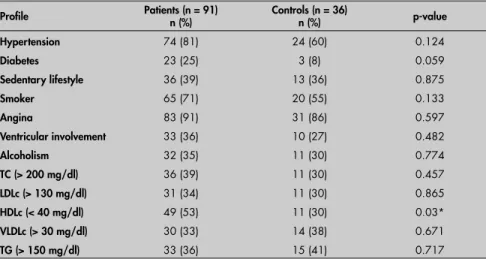
RESULTS Table 1 shows characteristics of patients
Table 1. Characterization of patients with coronary artery disease and controls who underwent angiography, and the respective statistical signifi cance between the two groups (p-value)
Profi le Patients (n = 91) n (%) Controls (n = 36) n (%) p-value
Hypertension 74 (81) 24 (60) 0.124
Diabetes 23 (25) 3 (8) 0.059
Sedentary lifestyle 36 (39) 13 (36) 0.875
Smoker 65 (71) 20 (55) 0.133
Angina 83 (91) 31 (86) 0.597
Ventricular involvement 33 (36) 10 (27) 0.482
Alcoholism 32 (35) 11 (30) 0.774
TC (> 200 mg/dl) 36 (39) 11 (30) 0.457
LDLc (> 130 mg/dl) 31 (34) 11 (30) 0.865
HDLc (< 40 mg/dl) 49 (53) 11 (30) 0.03*
VLDLc (> 30 mg/dl) 30 (33) 14 (38) 0.671
TG (> 150 mg/dl) 33 (36) 15 (41) 0.717
TC = total cholesterol; LDLc = low-density lipoprotein cholesterol fraction; HDLc = high-density lipoprotein cholesterol fraction; VLDLc = very low-density lipoprotein cholesterol fraction; TG = triglycerides. * p < 0.05.
Table 2.Distribution of the allelic and genotypic frequencies of C677T polymorphism in 127 individuals who underwent angiography
Patients (n = 91) Controls (n = 36) p-value
Genotype
CC CT
n %
26 28 59 65
n %
14 39 20 55
0.360 0.442 TT
T allele
6 7 71 0.39*
2 6 24 0.34*
0.851 0.485
* absolute frequency.
HDLc (p = 0.01). No associations were seen between CAD and diabetes (p = 0.1359), hy-pertension (p = 0.1065) or C677T polymor-phism (p = 0.56), in the individuals studied. The mean values relating to the lipopro-tein profi le showed slightly higher levels of TC and LDLc in patients (193 ± 61 mg/dl and 124 ± 50 mg/dl respectively) than in controls (187 ± 39 mg/dl and 119 ± 31 mg/dl). Even so, both groups presented with levels within the reference ranges. On the other hand, the lower mean values for HDLc were similar in the two groups (38 ± 11 mg/dl and 38 ± 7 mg/dl, respectively).
Analysis of the allelic and genotypic fre-quencies of C677T polymorphism (Table 2) demonstrated that the most prevalent allele type and controls and their lipid profi le. Prior
diseases identifi ed in the CAD group (91 patients) included high blood pressure in 81% of the individuals and diabetes in 25%. In the control subjects the rates were 60% and 8%, respectively. Seventy-one percent of the patients reported they were smokers; hence there was no signifi cant difference in comparison with the controls (55%; p = 0.13). Serum levels for the lipid profi le remained within the reference range in both groups except for HDLc, for which levels of less than 40 mg/dl were signifi cantly more frequent in the patients (53%) than in the control subjects (30%, p = 0.03).
Logistic regression indicated associations between CAD and smoking (p = 0.02) and
Table 3.Coronary artery involvement in patients, in relation to C677T polymorphism, and the respective statistical signifi cance (p-value)
Genotype < 50%
n (p-value)
50-75% n (p-value)
75-95% n (p-value)
> 95% n (p-value)
2 (0.861) 6 (0.708)
4 (0.596) 14 (0.523)
14 (0.269) 27 (0.906)
6 (0.908) 12 (0.366) CC
CT
TT 0 (0.967) 1 (0.681) 1 (0.212) 4 (0.029)*
was the C allele, in both patients (0.61) and con-trols (0.66). The most frequent genotype was the CT genotype, in both groups (65% and 55%, respectively), followed by the CC genotype (28% and 39%, respectively). There was no signifi cant difference between the groups with regard to the allelic and genotypic frequencies.
A degree of arterial obstruction greater than 95% and presence of two damaged arte ries seemed to be associated with the TT genotype, in comparison with the other genotypes, u sing Fisher’s exact test (p = 0.029, Table 3; and p = 0.04, Table 4). Twenty-four patients (26%) presented obstruction in one artery, 38 (42%) in two arteries and 29 (32%) in three arteries. The artery affected was the anterior descen ding artery in 84 cases (92%), followed by the right coronary artery in 71 cases (78%) and the circumfl ex artery in 50 cases (55%).
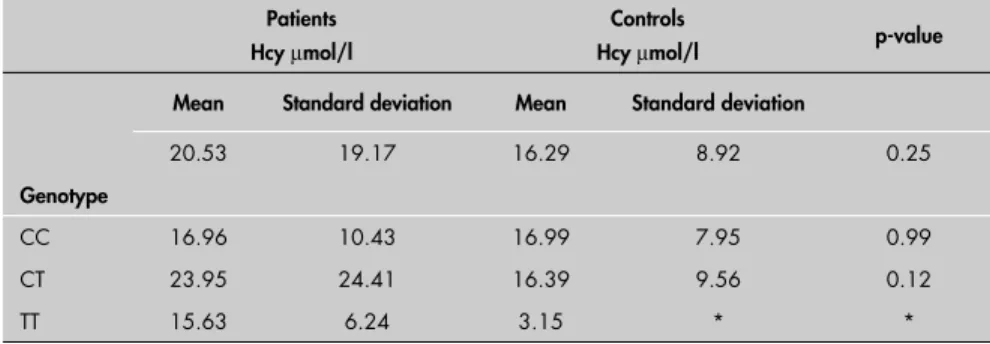
Analysis of mean Hcy concentrations demonstrated higher levels in patients (20.53 µmol/l) than in controls (16.29 µmol/l)
but the difference was not statistically signifi cant (p = 0.25); in relation to C677T polymorphism the mean Hcy levels were higher in patients with the CT genotype (23.95 µmol/l) and TT
genotype (15.63 µmol/l) than in the controls
(16.39 µmol/l and 3.15 µmol/l,
respec-tively) but again without statistical signifi cance (Table 5). In addition, no associations were ob-served between the presence of the T allele and the number of patients with raised Hcy levels in either the patient or control group.
Table 4.Distribution of the genotypic frequencies of methylenetetrahydrofolate reductase/ C677T (MTHFR/C677T) polymorphism, in relation to the number of arteries affected
Genotype
Number of affected arteries
1 n = 24
2 n = 38
3 n = 29
n (p-value)
7 (0.48) 16 (0.41)
n (p-value)
9 (0.28) 24 (0.43)
n (p-value)
10 (0.25) 19 (0.46) CC
CT
TT 1 (0.46) 5 (0.04)* 0 (0.10)
* p < 0.05.
Table 5. Analysis of homocysteine (Hcy) levels between patients and controls, in relation to C677T polymorphism, and the respective statistical signifi cance (p-value)
Patients Hcy µmol/l
Controls Hcy µmol/l
p-value
Mean Standard deviation Mean Standard deviation
20.53 19.17 16.29 8.92 0.25
Genotype
CC 16.96 10.43 16.99 7.95 0.99 CT 23.95 24.41 16.39 9.56 0.12 TT 15.63 6.24 3.15 * *
* Analysis not performed, because the control group had only one individual with the TT genotype.
similar prevalences for the T allele in patients (0.39) and controls (0.34), this fi nding cor-roborates with the literature.23 The TT genotype, with a prevalence of 7% in patients, was associa-ted with a degree of obstruction greater than 95%, which is in agreement with a study on CAD patients by Morita et al.,20 in 1997. There has also been reference to associations between the T allele and peripheral vascular disease, but with decreased frequencies (0.31 in pa-tients and 0.27 in controls).16 Nevertheless, patients with atherosclerosis of the carotid artery have presented with signifi cantly higher frequen-cies of the T allele (0.47) than in control subjects (0.27; p < 0.02).9
Studies have shown that there is a relation-ship between the C677T genetic variant,21,23 Hcy level and myocardial infarction. Higher plasma Hcy concentrations have particularly been detected in patients with CAD and the TT genotype.23
Some studies have been conducted on Brazilian patients at risk of vascular thrombo-sis. High Hcy levels were detected in patients with the MTHFR 677TT genotype; however, this was not associated with increased risk of the disease.4,24,25
Concentrations greater than or equal to 15.6 µgmol/l have been associated with
greater risk of myocardial infarction than in individuals with levels less than 10.0 µgmol/l
(odds ratio = 2.3; 95% confi dence interval range from 0.94 to 5.64).23
Studies have also revealed a relationship between the TT genotype and decreased Hcy levels in patients with daily folate supplemen-tation of approximately 400 µg together with
vitamins B12 and B6.8 Schwartz et al.23 inves-tigated the relationships between the risk of myocardial infarction and serum folate levels, vitamin B12, Hcy and C677T polymorphism. In that study, women with folate levels greater than or equal to 8.39 nmol/l presented with decreased prevalence of myocardial infarction in comparison with women whose folate levels were less than 5.27 nmol/l (odds ratio = 0.54; 95% confi dence interval range from 0.23 to 1.28). However, there were no signifi cant dif-ferences with regard to vitamin B12levels (odds ratio = 0.90, 95% confi dence interval range from 0.31 to 2.29). Thus, even though folic acid, vitamin B6 and vitamin B12 supplemen-tation can reduce Hcy levels,26 such intake is neglected by the general population and by healthcare professionals.
Although the present study did not dem-onstrate any associations between Hcy, CAD and C677T polymorphism, the higher mean Hcy levels in patients with the T allele suggest DISCUSSION
In this study, MTHFR/C677T polymor-phism did not differentiate between patients and controls. Moreover, CAD was mainly observed in patients with decreased HDLc levels and those who were smokers (logistic regression), which is in agreement with other studies.14,15 On the other hand, the similar levels of TC, LDLc, VLDLc and TG in the two groups found in the present study are discordant with other published studies.16,17
The other risk factors and clinical signs, including high blood pressure, lack of exer-cise, ventricular involvement and alcoholism were also similar between the groups. It is possible that the selection of controls (with negative angiography for coronary artery obstruction) in the cardiology outpatient clinic may have contributed towards the very high prevalences of hypertension (60%) and angina (86%).18
1. Aire S, Garcia DP, Kajita LJ, Rati AM. Estudo hemodinâmico e cineangiográfi co. Sociedade de Cardiologia do Estado de São Paulo. Cardiologia: atualização e reciclagem. Rio de Janeiro: Atheneu; 1994. p. 159-71.
2. Andreassi MG, Botto N, Cocci F, et al. Methylenetetrahydro-folate reductase gene C677T polymorphism, homocysteine, vitamin B12, and DNA damage in coronary artery disease. Hum Genetic. 2003;112(2):171-7.
3. Doevendans PA, Jukema W, Spiering W, Defesche JC, Kastelein JJ. Molecular genetics and gene expression in atherosclerosis. Int J Cardiol. 2001;80(2-3):161-72.
4. Arruda VR, Siqueira LH, Gonçalves MS, et al. Prevalence of the mutation C677-- > T in the methylene tetrahydrofolate reductase gene among distinct ethnic groups in Brazil. Am J Med Genet. 1998;78(4):332-5.
5. Robinson K, Mayer EL, Miller DP, et al. Hyperhomocystein-emia and low pyridoxal phosphate. Common and independent reversible risk factors for coronary artery disease. Circulation. 1995;92(10):2825-30.
6. Hofmann MA, Lalla E, Lu Y, et al. Hyperhomocysteinemia enhances vascular infl ammation and accelerates atherosclerosis in a murine model. J Clin Invest. 2001;107(6):675-83. 7. Hankey GJ, Eikelboom JW. Homocysteine and vascular disease.
Lancet. 1999;354(9176):407-13.
8. Lobo A, Naso A, Arheart K, et al. Reduction of homocysteine levels in coronary artery disease by low-dose folic acid combined with vitamins B6 and B12. Am J Cardiol. 1999;83(6):821-5. 9. Bova I, Chapman J, Sylantiev C, Korczyn AD, Bornstein NM.
The A677V methylenetetrahydrofolate reductase gene polymor-phism and carotid atherosclerosis. Stroke. 1999;30(10):2180-2. 10. Welch GN, Upchurch G Jr, Loscalzo J. Hyperhomocyst(e)inemia and atherothrombosis. Ann N Y Acad Sci. 1997;811:48-58; discussion 58-9.
11. Tyagi SC. Homocysteine redox receptor and regulation of extracellular matrix components in vascular cells. Am J Physiol. 1998;274(2 Pt 1)C396-405.
12. Abdel-Rahman SZ, Nouraldeen AM, Ahmed AE. Molecular interaction of [2,3-14C] acrylonitrile with DNA in gastric tissues of rat. J Biochem Toxicol. 1994;9(4):191-8. 13. Beiguelman B. Curso prático de bioestatística. Ribeirão Preto:
FUNPEC; 1996.
14. Alagona C, Soro A, Westerbacka J, et al. Low HDL choles-terol concentration is associated with increased intima-media thickness independent of arterial stiffness in healthy subjects from families with low HDL cholesterol. Eur J Clin Invest. 2003;33(6):457-63.
15. von Birgelen C, Hartmann M, Mintz GS, Baumgart D, Schmermund A, Erbel R. Relation between progression and regression of atherosclerotic left main coronary artery disease and serum cholesterol levels as assessed with serial long-term (> or =12 months) follow-up intravascular ultrasound. Circulation. 2003;108(22):2757-62.
16. Rassoul F, Richter V, Janke C, et al. Plasma homocysteine and lipoprotein profi le in patients with peripheral arterial occlusive disease. Angiology. 2000;51(3):189-96.
17. Souza DR, Campos BF, Arruda EF, Yamamoto LJ, Trindade DM, Tognola WA. Infl uence of polymorphism of apolipoprotein E in cerebral vascular disease. Arq Neuropsiquiatr. 2003;61(1):7-13. 18. Pereira AC, Schettert IT, Morandini Filho AA, Guerra-Shi-nohara EM, Krieger JE. Methylenetetrahydrofolate reductase (MTHFR) c677t gene variant modulates the homocysteine folate correlation in a mild folate-defi cient population. Clin Chim Acta. 2004;340(1-2):99-105.
19. Rudisch B, Nemeroff CB. Epidemiology of comorbid coronary artery disease and depression. Biol Psychiatry. 2003;54(3):227-40.
20. Morita H, Taguchi J, Kurihara H, et al. Genetic polymorphism of 5,10-methylenetetrahydrofolate reductase (MTHFR) as a risk fac-tor for coronary artery disease. Circulation. 1997;95(8):2032-6. 21. Frosst P, Blom HJ, Milos R, et al. A candidate genetic risk factor
for vascular disease: a common mutation in methylenetetrahy-drofolate reductase. Nat Genet. 1995;10(1):111-3. 22. Brattström L, Wilcken DE, Ohrvik J, Brudin L. Common
methylenetetrahydrofolate reductase gene mutation leads to hyperhomocysteinemia but not to vascular disease: the result of a meta-analysis. Circulation. 1998;98(23):2520-6. 23. Schwartz SM, Siscovick DS, Malinow MR, et al. Myocardial
infarction in young women in relation to plasma total homo-cysteine, folate, and a common variant in the methylenetetra-hydrofolate reductase gene. Circulation. 1997;96(2):412-7. 24. Morelli VM, Lourenço DM, D’Almeida V, et al.
Hyperhomocy-steinemia increases the risk of venous thrombosis independent of the C677T mutation of the methylenetetrahydrofolate reductase gene in selected Brazilian patients. Blood Coagul Fibrinolysis. 2002;13(3):271-5.
25. Franco RF, Araújo AG, Guerreiro JF, Elion J, Zago MA. Analysis of the 677 C-->T mutation of the methylenetetrahydrofolate reductase gene in different ethnic groups. Thromb Haemost. 1998;79(1):119-21.
26. Lobo A, Naso A, Arheart K, et al. Reduction of homocysteine levels in coronary artery disease by low-dose folic acid combined with vitamins B6 and B12. Am J Cardiol. 1999;83(6):821-5.
Sources of funding: State of São Paulo Research Foundation (Fundação de Amparo à Pesquisa do Estado de São Paulo, Fapesp), São Paulo, Brazil. Grant number 02/07538-1.
Confl ict of interest: Not declared.
Date of fi rst submission: February 12, 2005
Last received: December 12, 2006
Accepted: December 15, 2006
REFERENCES
that signifi cant results might be found in largercohorts. Thus, further studies are needed, us-ing larger series to analyze the real risk exerted by the presence of C677T polymorphism and its relationship with risk factors for CAD.
One diffi culty in this study was the ethnic characterization. A great number of individu-als were excluded because they were unable to unequivocally affi rm their ethnic origin. Another diffi culty was the cost relating to Hcy measurements, which was resolved through collaboration with the Thonson Laboratory of
the Chemistry Department of the University of Campinas.
Because of the importance of studies on different populations and with greater sample sizes, the authors intend to continue investi-gating the relationship between CAD and the MTHFR gene, as well as other genes related to folate metabolism (methionine reductase and methionine synthetase). Furthermore, the importance of B6 and B12 vitamin intake and folic acid intake will be studied in an attempt to analyze the infl uence of these variables.
AUTHOR INFORMATION Alexandre Rodrigues Guerzoni, PhD. Former researcher in Genetics and Molecular Biology Research Unit (Unidade de Pesquisa em Genética e Biologia Molecular, UPGEM), Faculdade de Medicina de São José do Rio Preto (Famerp), São José do Rio Preto, São Paulo, Brazil.
Érika Cristina Pavarino-Bertelli, PhD. Adjunct professor, Molecular Biology Department Genetics and Molecular Biology Research Unit (Unidade de Pesquisa em Genética e Biologia Molecular, UPGEM), Faculdade de Medicina de São José do Rio Preto (Famerp), São José do Rio Preto, São Paulo, Brazil.
Moacir Fernandes de Godoy, MD, PhD. Adjunct professor, Cardiology and Cardiovascular Surgery Department, Faculdade de Medicina de São José do Rio Preto (Famerp), São José do Rio Preto, São Paulo, Brazil.
Carla Renata Graça, BSc. Biologist.Faculdade de Medicina de São José do Rio Preto (Famerp), São José do Rio Preto, São Paulo, Brazil.
Patrícia Matos Biselli, MSc. Postgraduate student, Genetics and Molecular Biology Research Unit (Unidade de Pesquisa em Genética e Biologia Molecular, UPGEM), Faculdade de Medicina de São José do Rio Preto (Famerp), São José do Rio Preto, São Paulo, Brazil.
Dorotéia Rossi Silva Souza, PhD. Adjunct professor, Mole-cular Biology Department, Faculdade de Medicina de São José do Rio Preto (Famerp), São José do Rio Preto, São Paulo, Brazil.
Eny Maria Goloni Bertollo, PhD. Adjunct professor, Molecular Biology Department Genetics and Molecular Biology Re-search Unit (Unidade de Pesquisa em Genética e Biologia Molecular, UPGEM), Faculdade de Medicina de São José do Rio Preto (Famerp), São José do Rio Preto, São Paulo, Brazil.
Address for correspondence: Eny Maria Goloni Bertollo
Av. Brigadeiro Faria Lima, 5.416 — São Pedro São José do Rio Preto (SP) — Brasil CEP 15090-000
Tel. (+55 17) 3201-5720 E-mail: [email protected]
Copyright © 2007, Associação Paulista de Medicina
RESUMO Polimorfi smo do gene metilenotetrahidrofolato redutase e sua associação com doença arterial coronária CONTEXTO E OBJETIVO: A doença arterial coronariana (DAC) caracteriza-se pelo depósito de placa ateros-clerótica na parede arterial coronária. Sua manifestação é dependente da interação entre fatores de risco ambientais e genéticos. O objetivo deste trabalho é analisar a freqüência do polimorfi smo MTHFR/C677T em pacientes com doença arterial coronária e sua associação com o nível de Hcy plasmática. Fatores de risco para DAC também foram avaliados.
TIPO DE ESTUDO: Retrospectivo com análise cega quantitativa, no Hospital de Base, Faculdade de Medi-cina de São José do Rio Preto.
MÉTODOS: Foram estudados 127 indivíduos. Todos responderam a um questionário para análise dos fatores de risco para DAC. O polimorfi smo MTHFR/C677T, investigado por análise de comprimento de fragmentos de restrição, foi correlacionado com número de artérias afetadas e grau de obstrução arterial, determinadas pela cinangiocoronariografi a, e com o nível de Hcy plasmática.
RESULTADOS: Tabagismo (p = 0,02) and HDLc (p = 0,01) foram associados com DAC. O alelo C foi o mais prevalente em pacientes (0,61) e controles (0,66; p = 0,49). O polimorfi smo MTHFR/C677T não apresentou associação com níveis de Hcy plasmática. Entretanto, nos pacientes com genótipo TT obser-vou-se a prevalência de obstrução coronariana acima de 95% (p = 0,02) e a presença de duas artérias lesadas (p = 0,04).
CONCLUSÕES: Associou-se o genótipo TT com o grau de obstrução arterial coronária acima de 95% e a presença de duas artérias lesadas; confi rma-se, assim, a relação de variantes genéticas em subgrupos específi cos de pacientes com doenças cardiovasculares.