GASTROESOPHAGEAL REFLUX AND SWALLOWING
IN NEWBORNS AND INFANTS: INTEGRATIVE REVIEW
OF LITERATURE
Refluxo gastroesofágico e deglutição em recém nascidos e lactentes:
revisão integrativa da literatura
Flávia Rebelo Silva Puccini (1), Giédre Berretin-Felix (2)
(1) Faculdade de Odontologia de Bauru da Universidade de
São Paulo, FOB/USP, Bauru, São Paulo, Brasil.
(2) Departamento de Fonoaudiologia da Faculdade de
Odon-period, and it can occur at least in three short
episodes, at the irst two postprandial hours. The functional GERD occurs with more frequency than the physiological one, however, without causing disease to the child. It is called functional for not having any basic dysfunction (mechanical, inlam
-matory, infectious or biochemical) that can lead to relux, and it is a process of gastrointestinal maturity. Relux still can be occult or silent, being possible that it becomes pathological.
Inasmuch as the GERD comprises extraesoph
-ageal areas, it ceases to be a problem restrict to the digestive tract. Among the GERD complications is mentioned the bronchitic asthma and the otorhi
-nolaryngological problems, food problems, infantile colic and dental erosion. The GERD can also be
INTRODUCTION
The gastroesophageal relux disease (GERD) is deined as the involuntary return of the gastric content to esophagus¹ and it happens in approxi
-mately 25% of babies, being the second greatest problem regarding the most prevailing afections of
the digestive tract².
The GERD in children is classiied as physi
-ological, functional and primary and secondary pathological³ condition. The physiological GERD is characterized by episodic relux, in the postprandial
ABSTRACT
The so called gastroesophageal relux is found in 25% of babies and can give rise to a variety of child development related prejudice. The objective of this paper was to carry out a integrative review of the literature in order to verify whether there are publications on the relation between swallowing alteration and the gastroesophageal relux scenario in newborns and infants. The research was based on websites consultations, such as Bireme and PubMed. The key words used can be sumarized as follows: gastroesophageal relux, newborn and infant either in portuguese or english. The descriptors were used in pairs, since their isolate use covered a lot of papers with diferent contents from what we need for this speciic research of interest. Papers from the last 10 years have been taken into account. It remained 23 articles out of 1184 articles from Bireme and 1600 from PubMed analyzed from the application of inclusion and exclusion criteria, and the overwhelming majority of those 23 articles was related to signs, symptoms and diagnose of GER. Two of the afore-mentioned articles approached themes as GER and swallowing, demonstrating that there is no necessarily relation between GER and oropharyngeal dysphagia in newborns and infants, moreover, the lack of researches on these themes
demonstrates the need of new studies on pathophysiological related aspects.
consulted the LILACS and MEDLINE’s database, and in the PubMed’s site.
The catchwords used to the research were: gastroesophageal relux, newborn and infant, both in English and in Portuguese. The research was carried out with descriptors in pairs, since their isolated use comprised many texts containing subject matters diferent from authors’ interest.
All the scientiic articles that approached gastro
-esophageal relux, both the physiological relux and the GERD, in newborns and infants, in the period between 2004 and 2014, were included.
All duplicated articles, those that did not approach
the proposed subject matter, and those that did not mention babies or were not in the limit of time were excluded.
After all information was grasped and studied, the data were analyzed considering the journal and the year of publication, the research objective, the diagnosis exams and proposed treatments, as well as the relation between the gastroesophageal relux and swallowing disturbances. At last, the levels of evidence of each study was analyzed, according to Souza, Silva e Carvalho (2010)¹². Subsequently this data were discussed and compared with literature.
REVIEW OF LITERATURE
In the search carried out in the Bireme’s website, using catchwords in pairs, 1.184 articles were found. According to the established criteria, 8 studies were selected in LILACS and MEDLINE’s database. Yet in the search carried out in the PubMed’s website, 1.600 articles were found, from which remained 15 articles after the application of inclusion and exclusion criteria. The steps of this selection are
illustrated in Figure 1.
In spite of feeding, as well as breathing, being a natural function, it is necessary, to it occurs, a very complex process that involves several phases, as swallowing and digestion. Interruptions or altera
-tions in any of these phases can cause bad nutrition and growth deicit. The nutrition of a baby, especially in the irst year of life, is essential to brain growth
and development.
The most common symptoms that suggest a food problem are sucking and swallowing diiculties, apnea, repetitive cough and/or choking, excessive irritability, behavior changes during feeding, time of nutrition higher than 30 to 40 minutes, food refusal and growth deicit.
The occurrence of vomiting, regurgitation, chokings, lack of air, esophagitis, dysphagia, odyno
-phagia, pyrosis and retrosternal pain make the child to relate food to discomfort, pain and antipleasure¹. On the other side, the GERD jeopardizes the integrity of baby’s oral motricity, causing hypersensitivity in the oral cavity, anticipation of vomiting relex and aversion to tactile stimulation, justifying the refusal of some food and textures¹¹.
Thus, the objective of this paper was realize an review of literature to verify if there is publications relating swallowing disturbances to the condition of the GERD in newborns and infants.
METHODS
This paper is an integrative review, with descriptive and analytic character, being based on the analysis of articles on gastroesophageal relux in newborns and infants.
The collection of periodicals was realized in the Bireme’s website (Virtual Health Library), being
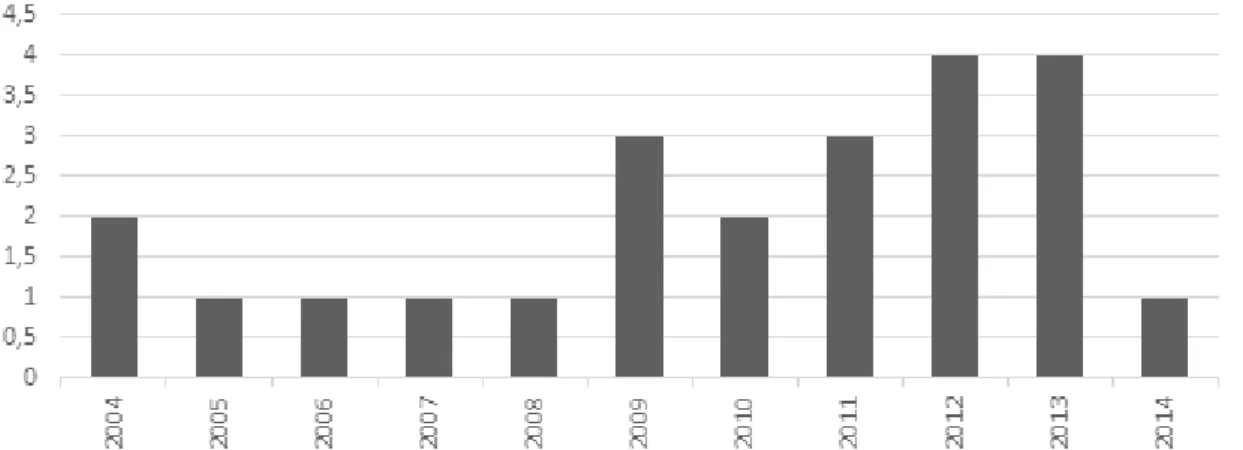
possible to observe that there was an increase in the number of publications on this subject matter in the last years, as presented in Figure 2.
Articles published in the period of 2004 to 2014 were selected, being one article published per year, mostly. The years of 2012 and 2013 presented the biggest number of publications (n=4). It was
Figure 2 – Presentation of the number of articles published per year according to the results found through the search in all data-bases e websites consulted
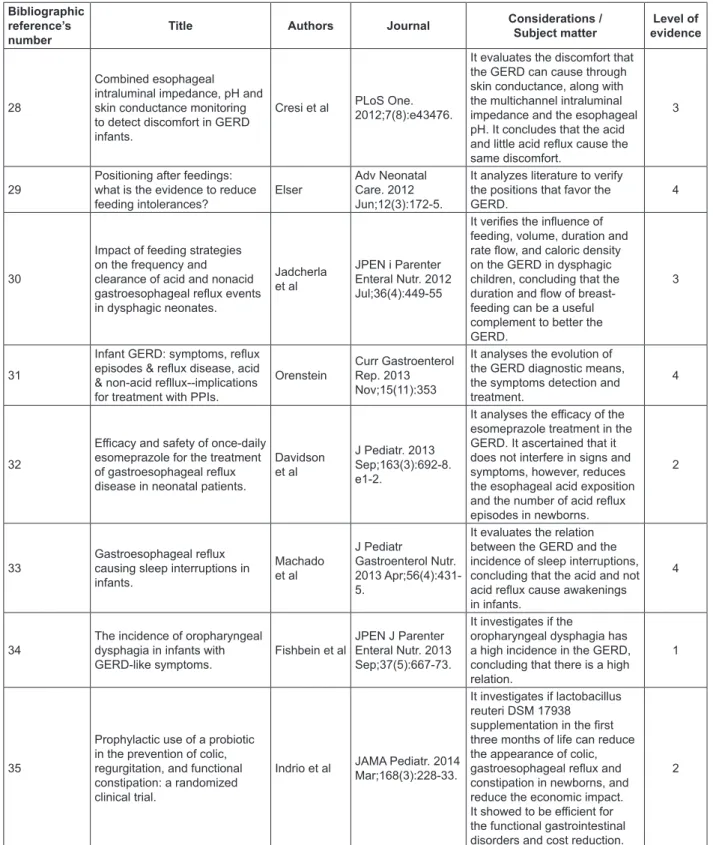
The Figure 3 presents information obtained from the analysis of each selected publication, being possible to observe that the majority of the studies had the objective of establishing the best exam to diagnose the GERD and, also, the objective
of relating clinic signs to the exams. The medical journals presented the biggest number of published articles related to the subject matter (n=18), followed by the nutrition journals (n=2), speech therapist (n=1), sleep (n=1) and neonatal care (n=1).
Bibliographic reference’s number
Title Authors Journal Considerations / Subject matter
Level of evidence
13
The inluence of the supine and prone position in the esophageal pH monitoring in very low birth weight infants
Mezzacappa, Goulart, Burnelli
Arq. Gastroenterol. 2004
Jan-Mar;41(1).
It veriies the postural inluence on the frequency and duration of GERD episodes, ascertaining the prone position’s eiciency.
4
14
Prevalence of pathologic gastroesophageal relux in
regurgitant infants Costa et al
J. Pediatr. (Rio J.). 2004 July-Aug;80(4).
It determines through Roma II’s criterion the prevalence of the pathological GERD in regurgitant infants.
3
15
Predominant respiratory symptoms in indications for prolonged esophageal pH-monitoring children
Goldani et al Arq. Gastroenterol. 2005 July-Sept;42(3).
It evaluates children and teenagers regarding demand, indications and results of prolonged esophageal pH monitoring to evaluate the GERD, concluding that the relux indexes in positive pH tests were higher in children under the age of 2 years old.
4
16
Efect of formula thickened with locust bean gum on gastric emptying in infants.
Miyazawa et al
J Paediatr Child Health. 2006 Dec;42(12):808-12.
It veriies the efect of a formula thickened with carob seed gum on gastric emptying, ascertaining that the efect is positive.
Bibliographic reference’s number
Title Authors Journal Considerations / Subject matter
Level of evidence
17
Diurnal variation in the chemical clearance of acid gastroesophageal relux in infants. Woodley, Fernandez, Mousa Clin Gastroenterol Hepatol. 2007 Jan;5(1):37-43
It evaluates feeding efects regarding duration, volume and chemical depurations.
3
18
The efect of thickened-feed interventions on gastroesophageal relux in infants: systematic review and meta-analysis of randomized, controlled trials. Horvath, Dziechciarz, Szajewska Pediatrics. 2008 Dec;122(6): e1268-77
It systematically evaluates and updates data from randomized controlled trials on the eicacy and safety of thickened foods in GERD treatment.
1
19
Gastroesophageal relux: a comparative study of receptiveness and sensitivity of upper gastrointestinal series and ultrasonography
Sakate et ak Radiol Bras. 2009 July-Aug;42(4).
It compares the sensitivity and receptivity of esophagus, stomach and duodenum’s seriography (ESD) with the intra-abdominal esophagus’s ultrasonography in patients with suspected GERD.
3
20
Technical limitations in detection of gastroesophageal relux in neonates.
Di Fiori et al
J Pediatr Gastroenterol Nutr. 2009 Aug;49(2):177-82
It characterizes GERD incidence detected by esophageal pH monitoring and not detected by intraluminal impedance.
4
21 GERD or not GERD: the fussy infant. Bhatia, Parish
J Perinatol. 2009 May;29 Suppl 2:S7-11.
It deines the GERD and GERD associated symptoms, and treatment options.
4
22
Disagreement between symptom-relux association analysis parameters in pediatric gastroesophageal relux disease investigation. Luthold, Rochat, Bahler World J Gastroenterol. 2010 May 21;16(19):2401-6.
It veriies if there is a relation between GERD symptoms and the pH test, showing that only symptoms can generate important discordances in diagnostic classiication.
4
23
Small volumes of feed can trigger transient lower esophageal sphincter relaxation and gastroesophageal relux in the right lateral position in infants.
Van Wijk et al
J Pediatr. 2010 May;156(5):744-8, 748.e1.
It investigates the quantity of food that activates the lower esophageal sphincter’s relaxation in right and left lateral decubitus.
3
24
Fluoroscopic indings ofswallowing: comparision between preterm and full-term infants
Silva-Munhoz, Bühler
J. Soc. Bras. Fonoaudiol. 2011 July-Sept;23(3).
It describes the luoroscopic indings of swallowing, clinic signs and symptoms related to the alteration in preterm and term newborns’ swallowing.
4
25
Sensitivity of upper gastrointestinal series in the diagnosis of gastroesophageal in infants
Alvares, Torres, Mezzacappa
Radiol Bras. 2011 July-Aug;44(4).
It determines the ESD’s low sensitivity to diagnose the GERD in comparison with the prolonged pH test, but showed to be useful in the anatomic alterations diagnosis.
3
26
Assessment and treatment of gastroesophageal relux in healthy infants with apneic episodes: a retrospective analysis of 87 consecutive patients. Koivusalo et al Clin Pediatr (Phila). 2011 Dec;50(12):1096-102.
It evaluates if the GERD treatment is related to the betterment of recurrent infant apnea, verifying that there is no relation.
3
27
Relationship between sleep and acid gastro-oesophageal relux in neonates.
Ammari et al J Sleep Res. 2011 Feb;21(1):80-6.
It investigates the acid relux’s impact on sleep. It concludes that the GERD occurs mostly in vigilance, and correlates sleep phases to the physiopathological impact of the GERD.
Bibliographic reference’s number
Title Authors Journal Considerations / Subject matter
Level of evidence
28
Combined esophageal intraluminal impedance, pH and skin conductance monitoring to detect discomfort in GERD infants.
Cresi et al PLoS One. 2012;7(8):e43476.
It evaluates the discomfort that the GERD can cause through skin conductance, along with the multichannel intraluminal impedance and the esophageal pH. It concludes that the acid and little acid relux cause the same discomfort.
3
29
Positioning after feedings: what is the evidence to reduce feeding intolerances? Elser
Adv Neonatal Care. 2012 Jun;12(3):172-5.
It analyzes literature to verify the positions that favor the
GERD. 4
30
Impact of feeding strategies on the frequency and clearance of acid and nonacid gastroesophageal relux events in dysphagic neonates.
Jadcherla et al
JPEN i Parenter Enteral Nutr. 2012 Jul;36(4):449-55
It veriies the inluence of feeding, volume, duration and rate low, and caloric density on the GERD in dysphagic children, concluding that the duration and low of breast-feeding can be a useful complement to better the GERD.
3
31
Infant GERD: symptoms, relux episodes & relux disease, acid & non-acid rellux--implications for treatment with PPIs.
Orenstein
Curr Gastroenterol Rep. 2013 Nov;15(11):353
It analyses the evolution of the GERD diagnostic means, the symptoms detection and treatment.
4
32
Eicacy and safety of once-daily esomeprazole for the treatment of gastroesophageal relux disease in neonatal patients.
Davidson et al
J Pediatr. 2013 Sep;163(3):692-8. e1-2.
It analyses the eicacy of the esomeprazole treatment in the GERD. It ascertained that it does not interfere in signs and symptoms, however, reduces the esophageal acid exposition and the number of acid relux episodes in newborns.
2
33
Gastroesophageal relux causing sleep interruptions in infants. Machado et al J Pediatr Gastroenterol Nutr. 2013 Apr;56(4):431-5.
It evaluates the relation between the GERD and the incidence of sleep interruptions, concluding that the acid and not acid relux cause awakenings in infants.
4
34
The incidence of oropharyngeal dysphagia in infants with
GERD-like symptoms. Fishbein et al
JPEN J Parenter Enteral Nutr. 2013 Sep;37(5):667-73.
It investigates if the
oropharyngeal dysphagia has a high incidence in the GERD, concluding that there is a high relation.
1
35
Prophylactic use of a probiotic in the prevention of colic, regurgitation, and functional constipation: a randomized clinical trial.
Indrio et al JAMA Pediatr. 2014 Mar;168(3):228-33.
It investigates if lactobacillus reuteri DSM 17938
supplementation in the irst three months of life can reduce the appearance of colic, gastroesophageal relux and constipation in newborns, and reduce the economic impact. It showed to be eicient for the functional gastrointestinal disorders and cost reduction.
2
Figure 3 – Information referring to the articles selected for the research, collected in Bireme’s
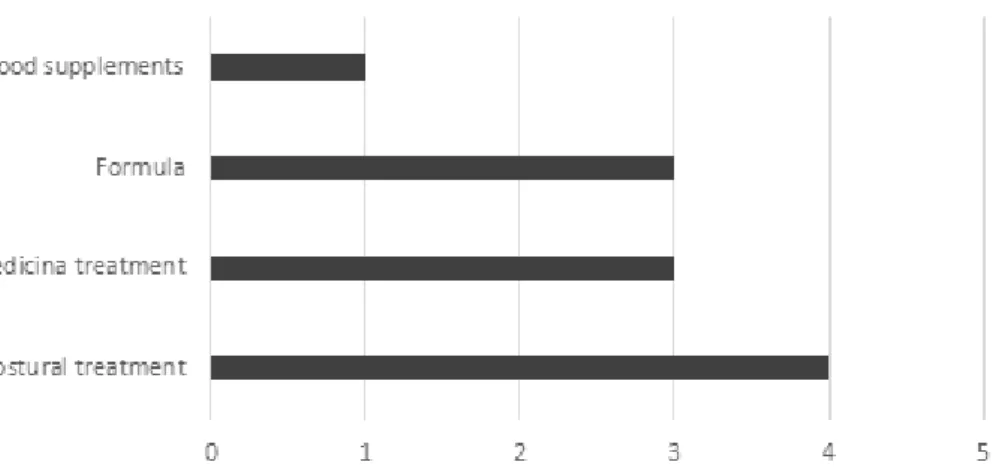
The most mentioned types of treatment were the postural one (n=4), drug treatment (n=3) and use of thickening formula (n=3). The treatments are
presented in Figure 6.
Few articles related the GERD to swallowing (n=2), being one of them published in a journal that covers the area of phonoaudiology and the other the area of nutrition. The indings of these studies are
disposed in Figure 7.
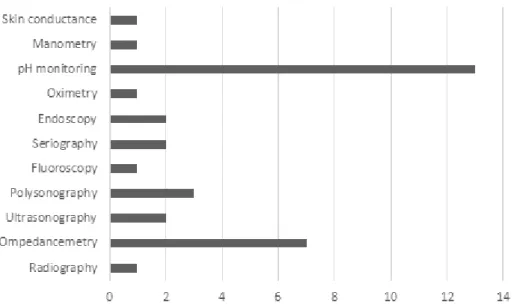
According to the review that was realized, several exams were used to diagnose the GERD, however, the Esophageal pH monitoring was the most used (n=13) and demonstrated better sensitivity and greater reliability. The exams are presented in
Figure 4.
The signs and symptoms most related to the GERD were breathing problems (n=7), followed by regurgitations (n=5) and vomiting (n=4), regarding
that the same article can mention t than one sign/
symptom, as presents Figure 5.
Figure 4 – Presentation of the number of articles in relation to the diagnostic test used to detect the
gastroesophageal relux disease.
Figure 5 – Presentation of the number of articles in which was mentioned the signs and symptoms –
Figure 6 – Presentation of the number of articles in which were presented treatments
Bibliographic
reference’s number Tilte Authors Abstract
24
Fluoroscopic indings of swallowing: comparison between preterm and full-term infants
Silva-Munhoz;
Bühler (2011)
It inds absence of relation between the presence of the GERD and swallowing disturbances in oral and pharyngeal phases. The incoordination of sucking, swallowing and breathing was related to prematurity, as well as to sucking diiculty.
34
The incidence of oropharyngeal dysphagia in infants with GERD-like symptoms.
Fishbein et al.
(2013)
It presents the incoordination of sucking/swallowing/ breathing, weak sucking, apnea, altered vomiting relex, cough, irritability, nasopharyngeal relux and increased lactation time as the main symptoms. It inds a high relation between oropharyngeal dysphagia and the GERD.
Figure 7 – Information referring to the articles that approached the relation between the
gastroesophageal relux disease and swallowing in babies and the indings of these studies.
DISCUSSION
The intention of this study was to research if the GERD inluence on swallowing has become evident in the scientiic literature, seeing the physiological GERD is common in the neonatal period and can cause damages to baby’s health and development. The GERD is considered one of the main causes of
visiting a pediatric gastroenterologist².
It was possible to observe that the number of publications is increasing over the years, corrobo
-rating Mooloy, Di Fiori, Martin (2005)³, that veriied an increase in researches on the GERD in the last decades due to its aspects that were not clariied yet.
The majority of the articles found sought to connect signs and symptoms with GERD verii -cation14-16,22,24,27 and to identify the most sensitive
exams to the GERD diagnosis. Another objective, that was also approached, was to study the efect of the postural treatment on the GERD, what proved
The bibliographic collection demonstrated that great majority of publications found (n=18) correspond to medical ield. There was a diversity of topics in the medical research found, from food thickening¹, corporal posture13,29, diagnosis14,31,
treatments26,32,35 to exams15,19,20,22,2, among others.
The most used diagnostic test and considered efective by the studies found13,15,17,20,22,26,27,29-33 was
the Esophageal pH monitoring, conirming Moraes-Filho that consider the pH monitoring a gold standard test due to its sensitivity to detect problems and, still, to its capacity of propitiating a connection with the symptoms found in patients38.
The most mentioned signs/symptoms in the research were the breathing ones14,15,20,21,31-33,
including oxygen saturation drop, pneumonia, the crying baby syndrome, cyanosis, among others, followed by regurgitation16,18,31,32,35 and vomiting18,21,32,33, conirming another research2 that
cited these ones as being the main clinic signs and symptoms.
Additionally, a study40 that found association between
such aspects evidenced the high incidence of this relation in babies that presented the GERD. Few researches of medical ield dealt with the possibility of oropharyngeal dysphagia in this population, being scarce the references found that approach the oral phase of swallowing or even relate food problems to the GERD, evidencing the need of new researches.
The data found in the present research demonstrated that the GERD treatment must be multi-professional, being the participation of a phonoaudiologist of fundamental importance in the supervision of the sucking and swallowing condi
-tions, enabling to obtain best results by reducing the risk of sequelae that can afect the child’s global
development.
CONCLUSION
The review of literature realized by this paper demonstrated that can have relation between the GERD and swallowing disturbances in newborns and infants, being that the scarcity of studies on this subject matter demonstrated the need of more researches approaching the pathophysiological
aspects involved.
where they ascertained that the preterm newborns presented higher desaturation, while the term newborns showed vomiting as the main symptom. Another topic found in this collection21,32 is the baby’s
nutritional state, that in most cases is altered,
jeopar-dizing its growth, what corroborates literature2.
Drent and Pinto (2007)39, relating the GERD to
food problems, concluded that the GERD presence results in alimentary disturbances of behavioral and myofunctional orofacial magnitude, causing malnutrition and growth deicit. Meira (1998)11 still
mentions that the GERD can increase the intraoral sensitivity, making child to develop aversion to some stimuli and textures, justifying the food refusal.
The studies showed that the therapeutic approach focusing in corporal posture changes13,29 and
formulae to modify food consistency16,18 generates
positive results. Another authors approached, yet,
medicinal treatment26,31,32, being necessary to adopt
surgical conducts only in extreme cases.
The jeopardized oral and pharyngeal phases of swallowing and feeding diiculties in GERD children was considered only by two studies14,24,
being one of them published in a journal that covers the area of phonoaudiology and the other, the area of nutrition. However, in an article24 this relation
was not observed in term babies, only in preterm babies relating swallowing diiculty to immaturity.
RESUMO
O reluxo gastroesofágico é encontrado em 25% dos bebês e pode acarretar vários prejuízos para o desenvolvimento. O objetivo deste trabalho foi realizar uma revisão integrativa da literatura buscando veriicar se há publicações relacionando alterações da deglutição com o quadro de reluxo gastroe
-sofágico em recém-nascidos e lactentes. A pesquisa foi realizada consultando os sites da Bireme e da PubMed. Os unitermos utilizados foram reluxo gastroesofágico, recém-nascido e lactente, em português e os correspondentes em inglês. Os descritores foram utilizados pareados, pois isolados abrangia muitos textos com temáticas diferentes da de interesse. Os trabalhos selecionados foram dos últimos dez anos. Não houve limite de tempo. De 1184 artigos da Bireme e 1600 da PubMed ana
-lisados a partir da aplicação dos critérios de inclusão e exclusão, restaram 23 artigos, sendo a maioria voltada aos sinais, sintomas e diagnóstico do RGE. Dois artigos abordaram o RGE e a deglutição, demonstrando que pode haver ou não relação entre RGE e disfagia orofaríngea em recém nascidos e lactentes, sendo que a escassez de pesquisas com essa temática demonstrou a necessidade de novos estudos abordando os aspectos patoisiológicos envolvidos.
14. Costa AJD, Silva GAP, Gouveia PAC, Pereira Filho EM. Prevalência de reluxo gastroesofágico
patológico em lactentes regurgitadores. J Pediatr.
2004;80(4):291-5.
15. Goldani HAS, Silveira TR, Rocha R, Celia L, Molle LD, Barros SGS. Predomínio de manifestações respiratórias na indicação de pHmetria esofágica prolongada em crianças. Arq Gastroenterol.
2005;42(3):173-7.
16. Miyazawa R, Tomomasa T, Kaneko H, Morikawa A. Efect of formula thickened with locust bean gum on gastric emptying in infants. J Paediatr Child Health. 2006;42(12):808-12.
17. Woodley FW, Fernandez S, Mousa H. Diurnal variation in the chemical clearance of acid gastroesophageal relux in infants. Clin Gastroenterol Hepatol. 2007;5(1):37-43.
18. Horvath A, Dziechciarz P, Szajewska H. The efect of thickened-feed interventions on gastroesophageal relux in infants: systematic review and meta-analysis of randomized, controlled trials. Pediatrics. 2008;122(6):e1268-77.
19. Sakate M, Silveira GL, Muzio BP, Teigao Junior H, Ozaki JGO, Spadim MD et al. Reluxo gastroesofágico: estudo comparativo da receptividade e sensibilidade entre seriograia e ultrassonograia. Radiol Bras. 2009;42(4):245-8. 20. Di Fiore JM, Arko M, Churbock K, Hibbs AM, Martin RJ. Technical limitations in detection of gastroesophageal relux in neonates. J Pediatr Gastroenterol Nutr. 2009;49(2):177-82.
21. Bhatia J, Parish A. GERD or not GERD: the fussy infant. J Perinatol. 2009;29(Suppl 2):S7-11. 22. Lüthold SC, Rochat MK, Bähler P. Disagreement between symptom-relux association analysis parameters in pediatric gastroesophageal relux disease investigation. World J Gastroenterol.
2010;16(19):2401-6.
23. Van Wijk MP, Benninga MA, Davidson GP, Haslam R, Omari TI. Small volumes of feed can trigger transient lower esophageal sphincter relaxation and gastroesophageal relux in the right lateral position in infants. J Pediatr. 2010;156(5):744-8.
24. Silva-Munhoz LF, Buhler KEB. Achados luoroscópicos da deglutição: comparação entre recém-nascidos pré-termo e recém-nascidos de
termo. J Soc Bras Fonoaudiol. 2011;23(3):206-13.
25. Alvares BR, Torre OHD, Mezzacappa MA. Sensibilidade da seriograia do esôfago, estômago e duodeno para o diagnóstico de doença do reluxo gastroesofágico em recém-nascidos. Radiol Bras.
2011;44(4):211-4.
26. Koivusalo AI, Pakarinen MP, Wikström A, Rintala
REFERENCES
1. Rudolph CD, Mazur LJ, Liptak GS, Boyle JT, Colletti RB, Gerson WT et al. Guidelines for evaluation and treatment of gastroesophageal relux in infants and children: recommendations of the North American Society for Pediatric Gastroenterology and Nutrition. J Pediatr Gastroenterol Nutr. 2001;32(Suppl
2):S1-31.
2. Norton RC, Penna FJ. Reluxo gastroesofágico. J. pediatr. 2000;76(Supl 2): S218-24.
3. Boyle JT. Gastroesophageal relux in the pediatric patient. Gastroenterol Clin North Am. 1989;18(2):315-37.
4. Duca AP. Deglutição em crianças com reluxo gastroesofágico: avaliação clínica fonoaudiológica e análise videoluoroscópica [dissertação]. Ribeirão Preto (SP): Universidade de
São Paulo; 2004.
5. Yellon RF. The spectrum of relux-associated otolaryngologic problems in infants and children. Am J Med. 1997;103(5A):125S-9S.
6. Bronshtein M, Blumenfeld I, Blumenfeld Z. Early prenatal diagnosis of cleft lip and its potential impact on the number of babies with cleft lip. Br J Oral Maxillofac Surg. 1996;34(6):486-7.
7. O’Sullivan EA, Curzon ME, Roberts GJ, Mila PJ, Stringer MD. Gastroesophageal relux in children and its relationship to erosion of primary and permanet teeth. Eur J Oral Sci. 1998;106(3):765-9. 8. Field D, Garland M, Williams K. Correlates of speciic childhood feeding problems. J Paediatr Child Health. 2003;39(4):299-304.
9. Arvedson JC, Rogers BT. Swallowing and feeding
in the pediatric patient. In: Perlman AL,
Schulze-Delrieu K. Deglutition and its Disorder. Anatomy physiology, clinical diagnosis and management. San Diego: Cengage Learning. 1996. p.419-48. 10. Quintella T, Silva AA, Botelho MIMR. Distúrbio da Deglutição (E Aspiração) na Infância. In: Furquim AM, Santini CS. Disfagias Orofaríngeas. Carapicuíba: Pró-Fono. 1999. p.61-95.
11. Meira RRS. Reluxo gastroesofágico: uma demanda da clínica pediátrica e a intervenção fonoaudiológica. In: Marchesan IQ, Zorzi JL, Gomes ICD. Tópicos em Fonoaudiologia. São Paulo:Lovise. 1998. p.479-87.
12. Souza MT, Silva MD, Carvalho R. Revisão integrativa: o que é e como fazer. Einstein. 2010;8(1):102-6.
recém-causing sleep interruptions in infants. J Pediatr Gastroenterol Nutr. 2013;56(4):431-5.
34. Fishbein M, Branham C, Fraker C, Walbert L, Cox S, Scarborough D. The incidence of oropharyngeal dysphagia in infants with GERD-like symptoms. JPEN J Parenter Enteral Nutr. 2013;37(5):667-73. 35. Indrio F, Di Mauro A, Riezzo G, Civardi E, Intini C, Corvaglia L et al. Prophylactic use of a probiotic in the prevention of colic, regurgitation, and functional constipation: a randomized clinical trial. JAMA Pediatr. 2014;168(3):228-33.
36. Molloy EJ, Di Fiore JM, Martin RJ. Does Gastroesophageal Relux Cause Apnea in Preterm Infants? Biol Neonate. 2005;87(4):254-61.
37. Tobin JM, McCloud P, Cameron DJ. Posture and gastro-oesophageal relux: a case for left lateral positioning. Arch Dis Child. 1997;76(3):254-8. 38. Moraes-Filho JPP. Doença do reluxo gastroesofáico. In: Dani R, Castro LP. Gastroenterologia Clínica. 3ª ed. Rio de Janeiro: Guanabara Koogan. 1993. p. 372-84
39. Drent LV, Pinto EALC. Problemas de alimentação em crianças com doença do reluxo gastroesofágico.
Pró-Fono R Atual Cient. 2007;19(1):59-66.
40. Neufeld CB, Toporovski MS, Magni AM, Martins VJ, Toledo C. Contribuição ao estudo do reluxo gastroesofágico em crianças: correlação entre cortejo de sinais e sintomas clínicos e a prova de pHmetria esofágica de 24 horas. Rev Paul Pediatr.
2003;21(3):143-52.
retrospective analysis of 87 consecutive patients.
Clin Pediatr. 2011;50(12):1096-102.
27. Ammari M, Djeddi D, Léké A, Delanaud S, Stéphan-Blanchard E, Bach V, et al. Relationship between sleep and acid gastro-oesophageal relux in neonates. J Sleep Res. 2012;21(1):80-6.
28. Cresi F, Castagno E, Storm H, Silvestro L, Miniero R, Savino F. Combined esophageal intraluminal impedance, pH and skin conductance monitoring to detect discomfort in GERD infants. PLoS One. 2012;7(8):e43476.
29. Elser HE. Positioning after feedings: what is the evidence to reduce feeding intolerances? Adv Neonatal Care. 2012;12(3):172-5.
30. Jadcherla SR, Chan CY, Moore R, Malkar M, Timan CJ, Valentine CJ. Impact ofeed ing strategies on the frequency and clearance of acid and nonacidga stroesophageal relux events in dysphagic neonates. JPEN J Parenter Enteral Nutr.
2012;36(4):449-55.
31. Orenstein SR. Infant GERD: symptoms, relux episodes & relux disease, acid & non-acid rellux--implications for treatment with PPIs. Curr Gastroenterol Rep. 2013;15(11):353.
32. Davidson G, Wenzl TG, Thomson M, Omari T, Barker P, Lundborg P et al. Eicacy and safety of once-daily esomeprazole for the treatment of gastroesophageal relux disease in neonatal patients. J Pediatr. 2013;163(3):692-8.
33. Machado R, Woodley FW, Skaggs B, Di Lorenzo C, Splaingard M, Mousa H. Gastroesophageal relux
Received on: March 24, 2015
Accepted on: June 26, 2015
Mailing address:
Flávia Rebelo Silva Puccini
Rua Santo Antônio, 191, sala 04, Cambuí