EFFECTS OF WORKSHOPS ABOUT STORYTELLING
THROUGH CHILDREN’S BOOKS REALIZED
WITH DEAF CHILDREN RELATIVES
Efeitos de oicinas de contar histórias com livros infantis
realizadas com familiares de crianças surdas
Gicélia Barreto Nascimento (1), Themis Maria Kessler (2)
(1) Programa de Pós-Graduação em Distúrbios da Comuni-cação Humana da Universidade Federal de Santa Maria, Santa Maria, Rio Grande do Sul, Brasil.
(2) Departamento de Fonoaudiologia da Universidade Federal de Santa Maria, Santa Maria, Rio Grande do Sul, Brasil. Source of help: CAPES.
Conlict of interest: non-existent
govern its functioning and language, the broader
involves signiicance and is at work even in times when the subject does not communicate with each
other1-3.
Acquire language, such as ownership of a set of complex and conventional symbols, assumes
that the child has language competence of abstract
structures of language (phonology, morphology, syntax and semantics) and the use of them, which is
called pragmatics4,5. In cases of pre-lingual hearing
loss, without the beneits of sound ampliication,
the acquisition of oral language of deaf child is
distinguished from acquisition by the hearing child,
since the former has no access to sound information
that the ambient in which it is embedded ofers and assimilates the information around it preferably in
INTRODUCTION
In addressing the language in the deafness of
the universe is important to highlight the diference between the language of concepts, language and speech. The speech would be the production of a particular speaker in interaction situation, the language the regulatory aspects that together
ABSTRACT
Purpose: to analyze the storytelling strategies of deaf children relatives, through children’s books, before and after workshops with a speech and language therapist. Methods: a descriptive/exploratory qualitative research was developed with families attending a school clinic of a federal public university. At the irst moment of this research, the patients’ medical charts were analyzed. At a second moment, video recordings of the relative-child dyads were made while telling stories through deaf children’s books. At a third, the families participated in workshops about playing and storytelling presented by a speech and language therapist. After the workshops, new video recordings of the dyads telling stories were made. Data were transcribed and subjected to video analysis as well as the dyads’ eyes directions were computed. Results: took part in the study three adults and three children. After the workshops, there were signiicant changes in the storytelling strategies of the children’s relatives. They employed intonation variation, used onomatopoeia, body signals such as facial expressions, movements and touches and highlighted the books’ illustrations. With respect to eyes’ directions, after the workshops the children looked more to the books, and both children and relatives looked
more to each other. Conclusion: after the workshops, there were qualitative changes in the way of
storytelling, using storybooks as mediators of the linguistic interaction by the relatives that participated in this study. The resulting efects aforded a more productive participation of the dyads in the language
development of the children.
KEYWORDS: Speech, Language and Hearing Sciences; Deafness; Mother-Child Relations; Reading;
is the use of some strategies because it enables the
understanding and the maintenance of the child’s interest in story. Among the strategies to be used, stand out: comment on the story or on the illustra
-tions; make use of varying the intonation of the voice, marked by changes in syllabic composition and speaking speed; employ repetitions of the text; use visual aids; make written text adaptations into oral one and use gestures associated with verbal
-ization 15.
Thereby, the aim of this study is to analyze the efects on the strategies used by relatives of deaf children to tell story through children’s books before and after workshops with speech and language
therapist.
METHODS
This study was approved by the Ethics in Research
Committee of Universidade Federal de Santa Maria, in the opinion CAAE 26743114.9.0000.5346. All participants signed the Informed Consent (IC) according to the standard 466/12 of the National
Health Council, which provides guidelines and regulatory standards, focused on research involving human subjects.
This is an exploratory research that has as
methodological approach the qualitative and
descriptive study. It was developed in a Public University.
The selection of subjects was taken from the study participants “Speech Intervention with families of deaf children”, attended by eight
family-eight children. To compose this sample, three
family members who regularly accompanied three children to speech language therapy were randomly selected, two mothers and a grandmother, totaling six subjects, among adults and children.
All participants attended the Speech Language
Therapy Service that provides services for Serviço Único de Saúde (SUS). Service is linked to the
clinical school of Speech, Hearing and Language
Sciences at the university. To select the research participants the following criteria were adopted:
• Inclusion criteria: for family members were
eligible who signed the Informed Consent (IC); they were literate and normal hearing. For children, those who were aged between one and seven years; were diagnosed with hearing loss moderately severe, severe and / or
profound degree in at least one ear, regardless of presenting another associated compromising,
and who used hearing aids in both ears.
• Exclusion criteria: deaf family; illiterate family;
children older than seven years and that did not
use hearing aids.
a visual way. This hearing loss can lead to a deaf child’s language delay 6,7.
If the family does not understand the speciics of
the child or it does not have access to technologies
such as the Personal Hearing Ampliication Device (HA) or Cochlear Implant, the child will be deprived
of the basic conditions for the development of oral
language and afective-social relationship 8,9.
Thus, the speech and language therapist should
be aware that the therapeutic work is not only focused on the child, but the family must also be involved in the whole process. When in the speech and language therapy are inserted workshops involving parents and children in contact with children’s books, a possibility is open so that both
pass through the language universe. Therefore,
the family can take an active role in building and
language development of their children, because
children’s literature whether oral or written enables the child to establish contact with the books 10.
Dialogical and social relationships that the
child establishes with family members promote language development as well as their integration
into communicative universe. The interaction
between the mother-child dyad enables the child to establish initial contact with the language. From that contact, within the family, the child will develop their language skills, broaden their understanding of aspects of the language, build increasingly complex structures and relect on the knowledge acquired in a metalinguistic way 11.
In the process of language acquisition the child
develops the storytelling, an important skill that enables greater control of orality. Narrating allows the child to relate their own experiences, make chain of words and get perceptions of temporal events 12.
The construction of the storytelling in children occurs in the interaction, especially with parents. Thus, the narrative skills can develop in various ways, such as through lullabies, reading children’s stories and through conversations with an adult 11.
Thus, this article highlights the importance of
reading children’s stories to promote language development of children. Infant’s literature can be deined as a literary form that appropriates texts that share fairy-tale characteristics. The books of this style reproduce the adult world, to the extent that it is in a diferent position of the child occupies because intervenes in child imaginary reality 13.
The choice of books must take into consideration
the interests of the child, highlighting the illustrated
and sung stories. Thus, engravings, drawings, dolls, puppets, folding, and music, when part of the stories, easily involve the kids 14.
Another important aspect of involvement of
After the closing of workshops, new video recordings of each dyad were conducted, following
the same procedures described above.
To better analyze the dialogues were transcribed, video analysis was adopted in this study. For this, we used in full the “Mother/ child behavior analysis
Protocol”15.
Mother behavior analysis Protocol is divided into four topics, which are: 1) speaker identiication; 2) Direction of the eye; 3) Intonation change and 4) Facial expression change or gesture15.
All topics underwent verbalizations transcription and actions such as: direction of the eye, touch, gestures and signs shown by the child and the adult. For analysis of direction of the eye, the frequency of occurrence of the number of eye direction was tabulated in Microsoft Excel 2010 spreadsheet
program.
The use of this protocol (Appendix 1) the analysis aimed clarity on the dynamics of dialogue between the dyads, during the practice of telling children’s stories, and the child’s spontaneous record.
RESULTS
Dyad 1- J and A
“J” is 58 years old and is a housewife. Her level of education is the elementary school and
reports not have the habit of reading stories to A.
J is A’s paternal grandmother and takes care of the
child since the parents abandoned it. Besides the
grandmather and the granddaughter, a child of “J” lives with them which is child’s uncle. “A” is a ive- year- old girl and she has diagnosis of moderate
preverbal sensorineural hearing loss in the right ear
and severe in the left ear. Associated with hearing loss, the girl has neurological deiciency. She uses hearing aids for a year and seven months in both
ears. Related to the language she uses gestures
and vocalizations to communicate. Currently, she attends a regular primary education.
Dyad 2- C and G
“C” is the child’s mother, she is 39 years old and
is a trader. Her level of education is high school and
reports that reads and tells many stories to her son. “G” is a three-year-old boy and he has diagnostic
of moderate preverbal sensorineural hearing loss in
the left ear and severe in the right ear, without other associated deiciency. He uses hearing aids in both ears for a year and eleven months. The child lives with his parents, a twin brother and a
nine-year-older brother. Regarding language, He
communi-cates using oral language and he has already built simple sentences. He also attends a regular primary
education.
This study was developed in three stages. At irst, after the composition of the sample, analysis
of medical records of patients seen in the Service
was efected. Data were analyzed to report on the family background of the child, as well as aspects of language, listening skills and communicative modality of the child, in other words, it was only used the oral language, or if it was bilingual using oral
language and sign language.
In a second moment, a video recording of the
deaf family-child dyad was efected while the family
told the stories, in order to investigate the strategies
used to tell stories with children’s books of each dyad. A camera SONY Handycam DCR-SX60 was used in a light and airy room of Speech Language Therapy Service, with a rubber mat and cushions. The duration of each recording was determined by performing time of each dyad on task, it was not exceeded 30 minutes.
Family members were instructed to tell the stories as they were accustomed to do it, using the available books. For that, two children’s books of the same collection were available: O cãozinho Dengoso and A Gatinha Lu (written by Paulo Moura
and illustrated by MW Editora e Ilustrações).
The selected stories have in common the
following aspects: they were written by the same author, the text is displayed below the illustrations and it is written two to three lines, the illustrations
have vibrant and bright colors, revealing the highlight
they receive in the chosen children’s books.
The stories also have similar themes, as they approach the following aspects:
“A gatinha Lu” tells the story of a spoiled cat
which loves to walk and gets compliments. It also has its routine, showing how it is happy close to its
mother.
“O cãozinho Dengoso” tells the story of a naughty
and smart dog which does not like bathing. It also has its routine, showing that it has many friends.
On the third time, the family participated in workshops efected by the researcher, involving themes of playing and storytelling. The workshops were conducted with each family individually, totaling ive meetings lasting 60 minutes each.
In this study, workshop is deined as a strategy “in the area of construction and reconstruction of knowledge are the main emphases” 16. The workshop
enables us to think, discover, reinvent, create and recreate, through a horizontal relationship. By using this strategy songs, text, direct observations, videos, practical experiences, experiences of ideas and feelings are applied, aiming at “movement of
the children’s books, valuing the uniqueness of each
other.
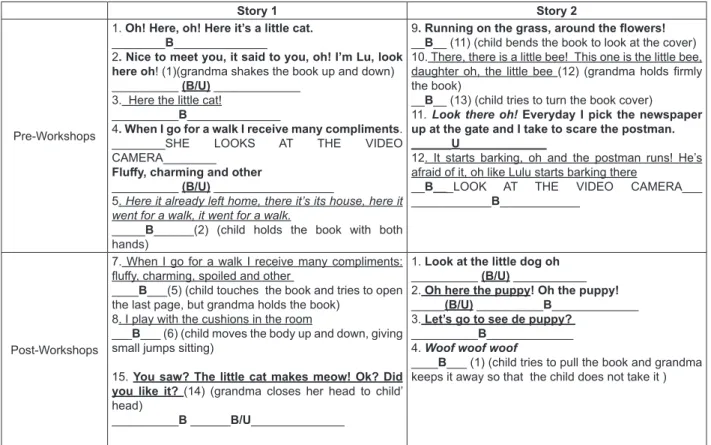
Figure 1 shows excerpts from the transcript of the interaction between “J” and “A” during the reading of children’s books. The analysis showed that before the workshops “J” made clariications of the story to the child, emphasized the book’s illustrations, named and compared with situations and people that were part of the context of A’s life. However, she hardly used variation of vocal intonation during inter
-action. She also did not allow the child to explore the book, because she always held the child’s hands to not touch the book and she did not return pages when the girl asked it.
When “J” told the stories after the workshops
she began using the change in intonation,
onomato-poeic elements were included when she referred to animals from the books. “J” also always tried to keep the attention of “A”, she touched the girl and looked for girl’s eye.
Dyad 3- E and L
“E” (L’s mother) is 40 years old and she works
as a farmer. Her level of education is incomplete
elementary education and reports not be accus
-tomed to telling stories to the child. “L” is a three-year-old boy and he lives with his parents and a nineteen-year-older brother. “L” has a diagnosis of
moderate preverbal sensorineural hearing loss in the
right ear and severe in the left ear. Associated with
hearing loss, he presents neurological changes. He
uses hearing aids in both ears for two years and one
month. Related to language, he uses gestures and
vocalizations to communicate. “L” does not attend
school.
By comparing the strategies used to tell stories with children’s books in the two moments of the study, it was revealed that there were signiicant changes in all dyads. Here, some particularities of the dyads are highlighted during the interaction with
Story 1 Story 2
Pre-Workshops
1. Oh! Here, oh! Here it’s a little cat.
________B______________
2. Nice to meet you, it said to you, oh!I’m Lu, look here oh! (1)(grandma shakes the book up and down)
__________ (B/U) _____________ 3. Here the little cat!
__________B______________
4. When I go for a walk I receive many compliments.
________SHE LOOKS AT THE VIDEO
CAMERA________
Flufy, charming and other
__________ (B/U) __________________
5. Here it already left home, there it’s its house, here it went for a walk, it went for a walk.
_____B______(2) (child holds the book with both
hands)
9. Running on the grass, around the lowers! __B__ (11) (child bends the book to look at the cover)
10. There, there is a little bee! This one is the little bee, daughter oh, the little bee (12) (grandma holds irmly
the book)
__B__ (13) (child tries to turn the book cover)
11. Look there oh! Everyday I pick the newspaper up at the gate and I take to scare the postman.
______U_____________
12. It starts barking, oh and the postman runs! He’s
afraid of it, oh like Lulu starts barking there
__B___LOOK AT THE VIDEO CAMERA___
____________B____________
Post-Workshops
7. When I go for a walk I receive many compliments:
lufy, charming, spoiled and other
____B___(5) (child touches the book and tries to open
the last page, but grandma holds the book)
8. I play with the cushions in the room
___B ___ (6) (child moves the body up and down, giving
small jumps sitting)
15. You saw? The little cat makes meow! Ok? Did you like it? (14) (grandma closes her head to child’
head)
__________B ______B/U______________
1. Look at the little dog oh
__________ (B/U) ___________ 2. Oh here the puppy! Oh the puppy!
_____(B/U) __________B _____________ 3. Let’s go to see de puppy?
__________B _____________ 4. Woof woof woof
____B ___ (1) (child tries to pull the book and grandma
keeps it away so that the child does not take it )
Subtitle: Lines represent lack of speech. B: Bold represents the eye towards the book. U: Underlined is the action of looking and poin
-ting the book. B / U: Bold and underline is looking at the other one. Italic is vocal intonation
Story 1 Story 2
Pre-Workshops
8. Look here the little cat talking to the little ish oh!
What are they talking about? Huh? LITTLE FISSSS
9. The little ish? What is the little ish saying to it? In what way is it calling the little cat? 10. For lufy,
for cute!(3) (mother touches the child with her thumb)
___B__(4) (child passes her both hands on chin)
27. What do they have to do now, it’s already night? They have to go home to? Sle-ep!
MI (9) (child talks while the mother)
28. Did you see how it’s beautiful? _________B______________
29. There It’s the house of...of...DengosoWhat’s its name? Den?
The puppy
30. Dengoso! The puppy’s name is Dengoso!
Post-Workshops
9. I play with the cushions in the rrom, I watch TV and I talk with my friendTrics, the little ish
_____________B ____________ 10. Is it little cat’s friend?
______B _____ (23) (child nods) 11. Yeah? And where is it?
HERE!
12. In an aquarium? Look there, in water! It can’t stay
out of water, the little ish, yeah?
_____________B _________
7. And I take to scare the postman ____________B _____________
8. When the postman is going to put the newspaper, the dog makes woof woof (7) (mother makes gestures
with her hands imitating the barking dog)
______________B __________________
9. Scare the postman , oh he’s very afraid, puting hands on his head oh (8) (mother puts her hand on head)
____________B ______________
10. He is afraid of the dog!The dog barked him oh __________B/U ______B ______
11. He dropped the newspaper and the dog made
woof woof (9) (mother makes head movements
imitating the barking dog)
__________B/U _____B______
Subtitle: Lines represent lack of speech. B: Bold represents the eye towards the book. U: Underlined is the action of looking and point
-ing the book. B / U: Bold and underline is look-ing at the other one. Italic is vocal intonation.
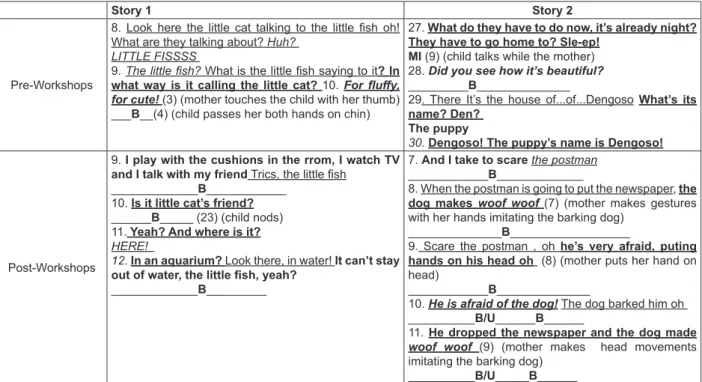
Figure 2 – Transcript storytelling of dyad 2 In Figure 2, the transcripts between “C” and “G” show that the mother used intonation change in the irst moment of interaction. She pointed and explained the illustrations of books for children. However, “C” questioned “G” about the stories a lot, making it impossible for the story to low naturally.
In addition, she almost left no time for the child to
answer the questions because she responded
immediately and gave clues to “G” to complete the word or phrase.
After the workshops “C” explored more intonation and prosody of speech, she used onomatopoeia, highlighted the illustrations of books by entering detailed explanations in addition to the books presented. “C” used facial and body expression while reading the stories. It was also less frequent questioning on the story that was being told.
Figure 3 shows excerpts from the transcription that allowed to characterize “C” style to tell the stories to “L”. It could be perceived that she used
less time than other mothers to tell the stories,
showing that she had little familiarity with books. But before the workshops she kept the child’s attention in story through gestures, touching and pulling “L” when he was not looking at the books. She also did not change the vocal intonation, looked a few times
to the child, focusing all the time in the book. She did not allow “L” to explore the book and tried to keep him away from it.
Story 1 Story 2
Pre-Workshops
1. Oh L oh! (1) (mother pulls the child by the arm to
show the book)
_____________ (B/U) _________ 1.
2. Nice to meet you I’m Lu, a very spoiled cat _____________B____________
3. Wow the little cat!
___ N______ (2) (child smiles and pulls the book of
mother’s hand)
4. Oh when I go for walk I receive many compliments
(3) (mother keeps the book away from the child)
___________B___________
5. Look at the puppy! Oh the puppy! ___________ B_____________
6. Everyday I pick the newspaper up at the gate and I
take to scare the postman.
__B__HE LOOKS AT THE VIDEO CAMERA ___
7. I confess I do not like to take a shower, but not always I escape.
Post-Workshops
4. Oh L!Let’s see the story of the little cat, oh(16)
(mother closes the book from the child)
____________________B_____________ 5. Oh!L?
________ (17) (child walks on the carpet by leaning his knees and hands)
6. Look at me, oh (mother) _________B/U________ 7. Nice to meet you, I’m Lu! ________B______
2. Oh, The puppy! Oh (5) (mother touches child’s arm
so he looks at the book)
___HE LOOKS AT THE VIDEO CAMERA____B_______ 3. woof woof woof! Hellolittle friend, my name is... Dengoso!
_______________B_____________ 4. Look! Puppy!
______U____ (6) (child vocalizes trying to produce the barking dog)
5. Yeah? Make woof woof woof! ____________B__________ I like to suck and sleep, but I’m lazy! ____________B__________
Subtitle: Lines represent lack of speech. B: Bold represents the eye towards the book. U: Underlined is the action of looking and poin
-ting the book. B / U: Bold and underline is looking at the other one. Italic is vocal intonation.
Figure 3 – Transcript storytelling of dyad 3
The graphs below show the frequency of the eye direction of participants, during the storytelling, before and after the workshops that were conducted.
In Figure 4 can be seen that all the children began to
look into the book the second time the stories were told. Among adults, only “E” looks into the book after the workshops.
Figure 5 shows a prevalence of adults in looking and pointing the book in both moments.
In the Figure 6 all study participants, adults and children, started looking more at each other after the workshops.
36
28
38
46
3
15 16
37
25
55
15
20
J A C G E L
adult child adult child adult child
F
re
q
u
e
n
cy
o
f
th
e
e
y
e
d
ir
e
ct
io
n
Looking towards the book
Pre-Workshops
Post-Workshops
22
2
25
9
15
2 31
0
43
6 9 7
J A C G E L
adult child adult child adult child
F
re
q
u
e
n
cy
o
f
th
e
e
y
e
d
ir
e
ct
io
n
Looking and pointing to the book
Pre-Workshops
Post-Workshops
Figure 5 – Frequency of the direction of glances and gestures of the family members (listeners) and deaf children
4
10
22
2
9
1 19
11
31
6
37
2
J A C G E L
adult child adult child adult child
F
re
q
u
e
n
cy
o
f
th
e
e
y
e
d
ir
e
ct
io
n
Looking at the other one
Pre-Workshops
Post-Workshops
Figure 6 – Frequency of the exchange of glances between family (listeners) and deaf children
DISCUSSION
Taking into account the results of the research, the efects could be seen by the occurrence of trans
-formation in the strategies used by family members to tell stories, considering the two moments that were observed.
Conducting practical workshops with families of deaf children has proved a potentially beneicial
resource for the acquisition and development of
children language. The experiences generated by the workshops promoted family interaction listener / deaf child mediated by children’s books, which are
important tools for the development and learning of children 17.
Of the three family members who participated in this research, only one reported that he had the habit of reading for deaf children. This shows that the place that the child occupies in the family
reading practices is restricted.
By analyzing literacy practices aimed at deaf child in the family and school ambient, a study showed that the irst restricted to the use of the Bible and in the second predominated textbook. The conclusion of the study showed that there was no change in the use of literary genres in this context, which it hinders the formation of the deaf subject as a reader and cancels signiicant situations in the
story, moreover, this variation causes the child and makes it relect the vocal intonation produced by the
mother 15, linguistically interacting in the story.
The voice is the main instrument of the person
who tells a story. The listener can engage himself emotionally if it is used properly, creating expecta
-tions throughout story, leading to the suspense and climax in the outcome. The voice of the narrator should be expressed in a clearly deined manner, with vocal variation in brief and timely pauses 23.
Onomatopoeia allows to give action to the text because they make in the excerpt in which they appear the words acquire sound and movement. When animal sounds appear in the stories the text
comes alive. So reading becomes more attractive and pleasant and the listener participates in the
story as a co-author, living every move of words and
building sense 21.
The features like facial and body expressions associated with children’s literature characterize the development of literacy and stimulate the production of knowledge 21. Activities that allow the child to use
facial and body expression enrich the experiences, they can also develop imagination, stimulate the attention, help organizing ideas and thoughts 14.
When illustrations of the story are highlighted deaf children’s visual experiences are enhanced and valued, giving interest in reading and writing. What it is important for deaf people depend more on
vision to learn than hearing people 24. The images
associated with the text enrich content, concretize
the topic and are resources that help the
internal-ization of learning 20.
There was also a change in the frequency of eye direction between dyads. The children started to look more books when their family told stories after the workshops. This shows that there was more interaction between them in the second time. The involvement of children with children’s books increased, enabling them to be suicient for them to become aware while maintaining the eye in the illustrations. After participating in the workshops the family began to explore the images of books and modify the way to tell the stories, thus children’s interest in books also intensiied.
The language and images present in tales and
stories provide the child an imaginary world to be explored, enabling learning a language. A study developed an online tool for literacy deaf children observed the following: the use of simpliied stories, illustrated with drawings and deinitions were more efective for reading comprehension by children 25.
The illustrations in the books when rich and colorful turn the books in charming objects that
captivate and attract small readers 20. The chosen
books for this search had designs with vibrant colors, The family is the child’s irst contact with reading
and writing, enabling it to create hypotheses and establish meanings of the literary universe. The greater the opportunity for children to handle written material, listen to stories, watch people reading and writing will be better its relationship with books as well
as its formation as readers and authors 18,19. Thus,
to attend school, they will be able to understand the social function of reading and writing, making the school an extension of family atmosphere 18.
This work allowed the family to raise a privileged
position in speech intervention, it began to mediate
the interaction with their children. In this sense, the workshops were essential for them to understand the importance of children’s stories and their contri -bution in the development of language.
Studies that consider sign language as a irst
language and Portuguese as the second language
which the deaf people acquire, they highlight the visual behavior of deaf children and the diferent way in which they relate and perceive the world. In this context children’s literature goes to mediate the learning of a second language through the discovery and the relationships established through the literary universe. In addition, children’s literature is a tool that allows young readers to question themselves
and to others, guiding their interests and needs of
self-assertion and safety 20.
It is also known that the use of children’s stories, taking into account the text, allows the language to become instrument and teaching object concur
-rently. In addition, the child can build assumptions about the organization of the text and listen to understand the story 21. It also allows the child to
have an active role in expanding its vocabulary and build relationships of meaning during storytelling 17.
The stories also allow the children’s development of language creativity 22.
It was observed that in all dyads there were expansion and use of strategies that enable the
maintenance of attention and the involvement
of children with stories. They used, in a more accentuated way, the change in intonation; use of onomatopoeia; bodily features such as facial expressions, movements, touches in child and gave
greater prominence to the illustrations.
Several studies 15,17,18,20 highlight the importance
of such associated resources during the action
of storytelling to enable the child involvement in children’s literature. Through the use of these resources there was more luid in storytelling after the workshops, because the family began to use children’s books and interact with them more naturally.
It is understood that by applying variation of
in vocabulary, in morphosyntax, prior knowledge and the development of the theory of mind 17,27.
CONCLUSION
The study showed that the workshops enabled a positive exchange between therapist and family, which brought beneits for deaf children as come to share language moments mediated by children’s books. There was expansion and use of strategies
such as variation in intonation, use of onomatopoeia,
body features, facial expressions and especially
the illustrations, enabling the engagement of
children with stories. In addition, dyads started to present more frequent exchange of eyes after the workshops, strengthening interaction and under
-standing of books by children.
The families of the children in this study did not have the habit of storytelling. It is understood that a
relevant practice for the acquisition and development
of oral language was hardly emphasized, been little explored. By enabling the family / child interaction through children’s books the speech language
therapist contributed to enrich this moment, bringing
changes in the meaning given to books, as they are no longer distant objects and negligible to be
mediating instruments of linguistic interaction. All things considered, it is evident the
impor-tance of the speech language therapist, who works with hearing habilitation and rehabilitation, involves family members in the therapeutic process, promoting ways and means of these play and tell
stories to children.
but the look of the children was only captured more intensely after the workshops, because the family learned to explore these resources.
Another important aspect is that the dyads were more frequent in the exchange of eyes after the workshops. This shows the positive efect of the
intervention of the speech and language therapist,
because the exchange of eyes during the stories there was dialogue and search for understanding of the child and family in the story to make sure that the child was understanding what it was being told.
There was a predominance of adults in look and point the book in the moments before and after the workshops. It can be seen that the reduced practice of family in storytelling for children, exploring children’s literature as a resource also prevents them allow the kids handling the books. The books are still treated as fragile objects, which must be
preserved so that children do not spoil them.
The family kept the books with them, always holding irm so that children would not pull and move them away, with this, they did not touch the books. This breaks the natural process of storytelling and prevents children establish a playful relationship with books. The children’s literature should allow the child to feel, see and touch the book. So it can enjoy the literary work and sympathize with the text, separating the obligation image and didactic
aspects of reading 26.
REFERENCES
1. Goldfeld MA. A Criança Surda: Linguagem e Cognição numa Perspectiva Sociointeracionista. 3
ed. São Paulo: Plexus; 2002.
2. Quadros RM, Finger I. Teorias de Aquisição da Linguagem. 2 ed. Florianópolis: Editora UFSC; 2013.
3. Fortunato CAU, Bevilacqua MC, Costa MPR. Análise comparativa da linguagem oral de crianças ouvintes e surdas usuárias de Implante Coclear. Rev CEFAC. 2009;11(4):662-72.
4. Lichtig I, Couto MIV, Leme VN. Peril pragmático
de crianças surdas em diferentes fases linguísticas. Rev Soc Bras Fonoaudiol. 2008;13(3):251-7.
5. Most T, Shina-august E, Meilijson S. Pragmatic Abilities of Children With Hearing Loss Using
Cochlear Implants or Hearing Aids Compared to Hearing Children. J deaf stud deaf educ. 2010;15(4):422-37.
6. Lodi ACB, Luciano RT. Desenvolvimento da linguagem de crianças surdas em língua brasileira de sinais. In: Lodi ACB, Lacerda CBF. Uma escola duas línguas: letramento em língua portuguesa e
língua de sinais nas etapas iniciais de escolarização.
Porto Alegre: Mediação; 2009. P. 33-50.
7. Witkoski AS, Baibich-Faria TM. A importância
da língua de sinais para as pessoas surdas na
construção de uma linguagem plena e genuína. Contrapontos. 2010;10(3):338-44.
8. Tabaquim MLM, Nardi CGA, Ferrari JB, Moretti
CN, Yamada MO, Bevilacqua MC. Avaliação
do desenvolvimento cognitivo e afetivo-social de crianças com perda auditiva. Rev CEFAC. 2013;15(6):1475-81.
9. Alves M, Ramos D, Alves H, Martins JH, Silva L, Ribeiro C. Desenvolvimento da linguagem em
crianças com implante coclear e inluência da idade de implantação. Rev Port Otorrinolaringol e Cir
Cérvico-Facial. 2013;51(2):81-6.
10. Regatieri LPR. Didatismo na contação de
histórias. Rev em extensão. 2008;7(2):30-40.
11. Silva ACF, Ferreira AA, Queiroga BAM. Desenvolvimento da narrativa oral e o nível de escolaridade materna. Rev. CEFAC. 2014;16(1):174-86.
12. Verzolla BLP, Isotani SM, Perissinoto J. Análise
da narrativa oral de pré-escolares antes e após estimulação de linguagem. J Soc Bras Fonoaudiol. 2012;24(1):62-8.
13. Zilbermann R. A literatura infantil na escola. 11 ed. São Paulo: Global; 2003.
14. Ferreira A. Contar Histórias com arte e ensinar brincando: para educação infantil e séries iniciais de
ensino fundamental. 2 ed. Rio de Janeiro: Wak Ed;
2010.
RESUMO
Objetivo: analisar os efeitos nas estratégias utilizadas por familiares de crianças surdas ao contar história por meio de livros infantis, antes e depois de oicinas com fonoaudiólogo. Métodos: pesquisa
exploratória, qualitativa e descritiva. Foi desenvolvida com familiares que frequentavam uma clínica
escola de uma universidade pública federal. No primeiro momento deste estudo foram analisados os
prontuários dos pacientes. No segundo foi realizada a gravação em vídeo da díade familiar-criança surda enquanto contava histórias com livros infantis. No terceiro os familiares participaram de oici
-nas com fonoaudiólogo, envolvendo temas sobre brincar e contar histórias. Após as oici-nas, foram realizadas novas gravações em vídeo das díades contando histórias. Os dados foram transcritos e submetidos à análise de vídeo, bem como computado a frequência do número de direção de olhares. Resultados: participaram do estudo três adultos e três crianças. Após as oicinas houve modiicações signiicativas nas estratégias utilizadas pelos familiares ao contar histórias. Empregaram variação da entonação; usaram onomatopeias; recursos corporais como expressões faciais, movimentos, toques na criança e destacaram as ilustrações. Com relação à direção do olhar, após as oicinas as crianças
olham mais para o livro e ambos passaram a olhar mais uns para os outros. Conclusão: após as oici
-nas observaram-se mudanças qualitativas na maneira de contar histórias, utilizando-se livros infantis como mediadores da interação linguística, por parte dos familiares participantes deste estudo. Os efeitos produzidos proporcionaram uma participação mais produtiva da díade para o desenvolvimento
de linguagem das crianças.
21. Tonelli JRA. O uso de histórias infantis no ensino do inglês para crianças: analisando o gênero textual história infantil sob a perspectiva do
interacionismo sócio-discursivo. Acta Sci Lang Cult. 2008;30(1):19-27.
22. Smogorzewska J. Developing children’s language creativity through tellingstories – An experimental study. Thinking Skills Creativity.
2014;13:20-31.
23. Coelho BN. Contar histórias uma arte sem idade. 10 ed. São Paulo: Ática; 2008.
24. Marschark M, Morrison C, Lukomski J, Borgna
G, Convertino C. Are deaf students visual learners
Learn Individ Difer. 2013;25:156-62.
25. Mich O, Pianta E, Mana N. Interactive stories and exercises with dynamic feedback for improving reading comprehension skills in deaf children.
Comput Educ. 2013;65:34-44.
26. Ferreira A. Contar Histórias com arte e ensinar brincando: para educação infantil e séries iniciais de
ensino fundamental. 2 ed. Rio de Janeiro: Wak Ed;
2010.
27. Mueller V, Hurtig R. Technology-Enhanced Shared Reading With Deaf and Hardof-Hearing
Children: The Role of a Fluent Signing Narrator. J Deaf Stud Deaf Educ. 2010;15(1):72-101.
15. Chelucci LSO, Novaes BC. Contar histórias com livros infantis: caracterização da interação das díades mãe ouvinte/criança com deiciência
auditiva e mãe/criança ouvintes. Rev Dist Com. 2005;17(1):55-67.
16. Anastasiou LGC, Alves LP. Estratégias de Ensinagem. In: Anastasiou LGC, Alves LP. Processos de ensinagem na universidade: pressupostos para as estratégias de trabalho em aula. 5 ed. Joenville: Univille; 2009.P.67-99.
17. Rodrigues MC, Ribeiro NM, Cunha PC. Leitura Mediada com Enfoque Sociocognitivo: Avaliação de uma Pesquisa-Intervenção. Paideia. 2012;22(53):393-402.
18. Shemberg S, Guarinello AC, Santana APO.
As práticas de letramento na escola e na família
no contexto da surdez: relexões a partir do
discurso dos pais e professores. Rev Bras Ed Esp. 2009;15(2):251-68.
19. Barbosa KS, Santos MLR, Cardoso PC. A arte de contar histórias infantis: propiciando encantamentos. Rev Participação. 2009;16(9):21-7.
20. Silva AC, Medeiros MCM, Lorensi VM. O
desenvolvimento do processo de letramento do
aluno surdo a partir das experiências visuais
proporcionadas pela literatura infantil. REI. 2010;5(12):1-12.
Received on: December 19, 2014 Accepted on: March 16, 2015
Mailing address:
Gicélia Barreto Nascimento
Av. Roraima, 1000 – Camobi
Universidade Federal de Santa Maria
Santa Maria – RS – Brasil
CEP: 97105-900
APPENDIX 1 – PROTOCOL
MOTHER/CHILD BEHAVIOR ANALYSIS PROTOCOL (CHELUCCI; NOVAES, 2005)
The method used in transcription involved codes with fonts, italic, bold and underline, representing diferent characteristics of statements. To identify the mother and child, we chose to keep mother always at the irst line of dialogue and the child on the second line of dialogue, and the child’s speech is transcribed in uppercase and, at the moment there is no verbalization, it is placed one line with the characteristic of the direction of its eye.
1) Speaker identiication:
Mother: Arial Font– Normal – Look at the tear of her eye
Child: Arial Font – Uppercase Letter – __________ YEAH, WHAT ELSE?
Observation: when there is no verbalization, we represent with a line.
2) Eye direction:
Normal underline: Mother looking and pointing the
book.
Underline and uppercase: CHILD LOOKING AND
POINTING THE BOOK.
Normal bold: Mother looking at the book.
Bold and uppercase: CHILD LOOKING AT THE BOOK.
Bold and normal underline (B/U): Mother looking at the child.
Bold, underline and uppercase (B/U): CHILD LOOKING AT THE MOTHER.
Color grey normal: Mother looking at the vídeo
camera.
Color grey and uppercase: Child looking at the vídeo
camera.
Besides characterizing the direction of eye, a score by changing segment of the direction of eye was
made. This is to obtain the number of the directions
of eye of each separately (mother and child) in the analyzed pairs.
She gave her a head of lettuce (for mother we
count 1 bold and 1 underline bold)
7. _(bold)_______ Yeah (for child we count 2 bolds )
In the same segment, where the mother has two diferent segments, while the child has only one, we count twice eye direction the child had, as the mother had two directions of diferent looks, so that there was equivalence.
3) Intonation change:
By the time mother or child change the intonation of their speech, this happens to be transcribed with the
features presented above and in italics.
A caterpillar cried Boo-hoo Boo-hoo. ___(bold)______(B/U) _______Yeah yeah
4) Change in facial expression or gesture:
When the mother or the child change facial expression or make some gesture, we put a number next to the dialogue and the representation of those acts in a numbered subtitle in a board below the
transcript.
And she took the caterpillar to go for a walk. (10)
______(bold)_________ (1)
(10) mother holds the page. (1) child tries to change the page.
Each of these four aspects described for each pair
to characterize both the verbal interaction as the
maintenance strategies of attention, using orofacial reading, repetition, intonation changes and their