ABSTRACT
BACKGROUND AND OBJECTIVES: Group
cognitive--behavioral therapy has shown to be efective for chronic pain management in the international literature. However, the need to bring evidence-based practices to health services requires that therapies like this are implemented and evaluated in Brazil. his study has not intended to evaluate the eicacy of group cogniti-ve-behavioral therapy for chronic pain adult patients, but rather to identify how studies in this area are being performed by Bra-zilian investigators.
CONTENTS: A search was carried out about Brazilian studies published in the last two decades (1994-2014), evaluating the eicacy of group cognitive-behavioral therapy for adults with non-malignant chronic pain. Health Virtual Library databases were used and search terms were: Chronic pain “and” Psycholo-gy “or” Cognitive-Behavioral herapy. Evaluated variables were clinical and socio-demographic characteristics, pre and post-in-tervention evaluation tools, sessions’ structure (sessions number and duration), primary results, and evaluation of the quality of studies by means of the PEDro scale.
CONCLUSION: Six out of 816 articles available were selected for analysis, because they were the only ones to meet chosen search criteria. One should stress the scarcity of Brazilian studies in the area, the use of exclusively subjective evaluations aimed at unidi-mensional pain aspects, and the concern with the methodological quality of studies, especially with regard to internal validity. Keywords: Chronic pain, Group cognitive-behavioral therapy, Psychology.
Group cognitive-behavioral therapy for chronic pain adults: review of
Brazilian trials*
Terapia cognitivo-comportamental em grupo para adultos com dor crônica: uma revisão de
estudos brasileiros
Luziane de Fátima Kirchner1, Cynthia Carvalho Jorge1, Maria de Jesus Dutra dos Reis1
*Received from Federal University of São Carlos, São Carlos, SP, Brazil.
1. Universidade Federal de São Carlos, São Carlos, SP, Brasil.
Submitted in February 10, 2015. Accepted for publication in May 28, 2015.
Conlict of interests: none – Sponsoring sources: Coordination of Higher Education Person-nel Improvement (CAPES).
Correspondence to: Luziane de Fátima Kirchner
Rodovia Washington Luís, Km 235, s/n - Jardim Guanabara Departamento de Pós-Graduação em Psicologia –PPGPSi 13565-905 São Carlos, SP, Brasil.
E-mail: [email protected]
© Sociedade Brasileira para o Estudo da Dor
RESUMO
JUSTIFICATIVA E OBJETIVOS: A terapia cognitivo-compor-tamental em grupo tem se mostrado eiciente no tratamento para dor crônica, na literatura internacional. Entretanto, a necessi-dade de trazer práticas baseadas em evidências para os serviços de saúde exige que tratamentos como este sejam implantados e avaliados no Brasil. O presente estudo não pretendeu analisar a eicácia da terapia cognitivo-comportamental em grupo para adultos com dor crônica, mas identiicar como os estudos nessa área têm sido conduzidos por pesquisadores brasileiros.
CONTEÚDO: Realizou-se uma busca de estudos brasileiros pu-blicados nos últimos 20 anos (1994-2014), que avaliaram a eicá-cia da terapia cognitivo-comportamental em grupo para adultos com dor crônica não maligna. Utilizaram-se as bases de dados da Biblioteca Virtual em Saúde, e os termos de busca foram: Dor Crônica “and” Psicologia “or” Terapia Cognitivo-Compor-tamental. As variáveis avaliadas foram características clinicas e sócio-demográicas dos participantes, instrumentos de avaliação pré e pós-intervenção, estrutura das sessões (quantidade e dura-ção das sessões), principais resultados, eanálise da qualidade dos estudos realizada por meio da escala PEDro.
CONCLUSÃO: Seis dos 816 artigos disponibilizados foram se-lecionados para análise, pois foram os únicos a atingir os critérios de busca escolhidos. Destaca-se a escassez de estudos brasileiros na área, o uso de avaliações exclusivamente subjetivas e voltadas a aspectos unidimensionais da dor, e a preocupação com a qua-lidade metodológica dos estudos, sobretudo no que se refere à validade interna.
Descritores: Dor crônica, Psicologia, Terapia cognitivo-compor-tamental em grupo.
INTRODUCTION
Pain is experienced by almost all individuals, since it alerts the body with noxious physical and chemical stimulations, protecting it against future injuries. Since the dawn of civi-lization, men try to explain what justiies pain and, this way, to develop procedures to control it. From pre-history to the Renaissance era, pain was understood as a divine punishment coming from bad spirits for misconducts or from the loss of vital body substances. In mid 15th century, the advance with regard to this phenomenon was greatly inluenced by
tes, who described pain as a sensation perceived in the brain, resulting from the stimulation of sensory nerves1. In the 20th century, scientiic advances have contributed for the unders-tanding of pain as a complex nociceptive sensory system. As from 1950s, it is understood that painful information is captured by morphologically diferentiated receptors located on nervous ibers terminations (nociceptive receptors) which respond to several exogenous substances (ex., heat, cold and pressure) and to endogenous chemical substances (produced by the body in response to irritation or injury), transmitting nervous impulses to the spinal cord. Before long, the Gates theory2 has proposed that stimulated nociception in this pro-cess is diferent from that perceived by the individual, and that inhibitory interneurons responsible for the regulation of emotion (endorphin, norepinephrine and serotonin, among others), would be involved in pain perception modulation process. With advances in studies, psychosocial variables and individual characteristics started to be observed to explain the painful process and this started to be deined as a complex psychophysiological phenomenon1,3.
In mid 1970s, pain was deined by the Taxonomy Committee of the International Association for the Study of Pain (IASP) as an unpleasant sensory and emotional experience related to real or potential tissue injury or described in terms of such injury4. Due to this deinition, pain started to be understood as a subjective experience in which each individual learns how to describe it based on his/her own experiences3. Pain concept developed by IASP has leveraged the integration of diferent health professionals (physicians, nurses, psychologists, phy-siotherapists and occupational therapists), who started to act in a multi- and interdisciplinary way to control pain5. Authors also add that interdisciplinarity is an ideal to be reached by health services, since multidisciplinary practices still prevail. Approximately 20 to 30% of the world population are afec-ted by chronic pain (CP) and although there are few Brazilian epidemiologic studies, some authors indicate similar inciden-ce for the Brazilian population6. Some authors state that sufe-ring and disability as a function of pain is the primary reason for looking for outpatient assistance7. Anxiety, depression and sleep disorders are commonly associated to CP5, being such comorbidities one of the aspects characterizing the importan-ce of psychological pain evaluation and intervention8. here are diferent psychological theories trying to understand and intervene on pain9,10, however our study will be based only on the Cognitive-Behavioral herapy (CBT) model.
CBT is the most accepted approach for psychological CP tre-atment, being recognized in this area since the 1970s11 and currently showing the highest scientiic evidence of efecti-veness12,13. Within the cognitive-behavioral perspective, pain is understood as a product inluenced by the interaction of behaviors, feelings, and thoughts not adaptive to the envi-ronment of the individual, which intensify pain as a feedba-ck system5-12. Treatment helps patients identifying this non adaptive interactional process, recognizing its impact on pain, and changing it to improve pain and general health12. here is no standard treatment protocol, but major
techni-ques are psycho-education, cognitive restructuring, assertive training, problems resolution and progressive muscle relaxa-tion, which may be used by individual or group assistance modalities12-14. Both assistance modalities are efective, howe-ver CBT applied in groups may promote even more promi-sing results, when considering cost-beneit ratio of the treat-ment15. For the authors, group intervention may promote a broader support network and exchange of experiences among people going through the same problems, in addition to favo-ring encouragement for change15.
his treatment has been widely applied for people with dife-rent CP diagnoses. Some international meta-analyses, taken as a whole, have shown that treatment has produced mild or moderate efects on pain intensity, depressive symptoms and sleep quality, and minor efect on daily performance. Such results were observed by comparing experimental group and control group12,16,17.
Investigators argue that CBT eicacy for CP is so well-esta-blished that there is no need for further studies evaluating its results14. However, to bring such evidence-based practices to Brazilian health services, it is necessary that such therapeutic modality is implemented and validated for this population. Our objective was not discussing GCBT eicacy and efec-tiveness to manage CP, but rather identifying how studies in this area are being performed by Brazilian investigators. For such, we have identiied studies published in the last 20 ye-ars, which evaluated GCBT applied to adults with CP, being identiied participants’ characteristics, pre- and post-inter-vention evaluation tools, sessions structure (sessions number and duration), and quality of studies with regard to statistical description and internal validity.
CONTENTS
Selected materials for analysis were studies developed by Brazilian investigators, published between 1994 and 2014, and available in the Virtual Health Library (BVS) databa-se. Keywords were Dor Crônica “and” Psicologia “or” Terapia Cognitivo-Comportamental, and should be inserted in titles, abstracts or keywords. Selected studies should have as prima-ry objective to describe GCBT directed to adults with non--malignant CP. In addition, studies should have quantitative analysis of data and should describe the tools used for pre- and post-intervention evaluation. Studies carried out with other age groups (below 18 or above 65 years of age) and/ or which did not describe the use of GCBT procedures were excluded from the analysis.
As from these selection criteria, BVS online database made available a total of 816 articles, but only six were selected for analysis. Remaining articles described correlational, epide-miological studies and/or other types of treatments not inclu-ding GCBT. hese data summarize the lack of publications in this area of Psychology, especially the contribution of GCBT to the treatment of CP patients.
of Psychology in understanding and treating CP patients is unquestionable8. he Clinical Protocol and herapeutic Gui-delines for Chronic Pain recommends GCBT as one of the non-pharmacological treatments for CP18. In addition, the Brazilian Society for the Study of Pain (SBED) indicates the existence of several multidisciplinary groups committed to the amplitude of assistance to teaching and research about this subject, distributed throughout Brazil, being Psychology inserted in those services19.
Psychological treatment is often integrated to multi- and in-terdisciplinary programs which gather the action of diferent health professionals, among them: physiotherapists, occupa-tional therapists, physicians and others5. With regard to inter-vention programs objectives, it was observed that, among se-lected studies, two have evaluated the eicacy of sequentially applied GCBT and physiotherapy20,21; one has evaluated the efect of a single intervention by physician, occupational the-rapist, physiothethe-rapist, psychologist and social worker, where
some GCBT techniques were inserted22; one has compared
the efects of pharmacological treatment versus GCBT23; and two have evaluated the efect of GCBT alone.
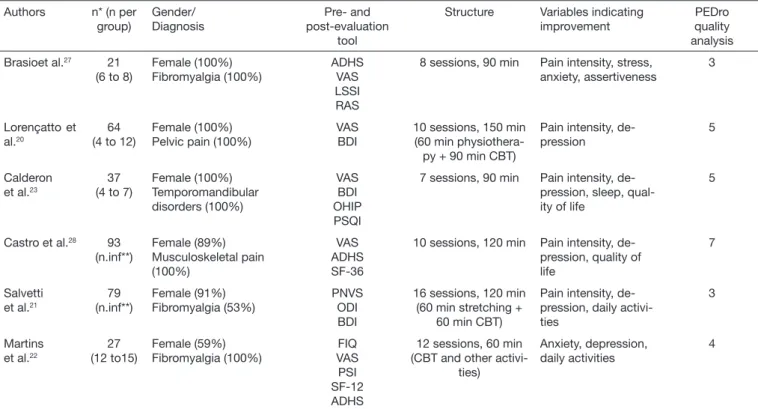
Table 1 shows major data characterizing studies, especially with regard to evaluation, intervention and results. Studies were evaluated as to methodological quality and statistical description using the PEDro scale24. his scale was developed and is used by physiotherapists25, but has been chosen for meeting evaluation needs of this study. It is composed of 11 evaluating criteria, of which 10 are scored (8 evaluate
inter-nal validity and 2 evaluate statistical description). Maximum score to evaluate the quality of studies is 10; scores equal to or above 5 indicate that the study has moderate or high quality26. With regard to studied population, table 1 shows predomi-nance of females in all studies, being ibromyalgia (FM) the most frequent diagnosis. Nevertheless, literature shows that the prevalence of CP diagnosis is higher in females as compa-red to males, moreover in case of FM29,30. Females also look more often for health services31, which could justify their pre-valence in selected studies.
CP is often associated to psychoafective disorders, such as anxiety and depression, and to sleep disorders5. A correla-tional study has shown that the more severe is the pain, the higher are the symptoms of anxiety, depression and sleep qua-lity32. Quality of life (QL) is also impaired and total or partial incapacity may be seen in at least half of afected individuals. he inter-relation of these problems shows that these comor-bidities should also be focus of evaluation and intervention33. Table 1 shows that all studies have evaluated at least one of diferent indicators of comorbidities commonly associated to CP (depression, anxiety, sleep disorders), as well as varia-bles related to QL and social life of patients. he six studies have evaluated depressive symptoms (BDI – Beck Depression Inventory) and pain intensity (VAS – Visual Analog Scale, PNVS – Pain Numeric Visual Scale). In addition to evalua-ting such variables, three studies have investigated symptoms of anxiety (ADHS – Anxiety and Depression Hospital Scale); two have evaluated subjective sleep quality (PSI – Post-Sleep
Table 1. Characteristics of studies applying group cognitive-behavioral therapy to chronic pain adults
Authors n* (n per group)
Gender/ Diagnosis
Pre- and post-evaluation
tool
Structure Variables indicating improvement
PEDro quality analysis
Brasioet al.27 21
(6 to 8)
Female (100%) Fibromyalgia (100%)
ADHS VAS LSSI RAS
8 sessions, 90 min Pain intensity, stress, anxiety, assertiveness
3
Lorençatto et al.20
64 (4 to 12)
Female (100%) Pelvic pain (100%)
VAS BDI
10 sessions, 150 min (60 min
physiothera-py + 90 min CBT)
Pain intensity, de-pression
5
Calderon et al.23
37 (4 to 7)
Female (100%) Temporomandibular disorders (100%)
VAS BDI OHIP PSQI
7 sessions, 90 min Pain intensity, de-pression, sleep, qual-ity of life
5
Castro et al.28 93
(n.inf**)
Female (89%) Musculoskeletal pain (100%)
VAS ADHS SF-36
10 sessions, 120 min Pain intensity, de-pression, quality of life
7
Salvetti et al.21
79 (n.inf**)
Female (91%) Fibromyalgia (53%)
PNVS ODI BDI
16 sessions, 120 min (60 min stretching +
60 min CBT)
Pain intensity, de-pression, daily activi-ties
3
Martins et al.22
27 (12 to15)
Female (59%) Fibromyalgia (100%)
FIQ VAS PSI SF-12 ADHS
12 sessions, 60 min (CBT and other
activi-ties)
Anxiety, depression, daily activities
4
Protocol and PSQI – Pittsburgh Sleep Quality Index); and one has investigated stress indicators by means of the Lipp Stress Symptoms Inventory (LSSI), and assertiveness by Ra-thus Assertiveness Scale (RS), however relationships between such variables (stress and assertiveness) and pain are still po-orly investigated34,35.
Pain evaluation is subjective, so that there is no objective and satisfactory measurement to evaluate it3. Subjective evaluation uses one- or multidimensional tools. Multidimensional tools, such as McGill Pain Questionnaire (MPQ) and Multidimen-sional Pain Inventory (MPI), evaluate pain as from diferent indicators of dimensions making up the painful experience (sensory, cognitive and afective) and their interactions. One-dimension tools, such as VAS or PNVS, are designed to indicate just the sensory dimension of pain intensity36. Althou-gh one-dimension tools are easy to apply, multidimensional evaluation should be the priority, aiming at better identifying variables interfering with pain3. No selected study has used multidimensional evaluation tools, although all have evaluated pain intensity before and after intervention. As shown in Table 1, three studies have evaluated the impact of pain on daily life by means of questionnaires such as ODI (Oswestry Disability Index), FIQ (Fibromyalgia Impact Questionnaire) and OHIP (Oral Health Impact Proile), and two have evaluated QL as-pects by means of tools such as SF-36 or SF-12.
Exclusively subjective evaluations, having as respondent par-ticipants themselves, may be considered a limitation of the studies. Although this type of evaluation is the most indicated for pain evaluation, objective measurements and/or the use of other information sources diferent from patients, could contribute to make data more reliable and it is suggested that they should be used to complement evaluation36. For exam-ple, to evaluate sleep, it is possible to use actigraphy, which evaluates activity and rest periods by means of an electronic device, and to evaluate daily activities it is possible to observe patients’ performance during certain activities.
With regard to interventions structure, it can be seen that selected studies have carried out from 7 to 16 sessions, lasting 60 to 90 minutes each, which has indicated a higher number of sessions and longer duration as compared to the study by Morley, Eccleston & Williams16. he studies have involved between 21 and 93 participants, and 4 to 15 was the number of people per group, which is in agreement with the size of groups described by international studies13,16. GCBT efecti-veness for CP patients has been proven by the international literature, according to meta-analyses, indicating mild and/or moderate efects on pain intensity, depression, sleep quality and daily performance13,16,17. Such results are consistent with those described in selected studies; from six selected studies, all have indicated that GCBT was efective to decrease de-pressive symptoms and ive studies have indicated decreased pain intensity. here were also improvements in daily perfor-mance and sleep quality in all studies which have measured such variables.
With regard to methodological and statistical quality evalua-ted by PEDro scale, only half (n=3) the selecevalua-ted studies have
indicated scores equal to or above ive. One study had no statistical analysis and all of them had failures with regard to participants’ homogeneity and randomization, and masking of interventions.
Only two studies have mentioned that there has been ran-domized distribution of participants, being that one has not clearly described the randomization process. Only one study has identiied the masking of interventions which was made just for participants.
Failures regarding homogeneity and clarity of the randomi-zation process were also observed in meta-analysis studies evaluating CBT interventions for CP adults13,16. According to the authors of those studies, masking of interventions for patients and therapists is a diicult criteria to be achieved in Psychology, because the investigator-therapist in general has to know the objectives and stages of the treatment to be administered. However, other criteria should be met by Bra-zilian studies (participants homogeneous distribution, secret randomization, masking of interventions, use of psychome-trically tested tools adapted to the studied population, blind evaluations and presentation of statistical analyses) aiming at conirming the efectiveness of psychological interventions for this population37.
BVS is a portal available in the Internet, which contemplates scientiic databases such as Scielo, LILACS, Cochrane and Medline, and gathers the largest number of articles published in national journals of broad circulation38. Although our stu-dy was limited to the search of studies in this database, it is known that in Brazil there are few clinical randomized trials in Psychology with the described methodological precision, which probably justiies the scarcity of publications in Brazi-lian journals describing national studies39.
CONCLUSION
Although pain being considered a biopsychosocial phenome-non since the 1970s, Brazilian Psychology has not occupied its space, and such aspect is in disagreement with the inter-national literature. Brazilian studies found were published approximately 30 years after CBT has been recognized as tre-atment for CP. his fact is also of concern if one considers the incidence of CP in Brazil and the need for psychological interventions empirically validated for this population. Exclusively subjective evaluations of selected studies and the use of one-dimension scales are limitations for studies eva-luation. We suggest the use of objective measurements and multidimensional pain scales, aiming at further understan-ding variables interfering with pain.
CBT for Brazilian adults with CP, and maybe this would be a way to put pressure on politicians and health managers to implement this type of treatment as mandatory specialty in health institutions.
It was, however, observed a concern of Brazilian studies, with regard to methodological quality. We suggest that future stu-dies take fundamental methodological and analytical care, such as: participants’ homogeneous distribution, secret ran-domization, masking of interventions and use of psychome-trically tested tools adapted to the studied population, blind evaluations and presentation of statistical analyses.
REFERENCES
1. Melzack R. Pain: past, present and future. Can J Exp Psychol. 1993;47(4):615-29. 2. Melzack R, Wall PD. Pain mechanisms: a new theory. Science. 1965;150(3699):971-9. 3. Silva JA, Ribeiro-Filho NP. A dor como um problema psicofísico. Rev Dor.
2011;12(2)138-51.
4. Merskey H, Albe Fessard DG, Bonica JJ, Carmon A, Dubner R, Kerr FW, et al. Pain terms: a list with deinitions and notes on usage. Recommended by the IASP subcom-mittee on Taxonamy.Pain; 1979;6(3):249-52.
5. Gatchel RJ, McGeary DD, McGeary CA, Lippe B. Interdisciplinary chronic pain management: past, present, and future. Am Psychol. 2014;69(2):119-30.
6. Almeida IC, Sá KN, Silva M, Baptista A, Matos, MA, Lessa I. Prevalência de dor lom-bar crônica na população da cidade de Salvador. Rev Bras Ortop. 2008;43(3):96-102. 7. Ponte ST, Machado A, Dutra AP, Cardoso J, Lima R. Dor como queixa principal no
serviço de pronto-atendimento do hospital municipal de São Pedro do Sul. Rev Dor. 2008;9(4):1345-9.
8. Siqueira JL, Morete MC. Avaliação psicológica de pacientes com dor crônica: quando, como e por que encaminhar? Rev Dor. 2014:15(1):51-4.
9. Eccleston C. Role of psychology in pain management. Br J Anaesth. 2001;87(1):144-52. 10. Rachlin, R. Dor e comportamento. Temas Psicol, 2010;18(2):429-47.
11. Fordyce WE, Fowler RS, DeLateur B. An application of behavior modification tech-nique to a problem of chronic pain. Behav Res her. 1968;6(1):105-7.
12. Morley S. Eicacy and efectiveness of cognitive behaviour therapy for chronic pain: Progress and some challenges. Pain. 2011;152 (3 Suppl): 99-106.
13. Hofman BM, Papas RK, Chatkof DK, Kerns RD. Meta-analysis of psychological interventions for chronic low back pain. Health Psychol. 2007;26(1):1-9.
14. Ehde DM, Dillworth TM, Turner JA. Cognitive-behavioral therapy for individuals with chronic pain: efficacy, innovations, and directions for research. Am Psychol. 2014;69(2):153-66.
15. Knox CR, Lall R, Hansen Z, Lamb SE. Treatment compliance and efectiveness of a cognitive behavioural intervention for low back pain: a complier average causal efect approach to the BeST data set. BMC Musculoskelet Disord. 2014;14:15-17. 16. Morley S, Eccleston C, Williams A. Systematic review and meta-analysis of
randomi-zed controlled trials of cognitive behavior therapy and behavior therapy for chronic pain in adults, excluding headache. Pain. 1999;80(1-2):1-13.
17. Bernardy K, Füber N, Köllner V, Häuser W. Eicacy of cognitive-behavioral therapies in ibromyalgia syndrome - a systematic review and metaanalysis of randomized con-trolled trials. J Rheumatol. 2010;37(10):1991-2005.
18. Brasil. Ministério da Saúde. Portaria nº 1.083, de 02 de outubro de 2012. Aprova o
Protocolo Clínico e Diretrizes Terapêuticas da Dor Crônica. Secretaria de Atenção à Saúde. 2012 out. 02 [acesso em 2015 fev 2]. Disponível em: http://portal.saude.gov. br/portal/arquivos/pdf/pt_sas_1083_dor_cronica_2012.pdf,
19. Sociedade Brasileira de Dor. Ligas da dor. [Internet]. 2015 [acesso em 2014 Jun 27]. Disponível em http://www.dor.org.br/ligas-da-dor
20. Lorençatto C, Vieira MJ, Marques A, Benetti-Pinto CL, Petta CA. [Evaluation of pain and depression in women with endometriosis after a multiprofessional group intervention]. Rev Assoc Med Bras. 2007;53(5):433-8. Portuguese.
21. Salvetti Mde G, Cobelo A, Vernalha Pde M, Vianna CIA, Canarezi LC, Calegare RG. [Efects of a psychoeducational program for chronic pain management]. Rev Lat Am Enfermagem. 2010;20(5):896-902. English, Portuguese, Spanish.
22. Martins MR, Grittib CC, Santos Junior R, Araújo MC, Dias LC, Fossa MH, et al. Es-tudo randomizado e controlado de uma intervenção terapêutica grupal em pacientes com síndrome ibromiálgica. Rev Bras Reumatol 2014;54(3):179-84.
23. Calderon Pdos S, Tabaquim Mde L, Oliveira LC, Camargo AP, Ramos Netto Tde C, Conti, PC. Efectiveness of cognitive-behavioral therapy and amitriptyline in patients with chronic temporomandibular disorders: a pilot study. Braz Dent J. 2011;22(5):415-21.
24. Physiotherapy Evidence Database. PEDro scale, [Internet]. 2015 [acesso em 2015 Jan 20]. Disponível em http://www.pedro.fhs.usyd.edu.au.
25. Shiwa SR, Costa LO, Moser AD, Aguiar IC, Oliveira LV. PEDro: a base de dados de evidências em isioterapia. Fisioter Mov. 2011;24(3):523-33.
26. Verhagen AP, de Vet HC, de Bie RA, Kessels AG, Boers M, Bouter LM, et al. he Delphi list: a criteria list for quality assessment of randomised clinical trials for conducting systematic reviews developed by Delphi consensus. J Clin Epidemiol. 1998;51(12):1235-41.
27. Brasio KM, Laloni DT, Fernandes QP, Bezerra TL. Comparação entre três técnicas de intervenção psicológica para tratamento da ibromialgia: treino de controle de stress, relaxamento progressivo e reestruturação cognitiva. Rev Ciênc Med. (Campinas). 2003;12(4):307-18.
28. Castro MC, Daltro C, Kraychete DC, Lopes J. he cognitive behavioral therapy cau-ses an improvement in quality of life in patients with chronic musculoskeletal pain. Arq Neuropsiquiatr 2012;70(11):864-8.
29. Cipriano A, Almeida DB, Val J. Peril do paciente com dor crônica atendido em um am-bulatório de dor de uma grande cidade do sul do Brasil. Rev Dor. 2011;12(4):297-300. 30. Wolfe F, Smythe HA, Yunus MB, Bennett RM, Bombardier C, Goldenberg DL,
et al. he American College of Rheumatology 1990 Criteria for the Classiication of Fibromyalgia: Report of the Multicenter Criteria Committee. Arthritis Rheum. 1990;33(2):160-72.
31. Pinheiro RS, Viacava F, Travassos C, Brito AS. Gênero, morbidade, acesso e utilização de serviços de saúde no Brasil. Ciênc Saúde Coletiva. 2002;7(4):687-707. 32. Castro MM, Daltro C. Sleep patterns and symptoms of anxiety and depression in
patients with chronic pain. Arq Neuropsiquiatr. 2009;67(1):25-8.
33. Finan PH, Goodin BR, Smith MT. he association of sleep and pain: an update and a path forward. J Pain. 2013;14(12):1539-52.
34. Penido MA, Fortes S, Rangé B. Um estudo investigando as habilidades sociais em pacientes ibromiálgicas. Rev Bras Ter Cogn. 2005;1(2):75-86.
35. Reis MJ, Rabelo LZ. Fibromialgia e estresse: explorando relações. Temas Psicol. 2010;18(2);399-414.
36. Sousa FA. Dor: o quinto sinal vital. Rev Lat Am Enfermagem. 2002;10(3):446-7. 37. Seligman ME. he efectiveness of psychotherapy: he Consumer Reports Study. Am
Psychol. 1995;50(12):965-74.
38. Bireme. Guia 2001 de desenvolvimento da Biblioteca Virtual em Saúde. São Paulo: BIREME, 2001.